



McClatchy reports: Wael Nasrallah has organized more than 100 demonstrations in the past 20 months. On Friday, he led another one in Qalat al Mudiq, a city of about 30,000 in central Syria.
Even with civil war engulfing the country, the peaceful demonstrations that kicked off the rebellion against the government of President Bashar Assad so long ago continue, at least in this part of Syria. Often, the target is no longer the Assad regime but the rebels who now rule in many areas.
“It is still necessary because we have demands,” said the 35-year-old Nasrallah, who’s a truck driver by trade. “Today we mentioned two things: We want the revolutionaries to organize electricity service and to organize the distribution of bread.”
In other parts of the country, demonstrators also have called on the rebels to provide security, something Nasrallah and others say isn’t an issue here, and for the international community to provide weapons to the rebels.
In a country where people were generally terrified to speak freely before the rebellion began, the demonstrations are an important advance, activists say, and one people are loath to lose. People now can discuss what the future holds and generally appear unafraid to criticize the rebels themselves. The rebellion has empowered conservative Islamist groups who’ve done much of the frontline fighting and call openly for a state based on Islamic law, but the demonstration here Friday encompassed a wide range of the opposition’s members, from the conservative to the secular. [Continue reading…]
Demonstrators in Damascus today:
The New York Times reports: The American effort to stem the flow of Iranian arms to Syria has faltered because of Iraq’s reluctance to inspect aircraft carrying the weapons through its airspace, American officials say.
The shipments have persisted at a critical time for President Bashar al-Assad of Syria, who has come under increasing military pressure from rebel fighters. The air corridor over Iraq has emerged as a main supply route for weapons, including rockets, antitank missiles, rocket-propelled grenade and mortars.
Iran has an enormous stake in Syria, which is its staunchest Arab ally and has also provided a channel for Iran’s support to the Lebanese Islamist movement Hezbollah.
To the disappointment of the Obama administration, American efforts to persuade the Iraqis to randomly inspect the flights have been largely unsuccessful.
Adding to American concerns, Western intelligence officials say they are picking up new signs of activity at sites in Syria that are used to store chemical weapons. The officials are uncertain whether Syrian forces might be preparing to use the weapons in a last-ditch effort to save the government, or simply sending a warning to the West about the implications of providing more help to the Syrian rebels.
“It’s in some ways similar to what they’ve done before,” a senior American official said, speaking on the condition of anonymity to discuss intelligence matters. “But they’re doing some things that suggest they intend to use the weapons. It’s not just moving stuff around. These are different kind of activities.”
The official said, however, that the Syrians had not carried out the most blatant steps toward using the chemical weapons, such as preparing them to be fired by artillery batteries or loaded in bombs to be dropped from warplanes. [Continue reading…]
David Ignatius writes: Syrian opposition leaders report an alarming growth within their ranks of fighters from Jabhat al-Nusra, an extremist group linked to al-Qaeda.
The Jabhat group now has somewhere between 6,000 and 10,000 fighters, according to officials of an non-governmental organization that represents the more moderate wing of the Free Syrian Army (FSA). They say that the al-Qaeda affiliate now accounts for 7.5 percent to 9 percent of the Free Syrian Army’s total fighters, up sharply from an estimated 3 percent three months ago and 1 percent at the beginning of the year.
The extremist group is growing in part because it has been the most aggressive and successful arm of the rebel force. “From the reports we get from the doctors, most of the injured and dead FSA are Jabhat al-Nusra, due to their courage and [the fact they are] always at the front line,” said a message sent today to the State Department by the moderate Free Syrian Army representatives, warning of the extremists’ rise.
These estimates are very rough, given the scattered and disorganized nature of the opposition. But they are based on detailed reporting from the field by the members’ military councils, which are the closest thing to an organized command structure among the rebels. [Continue reading…]
GlobalPost reports: With coffins stacking up at the airport in Syria’s Alawite heartland, and funerals now a daily routine for its mountain villagers, support is fraying among the community on which the Syrian regime depends.
“Day by day the military operations are getting harder and harder,” said Abu Haider, 40, a member of the Syrian security forces, near Qerdaha, the home village of President Bashar al-Assad.
“The Alawites will fight to the end to defend President Bashar but are paying a big price. Most of our men are serving in the army or security forces,” he told GlobalPost.
Ali, a 28-year-old Alawite living in Lattakia, the regional capital, said Alawite villages he recently visited had been nearly emptied of men after the regime enforced conscription for any member of the Alawite sect aged between 18 and 50.
Alawites are the minority off-shoot of Shiite Islam to which the president’s family belongs. The conflict in Syria has increasingly become a sectarian war between the Alawites and the Sunni majority rebels.
“Every day there are 50 to 60 wooden coffins brought through Lattakia’s Bassel al-Assad Airport. There are funerals in most villages every day,” he said. “The regime’s media used to cover the martyrs’ funerals but in the last few months they stopped broadcasting news of dead soldiers.”
And with good reason: More than 40,000 people have now been killed in the 20-month uprising, according to human rights groups. And in recent months, the numbers of soldiers and security men dying has reached, or at times surpassed, the rebel death toll.
Civilians continue to pay a high price with about 20,000 killed, including more than 3,000 children. But at least 10,000 of Assad’s men have also been killed.
With ever more coffins flown home from a war now being fought in almost every province, the Alawites — whose support the regime relies on most — are beginning to question their sacrifice. [Continue reading…]
AFP reports: The Syrian army shelled the outskirts of Damascus Saturday in a drive to establish a secure perimeter around the capital, including the key airport road that has come under sustained rebel attack.
The 27-kilometre (17-mile) highway remained perilous a day after troops said they had reopened the key link to the outside world in heavy fighting that followed repeated deadly fire on a bus carrying airport staff and at least two attacks on UN convoys, a watchdog said.
The fighting sparked mounting expressions of concern from UN officials.
UN chief Ban Ki-moon said the conflict had reached “appalling heights of brutality”. UN-Arab League peace envoy Lakhdar Brahimi said Syria was in danger of becoming a “failed state” if a political settlement was not reached soon.
The army shelled both the southwestern outskirts of the capital and the town of Douma in the northeastern suburbs, human rights monitors and opposition activists said.
Douma forms part of the so-called Eastern Ghouta region where troops have gone on the offensive to secure the airport highway.
Analysts say President Bashar al-Assad’s regime has been trying to establish a secure perimeter around Damascus at all costs in a bid to be in a position to negotiate a solution to the 20-month conflict.
Glenn Robinson writes: The first year and a half in the current round of Syria’s long civil war took as many lives as the three-week orgy of violence in the city of Hama that ended the last round in 1982. In both cases, some 25,000 to 30,000 people were killed, and in both cases, the root issues and the competing sides have been the same: a minoritybased regime, allied with other minorities along with privileged elements from the majority population, ruling over a poor and often dysfunctional state that does not tolerate dissenters.
The last round in the Syrian civil war began after the regime of Hafez al-Assad in 1976 intervened in Lebanon’s civil war. While that intervention had broad regional and international support, it was far more controversial at home. For Syrian forces to come to the aid of Lebanon’s Christians — who were on the verge of defeat at the hands of Muslim forces — was seen by pious Sunni Muslims in Syria as proof positive of the heretical nature of the Assad regime, a regime dominated by Alawites, an offshoot of Islamic Shiism.
The resulting low-intensity civil war, instigated by the Muslim Brotherhood and fueled by forces that had given rise to the rapid growth of Islamist politics throughout the Middle East in the 1970s, continued in Syria for six years. Assassinations, attacks on Alawite military cadets, the mass murder of Muslim Brotherhood prisoners, and ultimately a crippling commercial strike brought the Assad government to the brink of collapse.
To ensure the survival of his regime, Hafez al-Assad cut a political deal with his bitter rivals, the Sunni bourgeoisie, heirs of the notable class that had dominated Syrian politics for centuries. This alliance between Alawite military power and Sunni (and Christian) economic muscle gave Assad the political cover he needed to launch an assault on Hama, the stronghold of Muslim Brotherhood power in Syria. By leveling much of the city with a relentless artillery barrage, Assad drove the Muslim Brotherhood underground, thereby winning the first round of Syria’s long civil war. [Continue reading…]
(H/t Joshua Landis)
The Daily Beast reports: In recent days, some seasoned members of the Syrian opposition have been watching the situation in Damascus with a sense of alarm. The heavily secured capital — once considered an untouchable stronghold of President Bashar al-Assad’s government — has spiraled into violence as rebels have penetrated deeper into the city. But the rebellion’s steady gains have lately been accompanied by a sense of dread. “This winter will be a terrible one in Damascus,” said a rebel coordinator who goes by the nickname Abu Jalal, who has been working with rebel groups in the capital. “God have mercy.”
Rebels and activists in the city fear that the government, pressed by their success, may be planning a brutal campaign to push back. “Things will be happening over the next few days in Damascus that will cause huge massacres on both sides,” said Ammar al-Wawi, a rebel spokesman and commander.
Those dire predictions came just before a massive car bombing in the suburb of Jaramana, which killed dozens of civilians yesterday. Then, on Thursday morning, Damascus citizens received more ominous news: Internet service across the country had been cut, and many phone lines were also down in Damascus. The capital, it seemed, had been cut off from the outside world. As activists, family members and journalists scrambled to make contact with people inside the city, a sense of alarm and confusion took hold. “It seems that Damascus is about to go crazy,” said an activist who goes by the nickname Jodi Chou, who is based in the Damascus neighborhood of Daraya, but who left yesterday for a short trip to Beirut.
Some analysts believe that an aggressive government offensive may indeed be underway in Damascus — something that could be seen as a sign of desperation on the part of the government. Andrew Tabler, a Syria expert with the Washington Institute for Near East Policy, points out that the rebels have made a series of key gains around the capital in recent weeks, including the capture of a helicopter military base outside the city. Heavy fighting was also reported near the Damascus airport today, causing some major airlines to cancel flights. In light of these developments, Tabler said, the government may be feeling pressed to push back. “Losing Damascus would be a disaster,” he said. “They have to try to hold onto it, and the only way to do that is to reassert themselves. And we’re already starting to see that.”
As for the disrupted Internet and phone service, Tabler said the government may be trying to scramble rebel communications ahead of an offensive. “I think the regime is getting ready to take the gloves off,” he said.
The Washington Post reports: Whatever the cause of the blackout, it was clear that the remarkable window into the war offered by technology had dramatically narrowed for Syrians on both sides of the conflict and the many outsiders following the story. Observers said it signaled the beginning of a dangerous new phase after 20 months of escalating conflict.
“In some ways, it’s a Cyclops stabbing itself in the eye,” said Joshua M. Landis, a Syria expert at the University of Oklahoma. “They’re turning the light out on themselves here, which is not good.”
The shutdown came amid scattered rebel gains Thursday and intensified fighting that shut down the Damascus airport. In Washington, meanwhile, officials indicated that the Obama administration was moving toward recognizing a newly formed opposition coalition as the legitimate representative of the Syrian people.
‘There will be panic’
The rising popularity of smartphones and the Syrian government’s sharp limits on the movements of independent journalists have made social media an especially vital source of information about the conflict. The abrupt loss of the technology has caused widespread fear, said Ammar Abdulhamid, a fellow at the Foundation for Defense of Democracies.
“Not everyone will have access” to news about the conflict, said Abdulhamid, who has close ties to Syria’s opposition. “There will be panic. There will be fear.”
Syrian rebel forces have many satellite phones. But the devices expose users to risk of detection by government forces, and there are not enough of the phones to keep millions of Syrians informed.
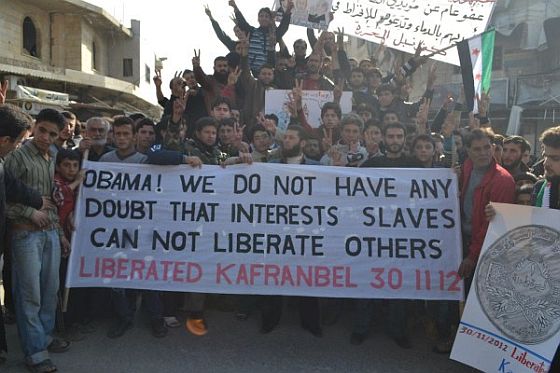
The internet has been shut down in Syria but someone has managed to get out photos from liberated Kafranbel today.

Cloudflare reports: The Syrian Minister of Information is being reported as saying that the government did not disable the Internet, but instead the outage was caused by a cable being cut. Specifically: “It is not true that the state cut the Internet. The terrorists targeted the Internet lines, resulting in some regions being cut off.” From our investigation, that appears unlikely to be the case.
To begin, all connectivity to Syria, not just some regions, has been cut. The exclusive provider of Internet access in Syria is the state-run Syrian Telecommunications Establishment. Their network AS number is AS29386. The following network providers typically provide connectivity from Syria to the rest of the Internet: PCCW and Turk Telekom as the primary providers with Telecom Italia, TATA for additional capacity. When the outage happened, the BGP routes to Syrian IP space were all simultaneously withdrawn from all of Syria’s upstream providers. The effect of this is that networks were unable to route traffic to Syrian IP space, effectively cutting the country off the Internet.
Syria has 4 physical cables that connect it to the rest of the Internet. Three are undersea cables that land in the city of Tartous, Syria. The fourth is an over-land cable through Turkey. In order for a whole-country outage, all four of these cables would have had to been cut simultaneously. That is unlikely to have happened.
James Miller writes: Why has the regime cut the internet? For a possible answer, one has to understand the duality of the insurgency.
The insurgency has many dimensions, but — to oversimplify it — two are notable. The first is what we see in Deir Ez Zor or Aleppo or Idlib Province — a semi-functional military apparatus, either coordinated at the brigade level or on a larger scale. These units seek military victories, destroying the regime’s resources and capturing bases, equipment, and territory. This element to the Free Syrian Army has been building for many months, and has not lost a battle since September. It has been advancing steadily since June; however, in recent weeks, this force has surged in a series of one-sided victories from Damascus to Aleppo, from al Raqqah to Deir ez Zor, and beyond.
But in Damascus in particular there has been a second dimension: while there is no place for a traditional military to hide, insurgents have been eating away at the Assad regime for months. Despite efforts to put them down, opposition fighters have been able to hit regime targets and then melt away into the civilian population operating very much like insurgents in Iraq or South Vietnam.
This is the imminent threat. While the military wing of the insurgency is creeping forward, slowly encircling the capital, the lurking enemy lies in many neighborhoods across the city and its suburbs. It is this two-pronged threat that has toppled a half dozen bases around Damascus since the beginning of October.
Now the target is the airport: if that is closed, all sense of normalcy will be gone. Over the last several nights, there have been insurgent attempts to take it. Now it appears that the challenge may be serious enough to close the airport — maybe for good. The news has already shaken the confidence of the international airlines, hesitant to send their people and planes into what looks like a warzone.
Elements of the Syrian opposition military are closing a noose around the cities of Idlib, Deir Ez Zor, and Aleppo. Once these are surrounded, or possibly captured, Al Raqqah and Hassakah in the north, and Hama in the west, will be the new targets. The insurgents are making a play for Daraa, and are attempting to build strength around Damascus while reducing Assad’s military advantage.
Many of the bases recently taken by the insurgents, particularly around Damascus, do not look as though they were vigorously defended, indicating that morale is the lowest it has been. As an insurgent advance takes much of his country, Assad could find his closest defenses dissolving in a matter of days, or even hours.
Anonymous Operation Syria issued a press release saying: Fortunately, Anonymous has been working with Syrian activists for well over a year in anticipation of this moment. We produced and disseminated the Syrian Care Package – http://bit.ly/Wxx0ev and there are emergency independent media centers already set up in every city of Syria. Activists and independent journalists in Syria will be able to utilize these media centers to get news and media out of Syria, and Anonymous will assist in propagating that media to the world. Anonymous will keep open the lines of telecommunication with the free Syrian people. We will be the voice of the voiceless in Syria.
“When your government shuts down the Internet, shut down your government.” ~~ Anonymous Egypt
Anonymous will NOT allow this massive violation of the human rights of the free Syrian people go un-punished. We feel this is a desperate move by a dying regime, one that has slaughtered tens of thousands of innocent civilians. Beginning at 9:00 PM ET USA Anonymous will begin removing from the Internet all web assets belonging to the Assad regime that are NOT hosted in Syria. We will begin with the websites and servers belonging to ALL Syrian Embassies abroad, which we will begin systematically removing from the Internet tonight. Our first target will be the website of the Syrian Embassy of in China: syria.org.cn – we encourage the media to follow the Twitter account @OpSyriaIRC for announcements on take-downs, defacements, data dumps, E-Mail bombs and black fax attacks. By turning off the Internet in Syria, the butcher Assad has shown that the time has come for Anonymous to remove the last vestiges of his evil government from the Internet. Soon, his people will remove him from this world. Let the final battle for a free Syria begin….
Today the internet was cut off across the whole of Syria. Max Fisher says the blackout poses three questions: 1. Is this blackout proactive or reactive?
In other words, is the Syrian government shutting down the Web as a precursor to some future event, or is the step a reaction to things that have already happened? The government has at times cut off connectivity in certain areas in advance of military operations there. Many observers seem to fear an impending major counterattack by the Syrian military, which has experienced a steady trickle of small setbacks. The closure of the Damascus airport is fueling speculation that the military may focus such an effort there.
It’s also possible, though, that the move is simply meant to slow the rebels’ recent gains, online and on the ground. James Miller at Enduring America writes: “A disconnected insurgency, and activists who cannot access each other or the outside world, will have trouble galvanizing their supporters or organizing the final push. Meanwhile, if bad news can be hidden away from Assad’s own soldiers, defections may not increase as much as they would otherwise.” [Continue reading…]
Responding to questions about the blackout, US State Department spokesperson Victoria Nuland said today:
[W]e’ve provided [the opposition] some 2000 communication kits since this effort began. These are all kinds of things – computers, cameras, phones – they are all designed to be independent from and circumvent the Syrian network …. precisely to keep them free from regime tampering, interference and interception.
If this assurance that these devices cannot be intercepted turns out to be mistaken, this could explain why the internet has been shut down: so that the Syrian government can flush out the users.
GlobalPost reports: Divided by history, geography and God, Abu Mohammed and Abu Hamza both smoke Marlboro cigarettes and agree on one point: The war for Syria is also a war for Iraq.
Driven from their homes by the 2003 US-led war in Iraq, both men, now in their 40s, found refuge for themselves and their families in neighboring Syria.
Nearly a decade later, both are back in the country that once sheltered them.
But this time their wives and children are no longer with them. The men are not in Syria to flee a war, but to fight one. Abu Mohammed, a Sunni, is training rebels in Aleppo. Abu Hamza, a Shiite, is battling alongside President Bashar al-Assad’s forces in Damascus.
Their involvement in Syria is further evidence that the war is evolving into an extension of the Sunni-Shia violence that Washington unleashed when it toppled Saddam Hussein.
More from GlobalPost: Complete Coverage: Inside Syria
“People ask me why a Sunni Iraqi is fighting in Syria and I have a simple answer: ‘I am fighting in Syria to liberate my country, Iraq, from the pro-Iranian Shiite militia,” said Abu Mohammed, 46, dressed in military fatigues, with a short greying beard, cigarette in one hand, sniper rifle in the other.
Iraq, said Abu Mohammed, was now “occupied” by Shiite militias: The Mahdi Army, led by Iraqi cleric Muqtada Sadr who has long ties to Iran; the Badr Brigade, armed and trained in Iran and formerly the armed wing of the Islamic Supreme Council of Iraq; and Iran’s own Quds Force.
Abu Mohammed considers Syria’s Assad regime ― led by members of the Allawite sect, an ancient off-shoot of Shiite Islam ― to be another arm of Iran’s attempt to dominate the Sunni-majority Middle East.
Any war against Assad in Syria is thus a war against Iran’s proxies in Iraq. [Continue reading…]
The Guardian reports: Syrian rebels are believed to have used surface-to-air missiles to down two government aircraft in less than 24 hours – the first time such weapons have been used in the 20-month insurrection.
The downing of the aircraft is being hailed as a significant tactical advance in northern Syria, where fierce clashes between Assad regime forces and rebels over the summer have given way to several months of stalemate and rising despair on the opposition side.
A warplane crashed on Wednesday near Darat Azzah outside Aleppo after being shot at from the ground. The wounded pilot was captured. Late on Tuesday, a regime helicopter also crashed. Several videos uploaded to the internet clearly showed a missile hitting it broadside before it plummeted to earth.
Reuters reports: Rebel strikes against military bases across Syria have exposed President Bashar al-Assad’s weakening grip in the north and east of the country and left his power base in Damascus vulnerable to the increasingly potent opposition forces.
Rebel fighters, who have taken at least five army and air installations in the last 10 days, are still waging an asymmetrical war against a powerful army backed by devastating air power, and predict months of conflict still lie ahead.
Their tactics are gradually choking off Assad’s forces in the northern provinces of Aleppo and Idlib, as well as the eastern oil region of Deir al-Zor, while in Damascus “there is a sense that the flames are licking at the door”, a diplomat in the capital said.
The steady capture of military installations and arsenals is sapping the morale of Assad’s forces and also ensuring a modest supply of new weapons to relatively ill-equipped rebels whose calls for a no-fly zone — which proved crucial in the Libyan uprising — have been ignored.
Although they have yet to seize control of a single city, or translate their dominance in swathes of rural Syria into “liberated” territory free of air and artillery strikes, rebels say that their increasing prowess on the battlefield and growing armories have finally allowed them to take the initiative. [Continue reading…]
The Los Angeles Times reports: First his parents’ home in eastern Syria was reduced to rubble, followed by his father’s pharmacy. Then Melad received a call last month informing him that his own apartment in a Damascus suburb had been obliterated by a bomb unleashed by a MiG jet.
By then, he had become inured to the sense of loss.
“I got to the point that when I would hear of another of our properties destroyed, I started laughing,” said Melad, a computer engineer who now helps with the humanitarian effort in Syria. “Just as we have gotten accustomed to the amount of blood over these last two years, we have grown accustomed to the destruction.”
Much of Syria has become a disaster zone: In September, the opposition group Syrian Network for Human Rights estimated that more than 2.9 million homes, schools, mosques, churches and hospitals had been damaged or destroyed since the uprising began in March 2011. More than half a million are a complete loss, it said.
Weeks later, the group’s founder, Sami Ibrahim, estimated that 600,000 more buildings had been shelled or bombed, as the government of President Bashar Assad escalated its campaign with daily airstrikes by helicopter and warplane. [Continue reading…]
The Wall Street Journal reports: All that remains of Abu Mohammed’s ancestral home here in Syria’s capital are two small adobe brick rooms and a few fig, loquat and mulberry trees.
It was bulldozed as part of a government slum-clearance program that appears to have a political motive: isolate neighborhoods sympathetic to Syria’s armed insurrection, and then obliterate them, according to critics, human-rights groups and even some officials within the government itself. “We are like gypsies now,” says Mr. Mohammed, who took his wife and five children to another part of the city after sections of his neighborhood, Qaboun—one of the first to rise up against Syria’s regime—were flattened and ringed by military posts.
The campaign stands in contrast to the all-out urban warfare in the northern city of Aleppo. Here in the capital, Damascus, the strategy appears designed to cripple and disperse the rebels through the destruction and encirclement of communities where they operate.
For the regime of President Bashar al-Assad, the stakes in Damascus are nothing short of retaining control of the nation itself. “If they lose Damascus, they lose the state,” says Patrick Seale, a British author and Syria expert.
Senior security officials within the Assad regime say partial demolitions of pro-rebel neighborhoods in and around Damascus are a key element of an ambitious counterinsurgency plan now unfolding. The plan also involves the expansion of regime-funded militias known as “Popular Committees” within the capital.
These officials say the strategy applies lessons learned from other offensives against the rebels since the start of the conflict more than 20 months ago, most notably in the central city of Homs.
The government’s official position is that the destruction is part of a long-discussed master plan to rid Damascus of illegal slums. City officials say illegal settlements account for nearly 20% of the capital’s 26,500 acres.
Based on several extended visits to Damascus and vicinity last month—some of which coincided with demolition by military authorities—the destruction appears to be occurring only in areas where opposition fighters have been active. In addition, much of it has been overseen by the military rather than municipal authorities, residents say.
“There’s still work to be done, we are not finished yet with cleansing operations that are in response to popular demand,” says Hussein Makhlouf, a relative of Mr. Assad and governor of Rif Damascus, the province surrounding the capital.
In his Damascus office, Mr. Makhlouf praised the government’s official slum-destruction decree, known as “presidential decree No. 66,” as a model for urban renewal. He said demolitions will soon begin in Daraya, Harasta and Yalda, all suburbs that have been at the center of the insurgency against Mr. Assad. Mr. Makhlouf was forthright about the motives behind the demolitions, saying they were essential to drive out rebels, or “terrorists” as he called them.
The Washington Post reports on the fractured relationship between Syria’s 500,000 Palestinians and the ruling Assad family: Palestinian refugees in Syria, in comparison with many countries in the region, are more integrated into society and have greater rights, such as the right to own property. As a result, the Assads have long touted themselves as regional leaders for the Palestinian cause.
So it was no small snub when some Palestinians supported the uprising and took up arms against the government. Opposition activists say there are units within the rebel Free Syrian Army made up entirely of Palestinian fighters.
There is also a sectarian dimension. Sunni Palestinians sympathize with the predominantly Sunni opposition in its fight against a Syrian government led by Alawites, who are an offshoot sect of Shiite Islam.
Within the Palestinian community, the group that best embodies the conflicting views is Hamas. This year, Hamas’s political leader, Khaled Meshal, expressed support for the Syrian opposition and moved his base to Qatar, a dramatic step for a group that had been receiving Syrian support for more than a decade.
“The regime supported us — that’s true. But the Syrian people have also supported us,” said the head of international relations for Hamas, Osama Hamdan, who is based in Beirut.
He added: “We as the Palestinian people are seeking to have our freedom, our right of self-determination. So we will not stand in a position which may be against the will of any nation or any people.”
But the leaders of Hamas’s military wing, which is largely based in the Gaza Strip, have taken a different stance, analysts say. In recent years they have received financial and military assistance as well as training from Iran, one of President Bashar al-Assad’s closest allies, and have remained supportive of the Syrian government.
The group’s difficult position on the Syrian uprising was evident in comments Meshal made at a news conference in Cairo on Wednesday. He thanked Iran for its support during the recent Israeli military operation targeting Gaza but noted that his praise came despite “disagreements on the situation in Syria.”
Syrian security services raided Meshal’s office in Damascus this month, according to a Hamas statement. But the fallout between Hamas and the Syrian government had surfaced earlier this year; in late June, Hamas official Kamal Ghanaja was assassinated in Damascus, and his body reportedly showed signs of torture.
Many activists say the killing was carried out by Syrian security services in retaliation for the group’s shifting allegiances.
EA Worldview‘s James Miller writes: [A]t several points in this conflict there have been collections of bad data that suggested that EA, and the media at large, was missing a trend. For several weeks there has been a growing number of rumors, low-quality Youtube videos, and eyewitness reports that suggested that not only was the FSA winning in Deir Ez Zor, Lattakia, and Aleppo, but it was on the brink of major victories in all three provinces. Similarly, there is a growing body of inconclusive evidence that the FSA is surging in Daraa province, and was increasingly effective in and around Damascus. While individual reports of this nature may or may not each be true, the trend lines were beginning to look clear.
For more than a week, however, that body of evidence has been harder and harder to dismiss as noise and rumor. With well documented victories yesterday, the FSA has encouraged us to post headlines that we have been sitting on for a long time.
Two trends are clear – The Assad regime is retreating, pulling many units towards the capital and leaving its garrisons to fend for themselves – and they are fending poorly. Meanwhile, the FSA continues to ratchet up pressure on the capital, and despite the fact that Damascus is now the highest priority of the Assad military, those advances are accelerating.
Is it a state of collapse? Perhaps it’s too early to say, and we’re not predicting a sudden collapse even if that were true. Regardless, it is my conclusion that we have been too cautious in estimating the strengths of the insurgency, and this is saying something because we have been consistently more hawkish (and I would argue more accurate) than many media outlets who assess the strength of the Syrian insurgents. [Continue reading…]
The Associated Press reports: Activists say Syrian rebels have captured a hydroelectric dam on the Euphrates river in the country’s north in a strategic victory that followed days of fighting.
The Britain-based Syrian Observatory for Human Rights says the Tishrin Dam, near the town of Manbij, fell to the rebels before dawn on Monday.
Rami Abdul-Rahman, who heads the Observatory, says the dam supplies several areas of Syria with electricity.
The rebels have been making strategic advances recently. On Sunday, they briefly captured a regime helicopter base outside Damascus.
Earlier, Al Jazeera reported: Opposition commanders in the Syrian city of Aleppo have voiced their support to the Syrian National Coalition, a day after a video emerged showing fighters from at least 14 brigades announcing their rejection of the opposition bloc.
The powerful Liwaa al-Tawhid Brigade, along with the Aleppo Military Council and Transitional Military Council, in a video uploaded on YouTube on Tuesday, said they would co-operate with the newly formed opposition body, but called for greater representation in it.
They also said that the earlier statement by some local commanders rejecting the coalition was due to “the marginalisation of the revolutionary forces on the ground”.
“We call on [the coalition] to increase the representation of the revolutionary forces and to activate their role in the coalition’s offices and apparatus,” Tuesday’s statement, read by Abdel Qader Saleh, the head the Liwaa al-Tawhid Brigade, said.
The brigade, formed in July, is said to have at least 10,000 fighters. It has been credited for the opposition’s control of vast areas in Aleppo province.
In the earlier video posted online on Monday, a fighter could be seen reading out a statement that said: “We, the groups in the city of Aleppo and its suburbs, completely reject the conspiratory project which was named the National Coalition.”