Category Archives: Syria

Flight records say Russia sent Syria tons of cash

By Dafna Linzer, Michael Grabell and Jeff Larson, ProPublica, November 26, 2012

This past summer, as the Syrian economy began to unravel and the military pressed hard against an armed rebellion, a Syrian government plane ferried what flight records describe as more than 200 tons of “bank notes” from Moscow.

The records of overflight requests were obtained by ProPublica. The flights occurred during a period of escalating violence in a conflict that has left tens of thousands of people dead since fighting broke out in March 2011.

The regime of Bashar al-Assad is increasingly in need of cash to stay afloat and continue financing the military’s efforts to crush the uprising. U.S. and European sanctions, including a ban on minting Syrian currency, have damaged the country’s economy. As a result, Syria lost access to an Austrian bank that had printed its bank notes.

“Having currency that you can put into circulation is certainly something that is important in terms of running an economy and more so in an economy that is become more cash-based as things deteriorate,” said Daniel Glaser, Assistant Secretary of the Treasury for Terrorist Financing and Financial Crimes.  “It is certainly something the Syrian government wants to do, to pay soldiers or pay anybody anything.”

According to the flight records, which are in English and Farsi, eight round-trip flights between Damascus International Airport and Moscow’s Vnukovo Airport each carried 30 tons of bank notes back to Syria.

Syrian and Russian officials did not respond to ProPublica’s questions about the authenticity and accuracy of the flight records. It is not possible to know whether the logs accurately described the cargo or what else might have been on board the flights. Nor do the logs specify the type of currency.

But ProPublica confirmed nearly all of the flights took place through international plane-tracking services, photos by aviation enthusiasts, and air traffic control recordings. 

Each time the manifest listed “Bank Notes” as its cargo, the plane traveled a circuitous route. Instead of flying directly over Turkish airspace, as civilian planes have, the Ilyushin-76 cargo plane, operated by the Syrian Air Force, avoided Turkey and flew over Iraq, Iran, and Azerbaijan.

The flight path between Syria and Russia described in the manifests.

Tensions have been rising between Syria and Turkey since the spring. Last month, Turkey forced down a Syrian passenger plane traveling from Moscow. Turkey suspected the flight of carrying military cargo but officials have not said what, if anything, was confiscated.

If the flight manifests are accurate, a total of 240 tons of bank notes moved from Moscow to Damascus over a 10-week period beginning July 9th and ending on September 15th.

U.S. officials interviewed said evidence of monetary assistance, like military cooperation, point to a pattern of Russian support for Assad that extends from concrete aid to protecting Syria from U.N. sanctions.

In September, 2011, six months into the violence, the European Union imposed sanctions that prohibited its members from minting or supplying new Syrian coinage or banknotes. In a statement, the EU said the sanctions aimed “to obstruct those who are leading the crackdown in Syria and to restrict the funding being used to perpetrate violence against the Syrian people.” At the time, Syria’s currency was being minted by Oesterreichische Banknoten- und Sicherheitsdruck GmbH, a subsidiary of Austria’s Central Bank.

President Obama has issued five Executive Orders that prevent members of the Assad regime from entering the United States and accessing the U.S. financial system.

 “Increasingly, it is more difficult to finance the war machine and the cost of the war is becoming more expensive for the Assad regime,” said one U.S. official who spoke on the condition of anonymity. “Targeted sanctions on those leading the violence are working and start to bite into their pocket books.”

Russia appears to be helping Syria blunt the impact of the sanctions.

This past June, Reuters reported that Russia had begun printing new Syrian pounds and that an initial shipment of bank notes had already arrived.  The report was denied by the Syrian Central Bank, which claimed the only new money in circulation were bills that had replaced damaged or worn bank notes. Such a swap, the bank contended, would have no effect on the economy.

On August 3rd, the official Syrian news agency SANA, reporting from a news conference in Moscow with Syrian and Russian economic officials, quoted Syrian officials acknowledging that Russia is printing money. Qadr Jamil, Syria’s deputy prime minister for Economic Affairs, was quoted by SANA as calling the deal with Russia a “triumph,” over sanctions.

Syrian Finance Minister Mohammad al-Jleilati said that Russia was providing both replacement notes and additional currency to, as SANA put it, “reflect the country’s changing GDP.”  

Al-Jleilati said the money would have no effect on inflation. Printing new notes beyond simply replacing old ones could undermine Syria’s already battered currency.

At the time of the meeting, at least 30 tons of currency had already been delivered, according to the flight records, and another 210 tons would be delivered in subsequent flights.

In its regional economic outlook released earlier this month, the International Monetary Fund noted that Syria’s currency has lost 44 percent of its value since March 2011, trading for about 70 pounds to the dollar compared with about 47 pounds when the conflict began.

Ibrahim Saif, a political economist based in Jordan and a resident scholar at the Carnegie Middle East Center said 30 tons of bank notes twice a week is a significant amount for a country like Syria.

“I truly believe it’s not only that they’re exchanging old money for new notes. They are printing money because they need new notes,” Saif said.

“Most of the government revenue that comes from taxes, in terms of other services, it’s almost now dried up,” noted Saif. Yet, “they continue to pay salaries. They have not shown any signs of weakness in fulfilling their domestic obligations. The only way they can do this is to get some sort of cash in the market.”

Before the unrest broke out, Syria had about $17 billion in foreign currency reserves. Saif said he and other economists in the region estimate they now have about $6-8 billion in reserves, dwindling about $500 million a month for salaries and supplies to keep the government running.

In Moscow, the Syrian finance minister had said that his country required additional foreign currency reserves, which Russia may provide in the form of loans.

“It’s possible the Syrians are acquiring foreign currency reserves, either Euros or US dollars, which they would need to conduct any serious commerce,” said Juan Zarate, who served as Assistant Secretary of the Treasury for Terrorist Financing and Financial Crimes during the Bush administration.

Zarate noted that other countries, when faced with economic sanctions, have leaned on allies for foreign currency reserves. China supplied North Korea with such funds in the past and Venezuela agreed to sell reserves to Iran.

Syria’s currency is still traded on open markets, but there is limited on-the-ground information about the economy, including inflation.  

Officials at the IMF “have not been able to get direct information about Syria for at least a year,” Masood Ahmed, director of the group’s Middle East and Central Asia department, told reporters at a conference in Tokyo last month.

Glaser, at Treasury, declined to put a figure on Syria’s current reserves but said the Syrian economy is suffering in part from a lack of tourism and a ban on oil sales, both of which provided Damascus with foreign currency. “There is significant inflation in the country. It can be caused by adding new currency or not having foreign reserves to prop up the existing currency.”

Quinn Norton contributed to this story.


Facebooktwittermail

Syria’s new opposition in race to convince skeptical Islamists

Reuters reports: Syria’s new opposition leaders are struggling to win over powerful Islamist rebel combat units, whose radical elements question whether the “hotel warriors” of the fledgling coalition can offer their fighters any real support.

Islamists have established themselves as the most effective, best armed and fastest growing units in the 20-month-old uprising against President Bashar al-Assad.

Many of them are wary of the National Coalition for Syrian Opposition and Revolutionary Forces, set up earlier this month in an attempt to unify Assad’s fractured opponents and win greater international support.

“They are the hotel warriors, we are the men in the trenches. No one should be allowed to marginalize us, politically or militarily. These coalitions are just fighting over us and not for us,” said Yassir al-Karaz, a leader in the rebel Tawheed Brigade in northern Aleppo province.

Most rebels are conservative but politically moderate and willing to work with diverse opposition groups. But they were left to their own devices for months in an uprising they dubbed an “orphan revolution” and the challenge to bring them into the fold is made bigger by the rising role of radicals, including al Qaeda-style fighters in Syria.

The problem for the new coalition is maintaining the backing of this crucial bloc of Syrian fighters on the ground while bolstering support from Western powers wary of funding a movement that may be linked to extremist groups.

While the coalition has won formal recognition from Turkey, France, Britain and Gulf Arab states, the response from many Islamist fighters has been skeptical or downright dismissive.

“We are with the coalition – for now. We want to see what it is going to do for us,” said a fighter from one of the biggest Islamist brigades in the capital Damascus.

“It is known that we want weapons, we want a no-fly zone. Can it do that? We will see. We are not going to wait forever. With or without them, we are fighting and we are going to win.” [Continue reading…]

Facebooktwittermail

Against the odds, Syrian rebels begin to chip away at regime’s air advantage

Christian Science Monitor reports: Syrian opposition fighters have long decried their lack of anti-aircraft weapons and called on the international community to arm them with something that can counter the the Syrian regime’s military’s jets and helicopters. Such support has yet to come – and there are few indicators that it will arrive anytime soon.

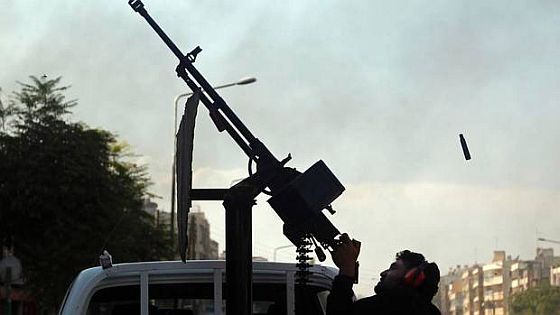
Still, those in the Free Syrian Army fighting for control of Aleppo province say that they’re making some progress in the battle for the skies. Using truck-mounted, DShK heavy machine guns, more commonly referred to as dushkas, FSA fighters say that they’ve managed to establish anti-air defenses capable of challenging jets.

Dushkas are one of the more difficult weapons for FSA fighters to acquire and in almost all cases must be captured from the regime forces or brought over by defectors. The anti-air defense network has grown slowly over the last several months, but many now say it’s reached a point where it can effectively challenge airplanes and helicopters.

“We control 70 percent of the sky, because if you compare the situation now to two months ago there are a lot less airplanes,” says Khlief Abu Allah, a dushka gunner who worked in an anti-aircraft unit in the Syrian Army during his obligatory military service before the revolution started.

While airstrikes remain a major threat in Aleppo, residents and FSA fighters say there’s been a noticeable drop in the number of attacks in recent weeks. [Continue reading…]

Facebooktwittermail

Syrian rebels capture three military bases in a week

The Guardian reports: Syrian rebels’ success in seizing three military bases in less than a week has underscored the growing difficulty faced by Damascus in securing its outposts and stopping a rebel encroachment that has claimed large swaths of the east and north of the country.

Attacks on the bases, one north-east of Aleppo, a second at Mayedin in the far east and a third near Damascus, yielded a large number of weapons, which had been in desperately short supply, especially in positions across Syria’s second city.

The impact of the new weapons seemed to have been felt immediately along northern frontlines, where Kurdish groups loyal to the Assad regime were on Friday engaged in their heaviest clashes yet with rebel forces and jihadists, near the border town of Ras al-Ain. [Continue reading…]

Facebooktwittermail

With Syria’s eastern oilfields in rebel hands, a brisk business in pirated crude grows

McClatchy reports: Syrian rebels have captured two of the three major oilfields in the country’s southeastern Deir al Zour province and are extracting oil that they say is helping to support their rebellion.

“We are at the beginning of winter, and people need oil to run the bakeries and to heat their homes. The weather is very cold here,” said a rebel leader here who, for security reasons, identifies himself by his nom de guerre, Abu Mohamed.

The capture of the fields is another blow to the Syrian government’s attempt to offset inflation and shortages of various goods in the areas it still controls. It also has set off a booming oil trade in this impoverished area. Dozens of trucks wait in line 24 hours a day to fill up at rebel-held wells, which produce a light crude that can be burned without refining, though the result is dense smoke. Some farmers insist the unrefined crude can be used to power farm equipment, though it seems primarily to be used for heat.

Some of those waiting in line at one well this week said they’d been waiting for days. Along roadsides and at intersections all over the area, men could be seen reselling the oil from improvised tanker trucks and barrels loaded into the backs of pickups.

Abu Mohammed said the price at which the rebels sell the oil is largely a symbolic one, and prices at the various wells in operation appeared to be about $5 a barrel, far below the world price that hovers above $80 a barrel. [Continue reading…]

Facebooktwittermail

More than 40,000 killed since start of Syria conflict

Reuters reports: More than 40,000 people have been killed in 20 months of conflict between Syrian President Bashar al-Assad’s forces and those fighting for his overthrow, a violence monitoring group said on Friday.

Rami Abdelrahman, head of the Syrian Observatory for Human Rights, said about half the fatalities were civilians and the other half split about evenly between rebels and government soldiers.

“The figure is likely much higher as the rebels and the government lie about how many of their forces have died to make it look like they are winning,” Abdelrahman told Reuters.

Robert King writes: Today the dazed and grieving medical staff of Aleppo’s Dar al-Shifa Hospital, which just weeks ago I documented for VICE’s Ground Zero series, wandered around their razed makeshift medical facility, searching the rubble for victims of yesterday’s rocket attack launched by one of Assad’s fighter jets.

While some news reports claim that the destroyed building was adjacent to the hospital, they are incorrect. I have eaten lunch in that building several times. It housed the hospital’s administrative offices and doubled as its instrument-sanitization facility. Regardless, Dar al-Shifa’s operating facilities were also destroyed. It’s all gone, and anyone who is reporting that it is a lie or propaganda doesn’t know anything worthwhile. As with many times during my reporting in Syria, I was the only reporter on the scene who wasn’t also an activist.

Family members of the deceased stood in the street, waiting in agony for their love ones to be recovered. The exact death toll has yet to be confirmed, but today’s estimates put it at 40 and climbing.

Bulldozers worked through the night to move the debris so volunteers could extract the dead. Among the fallen were Dr. Abu Faisal, a newly married nurse Mrs. Bushra, the hospital’s information manager, and two of their security guards. Five additional nurses were wounded in the attack.

Earlier today I interviewed Dr. Osman, the head doctor of the now destroyed hospital, while he was surveying the damage. “Dar al-Shifa Hospital is now finished but in the future we will rebuild,” he said. “[Our] message was never the building itself, the message of Dar al-Shifa is [its] people and the doctors, and we will continue to save lives and relieve pain.”

Despite the obstacle Dr. Osman said that he expects to have a working hospital up in running in 48 hours. Until then many civilians in Aleppo are on their own in a war without any moral boundaries whatsoever.

Watch King’s interview with Dr Osman in this recent report:

Facebooktwittermail

Gaza ceasefire: Syria’s shrinking influence now exposed

Ian Black writes: No one is taking bets on how solid the ceasefire between Israel and the Palestinians will prove to be. But the Gaza conflict has highlighted one apparently permanent change in the Middle East – the shrinking influence of Syria, stuck in a bloody and unstoppable war.

If Mohamed Morsi, the Egyptian president, is now basking in glory as the indispensable mediator between Hamas and Israel, his counterpart in Damascus, Bashar al-Assad, looks distinctly like yesterday’s man.

Syrian state media focused intensely on Israel’s onslaught against the Palestinians in Gaza. But Assad’s Arab critics have been doing some bleak calculations: in the eight days of Operation Pillar of Defence 160 Palestinians were killed by Israel. In the same period, Syrian forces killed 817 civilians and injured thousands. Last Monday alone, says the opposition, 150 Syrians died.

Al-Arabiya, the Saudi-owned TV channel, drove home the point about double standards nicely by quoting an Israeli rabbi who publicly urged his army to “learn from the Syrians how to slaughter and crush the enemy.”

Any sense that the Gaza crisis was providing a handy diversion from the global attention to Syria was shortlived. [Continue reading…]

Facebooktwittermail

Assad forces destroy Dar al Shifa hospital in Aleppo

Vice, November 21: Today, the Dar al Shifa field hospital in Aleppo — which was the subject of the VICE documentary Ground Zero Syria: Aleppo Field Hospital [see Ground Zero Part 3, below] — was bombed into rubble by Assad’s MIG jets. The FSA’s Aleppo media center is reporting 15 dead, 20 wounded, and many still under the rubble. Two of the dead were allegedly hospital staff and two were children. An unconfirmed rumor is circulating that a Canadian film crew was also inside at the time of the bombing. Our correspondent Robert King was 100 yards away when the bombs dropped. The air was thick with smoke and debris, like a thick fog—the hospital was nowhere to be seen because it had been completely leveled. Grown men stumbled around shellshocked, covered in dust. Grieving Syrians shouted “Allahu Akhbar” and gathered the wounded from the rubble, wrapping up the dead and throwing their bodies in the backs of minitrucks. As the cease-fire between Israel and Gaza devours headlines, the bombs continue to fall in Aleppo and Idlib province. VICE’s Robert King will remain in Aleppo, documenting the ongoing civil war.

Facebooktwittermail

Notes from an Egyptian mujahid in Syria

Mara Revkin writes: If there is such a thing as a stereotypical jihadist, Ahmed is not it. The 22-year-old Egyptian Salafi tweets prolifically from his iPad, quotes Martin Luther King, Jr., and works part-time for a successful alternative media start-up company.

Like a lot of college students, Ahmed loves road trips. But unlike most Egyptians his age, Ahmed’s last journey was to a war zone – Syria – where he spent six weeks fighting with rebel forces against Bashar al-Assad’s entrenched regime. Ahmed is one of a growing number of mujahideen (predominately Sunni guerrilla fighters) traveling from Egypt, Tunisia, and as far as Croatia and Pakistan to volunteer with the Free Syrian Army (FSA).

The United Nations estimates that the number of foreign combatants on the ground may lie in the hundreds, but anecdotal reports indicate that the true figure may be in the thousands and growing. On September 17, the United Nations expressed concern that the influx of foreign fighters could be contributing to the radicalization of rebel forces. The head of the UN inquiry into Syria’s civil war, Paulo Pinheiro, warned, “Such elements tend to push anti-government fighters towards more radical positions.” Among the mujahideen are veteran jihadists who fought alongside Muslim separatists in Bosnia and Chechnya. Others have ties to al-Qaeda affiliates and fought against Coalition Forces in Iraq and Afghanistan.

Half a dozen jihadist groups are currently operating in Syria. The FSA does not condone the extreme tactics of these groups, and their assassinations and suicide bombings against military and civilian targets have become a major liability in the rebels’ campaign to cultivate international goodwill and credibility. While the FSA has tried to distance itself from extremists groups, as the conflict drags on, the over-extended and under-supplied rebels have become heavily reliant on any reinforcements they can find, however radical. [Continue reading…]

Facebooktwittermail

Another day in Syria

Local Coordination Committees in Syria: By the end of Thursday the LCC managed to document 130 martyrs (including 11 children and 5 women), 59 martyrs were reported in Damascus and its Suburbs, 21 martyrs in Aleppo, 17 martyrs in Homs, 10 martyrs in Idlib, 8 martyrs in Daraa, 5 martyrs in Raqqa, 5 martyrs in Hama, 3 martyrs in Deir Ezzor and 2 martyrs in Lattakia

The LCC documented 206 shelled points, 146 points were shelled by artillery, 46 points by mortars and 23 points by missiles
Also 21 points in Syria were targeted by the regime Warplane by throwing 6 explosive barrels in 6 points and Thermobaric Bombs in 4 points

The FSA had clashes with the regime forces in 84 points, and they shot down a MiG Warplane in Bokamal, they also liberated the Agriculture Bank and the Military Security in Bokamal, the FSA announced a full liberation of Bokamal City.

EA Worldview adds: The city (map) is Syria’s gate to Iraq, and any supplies and reinforcements that come with it. Furthermore, the FSA is using Al Bukamal to eat away at the regime’s control in Deir Ez Zor. Though the Assad regime has pockets of stiff resistance, for the most part its control of the entire eastern province of Deir Ez Zor has been slipping for months.

With Ma’arrat al Nouman in Idlib (map) still under FSA control, and Assad’s supply routes to Idlib and Aleppo cut, the FSA is strangling Assad’s military, and Assad may not have enough firepower to spare in order to retake Al Bukamal, if the city has indeed fallen.

But the FSA’s struggle to take Deir Ez Zor has been painstakingly slow, if steady. It will likely be a long time before they convert victories here into control of eastern Syria.

Facebooktwittermail

Turkey recognizes Syrian National Coalition

The New York Times reports: Turkey made it clear on Thursday that it officially recognized a newly formed rebel coalition as the legitimate leader of the Syrian people, an important step in the group’s effort to attract legitimacy and, it hopes, more weapons to bring about the end of President Bashar al-Assad’s rule.

Turkey “once again reiterates its recognition of the Syrian national coalition as the legitimate representative of the Syrian people,” Turkey’s foreign minister, Ahmet Davutoglu, said in a speech at an Organization of Islamic Cooperation meeting in Djibouti, the tiny country on the Horn of Africa.

The announcement by Turkey, Syria’s northern neighbor and a haven for thousands of Syrian refugees and rebel fighters, was the third significant recognition of the new group this week.

On Monday, members of the Gulf Cooperation Council — Saudi Arabia, Bahrain, the United Arab Emirates, Oman, Qatar and Kuwait — recognized the group, known as the National Coalition of Syrian Revolutionary and Opposition Forces.

On Tuesday, France became the first Western country to do so, and it said it was considering providing arms to the insurgent groups within Syria that have been engaged in a 20-month-long war with the government that has claimed nearly 40,000 lives.

Facebooktwittermail

Four key tests face the Syrian opposition

Rami G Khouri writes: The rapid developments in recent days in the world of the Syrian groups fighting to overthrow the regime of President Bashar Assad will be a game-changer if the new coalition of opposition forces actually becomes a unified movement that achieves four critical and linked goals: coordinating internal military action, generating legitimate and credible local governance bodies in areas liberated from government control, connecting with Alawites, senior security personnel and other regime supporters to convince them of their safety in a post-Assad Syria, and managing a rising flow of international diplomacy and aid. That is a tall order, but for the country and ancient culture that gave the world its first alphabet and musical notations, among other wonders, it is doable.

The new “National Coalition for Revolutionary Forces and the Syrian Opposition” was agreed upon during a weekend marathon negotiation and political pressure cooker in Doha, Qatar. This kind of reconciliation and consensus-building exercise has now become a hallmark of the dynamic Qatari approach to resolving thorny issues among Lebanese, Palestinians, Yemenis, Sudanese and now Syrians: lock the recalcitrant participants in a luxury hotel for a few days, shower them with fine hospitality and promises of substantial aid in the future, focus the world’s media and political attention on them, and tell them they cannot leave until they have reached an agreement.

The Syrian opposition coalition that was born through this kind of Qatari midwifery faces many hurdles, but it also carries the hopes of tens of millions of Syrians and hundreds of millions of Arabs who wish to see it prevail. It has already been recognized as the legitimate Syrian government by heavyweights like Saudi Arabia, Qatar and the rest of the Gulf Cooperation Council, Egypt, the U.S., Germany, Italy and France. Pulling recognition from the Assad family regime and bestowing it upon this new opposition coalition is one of the few safe moves that foreign countries can make, given their hesitancy in offering serious weaponry to the opposition groups, for fear of promoting the fortunes of Islamists among them. This is an easy step, but we will soon discover if it is also meaningful. [Continue reading…]

Facebooktwittermail

The new Syrian National Coalition

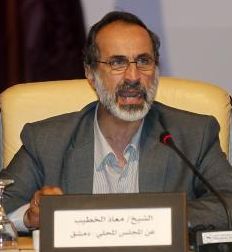
Ahmad Muaz al-Khatib

Robin Yassin-Kassab writes: Following my previous comment on the astounding failures of Syrian political elites, I must report some optimism. The Syrian National Council has accepted its place within the new Syrian National Coalition (it makes up a third of the new body), and the Coalition has won recognition by the Arab League, France, Japan and others.

The Coalition’s choice of leaders is the most inspiring sign, one which suggests both that the Coalition is no foreign front, and that another, much more positive aspect of Syria is finally coming to the fore.

President Ahmad Muaz al-Khatib is a mosque imam, an engineer and a public intellectual. He is Islamist enough for the Islamists and less extreme Salafists of the armed resistance to give him a hearing, but not Islamist enough to scare secularists and minority groups. He has written books on the importance of minority religious rights and women’s rights in a just Islamic society. His speeches since assuming his position have reached out to minorities and to the soldiers in Asad’s army, who he described as victims of the regime.

Vice President Riyadh Saif is a businessman, former MP, and a liberal democrat.

And Vice President Suheir al-Atassi, daughter of foundational Ba’athist Jamal al-Atassi, is a human rights activist, a secular feminist, a founder of the Syrian Revolution General Commission, and a key activist of the grassroots Local Coordination Committees. She is the sort of person who should have been representing the Revolution at the highest level from the very start. [Continue reading…]

Facebooktwittermail

Syria’s new opposition wins Western backing, but what about Western weapons?

Tony Karon writes: Syria’s new opposition leadership structure announced in Qatar on Sunday could mark a turning point in the stalemated 20-month old rebellion against the Assad regime. But it could just as easily prove to be another chimerical Western attempt to stand up a friendly regime for an Arab country in transition. That’s because the impetus for the new National Coalition for Revolutionary Forces and the Syrian Opposition has come from foreign powers rather than from the grassroots of the rebellion, and its authority on the ground, particularly with the hundreds of autonomous militia groups, is more of an aspiration than an established fact at this stage.

“It’s obviously a great step forward for the West and the Syrian opposition,” says Joshua Landis, a Syria specialist at the University of Oklahoma. “This group has great purchase among upper-class urban Sunnis, particularly those who have spent a lot of time in the West. But the key question will be whether or not it is able to unify rebel military groups on the ground, which haven’t been particularly involved in this process.”

The National Coalition is a product of Western and Arab backers — exasperated by the failure of their previous favorite, the Syrian National Council, to overcome crippling factional disputes, much less establish any traction on the ground — twisting the arms of exile-based opposition groups to accept a new, more representative leadership structure as the condition for continued foreign backing. The Gulf Cooperation Council, representing Saudi Arabia, Qatar and four of their neighbors, on Monday recognized the new group as “the legitimate representative of the Syrian people.” The new opposition group, which includes leadership spots reserved for minorities and for representatives of provincial revolutionary committees on the ground, expects immediate recognition as the legitimate government of Syria, and also military assistance to rebel fighters. But before the U.S. and other Western powers follow the lead of the Saudis and Qataris, they may expect the new group to provide credible evidence of its authority on the ground. And that may be the tricky part of the second phase of the plan to reorganize the Syrian opposition. [Continue reading…]

Facebooktwittermail

Syrian National Mess

Robin Yassin-Kassab writes: George Sabra has been elected new head of the Syrian National Council. He seems like a good man and his first interviews suggest he’s an effective talker. But his election comes as the SNC loses the last of its relevance. Despite the gravity of its historic responsibility, the Council failed to connect properly with revolutionaries on the ground, it failed to do enough to reassure minorities, or to aid refugees, it put all its eggs in the basket of a foreign military intervention which was never going to happen, it overrepresented the Muslim Brotherhood, it was bedevilled by factional and ego-based conflict, and its self-renewal process ended up with no women in the leadership. Foreign governments have lost interest in it. Crucially the grassroots Local Coordination Committes say the SNC no longer represents them. Other opposition bodies and individuals outside the SNC (some of them doubtless secretly backed by the regime) have added to the sniping and backstabbing.

Today the news is that a new, broader body has been formed to coordinate the fight against Asad, to implement law in liberated areas, and to oversee the post-Asad transition. It’s called the National Coalition of the Syrian Revolutionary Forces and the Opposition, or the Syrian National Coalition. Perhaps this initiative will be more successful than others; we’ll see. Very sadly, it took Qatari and American badgering and perhaps promises of better weaponry (at this late stage with the country in flames and the resistance finally capturing heavy weaponry for itself) to force the ‘opposition’ to coalesce. You’d think Syria’s elite politicians would have been self-motivated to compromise and act by the destruction and mass slaughter in their homeland, by the urgency of the tragedy, by the vacuum allowing nihilists and potential warlords to call shots. But no. While Syria’s grassroots revolutionaries are unparalleled heroes, seemingly capable of endless self-sacrifice, Syrian political elites have failed their people massively. [Continue reading…]

Facebooktwittermail

Israeli army scores ‘direct hits’ on Syrian target

Reuters reports: Israel’s army fired tank shells into Syria on Monday and scored “direct hits” in response to a Syrian mortar shell that struck the Israeli-controlled Golan Heights, the Israeli military said in a statement.

Israeli military sources said Syrian mobile artillery was directly hit in the incident.

It was the second time in two days that Israel has responded to what it said was errant Syrian fire. On Sunday the military said it had a fired a “warning shot” across the disengagement line, while on Monday it said it had fired back at “the source”.

Military sources would not say if the mortar bomb was fired by Syrian army forces or by the rebels they are battling in and around the United Nations’ patrolled area of separation.

“A short while ago, a mortar shell hit an open area in the vicinity of an (Israeli Defense Forces) post in the central Golan Heights, as part of the internal conflict inside Syria, causing no damage or injuries,” the military statement said.

“In response, IDF soldiers fired tank shells towards the source of the fire, confirming direct hits. The IDF has filed a complaint with the UN forces operating in the area, stating that fire emanating from Syria into Israel will not be tolerated and shall be responded to with severity.”

Facebooktwittermail