Category Archives: Syria

Turkey calls on major powers to intervene in Syria

The Guardian reports: Turkey has called on the US, Britain and other leading countries to take immediate action to intervene in Syria to prevent a looming humanitarian “disaster” that it says threatens the lives of millions of internally displaced people and refugees as winter approaches and could soon ignite a region-wide conflagration.

Appealing to the major powers to set aside their differences over how to end the 20-month-old civil war in which an estimated 32,000 people have died, Ahmet Davutoglu, Turkey’s foreign minister, said the crisis had gone on for long enough. The Syrian people were crying out for help and their pleas could no longer be ignored.

“How long can this situation continue? I mean in Bosnia, now we have Ban Ki-moon [the UN secretary general] apologising 20 years after. Who will apologise for Syria in 20 years’ time? How can we stay idle?” Davutoglu told the Guardian in an exclusive interview in Istanbul.

“We [Turkey] are doing all we can to help these people, using all diplomatic capacity to stop this bloodshed. But there should be a much more concerted effort by the international community. The best way we can see now is direct humanitarian intervention.” [Continue reading…]

Facebooktwittermail

The target of today’s bombing in Beirut

Elias Muhanna writes: The news is still trickling out about the bombing today in Beirut, but all media outlets are now confirming that the target was Brigadier-General Wissam al-Hassan, the head of the Information Branch of the Internal Security Forces.

I’ve written a great deal about Wissam al-Hassan over the past few years and will have more to say about him this evening, but for the time being, here’s a quick backgrounder, followed by several links to my blog posts about the most important events in which al-Hassan played a major role.

Wissam al-Hassan was one of the most important security figures in Lebanon. He headed up the Information Branch of the Lebanese Internal Security Forces (fir` al-ma`lumat), and was recently responsible for arresting Michel Samaha, a former minister with close ties to Syria, for allegedly conspiring to have explosives blown up all around Lebanon in a bid to create havoc. The move was seen as very destabilizing in Lebanon because Wissam al-Hassan is very close to the March 14th coalition while Samaha had long been regarded as “untouchable” because of his connections to Damascus. And yet, none of Samaha’s Lebanese allies demanded his release. Many people were shocked at the ISF’s boldness and concluded that the evidence against Samaha (which allegedly included video and audio footage) was so compelling that he became politically radioactive to his allies.

Wissam al-Hassan has long been the target of March 8th ire. His branch of the police has been described as an independent fiefdom that is not under any real civilian control. Al-Hassan was a key security chief for former Prime Minister Rafiq al-Hariri, and was accused by some of having played a suspicious role in the build-up to the assassination in 2005. From March 14th’s perspective, the loss of al-Hassan is a major blow.

Facebooktwittermail

Syrian forces’ improvised arms: desperate measures, or deliberate aid?

C.J. Chivers writes: As the war in Syria escalated this year, fighters opposed to President Bashar al-Assad reached for arms from many sources, including weapons manufactured by their own hands: Molotov cocktails, roadside bombs and locally made mortars and rockets. These are the familiar tools of modern insurgencies — weapons of choice or necessity for fighters who begin conflicts with limited means.

But a more surprising phenomenon is also present on Syria’s battlefields: pro-government forces are using makeshift weapons, too.

The development of improvised ordnance for both the Syrian military and loyalist militias, or shabiha, is at this point beyond dispute. Since this summer, evidence has surfaced showing the remains of so-called “barrel bombs,” which have been dropped from government aircraft, and the presence of a particular type of improvised rocket that has a history of use against American forces in Iraq. Both have been dropped or fired repeatedly into rebel-controlled territory. And both summon intriguing questions, for which answers remain elusive.

According to conventional wisdom, pro-government forces should be well equipped by weapons from Russia and China and, to a lesser extent, Iran. But for some reason they have resorted to crafting weapons to complement, or perhaps even replace, their standard arms. We are not sure why, though theories abound. [Continue reading…]

Facebooktwittermail

Enemies of Assad in Syria fit a mold: Poor, pious, rural

The Associated Press reports: Most of the rebels fighting government forces in the city of Aleppo fit a specific mold: They’re poor, religiously conservative and usually come from the underdeveloped countryside nearby.

They bring to the battle their fury over years of economic marginalization, fired by a pious fervor, and they say their fight in the civil war is not only against President Bashar Assad but also the elite merchants and industrialists who dominate the city and have stuck by the regime. The rebels regard this support for the government to be an act of betrayal.

The blend of poverty, religious piety and anger could define the future of Aleppo, and perhaps the rest of Syria, if the rebels take over the country’s largest city, which is also its economic engine. They may be tempted to push their own version of Islam, which is more fundamentalist than what is found in the city. Their bitterness at the business class may prompt them to seek ways of redistributing the wealth.

“Those who have money in Aleppo only worry about their wealth and interests when we have long lived in poverty,” said Osama Abu Mohammed, a rebel commander who was a car mechanic in the nearby town of Beyanon before he joined the fight.

“They have been breast-fed cowardice and their hearts are filled with fear. With their money, we could buy weapons that enable us to liberate the entire city in a week,” he said. [Continue reading…]

Facebooktwittermail

Syria’s future lies in ruins

William Dalrymple writes: Few forms of conflict are so damaging to a country or its people as a prolonged civil war. By 1939, when Franco’s forces had finished mopping up the last Republican resistance in Spain, more than half a million lay dead and some of the most beautiful city centres in Europe had been destroyed.

A similar pattern played out in 1970s Lebanon, which saw 150,000 casualties and the almost complete destruction of the elegant villas of Ottoman Beirut. In Afghanistan it was not Soviet invasion or occupation that killed most people or wrecked Kabul, but the internecine street fighting that followed in the early 1990s. In a few years, as Masood‘s rockets fell on Pashtun neighbourhoods of Kabul, and Hekmatyar’s forces emptied the Tajik suburbs, palaces and museums were looted; while in the Shomali plain, Gandharan Buddhist sites were serially plundered of their treasure.

Today, as Syria faces the desperate prospect of an open-ended civil conflict, traumatised by its 20,000 dead and 250,000 refugees – the human cost of the war – it may seem trivial to mourn the speed with which its astonishing archaeological and architectural heritage is disappearing. But while the human pain inflicted by torture and killing is immeasurable, the destruction of a people’s heritage is irretrievable: once a monument is destroyed, it can never be replaced. With modern weaponry it only takes a few months of concerted shelling for the history of an entire people to be reduced to rubble. [Continue reading…]

Facebooktwittermail

BBC services jammed in Middle East, Europe

AFP reports: The BBC said Thursday its services in the Middle East and Europe were being deliberately jammed, along with those of other broadcasters — with the interference coming from Syria.

The jamming of Eutelsat satellites affected BBC television and radio services in English and Arabic, the British Broadcasting Corporation said.

The French-based satellite provider Eutelsat said the interference was coming from Syria.

A BBC spokeswoman said: “The BBC, together with a number of other broadcasters, is experiencing deliberate, intermittent interference to its transmissions to audiences in Europe and the Middle East.

“Impacted services include the BBC World News and BBC Arabic television channels and BBC World Service radio services in English and Arabic.

“Deliberate interference such as the jamming of transmissions is a blatant violation of international regulations concerning the use of satellites and we strongly condemn any practice designed to disrupt audiences’ free access to news and information.”

Facebooktwittermail

Up to 28,000 Syrians have ‘disappeared’ since uprising began

The Guardian reports: Up to 28,000 Syrians have disappeared over the past 19 months, with civilians snatched from the streets or forcibly abducted by government troops or security forces, human rights groups say.

Relatives had been unable to discover the fate of their loved ones. Many of those abducted were almost certainly dead, while others were alive and being held in Syrian prisons or secret detention centres where they were tortured, the groups claimed.

Since the uprising against President Bashar al-Assad began in March 2011, government forces had “disappeared” peaceful protesters on an unprecedented scale, the groups said. Some campaigners have estimated the number of those who have vanished could be as high as 80,000.

A harrowing film released on Thursday by the global campaign network Avaaz shows disturbing footage of forced disappearances. In one incident, three soldiers grab two women dressed in black abayas walking down a street. They hit them and drag them away. In another, soldiers abduct a Syrian man, yanking him by the hair past a tank.

Facebooktwittermail

U.N.: 150,000 Syrian refugees have fled to Egypt

The Associated Press reports: The U.N. refugee agency said Thursday the number of Syrian refugees who have fled their country’s civil war and found shelter in Egypt has now topped 150,000 – a significant jump from last month’s figure of 95,000.

The director of UNHCR in Egypt, Mohamed Dayri, said that despite the growing number of refugees in Egypt, only 4,800 Syrians have registered with the agency in Cairo. He called on Egyptian authorities to help UNHCR deal with the “rising emergency” of Syrian refugees here.

A U.N. official, speaking on the condition of anonymity because they were not authorized to brief the media, suggested Syria’s neighbors who have taken in refugees – Turkey, Lebanon, Iraq and Jordan – are “reaching (the) saturation point,” prompting an influx into Egypt, where the cost of living is cheaper.

Facebooktwittermail

Turkey cannot enter Syria unilaterally

The Turkish Radikal (translation by Al Monitor) reports: If anyone wants to advocate intervention in Syria he should first explain to us Henri Barkey’s concerns and that air defense system.

We have been debating Syria for months. Are you pro-war or pro-Assad? Shall we enter or not? Shall we set up a buffer zone with the United States or go to Damascus by ourselves in three hours?

Talking is free of charge. Everybody talks. But look what Barkey [a Turkey analyst at Lehigh University], was telling [Radikal journalist] Ezgi Basaran in their interview yesterday: “The Turkish army doesn’t have enough experience to set up a buffer zone.”

And then he lists the bitter truths.

To those who might ask who Henri Barkey is, let me remind them: He speaks Turkish better than most Turks, has worked in the US State Department and is a highly respected academic close to the Democratic Party. What does he say?

“Turkey cannot enter Syria unilaterally even if it wants to.”

Why not?

“Turkey’s aim to create a kind of buffer zone coupled with a no-fly zone in Syria. This is why it is pressing on the US [to get involved] because it can’t do this by itself. So why aren’t Americans doing it? The Syrian air defense system is highly sophisticated. America has to put hundreds of planes in the air to suppress that system. Since that air defense system was designed for use against Israel, it is developed far more than you may think. Yes, we can create a buffer zone in Syria but they will definitely shoot down some of our planes. This is not a game.” [Continue reading…]

Facebooktwittermail

A field guide to Syria’s jihadi groups

Aron Lund writes: Eighteen months into the Syrian uprising, the country’s Sunni Arab insurgency is now fighting a largely sectarian war against a regime dominated by religious minorities, most notably the Alawite sect to which the Assad family belongs. While the exiled opposition movement in Turkey and elsewhere remains reasonably pluralistic, the armed insurgency that took off in mid-to-late 2011 has always been a Sunni Muslim Arab affair.

This climate of sectarian polarization has triggered a slow but certain “Islamization” of the armed movement. Ultraconservative Salafi-jihadis, in particular, have made rapid inroads among the rebels. They tend to organize in small, close-knit groups, but their ideological impact is visible across the rebel movement, with other factions increasingly adopting their religious discourse.

Even the most well-known insurgent alliance, the Free Syrian Army (FSA), a loose umbrella term used by several inter-related insurgent networks, is hardly the secular movement it is portrayed as in the West, where it is represented by a small coterie of exiled military defectors. In Syria, the main body of FSA networks has come to resemble a Sunni sectarian movement, which is increasingly influenced by Islamist ideology. For example, when a group of Western-backed FSA commanders established a Joint Command recently, they were seen to represent the most “secular” element of the armed uprising. But virtually all of the participants were Sunni Arabs, and in a nasty slap to minority sensibilities, they invited as their guest of honor Adnan al-Arour, a Salafi preacher infamous for his incitement against non-Sunni religious groups.

The reasons for this shift towards overt sectarianism and Islamic radicalism are complex and interrelated. The war’s sectarian polarization is a self-reinforcing process, which automatically brings religious distinctions to the fore. Fighters are naturally drawn to religion as a tool to cope with the strains of war — there are no atheists in foxholes, as the saying goes. Foreign funding is also a factor, with most major donors (including Salafi networks, Syrian expats, and the governments of Turkey, Qatar and Saudi Arabia) favoring Islamist rebels over more moderate groups. As the New York Times reported Monday, most of the weapons donated or financed by conservative Gulf Arab states have gone to hard-line Islamists of one stripe or another. Finally, the growing trickle of foreign fighters coming in through Turkey contributes not only resources and guerrilla know-how, but also an aggressive strain of religious radicalism. [Continue reading…]

Facebooktwittermail

Syria and the battle for regional control

David Hearst writes: Two years on, they are still haggling over the name. An Arab spring? Springs are seasonal, and tumultuous though transitional government is, what they have in Egypt and Tunisia is a long way away from an Arab winter. If the wave of revolt sweeping across the postcolonial borders of the Arab world looks as irreversible as the one that brought down the Soviet empire, revolution does not fit the bill either.

Revolutions topple monarchs. This one has gone through republican dictators like a dose of salts but has yet to have the same effect on the royal families of Saudi Arabia, Bahrain and Jordan, although of course the royal households are rightly petrified that it still will. How about the Arab awakening? Few words can do justice to the street battles of Syria, where 150 to 200 people, most of them civilians, die each day, but awakening is not one of them. This needs a label as brutal and as clinical as the daily trade of aerial bombardment and suicide bombings. An ethno-sectarian conflict?

Words matter. Turkey’s prime minister Recep Tayyip Erdogan tore into the UN, and by implication Russia, which wields the veto at the security council, for not intervening in Syria at a conference in Istanbul on Saturday. In Bosnia, he said, the UN claimed it did not know what was going on, but in Syria they lack even this fig leaf.

However, the same conference, the Istanbul World Forum, heard that if Syria follows the trajectory of other ethnic conflicts, Erdogan may be right to keep the rhetoric high, and the military response low. Turkey’s response to a series of border skirmishes with the Syrian army has been muted – at least by the standards of the Turkish army.

Steven Heydemann of the US Institute for Peace rattled off some stylised facts about ethno-sectarian conflicts: they last on average between four and four-and-a-half years; foreign intervention extends the life of a civil war by 156%. Where the conflict ends by one side winning militarily, the average number of deaths is 133,000, as opposed to 86,000 if the conflict is concluded by negotiation. Most of the countries that have gone through civil war relapse into violence. And a transition to democracy is least likely to be final.

The conclusion is bleak. If Syria follows this path, the 33,000 deaths it has so far caused may just be the start of what is to come. Heydemann’s logic isn’t necessarily anti-intervention. If you look at the 70% of the Syrian countryside that is liberated from government control, the transition from dictatorship to democracy is already happening and the longer this conflict goes on, he argues, the more pressure Obama will come under to protect this part of the Syrian population which is vulnerable from the air.

What emerges loud and clear from Istanbul is that toppling Assad is not the problem. With the right weapons, it could be over in two months. It’s the makeup and allegiance of the post-Assad government that Syria’s regional neighbours are really fighting for. The proxy war being waged in Syria is a battle not for Syrians, but for regional control. [Continue reading…]

Facebooktwittermail

Iraqi Shi’ite militants fight for Syria’s Assad

Reuters reports: Scores of Iraqi Shi’ite militants are fighting in Syria, often alongside President Bashar al-Assad’s troops, and pledging loyalty to Iran’s supreme Shi’ite religious leader, according to militia fighters and politicians in Iraq.

Iraqi Shi’ite militia involvement in Syria’s conflict exposes how rapidly the crisis has spiraled into a proxy war between Assad’s main ally Shi’ite Iran and the Sunni Arab Gulf states supporting mostly Sunni rebels fighting the president.

The conflict has already drawn in a stream of Sunni Islamist fighters from across the region attracted to the rebel cause, while on the other side Syrian rebels accuse Lebanon’s Shi’ite Hezbollah of supporting Assad’s troops on the ground.

For Iraqi Shi’ites who follow Iran’s Ayatollah Ali Khamenei, the uprising in Syria threatens Shi’ite influence and Iraqis fighting there say they see a duty to help Assad because of their loyalty to the Islamic Republic’s highest authority.

Among them are defectors and former fighters from anti-U.S. Iraqi cleric Moqtada al-Sadr’s Mehdi Army, the Iran-backed Badr group and Asaib al-Haq and Kata’ib Hezbollah, militias who once waged a bloody war on American troops, Shi’ite militants and Iraqi politicians say.

Facebooktwittermail

U.S. says Hezbollah is increasing support for Syria’s Assad and is now part of his ‘war machine’

The Associated Press reports: The United States said Monday that Lebanon’s Hezbollah militia is stepping up support for the Syrian government and has become part of President Bashar Assad’s “killing machine.”

U.S. Ambassador Susan Rice told the U.N. Security Council’s monthly meeting on the Mideast that Hezbollah leaders are also continuing to plot new measures with Iran to keep Assad in power.

Rice’s comments — and those of Israel’s U.N. Ambassador Ron Prosor — gave the clearest indication that Hezbollah, which fought a war against Israel in 2006 and is a major political and military force in Lebanon, is sending an increasing number of fighters to help the embattled Syrian regime.

Facebooktwittermail

In Syria in search of a gun

Damien Spleeters follows one Syrian fighter, Mahmoud al-Khalaf, on his arduous and fruitless search for a gun.

The Free Syrian Army’s lack of formal hierarchy appears to be an asset here [west of Aleppo], as it allows the citizens of the region to organize the insurgency locally and tailor their military response to their environment. Although the rebels in Jabal al-Zawiya recognize a general leadership above them — and though they place themselves under the FSA’s umbrella — these semiautonomous groups of fighters are organized along village and family lines. That gives them several advantages: They have natural intelligence-gathering networks, and they know the terrain like the palms of their hands, having relied on back roads for supplies and secret meetings for many months. These assets, coupled with basic military skills, have allowed them to drive a far superior foe out of the towns.

Now, Khalaf needs to draw on that network to join the battle. Later that night, after he arrives in Ibleen, five young men sit with him in a small room isolated from the family’s house. The glass on the door was broken by the army months ago. The fan on the ceiling is slowly balancing the light bulb, and the shadows are moving. One of the men has brought a “56” — a Type 56, a Chinese-made Kalashnikov knockoff.

Khalaf wants to buy a gun, and he wants it quickly. He has to go fight in the north, where he recently integrated into a group of insurgents whose commander is an acquaintance from Jabal al-Zawiya. His cousins are here to help with the arms deal. This “56” has a particular importance for him: It was captured 40 days ago from the army that had been occupying the village since Dec. 17.

Soon, the rifle is broken open, and Khalaf inspects its guts. “It was clean, but it was not as good as a Russian one,” he explained later, pointing out that the latter would have “diamonds” in the cannon.

Syria’s 19-month uprising has bred a set of popular mythologies into the minds of the men, who have only a hands-on knowledge of weapons. And these myths are now important elements in the arms market. The “diamonds” would make a rifle worth at least $2,000 — a price an insurgent could not easily afford. One of Khalaf’s cousins had brought a “German” to the meeting — actually, an Md.65, a Bulgarian AK variant — that was worth only $1,000. The lesser price was because it did not have the folding bayonet of the “56,” a completely useless accessory in the Syrian conflict. The “German,” however, was not for sale.

“Sixty percent of our weapons are from the army,” explains Khalaf. “The rest is given to us by other countries or bought from smugglers. Sometimes we also buy from friendly elements in the army. But since they keep a pretty tight inventory of their arsenal, we cannot buy the guns one by one. We have to buy the whole storage.”

Weapons from past wars have also filtered into Syria. Presenting a “NATO,” a Belgian-made FAL rifle, Khalaf says, “These ones are given to us by Libya. They are worth $2,000 apiece, or more.” The “NATO” comes with an ammunition problem: It is sold with only 100 cartridges per rifle, and the 7.62-by-51 mm rounds are not readily available to the insurgents. To resupply, a fighter would have to pay $3 per cartridge. As a result, these rifles quickly become useless. [Continue reading…]

Facebooktwittermail

Doha’s Four Seasons Hotel Tea Lounge a painful exile for Syrians in Qatar

The National reports: No one at the Tea Lounge in Doha’s Four Seasons Hotel seems to have come to Qatar to take in the sights. An exiled Somali shuffles documents back and forth to the man across from him, dominating the conversation with quick talk. An Australian businessman whispers his order to a waitress, then begins to speak in hushed tones on his mobile phone.

“I don’t dare go outside,” says a woman with a nervous giggle into her phone, as a pall of cigar smoke envelops several men deep in discussion at another table. “All of the meetings are inside the hotel.”

Last year, the opponents of Muammar Qaddafi were said to have plotted and planned in the Tea Lounge and nearby lobby. These days, many of the people on its stiff, Victorian-style chairs and couches are Syrian.

An assortment of opposition leaders and businessmen are passing through Doha, hoping to attract Qatar’s arsenal of quickly-deployed cash and considerable diplomatic clout to their cause.

The stakes are higher than ever. Qatar’s prime minister, Sheikh Hamad bin Jassim Al Thani, has denied reports that his country is providing weapons to the opposition in Syria – but few here doubt that his country is providing financial backing and non-lethal aid.

Security sources in Doha say that could mean everything from cash and military trainers to incentives for leading Syrian officials thought to be considering whether to defect. Another highly sought prize for any aspiring opposition leader is an appearance on Al Jazeera, the Qatar-based satellite television station.

Last year, the Syrian National Council (SNC), the opposition coalition based in Istanbul, enjoyed Qatar’s “most favoured” status. But it has failed to win broad-based international support and so the Tea Lounge and lobbies of Doha’s five-star hotels are once again bustling crossroads for opponents of president Bashar Al Assad – and the diplomats and scholars who scurry to meet them.

Western diplomats and analysts are exasperated that opposition groups have failed to form a coalition that everyone can support.

“Conflicting personalities are a natural occurrence within the Syrian opposition, as elsewhere,” says Peter Harling, a Syria analyst for the International Crisis Group. “What is truly problematic is how uninspiring and shallow these politicians have been in formulating an actual vision for the future.” [Continue reading…]

Facebooktwittermail

A diarist of the Syrian revolution

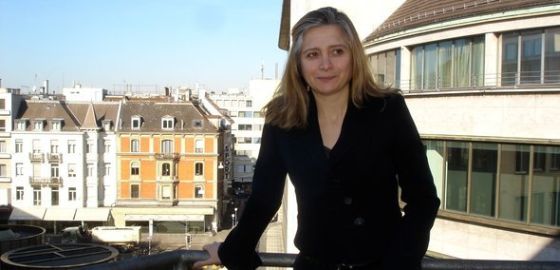
Samar Yazbek in Zurich

Aida Edemariam interviews that Syrian writer, Samar Yazbek, who comes from an Alawite family that used to be among the grandest and wealthiest on the Syrian coast.

At first, before Yazbek’s novels were published, and before she became well known as a TV presenter, documentary-maker and journalist, she lived in one room just outside the city [Damascus], working in admin for 12 hours a day, keeping herself and her daughter just above the poverty line, refusing family connections because she didn’t want to owe them anything.

It was then that she began to carry a flick-knife to defend herself, which came in handy last year, when security forces came to her home, blindfolded her and took her to a commanding officer in a place she did not recognise. He grabbed her wrists so tightly they burned, she writes, and hit her so hard she fell to the ground and stayed there. The third time he hit her, she took out the knife and he backed away, but it did not stop him from demanding she recant and fall into line with her kind. Two men took her on a tour of the cells, as a warning: she saw three young men, “their hands hanging from metal clamps, and the tips of their toes barely touching the ground”. They pushed her forward, and one raised his head. “There was a blank space where his nose should be, no lips.” More cells, a young man with his back split open, bodies stacked behind bodies, terrible sounds, terrible sights, terrible smells.

“It’s a revolution of the poor against the rich, but as they began killing people and got increasingly cruel, more people are joining the rebellion,” she says. It doesn’t matter that she is from a privileged background, and has little in common with many of those fighting. “It’s a problem of conscience. It’s not a problem of Sunni, Shiite or anything else.”

She reiterates this later. “It’s not a sectarian war. It’s a revolution. The regime makes it a sectarian crime between the people. It’s not true.

“There is a big risk, now, for the revolution – they are confronting much more repression. It’s dividing the societies in Syria and the opposition is becoming much more cruel.”

Is she losing hope of establishing the structures of civil society? “I don’t think all hope is gone. I think there are many in Syrian society who are working to keep the civil institutions. We are at a very risky point … I’m afraid that if the world doesn’t help the Syrian people now, and help to make the regime fall, Syria will be in great danger. If we get rid of Assad today, not tomorrow, it would help us to build the country normally.

“That is my hope and also my fear, because Assad takes strength from Iran, from Russia and from the non-reaction of Europeans and Americans. There is a complicity with Assad in the west, even if it’s not official, or said, or clear. But they are helping him to stay. And that is very dangerous for the Syrian people.” [Continue reading…]

Facebooktwittermail