Category Archives: Syria

Aleppo: Treating trauma on the frontline

Ian Pannell reports: An artillery shell had just landed and the hospital entrance was a grotesque tableau of blood, bodies and tears.

A small team of doctors set to work against a soundtrack of bombs and bullets.

The hospital lies in one of the southern districts of Aleppo city close to one of the city’s many front lines.

The staff asked us not to identify its name or location in case government troops attack it.

It is a well-placed fear – the building has already been hit 12 times.

The doctors say it is seen as a “legitimate target” by the army because they treat rebel fighters as well as civilians. [Continue reading and watch the video which accompanies this report …]

Facebooktwittermail

Tentative jihad: Syria’s fundamentalist opposition

International Crisis Group: Prematurely and exaggeratedly highlighted by the regime, belatedly and reluctantly acknowledged by the opposition, the presence of a powerful Salafi strand among Syria’s rebels has become irrefutable. That is worrisome, but forms only part of a complex picture. To begin, not all Salafis are alike; the concept covers a gamut ranging from mainstream to extreme. Secondly, present-day Syria offers Salafis hospitable terrain – violence and sectarianism; disenchantment with the West, secular leaders and pragmatic Islamic figures; as well as access to Gulf Arab funding and jihadi military knowhow – but also adverse conditions, including a moderate Islamic tradition, pluralistic confessional make-up, and widespread fear of the kind of sectarian civil war that engulfed two neighbours. Thirdly, failure of the armed push this past summer caused a backlash against Salafi groups that grabbed headlines during the fighting.

This is not to dismiss the Salafis’ weight. The opposition has a responsibility: to curb their influence, stem the slide toward ever-more radical and confessional discourse and halt brutal tactics. So too do members of the international community, quick to fault the opposition for fragmentation and radical drift that their own divisions, dysfunctionality and powerlessness have done much to foster. For as long as different countries sponsor distinct armed groups, a bidding war will ensue, and any hope of coordinating the rebels, disciplining them and restraining their most extremist members will be in vain. The issue, in other words, is not so much whether to arm them – and, if so, with what – but rather to rationalise and coordinate the support provided to the opposition in order to make more likely the emergence of a more coherent, structured, representative and thus effective interlocutor in what, sooner or later, must be a negotiated outcome. Even those who side with the regime would stand to benefit from that development, if they wish to see today’s devastating military stalemate evolve toward a political solution.

From day one, the question of Salafism within opposition ranks has been more of a political football than a subject of serious conversation. Assad backers played it up, convinced they could frighten both the country’s own non-Islamists and minorities as well as the West, still traumatised by its misadventure in Iraq. Regime detractors played it down, intent on preserving the image of a pristine uprising; people sympathetic to their cause, whether in the media or elsewhere, likewise were reluctant to delve too deeply into the issue, anxious about playing into regime hands. The net result has been more fog than light.

That is unfortunate, and not because Salafism necessarily is a central, dominant or even lasting feature of the Syrian landscape. But because it undoubtedly is present, almost certainly has been growing, clearly is divisive and strongly affects dynamics on the ground: it has an impact on who is willing to fund opposition groups, on popular attitudes, on the narrative the regime is able to expound and on relations among armed factions. This report, based both on field work in Syria and systematic analysis of the armed groups’ own communications, seeks to clarify the origins, growth and impact of the opposition’s fundamentalist threads.

Far from being rigid or monolithic, Syrian Salafism is eclectic and fluid. While all Salafists in theory apply literalist interpretations of scripture based on the example set by the Prophet and his companions, some have only a superficial understanding, lacking any genuine ideological vision; others seek to replace the secular regime with an Islamist form of governance; while a third tendency embraces the concept of global jihad advocated by al-Qaeda. The degree of intolerance toward members of other faiths likewise varies widely. The Iraqi precedent underscores how much these distinctions matter and how, for example, local objectives of mainstream insurgent groups, including those with Salafi tendencies, can be threatened by global ambitions of Salafi-jihadis.

Nor is it always straightforward to distinguish Salafis from non-Salafis: in some cases, adoption of Salafi nomenclature, rhetoric and symbols reflects a sincere commitment to religious ideals; in others, it expresses an essentially pragmatic attempt to curry favour with wealthy, conservative Gulf-based donors. Most armed groups have yet to develop a firm ideology or leadership structure; membership fluctuates, with fighters shifting from one faction to another based on availability of funds, access to weapons, personal relationships – in other words, based on factors having little if anything to do with belief.

Of course, there is no denying the striking inroads made by Salafism – at first, a marginal tendency at best – since the onset of the protest movement. There also is little dispute about reasons behind this growth. Conditions were favourable: the uprising was rooted in a social category readymade for Salafi preachers, the poor rural underclass that, over years, migrated to rough, impersonal urban settings far removed from its traditional support networks. And conditions ripened: as violence escalated, hopes for a quick resolution receded, and alternative tendencies (proponents of dialogue; peaceful demonstrators; the exiled leadership; more moderate Islamists) proved their limitations, many naturally flocked to Salafist alternatives. The West’s initial reluctance to act – and enduring reluctance to act decisively – coupled with early willingness of private, wealthy, and for the most part religiously conservative Gulf Arabs to provide funds, bolstered both the Salafis’ coffers and their narrative, in which Europe and the U.S. figure as passive accomplices in the regime’s crimes.

More broadly, Salafism offered answers that others could not. These include a straightforward, accessible form of legitimacy and sense of purpose at a time of substantial suffering and confusion; a simple, expedient way to define the enemy as a non-Muslim, apostate regime; as well as access to funding and weapons. Too, Salafists benefited from the experience its militants had accumulated on other battlegrounds; they volunteered to fight, thereby sharing their knowledge with inexperienced domestic armed groups. At a time when such groups struggled to survive against a powerful, ruthless foe and believe themselves both isolated and abandoned, such assets made an immediate, tangible difference. Little wonder that, by January 2012, Salafism slowly was becoming more conspicuous on the opposition scene.

The regime cannot escape its share of blame. For years, Salafis were among those who claimed that mainstream Sunnis faced a serious threat from Iran and its Shiite allies, a category in which they included Alawites. Through increasing reliance on the most loyal, Alawite-dominated elements of its security forces to suppress a predominantly Sunni uprising, and because it received support mainly from its two Shiite partners (Iran and Hizbollah), the regime ultimately corroborated this sectarian storyline: many opponents equated the struggle against Assad with a jihad against the occupier.

Yet, it would be wrong to conclude that, for Salafis, the coast is clear. Syria boasts a history of moderate Islamic practice and has long prided itself on peaceful, cross-con­fes­sional coexistence. Its citizens have seen, first-hand, the calamitous repercussions of sectarian strife as civil war destroyed two of its neighbours, first Lebanon, later Iraq. Key figures of the uprising as well as its popular base often espouse antithetical ideology and goals. Large-scale attacks against regime forces in July and August 2012, during which Salafi groups assumed a highly visible role, ended in failure, deflating some of the pre-existing faith. And the opposition is well aware of pitfalls: the rise of Salafism essentially validates the regime’s thesis and thus helps justify its repression; worries actual and potential foreign backers; and, while rallying some Syrians, jihadi volunteers and outside Islamist sponsors to the cause, simultaneously undercuts the opposition’s broader appeal and enhances the regime’s ability to mobilise its own social base and allies.

All this places Salafis in the uncomfortable position of bolstering, by their behaviour and rhetoric, a central argument of the regime they seek to oust. And it explains why the mainstream opposition has launched several campaigns – unsuccessful to date – to unify rebel ranks, strengthen their overall effectiveness and contain or at least channel more radical outlooks.

Many myths surround Syria’s Salafis. They are not an expression of society’s authentic, truer identity; they are not merely a by-product of regime machinations; and they are not simply the result of growing Gulf Arab influence. Rather, they should be understood as one of the conflict’s numerous outgrowths and, not least, part of the profound identity crisis it has produced. In many ways, it is the mirror image of the simultaneous cult of violence and ruling-family worship that, to a striking degree, has emerged among Alawites. In both cases, the rise of more extremist, militant, quasi-millenarist worldviews is not deniable, but nor is it necessarily irreversible. Salafism, both cause and symptom of the opposition’s current shortcomings, is – like so much else in Syria – the expression of a bloody political and military stalemate that, for now, appears to have no way back, and no way out.

Read the full ICG report, Tentative Jihad: Syria’s Fundamentalist Opposition.

Facebooktwittermail

The Fall of the House of Assad

Robin Yassin-Kassab reviews Syria: The Fall of the House of Assad by David W Lesch: Until his elder brother Basil died in a car crash, Bashaar al-Assad, Syria’s tyrant, was planning a quiet life as an opthalmologist in England. Recalled to Damascus, he was rapidly promoted through the military ranks, and after his father’s death was was confirmed in the presidency in a referendum in which he supposedly achieved 97.29% of the vote. Official discourse titled him ‘the Hope.’

Propaganda aside, the mild-mannered young heir enjoyed genuine popularity and therefore a long grace period, now entirely squandered. He seemed to promise a continuation of his father’s “Faustian bargain of less freedom for more stability” – not a bad bargain for a country wracked by endless coups before the Assadist state, and surrounded by states at war – while at the same time gradually reforming. Selective liberalisation allowed for a stock market and private banks but protected the public sector patronage system which ensured regime survival. There was even a measure of glasnost, a Damascus Spring permitting private newspapers and political discussion groups. It lasted eight months, and then the regime critics who had been encouraged to speak were exiled or imprisoned. Most people, Lesch included, blamed the Old Guard rather than Bashaar.

“I got to know Assad probably better than anyone in the West,” Lesch writes, and this is probably true. Between 2004 and 2008 he met the dictator frequently. His 2005 book “The New Lion of Damascus” seems in retrospect naively sympathetic. He can be forgiven for this. Most analysts (me included), and most Syrians, continued to give Bashaar the benefit of the doubt until March 2011.

The most visible result of the early reforms was the rise of a new crony capitalist class. There was economic growth, but not enough to keep pace with population growth, or to withstand the shocks of recurrent drought and the 2008 financial crisis. The regime’s socialist pretensions collapsed, and by 2011 Syria’s working classes were as discontented as Egypt’s or Tunisia’s. Still, almost every observer predicted that Syria would weather the revolutionary storm. The Assadist state was expected to survive because of its (false) image as a ‘resistance regime’ amid a sea of cowering Arab puppets, because of the crushed and divided opposition, the unity of the government with military and security agencies, the threat of sectarian splintering, and a deeply-rooted popular fear of repression.

There was a great deal of truth to this perception. Calls for protests in January and February failed to mobilise the people. It was regime stupidity and barbarism, its failure to recognise the historical moment, which finally brought crowds to the streets. (“Bashaar is the real leader of the revolution,” a Syrian recently told me.) In March children scrawled subversive graffiti on the walls of the drought-struck city of Deraa, and were arrested and tortured. A few hundred relatives demonstrated for their release. Soldiers opened fire, killing four. The next day 20,000 protested. Soldiers killed still more and water and electricity were switched off. Protests then spread around the country.

Lesch blames the miscalculation on inertia and instinctive violence as well as Bashaar’s increasing hubris since 2005, by which time he’d survived Syria’s forced withdrawal from Lebanon and the threat of Bush-doctrine regime change. A man who was “unpretentious, even self-deprecating” betrayed by 2007 “self-satisfaction, even smugness.”

At first the protests were uncoordinated, and local grievances were as important as national. Nobody called for the downfall of the regime, only for reform. Yet, crucially, the fear barrier was falling. Lesch quotes an activist on the catharsis felt by many: “It was better than joy, it was better than love. What was amazing was that suddenly everyone felt like family.” [Continue reading…]

Facebooktwittermail

Video: Plane incident marks new low in Syria-Turkey relations

The Washington Post reports: Russia demanded an explanation from Turkey on Thursday for why it intercepted a Syrian passenger plane flying from Moscow to Damascus, the latest instance of spiraling Syrian-Turkish tensions related to Syria’s bloody civil war.

Turkey said it used F-16 fighter jets to force the Syrian Airbus to land at Esenboga Airport in Ankara in order to seize equipment that it believes was destined for use by the Syrian military against the armed, anti-government rebels.

Syrian Transport Minister Mahmoud Said said the move amounted to “air piracy,” Reuters quoted the state-controlled television news as saying. The comments exacerbated the already tense back-and-forth between Turkey and Syria following a Syrian mortar strike that killed five civilians in a Turkish border village last week.

The Airbus 320, with 30 passengers on board, was intercepted as it entered Turkish airspace shortly after 5 p.m. local time on Wednesday (10 a.m. in Washington). Hours earlier, Turkey had ordered all Turkish civilian aircraft to cease flights through Syrian airspace, apparently to prevent Syria from taking reciprocal action.

Turkish Foreign Minister Ahmet Davutoglu told Turkish television network TGRT that the plane had been forced down because it was carrying “non-civilian cargo” and “banned material.”

“There is information that the plane had cargo on board that does not meet the requirements of civil aviation,” Davutoglu said. The Today’s Zaman newspaper later reported that Turkish authorities found military communication equipment and “parts that could be used in missiles” on the plane.

Facebooktwittermail

Is the glass half full for Syria’s Assad?

Tony Karon writes: Winter is coming, and with it the near certainty that the lot of millions of suffering Syrians will get substantially worse. Some 335,000 and counting find themselves in refugee camps in neighboring Turkey and Jordan, the lucky among them in pre-fabricated structures provided in some of the Turkish camps, the vast majority huddled in tents. But for millions more back home, the brutal ravages of an 18-month civil war that has claimed as many as 30,000 lives must now be endured under the growing privations of a siege economy imposed by war and sanctions, the winter chill and shortages of everything from fuel to medicines and foodstuffs raising the specter of disease and hunger along with the threat of instant death from rockets and bombs.

But one group of Syrians may be greeting the oncoming winter with a grim sense of satisfaction: As bad as things may be, President Bashar al-Assad and his entourage — and those who are willing to fight and die to keep in power — know that for them, things could be a whole lot worse. Sure, the regime has lost control of vast swathes of territory that appear to be intractably under the control of insurgents. But if the rebels are able to control much of the countryside, they remain hopelessly outgunned in the head-to-head fight for the major cities, with no sign of any heavy weapons deliveries from their allies abroad, much less a NATO cavalry riding to the rescue as it had done in Libya. The rebels continue to be plagued by divisions, and Western powers are increasingly anxious over the influence of salafist extremists within the armed insurgency.

The expected collapse of Assad’s armed forces has failed to materialize, and defections to the rebel side have slowed to a trickle. Instead of signaling an imminent denouement, the incremental gains and losses of each side along the shifting front-lines suggests a strategic stalemate, in which neither side is capable of delivering the other a knockout blow. Against that backdrop, the latest developments on Syria’s borders with Turkey and Jordan in recent days and weeks appear to be symptoms of that stalemate, rather than signs of imminent outside intervention. ”If this continues we will respond with greater force,” said Turkey’s military chief, General Necdet Özel, Wednesday, during a visit to the Turkish border town of Akçakale, which had suffered six days of artillery fire from Syria. Turkey had responded in kind to the shelling that began last week, and on Wednesday it intercepted and inspected (and later released, after confiscating communication equipment) a Syria-bound civilian airliner on suspicion of carrying weapons from Moscow. [Continue reading…]

Facebooktwittermail

As Assad hangs on, Turkey confronts failure on Syria

Andrew Parasiliti writes: Turkish President Abdullah Gul said this week that Syria is becoming the “worst-case scenario that we’ve all been dreading.”

The shelling across the Turkish-Syrian border, now entering its seventh day, gives further testimony, as if any were needed, that Turkey’s Syria policies have failed and that the civil war in Syria is also a regional, sectarian war, with no end in sight.

Turkish intervention in Syria is unpopular and Ankara may be desperate to end it. A clear majority of Turkish citizens oppose intervention in Syria, according to a recent poll. Just two years ago, Turkey prospered under a “good neighbor” policy with Syria, Iran and Iraq. Now Turkey has problems along all three borders.

Any clear-eyed assessment of the battlefield does not foresee President Bashar al-Assad stepping down or being forced to step down anytime soon. Assad is committed to staying in place until constitutionally mandated elections in 2014, and he has not yet decided whether he will run in those elections. Russia and Iran have no interest in letting his regime fall. [Continue reading…]

Facebooktwittermail

Defecting Syrian propagandist says his job was ‘to fabricate’

CNN reports: For years, Abdullah al-Omar rubbed shoulders with some of the most powerful people in Syria.

In case there is any doubt, he is quick to show photos in his phone as proof.

Scores of photographs show the corpulent Syrian beaming and shaking hands with government ministers, foreign dignitaries, and even the Syrian president.

“He knew me by name,” al-Omar said, pointing to a photo of himself standing with Bashar al-Assad. “One day we were sitting at a table and he fed me with his own hand and said to me, ‘You love food since you are from Aleppo.’ Then he said to his escort, ‘Take special care of Abdullah al-Omar because he loves food and his stomach.'”

Al-Omar claims that for five years he worked in the press office of the presidential palace in Damascus, as part of a 15-person team under the direction of long-time government spokeswoman and presidential adviser Bouthaina Shabaan.

Al-Omar claims that for five years he worked in the press office of the presidential palace in Damascus, as part of a 15-person team under the direction of long-time government spokeswoman and presidential adviser Bouthaina Shabaan.

Until he defected and fled the Syrian capital last month, al-Omar said, the bulk of his work consisted of lying.

“Our job was to fabricate, make deceptions and cover up for Bashar al-Assad’s crimes,” he said.

Facebooktwittermail

U.S. military is sent to Jordan to help with crisis in Syria

The New York Times reports: The United States military has secretly sent a task force of more than 150 planners and other specialists to Jordan to help the armed forces there handle a flood of Syrian refugees, prepare for the possibility that Syria will lose control of its chemical weapons and be positioned should the turmoil in Syria expand into a wider conflict.

The task force, which has been led by a senior American officer, is based at a Jordanian military training center built into an old rock quarry north of Amman. It is now largely focused on helping Jordanians handle the estimated 180,000 Syrian refugees who have crossed the border and are severely straining the country’s resources.

American officials familiar with the operation said the mission also includes drawing up plans to try to insulate Jordan, an important American ally in the region, from the upheaval in Syria and to avoid the kind of clashes now occurring along the border of Syria and Turkey.

The officials said the idea of establishing a buffer zone between Syria and Jordan — which would be enforced by Jordanian forces on the Syrian side of the border and supported politically and perhaps logistically by the United States — had been discussed. But at this point the buffer is only a contingency.

The Obama administration has declined to intervene in the Syrian conflict beyond providing communications equipment and other nonlethal assistance to the rebels opposing the government of President Bashar al-Assad. But the outpost near Amman could play a broader role should American policy change. It is less than 35 miles from the Syrian border and is the closest American military presence to the conflict. [Continue reading…]

Facebooktwittermail

Syria clashes intensify near Turkey border

Reuters reports: NATO said on Tuesday it had drawn up plans to defend Turkey if necessary against any further spillover of violence from Syria’s border areas where rebels and government forces are fighting for control.

Rebel suicide bombers struck at President Bashar al-Assad’s heartland, attacking an Air Force Intelligence compound on the edge of Damascus, insurgents said. Activists living nearby said the bombing caused at least 100 casualties among security personnel, based on the ambulances that rushed to the scene.

“Assad…is only able to stand up with crutches,” Turkish Prime Minister Tayyip Erdoğan, once a close ally of Assad, told a meeting of his ruling AK Party.

“He will be finished when the crutches fall away.”

Erdoğan, reacting to six consecutive days where shells fired from Syrian soil have landed on Turkish territory, has warned Ankara will not shrink from war if forced to act. But Ankara has also made clear it would be reluctant to mount any major operation on Syrian soil, and then only with international support.

Syrian forces and rebels have clashed at several sites close to the Turkish border in the last week. There has been no sign of any major breakthrough by either side, though activists said rebels killed at least 40 soldiers on Saturday in a 12-hour battle to take the village of Khirbet al-Joz.

It was not clear whether the shells landing on the Turkish side were aimed at Turkey or simply the result of government troops overshooting as they attacked rebels to their north. [Continue reading…]

Facebooktwittermail

Wider war feared between Turkey and Syria

The Associated Press reports: Turkey and Syria fired artillery and mortars across their volatile border for a fifth consecutive day on Sunday, in one of the most serious and prolonged flare-ups of violence along the frontier.

The exchange of fire stoked fears that Syria’s civil war will escalate into a regional conflagration drawing in NATO member Turkey, once an ally of President Bashar Assad but now a key supporter of the rebels fighting to topple him.

Turkish Foreign Minister Ahmet Davutoglu had warned on Saturday that Ankara would respond forcefully to each errant Syrian shell that lands on Turkish soil.

Ankara’s warning was coupled by an apparent diplomatic push by the Turkish leadership to promote Syrian Vice President Farouk al-Sharaa as a possible figure to head a transitional administration to end the conflict in the country.

In an interview with Turkish state television TRT Saturday, Davutoglu said that al-Sharaa was a figure “whose hands are not contaminated in blood” and therefore acceptable to Syrian opposition groups.

It was not clear whether the Turkish stance was coordinated with other allies, but the candid remarks by Davutoglu suggested some consensus might be emerging over a future role for him.

Al-Sharaa, 73, a close associate and longtime loyalist to the Assad family, has been a controversial figure since the start of the uprising.

He appeared in public in late August for the first time in weeks, ending repeated rumors that he had defected. The regime has suffered a string of prominent defections in recent months, though Assad’s inner circle and military have largely kept their cohesive stance behind him.

Early on in the uprising, the Syrian president delegated to al-Sharaa, a skilled diplomat, responsibility for holding a dialogue with the opposition. A Sunni from the southern town of Daraa, birthplace of the Syrian uprising, al-Sharaa’s silence since the start of the uprising made him a prime candidate for rumors that he broke with the regime.

“No one knows the system better than Farouk al-Sharaa,” said Davutoglu, adding that al-Sharaa has not been involved in the violence and massacres in Syria.

The Syrian opposition is deeply fragmented, and various factions would likely disagree on whether they would accept him to lead a transitional government. [Continue reading…]

Meanwhile, Reuters reports: Turkey’s military launched a retaliatory strike after Syria fired a mortar shell into countryside in Turkey’s southern province of Hatay on Monday, a Turkish state official told Reuters.

It was the sixth consecutive day of Turkish retaliation against bombardment from the Syrian side of the border, where President Bashar al-Assad’s forces are battling rebels.

The exchanges are the most serious cross-border violence in Syria’s revolt against Assad, which began in March last year with protests for reform and has evolved into a civil war with sectarian overtones which threatens to draw in regional powers.

The Associated Press reports: The leader of Syria’s main opposition group says members of President Bashar Assad’s ruling Baath party can play a role in Syria’s political future as long as they did not participate in killings during the country’s uprising and civil war.

Abdulbaset Sieda’s comments Monday appear to be a softening of the opposition’s stance that it will accept nothing less than the complete removal of the Assad regime and its inner circle.

Sieda is the head of the opposition Syrian National Council, based in Turkey.

Facebooktwittermail

Syria’s suffering opens a door for Washington

Patrick Cockburn writes: Turkish artillery is firing across the border into Syria. Explosions have torn apart buildings in Aleppo, Syria’s largest city, making their floors collapse on top of each other so they look like giant concrete sandwiches. The country resembles Lebanon during its civil war, the victim of unbearable and ever-escalating violence but with no clear victor likely to emerge.

In Iran, Syria’s most important ally in the region, sanctions on oil exports and central bank transactions are paralysing the economy. The bazaar in Tehran closed after violent protests at a 40 per cent fall in the value of the currency, the rial, over the past week. Demonstrators gathered outside the central bank after finding they could no longer get dollars from their accounts. Popular anger is at its highest level since the alleged fixing of Iran’s presidential election of 2009.

Will these events lead to a change in the balance of power at the heart of the region? Iran and Syria were the leaders for the past 10 years of the so-called “resistance bloc”, the grouping that supported the Palestinians and opposed the US-led combination that brought together Arab dictatorships and Israel in a tacit alliance. This anti-American bulwark was at the height of its influence between 2006 and 2010 after the failed US invasion of Iraq and Israel’s bombardment of Lebanon and Gaza.

At first, the Arab Spring seemed to favour the “resistance bloc”. Without Syria and Iran having to lift a finger, President Hosni Mubarak and President Zine el-Abidine Ben Ali were driven from power in Egypt and Tunisia. And Bashar al-Assad seemed confident, in the first months of 2011, that his opposition to the US, Arab autocracies and Israel would protect him against the revolutionary wave.

Eighteen months later, it is the “resistance bloc” that is fighting for its life. Turkey is becoming ever more menacing to Syria and impatient of American restraint. After the US presidential election, Washington could well decide that it is in its interests to go along with Turkish urgings and give more military support to the Syrian opposition. The US might calculate that a prolonged and indecisive civil war in Syria, during which central government authority collapses, gives too many chances to al-Qa’ida or even Iran. It has had a recent example of how a political vacuum can produce nasty surprises when the US ambassador to Libya, Christopher Stevens, was killed in Benghazi last month. [Continue reading…]

Facebooktwittermail

Rebels say West’s inaction is pushing Syrians to extremism

C.J. Chivers reports: Majed al-Muhammad, the commander of a Syrian antigovernment fighting group, slammed his hand on his desk. “Doesn’t America have satellites?” he asked, almost shouting. “Can’t it see what is happening?”

A retired Syrian Army medic, Mr. Muhammad had reached the rank of sergeant major in the military he now fights against. He said he had never been a member of a party, and loathed jihadists and terrorists.

But he offered a warning to the West now commonly heard among fighters seeking the overthrow of President Bashar al-Assad: The Syrian people are being radicalized by a combination of a grinding conflict and their belief that they have been abandoned by a watching world.

If the West continues to turn its back on Syria’s suffering, he said, Syrians will turn their backs in return, and this may imperil Western interests and security at one of the crossroads of the Middle East.

This is a theme that has resonated in recent days, not just in Syria, but in Turkey, where the government fired artillery shells into northern Syria this week after a Syrian mortar round hit a Turkish town and killed five civilians. In Turkey, there is a growing sense of frustration shared by the Syrian rebels that the West, the United States in particular, called for Mr. Assad to leave power, only to sit quietly on the sidelines as the crisis transformed into a bloody civil war.

“We are now at a very critical juncture,” wrote Melih Asik in the Turkish newspaper Milliyet. “We are not only facing Syria, but Iran, Iraq, Russia and China behind it as well. Behind us, we have nothing but the provocative stance and empty promises of the U.S.” [Continue reading…]

Facebooktwittermail

Video: Is a Turkey-Syria conflict inevitable?

Today’s Zaman reports: Another mortar shell from Syria struck Turkish territory on Sunday, prompting a fifth straight day of retaliatory artillery fire by the Turkish military.

An Associated Press video journalist said Turkish artillery fired toward Syria minutes after a Syrian shell landed on Turkish territory.

The Syrian shell landed some 200 meters (200 yards) inside Turkey, near the border town of Akçakale. A short time later, at least six mortars could be heard fired from Turkey. It was the fifth day in a row that Turkey returned fire.

Facebooktwittermail

Syrian activists reach across sectarian divide

BBC News reports: While the Syrian conflict has been characterised by fighting between the Sunni majority and ruling Alawite minority, it has also given birth to some movements which aim to bridge the sectarian divide, as Samer Mohajer and Ellie Violet Bramley report from Beirut.

Nabeel, a 24-year-old Alawite doctor from Homs, describes how he and other Syrian activists first decided to start campaigning against the regime of Bashar al-Assad in the summer of 2011.

“A bunch of us were having coffee in Homs,” he said. “We wanted to have some influence on our revolution, so we tried to do something to express ourselves, to express our opinions.”

The result was the creation of the Nabd (or Pulse) Gathering for Syrian Civil Youth – one of the many cross-sectarian movements that have emerged from Syria’s 18-month-long revolt.

They are designed to campaign against the regime, but also to promote unity among Syria’s religious sects in the face of the increasing role of foreign and jihadi fighters and the characterisation of the struggle along sectarian lines.

“We started our work in Homs, addressing the dangerous subject of sectarianism,” explained Nabeel. “We organised some protests involving guys and girls from all sects, distributed flyers and put posters up. We campaigned against violence and distributed flowers.”

Next came a sit-in, in the Khaldiyeh neighbourhood of Homs attacked by security forces, and a week of national unity.

Quickly, “things escalated until we had cells in every city – Damascus, Salamiyah [an Ismaili Muslim town], and Latakia [an Alawite centre],” said Nabeel. [Continue reading…]

Facebooktwittermail

Citing U.S. fears, Arab allies limit Syrian rebel aid

The New York Times reports: For months, Saudi Arabia and Qatar have been funneling money and small arms to Syria’s rebels but have refused to provide heavier weapons, like shoulder-fired missiles, that could allow opposition fighters to bring down government aircraft, take out armored vehicles and turn the war’s tide.

While they have publicly called for arming the rebels, they have held back, officials in both countries said, in part because they have been discouraged by the United States, which fears the heavier weapons could end up in the hands of terrorists.

As a result, the rebels have just enough weapons to maintain a stalemate, the war grinds on and more jihadist militants join the fray every month.

“You can give the rebels AKs, but you can’t stop the Syrian regime’s military with AKs,” said Khalid al-Attiyah, a state minister for foreign affairs in Qatar. Providing the rebels with heavier weapons “has to happen,” he added. “But first we need the backing of the United States, and preferably the U.N.”

Saudi officials here said the United States was not barring them from providing shoulder-fired missiles, but warning about the risks. The Saudis and Qataris said they hoped to convince their allies that those risks could be overcome. “We are looking at ways to put in place practices to prevent this type of weapon from falling into the wrong hands,” one Arab official said, speaking on the condition of anonymity in line with diplomatic protocol.

American support for such weapons transfers is unlikely to materialize any time soon. The Obama administration has made clear that it has no desire to deepen its efforts, mostly providing logistical support for the rebels. [Continue reading…]

Facebooktwittermail

Syrian government forces bombard Homs

The New York Times reports: Syrian government warplanes and artillery were reported on Friday to have launched a ferocious barrage against the central city of Homs while, near the capital, Damascus, rebels said they captured an air defense base with a cache of surface-to-air missiles.

The fighting came a day after the bloody, 18-month conflict raised broad fears of regional repercussions when Turkish artillery hit Syria for a second consecutive day on Thursday following a mortar attack on Wednesday that killed five Turkish civilians. Turkey’s Parliament reinforced Ankara’s resolute message by authorizing further military action against Syria.

The confrontation between the two countries along the divide between the NATO alliance and the Arab world threatened to escalate a confrontation that has highlighted Turkey’s fraught double role as it tries to stay out of direct involvement in the fight against President Bashar al-Assad of Syria while offering haven and support to the rebels.

Inside war-battered Syria, Friday’s bombardment of Homs by airstrikes, tank and mortar fire subjected rebel strongholds to their heaviest bombardment in months, according to The Associated Press quoting activists. Some analysts suggested that the focus on big cities like Homs and Aleppo further north showed that the government was maintaining its focus on urban warfare rather than regional maneuvering.

Facebooktwittermail

‘Turkey does not want war with Syria’ — aide to Erdogan

The New York Times reports: Turkey’s Parliament approved a motion Thursday that authorizes further military action against Syria, as Turkey began its second day of shelling targets within Syria in response to a mortar attack that killed five civilians.

The measure, which was ratified after several hours of a closed-door session in the capital, Ankara, permits cross-border raids, although senior officials insisted that NATO ally Turkey did not want a war with its Arab neighbor — an escalation that could turn Syria’s bloody civil strife into a regional conflict with international involvement.

The motion read, in part, “The ongoing crisis in Syria affects the stability and security in the region and now the escalating animosity affects our national security,” according to the semiofficial Anatolian News Agency.

The Turkish military pounded targets inside Syria on Thursday in retaliation for the mortar attack a day earlier that killed five civilians in Turkey.

Local news reports said Turkish shells fell inside Syria on at least 10 occasions after midnight, landing near the border town of Tel Abyad, some six miles inside Syrian territory, across a historic fault line where modern Turkey abuts Arab lands that once formed part of the Ottoman Empire.

State television said the shelling continued until dawn with four more barrages until the guns fell silent around 6:45 a.m. Activist groups in Syria said the shelling killed several Syrian government soldiers.

The exchanges sent tremors across a region fearful that the mounting violence in Syria would spill into neighboring countries. Ibrahim Kalin, a senior aide to Prime Minister Recep Tayyip Erdogan of Turkey, wrote on Twitter feed: “Turkey does not want war with Syria. But Turkey is capable of protecting its borders and will retaliate when necessary.” In a separate message, he said: “Political, diplomatic initiatives will continue.” [Continue reading…]

AFP reports: Turkish troops pounded targets in Syria on Thursday morning in reprisal for cross-border fire that killed five Turkish civilians the previous day, a security source said.

“Artillery fire resumed at 0300 GMT this morning,” the source told AFP on condition of anonymity.

Several Syrian soldiers have been killed as a result of overnight Turkish shelling across the border, the Syrian Observatory for Human Rights watchdog said earlier, without giving an exact figure.

AFP also reports: Syria has admitted it was responsible for a shelling that killed five civilians on Turkish soil and apologised, Turkey’s deputy prime minister said today.

“The Syrian side has admitted what it did and apologised,” Besir Atalay told reporters.

Michael Koplow sees little evidence that either Turkey, NATO, or Syria have an interest in seeing further escalation.

First, as I have noted too many times to count and as Aaron Stein firmly argued yesterday, there is simply no appetite on NATO’s part to get involved in Syria. Turkey was able to convene an Article 4 meeting in which NATO strongly condemned the Syrian shelling that killed five Turkish civilians, but that is about as far as NATO is willing to go. NATO is not going to get involved in setting up a buffer zone, a no-fly zone, or a humanitarian corridor inside Syria, and the U.S. is also not going to commit to doing any of those things any time soon. It has been clear for a year now that Turkey is not going to invade Syria on its own, which is why Ankara has desperately been trying to convince outside actors to intervene, and absent an international intervention, I don’t see yesterday’s incident changing this calculus. Without international support – and I’d note that Prime Minister Erdoğan has explicitly ruled out anything outside of official UN auspices – Turkey is going to stay out of Syria. With reports of Hizballah fighters and IRGC soldiers crawling inside Syrian borders, the Turkish government does not want to get entangled in a scenario that might quickly blow up out of its control.

Second, there is no reason for Syria not to back away from this as quickly as possible. The only way in which Turkey will be drawn into Syria unilaterally is if the Assad regime escalates this in a serious way, and while Assad and the Syrian army are unpredictable, this is not a fight they are eager to have. Syria has spent months testing Turkey’s patience and trying to figure out what its boundaries are, and yesterday’s events will make it clear to Syria that this was one step too far. The regime has its hands full with the FSA and doesn’t need to add the Turkish military into the mix, which explains the quick decision to express sorrow over the death of Turkish civilians and a promise to investigate. There are two possibilities here; either the shelling was unintentional, in which case Syria has every reason to back down, or it was done on purpose to test how far Turkey is willing to go in retaliation, in which case mission accomplished and Syria still has every reason to now back down. While allowing for the fact that this cannot necessarily be gamed out in an entirely logical manner, I don’t see a scenario in which Syria decides to turn this into a high intensity conflict.

There is little question that Turkey had no choice but to retaliate in some form yesterday. When Syrian forces shot across the border last spring and killed two Syrian refugees in Turkish camps, Turkey threatened retaliatory action but did nothing. When the Turkish F-4 reconnaissance plane was downed this summer, Turkey moved tanks and artillery to the border but ultimately stood down. This time, however, Turkish civilians died, and no government can afford to sit idly by when its citizens are targeted and killed by a hostile foreign government.

Facebooktwittermail

Car bombs rip apart Saadallah Square in Aleppo

Syria Comment: Aleppo and Damascus are the two geese that lay Syria’s golden eggs. The revolutionaries must take them from the regime. The problem is that the regime cannot allow the opposition to have them alive. It will have to kill the golden geese rather than give them alive to the enemy. Both sides will grind Syria’s two commercial and political capitals into dust rather then permit the other side to own them and harvest their golden eggs. Aleppo and Damascus produce much of Syria’s wealth. Even more importantly they are the two centers that extract that wealth from the rest of the country. During Ottoman times, it has been estimated that taxes on peasants were 4 times higher than on city dwellers.

The country folk that have fought much of this rebellion waited for a Tahrir Square moment. They waited for the city people to rise up and come to their aid. Unfortunately, Aleppo and Damascus did not rise up or couldn’t. Over the last several months the revolutionaries have been taking the revolution to the cities. They cannot be allowed to sit out this revolt or the regime will win. Amn wa Istiqrar – security and stability – has been the montra of this regime for 40 years. The revolution cannot allow it to go on. By taking the fight to the city centers, they will deny the wealthier urbanites the security and safety they have always been willing to settle for.

There is a strong class element to this struggle. It is not only about sect and religion. For the rural Syrians that make up so much of the militias, destroying the city centers is a price that they must extract to set the city folk on fire. Of course Assad’s army cannot allow the cities to pass into the hands of the opposition. Whoever owns the cities, owns Syria.

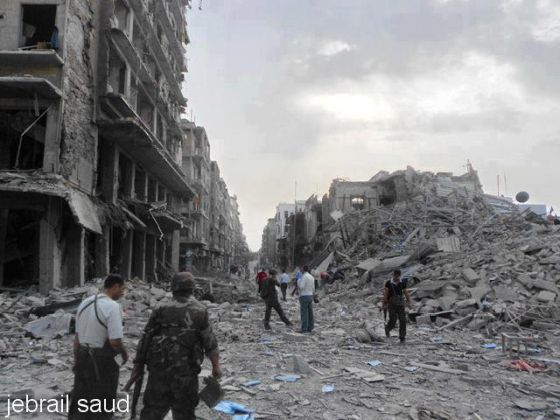
Two car bombs rocked Saadallah al-Jabri Square in Aleppo, causing much damage and death. 40 reported dead so far. VOA story. The obliterated building to the right of the picture is a well known coffee shop that occupies the corner of the street facing the Siyahi hotel, which is seen at the left of the picture. The real target, however, was undoubtedly the “officers club” or “nadi Al-zubbat” which is located directly to the right of the coffee shop. Other pictures of the scene, clearly show that the club was totally destroyed by the blast.” Another explosion took place near Aleppo’s Chamber of Commerce.

Facebooktwittermail