Category Archives: Syria

Syrian rebels fight on for Aleppo despite lack of local support

The Guardian reports: More than a month into the battle for Aleppo, the rebels who seized control of much of the city sense that its residents do not yet fully support them. Opposition fighters – around 3,000 of them – are almost the only people moving around the eastern half that the Free Syrian Army now controls. The small numbers of non-fighters who remain seem to pay them little heed. Few seem openly welcoming.

“Yes it’s true,” said Sheikh Tawfik Abu Sleiman, a rebel commander sitting on the ground floor of his fourth new headquarters – the other three were bombed. “Around 70% of Aleppo city is with the regime. It has always been that way. The countryside is with us and the city is with them. We are saying that we will only be here as long as it takes to get the job done, to get rid of the Assads. After that, we will leave and they can build the city that they want.”

As the sun set on the first day of Eid al-Fitr marking the end of Ramadan on Sunday, Sheikh Abu Sleiman visited a mosque in the north of the city and took up the microphone. “I told them that we understand their suffering,” he said. “We are sensitive to their needs and we know that this has been a major disruption. And that when we finish, Aleppo is theirs.” The sheikh’s words echoed from a minaret in a rebel-held district across residential streets long since deserted.

Facebooktwittermail

Syrian activists say pledges of U.S. communications aid are largely unfulfilled

The Washington Post reports: Even as the Obama administration hardens its rhetoric on Syria, members of the Syrian opposition say the United States has failed to deliver promised communications and other equipment intended to support those seeking to overthrow President Bashar al-Assad.

President Obama used his toughest language yet Monday to warn Syria that any movement or use of its chemical weapons would cross a “red line,” the closest he has come to threatening the use of force. Until now, the administration has ruled out a direct intervention and has made the provision of communications gear the centerpiece of U.S. involvement.

But opposition activists say they have smuggled hundreds of satellite receivers and other gear they have acquired on their own into Syria in recent months in part because they have not received significant quantities of such equipment from the United States.

The activists’ accounts contrast sharply with assertions by the administration that it has spent millions of dollars and provided about 900 satellite phones and other pieces of equipment to the Syrian opposition.

Facebooktwittermail

Climate change and the Syrian uprising

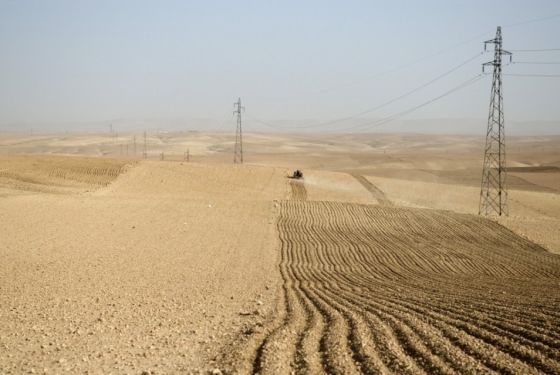
The Syrian drought has displaced more than 1.5 million people, with subsistence farmers losing up to 90% of their income.

Shahrzad Mohtadi writes: Two days short of Egyptian leader Hosni Mubarak’s resignation, Al Jazeera published an article, headlined “A Kingdom of Silence,” that contended an uprising was unlikely in Syria. The article cited the country’s “popular president, dreaded security forces, and religious diversity” as reasons that the regime of Bashar al-Assad would not be challenged, despite the chaos and leadership changes already wrought by the so-called Arab Spring. Less than one month later, security forces arrested a group of schoolchildren in the Syrian city of Dara’a, the country’s southern agricultural hub, for scrawling anti-government slogans on city walls. Subsequent protests illustrated the chasm between the regime’s public image — encapsulated in the slogan “Unity, Freedom and Socialism” — and a reality of widespread public disillusion with Assad and his economic policies.

Among the many historical, political, and economic factors contributing to the Syrian uprising, one has been devastating to Syria, yet remains largely unnoticed by the outside world. That factor is the complex and subtle, yet powerful role that climate change has played in affecting the stability and longevity of the state.

The land now encompassed by Syria is widely credited as being the place where humans first experimented with agriculture and cattle herding, some 12,000 years ago. Today, the World Bank predicts the area will experience alarming effects of climate change, with the annual precipitation level shifting toward a permanently drier condition, increasing the severity and frequency of drought.

From 1900 until 2005, there were six droughts of significance in Syria; the average monthly level of winter precipitation during these dry periods was approximately one-third of normal. All but one of these droughts lasted only one season; the exception lasted two. Farming communities were thus able to withstand dry periods by falling back on government subsidies and secondary water resources. This most recent, the seventh drought, however, lasted from 2006 to 2010, an astounding four seasons — a true anomaly in the past century. Furthermore, the average level of precipitation in these four years was the lowest of any drought-ridden period in the last century.

While impossible to deem one instance of drought as a direct result of anthropogenic climate change, a 2011 report from the National Oceanic and Atmospheric Administration regarding this recent Syrian drought states: “Climate change from greenhouse gases explained roughly half the increased dryness of 1902-2010.” Martin Hoerling, the lead researcher of the study, explains: “The magnitude and frequency of the drying that has occurred is too great to be explained by natural variability alone. This is not encouraging news for a region that already experiences water stress, because it implies natural variability alone is unlikely to return the region’s climate to normal.” The Intergovernmental Panel on Climate Change predicts that global warming will induce droughts even more severe in this region in the coming decades.

It is estimated that the Syrian drought has displaced more than 1.5 million people; entire families of agricultural workers and small-scale farmers moved from the country’s breadbasket region in the northeast to urban peripheries of the south. The drought tipped the scale of an unbalanced agricultural system that was already feeling the weight of policy mismanagement and unsustainable environmental practices. Further, lack of contingency planning contributed to the inability of the system to cope with the aftermath of the drought. Decades of poorly planned agricultural policies now haunt Syria’s al-Assad regime.

Hafez al-Assad — the father of the current president, Bashar al-Assad — ruled Syria for three decades in a fairly non-religious and paradoxical way. To some degree, he modernized the nation’s economy and opened it to the outside world; at the same time, his regime was infamous for repression and the murder of citizens. The elder al-Assad relied on support from the rural masses to maintain his authority, and during his rule, the agricultural sector became one of the most important pillars of the economy. In a 1980 address to the nation, he said: “I am first and last — and of this I hope every Syrian citizen and every Arab outside of Syria will take cognizance — a peasant and the son of a peasant. To lie amidst the spikes of grain or on the threshing floor is, in my eyes, worth all the palaces in the world.” Hafez al-Assad assured the Syrian people of their right to food security and economic stability, granting subsidies to reduce the price of food, oil, and water. The regime emphasized food self-sufficiency, first achieved with wheat in the 1980s. Cotton, a water-intensive crop requiring irrigation, was heavily promoted as a “strategic crop,” at one point becoming Syria’s second-largest export, after oil. As agricultural production swelled, little to no attention was paid to the environmental effects of such short-term, unsustainable agricultural goals.

With a steadfast emphasis on quick agricultural and industrial advancements, the Baathist regime did little to promote the sustainable use of water. As Francesco Feria and Caitlin Werrell state: “The al-Assad regime has, by most accounts except their own, criminally combined mismanagement and neglect of Syria’s natural resources, which have contributed to water shortages and land desertification.” [Continue reading…]

Facebooktwittermail

Azmi Bishara criticizes the outsiders who have failed to support the Syrian revolution

The Palestinian intellectual and former member of the Knesset, Azmi Bishara, who has been forced to live in exile since 2007, challenges those who find fault with Syria’s revolutionaries:

Those who abandoned the revolutionaries at their time of need have no right to lecture them on who their sources of support are, especially if nobody is able to persuade the regime to carry out any kind of meaningful process of reform towards democracy, or even to hand over power gradually.

There is no fault in the people seeking their own dignity and freedom; there is no sin for those youth who have taken up arms in the face of the regime’s barbarity. The only culprit here is the regime. Writing off the earliest protests as a foreign conspiracy, and dismissing Arab diplomatic moves for a gradual transfer of power — such as the now seemingly fanciful August, 2011 plan for a National Unity Government which would usher in Presidential elections in 2014, and a January, 2012 plan for power to be handed over to the Vice-President — this regime refused them all. None of these proposals ever sought to undo Syria’s army, or to undermine the army’s morale.

The duty of the revolution’s leadership and the political opposition at this point is to remain vigilant with regards to those powers which are supporting their efforts, and the political ends for which they do this. It falls on this revolutionary leadership to preserve the sovereignty and identity of Syria, preventing foreign support for their revolution from turning into a bridgehead for those foreign powers’ ulterior plans.

In spite of all of the above, I can understand the confusion and anguish felt by a wide number of Arab patriots about the events presently unfolding in Syria. It is not only the anguish shared by those who are shocked by the fate of large swathes of this part of the Arab homeland, at the way the regime has chosen to go with the Samson option, but rather a more nuanced, political anguish. Looking at those states which presently support the Syrian revolution, or at least claim to, one can see countries which have never been democratic, and have in fact stood in the way of all of the other Arab revolutions. Doubtlessly, these states are doing so for an entirely different set of reasons: Syria’s foreign policy and the country’s long-standing support for the resistance movements in Palestine and Lebanon. The use of sectarianism to fan the flames of the revolution are also here, deeply troubling: in our part of the world, sectarianism is not only disgusting, it is deadly. Yet no matter how anguished and confused an outside observer feels on these issues, anguish and confusion cannot be the policy of the Syrian people, and the Syrian revolution. The Syrian people are not an outside observer, they must choose between either moving forward, or falling back and having to deal with an emboldened, despicable new set of thugs. The Syrian people cannot afford to fret over the identity of those supporting their revolution, their only worries are about the limited number of those supporters, and the limited, cautious nature of that support.

(H/t Pulse)

Facebooktwittermail

Obama warns of military action on Syria over chemical weapons

The New York Times reports: President Obama on Monday threatened military action against Syria if there was evidence that the government of President Bashar al-Assad was moving its stocks of chemical or biological weapons. It was Mr. Obama’s most direct warning of American intervention in Syria, where Mr. Assad’s military is fighting an 18-month-old rebellion.

“We cannot have a situation in which chemical or biological weapons are falling into the hands of the wrong people,” Mr. Obama said in an impromptu appearance in the White House briefing room. “We have put together a range of contingency plans. We have communicated in no uncertain terms with every player in the region that that’s a red line for us.”

The president said he was deeply troubled by the possibility that the safekeeping of such weapons was now at risk in the Assad government’s increasingly harsh effort to crush the uprising. “That’s an issue that doesn’t just concern Syria,” Mr. Obama declared. “It concerns our close allies in the region, including Israel. It concerns us.”

Meanwhile, BBC News reports: The new UN special envoy to Syria has rejected criticism from opposition groups for refusing to say whether President Bashar al-Assad must resign.

Lakhdar Brahimi told the BBC that he was “not in a position to say yet” but was “committed to finding a solution”.

Mr Brahimi, a former Algerian foreign minister, last week succeeded Kofi Annan who resigned after both sides largely ignored his peace plan.

On Sunday, UN observers ended their mission to verify its implementation.

Their departure came after the UN Security Council agreed to allow their mandate to expire at midnight, and instead set up a new civilian office in Damascus to pursue political contacts that might lead to peace.

Facebooktwittermail

Assad’s Kurdish strategy

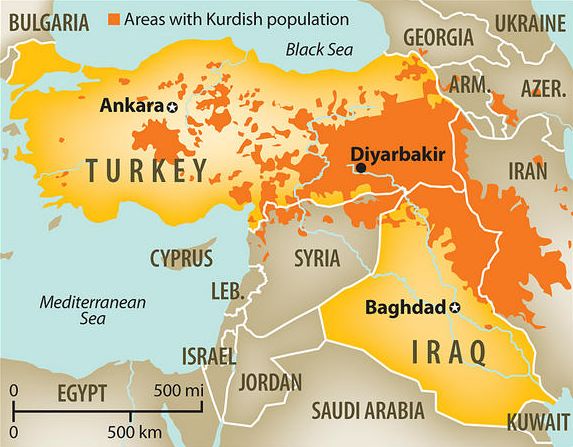
Joshua Landis writes: Assad’s Kurdish strategy appears to be to help the PKK to take control of the Kurdish regions of Syria in the North East. His aim is to hurt both the Free Syrian Army and Turkey, which are leading the opposition against him. In general, his strategy is to weaken the Sunni Arabs of Syria. On July 19, the Syrian Army withdrew from the town of Kobani followed by Efrin, Derik and Amuda as PYD forces swept in to take its place. Many claimed this peaceful transfer of power was orchestrated by the Assad regime and PYD leaders. There was no fighting and no casualties were incurred, according to the PYD , which said the party essentially issued an ultimatum that prompted Syrian government forces to withdraw from their positions.

The PKK, masquerading as the Democratic Union Party (PYD), is the wing of the Kurdish movement that is most anti-Turkish and therefor anti-Free Syrian Army. It is also vocally pan-Kurdish in contrast to many of the other Kurdish parties in Syria, which have positioned themselves, at least for the time-being, around the more limited goal of seeking Kurdish national rights enshrined in an autonomous region within Syria. The Kurdistan Workers’ Party is blamed by Turkish authorities for the death of 40,000 Turks and Kurds over the last several decades due to their separatist agenda and insurgent tactics. Because the PKK is better armed and more militant than other Kurdish groups, it has advantages because it is more prepared for war and the use of force.

The Kurdish National Council (KNC) represents most of the Kurdish parties that oppose the PYD strategy. It is looking for an accommodation with the Free Syrian Army and Syrian opposition forces as a means to gaining national rights and freedom for Kurds. The KNC is a fractious coalition, that is not well armed or organized.

The Kurdish parts of Syria will undoubtedly become the focus of the power struggle that is emerging in the region over Syria. Sunni Arabs and Turks will line up against it. Shiite forces will be inclined to encourage Kurdish independence if only to hurt the Sunni Arabs by playing minorities of every stripe against the against the FSA, Saudi Arabia, Turkey and the US.

But what should the Kurds do? All Kurds are looking to take advantage of the collapse of central authority in Syria. They see this as an historic opportunity to press for their freedom and national rights. But how hard should they press and how fast? Should they work with Turkey against Assad or should they fight Turkey and ally with Assad? Is this a moment for caution or for audacity? Should they side with the Syrian opposition and Turkey against the Assad regime based on the notion that the Syrian revolt is about freedom versus dictatorship? Or should they side with Syria’s religious minorities against Sunni Arabs, based on the understanding that this uprising is largely sectarian. If this is the case, perhaps Kurds, being an ethnic minority, should stick with minorities in general against Sunni Arabs, who will present the greatest future obstacle to Kurdish ambitions? For decades the Assad regime has stood for Arab chauvinism and the denial of Kurdish national rights. Now that Assad and the Arab Baath Party are losing power, some Kurds calculate that the Free Syrian Army will inherit the banner of Arab Nationalism.

Syria’s Kurds are understandably divided over how to pursue the struggle for Kurdish national rights and freedoms. The Syrian revolution is only in its infancy. The forces on the ground are changing with great speed to meet the challenges of the battlefield. Along with the emergence of new combatants and the transformation of the Syrian Army into an Alawite militia, ideologies are changing as rapidly as the faces of the leading fighters. Trying to keep up with the emerging forces in Syria is a full-time job. Kurds are having as much trouble picking their way through the dynamic battlefield and defining a strategy as everyone else. Their many factions are also fighting furiously among themselves for primacy in what many see as an emerging Kurdish state.

Facebooktwittermail

Robin Yassin-Kassab et al discuss recent developments in Syria on BBC World Service

The following edition of “World Have Your Say” was broadcast on August 14.


Please note, the BBC's podcast website says today, August 20, that this broadcast is available for just two more days.

Facebooktwittermail

Syria conflict: British fighters seek jihad

BBC News reports: However vague the picture in Syria may have been before this conflict began, the blood of many thousands has now muddied it further still.

But in this complex web of armed civilians, defected soldiers, paramilitary units and bloodthirsty militias, a further dynamic is growing in strength: militants from outside Syria joining the fray.

Foreign fighters have been heading to Syria for some time – many of Syrian descent but living in Europe or the US, keen to help their brothers in arms. A similar pattern emerged in Libya, where young western Libyans joined the battle against [late leader Col Muammar] Gaddafi.

However, a different, more dangerous contingent is joining this struggle now.

Militant groups thought to be linked to al-Qaeda are operating in the country. Among their ranks, a small number of young British men – at this stage, probably only running into the dozens – are joining this fundamentalist fringe, having been recruited from towns and cities across the UK.

Driving along the Asian district of Coventry Road in his Birmingham constituency, local MP Khalid Mahmood explained that from amongst the Muslim communities in Britain that have embraced the Syrian cause, a small number have taken their grievances a step further.

“I’m extremely concerned at the moment because I see similar things to those that happened in Afghanistan. We encouraged people to fight – to fight for the jihad. In the Syrian situation, similar messages are going out. Quite a number in Birmingham are heading out.

“Some are of Syrian origin, others of South Asian origin – for whom religion is the main pull. As this conflict goes on, I would anticipate greater numbers going forward.”

Malik al-Abdeh, a prominent Syrian journalist based in the UK, explained why the conflict in Syria has pulled in these young fighters.

“Most of these people are essentially thrill-seekers wanting to experience the jihad, which for some people is a lot of fun. They get to carry a gun for the first time in their lives. They get trained up and it’s exciting.

“I think it’s inevitable that people from the UK would go to Syria. Fighting for God and fighting for Islam is one of the pillars of being a Muslim.

“There was an opportunity against the Soviets in Afghanistan, against the Russians in Chechnya, against the Serbs in Bosnia and now against the Alawites in Syria.

“They see it as another stop on the jihadi tour, if you like. And they have to be there otherwise they are missing out on a big opportunity.”

So far, says Mr Abdeh, the numbers are limited because mainstream rebel groups do not want them in the country.

“The phenomenon so far of non-Syrians going to fight in Syria is quite limited simply because people within Syria don’t want those people coming to fight.

“Actually these foreigners hamper the effort. You have the language barrier, different cultures and no knowledge of the local area.”

But their differences could grow into armed confrontation, as British photographer John Cantlie found after having been abducted by an extremist group in Syria. It was the Free Syrian Army (FSA) who rescued him. He paints a similar picture of embittered and disillusioned British youths seeking to find purpose.

“They were hostile to us, I believe, because many of these were disenchanted young men from Britain. And I believe we represented everything that they were disenchanted about.

“They were young, they were impressionable and they were united under an extremist flag in Syria. And I think the sight of genuine western hostages excited them; it fulfilled their concept of what jihad was about.”

Facebooktwittermail

BBC speaks to Mohammed al-Jayoosi, Syria Arab News Agency correspondent in Jordan

In an interview with the BBC, a correspondent for Syria’s state-run SANA comes out with a series of bizarre claims such as these: that the protest movement that began in Syria in March 2011 had no political agenda; that the protests were induced by people standing at the back of the crowds releasing chemicals causing a sexual frenzy; that the Shabiha are not thugs, as they are commonly described, but are humanitarian workers and social media activists.

Facebooktwittermail

Securing Syria chemical weapons may take tens of thousands of troops

Reuters reports: The United States and its allies are discussing a worst-case scenario that could require tens of thousands of ground troops to go into Syria to secure chemical and biological weapons sites following the fall of President Bashar al-Assad’s government, according to U.S. and diplomatic officials.

These secret discussions assume that all of Assad’s security forces disintegrate, leaving chemical and biological weapons sites in Syria vulnerable to pillaging. The scenario also assumes these sites could not be secured or destroyed solely through aerial bombings, given health and environmental risks.

A U.S. official, speaking on condition of anonymity to explain the sensitive discussions, said the United States still had no plans to put boots on the ground in Syria. President Barack Obama’s administration has, in fact, so far refused to provide lethal support to the rebels fighting to oust Assad’s regime and the Pentagon has played down the possibility of implementing a no-fly zone anytime soon.

“There is not a imminent plan to deploy ground forces. This is, in fact, a worst-case scenario,” the official said, adding U.S. forces would likely play a role in such a mission.

Two diplomatic sources, also speaking on condition of anonymity, said as many as 50,000 or 60,000 ground forces may be needed if officials’ worst fears are realized, plus additional support forces.

Even a force of 60,000 troops, however, would not be large enough for peacekeeping and would only be the amount required to secure the weapons sites – despite some of the appearances of a Iraq-style occupation force, the diplomatic sources cautioned.

It is unclear at this stage how such a military mission would be organized and which nations might participate. But some European allies have indicated they are unlikely to join, the sources said.

Facebooktwittermail

Houla killings: UN blames Syria troops and militia

The Guardian reports: The UN has issued a damning 102-page report saying that Syrian government forces and Shabiha fighters have carried out numerous war crimes in the country including murder, torture and the massacre of 100 civilians, almost half of them children, near the town of Houla in May.

The UN’s independent international commission of inquiry said the violations were the result of “state policy”. It claimed president Bashar al-Assad’s “security forces and government” at the highest levels were involved in “gross violation of international human rights”.

The violations included “unlawful killing, indiscriminate attacks against civilian populations and acts of sexual violence,” it said. The report painted a bleak picture of events on the ground in Syria, noting the situation inside the country has “deteriorated significantly” since February.

The commission, led by investigator Paulo Pinheiro, also reported that Syria’s rebels were guilty of violations including murder, torture and extra-judicial killings. But it said abuses by anti-government groups were not “of the same gravity, frequency and scale” as those committed by Syrian regime forces and allied Shabiha militia.

The UN’s findings were published on another day of carnage inside Syria. Opposition activists said at least 30 people were killed and scores wounded when a Syrian jet bombed a hospital in the northern city of Azaz, close to a strategic Turkish border crossing, which was captured by rebels last month after a fierce battle.

Facebooktwittermail

Some in Syrian opposition fear rebels miscalculated in Aleppo

The Los Angeles Times reports: In million-dollar apartments in a neighborhood of the city as yet unscathed, the battle for Aleppo plays out daily on flat-screen TVs. Amid imported sofas and abstract art, the revolution doesn’t seem so close.

But as the call for night prayers rang out from the minaret of the nearby mosque on a recent day, two loud explosions boomed.

“Do you hear that?” a father of seven asked, briefly looking away from the TV. “It’s like this every night.”

From the balcony, which on this night let in a little cool summer breeze, his family can occasionally see smoke rising above other Aleppo neighborhoods that are under attack by forces loyal to President Bashar Assad.

The father is solidly opposed to Assad, but he fears the prospect of rebels who have filtered in from the suburbs seizing his neighborhood as they try to take Syria’s largest city and commercial hub.

“What [the rebels] did was wrong, coming in and forcing all these civilians to flee and live in schools. You came to protect civilians, but now you’re hurting them?” said the father, one of the city’s merchants. “It’s wrong what they did.”

As the fighting intensifies in a city once regarded as immune to the violence racking much of Syria, some opposition activists are concerned that those who have taken up arms against Assad have made a serious miscalculation here. They fear that the offensive is creating a humanitarian crisis they are ill-equipped to handle and turning many of those affected against the rebels.

“The military campaign for Aleppo came too, too early,” said Marcell Shehwaro, a dentistry graduate and a prominent activist. “Because people here didn’t see the government violence that would make them believe the Free Syrian Army was needed.”

Even now, weeks into the battle for Aleppo, the traffic of everyday routines still snarls roundabouts in safer parts of the city. Syria’s national flag still flies freely here, and the walls are devoid of antigovernment graffiti that festoon rebel-held areas.

Pricey restaurants in nice neighborhoods open — expectantly — every night.

Abdulaziz “Abu Jumuah” Salameh, who heads a coalition of dozens of militias called the Al Tawheed Brigade, acknowledged that the city may not have wanted the rebel offensive to begin so soon. But that didn’t matter: The revolution has its own timing.

“Other provinces finished their revolution, and Aleppo hadn’t started yet,” he said, speaking from his headquarters in Tal Rifaat, a town north of the city. “You could wait 100 years, and Aleppo still won’t be ready.”

Even as rebels continue to stream into Aleppo, there is bitter disagreement over whether they can win over its residents. [Continue reading…]

Facebooktwittermail