Reuters reports: A handful of soldiers in blue caps put a tentative United Nations presence on the ground in Syria on Monday, predicting success for their mission to stabilize a shaky four-day-old ceasefire even as shells continued to fall.
Charged with overseeing an end to 13 months of violence, the unarmed multinational squad of six professed their optimism.
“We are going to organize ourselves in order to be ready to do our task as soon as possible,” the leader of the advance guard, Colonel Ahmed Himmiche of Morocco, told reporters at a Damascus hotel before meeting Syrian officials in the capital.
“All peacekeepers are optimistic,” he added when asked if he was hopeful an observer mission that will be expanded to 250 could cement a truce that has been marked by persistent, sporadic violence.
Activists trying to topple President Bashar al-Assad said his army was still shelling targets in the battered city of Homs and rounding up opponents, despite its promise to U.N. peace envoy Kofi Annan to withdraw from cities.
Security forces in armored vehicles stormed the village of Khattab in Hama province and carried out raids, the activist Syrian Observatory for Human Rights reported, and dozens of people were detained.
Activists said the army on Monday once again shelled the Bayada and Khalidiya districts in Homs with heavy mortars. A video posted by them on YouTube showed explosions followed by clouds of smoke and dust.
Category Archives: Syria
U.N. votes to send monitors to Syria amid shaky truce
The Washington Post reports: The U.N. Security Council voted unanimously Saturday to send up to 30 U.N. blue berets to Syria as the spearhead of a U.N. monitoring mission charged with reinforcing a shaky two-day cease-fire between the Syrian government and armed insurgents.
The vote places the United Nations at the center of one of the most volatile crises of the Arab Spring and offers the outside world independent eyewitness to what has unfolded during a 13-month crackdown on anti-government protesters that left more than 9,000 dead and pitched the country into civil war.
The cease-fire that went into effect on Thursday appeared to be fraying. There were reports of renewed tank and artillery fire in several areas of the embattled city of Homs, and in the relatively peaceful city of Aleppo at least five people were said to have been killed when security forces used live ammunition to suppress demonstrators at the funeral of a man killed the previous day.
The Syrian Revolution General Commission, an opposition group, said 17 people had been killed nationwide in the renewed violence, nine of them in the shelling of Homs.
The action by the council followed a contentious round of negotiations that pitted the United States and its European and Arab allies against Russia. Moscow had opposed efforts to include language requiring Syria to empower the monitors with greater freedom of movement and action, saying their mandate needed to be negotiated with the Syrian government.
In order to secure Russian support, the United States and other key sponsors of the resolution were forced to strip out provisions from the resolution that would have required Syria to provide unimpeded access throughout the country. Instead, it merely “calls upon” the Syrian government to guarantee “full, unimpeded, and immediate freedom of movement and access” for the U.N. monitors.
Video: Listening Post – Navigating Syria’s slippery narratives
Syrian protesters test fragile truce
The Associated Press reports: In the first major test of a U.N.-brokered truce, tens of thousands of Syrians poured into the streets Friday for anti-government protests, activists said. Security forces used live fire, tear gas and beat some protesters, but there was no immediate sign of widescale shelling, sniper attacks or other potential violations of the cease-fire.
At least three protesters were shot dead by security forces, activists said.
President Bashar Assad’s regime has cracked down on protest rallies in the past and suggested it would not allow them to resume Friday, insisting protesters need to seek permission first. Syrian forces tightened security in public squares and outside mosques.
A major outbreak of violence at a chaotic rally could give government forces a pretext for ending the peace plan, which aims to calm a year-old uprising that has killed 9,000 people and pushed the country toward civil war.
Syrian opposition vows protest to test shaky truce
The Associated Press reports: Syria’s opposition called for widespread protests Friday to test the regime’s commitment to an internationally brokered cease-fire that the U.N. chief described as so fragile it could collapse with a single gunshot.
Regime forces halted heavy shelling and other major attacks in line with the truce that began at dawn Thursday, though there were accusations of scattered violence by both sides. The government ignored demands to pull troops back to barracks, however, defying a key aspect of the plan, which aims to calm a year-old uprising that has killed 9,000 people and has pushed the country toward civil war.
“The onus is on the government of Syria to prove that their words will be matched by their deeds at this time,” U.N. Secretary-General Ban Ki-moon told reporters in Geneva. He said the world was watching with skeptical eyes.
“This cease-fire process is very fragile. It may be broken any time,” Ban added, saying “another gunshot” could doom the truce.
The presence of tanks and troops could discourage any large gatherings, but the leader of the opposition Syrian National Council, Burhan Ghalioun, urged Syrians to demonstrate peacefully on Friday. “Tomorrow, like every Friday, the Syrian people are called to demonstrate even more and put the regime in front of its responsibilities – put the international community in front of its responsibilities.”
A massive protest would be an important test of the cease-fire – whether President Bashar Assad will allow his forces to hold their fire and risk ushering in a weekslong sit-in or losing control over territory that government forces recently recovered from rebels.
NATO says monitoring tension in Turkey-Syria border
Today’s Zaman reports: NATO said on Thursday that it was concerned about an incident on the Turkish-Syrian border this week that caused casualties on the Turkish side of the frontier, after Turkish Prime Minister Recep Tayyip Erdoğan said Turkey could seek NATO’s help if similar incidents occur.
Two Turkish nationals and two Syrians were injured in a refugee camp in Kilis province when Syrian forces fired across the border during clashes with opposition fighters that reportedly had attempted to seize control of the border gate and then fled to Turkey. Erdoğan called the incident a border violation and said Turkey would pursue measures under international law in response, raising prospects of military retaliation.
On Wednesday, he further said that “NATO has responsibilities to protect the Turkish border according to Article 5.” The premier was referring to the fifth article of the alliance’s treaty stating that an attack against one NATO member shall be considered an attack against all members.
Carmen Romero, a NATO spokeswoman, expressed concern over the incident and said Thursday that the military alliance is “monitoring the situation very closely and will continue to do so.”
The NATO spokeswoman, however, said Turkey did not ask the Alliance for help in dealing with Syria’s cross-border attacks.
Syria mostly calm after UN truce deadline
The Associated Press reports: A fragile cease-fire brokered by the U.N. took hold in Syria on Thursday with regime forces apparently halting widespread attacks on the opposition, but there were reports of scattered violence and the government defied demands by international envoy Kofi Annan to pull troops back to barracks.
A civilian and a Syrian soldier were reported killed after the 6 a.m. cease-fire deadline, but there was no sign of the normally intense shelling, rocket attacks and sniper fire that have become routine.
If the truce holds, it would be the first time the regime has observed an internationally brokered cease-fire since Bashar Assad’s regime launched a brutal crackdown 13 months ago on mass protests calling for his ouster.
However, troops intensified searches at checkpoints, tightening controls ahead of possible large-scale protests Friday called by the opposition and meant to test the regime’s commitment to the Annan plan.
There was deep skepticism that the regime would halt its fire for long, given that Assad has broken promises in the past. Also, the regime said Wednesday, on the eve of the truce deadline, that it reserves the right to respond to any aggression, potentially a pretext for breaking the truce.
Annan’s plan calls for the deployment of international observers and talks on a political transition once a truce is in place. The initiative has broad international support, including from Assad allies Russia, China and Iran, and is widely seen as the last chance for diplomacy to end the violence. The increasingly militarized uprising has been veering toward an armed insurgency.
Analysts said the apparent halt in government attacks suggests Assad’s allies are pressuring him for the first time, after shielding him from international condemnation in the past. Annan has visited Russia, Iran and China to get the broadest possible backing for the plan.
Human Rights Watch accuses Assad of executing civilians
Video: Will more diplomacy save Syria?
Syria’s key to real change
Rami Khouri writes: The UN action in support of the call from special envoy Kofi Annan for a total ceasefire in Syria on 12 April is, like all security council presidential statements, a lot like a new year’s resolution – sincere, grounded in real needs and aspirations, but really difficult to implement.
Of the several different but linked issues at play here, three will determine its fate: the capacity of the security council to intervene in a sovereign state’s affairs; the Syrian government’s sense of its own durability; and the capacity of the opposition to challenge and change the Damascus ruling elite. And my impression is that the ability of the opposition groups to form a more coherent movement will be the crucial factor, drawing on the substantial support they have generated in the Middle East and around the world.
I say this because recent history suggests that the iron will of both the security council and stubborn sovereign governments tend to balance out each other. If military force is employed, as in Kosovo or Libya, global coalitions of states can oust governments. Barring that, only the determination, efficacy and sacrifice of authentic indigenous movements for freedom and citizens’ rights, teamed with global political support, can topple governments and usher in more democratic rule, as perhaps Burma demonstrates.
Syrian violence spills into Lebanon and Turkey
The Washington Post reports: Conflict in Syria burst into neighboring Lebanon and Turkey on Monday, with one Lebanese cameraman killed and at least four people injured in fighting on the Syria-Turkey border.
The attacks, on the eve of a deadline under a fading U.N.-backed deal for Syrian troops to withdraw from cities and cease hostilities amid a widespread uprising, risked bringing the Syrian conflict to what the Turkish government called a “new stage.”
With the populations in neighboring countries divided between those who support the opposition in Syria and those who hope that embattled President Bashar al-Assad will remain in power, some fear that the conflict could expand across the region and widen political, ethnic and religious fault lines.
“I think we can expect more violence along the borders. I think that’s going to be the new normal,” said Shadi Hamid of the Brookings Doha Center in Qatar. “The more refugees there are trying to escape, the more skirmishes there will be.”
Activists have reported heavy casualties in recent days, with 84 civilians killed Monday, according to the Britain-based Syrian Observatory for Human Rights, along with 19 members of the security forces and eight defectors. Hopes are rapidly dimming that a six-point peace plan that U.N.-Arab League envoy Kofi Annan negotiated with Syrian authorities can halt the violence.
Video: Will Annan’s Syria peace plan succeed?
The ‘sheik’ of Syria’s rebellion ponders its obstacles
The Los Angeles Times reports: He doesn’t have a cellphone and doesn’t use regular phones. He avoids his home and mostly ventures out under cover of night, a cap pulled low on his head to conceal his identity.
“For 11 months, I have not been in a public place, not in a restaurant or a cafe,” Yassin Haj Saleh, a former political prisoner, said as he arrived at a previously agreed-upon rendezvous spot as darkness fell.
Despite his clandestine existence, Saleh is a prominent Syrian dissident, a prolific writer and columnist with a wide following both in print and on the Internet. One young opposition activist calls him the “sheik” of Syria’s yearlong rebellion.
Unlike some high-profile Syrian dissident exiles featured in opposition conferences abroad, Saleh spent 16 years imprisoned for his views and has remained in Damascus, the capital, daily risking arrest.
“He’s got total credibility: He was in prison and is part of that crowd still inside Syria, not living outside the country for 30 years,” said Joshua Landis, who directs the Center for Middle East Studies at the University of Oklahoma and writes an influential blog on Syria.
Syria’s opposition includes many disparate currents, among them secular liberals such as Saleh, Islamists, Kurdish nationalists, Web-savvy youths and urban and rural guerrillas. While at odds on many issues, they generally are united on one objective: the need to oust the government of President Bashar Assad.
“The worst possibility for our country is that the regime stays in power,” Saleh, 51, said in an interview at a safe house here. “Anything else is less bad.”
Still, the opposition is a fractious network riven by internal disputes. Last month, several prominent dissidents split from the best-known umbrella group, the Syrian National Council, complaining that it was a front for the exiled Muslim Brotherhood, the Islamist movement viewed warily by many secular Arabs.
Saleh, who describes the Syrian National Council’s overall performance as “depressing,” has reluctantly come to accept the rebellion’s increasing militarization. But he bemoans the lack of a centralized command structure and discipline among the proliferating insurgent bands.
“None of us asked for it,” Saleh said of the Free Syrian Army and other factions that have taken up arms. “The problem is how to organize these groups.”
He believes the lack of unity and organization among armed factions and political groups are obstacles to the revolt progressing faster, as is a lack of “new” thinking.
What is most needed, he says, is fresh thinking about a dynamic, grass-roots upheaval that emerged with a vitality that shocked him and other longtime dissidents, both in Syria and outside. Too many Syrian intellectuals, he said, are still shackled to Arab nationalism and other Cold War-era ideas and political ideologies.
Video: Syrian refugees flood to Jordan
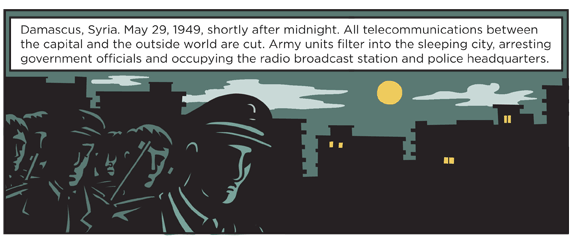
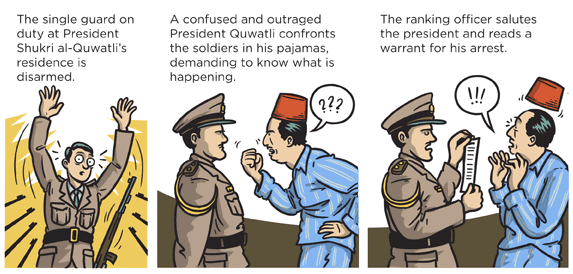
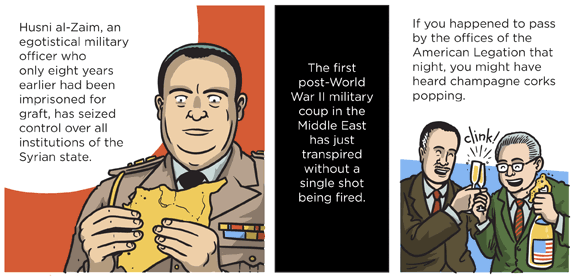
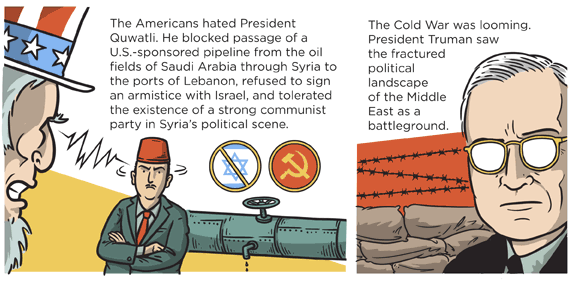
Syria: An illustrated guide to the 1949 coup
The cartoonist, Andy Warner, presents illustrated guide to the 1949 coup—possibly CIA-assisted—that plunged the country into decades of political turmoil.
Video: “Friends of Syria” push civil war
Syria: As his adversaries scramble for a strategy, Assad sets his terms
Tony Karon writes: That which has not been achieved on the battlefield can rarely be achieved at the negotiation table, and the harsh reality facing Syria’s opposition is that the regime of President Bashar al-Assad has not been defeated, nor is it in danger of imminent collapse. Assad has promised, former U.N. Secretary General Kofi Annan announced Monday, to begin a partial implementation of Annan’s peace plan by withdrawing troops and heavy weaponry from opposition-stronghold cities on April 10. In response, Western powers were left warning of unspecified “consequences” for failure to do so, and citing the history of Assad breaking promises. Skepticism from opposition activists on the ground was hardly surprising, but had little effect — they haven’t exactly been party to shaping Annan’s plan, which in itself is a reflection of their relative weakness in the power equation right now. Formulating a strategy in response to Assad appears to be the role of the Western and Arab powers who’ve backed the exile-based Syrian National Council, and after last weekend’s inconclusive Friends of Syria meeting in Istanbul, they don’t appear yet to have achieved a strategic consensus.
The Assad regime may, in fact, be feeling pretty smug: Its foreign adversaries were unable to prevent its brutal pummeling of cities controlled by opposition fighters, which scattered those fighters and forced the rebels to abandon an insurrectionist strategy of seizing control of whole towns in the hope of prompting mass defections that would bring down the regime. It has proved impossible, thus far, for the rebels to hold ground against counter-offensives by regime forces whose advantage in weaponry is overwhelming. Instead, the insurgency is on its back foot, struggling to find the arms and ammunition to sustain the confrontation, and reduced to waging a more diffuse campaign of guerrilla attacks and terror strikes. The regime, meanwhile, has remained largely intact with its core security forces remaining focused and motivated by the sectarian dimension of the war. Nor does the regime appear likely to collapse internally in the near term, even if the repression it has unleashed precludes it restoring long-term stability.
The Annan peace plan reflects the reality that the opposition and its international backers have been unable to impose terms on Assad on the ground. Western and Arab powers have been forced to walk back from the demand that Assad stand down as a pre-condition for resolving the crisis; Annan’s plan involves a cease-fire, demilitarizing the conflict and creating space for peaceful political opposition, but its key dimension is the recognition that the political negotiations over Syria’s future will be conducted with the regime, rather than after it has been dispatched.
‘Friends of Syria’ threaten Assad with strong condemnation and stern disapproval
The Guardian reports: Bashar al-Assad has been warned to implement a UN-backed peace plan to end more than a year of violence in Syria, amid growing scepticism at the lack of international resolve to tackle the bloodiest crisis of the Arab spring.
Hillary Clinton, the US secretary of state, issued the threat at a conference of the Friends of the Syrian people in Istanbul on Sunday, but there was little evidence of coherent international action if he does not comply.
Syria announced last week that it had accepted a six-point plan being promoted by the former UN secretary general Kofi Annan, though Assad then demanded that the “armed terrorist groups” he says are supported by an Arab-western “conspiracy” disarm first. According to the UN, 9,000 people have been killed in Syria over the last year.
“Nearly a week has gone by, and we have to conclude that the regime is adding to its long list of broken promises,” Clinton told the representatives of 83 countries as pro-Assad protesters demonstrated outside the conference venue. “The world must judge Assad by what he does, not by what he says. And we cannot sit back and wait any longer.”
Russia and China, traditional allies of Assad, stayed away from the meeting, while Syrian officials and media scorned it. Opposition activists, under pressure to close ranks, appeared less divided than before, but many dismissed the event as a display of impotence or even as an April Fool’s Day Joke.
Annan’s six-point plan calls for a ceasefire, military withdrawals from towns, prisoner releases, humanitarian and media access and above all a “Syrian-led” political process to negotiate transition to a new government.
On Saturday, the Damascus regime claimed victory over its enemies, declaring an end to the 13-month uprising and the start of a new stage of “stabilisation”.
But the repeated calls in Istanbul to adopt the Annan plan sounded half-hearted. Annan, who is due to brief the UN security council on Monday, did not even attend.