Reuters reports: The Gaza Strip, a tiny wedge of land jammed between Israel, Egypt and the Mediterranean sea, is heading inexorably into a water crisis that the United Nations says could make the Palestinian enclave uninhabitable in just a few years.
With 90 to 95 per cent of the territory’s only aquifer contaminated by sewage, chemicals and seawater, neighbourhood desalination facilities and their public taps are a lifesaver for some of Gaza’s 1.6 million residents. But these small-scale projects provide water for only about 20 per cent of the population, forcing many more residents in the impoverished territory to buy bottled water at a premium. The UN estimates that more than 80 per cent of Gazans buy their drinking water. “Families are paying as much as a third of their household income for water,” said June Kunugi, a special representative of the UN children’s fund Unicef.
The Gaza Strip, governed by the Islamist group Hamas and in a permanent state of tension with Israel, is not the only place in the Middle East facing water woes. A Nasa study of satellite data released this year showed that between 2003 and 2009 the region lost 144 cubic kilometres of stored freshwater – equivalent to the amount in the Dead Sea – making a bad situation much worse. [Continue reading…]
Challenging the ruling bureaucracy
In 1969, Hannah Arendt wrote: Violence, being instrumental by nature, is rational to the extent that it is effective in reaching the end which must justify it. And since when we act we never know with any amount of certainty the eventual consequences of what we are doing, violence can remain rational only if it pursues short-term goals. Violence does not promote causes, it promotes neither History nor Revolution, but it can indeed serve to dramatize grievances and to bring them to public attention. As Conor Cruise O’Brien once remarked, “Violence is sometimes needed for the voice of moderation to be heard.” And indeed, violence, contrary to what its prophets try to tell us, is a much more effective weapon of reformers than of revolutionists. (The often vehement denunciations of violence by Marxists did not spring from humane motives but from their awareness that revolutions are not the result of conspiracies and violent action.) France would not have received the most radical reform bill since Napoleon to change her antiquated education system without the riots of the French students [in May 1968], and no one would have dreamed of yielding to reforms of Columbia University without the riots during the [1968] spring term.
Still, the danger of the practice of violence, even if it moves consciously within a non-extremist framework of short-term goals, will always be that the means overwhelm the end. If goals are not achieved rapidly, the result will not merely be defeat but the introduction of the practice of violence into the whole body politic. Action is irreversible, and a return to the status quo in case of defeat is always unlikely. The practice of violence, like all action, changes the world, but the most probable change is a more violent world.
Finally, the greater the bureaucratization of public life, the greater will be the attraction of violence. In a fully developed bureaucracy there is nobody left with whom one could argue, to whom one could present grievances, on whom the pressures of power could be exerted. Bureaucracy is the form of government in which everybody is deprived of political freedom, of the power to act; for the rule by Nobody is not no-rule, and where all are equally powerless we have a tyranny without a tyrant. The crucial feature in the students’ rebellions around the world is that they are directed everywhere against the ruling bureaucracy. [Continue reading…]
The myth of secrecy
Leaf Van Boven, Charles M. Judd, and Mark Travers write: The revelation that the National Security Agency has been secretly amassing huge amounts of data about Americans’ phone and Internet use has sparked a lively debate about the proper role of secret information in a free and open society.
The crux of the debate is whether the value of secret information justifies the sacrifice of personal privacy. If secret information yields valuable intelligence that can be used to protect Americans, the reasoning goes, then it is worth sacrificing privacy for security.
But there is a major problem with evaluating information labeled “secret”: people tend to inflate the value of “secret” information simply because it is secret.
In a recent series of studies that we will present in a forthcoming issue of the journal Political Psychology, we have shown that people apply what we call a “secrecy heuristic” — a rule of thumb, in other words — when evaluating the quality of information related to national security. People rate otherwise identical pieces of information as more accurate, reliable and of higher quality when they are labeled secret rather than public. And people tend to think that national security decisions are wiser and better-reasoned when based on the same information labeled secret rather than public. [Continue reading…]
Video: Glenn Greenwald addressing Socialism 2013 conference
Glenn Greenwald spoke via Skype to the Socialism 2013 conference in Chicago on June 27, 2013.
When the democratic process isn’t enough
Rami G. Khouri writes: The fascinating, simultaneous demonstrations and challenges to democratically elected regimes in Egypt, Turkey and Brazil this month suggest that we need to look for an explanation for all this in something structural in newly democratized societies, rather than in cultural explanations. The silliest common cultural line of analysis asks about the compatibility between “Islam and democracy,” without our ever hearing an analogous discussion of, say, “Judaism and democracy” or “Christianity and democracy.”The mass demonstrations in these three countries are particularly intriguing because their leaderships are democratically elected, and therefore unquestionably legitimate. Also, all three countries were passing through moments of great hope and achievement; these included significant mass economic improvements in people’s well-being in Brazil and Turkey, and a democratic transition in Egypt that created a new global icon of the popular will for mass dignity and civil rights: Tahrir Square. Politically mummified Egypt set a new benchmark against which other political agitation around the world would be measured, whether in Madison, Wisconsin, in 2011 or in Turkey this month where analysts debated whether the Turkish people were about to create a new Tahrir Square.
The hundreds of thousands of people who took to the streets in Turkey and Brazil, and those millions in Egypt who promise to hold a mass national demonstration on June 30 to seek the ouster of President Mohammad Mursi on the first year anniversary of his arrival to power, raise reasonable questions that relate to several aspects of the two most compelling dimensions of governance: the policy and the style of the ruling incumbents. If the legitimacy of the leaderships in these three countries is not directly in question – after all, they were elected in free and fair democratic elections – then why have dissatisfied citizens taken to the streets to show their concerns?
I suspect that what we are witnessing is a dramatic expression of the weaknesses inherent in two simultaneous processes that are slowly expanding across the world: One is democratic rule based on majoritarianism, and the other is the continued diffusion of neoliberal capitalism, which turns citizens into consumers and gives corporations much greater power in the public realm than it does to the mass of ordinary citizens. The convergence and the initial globalization of these two forces can be traced to the early 1980s, under the leaderships of President Ronald Reagan in the United States and Prime Minister Margaret Thatcher in the United Kingdom. [Continue reading…]
Video: Snowden, Greenwald and the media saga
Senators accuse government of using ‘secret law’ to collect Americans’ data
The Guardian reports: A bipartisan group of 26 US senators has written to intelligence chiefs to complain that the administration is relying on a “secret body of law” to collect massive amounts of data on US citizens.
The senators accuse officials of making misleading statements and demand that the director of national intelligence James Clapper answer a series of specific questions on the scale of domestic surveillance as well as the legal justification for it.
In their strongly-worded letter to Clapper, the senators said they believed the government may be misinterpreting existing legislation to justify the sweeping collection of telephone and internet data revealed by the Guardian.
“We are concerned that by depending on secret interpretations of the Patriot Act that differed from an intuitive reading of the statute, this program essentially relied for years on a secret body of law,” they say.
“This and misleading statements by intelligence officials have prevented our constituents from evaluating the decisions that their government was making, and will unfortunately undermine trust in government more broadly.” [Continue reading…]
WikiLeaks volunteer was a paid informant for the FBI
Wired: On an August workday in 2011, a cherubic 18-year-old Icelandic man named Sigurdur “Siggi” Thordarson walked through the stately doors of the U.S. embassy in Reykjavík, his jacket pocket concealing his calling card: a crumpled photocopy of an Australian passport. The passport photo showed a man with a unruly shock of platinum blonde hair and the name Julian Paul Assange.
Thordarson was long time volunteer for WikiLeaks with direct access to Assange and a key position as an organizer in the group. With his cold war-style embassy walk-in, he became something else: the first known FBI informant inside WikiLeaks. For the next three months, Thordarson served two masters, working for the secret-spilling website and simultaneously spilling its secrets to the U.S. government in exchange, he says, for a total of about $5,000. The FBI flew him internationally four times for debriefings, including one trip to Washington D.C., and on the last meeting obtained from Thordarson eight hard drives packed with chat logs, video and other data from WikiLeaks.
The relationship provides a rare window into the U.S. law enforcement investigation into WikiLeaks, the transparency group newly thrust back into international prominence with its assistance to NSA whistleblower Edward Snowden. Thordarson’s double-life illustrates the lengths to which the government was willing to go in its pursuit of Julian Assange, approaching WikiLeaks with the tactics honed during the FBI’s work against organized crime and computer hacking — or, more darkly, the bureau’s Hoover-era infiltration of civil rights groups. [Continue reading…]
Video: Has capitalism failed the world?
Obama administration infighting suddenly goes public
Shane Harris and Noah Shachtman write: Usually, the Obama administration and the Pentagon do their bureaucratic knife fighting in private. Not so in the latest investigation of a national security leak.
This time the target is one of the highest-profile — and perhaps most controversial — senior military officers in the United States, Gen. James Cartwright. The former vice chairman of the Joint Chiefs of Staff is now allegedly a top target in the FBI’s investigation of who leaked details about the Stuxnet cyberweapon that hit Iran’s nuclear program.
NBC News broke the story last night. (Who leaked word to them is unknown; the possibilities are vast.) Cartwright, however, saw this coming. In recent months, he believed that his communications were being monitored and that he was being watched. He knew he was a target of the investigation. And with good reason. Aside from the fact that he was identified in David Sanger’s book Confront and Conceal as a mastermind of the Stuxnet project, Cartwright is also one of the most politically contentious military officers in Washington.
Cartwright has taken contrarian and politically risky positions on major policy decisions, most notably when he broke with many of his fellow generals and opposed a troop surge in Afghanistan. This brought him closer to the commander in chief (Cartwright had been called Obama’s favorite general), but it alienated him from his own cohort, including David Petraeus and Stanley McChrystal.
Cartwright also loved to talk about cyberconflict. He took the lead in establishing what would become the Pentagon’s Cyber Command. He pushed to make the United States’ own cyberattack capabilities “credible,” which some took to mean public. Being the guy who likes to talk about things like Stuxnet makes him a logical suspect for leaking about Stuxnet.
A close reading of Sanger’s book shows he had sources on Stuxnet that went far beyond Cartwright, and far beyond the White House. Sanger also had the project approved at the highest levels. “We certainly didn’t lock him out,” jokes one former administration official. [Continue reading…]
Why Washington is wrong to discredit Iran’s new president
Trita Parsi writes: America finds itself exactly where Iran was four years ago. Back then, America had just elected a new, articulate president who offered hope and promised a new approach to the world and Iran. His election was a direct rejection of the foreign policy of his predecessor, President George W. Bush, whose favorite tools of statecraft appeared to be military force and confrontational rhetoric.
The question Iran grappled with in 2009 was whether this new president — Barack Obama — really represented change or if it was merely an act of electoral deception.
Today, the roles are reversed. Iranians have elected a new, articulate president who is promising both the Iranian people and the world community hope and a new approach. His election is seen as a direct rejection of his predecessor Mahmoud Ahmadinejad’s confrontational policies and rhetoric. Iranians wanted hope and change and they went to the ballot boxes to obtain it.
But four years ago, the Iranian leadership couldn’t bring themselves to believe that the new U.S. president could be a sign of change. Was Obama really intent on shifting Washington’s Iran policy or was it all just talk? Even if his intentions were good, did he have the power to change long-standing policies?
Archconservatives expressed disbelief that Obama could even win. In their cynical view of the U.S. political system, perhaps reflective of their own political conduct, they never thought that Obama could get elected — in spite of his strong popular support. Rather, he won because “those behind the scenes who make presidents and make policies — the puppeteers — decided, and only changed their puppet.”
Similarly today, conventional wisdom in Washington first dismissed as fantasy the idea that Hassan Rohani could win the Iranian presidential elections and later wondered why Iran’s supreme leader had “permitted” this impossible outcome. [Continue reading…]
Egypt’s Salafists are hoping to capitalize on Morsi’s failure
Al-Monitor reports: In a statement issued June 21 addressing the upcoming June 30 nationwide opposition protests, the Salafist al-Nour Party illustrated its guarded, line-straddling position in the conflict between the Muslim Brotherhood and Egypt’s liberal opposition forces.
While the Nour Party expressed support for the controversial constitution and recognition of the legitimacy of the embattled president, it inconspicuously rallied behind efforts to destabilize the current regime. It called on protesters to adopt peaceful measures to change the balance of power, criticized the partisanship of the president and rejected attempts to portray Egypt’s political stalemate as an Islamist-secular struggle.
“They want to say they are not against secular parties,” Khaled Dawoud, a spokesperson for the National Salvation Front (NSF), told Al-Monitor. “The point that continues to cause problems between us is the constitution.” Opposition groups hold that various articles in Egypt’s constitution challenge religious and social freedoms, whereas al-Nour staunchly opposes removing the debated articles.
Al-Nour has long been wary of attempts by the Muslim Brotherhood to amass power and marginalize its competition. After leaving the Brotherhood-dominated Democratic Alliance for Egypt ahead of the parliamentary elections, the former head of al-Nour told Reuters that the group would not operate in the shadow of the Muslim Brotherhood, and spoke of the acrimonious experience of other parties in the alliance.
Al-Nour, the largest of several Salafist parties, boasts more than 180,000 registered members, and, as an organized political body, is second to the Muslim Brotherhood in size and political strength. “They have ambition to govern, banking on their wide popular base,” said Ahmad Ban, head of the Social and Political Movements Unit at the Nile Center for Political and Strategic Studies. [Continue reading…]
Is a second revolution really what Egypt needs?
Shadi Hamid writes: Supporters of the Tamarod (“rebel”) movement are taking to streets on June 30th in what is likely to be a massive show of force. Their goals are deceptively simple — pushing President Mohamed Morsi out of power and holding early presidential elections. When asked, however, how they plan to do this, the answers acquire a certain vagueness. Egyptians have every right to call for Morsi to resign — and that right must be protected — but he is obviously under no obligation to heed their calls. So, then what?
There is no legal or constitutional mechanism through which Morsi, who was elected with 51.7 percent of the vote just a year ago, can be ousted. Realistically, there is only one way he falls – if mass violence and a total collapse of public order provoke the military to step in. In this sense, for Tamarod to “succeed,” Egypt must fail. For some in the opposition, this short-term cost — as devastating as it might be — is justified because the alternative of continued Muslim Brotherhood rule will fundamentally alter the very nature of Egypt.
Opposition figures have been flirting with the possibility of various kinds of coups against an incompetent, unpopular — though democratically elected — president. Some, like April 6th’s Tarek al-Khouli and human rights activist Dalia Ziada, have explicitly called for military intervention. Others, like Mohamed ElBaradei and Ahmed el-Borai have taken to issuing what the journalist Evan Hill calls “non-request requests” for the army to step in. Still others, including leaders of Tamarod, have called for the judiciary to intervene and “annul” Morsi’s presidency. [Continue reading…]
Renewed violence in Egypt
The Guardian reports: Egypt suffered renewed outbreaks of violence on Friday as Muslim Brotherhood offices were attacked in at least four provinces two days before the scheduled start of mass protests against the president and Brotherhood associate Mohamed Morsi.
Two people were killed in Alexandria on Friday – one an American bystander who was watching an attack on local Brotherhood offices – and 70 were injured. Clashes were reported in several other cities between Morsi’s often secular-minded critics – who seek his immediate resignation – and his allies in the Muslim Brotherhood and other Islamist groups, who defend his democratic legitimacy.
Six people have now been killed in the renewed violence this week. According to Brotherhood officials, a former MP from their political wing was among the dead on Thursday.
Egypt Daily News reports: On Friday thousands of protesters vowed to remain in Tahrir Square in their call for the ouster of President Mohammed Morsi, and many started erecting tents in preparation for mass demonstrations on 30 June.
Marches from various locations in Cairo, including Talaat Harb Street, Mostafa Mahmoud and Sayeda Zeinab, brought in thousands of protesters into the square in the afternoon.
“We are staying for the long run, we are not leaving before [Morsi] does,” yelled one protester in the square.
Syria’s oilfields create surreal battle lines amid chaos and tribal loyalties
Ghaith Abdul-Ahad writes: A northern wind had been blowing since early morning, lifting a veil of dust that had blocked the sun and turned the sky the colour of ash. Abu Zayed was sitting on the porch of his unfinished concrete home, watching the storm build. He loved sandstorms. They reminded him of Dubai, where he had lived before the war. He admired the people there for turning a desert into a paradise. They had vision, he told his followers.
Six months ago, he left the Gulf emirate to join the Syrian revolution, attending opposition conferences in Istanbul and Cairo, jostling for position on behalf of his father, the leading sheikh of a powerful tribe in eastern Syria.
But Abu Zayed soon became disgusted with the bickering among the rebel leadership. “There is an opposition council in every hotel lobby in Istanbul,” he said. “You can’t distinguish them from the regime.”
Instead, like other disaffected tribal leaders, Abu Zayed returned home to his ancestral land and put his energy into building up his clan, taking control of his energy-rich ancestral lands.
Most of the oil and gas fields in eastern Syria lie idle or pump meagre quantities that are refined using primitive techniques to generate a pittance, but Abu Zayed’s land has a huge gas plant. It stands less than a mile from his home.
His father had chosen him out his 40 brothers to look after the plant because he was seen as a man of vision. The war had given him a chance to realise his dream: to build an oil-fuelled emirate.
The hard edges of Syria’s frontlines – dogmatic, revolutionary, Islamist or pure murderously sectarian – almost melt away outside the oilfields. New lines emerge pitting tribesmen against battalions, Islamists against everyone else, and creating sometimes surreal lines of engagement, where rebels help maintain government oil supplies in return for their villages being spared from bombardment and being allowed to siphon oil for themselves.
“There is chaos now,” Abu Zayed said. “The Free Syrian Army is chasing loot, and they don’t care about civilians. The military councils are stealing the aid and then selling it. There are dozens of battalions here, we don’t even know who is manning a checkpoint at the end of the street. Some people are saying the days of Bashar [al-Assad] were better, that the opposition has betrayed the people.
“But we can organise this situation,” he said. “Look at this gas plant, it’s under our control. Things are organised here and we can do the same for other oil and gas fields.
“Most of the people who control the oilfields around here are making about 5m Syrian pounds [£32,000] a day. They exploit a field for a few weeks, but because of the chaos, another powerful cousin or battalion soon arrives to fight for it and take control of it.
“I tell these people to lease me the field for S£10m a month. I collect all the fields under my control, bring in companies to exploit them properly and organise truck convoys to sell the gas to Turkey. Then we’ll buy Patriot [missile] batteries and drones to protect the fields against the regime.”
His ambition did not stop there. “Once you have economic power you can convene a council for the tribes here inside the country, and organise all the military units in one military council,” he said.
Using the old definition of tribal land from the French colonial era, before the Syrian republic and its socialist laws that smashed feudal property, each tribe is now claiming ownership of the fields that lie in its wajeh (tribal territory). As the Syrian regime has crumbled, society in the desert east has fallen back on the tribes. “Even [al-Qaida affiliate] Jabhat al-Nusra can’t do anything against us,” said Abu Zayed. “They try to get fields but they can’t. Not Nusra, not even the Americans could take these fields from us with all the weapons we have now.” [Continue reading…]

Ecuador cools on Edward Snowden asylum as Assange frustration grows
The Guardian reports: The plan to spirit the surveillance whistleblower Edward Snowden to sanctuary in Latin America appeared to be unravelling on Friday, amid tension between Ecuador’s government and Julian Assange, the founder of WikiLeaks.
President Rafael Correa halted an effort to help Snowden leave Russia amid concern Assange was usurping the role of the Ecuadoran government, according to leaked diplomatic correspondence published on Friday.
Amid signs Quito was cooling with Snowden and irritated with Assange, Correa declared invalid a temporary travel document which could have helped extract Snowden from his reported location in Moscow.
Correa declared that the safe conduct pass issued by Ecuador’s London consul – in collaboration with Assange – was unauthorised, after other Ecuadorean diplomats privately said the WikiLeaks founder could be perceived as “running the show”. [Continue reading…]
The NSA only targets citizens of the world (which includes America)
Shane Harris writes: The National Security Agency has said for years that its global surveillance apparatus is only aimed at foreigners, and that ordinary Americans are only captured by accident. There’s only one problem with this long-standing contention, people who’ve worked within the system say: it’s more-or-less technically impossible to keep average Americans out of the surveillance driftnet.
“There is physically no way to ensure that you’re only gathering U.S. person e-mails,” said a telecommunications executive who has implemented U.S. government orders to collect data on foreign targets. “The system doesn’t make any distinction about the nationality” of the individual who sent the message.
While it’s technically true that the NSA is not “targeting” the communications of Americans without a warrant, this is a narrow and legalistic statement. It belies the vast and indiscriminate scooping up of records on Americans’ phone calls, e-mails, and Internet communications that has occurred for more than a decade under the cover of “foreign intelligence” gathering.
The NSA is routinely capturing and storing vast amounts of the electronic communications of American citizens and legal residents, even though they were never individually the subject of a terrorism or criminal investigation, according to interviews with current and former intelligence officials, technology experts, and newly released government documents. [Continue reading…]
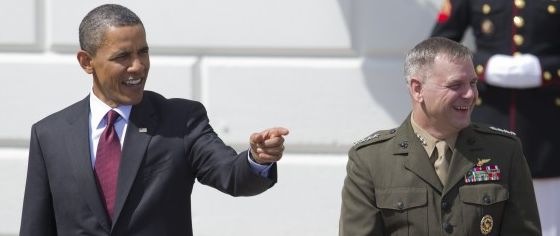
Obama’s ‘favorite general’ target of leak investigation

NBC News reports: Legal sources tell NBC News that the former second-highest-ranking officer in the U.S. military is now the target of a Justice Department investigation into an alleged leak of classified information about a covert U.S. cyberattack on Iran’s nuclear program.
According to legal sources, retired Marine Gen. James “Hoss” Cartwright, the former vice chairman of the Joint Chiefs of Staff, has been notified that he’s under investigation for allegedly leaking information about a massive attack using a computer virus named Stuxnet on Iran’s nuclear facilities. Gen. Cartwright, 63, becomes the latest alleged leaker targeted by the Obama administration, which has already prosecuted or charged eight individuals under the Espionage Act.
Last year, the New York Times reported that Cartwright, a four-star general who was vice chairman of the Joint Chiefs from 2007 to 2011, conceived and ran the cyber operation, called Olympic Games, under President Bush. President Obama ordered the cyberattacks sped up, and in 2010 an attack using the Stuxnet worm temporarily disabled 1,000 centrifuges that the Iranians were using to enrich uranium.
The Times story included details of the Olympic Games operation, including the cooperation of Israeli intelligence. The story said that President Barack Obama had ordered the attacks, which began during the Bush administration, to continue even after Stuxnet “escaped” from the Natanz nuclear plant in Iran and began to spread via the Internet. The virus was first publicly identified by a computer security company in June 2010.
The story described meetings in the White House Situation Room and was based on 18 months of interviews with “current and former American, European and Israeli officials involved in the program.” It credited Gen. Cartwright with presenting the original idea for Stuxnet to President Bush, said the NSA had developed the Stuxnet worm in tandem with the Israelis, and said thumb drives were first used to introduce the virus into the Natanz plant in 2008.
“This leak was very damaging,” said former California congresswoman Jane Harman, now a member of the Defense Policy Board. “Clearly what was going on here was a method and it should have been protected and I think it’s had devastating consequences.”
President Obama said in June 2012 that his attitude toward “these kinds of leaks” was “zero tolerance,” and that they were “criminal acts.”
According to legal sources, the original FBI probe into the Stuxnet leak focused on whether the information came from someone in the White House. By late last year, according to legal sources, FBI agents were zeroing in on Cartwright, who retired from the military in August 2011.
The Washington Post adds: Although Obama forged a quick rapport with Cartwright — White House officials referred to him as the president’s favorite general — the president chose not to promote him to chairman in 2011, in part because of concern that Cartwright had frayed his relationships with too many senior generals during the surge debate. Within the Pentagon, “he wasn’t seen as a team player,” said a senior military official who worked on the Joint Staff.
After retiring, Cartwright took a position at the Center for Strategic and International Studies and has spoken frequently on national security issues. He has emerged as a growing critic of the Obama administration’s expanded use of drones to counter the al-Qaeda threat.
At at event in Chicago in March, Cartwright said that the United States was beginning to see “blowback” from that targeted killing campaign. “If you’re trying to kill your way to a solution, no matter how precise you are, you’re going to upset people even if they’re not targeted.”