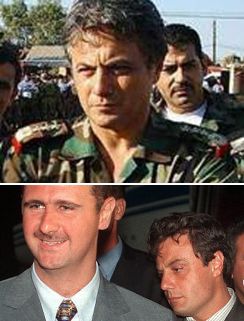
Manaf Tlas: Syrian regime ‘taking country to Hell’

BBC News reports: Sources close to Brigadier General Manaf Tlas, who met him days before he deserted, told the BBC he was very angry about what was happening in Syria and accused the regime of “taking the country to Hell”.

“If I were him, I would have done an [former Turkish leader and political reformer Kamal] Ataturk or resigned the second month the uprising began,” the sources quoted him saying of Bashar al-Assad, before he left for Turkey.

A commander in the elite Republican Guard, Gen Tlas is the highest ranking official – and the first from President Assad’s inner circle – to desert since the uprising began in March 2011.

Gen Tlas had been under partial house arrest since May 2011 because he opposed the regime’s response to the uprising.

He was the first government official to meet the opposition, back in March 2011, seeking to open a dialogue and find a political solution to the crisis.

He was also involved in reconciliation efforts in rural Damascus – mainly in Douma and Daraya and Tal – as well as in Homs and his home town Rastan.

Brig Gen Tlas met residents of several towns and helped obtain the release of many of their prisoners, even taking families from Douma to meet President Assad, who promised them a peaceful solution.

But Rastan was the turning-point for Manaf Tlas.

In May 2011, power and mobile networks were cut off in Rastan in preparation for an attack on the city by the official forces. Manaf Tlas ordered the services to be restored and promised the protesters they had the right to demonstrate peacefully.

Celebrating this, protesters chanted his name, which was enough to anger Maher al-Assad, Bashar’s brother and head of the Republican Guard, who ordered Manaf Tlas to stay at home.

Gen Tlas continued going to his base but no longer with any power to issue orders.

Hours after his desertion was announced, his house was ransacked by a mob, under the watch of the army, eyewitnesses said.

The BBC has spoken to members of Gen Tlas’ family, but they refused to comment.

His wife, Thala Khair, and other family members, are in Paris.

Many people within the opposition see Manaf Tlas as someone who has not been involved in bloodshed and believe he could play an important role in a transitional phase in rebuilding the military establishment.

Members of the Free Syrian Army (FSA) who defected from the military, are said to hold hopes for Gen Tlas as a reputed army figure.


Facebooktwittermail

Leading Syrian general has ‘defected and is on his way to Paris’

Brig. Gen. Manaf Tlass

The New York Times reports: Opponents of President Bashar al-Assad of Syria met with their international sponsors here on Friday to intensify pressure for his removal, buoyed by word that Brig. Gen. Manaf Tlass, a commander in the elite Republican Guard, close friend of the president and a member of the Damascus aristocracy, had defected and fled the country.

French Foreign Minister Laurent Fabius told the meeting that a “senior official” and commander of the Republican Guard had “defected and is on his way to Paris.” Ministry officials confirmed that Mr. Fabius was referring to General Tlass but did not say whether the Syrian general would join the talks.
[…]
Much attention at the meeting on Friday seemed certain to be devoted to General Tlass’s intentions.

Within the Damascus leadership, “Manaf is one of the regime’s main figures,” said Bashar al-Heraki, a member of the Syrian National Council, the umbrella political group in exile. “It is a negative sign for this regime,” Mr. Heraki said. “It has started to lose control.”

As one of the government’s most prominent Sunni Muslims, the elder General Tlass helped to disguise the fact that Hafez al-Assad relied on an inner circle composed mostly of his own minority Alawite sect.

The elder General Tlass was also said to have played a key role in the anointment of Bashar al-Assad as his father’s heir after his firstborn son, Basil, died at the wheel of his Mercedes in 1994.

At the official memorial service for Basil, the elder General Tlass was quoted as saying that he could see the light of Basil’s eyes shining from Bashar’s. Bashar soon became the heir apparent, ending his medical career and enrolling for military training, where the elder General Tlass promoted him and where his elevation into the officer corps coincided with that of Manaf’s.

In the second generation of the elite, families with two sons often divided their roles, with one going into business and the other joining the armed forces. It was true of Bashar’s first cousins, the Makhloufs, and it was true for the Tlass family.

Firas Tlass became a business tycoon, while Manaf — a charismatic figure — was promoted to a one-star general in the Republican Guards, one of the core units used in attempts to crush the current uprising. Maher al-Assad, the president’s younger brother, heads the praetorian force where Manaf served.

The president and Manaf were sometimes seen eating out together in Damascus.

“He’s a close friend to Bashar,” Mr. Heraki said. “So it is not only a strong strike against the regime, but the strongest message yet to Bashar that he is no longer safe, and a message to other officers thinking about defecting.”

Other opposition figures were less charitable, suggesting that General Tlass fled only to try to save the family’s substantial fortune as the government collapses.

The Tlass family came from Rastan, a predominantly Sunni Muslim city near Homs that has been under assault as a center for defecting officers. As the siege intensified, the Tlass family gradually left the country. Mustafa Tlass was said to have left for Paris in March, citing the need to seek medical treatment, while Firas was believed to be pursuing his business interests from the United Arab Emirates. He has kept a low profile, declining interview requests.

Manaf was believed to have at least one son enrolled at the American University of Beirut, where his wife also lived, and the reported defection came after the school year had ended.

Facebooktwittermail

For one top Syrian defector, a path less traveled

The Wall Street Journal reports: On his final day at Syria’s oil ministry in Damascus, Abdo Husameddin tried to avoid raising suspicions: He stayed to sign off on some paperwork, he said, chatted with the oil minister and left at 5 p.m.

That March evening, the deputy oil minister started a three-day covert journey to Turkey, hosted at safehouses across the country and guarded by fighters opposed to President Bashar al-Assad. A year into the country’s uprising, he became the highest-ranking official to defect from the Syrian government.

In the weeks that followed, all of Mr. Husameddin’s assets and bank accounts in Syria were frozen, he said in an interview with The Wall Street Journal. Months later, Turkish security agents still sometimes escort him around his new host country, warning him that even abroad, he faces a threat from Syrian intelligence agencies, he said.

Syria’s conflict has left up to 15,000 people dead, and has in recent months devolved into what some international diplomats have characterized as a civil war. Soldiers have defected at an increasing pace, including a Syrian air force pilot who flew his jet to Jordan last week. The government typically doesn’t comment on defections but called the air-force pilot who defected to Jordan a “traitor.”

On Thursday, Syrian media said a brigadier general from a family with close ties to President Assad had fled to Turkey in what would be the conflict’s highest-level military defection.

But far fewer of the regime’s high civilian officials have abandoned the regime. That fact has complicated efforts by the Syrian opposition to persuade world powers that it has legitimate leaders in line should President Assad fall. By contrast, in Libya’s recent conflict, a procession of high-profile ministry and diplomatic defectors provided the foundation of the opposition to Moammar Gadhafi and later of Libya’s transitional government.

President Assad’s top security, ministry and military officials have proven fiercely loyal, and many come from the president’s Alawite minority. But the 1.2 million civil servants in Syria’s state institutions are, like broader society, polarized between pro- and anti-regime Syrians, according to Mr. Husameddin and current and former Syrian officials who corroborated much of his account of the dynamics at the country’s state offices.

Mr. Husameddin attributes the lack of high-level defections largely to stepped-up security measures, a characterization echoed by other, lower-level state employees who have turned against the Assad regime. Safe passage out of the country is becoming increasingly tricky, Mr. Husameddin said, and there are few incentives to risk uprooting families and livelihoods to join a fragmented opposition.

Many state employees in Syria have turned against the regime but are staying in their jobs, he added, saying they are “defecting silently.”

“When the regime falls, we need these people,” he said. “We don’t want the state to collapse. In fact, they will be beneficial in the next phase.”

Regime officials say the lack of high-profile civilian defections reflects the loyalty of government workers and their determination to defeat what they see as a terrorist insurgency. The government hasn’t commented on Mr. Husameddin’s defection. The oil ministry didn’t return requests to comment.

Regional powers have even raised the prospect of offering tens of millions of dollars to woo potential defectors from government, said two people familiar with such offers. “A lot of money is being paid to ply people away,” said one of these people. “But there’s also the thinking that some people should be kept in place for the day after.” [Continue reading…]

Facebooktwittermail

America’s war on Iran: the plan revealed

At Open Democracy, Paul Rogers writes: The United States is more seriously preparing for military action against Iran than is widely realised. An attack – obviating the need for one by Israel – may not be immediate and is not yet certain, but it is being intensively planned.

The third round of talks between Iran and the “P5+1” group, held in Moscow on 18-19 June 2012, ended in stalemate. A formal process will continue at a lower level, but amid an atmosphere of continuing mutual suspicion and in a situation where United States electoral politics work against compromise. Iran believes that most of the P5+1 is bargaining that sanctions increase their impact until Tehran bends to its will, whereas Washington holds that it is the Iranians who are happy to prolong matters while they accelerate uranium enrichment (see “Syria and Iran: a diplomatic tunnel“, 25 June 2012).

Alongside these calculations, at least some European (especially German) politicians recognise that any substantial delay in negotiations could well create the space for a unilateral Israeli military strike on Iran, an act that would inaugurate a lengthy period of deep instability and perhaps an intensely destructive war.

The high European commitment to diplomacy over Iran has in part been motivated by the risk of Israel attacking Iran. There is little doubt that Israel would be prepared to make such a move at a time of its choosing. It is of even greater concern to the Europeans, then, that indications have emerged in recent weeks of the Pentagon’s own serious engagement in comprehensive multi-option war-planning.

The belief underpinning this hawkish approach seems to be that a short, sharp military action directed very precisely at Iran’s nuclear and missile facilities is the only way to force a weakened Iran to “come in from the cold” and – once and for all – abandon its nuclear ambitions.

There is no settled consensus in elite US circles about to handle the Iran problem. Several powerful voices, including within the Pentagon, argue that the best option is to continue the mix of sanctions and sustained cyber-warfare (the latter in collaboration with Israel). Others, however, argue that there is a need to plan for war, with the question of optimum timing a central issue (see David Fulghum, “Bombing Iran: U.S. military planners ponder when a kinetic attack might make sense“, Aviation Week, 25 June 2012).

The Pentagon advocates of a strike on Iran believe that the early part of 2013 might be the best moment. In their eyes, this offers three advantages. First, the presidential and congressional elections of November 2012 would be out of the way, with nearly two years to the next mid-sessional elections; thus any political controversy would have plenty of time to diminish. Second, the months between now and the point of decision would make clear whether there was any possibility of a political compromise. Third, keeping the war option open – and informing the Israelis well in advance – would make a lone Israeli attack less likely. The most hardline of the US planners hold the view that it is much better that the US “does the job properly” than lets Israel, with its much smaller forces, take the lead. [Continue reading…]

Facebooktwittermail

Israel threatens to carpet bomb Southern Lebanon

Haaretz reports: No less than four times in the past ten days, senior officials in the IDF’s Northern Command briefed representatives of the Israeli and foreign press.

The IDF’s Northern Command gave its fourth press briefing in ten days on Thursday. The many meetings, as well as the identical messages that emerge from them, do not appear to be coincidental.

The commander of the IDF’s 91st Division, Brigardier-General Hertzi Halevy, who met Thursday with reporters near the border, had some of the harshest words.

Should another Lebanon war break out, Halevy told the reporters, a week before the sixth anniversary of the second Lebanon war, it would require the IDF to enter Lebanese territory with a mighty force, and bring about the destruction of many villages.

“Lebanon will sustain greater damage than that done during the second Lebanon war,” he said.

“The response will need to be sharper, harder, and in some ways very violent. After the Goldstone Report, people in the international community and in Israel thought that battle in a densely populated area could be carried out in a nicer way.It cannot be nice. Without the use of great force, we will find it difficult to achieve our aim, and the enemy should also know that. ”

Halevy’s threats are nothing new. For four years now, Israel is threatening to torch Lebanon should Hezbollah create a cross-border provocation. In October 2008, the Northern Command chief at the time, Gadi Eizenkot, presented what he called the “Dahiya doctrine.”

In the next confrontation, Eizenkot said at the time, Israel will expand the destruction capability it showed when it bombed Dahiya, the Shiite quarter in Beirut.

“In every village from which shots were fired toward Israel, we will impose disproportional force and cause great damage and destruction. As far as we’re concerned, these are military bases,” Eizenkot said in 2008.

The significance of Halevy’s comments, then, lies not in their content but in their timing. Given the assessments that Israel is likely to attack Iranian nuclear facilities in the coming months ¬ and the possibility that the ramifications of the civil war underway in Syria (for instance, the possible transfer of chemical weapons from the Assad regime to Hezbollah) could lead to an escalation in Lebanon, Israel is sending a clear signal to Hezbollah leader Hassan Nasrallah.

The message is this: Sit quietly, this issue is too big for you to get involved in. If you dare harm us, in the name of defending the honor of Syria or Iran, you will pay a steep price that Lebanon will not be able to withstand.

Since Lebanon has only recently finished recovering from the damages it sustained in the Second Lebanon War, this threat seems to be significant. The Dahiya doctrine, the 2012 version: The coming weeks will tell if Israel’s threatening statements were received on the Lebanese side of the border.

Facebooktwittermail

Israel’s control of access to water

Israel controls the access to water from the Jordan River to the Mediterranean Sea. Its disproportionate allocation of water, the settlements’ takeover of natural springs, and the prohibition against maintaining and constructing water cisterns in the West Bank without Israeli permits make water a sparse commodity for Palestinians. The image below is a detail from an illustration in a series of infographics on Palestinian civilian life under occupation. See the complete infographic: Visualizing Occupation — Distribution of Water.

Facebooktwittermail

Islamophobia: A bipartisan project

Deepa Kumar writes: When the New York Times ran its story on Obama’s “kill list,” showing the president poring over names of people to potentially assassinate in drone strikes, it sparked a controversy. The content of that controversy was not over this extraordinary revelation about Obama’s use of power but rather over the leaking of state secrets, which Republicans accused him of doing to bolster his re-election campaign. Some liberal commentators (at Salon, The Nation etc.) were rightfully horrified and condemned such activity. But the Democrats – and much of the liberal establishment — remained silent.

Deep in the Times article, another shocking revelation that hasn’t received as much attention as the “kill list” is the Obama administration’s effort to erase the deaths of some innocent victims by categorizing “all military-age males in a strike zone as combatants.” This excludes them from the civilian casualties count, allowing the administration to claim that civilian casualties have been minimal. All Muslim men in “combat zones” in Afghanistan, Pakistan, Somalia and Yemen have been presumed to be terrorists, and therefore worthy of death, simply for being of “military age.”

How did we get to a place where innocent Muslim men can be killed with impunity around the world with little public outcry? The short answer is that Muslims have been long been constructed as “terrorists” upon whom righteous terror can be rained. The image of the Muslim enemy in the US is not new. While Hollywood and television play a key role in conveying that image to the public, they did not create it. The “Muslim enemy” is inextricably tied to a long history of US imperialism. [Continue reading…]

Facebooktwittermail

Judge helped Egypt’s military to cement power

The New York Times reports: Even as they promised to hand authority to elected leaders, Egypt’s ruling generals were planning with one of the nation’s top judges to preserve their political power and block the rise of the Islamists, the judge said.

Tahani el-Gebali, deputy president of the Supreme Constitutional Court, said she advised the generals not to cede authority to civilians until a Constitution was written. The Supreme Court then issued a decision that allowed the military to dissolve the first fairly elected Parliament in Egypt’s history and assure that the generals could oversee drafting of a Constitution.

The behind-the-scenes discussions, never publicly disclosed, shed new light on what some have called a judicial coup. From the moment the military seized control from President Hosni Mubarak, the generals “certainly” never intended to relinquish authority before supervising a new Constitution, Judge Gebali said.

The military council’s plan to cede authority was premised on first establishing the Constitution, the judge said, so the generals “knew who they were handing power to and on what basis. That was the point.”

When the military first seized power, it positioned itself as a guardian of the peaceful revolution, a force that was aimed at helping achieve the goals of a democratic Egypt. Demonstrators in Tahrir Square chanted that the people and the military were one, and there were promises of a quick transition to civilian control.

But the evidence since then has piled up demonstrating that the military had never intended to fully submit to democratically elected authority.

Now as Egypt’s new, popularly elected president, Mohamed Morsi of the Muslim Brotherhood, tries to fashion a role for himself as head of state, he is facing a military council that retains virtually all executive and legislative authority. The generals have again pledged to transfer power after a new Parliament is elected and a Constitution drafted. [Continue reading…]

Facebooktwittermail

Egyptian apathy on human rights

Tim Sebastian writes: I doubt very much if Mohamed Morsi knows the name Natasha Smith — still less what happened to her in Cairo’s Tahrir Square as tens of thousands of his supporters cheered his victory last week as president.

A 21-year-old student journalist from Britain, she had gone into the square to document the celebrations. She was modestly dressed and with a male companion.

Confronted by a jeering mob, the two became separated. She was attacked, subjected to repeated sexual abuse and stripped naked in front of hundreds of people. Eventually a group of Egyptians came to her aid — but the damage had already been done.

At almost exactly the same time, across the Nile, a 42-year-old Egyptian woman left a hotel — again modestly dressed in long-sleeved shirt and trousers — and headed through the hooting, drum-thumping streets to her car. She had not gone far before a middle-aged man appeared out of the darkness and spoke to her.

“You will not be allowed to dress like that in the New Egypt,” he warned. “Times have changed.”

I mention these incidents not because abuse and harassment are rare in Egypt, but because they now — for the first time — fall under the purview of an Islamist president, committed to ruling with a moral and religious compass.

The extent, therefore, to which the Morsi administration is ready to protect the rights of individuals, will go a long way toward determining what kind of Egypt emerges under his aegis over the months and, maybe, years to come. [Continue reading…]

Sebastian’s op-ed ends with these comments from an Egyptian election observer: “I do not fear the Muslim Brotherhood,” she says softly. “I do not fear the army. I fear my own people — their mentality. They will not defend my rights.”

As much as this might present a bleak image of Egypt, I have to wonder whether or not the same concern might be expressed about any population around the world. Universally, the defense of human rights seems to be a minority concern.

Facebooktwittermail

Syrian regime’s top Sunni defects — General Manaf Mustafa Tlass flees to Turkey

Joshua Landis writes: General Manaf Tlass, one of Syria’s top Sunni military figures from the inner-circle of Bashar al-Assad, has defected.

For 16 months the opposition has been complaining that elite Sunnis have not defected. That complaint can now, officially, be put to rest if the stories of Manaf’s flight prove to be true. In March it was rumored that he had led with his father and brother, but those stories were false.

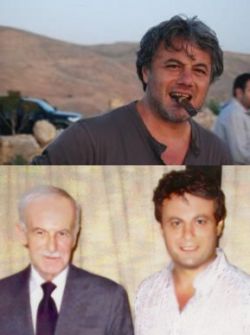
Manaf Tlass with cigar and with Hafez al-Assad

Manaf Tlass, the son of ex-Defense Minister (1972 – 12 May 2004), Mustafa Tlass, has fled the country. Mustafa Tlass was instrumental in smoothing the way for Bashar to assume power after the death of his father.

When Hafez al-Assad died in June 2000, his son Bashar was immediately promoted in military rank by Defense Minister Mustafa Tlass. He was also made secretary-general of the Baath Party whereas Manaf became a member of the Party’s Central Committee and an officer in the Republican Guard.

On Tuesday, all of Syria was buzzing that Manaf had defected but there was no confirmation. His Honda had supposedly turned up in the Rukn ad-Din neighborhood of Damascus, but he was no where to be found. Rumors of his possible defection were wide-spread on Twitter.

Syria-Steps, an on-line news source in Syria that is known for being pro-regime, has just confirmed the rumors. It claims:

أكد مصدر أمني رفيع المستوى “لسيرياستيبس” فرار العميد مناف مصطفى طلاس إلى تركيا..
“A highly placed source in intelligence has confirmed that General Manaf Mustafa Tlass has fled to Turkey.”

Manaf Tlass’s father and brother, Firas who is a leading businessman, are believed to be out of the country. The father had gone to Paris on the pretext of getting medical attention. Firas is said to be in Dubai. It is not clear where the women and children of his family are.

Manaf Tlass was a close confidant of Bashar from his earliest days and part of his inner circle or “shille”, which included people, such as his cousins Rami and Hafiz Makhlouf, Mudar al-Assad (son of Rifaat), Nader Qala’i (ex-CEO of Syriatel and business partner to Rami) Yazan Aslan (son of Ali Aslan, Chief of Staff)

Manaf is as handsome as a movie star and carried a lot of authority. He was a true military guy and had spent his entire life in the military, unlike Bashar. People close to him say that when he walked into a room, all eyes turned to him. Not only did women find him attractive, but men did as well. He carried himself with an air of self-confidence and authority. He is smart, dashing and cunning.

The word is that Manaf had been told to solve the Harasta and Duma problems (the growing uprising on the outskirts of Damascus). He did a good job by negotiating with the opposition leaders in both suburbs, agreeing that both government forces and opposition would pull back. The Alawi leadership said “no, that is not how we are going to do this.” They pushed him aside and came down like a ton of bricks on the opposition in both neighborhoods, in an effort to assert state authority and crush the uprising through military means.

Manaf supported a policy of negotiation, flexibility and compromise. He was overruled by the military leadership and has since looked for a way out. [Continue reading…]

Meanwhile, today Wikileaks released 25 emails from Syria (more to come).

Facebooktwittermail

Why try to understand the nature of the universe?

Rhett Allain, an Associate Professor of Physics at Southeastern Louisiana University, talks about how to discuss the Higgs boson announcement in the classroom — especially with non-science majors.

Given that those of us who don’t understand particle physics have not spent years wondering whether a missing piece to the Standard Model would ever be discovered, it’s discovery will lead many to question the value of finding this elusive particle.

But What Is It For?

This could be the question the students start with. It is a great opportunity to talk about the nature of science. In short, the answer is that the Higgs boson isn’t used for anything.

Chad Orzel (@orzelc) likes to say “Science is the most fundamental human activity.” I like to change this around and say “We do science, because we are human.” This is really part of my favorite quote from Robert Heinlein:

“A human being should be able to change a diaper, plan an invasion, butcher a hog, conn a ship, design a building, write a sonnet, balance accounts, build a wall, set a bone, comfort the dying, take orders, give orders, cooperate, act alone, solve equations, analyze a new problem, pitch manure, program a computer, cook a tasty meal, fight efficiently, die gallantly.”

Looking for the pieces of Standard Model is a human activity – just like painting the Mona Lisa. Why is just about everyone interested in black holes? Is there a practical use for black hole technology? Ok – maybe there could be, … [but] I doubt it is in the near future. We (humans) are interested in black holes because we are humans and that’s what we do.

Will there be “spin off” technologies from these high energy particle accelerators? Of course – but that’s not the goal. Will there be technologies based on the Higgs boson? Possibly, but that’s not the reason (and it will be a long way away).

To legitimize science by saying we do science because we are human, doesn’t to my mind go to the heart of the issue of value.

One can say — as many have — that we fight wars because we are human. But this doesn’t give value to war — it merely suggests that war might be unavoidable. (Whether it is unavoidable is a debate for another occasion.)

Instead of addressing the question about the value of science by just talking about science, it might be better to talk about the nature of value.

From the materialistic vantage point of American culture, the value of science is invariably measured through its utility. Will it provide us with faster computers, more fuel-efficient cars, new medicines or new materials? Will it make us wealthier?

The assumption about value is that the value of A is the fact that it can produce B.

This notion of productive value is insidious and it blinds us to something we all instinctively know but easily forget: the things of greatest value have intrinsic value — they need no justification.

We don’t dance to go somewhere. A song doesn’t rush to its conclusion. Beauty is not enhanced by ownership. Curiosity should not be extinguished by knowledge.

To want to understand the nature of the universe is to possess a desire that needs no justification.

Facebooktwittermail

How the Higgs boson explains our universe

Jeff Forshaw, professor of particle physics at the University of Manchester, writes: There is utter joy in the world of particle physics – Cern’s announcement that a new particle has been discovered will have long-lasting consequences for our understanding of how the universe works and it paves the way for a swathe of exciting new results over the coming years.

All the evidence points to this new particle being the long-sought Higgs boson. Its discovery is testament not only to the brilliance of the experimental physicists and engineers from around the world who have built the Large Hadron Collider but also to the theoretical physicists who dreamed of its existence almost 50 years ago.

Fundamental science like this is thrilling, not least because of the way that years of hard work, experimentation and mathematical analysis have led us to a worldview of astonishing simplicity and beauty.

We have learned that the universe is made up of particles and that those particles dance around in a crazy quantum way. But the rules of the game are simple – they can be codified (almost) on the back of an envelope and they express the fact that, at its most elemental level, the universe is governed by symmetry. Symmetry and simplicity go hand in hand – half a snowflake is enough information to anticipate what the other half looks like – and so it is with those dancing particles. The discovery that nature is beautifully symmetric means we have very little choice in how the elementary particles do their dance – the rules simply “come for free”. Why the universe should be built in such an elegant fashion is not understood yet, but it leaves us with a sense of awe and wonder that we should be privileged to live in such a place. [Continue reading…]

Facebooktwittermail

Palestinian leader seeks more information from Swiss lab before ruling on Arafat autopsy

The Associated Press reports: An aide says the Palestinian leader wants more information from a Swiss lab before deciding whether to dig up the remains of his predecessor, Yasser Arafat.

Doctors at the lab say they found elevated levels of the radioactive agent polonium-210 on clothing reportedly worn by Arafat before his death in November 2004.

The lab says the findings don’t prove Arafat was poisoned. Experts are divided over whether an autopsy, sought by Arafat’s widow, could clear up a lingering mystery surrounding the cause of Arafat’s death.

Palestinian President Mahmoud Abbas has said he’s willing to exhume the body. However, Abbas aide Nimr Hamad said Thursday the Palestinian leader first wants to send experts to Europe to learn more from the Swiss lab and to the French military hospital where Arafat died.

Reuters reports: Tunisia has called for Arab ministers to meet to discuss the death of former Palestinian President Yasser Arafat after new suspicions that he was murdered, a senior official in the Arab League said on Thursday.

The Palestinian Authority agreed on Wednesday to exhume Arafat’s body after new allegations that he was poisoned with the radioactive element polonium-210 in 2004, the same substance found to have killed a former Russian spy in London in 2006.

“The general secretariat received a request today from the Tunisian representative to convene a ministerial meeting to study the circumstances of the death of Palestinian leader Yasser Arafat,” League Deputy Secretary-General Ahmed Ben Helli told a news conference.

Ben Helli said a request had been passed to Arab member states for a meeting and to determine how they wished to deal with the issue in coordination with the Palestinians.

BBC News reports: Hamas Deputy Foreign Minister Ghazi Hamad has called for a full independent scientific investigation into the death of the former Palestinian leader Yasser Arafat following claims he had been poisoned.
[…]
Hamad told HARDtalk’s Zeinab Badawi that he believed Israel was responsible. Israel has denied any involvement in Arafat’s death. His medical records say he had a stroke resulting from a blood disorder.

Facebooktwittermail

Turkish firefighters battle blazes ‘deliberately started’ on Syria border

The Associated Press reports: Turkish firefighters are battling blazes along the border with Syria in areas where thousands of Syrians have crossed to flee the fighting in their country.

Mehmet Harbi, a forestry official, claimed the fires were “deliberately started” at four different points on the Syrian side of the border and spread to Turkey because of strong winds. Turkey’s state-run TRT television said Syrian forces were believed to have started the fires to deny shelter to rebels along the border area. Harbi and TRT provided no evidence to substantiate their claims.

More than 35,000 Syrians are living in refugee camps on the Turkish side of the border that were opened to care for the many people fleeing Syria’s unrest. Sporadic clashes between Syrian forces and activists also have occurred on the Syrian side of the border.

Facebooktwittermail

Libya beset by ethnic tension as elections loom

Luke Harding reports: In a villa on Libya’s stunning sea coast, a sculptor finishes off a war memorial. It commemorates the 50 men from the western town of Zuwara who perished last year in the battle against Muammar Gaddafi.

The slab, which is destined for Zuwara’s small concrete roundabout, is engraved in two languages: one is Arabic, the other is Tifinagh, the ancient script of North Africa’s Berbers, or Imazighen (the Berbers prefer to be called Imazighen, noting that Berber originally meant “barbarian”). Before last year’s uprising, anyone who spoke Berber in public could be arrested.

During his 42 years in power, Gaddafi persecuted the country’s minority Berber or Amazigh community, arresting its leaders, banishing its language from schools, and having protesters beaten. His vision for Libya was as a mono-Arab state. Gaddafi insisted the “traitorous” Imazighen were an ethnolinguistic fiction, even though they make up about 600,000 of Libya’s 6 million population.

Nearly a year after Gaddafi was turfed out of power, and days before the country’s first democratic election this Saturday, Amazigh culture is enjoying a revival. Zuwara’s secret police headquarters has been transformed into an Amazigh radio station. A beach mansion belonging to a Gaddafi loyalist is home to an artists’ workshop and a recording studio where banned Tifinagh songs and poems are heard again. Amazigh activists are busy relearning their forgotten, 2,000-year-old Punic alphabet.

But there are darker rumblings too. In March, 17 people were killed after fighting erupted between Amazigh Zuwara and the neighbouring Arab towns of Riqdaleen and Al-Jamail. The two sides lobbed mortars at each other. The ethnic clashes were triggered by fresh tensions over who did what during last year’s revolution – with Zuwara accusing its neighbours of siding with Gaddafi – as well as smouldering disputes over land and smuggling routes.

This isn’t post-revolutionary Libya’s only conflict. In the absence of a strong central authority, ethnic quarrels have broken out in several parts of the country, most notably in the south-eastern desert town of Kufra. Here, more than 150 people have been killed in fighting between black Toubou tribesmen and their Arab Zuwayy neighbours, leading some to wonder whether the country is already beginning to fall apart. [Continue reading…]

Facebooktwittermail

The shards of a civilization tearing up life

Please consider supporting the MIDWAY film project:

The MIDWAY film will take the viewer on a stunning visual journey into the heart of an astonishingly symbolic environmental tragedy.

Near the heart of the Pacific Ocean, Midway Island is one of the most remote places on Earth, and the iconic site of a world-changing naval battle. Today Midway is inhabited by a million Laysan albatrosses — magnificent and beautiful seabirds who range over the entire Pacific from their home base on the island. Midway is a multi-layered kaleidoscope of natural wonder and human history, and it also serves as a powerful lens into a shocking environmental tragedy: tens of thousands of albatrosses lie dead on the ground, their bodies filled with plastic from the Pacific Garbage Patch.

Returning to the island over several years, our team has witnessed and filmed cycles of birth, life, and death of these birds as a multi-layered metaphor for our time. With internationally acclaimed artist Chris Jordan as our guide, our film will walk directly into the fire of horror and grief, facing the immensity of this tragedy—and our own complicity—head on. And in this process, we discover a unexpected doorway to a deeply felt experience of hope, beauty and reverence for the mystery and miracle of our world. Stepping far outside the stylistic templates of traditional environmental or documentary films, MIDWAY will take viewers on a lyrical guided tour into the depths of their own spirits, delivering a profound message of renewal and love that is already reaching an audience of millions of people around the globe.

Please join our story

Through this KICKSTARTER we hope to finance our two final trips to Midway to complete our filming, including the cost of a remote-controlled helicopter and pilot to film spectacular aerial shots of the island; and the cost of bringing a world-class editor onto our team to help us cut the film together.

We also are seeking additional funding to complete production of the film for release. This includes the cost of the musical score (original composition and studio recording); sound editing and mix-down fees; color correction and title editing; production of multiple versions of the film for release through television, internet, theaters, etc.; translation of the film into multiple languages for international release; creation of educational curriculum materials for teachers; creation of a state-of-the art website and mobile apps with user forums and additional resource materials; and other associated costs to reach a global audience with our message.

Every contribution helps, however small!

We are a team of devoted artists who believe that the mythical story of Midway has the power to break open the hearts and minds of viewers worldwide. Our job is simply to honor this story as it has revealed itself to us, and deliver it to a global audience with the best quality filming, editing, production, and distribution that we can achieve. The process has been transformational to everyone on our team, and we look forward to sharing our results with you in 2013. Thank you for your contribution.

~with big smiles from chris jordan and the Midway team.

Facebooktwittermail

The Higgs boson discovery is another giant leap for humankind

Themis Bowcock writes: Early this morning, the physicists sat, with the media poised, waiting for two technical seminars from Cern to be delivered. There was only one question we all really wanted answered – would there be enough evidence to prove the Higgs particle had been discovered?

In London, John Womersley told us: “I can confirm that a particle has been discovered that is consistent with the Higgs boson theory.” In Cern, a spokesman said: “This is a preliminary result, but we think it’s very strong and very solid.” So there we have it. But what does the discovery of the Higgs actually mean to us? The answers lie in what the Higgs particle is and precisely what its role is in how the universe works.

About 50 years ago, physicists were faced with a conundrum in their theories of quantum mechanics, which describes nature at its most fundamental level. A successful theory called quantum electro-dynamics had been developed, which explained how particles of light and matter interacted. It was described as the “jewel of physics”, but while it correctly assumed that particles of light had no mass, it left a gap in our understanding of why otherwise similar particles were very heavy. For example we now know the particle of the force responsible for radioactivity is 100 times heavier than a hydrogen atom, but at the time we didn’t understand why. Two British scientists, Tom Kibble and Peter Higgs, decided to tackle this problem. They discovered that it is theoretically possible to make a particle without mass behave as if it did.

The Higgs theory suggested that nature, as it cooled after the big bang, froze into a unique configuration. The Higgs mechanism predicted that new particles came into existence as part of this freezing – “children” of the freeze. We now believe these Higgs particles are responsible for giving fundamental particles their mass and can leave them heavy or completely without mass; it’s as if the stickier a particle is to the Higgs, the heavier it is.

One of the great aims of modern physics has been to generate these Higgs particles. To create the right conditions for their study, huge accelerators such as the Tevatron in Illinois and the Large Hadron Collider in Geneva were built involving thousands of physicists and tens of thousands of engineers over decades, with funding from around the globe.

The Higgs particle is the first truly new particle that mankind has conceived – and now discovered – for millennia. Philosophers and scientists have reduced the world first to atoms, then fundamental particles, and then even the very quanta of the forces such as light.

The Higgs particle is not simply about the matter of which we are composed, nor about how it communicates (like light reaching our eyes from a distant galaxy), nor is it another layer of an infinite onion of smaller and smaller particles. It is the first part of the mechanism that tells us why the universe is the way it is today, why the stars burn the way they do and why light and matter are the way they are. Who among us can begin to imagine where this will lead in a century, let alone a millennium? [Continue reading…]

Facebooktwittermail

Iran ‘ready to fire missiles at U.S. bases’

The Guardian reports: Iran is prepared to launch missiles at US bases throughout the Gulf within minutes of an attack on the Islamic Republic, according to a commander of the country’s Revolutionary Guards.

In an apparent response to reports that the US has increased its military presence in the Gulf, the commander of the Revolutionary Guards’ air force said on Wednesdaythat missiles had been aimed at 35 US military bases in the Gulf as well as targets in Israel, ready to be launched in case of an attack.

The semi-official Fars news agency reported Brigadier General Amir Ali Hajizadeh as saying: “We have thought of measures to set up bases and deploy missiles to destroy all these bases in the early minutes after an attack.”

Hajizadeh’s remarks were made on the sidelines of a three-day war game called Great Prophet Seven, which Iranian officials claimed was a show of defiance against western pressure, including the US and EU embargo against imports of Iranian oil that came into effect on 1 July.

“These [US] bases are all in range of our missiles, and the occupied lands [a reference to Israel] are also good targets for us,” Hajizadeh said.

Facebooktwittermail