Israel’s ‘price tag’ terrorism has tactical political goals

Jonathan Cook writes: Violent, so-called “price tag” attacks by Jewish settlers have become a staple of life for Palestinian communities over the past few months. The latest is the torching this week of a mosque in the village of Jaba, close to the city of Ramallah.

Palestinians in areas of the West Bank under Israeli control live with settler neighbours who beat and shoot them, set alight fields, poison wells, kill livestock and steal crops. These acts of terror have begun to spread elsewhere: homes, cars, cemeteries, mosques and churches are now targets in East Jerusalem and Israel too. Earlier this month a school and several cars were vandalised in Neve Shalom, the only genuinely mixed Jewish-Arab community in Israel.

Invariably the “price” invoked by the settlers is unrelated to any Palestinian action. Instead Palestinians are punished indiscriminately for the smallest concession the settlers fear Israel might make in the diplomatic arena.

Superficially, the settlers’ behaviour looks like a particularly vicious form of tantrum-throwing, but there are tangible benefits to be gained from the trail of destruction they leave behind.

They provided a clue to their reasoning, as they always do in “price-tag” attacks, on the walls of Jaba’s mosque. In black spray-paint, they spelt out their grievance: “Ulpana”.

Ulpana, also near Ramallah and home to 30 Jewish families, is a settler “outpost” – one of more than 100 such settlements-in-the-making that are scattered across the West Bank. Unlike a similar number of much larger and more established settlements, which are illegal under international law, the outposts violate Israeli law too.

After years of petitions from human-rights groups, Israel’s Supreme Court has reluctantly ruled recently that Ulpana must be removed. D-Day for the settlers, July 1, is rapidly approaching.

The torching of the mosque – the settlers’ trump card – was intended chiefly as a reminder to Israel’s right-wing government, led by Benjamin Netanyahu, that any move against them risks triggering a round of intensified violence that will further damage Israel’s image with the international community.

But it was also designed to dampen the enthusiasm of the courts for further costly run-ins with settlers. The Supreme Court, settlers hope, will be in no hurry to enforce the destruction of future Ulpanas. [Continue reading…]

Facebooktwittermail

The creation of the myth of the global terrorist network

This is a long passage from an article on Adam Curtis’ blog, published on September 11, 2010. Curtis illustrates his piece with lots of photographs and video clips. Much of the video is integral to the narrative but unfortunately no embedding code is available. The passage I’ve selected includes a couple of videos and readers will need to go to the BBC website to view these.

In July 1979 a conference was held in Jerusalem to discuss the phenomenon of “International Terrorism”. It was organised by a young Benjamin Netanyahu at the Jonathan Institute, named after his brother who had been killed by terrorists at Entebbe.

All sorts of people were there, including George Bush Snr, many Neoconservatives who would become influential in Bush Jnr’s adminsitration, and Prime Minister Begin.

But the agenda of the conference was shaped by a new breed of what would become known as “terror experts”. And all of them were convinced by the new theory that the KGB were running almost all terrorism around the world.

They were also great, and sometimes very weird, characters.

One was an Australian journalist and novelist who wrote for the British Economist called Robert Moss.

Moss was one of the earliest promoters of the idea of hidden Soviet control. And in 1976 he helped write the speech for Mrs Thatcher that led the Soviets to call her the Iron Lady.

Later – in the mid 80s – Moss decided he had found a route to perceiving higher truths in the world. Truths hidden from ordinary mundane consciousness.

Through his dreams.

He developed a system he called Active Dreaming. You can find his theory here.

“When we act to bring the energy and imagery of dreams into physical reality, we become poets of consciousness and infuse our world with magic. Deep into multidimensional reality”

Another “terror expert” was a French historian called Annie Kriegel.

She had been a hardline Stalinist in the French Communist Party, but had turned violently against the Soviet Union.

Kriegel was convinced that all the terrorist acts in the Middle East were being co-ordinated from Moscow. This was music to the ears of Benjamin Netanyahu and the Israeli leaders who were seeking further US support.

In 1982 Kriegel wrote a book that said that the massacres in the Sabra-Chatila camps were organised by the Soviets and carried out by German terrorists under KGB control.

But perhaps the most important expert was another ex-communist. An American called Claire Sterling.

Sterling was a journalist who lived in Italy. She took all the “evidence” of Soviet control that was produced a the conference and bundled it up together into a book called The Terror Network.

It had a dramatic thesis.

It said that there was a “Global Terror Network” underneath the surface of most Western societies and the Middle East.

That all of them – the Red Brigades, Baader-Meinhof gang, Provisional IRA, South Moluccans, Japanese Red Army, Iranian terrorists, Turkish People’s Liberation Army, Spain’s ETA, Popular Front for the Liberation of Palestine and Fatah, the military arm of the Palestine Liberation Organization were all part of a grand Soviet scheme.

The aim of the scheme was to force the police in a Western democracies to crack down on individual freedoms. Then a repressive police state would emerge and breed resentment – making the masses ripe for Communist revolution.

One of Sterling’s closest friends in Italy was a young American academic called Michael Ledeen. He was fascinated by the theory.

And then early in 1981 he became a special assistant to the new US Secretary of State in the first Reagan administration.

Who was General Alexander Haig.

Haig read The Terror Network and immediately bought Sterling’s theory – because it proved what he instinctively knew about the Soviet threat.

And few days later Haig went to Congress and publicly accused Moscow of “training, funding, and equipping” international terrorists. He announced that “international counterterrorism will take the place of human rights.”

William Casey, the new head of the CIA also read and believed Sterling’s book.

The only problem was the no-one else took it seriously.

Many of those running the Reagan administration knew that the Soviet Union was supporting and arming liberation movements in the developing world, but they didn’t believe in the Global Terror Network.

Casey met with his CIA analysts. He told them that the book – The Terror Network – “has told me more than you bastards whom I pay $50,000 a year.”

His analysts then patiently explained to him that much of Claire Sterling’s evidence was composed of Black Propaganda they themselves had invented and spread around Europe to discredit to Soviets.

Even Reagan – for all his anti-communism – didn’t take it seriously.

But then – on 13th of May 1981 – Mehmet Ali Agca tried to kill the Pope in Rome.

Agca was a member of an extreme right wing Turkish group called the Grey Wolves. But at first Agca said he had done it on his own – it was neither right or left, he said. He was tried and put in prison.

But then in May 1982 Agca suddenly changed his story.

But he didn’t say he had done it as a member of the extreme right. Instead he insisted he had been part of a communist conspiracy to kill the Pope that had been organised by the Bulgarian secret service – and was being controlled behind that by Moscow.
[…]
Claire Sterling seized on this and went into action. She talked to lots of “intelligence informants” in Italy and the rest of Europe and wrote an article for Readers Digest. It caused a worldwide sensation.

Sterling said that Agca showed the incredible spider’s web that Moscow had created to control terrorism throughout the world. It had been built in such a way that it was normally impossible to see the links. But, like a flash of lightning on a dark night, Agca had shown how web really worked.

In his case, the KGB controlled the Bulgarian Secret service, and they in turn controlled the Turkish criminal mafia.

The Bulgarians had told the Mafia to find someone who could never be suspected of being linked to Moscow, bring him to Rome and tell him to shoot the Pope.

He would be interpreted as a Muslim fanatic, while Moscow would be rid of a Polish Pope who was a supporting the Solidarity movement in Poland.

Claire Sterling became a media celebrity. She appeared on TV across America and the world.
[…]
Sterling’s theory caused consternation in the Reagan administration, and especially in the CIA.

Almost all CIA officers and analysts were united in a belief that what Sterling was saying was rubbish. They produced an internal report saying there was no evidence linking the KGB to the assassination attempt.

But the head of the CIA, William Casey, was convinced by Sterling.

A senior CIA analyst called Melvin Goodman testified in 1991 to a Senate Committee as to what Casey then did.

He forced CIA officers to alter the report’s main judgements and to “stack the deck” in favour of KGB complicity. The sections of the report that expressed doubts and had counter arguments were erased.

The altered report was then sent to the White House. And it became one of the underpinnings of President Reagan’s increasingly simplified view of the world – that there was an interconnected network of terror in the world.

Although a new puppet master had also appeared, along with the Soviet Union – Iran. [Continue reading…]

Facebooktwittermail

Iran is trying to broker a political solution in Syria

Mohammad Ataie writes: During the past few months, Iranian diplomats have contacted the Syrian opposition to assist the Assad-led reform and facilitate negotiations between the president and the opposition.

According to the Iranian ambassador to Damascus, their contacts have been extensive and have included opposition leaders in and outside Syria. They have carried messages back and forth between opposition leaders and Damascus and at one point Iranian diplomats, who met Syrian Muslim Brotherhood leaders in Turkey, even offered a roadmap for reconciliation between the Islamist group and Assad.

The deal, disclosed by a leader of the Muslim Brotherhood, included a power-sharing arrangement that handed the premiership to the Islamist group in return for Assad retaining the presidency. But such efforts have been fruitless in the light of the ongoing violence and the Syrian government’s recourse to a security crackdown.

The recent “multi-party parliamentary election” – which was devoid of meaningful participation by opposition groups – and the formation of the new Syrian government by a member of the ruling Ba’ath party, have in particular disenchanted Iranian officials with Assad’s strategy for a political solution.

Iranian officials, according to various political sources in Tehran, were unhappy with the exclusion of the opposition from the election and the nomination of a loyalist Ba’athist, Riad Hijab, by the Syrian president as the new prime minister. Iranian political and military leaders are dismayed at the over-reliance of Damascus on a security solution and believe that Assad could have done better to lend credibility to his reforms.

A few days ago, in a private conversation, a top general who is in charge of Iran’s key regional files, expressed his frustration with the Syrian president’s failure to heed calls for reform, saying: “Assad takes the pills in front of us. But once we turn our heads, he spits them out.”

A year and a half into the Syrian crisis, Iranian leaders have seen themselves drawn into a protracted crisis that has strained Iran’s broader strategic interests in the region. The vortex of violence and unrelenting bloodshed in Syria bodes ill for Iran’s soft power and its credentials as the standard bearer of resistance in the Islamic world. As Hamas has distanced itself from Damascus, this crisis is also posing a serious challenge to the “axis of resistance” – the alliance of Syria, Iran, Hamas and Hezbollah.

In the eyes of the Iranian leadership, civil war and sectarian violence in Syria only benefit Israel. In their view, the ramifications of sectarian violence in Syria extend far beyond Syria’s borders and could entirely shift the anti-Israeli struggle to a regional Sunni-Shia conflict that could isolate Iran, a predominantly Shia and Persian state, that presents itself at the heart of Muslim anti-Israel and anti-US struggle in the region.

Iran, though certainly intent on safeguarding its key regional ally, does not see its fundamental interest in a security crackdown, but rather in reform and serious dialogue between Assad and the opposition.

In the strategic thinking of the Islamic republic, a political solution is essential for long-term stability in the Levant and the protection of its regional interests. This is where Iran’s interests intersect with current international diplomatic efforts to find a political solution to the crisis. [Continue reading…]

Al Jazeera reports: Iran on Tuesday offered to use its good ties with Damascus and Ankara to help resolve the row between the two countries over Syria’s downing of a Turkish warplane.

Syria’s shooting down of the jet last Friday was “a very sensitive issue” that also concerns Tehran, Iran’s foreign ministry spokesman said, just ahead of an emergency NATO meeting on the incident.

“We will use our good relationship with the two countries to resolve the issue,” Ramin Mehmanparast said in his weekly news briefing.

“It should be resolved through restraint and negotiations and [the two sides] should avoid measures that disturb the security of the region,” he said. “We hope this issue will be resolved rapidly.”

Facebooktwittermail

Turkey threatens force if Syrian troops near border

The New York Times reports: Buoyed by support from NATO allies, Prime Minister Recep Tayyip Erdogan on Tuesday warned Syrian forces to stay clear of their troubled border or face a Turkish military response to any perceived threat, following the disputed downing of a Turkish warplane.

The Turkish leader’s bellicose tone signaled no discernible easing of tensions between the two Mediterranean neighbors as ambassadors from the NATO alliance, desperate to avoid a wider conflict, held emergency talks in Brussels.

After the meeting, the NATO secretary general, Anders Fogh Rasmussen, said the alliance considered Syria’s actions in shooting down the Turkish warplane last Friday “unacceptable.”

In a unanimous statement, the NATO allies called the episode “another example of the Syrian authorities’ disregard for international norms, peace and security, and human life.” Turkey is a member of the alliance.

“I would certainly expect that such an incident won’t happen again,” Mr. Rasmussen said at a news conference at NATO headquarters in Brussels. He added that the alliance would closely follow developments and “if necessary, consult and discuss what else could be done.”

In Ankara, Mr. Erdogan said Turkey had revised its military rules of engagement toward Syria.

“Every military element that approaches the Turkish border from Syria in a manner that constitutes a security risk or danger would be considered as a threat and would be treated as a military target,” he said in a speech to lawmakers attended by Arab diplomats.

“From here, we warn the Syrian regime not to make any mistakes, not to test Turkey’s decisiveness and wisdom,” Mr. Erdogan said.

Facebooktwittermail

Did the New York Times cover up the cause of Anthony Shadid’s death?

When heroes die, the institutions they represent sometimes feel driven to turn an avoidable tragedy into a final act of heroism. That’s what happened to Pat Tillman in Afghanistan. Did the New York Times journalist, Anthony Shadid, suffer the same fate?

Shortly after his death in Syria, the Times’ executive editor, Jill Abramson sent an email to the paper’s newsroom saying:

Anthony died as he lived — determined to bear witness to the transformation sweeping the Middle East and to testify to the suffering of people caught between government oppression and opposition forces.

The circumstances of Shadid’s death are now being questioned by his cousin, Ed Shadid, a physician in Oklahoma City.

In a speech delivered to the American-Arab Anti-Discrimination Committee’s convention on Saturday, Ed said that in his final phone conversation with his wife, Nada Bakri, Anthony said: “if anything happens to me I want the world to know the New York Times killed me.”

Ed said that in spite of being recently advised that it was unsafe for Anthony and his companion to enter Syria, he was nevertheless sent on the assignment.

John Cook reports:

According to Ed, a Times security consultant reviewed a plan to infiltrate Anthony and his photographer Tyler Hicks across the border between Turkey and Syria in December 2011, but rejected it as too dangerous. “There was a security advisor who said, in no uncertain terms, ‘You are forbidden to enter Syria,'” Ed says. “So Anthony wrote an email to Tyler Hicks and says, ‘Hey man, it’s off. We’re not allowed to go.'” But roughly six weeks later, Ed says, Anthony’s editors reversed course and asked him to go anyway.

“The situation was worse on the ground than it had been in December,” Ed says. “The only thing that had changed was that CNN had gained access to [the rebel stronghold] Idlid. My understanding is that CNN gaining access bothered his editors.”

Anthony further expressed his concern about the challenges involved in getting into Syria but didn’t get support from his editors.

He asked for camping equipment to bring along on the journey through the mountainous border, Ed says, but his editors said no. When the 43-year-old reporter complained about the physical demands of the journey, Ed says, Times foreign editor Joseph Kahn responded, “It sounds like you’re going to get a lot of exercise on this assignment.”

Was what Kahn described as a lot of exercise, enough physical stress to give Shadid a heart attack?

The New York Times claims that Shadid died from an asthma attack but his cousin now asks why the autopsy results — which should have revealed elevated antibody and allergen levels — have never been released.

The emphasis on asthma comes from Hicks, who wrote that Anthony sustained increasingly severe allergic reactions to the horses they travelled with. But according to Ed, Anthony took his young daughter to horseriding lessons once a week without any adverse reactions. “They put out a story that Anthony Shadid died from asthma — according to who? Dr. Tyler Hicks?” Ed says Hicks’ account of Anthony’s final moments — he “stopped and leaned against a large boulder [and] collapsed onto the ground…already unconscious and [not] breathing” — is much more consistent with a heart attack than an asthma attack. He also says an autopsy was performed on Anthony’s body in Turkey, and wonders why he hasn’t seen the results. “We don’t have them,” he says.

New York Times spokesperson Eileen Murphy told Politico:

With respect, we disagree with Ed Shadid’s version of the facts. The Times does not pressure reporters to go into combat zones. Anthony was an experienced, motivated correspondent. He decided whether, how and when to enter Syria, and was told by his editors, including on the day of the trip, that he should not make the trip if he felt it was not advisable for any reason.

When asked repeatedly by Gawker whether a security consultant had rejected the Syria trip in December, Murphy declined to comment. Kahn didn’t return a phone call.

The New York Times has yet to cover this story on its own pages or offer an explanation about why Shadid’s autopsy results have never been shown to his family.

Facebooktwittermail

Morsi’s Fars News Agency interview

Iran’s Fars News Agency reports on an interview with Egypt’s newly-elected president. (Note: The Guardian reports “Fars is linked to the revolutionary guards controlled by Supreme Leader Ali Khamenei. But now the Islamic Republic News Agency, linked to President Mahmoud Ahmadinejad, is reporting a denial of the story from Morsi’s spokesman.)

Part 1: Egypt’s newly-elected President Mohammed Mursi underlined his enthusiasm for the further expansion of ties with Iran, and said relations between Tehran and Cairo will create a strategic balance in the region.

“The issue will create a strategic balance in the region,” Mursi told FNA on Sunday, hours before the final results of the presidential election was announced.

Part 2: Mursi voiced strong protest at the [ruling military] council’s forced dissolution and closure of the parliament, and said the move was aimed at hitting a blow to the Islamist candidate in the presidential election.

“The dissolution of Majlis al-Sha’b (parliament) targeted me,” Mursi said in an interview with FNA, adding, “When the generals saw that I have come close to the presidential post, they attempted to take away certain authorities in their own interest.”

He also dismissed the SCAF’s decision to issue a supplement to the Constitution, and said, “The military council is not entitled to issue an amendment to the Constitution and we reject the Constitutional declaration which disclaims the elected president’s authorities.”

His remarks came after Egypt’s military told parliament earlier this month that it has been dissolved and banned its members from entering the house.

Part 3: Mursi rejected rumors claiming that the country’s Supreme Council of the Armed Forces (SCAF) seeks to decrease his presidency term to one year.

“Such comments are not correct since the new Constitution will be compiled by the elected Constituent Assembly which was formed one day before the parliament’s dissolution and no one can ever cancel the presidential election,” Mursi said…

Part 4: Mursi rejected rumors and media news about paying his first foreign trip to Saudi Arabia, stressing that no such visit is on his agenda.

“I have said nothing so and my first international trips after victory in presidential election have not yet been specified,” Mursi said in an exclusive interview with FNA on Sunday.

“My visit to Saudi Arabia was an issue proposed by a number of young people and not an official plan,” he added.

Asked about his future plan for relations with the regional countries, Mursi said, “(My plan) is establishment of relations with all countries of the region to revive Egypt’s identity in the region through economic cooperation among the Arab countries and making certain reforms in the Arab League to activate its role on the international scene and beside that, supporting the Palestinian nation in its legitimate campaign for materializing its rights.”

Facebooktwittermail

Muslim Brotherhood tallies and keeping Egypt honest

At The Arabist, Bilal Ahmed writes: The most striking thing about these elections, and probably one of its most important lasting effects, is the accuracy of the independent tallies conducted by the Muslim Brotherhood and its political faction the Freedom and Justice Party. There is no other organized political force in Egypt with the resources to accurately conduct polling at all of Egypt’s 16,000 polling stations, and the MB has not squandered its opportunity to occupy this role.

The MB results for the Egyptian revolutionary parliament seven months ago and the first round of presidential elections at the end of May were more or less in line with the final election results. The results that were announced for the Morsi/Shafiq contest this morning only differed from the MB figures by about 0.06%, which ranks this election among the least manipulated in Egyptian history. Through this successful organizing, the MB has successfully implanted an idea in the media and political consciousness where its results can be trusted as accurate figures. This makes it difficult for manipulation to occur on a state level, as defying the Muslim Brotherhood figures now makes voter fraud much more evident.

Given the thousands of people who flocked into Tahrir Square and staged sit-ins when voting results were delayed last week, this is a severe political risk for institutions attempting to preserve their Mubarak-era privilege.

Last week’s announcement of victory at Morsi’s campaign headquarters put massive pressure on senior officials to not consider tampering with election results and cause a Shafik presidency. This pressure was felt in Tahrir Square as equally as it was in the Obama Administration, which announced that it would reconsider its lucrative military assistance package to Egypt if power was not handed to a civilian government. It is true that in all likelihood, the Supreme Council of the Armed Forces is satisfied with a Morsi executive that is stripped of its power, but its obvious preference for Ahmed Shafiq was made much more difficult the moment that the MB’s independent exit polls announced this morning’s results.

It may seem odd to state in a political climate where many revolutionaries don’t trust the MB and its FJP candidates, but the Muslim Brotherhood electoral results are trustworthy. It may, in fact, be the most trustworthy part of the entire organization and its most positive contribution to the ongoing Egyptian revolution. The Muslim Brotherhood now officially has a reputation of offering a source of accurate electoral information that minimizes the chance of voter fraud.

Zeynep Tufekci adds: [T]he Muslim Brotherhood (or Ikhwan as Egyptians refer to them) made it harder for the election to be stolen because they combined a superior ground game with active and sophisticated online presence to control the narrative and force a level of transparency. (In other words, they forced it such that if the elections were going to be stolen, it was going to be “in-your-face” stolen which is a very different method with greatly different political implications than “under-the-rug” stolen).

Here’s how.

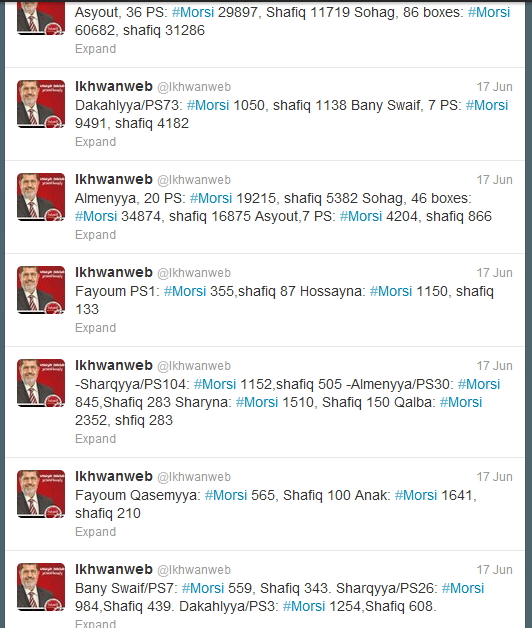
First, Muslim Brotherhood has a fairly active presence online, and especially in Twitter (although only their English feed is interactive at the moment). Throughout the election night, they kept tweeting out updated results:

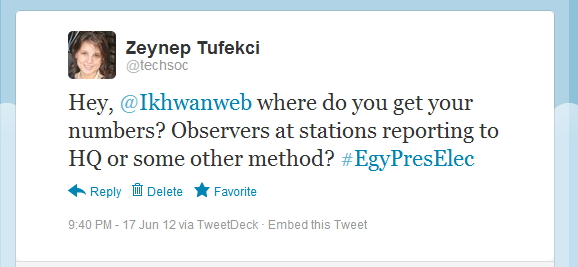
I was curious about where they got their numbers so I asked them:

About 10 minutes later, I had a reply that they had people at polling stations who updated them regularly. [Full disclosure: I do personally know at least one of the young woman who runs their English feed; in fact, most of my contacts with Muslim Brotherhood have been with young women as they happen to be quite active on their new media operations]. Other people I knew confirmed that MB had people on the ground at polling stations and were feeding results to the central headquarters as they became available. [Continue reading…]

Facebooktwittermail

New York Times accused of killing Anthony Shadid

Politico reports: Anthony Shadid, the Pulitzer prize-winning New York Times reporter who died in Syria this year, had heated arguments with his editors just prior to his final trip into the country, a cousin of Shadid’s says, and told his wife that were he to die the New York Times would be to blame.

“The phone call the night before he left [Turkey for Syria], there was screaming and slamming on the phone in discussions with editors,” Ed Shadid, a cousin to the late reporter, said last night at the Arab-American Anti-Discrimination Committee’s convention in Washington, D.C.

“It was at this time that he called his wife and gave his last haunting directive that if anything happens to me I want the world to know the New York Times killed me,” Ed Shadid said. [Continue reading…]

Facebooktwittermail

Defections and downed Turkish jet worsen Syria crisis

The New York Times reports: Syria’s isolation deepened on Monday, hit by a rash of high-ranking military defectors who sought refuge in Turkey, new European Union sanctions and plans for an emergency NATO meeting over its shooting down of a Turkish warplane.

Seeking to publicly justify the shooting of the plane off the Mediterranean coast last Friday and to profess no ill will toward Turkey despite rising tensions between the neighbors, the Foreign Ministry’s spokesman told reporters in Damascus that the plane had violated Syria’s territory.

“We had to react immediately,” said the spokesman, Jihad Makdissi. “Even if the plane was Syrian we would have shot it down.” Turkey says the airplane was over international waters when it was shot down after straying briefly into Syrian airspace.

Mr. Makdissi’s comments came a day before emergency talks at NATO headquarters in Brussels over the episode, which has heightened regional tensions springing from the 16-month crackdown on the antigovernment uprising in Syria. Referring to the NATO gathering, Mr. Makdissi said that “if the goal of that meeting is aggression, we say that Syrian airspace, territory and waters are sacred.”

The warning came as Turkish officials on Monday reported a further group defection by high-ranking Syrian military officers, adding to the strains between the two countries.

Facebooktwittermail

Why is the U.S. selling billions in weapons to autocrats?

Zach Toombs and Jeffrey Smith write: Every May and June, different branches of the State Department paint contrasting portraits of how Washington views dozens of strategically significant countries around the world, in seemingly rivalrous reports by its Human Rights and Political-Military Affairs bureaus.

The former routinely criticizes other nations for a lack of fealty to democratic principles, citing abuses of the right to expression, assembly, speech, and political choice. The latter tallies the government’s latest successes in the export of American weaponry, often to the same countries criticized by the former.

This year was no different. The State Department’s Military Assistance Report on June 8 stated that it approved $44.28 billion in arms shipments to 173 nations in the last fiscal year, including some that struggled with human rights problems. These nations include the United Arab Emirates, Qatar, Israel, Djibouti, Honduras, Saudi Arabia, Kuwait, and Bahrain.

Three nations with records of suppressing democratic dissent in the last year — Algeria, Egypt, and Peru — are listed in the report as recently receiving U.S. firearms, armored vehicles, and items from a category that includes chemical and riot control agents like tear gas. The State Department confirmed that U.S. tear gas was delivered to Egypt up to the end of November, but has declined to confirm it was also sent to Algeria and Peru.

The export of American arms to countries around the world — what the State Department calls a tangible expression of American “partnership” — is in fact booming. The commercial arms sales reviewed by the State Department reached $44.28 billion in fiscal year 2011, a $10 billion sales increase since 2010. Next year should see another increase of 70 percent, the department says. [Continue reading…]

Facebooktwittermail

America’s shameful human rights record

Former U.S. president, Jimmy Carter writes: The United States is abandoning its role as the global champion of human rights.

Revelations that top officials are targeting people to be assassinated abroad, including American citizens, are only the most recent, disturbing proof of how far our nation’s violation of human rights has extended. This development began after the terrorist attacks of Sept. 11, 2001, and has been sanctioned and escalated by bipartisan executive and legislative actions, without dissent from the general public. As a result, our country can no longer speak with moral authority on these critical issues.

While the country has made mistakes in the past, the widespread abuse of human rights over the last decade has been a dramatic change from the past. With leadership from the United States, the Universal Declaration of Human Rights was adopted in 1948 as “the foundation of freedom, justice and peace in the world.” This was a bold and clear commitment that power would no longer serve as a cover to oppress or injure people, and it established equal rights of all people to life, liberty, security of person, equal protection of the law and freedom from torture, arbitrary detention or forced exile.

The declaration has been invoked by human rights activists and the international community to replace most of the world’s dictatorships with democracies and to promote the rule of law in domestic and global affairs. It is disturbing that, instead of strengthening these principles, our government’s counterterrorism policies are now clearly violating at least 10 of the declaration’s 30 articles, including the prohibition against “cruel, inhuman or degrading treatment or punishment.”

Recent legislation has made legal the president’s right to detain a person indefinitely on suspicion of affiliation with terrorist organizations or “associated forces,” a broad, vague power that can be abused without meaningful oversight from the courts or Congress (the law is currently being blocked by a federal judge). This law violates the right to freedom of expression and to be presumed innocent until proved guilty, two other rights enshrined in the declaration.

In addition to American citizens’ being targeted for assassination or indefinite detention, recent laws have canceled the restraints in the Foreign Intelligence Surveillance Act of 1978 to allow unprecedented violations of our rights to privacy through warrantless wiretapping and government mining of our electronic communications. Popular state laws permit detaining individuals because of their appearance, where they worship or with whom they associate.

Despite an arbitrary rule that any man killed by drones is declared an enemy terrorist, the death of nearby innocent women and children is accepted as inevitable. After more than 30 airstrikes on civilian homes this year in Afghanistan, President Hamid Karzai has demanded that such attacks end, but the practice continues in areas of Pakistan, Somalia and Yemen that are not in any war zone. We don’t know how many hundreds of innocent civilians have been killed in these attacks, each one approved by the highest authorities in Washington. This would have been unthinkable in previous times. [Continue reading…]

Facebooktwittermail

The battle for the soul of Occupy Wall Street

Mark Binelli writes: In early February, Marisa Holmes, a 25-year-old anarchist who had been one of the core organizers of Occupy Wall Street, was contacted by an assistant of Ben Cohen and Jerry Greenfield – yes, that Ben and Jerry – looking to set up a conference call. Over the course of Occupy’s long winter hibernation, when friends and foes alike wondered if the movement, not even six months old, had already lost its way, Ben and Jerry decided OWS needed a professional fundraising arm. The pair calculated that it would be possible, with help from fellow liberal activists like former Nirvana manager Danny Goldberg, to infuse nearly $2 million into the movement, in the form of grants to various Occupy projects around the country and a permanent headquarters for OWS in New York.

But Ben and Jerry heard that Holmes and other members of Occupy had been expressing concerns. Holmes grew up in the suburbs of Columbus, Ohio, in a liberal, upper-middle-class family not so different, sensibility-wise, from the world of the ice cream moguls. Her father is an attorney; when Holmes was 14, she helped work on his campaign for city council. But since then, she’d become far more radical than her parents. For a while, she lived in a communal house in Detroit; last May, enthralled by the Arab Spring, she decided to travel to Egypt by herself, mere months after the uprising in Tahrir Square, to shoot a documentary, though she didn’t speak a word of Arabic. In September, she bedded down in Zuccotti Park from the very first night of the Occupation, invited down by her friend David Graeber, the brilliant anarchist academic who has been credited with coming up with the slogan “We are the 99 percent.”

Holmes herself is tiny, sleepy-eyed and temperamentally uncompromising. The latter trait can be tedious, like when she facilitates Occupy meetings and has people go around the room and state their names and gender-pronoun preferences, but also awesome, like the time Russell Simmons stopped by Zuccotti Park and wanted to be bumped up on the speakers’ list and Holmes told him, “Are you crazy? You’re number 12. Get used to it!” The conference call, suffice it to say, did not go well. Ben and Jerry seemed confused by her objections. “They said, ‘What’s the problem? Don’t you want our money and support?’ ” Holmes recalls. Occupy had been founded on anarchist principles of “horizontalism” – leaderless direct democracy, most poetically embodied in the People’s Microphone. “They didn’t get that it was a problem to create a hierarchical nonprofit institution and pick out leaders,” Holmes went on. “I was nice to them at first, but finally I said, ‘I know that’s how you’ve done things in the past, but that’s not how we’re doing it.'”

Holmes was especially wary of the offer because money had already proved so divisive within Occupy. The group had been flooded with donations in the wake of the police actions of the fall, but soon found itself consumed with squabbles over how to spend it. And petty bickering over things like subway MetroCards had highlighted not only tactical questions about what Occupy’s next move should be, but a more existential crisis. Having so suddenly and unexpectedly captured the world’s attention, now the question arose: What, exactly, would Occupy become? [Continue reading…]

Facebooktwittermail

Who’s the boss? There isn’t one

The Wall Street Journal reports: Like many tech companies, Valve Corp., a videogame maker in Bellevue, Wash., boasts high-end espresso, free massages and laundry service at its offices.

One thing it doesn’t have: bosses

Valve, whose website says the company has been “boss free” since its founding in 1996, also has no managers or assigned projects. Instead, its 300 employees recruit colleagues to work on projects they think are worthwhile. The company prizes mobility so much that workers’ desks are mounted on wheels, allowing them to scoot around to form work areas as they choose.

Welcome to the bossless company, where the hierarchy is flat, pay is often determined by peers, and the workday is directed by employees themselves.

So, how does anyone get things done?

“It absolutely is less-efficient upfront,” says Terri Kelly, chief executive of W.L. Gore, the Newark, Del., maker of Gore-Tex and other materials. Her title is one of the few at the company.

“[But] once you have the organization behind it…the buy-in and the execution happen quickly,” she adds.

Companies have been flattening out their management hierarchies in recent years, eliminating layers of middle management that can create bottlenecks and slow productivity. The handful that have taken the idea a step further, dispensing with most bosses entirely, say that the setup helps motivate employees and makes them more flexible, even if it means that some tasks, such as decision-making and hiring, can take a while.

At Valve, there are no promotions, only new projects. To help decide pay, employees rank their peers—but not themselves—voting on who they think creates the most value. The company declined to provide information about how much salaries vary.

Any employee can participate in hiring decisions, which are usually made by teams. Firings, while relatively rare, work the same way: teams decide together if someone isn’t working out.

As for projects, someone typically emerges as the de facto manager, says Greg Coomer, a 16-year veteran of Valve who works on product design. When no one takes the lead, he adds, it’s usually a sign that the project isn’t worth doing.

When colleagues disagree on whether to keep or scrap products, the marketplace decides, Mr. Coomer says. “When we honestly can’t come to an agreement—that’s really very rare—we ship and find out who was right. Over time we’ve become comfortable with the idea that we might be making a mistake when we do that; our customers know that if we screw up, we’ll fix it,” he says. [Continue reading…]

Facebooktwittermail

Egypt: a landmark victory

In an editorial, The Guardian says: A period of 84 years, most of them spent as a proscribed secret society languishing in prison or in exile, is a long time to wait. Egypt’s Muslim Brotherhood had to spend one hour more. That was the time it took Farouq Sultan, the head of the election commission, to read out a statement dealing with, it seemed, every one of the 456 objections made as a result of the presidential runoff. When he finally came to the point, Sultan could not get to the end of his sentence before the press conference, Tahrir Square and the country erupted. Mohamed Morsi had become the first Islamist to be elected head of an Arab state.

This is a historic moment for Egypt. Another nail has been hammered into the coffin of the old regime. The reaction of Tahrir Square on Sunday night was every bit as ecstatic as the toppling of Hosni Mubarak himself. Yet power itself has not changed hands, and the conflict with an ageing group of generals in the Supreme Council of the Armed Forces (Scaf) might yet drag on for weeks or months. Scaf thinks it owns the country, and by some reckoning it does. Its corrupt business empire could account for as much as 40% of Egypt’s GNP. Like all CEOs, they will not depart swiftly or cheaply. Theirs will be a slow and bitter rearguard action.

But after Sunday’s events few can doubt the direction of travel. The generals face a bald choice: declare a military coup or beat the retreat. How long that decision will take, no one knows. The generals now face an incomparably larger and more emboldened foe. The secular leftist and Islamic forces that comprise the revolution are still mutually distrustful and represent an unwieldy spectrum of political forces, many still half-formed.

However, from now on their torchbearer will not just be a crowd hundreds of thousands strong. It will be a president who represents the democratic and constitutional will of the Egyptian people. As Scaf represents neither, it will be hard put to keep the legislative, constitutional and executive powers it grabbed in the dying days of the presidential count.

Much will depend on the character of Egypt’s new president. Derided as a spare tyre by the Egyptian press – because he was not the Brotherhood’s first choice as presidential candidate – Morsi may be an accidental president, but he may also turn out to be a powerful one. Dismissed as a boring and unquotable technocrat, he produced his best speech on the very night, 11 days ago, the military council issued its constitutional decree.

He is a dogged negotiator and, supporters say, a man of courage. Although the election result was announced on Sunday, it was known on Thursday afternoon. By then it became clear that the number of ballot papers ruled ineligible had not been enough to dent the one million strong lead Morsi had over the army’s candidate, Ahmed Shafiq.

The Brotherhood then met the military council and made its three principal demands – that parliament be reinstated, the military’s right of arrest of civilians be rescinded, and a new constitutional assembly formed. The Brotherhood offered to put the military’s constitutional decree to a referendum. The military refused, and the Brotherhood returned to Tahrir Square.

The three days that followed were a battle of wills that Morsi won. His first act as president-elect was to resign his membership of the Brotherhood. His vice-presidents will all come from other groups, including Egypt’s Coptic Christians. All these moves are vital if a government of national unity is to be created.

The battle of wills between Morsi and the generals will continue. And as reaction poured in from the region – notably, Binyamin Netanyahu, Israel’s prime minister, said he respected the outcome – the US, Britain and Europe were all notably silent in the hours immediately after the victory, considering this is a triumph not just of one candidate but of democracy. Not for the first time in the Middle East, western powers could have found themselves on the wrong side of history.

Note that the White House had several days to fine tune statements in anticipation of either a Morsi or Shafiq victory. By the time Washington did actually speak, its congratulations were muted and couched in the lecturing tones reserved for non-Western leaders who, from America’s point of view, need tuition even when it’s unsolicited.

The Los Angeles Times reports: A statement from White House spokesman Jay Carney called the election a “milestone in their transition to democracy.”

“We look forward to working together with President-elect Morsi and the government he forms, on the basis of mutual respect, to advance the many shared interests between Egypt and the United States,” Carney said. “We believe that it is important for President-elect Morsi to take steps at this historic time to advance national unity by reaching out to all parties and constituencies in consultations about the formation of a new government.

“We believe in the importance of the new Egyptian government upholding universal values, and respecting the rights of all Egyptian citizens — including women and religious minorities such as Coptic Christians.”

The statement said the U.S. intends to work with all parties in Egypt and praised election monitors for supporting “a free and fair election.”

“We believe it is essential for the Egyptian government to continue to fulfill Egypt’s role as a pillar of regional peace, security and stability,” Carney said. “And we will stand with the Egyptian people as they pursue their aspirations for democracy, dignity, and opportunity, and fulfill the promise of their revolution.”

Facebooktwittermail

The difference between the Obamians and the neocons? Fifty years of American hegemony

We all remember the neocon hubris embodied in their Project for the New American Century. It turns out that the Obamians nurture a similar and only slightly more modest ambition: American world domination for just another fifty years.

James Mann writes:

Over his years in office, Obama has evolved and now is running for reelection as something of a Hard Power Democrat, highlighting his prowess in the use of force. Still, generational differences persist between the Obamians and the Clinton alums. For example, Bill Clinton and his secretary of state Madeleine Albright spoke of America as the “indispensable nation.” As secretary of state under Obama, Hillary Clinton has offered similar themes. “The United States can, must and will lead in this new century,” she said in a 2010 speech.

But when Obama’s younger aides talk about America’s role in the world, there is a subtle recognition that its post-World War II dominance may not last forever. “We’re not trying to preside over America’s decline,” deputy national security adviser and Obama speechwriter Ben Rhodes observed in an interview. “What we’re trying to do is to get America another 50 years as leader.”

In the language of Washington centrist politics, 50 more years of global domination is supposed to signal moderation.

Facebooktwittermail

What Sheldon Adelson wants

An editorial in the New York Times says: No American is dedicating as much of his money to defeat President Obama as Sheldon Adelson, the casino magnate who also happens to have made more money in the last three years than any other American. He is the perfect illustration of the squalid state of political money, spending sums greater than any political donation in history to advance his personal, ideological and financial agenda, which is wildly at odds with the nation’s needs.

Mr. Adelson spent $20 million to prop up Newt Gingrich’s failed candidacy for the Republican nomination. Now, he has given $10 million to a Mitt Romney super PAC, and has pledged at least $10 million to Crossroads GPS, the advocacy group founded by Karl Rove that is running attack ads against Mr. Obama and other Democrats. Another $10 million will probably go to a similar group founded by the Koch brothers, and $10 million more to Republican Congressional super PACs.

That’s $60 million we know of (other huge donations may be secret), and it may be only a down payment. Mr. Adelson has made it clear he will fully exploit the anything-goes world created by the federal courts to donate a “limitless” portion of his $25 billion fortune to defeat the president and as many Democrats as he can take down.

One man cannot spend enough to ensure the election of an unpopular candidate, as Mr. Gingrich’s collapse showed, but he can buy enough ads to help push a candidate over the top in a close race like this year’s. Given that Mr. Romney was not his first choice, why is Mr. Adelson writing these huge checks?

The first answer is clearly his disgust for a two-state solution to the Israeli-Palestinian conflict, supported by President Obama and most Israelis. He considers a Palestinian state “a steppingstone for the destruction of Israel and the Jewish people,” and has called the Palestinian prime minister a terrorist. He is even further to the right than the main pro-Israeli lobbying group, the American Israel Public Affairs Committee, which he broke with in 2007 when it supported economic aid to the Palestinians. [Continue reading…]

Facebooktwittermail

Class decides everything

Richard Florida writes: Class has long been a dirty word in America. We’re the society of opportunity after all – the place where anyone from anywhere can aspire to be president or at least get very rich. Innumerable pundits and a litany of books have trumpeted the eclipse of class and the rise of a classless society. It’s an old saw. Way back in the late 1950s, the sociologist Robert Nisbet declared, “the term social class … is nearly valueless for the clarification of data on wealth power and status.”

But numerous indicators and metrics suggest that class does structure a great deal of American life. America lags behind many nations – from Denmark to the United Kingdom and Canada – in the ability of its people to achieve significant upward mobility. America’s jobs crisis bears the unmistakable stamp of class. This past spring, for example, the rate of unemployment for people who did not graduate from high school was 13 percent, substantially more than the overall rate of 8.2 percent and more than three times the 3.9 percent rate for college grads. At a time when the unemployment rate for production workers who contribute their physical labor was more than 10 percent, unemployment for professionals, techies and managers who work with their minds had barely broken 4 percent.

While the political left has long pointed to America’s social and economic divides, a number of influential commentators on the right have only recently been drawn to the issue. “America is being polarized by class divisions that didn’t exist a quarter century ago,” writes Charles Murray in his book “Coming Apart.” “We have developed a new upper class with advanced educations, often obtained at elite schools, sharing tastes and preferences that set them apart from mainstream America. At the same time, we have developed a new lower class, characterized not by poverty but by withdrawal from America’s core cultural institutions.” While many have criticized the cultural and sociological underpinnings and implications of Murray’s argument, there’s no getting around the fact that he accurately identifies class as a, if not the, central axis of contemporary American life.

My own research bears this out. My initial research over a decade ago identified the rise of the creative class as a key factor in America’s cities and economy overall. What has struck me since is that the effects of class are not just limited to cities, jobs and the economy. Class increasingly structures virtually every aspect of our society, culture and daily lives — from our politics and religion to where we live and how we get to work, from the kind of education we can provide for our children to our very health and happiness. [Continue reading…]

Facebooktwittermail