Daily Archives: January 6, 2008

NEWS & EDITOR’S COMMENT: The new Cambodia?

U.S. considers new covert push within Pakistan

President Bush’s senior national security advisers are debating whether to expand the authority of the Central Intelligence Agency and the military to conduct far more aggressive covert operations in the tribal areas of Pakistan.

The debate is a response to intelligence reports that Al Qaeda and the Taliban are intensifying efforts there to destabilize the Pakistani government, several senior administration officials said.

Vice President Dick Cheney, Secretary of State Condoleezza Rice and a number of President Bush’s top national security advisers met Friday at the White House to discuss the proposal, which is part of a broad reassessment of American strategy after the assassination 10 days ago of the Pakistani opposition leader Benazir Bhutto. There was also talk of how to handle the period from now to the Feb. 18 elections, and the aftermath of those elections. [complete article]

Editor’s Comment — It’s never enough just to know what was said; we need to know who was talking.

This is a report that illustrates well the need for newspapers to limit their use of anonymous sources. The key to unlocking the article’s significance is knowing who was talking to the New York Times. On that basis we could attempt to understand the sources’ motives for making this information public. For instance, if the sources are intelligence officials we’d have reason to think they might be talking to the press in an effort to kill a harebrained plan before it gains momentum. If on the other hand the sources are inside the White House, then we’d have to wonder whether a political agenda was trumping the need for operational security. Myers, Sanger, and Schmitt should know the answer, but of course their sacred duty to protect the confidentiality of their sources prevents them from adding meaning that currently only they are in a position to discern. Still, why call it reporting if the reporter is only willing to tell part of the story?

What’s more important? That the New York Times is able to protect the privilege of its access to those in power, or that it uses all its means to hold those in power accountable to the people they represent?

Since the Grey Lady is so firmly wedded to its institutional authority, what can we do but go back to parsing the Times as though we were reading Pravda.

This is what I’m able to glean. President Bush, who was in the White House on Friday, did not attend the meeting. The key players at the meeting are named in the article and since they didn’t include Bush, it seems reasonable to infer he wasn’t there. Too busy? We do know for sure that Defense Secretary Gates wasn’t there, so it looks like this was Cheney’s meeting.

Midway through the article, our steely reporters toss in an idle piece of speculation about why the discussions in the White House were taking place: “In part, the White House discussions may be driven by a desire for another effort to capture or kill Osama bin Laden and his deputy, Ayman al-Zawahri.” Does this mean that the Times was told by its sources, this was the main reason for the discussions, but you can’t attribute that to your sources, or was this just some journalistic day-dreaming? Let’s assume the former. And if that’s the case, this discussion may have more to do with domestic American politics than a desire to bring stability to Pakistan.

Perhaps the most revealing lines in the report are these: “The Bush administration has not formally presented any new proposals to Mr. Musharraf, who gave up his military role last month, or to his successor as the army chief, Gen. Ashfaq Parvez Kayani, who the White House thinks will be more sympathetic to the American position than Mr. Musharraf…. But at the White House and the Pentagon, officials see an opportunity in the changing power structure for the Americans to advocate for the expanded authority [of the CIA] in Pakistan, a nuclear-armed country.” In this changing power structure, the administration’s focus remains unchanged: its interest in working more closely with Pakistan’s military than with its civilians. At the same time, the administration appears to want to communicate indirectly with Pakistan’s military by getting its ideas floated in the press. Is this a case of putting the word out to see if it provokes civil unrest?

It’s starting to sound like Cheney might be on the war path again. Iran is off the table, but maybe Pakistan will provide the CIA with an opportunity to help the administration pull its chestnuts out of the fire before November ’08. If they haul in or kill America’s most-wanted men, the presidential race might be nudged back onto national security, and maybe Bush and Cheney won’t go down in history as the men who destroyed the Republican Party.

Could Pakistan go up in flames in the process, al Qaeda’s leaders elude capture and the war in Afghanistan expand into a full-fledged regional war? These are all risks the vice president might be willing to take.

But I digress. The reporters at Pravda — I mean the Times — could do a bit more to enlighten us, couldn’t they?


Facebooktwittermail

NEWS, FEATURE & EDITOR’S COMMENT: Pakistan’s complex political landscape

Next-gen Taliban

The intelligence officer I met in Dera Ismail Khan, whose area of operations included the Taliban-ruled enclave of South Waziristan, maintains that his contacts with the militants were severed long ago. “We can hardly work there anymore,” he told me. “The Taliban suspect everyone of spying. All of our sources have been slaughtered.”

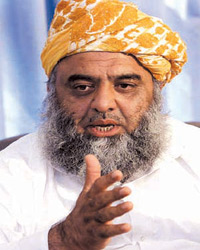
maulana-fazlur-rehman.jpgI asked [Jamiat Ulema-e-Islam chief, Maulana Fazlur] Rehman, who used to refer to the Taliban as “our boys,” if he still considered the Taliban, even those who might be firing rockets at his house, his boys. “Definitely,” he replied. “But because of America’s policies, they have gone to the extreme. I am trying to bring them back into the mainstream. We don’t disagree with the mujahedeen’s cause, but we differ over priorities. They prefer to fight, but I believe in politics.”

Mushahid Hussain, secretary general of the pro-Musharraf faction of the Pakistan Muslim League, told me that no one can negotiate the politics of the North-West Frontier Province better than Rehman. “We know that we need a bearded, turbaned guy out there,” Hussain told me. It is perhaps a measure of how inextricable Islamism and politics have become in Pakistan that even the United States would deal with an anti-American like Rehman. In September, he had the first meeting of his 30-year political career with an American ambassador. What did Rehman and Anne Patterson, the American envoy, discuss? “She urged me to form an electoral alliance with Benazir Bhutto and Musharraf,” he told me a few days after the meeting. “I am not against it. But politically, because of the American presence in Afghanistan and rising extremism, it is a bit hard for us to afford.” Plus, the fact that the Americans thought Bhutto could tackle the Taliban had simply baffled him. “She has no strategy in those areas, and nothing to do with those people,” he said.

When asked if Patterson’s meeting signaled a change in American attitudes, an embassy spokeswoman said it “reflects our approach to democratic politics in Pakistan” and was “part of a process of talking to all those who represent political movements in Pakistan, across the spectrum.” The U.S. has given more than $5 billion to Pakistan in the past few years to fight Islamist militants, but recent reports suggest that the aid has not been effective. Late last month, Congress put restrictions on some military aid and called for the restoration of democratic rights. [complete article]

Democracy gets small portion of U.S. aid

Two years before Benazir Bhutto was assassinated while leading her Pakistan People’s Party in its campaign against the rule of President Pervez Musharraf, the Bush administration devoted this much new aid money to strengthen political parties in Pakistan: $0.

The entire U.S. budget for democracy programs in Pakistan in 2006 amounted to about $22 million, according to State Department documents, much of it reserved for aiding the Election Commission — an entity largely controlled by Musharraf. That $22 million was just a small fraction of the $1.6 billion in aid the United States gave Pakistan that year, and it was equivalent to the value of jet engine and helicopter spare parts that Pakistan purchased in 2006 with the help of U.S. funds.

In the past year, as Musharraf’s grip on power became increasingly fragile, the Bush administration has scrambled to build contacts with the opposition and to provide expertise to opposition parties. The money devoted to democracy programs in the 165 million-person country was almost doubled in the fiscal 2008 budget, to $41 million, but that is still less than the $43 million set aside for such efforts in Kosovo, the former Albanian enclave of Serbia with a population of 2 million. In the region, U.S. democracy programs aimed at Afghanistan, Iraq, Iran and Egypt are all larger than the effort in Pakistan. [complete article]

At the heart of Pakistan, life keeps a normal beat

The presence of a Western journalist provokes rowdy debates. The collective answer to the question ‘Is the West anti-Islamic?’ is that governments are, but people are not. Razzaq, the teashop owner, answers the question of whether the dozen or so men there feel themselves to be Pakistani, Sindhi or Muslim. ‘We are Muslim and then Pakistani,’ he says to general approbation. The television, momentarily ignored, is tuned to a satellite TV station broadcasting in the local Sindhi, not Urdu, the national language.

Faith and politics are intertwined with local identity, too. Radical Islam that probably led to the killing of Bhutto is seen as foreign here, where the folksy, pluralistic Barelvi strand of the faith is dominant.

‘We are not extreme,’ said Maja Ali, Old Jatoi’s storekeeper. ‘We are Sindhis. We are secular and democratic people. We are not sectarian. We are not like people in other parts of Pakistan.’ The regional pride is sometimes hidden, but always there in the background. When one of the rare local supporters of Benazir Bhutto blames ‘the Punjab’ for her death, he is at the same time accusing the army, dominated by Pakistanis originating in the eastern province, and expressing a long-standing resentment against the politically and economically dominant north.

But the political debate does not last long. The villagers return to topics of more interest: the cricket, inflation and the interesting stories about the barber’s wife who, everyone agrees, is as beautiful as the heroine of a Bollywood movie, the highest possible praise. [complete article]

See also, It’s troubled, but it’s home (Mohsin Hamid).

Editor’s Comment — It’s not that the United States needs to be spending more on “democracy promotion” in Pakistan or anywhere else. Such efforts can rightly be regarded as intrusive. The need is simply to spend less on butressing governments that suppress the rights of their own people to self-determination. The will of the people has to be expressed — guess what? — by the people.

Facebooktwittermail

NEWS, ANALYSIS & EDITOR’S COMMENT: How stable is “stability”?

Ghosts that haunt Pakistan

The legend cultivated by Pakistani politicians like Ms. Bhutto and her principal civilian rival, Nawaz Sharif, cast the generals as the main villains in stifling democracy, emerging from their barracks to grab power out of Napoleonic ambition and contempt for the will of ordinary Pakistanis. It is a version of history calculated to appeal strongly to Western opinion. But it has been carefully drawn to excuse the role the politicians themselves have played in undermining democracy, by using mandates won at the polls to establish governments that rarely amounted to much more than vehicles for personal enrichment, or for pursuing vendettas against political foes.

William Dalrymple, a British author who has written widely about India and Pakistan, put it bluntly in an article for Britain’s left-of-center Guardian newspaper in 2005. “As Pakistan shows, rigid, corrupt, unrepresentative and flawed democracies without the strong independent institutions of a civil society — a free press, an independent judiciary, an empowered election commission — can foster governments that are every bit as tyrannical as any dictatorship,” he wrote. “Justice and democracy are not necessarily synonymous.” [complete article]

Musharraf apparently riding out crisis

In the first days after the Dec. 27 attack, the already unpopular Musharraf’s grip on power seemed to hang in the balance. Riots raged for three days in Karachi, Bhutto’s hometown, and across her home province of Sindh.

Much of the fury over the killing of the former prime minister and one of the most popular politicians in the country’s history was aimed directly at one man: the president. In a dozen cities, demonstrators shouted slogans such as “Musharraf, dog!” and “Musharraf, killer!”

But a scant week later, analysts and observers said the Pakistani leader appeared to have weathered the storm, methodically taking a series of steps aimed at shoring up his position, at least in the short term. [complete article]

See also, Bhutto was killed by single assassin, say investigators (The Observer), U.S. relying on two in People’s Party to help stabilize Pakistan (WP), and Sharif carrying the torch of opposition in Pakistan (LAT).

Editor’s Comment — Remember who said, “it is the practice of democracy that makes a nation ready for democracy, and every nation can start on this path”? Of course President Bush was talking about Iraq and the Middle East and it was four years ago. Pakistan isn’t in the Middle East, neoconservatism is festering in the garbage can of history, and the word on everyone’s lips is not “democracy”; it’s “stability.”

Facebooktwittermail

NEWS & EDITOR’S COMMENT: Sibel Edmonds claims nuclear secrets have been sold

For sale: West’s deadly nuclear secrets

A whistleblower has made a series of extraordinary claims about how corrupt government officials allowed Pakistan and other states to steal nuclear weapons secrets.

Sibel Edmonds, a 37-year-old former Turkish language translator for the FBI, listened into hundreds of sensitive intercepted conversations while based at the agency’s Washington field office.

She approached The Sunday Times last month after reading about an Al-Qaeda terrorist who had revealed his role in training some of the 9/11 hijackers while he was in Turkey.

Edmonds described how foreign intelligence agents had enlisted the support of US officials to acquire a network of moles in sensitive military and nuclear institutions.

Among the hours of covert tape recordings, she says she heard evidence that one well-known senior official in the US State Department was being paid by Turkish agents in Washington who were selling the information on to black market buyers, including Pakistan.

The name of the official – who has held a series of top government posts – is known to The Sunday Times. He strongly denies the claims. [complete article]

Editor’s Comment — According to Australia’s Luke Ryland (via The Brad Blog), the “well-known senior official” is Marc Grossman. For detailed background on Sibel Edmond’s efforts to make her story known, see David Rose’s Vanity Fair article from 2005, An inconvenient patriot.

Facebooktwittermail