Daily Archives: January 8, 2008

NEWS: With fewer threats from U.S., Ahmadinejad gets weaker

Ahmadinejad’s defender keeps his distance

A rift is emerging between President Mahmoud Ahmadinejad and Iran’s supreme religious leader, Ayatollah Ali Khamenei, suggesting that the president no longer enjoys the ayatollah’s full backing, as he did in the years after his election in 2005.

In the past, when Mr. Ahmadinejad was attacked by his political opponents, criticisms were usually silenced by Ayatollah Khamenei, who has the final word on state matters and regularly endorsed the president in public speeches. But that public support has been conspicuously absent in recent months.

There are numerous possible reasons for Mr. Ahmadinejad’s loss of support, but analysts here all point to one overriding factor: the United States National Intelligence Estimate last month, which said Iran had suspended its nuclear weapons program in 2003 in response to international pressure. The intelligence estimate sharply reduced the threat of a military strike against Iran, allowing the Iranian authorities to focus on domestic issues, with important parliamentary elections looming in March.

“Now that Iran is not under the threat of a military attack, all contradictions within the establishment are surfacing,” said Saeed Leylaz, an economic and political analyst. “The biggest mistake that Americans have constantly made toward Iran was adopting radical approaches which provided the ground for radicals in the country to take control.” [complete article]

Facebooktwittermail

NEWS & OPINION: The American-Iranian communication gap

Dire straits

Just what were the Iranians up to Sunday, when five small Iranian gunboats reportedly came within a couple hundred yards of three U.S. Navy vessels, dropping “box-like objects” (naval mines?) in their path, while threatening messages were transmitted over the radio?

Was it a rogue operation? Were the Iranians seeking to undermine President Bush’s upcoming trip to the region? Testing U.S. reactions? Preparing for a future attack? Vice Adm. Kevin Cosgriff, commander of the U.S. Naval Forces Central Command, couldn’t say when briefing reporters yesterday, because the Navy honestly doesn’t know.

The 30-minute incident was far from the most serious altercation between U.S. and Iran in recent history. But, as long as there’s no dialogue between the two countries, even innocuous interactions can quickly become dangerous. [complete article]

Iranian boats press US ships

In a conference call with Pentagon reporters, Vice Admiral Kevin Cosgriff, commander of the US Fifth Fleet, said the transmissions were to the effect that the “US ships would explode” – sparking fears of a repeat of the suicide bombing of the USS Cole off the coast of Yemen in 2000 that killed 17 US sailors.

But Roughead said it was unclear whether the radio warning came from Iranian vessels or from shore along the Straits of Hormuz, a narrow, 34-mile opening into the Persian Gulf, through which an estimated 40 percent of the world’s oil supply is shipped. Sunday’s incident occurred at 8 a.m. local time when the three American vessels were entering the Persian Gulf through the straits.

“In that part of the Gulf, who was saying what [is] sometimes very difficult to determine,” Roughead said. [complete article]

See also, Bush assails Iran for naval confrontation (NYT).

Facebooktwittermail

OPINION: The rising power of subnational identities

What people will die for

In the press conference at which the 19-year-old son of Benazir Bhutto was crowned co-head of the Pakistan Peoples Party, one note was striking. Bilawal Bhutto Zardari’s brief comments began with a pledge to “stand as a symbol of federation.” His words were carefully chosen. Pakistan’s deepest cleavage is not between religious extremism and liberalism, nor even dictatorship and democracy. It is between the country’s various regions. And in this regard, Pakistan is part of a growing phenomenon—the persistence and growing strength of subnational groups. With the end of the battle of ideologies—communism, socialism, liberalism—human beings’ oldest identities have moved to the core of politics. It is why people vote and what they will die for. [complete article]

Facebooktwittermail

NEWS: U.S.-backed insurgents find empowering role

New leaders of Sunnis make gains in influence

Saad Mahami wanted more firepower. He didn’t trust the Iraqi government to give him support, so inside Patrol Base Whiskey, at the edge of this village south of Baghdad, he told U.S. commanders that his 71 Sunni fighters needed additional weapons to fight the insurgent group al-Qaeda in Iraq.

As he listened to Mahami’s demand, Capt. David Underwood reminded his superiors that Mahami’s men — all members of a U.S.-backed Sunni paramilitary movement called Sahwa, or “Awakening” — were already buying arms with U.S. reward money for finding enemy ammunition dumps. “And as we confiscate weapons, we hand them to Saad Mahami,” Underwood told Maj. Gen. Rick Lynch, the top commander in the region, during their meeting with the Iraqi.

The United States is empowering a new group of Sunni leaders, including onetime members of former president Saddam Hussein’s Baath Party, intelligence services and army, who are challenging established Sunni politicians for their community’s leadership. The phenomenon marks a sharp turnaround in U.S. policy and the fortunes of Iraq’s Sunni minority.

The new leaders are decidedly against Iraq’s U.S.-backed, Shiite-led government, which is wary of the Awakening movement’s growing influence, viewing it as a potential threat when U.S. troops withdraw. The mistrust suggests how easily last year’s security improvements could come undone in a still-brittle Iraq. [complete article]

Facebooktwittermail

NEWS: In Pakistan, Bhutto dynasty continues; Islamic parties lose support

Islamic parties lose support in Pakistan

As Pakistan confronts an uncertain future after former Prime Minister Benazir Bhutto’s slaying, one thing is clear: Islamic parties sympathetic to al Qaida and the Taliban have lost a great deal of support since they won their greatest political victory in the country’s history five years ago.

“Giving your vote to the religious parties is just wasting your vote,” snorted tailor Abdul Sattar Mughal, 37, as he sat at an old sewing machine in a tiny back-street shop close to where Bhutto died. “They don’t deliver anything; just slogans, nothing more.”

The parties have been hurt by internal splits, leadership rivalries and widespread disdain for the hard-line Islamic rule they advocate. An outpouring of sympathy for Bhutto’s Pakistan Peoples Party unleashed by her death Dec. 27 appears to have drained more support. [complete article]

Benazir Bhutto’s son says he fears Pakistan may disintegrate

Benazir Bhutto’s 19-year-old son made his political debut in a London hotel today and was forced to defend the decision to hand him the leadership of his mother’s Pakistan’s People’s Party “like some piece of family furniture”.

Bilawal Bhutto Zardari chose his mother’s favourite boutique hotel in Knightsbridge for his first press appearance since her assassination in Rawalpindi 12 days ago.

He began by issuing an appeal to the media to respect his privacy while he completes his education at Oxford, where he is a first-year student at Christ Church college.

But Mr Bhutto Zardari, who was named chairman of the PPP shortly after his mother’s death, made it clear that he intended to follow the family tradition and move on to a career in politics. The PPP was founded 40 years ago by his grandfather, Zulfikar Ali Bhutto, the former president and prime minister who was executed in 1979. [complete article]

Facebooktwittermail

EDITORIAL: What makes Obama unbeatable

What makes Obama unbeatable

Barak Obama’s message is deceptively simple:

It’s not about me; it’s about you.
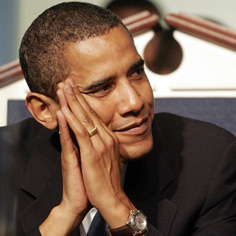
obama-in-repose.jpgThat’s a hard idea for the worldly-wise commentator to swallow because it sounds too glib. Even so, it is a message that resonates with Obama’s audience because he possesses that rarest of political commodities: authenticity.

To the cynical eye, Obama embodies the superficiality of American presidential politics. He is seen as the kind of candidate that Hollywood would dream up if concocting a modern-day JFK: good-looking; brimming with confidence and charisma; multicultural; a black man who sounds like a white man — the perfect star for an all-American blockbuster. As an icon, he makes the perfect contrast to Mitt Romney who, as Michael Kinsley wrote the other day, “radiates conventionality, with his ‘Leave-It-to-Beaver’-and-then-some family and his good looks straight out of ‘Mad Men,’ the TV series about Madison Avenue in the early 1960s.”

To the outside world, Obama represents a passionate yearning for America to redeem itself — for an end to the nightmare of the Bush era; for reconciliation and forgiveness; for the hope that the United States will once again resume an honored place within the community of nations.

To his supporters and an increasing number of other Americans, Obama has captured the hope that he can reclaim the possibility of government of the people, by the people, for the people.

*

In the world of a televised presidential contest, the primaries bear a disquieting resemblance to so many other TV games of elimination. Who’s going to get the prize? Who’s going to get bumped off the stage? Who scored points and who took the hard hits? As a game contestant, Obama’s performance has been mixed — but this isn’t why he’s winning.

He’s winning because whereas his opponents appear to be promoting themselves, he conveys a compelling sense that he’s rooting for America. This is quintessential populism but the unique distinction that Obama lends this is that his appeal to the collective is credible.

September 11 brought Americans together, but this was a unity forged through fear. It was the solidarity that comes from facing a common enemy. It was not and could never be sustainable. It was from its inception, ripe for abuse.

The unity that Obama has tapped into and is eager to cultivate comes from recognizing a common purpose and collective interests. It’s not about for-us-or-against-us; it’s about us.

While American democracy might be cursed by a poorly informed electorate — especially in the arena of international affairs — America’s voters are not lacking in the canniness that judges character and ultimately makes democracy work.

For many months, Hillary Clinton’s popularity was sustained as much by the expectation that her nomination was a foregone conclusion, as it was by her political acumen. But as soon as Obama upturned the equation, the zeitgeist shifted.

The prosaic questions facing the voters used to be, which among these candidates is capable of winning the election, of guiding the country in the right direction, and “appears presidential”?

The question then became, is it possible that the United States could have a president who actually places the country and not him or herself at the center of their vision of leadership?

Clinton said of herself when interviewed on CNN today, “I am so other-oriented,” yet as sincere as she might be in making that claim, she is running a campaign in which she places herself squarely at the center. In contrast, Obama puts the country first, yet if this was merely for rhetorical effect, it could as easily be imitated — just as the campaign theme of “change” has of late been universally adopted. What cannot be mimicked is authenticity.

When Obama says, “we are one nation; we are one people; and our time for change has come,” this resonates with his audience not simply because they like the message, but because they hear in this declaration the voice of a genuine catalyst for something much larger than himself.

Facebooktwittermail
