
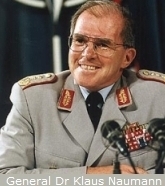
 “We cannot survive in a world in which we are confronted with people who do not share our values, who unfortunately are in the majority in terms of numbers, and who are extremely hungry to see success. So, if we want to survive, we have to stand together. And I think that is a view which the majority in Europe shares, and I think also the majority in the United States understands.”
When the post-Bush era starts a year from now, much of America and most of the world will let out a big sigh of relief. But we won’t be out of the woods. The leading neoconservatives might have been thoroughly discredited and effectively marginalized, but in a sense, they were always merely a caricature of important trends in the Western outlook that have much deeper roots, much greater breadth, and in the course of history have wrought much more destruction than did the small minds that shaped the Bush agenda.
Outside the glare of media attention a new circle of proponents of this outlook has emerged and their objectives are no less sweeping than those that gave rise to the neocons’ dream of a New American Century. The advocates of this new vision are regarded by others and see themselves as hard-headed realists. As retired generals, none will ever be dubbed a “chickenhawk.” But what the generals have in mind could very well provide the building blocks for what could fittingly be called, neoconservatism 2.0.
Important lessons have been learned. This time America won’t place itself in the bullseye as a target for global animosity. Instead, rather than striving for the preservation of the American hegemon, now the primary objective is the defense of the West, providing security for the citizens of every nation between Finland and Alaska. The Manichaean terms of a war of good against evil are being dropped; instead the conflict is being framed in dryly abstract terms: certainty versus irrationality. And just to make it clear that this is unequivocally about the preservation of secular Western preeminence, Zionism is kept well out of the picture.
The new message comes from a group of retired generals who self-effacingly describe themselves as “dinosaurs” and are known affectionately to their acolytes as “the gang of five.” Their aim is to restructure and empower NATO — a mission which will likely capture the interest of few outside the foreign policy communities on either side of the Atlantic. After all, how many Americans even know what the letters N-A-T-O stand for? Yet underpinning this objective there is a wider goal no less sweeping and not far removed from that advocated by Bernard Lewis, Norman Podhoretz and their merry band of followers: the defense of the West from the threat posed by those who do not share our values.
This time the plot unfolds not inside the reason-insulated walls of the American Enterprise Institute but instead comes from a bastion of realism, the Center for Strategic and International Studies in Washington DC. It was there recently that five distinguished military leaders presented their vision for a new world order in a manifesto they title, Towards a Grand Strategy for an Uncertain World – Renewing Transatlantic Partnership. [PDF] In his introduction to the so-called “Gang of Five,” CSIS president, John Hamre, described them as “some of the best minds that we have in defense intellectual circles”
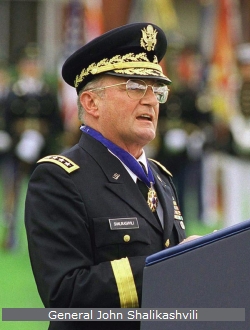 They are, from the United States, former Chairman of the Joint Chiefs of Staff and former NATO Supreme Allied Commander in Europe, General John Shalikashvili, joined from Europe by General Dr Klaus Naumann (former Chief of the Defence Staff of Germany and former Chairman of the Military Committee of NATO), Field Marshal Lord Inge (former Chief of the Defence Staff of the United Kingdom), Admiral Jacques Lanxade (former Chief of the Defence Staff of France and former Ambassador to Tunisia) and General Henk van den Breemen (former Chief of the Defence Staff of the Netherlands). They have all served together in NATO.
Put together any group of retired generals and it’s predictable that they will hanker after some of their lost power, but when it comes to this particular group their credentials guarantee that even in retirement their authority is hard to ignore. As commentator Dr Pascal Boniface notes, one can assume that “former military chiefs of staff are not free riders. Their document is probably a way to test ideas for NATO’s current leaders: since the latter cannot afford to be so blunt publicly, they let their former colleagues do it for them.”
The palliative that the generals present for a Western world threatened by disorder should be seen for what it is — a martial vision:
We seek to uphold a common and stable experience, shunning the arbitrary in favour of closure in debate. Certainty can promote strong society and social interdependence. While 100 per cent certainty may be unattainable, it is clear that in periods of great – even overwhelming – uncertainty something serious is happening to our institutions and our societies.
Certainty in our world is today being eroded by a proliferation of information, knowledge and choice. The erosion of certainty is accelerated by rapid technological, social and cultural change. On occasion, that change occurs too fast for some of our major institutions to cope with.
In certain important senses, we are today operating in a mist. Through that current mist a wide range of challenges are appearing. The challenges are acute, and no less so because our certainties are in retreat. If they were stronger, our resolve to address these problems might have stiffened. But the loss of familiar certainties reveals that we lack such resolve.
While the generals have as their stated aim, to provide “security for the citizens of all nations between Finland and Alaska,” they clearly lack confidence that in its current state the West can save itself from the corrosive effects of irrationality. In their eyes, an insidious process has already weakened our culture. What they call, “the problem of the rise of the irrational,” the generals perceive in “soft examples, such as the cult of celebrity, which demonstrate the decline of reason,” and in “harder examples, such as the decline of respect for logical argument and evidence, a drift away from science in a civilisation that is deeply technological,” and finally in their ultimate example, “the rise of religious fundamentalism, which, as political fanaticism, presents itself as the only source of certainty.”
At this point one might say, they’re entitled to their opinion and at least in America, with its deeply-rooted anti-intellectual tendencies, we might welcome some strong voices willing to speaking out in defense of reason. Even if the outlook of the Gang of Five expresses a form of cultural imperialism, is it not at the same time in its own terms quite reasonable?
If the Grand Strategy often seems measured and thoughtful, it is not until we come to the generals’ views on deterrence that it becomes clear that this is a genuinely radical manifesto. Understandably this is the part of the document that caught a few headlines:
One truly indispensable element of any strategy in the 21st century is deterrence. This will no longer be deterrence by punishment, nor the threat of total destruction, which served us so well in preserving peace during the Cold War.
In the Post-Westphalian world, and against non-state actors, such deterrence does not work. What is needed is a new deterrence, which conveys a single, unambiguous message to all enemies: There is not, and never will be, any place where you can feel safe; a relentless effort will be made to pursue you and deny you any options you might develop to inflict damage upon us.
Deterrence in our time thus still avails itself of creating uncertainty in the opponent’s mind – no longer reactively but proactively. What is needed is a policy of deterrence by proactive denial, in which pre-emption is a form of reaction when a threat is imminent, and prevention is the attempt to regain the initiative in order to end the conflict.
As deterrence might occasionally either be lost or fail, the ability to restore deterrence through escalation at any time is another element of a proactive strategy.
Escalation is intimately linked to the option of using an instrument first. A strategy that views escalation as an element can, therefore, neither rule out first use nor regard escalation as pre-programmed and inevitable. Escalation and de-escalation must be applied flexibly. Escalation is thus no longer a ladder on which one steps from rung to rung; it is much more a continuum of actions, as though there is a ‘trampoline’ that permits the action to be propelled up into the sky at one moment and just to stand still the next.
Such a concept of interactive escalation requires escalation dominance, the use of a full bag of both carrots and sticks – and indeed all instruments of soft and hard power, ranging from the diplomatic protest to nuclear weapons. As flexible escalation and de-escalation are the crucial instruments in gaining and maintaining the initiative, fast decision making is of the essence. The traditional forms and methods of governments and international organisations will today (in a world of instantaneous global communications) no longer be capable of meeting this requirement. Thus a thorough review and adaptation is required. Nuclear weapons are the ultimate instrument of an asymmetric response – and at the same time the ultimate tool of escalation. Yet they are also more than an instrument, since they transform the nature of any conflict and widen its scope from the regional to the global. Regrettably, nuclear weapons – and with them the option of first use – are indispensable, since there is simply no realistic prospect of a nuclear-free world.
What might this mean in practical terms?
The future we are facing requires more, not less, international integration; but as the national state is – and will remain for the foreseeable future – the core of decision making, we must stress that governments need to think about adapting the organisation of government, as well as about dramatic changes in national decision making.
The generals regard winning “the hearts and minds of their own people” as one of the many challenges facing Western governments. They also believe that we have already entered a “Post-Westphalian world” in which the nation state has lost much of its power. While many observers who might share a similar view would see at this time a need for the rejuvenation of democracy, for these distinguished military thinkers the security of the West hinges on a “restoration of certainty” derived from a greatly empowered Western alliance under the auspices of NATO.
Whereas in the narrative of the post-Cold War history of nation states we were, until quite recently, living in a world where the power of the United States was unchallenged, the authors of the Grand Strategy implicitly envisage a new unipolar moment in which among international entities NATO can assume a position of unchallenged supremacy. They claim that NATO’s actions would remain tethered to the will of nation states (“the core of decision making”), yet the NATO they envision would appear to have more power and less accountability than the United States has had under George Bush. It would be led by a triumvirate directorate — the President of the United States, the Secretary General of NATO, and the soon-to-be-established President of the European Council. There can be little doubt that the latter two would be subservient to the former. And while the generals seem to be purposefully vague in saying that there need to be adaptations in the organization of government, along with “dramatic changes in national decision making,” the thinly-veiled implication is that NATO must be unshackled from the currently slow moving wheels of democracy and international consensus building.
As a military entity, the new NATO would have the greatest destructive power that any nation can now wield, minus the inflexibility (whose actual source is political accountability — not that the authors care to mention this), providing military forces with the very same strengths that terrorists now use to such great effect:
Asymmetry will be used by all conflict parties, which means both that our side must be more prepared for the unexpected than ever before, and that the opponent must never know how, where or when we will act. To act asymmetrically could well be an instrument in regaining the initiative and could require deployment of the full range of options, from diplomacy to military intervention. Nuclear escalation is the ultimate step in responding asymmetrically, and at the same time the most powerful way of inducing uncertainty in an opponent’s mind.
It is important, furthermore, to have dominance over the opponent’s ability to calculate his risks. It is a very important element of strategy to keep things unpredictable for the opponent, who must never be able to know, or calculate, what action we will take. It is essential to maintain this dimension of psychological warfare by instilling fear in an opponent, to retain an element of surprise and thus deny him the opportunity of calculating the risk.
What the authors neglect to spell out is that there is actually only one way of credibly employing such a strategy: A willingness to engage in nuclear escalation would have to be proved through the use of nuclear weapons; otherwise it will be seen as an empty threat.
When the Grand Strategy was presented to the foreign-policy wonks at CSIS, the nuclear issue was not even mentioned. The realists would prefer to couch this strategic initiative in the seemingly benign terms of a much-needed renewal of the much-revered transatlantic alliance. This, they want to suggest, is a significant departure from the unilateralism of the Bush era and a recommitment to cooperation and a recognition of mutual dependence between long-allied nations. This is a welcome return to internationalism.
Select the right strands of the analysis and this is what one might come up with. But then we have to return to Gen. Klaus Naumann’s unvarnished remarks that appears at the top of this article. The issue here is not merely about re-tooling the operational structure of NATO; it’s about beating back the barbarians who are pounding at the gates. They, he says, out number us. Our survival is at stake. If we are going to effectively defend ourselves we need to unleash our ultimate strength and enter a brave new world of nuclear warfare. This goes beyond the boilerplate of “keeping all options on the table” — this is about shaping expectations by using those options.
As a policy document, who is to say whether the Grand Strategy will soon be forgotten and gather dust as quickly as have so many others. Its significance, however, may lay elsewhere, not as much in its details but as an enunciation of a broadly felt sense that Western power is threatened; that the relative stability of the West has been a testament to our values more than our ability to dominate the rest of the world; that the enterprise of Westernizing the world is now doomed to fail and that self-preservation has become the primary challenge.
To those who regard Western global dominance as a testament to the West’s inherent superiority, Western power must be guarded vigilantly. What the Western preservationists fail to admit is that the civilization they are so desperate to defend, no longer exists.



 Senator Edward M. Kennedy will endorse Barack Obama for president tomorrow, breaking his year-long neutrality to send a powerful signal of where the legendary Massachusetts Democrat sees the party going — and who he thinks is best to lead it.
 Over the years, I’ve been deeply moved by the people who’ve told me they wished they could feel inspired and hopeful about America the way people did when my father was president. This sense is even more profound today. That is why I am supporting a presidential candidate in the Democratic primaries, Barack Obama.
