
Memo: Laws didn’t apply to interrogators
The Justice Department sent a legal memorandum to the Pentagon in 2003 asserting that federal laws prohibiting assault, maiming and other crimes did not apply to military interrogators who questioned al-Qaeda captives because the president’s ultimate authority as commander in chief overrode such statutes.
Iranian who brokered Iraqi peace is on U.S. terrorist watch list
The Iranian general who helped broker an end to nearly a week of fighting between Iraqi government forces and Shiite Muslim militiamen in southern Iraq is an unlikely peacemaker.
Brig. Gen. Qassem Suleimani, who helped U.S.-backed Iraqi leaders negotiate a deal with radical Shiite cleric Muqtada al Sadr to stop the fighting in Iraq’s largely Shiite south, is named on U.S. Treasury Department and U.N. Security Council watch lists for alleged involvement in terrorism and the proliferation of nuclear and missile technology.
His role as peacemaker, which McClatchy first reported Sunday, underscores Iran’s entrenched political power and its alliances in Iraq, according to analysts.
Basra battle strengthens Sadr
The Iraqi government’s inability to oust Moqtada al-Sadr’s militia from Basra has boosted the fortunes of the Shiite cleric while damaging the standing of Prime Minister Nouri al-Maliki.
Mr. Sadr appears to be the one clear winner from the inconclusive fighting in the country’s second-biggest city, which began to taper off Monday after the cleric urged his followers to observe a truce.
The failure of the Iraqi strikes against Mr. Sadr’s Mahdi Army has implications for both U.S. policy in Iraq and the presidential campaign.
Disunity in Damascus
Muammar Gadafy is usually good for a laugh, and he raised some thin – if strained – smiles at the weekend’s Arab summit in Damascus when he took his fellow leaders to task for wasting his time and theirs. Talk of unity, complained Libya’s irrepressibly candid “brother leader”, was nonsense when Arab states spent their time plotting against each other, achieving nothing and standing idly by when one of their number (Saddam Hussein) was toppled by foreign armies.
Bashar al-Assad, the Syrian president and summit host, put a brave face on Gadafy’s jibes and the embarrassingly low turnout in his spanking new conference centre. But no-shows by 11 heads of state – exactly half the membership of the 22-strong Arab League – was hardly a ringing endorsement of an event described as expressing Arab solidarity or of his own country as “the beating heart of Arabism”.
Obama is the change that America has tried to hide
I have come home from a long stay in Mexico to find – because of the presidential campaign, and especially because of the Obama-Clinton race for the Democratic nomination – a new country existing alongside the old. On any given day we, collectively, become the goddess of the three directions and can look back into the past, look at ourselves just where we are, and take a glance, as well, into the future. It is a space with which I am familiar.
When I joined the freedom movement in Mississippi in my early 20s, it was to come to the aid of sharecroppers, like my parents, who had been thrown off the land they’d always known – the plantations – because they attempted to exercise their “democratic” right to vote. I wish I could say white women treated me and other black people a lot better than the men did, but I cannot. It seemed to me then, and it seems to me now, that white women have copied all too often the behaviour of their fathers and their brothers. In the south, especially in Mississippi, and before that, when I worked to register voters in Georgia, the broken bottles thrown at my head were gender-free.
I made my first white women friends in college; they loved me and were loyal to our friendship, but I understood, as they did, that they were white women and that whiteness mattered.
Clinton slipping on trust
In the weeks before the Pennsylvania primary, Sen. Hillary Clinton not only lags Sen. Barack Obama in the race for delegates, she also is losing ground in her effort to convince voters that she is trustworthy.
The debate over her record has left Sen. Clinton confronting her lowest approval rating since April 2006, according to a Wall Street Journal/NBC News poll released last week.
According to the survey, 29% of the approximately 1,000 respondents said they had a very negative opinion of Sen. Clinton compared with 15% for Sen. Barack Obama and 12% for Sen. John McCain, the likely Republican nominee.
The Coalition of the Unwilling
Last September, President Bush flew down to Sydney and urged Australian voters not to reject the leader he dubbed his “man of steel,” Prime Minister John Howard.
“I wouldn’t count the man out,” Bush said. “He’s kind of like me: We both have run from behind, and won.”
Australians weighed that advice and, two months later, emphatically dumped the conservative prime minister in favor of Labor leader Kevin Rudd — who had promised to sign the Kyoto accord on global warming and pull troops out of Iraq.
Now it’s time for Rudd’s revenge: a chance to meddle in domestic American politics the way Bush meddled in Australian affairs last year. “Consistent with my commitment to the Australian people, we are changing the configuration of our involvement in Iraq,” he told an audience yesterday morning at the Brookings Institution. “Our ground combat troops will be withdrawn.”



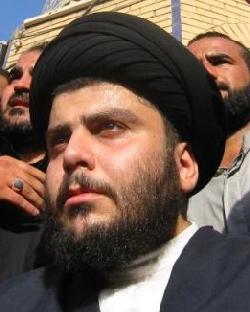 he Iraqi military’s offensive in Basra was supposed to demonstrate the power of the central government in Baghdad. Instead it has proven the continuing relevance of anti-American cleric Moqtada al-Sadr. Sadr’s militia, the Mahdi Army, stood its ground in several days of heavy fighting with Iraqi soldiers backed up by American and British air power. But perhaps more important than the manner in which the militia fought is the manner in which it stopped fighting. On Sunday Sadr issued a call for members of the Mahdi Army to stop appearing in the streets with their weapons and to cease attacks on government installations. Within a day, the fighting had mostly ceased. It was an ominous answer to a question posed for months by U.S. military observers: Is Sadr still the leader of a unified movement and military force? The answer appears to be yes.