Daily Archives: April 5, 2009

Nuclear disarmament: a dream or an imperative?

Obama outlines disarmament plan

Under a hazy spring sky, before a swelling Czech crowd, U.S. President Barack Obama called for an international effort to lock down nuclear weapons materials within four years, one of a host of steps he said would move the globe to nuclear disarmament.

Speaking just hours after North Korea launched a controversial multistage rocket, the U.S. president took to the stage in Castle Square here, testifying “clearly and with conviction” to an audience of at least 20,000 of “America’s commitment to seek the peace and security of a world without nuclear weapons.”

“We have to insist, ‘Yes, we can,'” he said, reprising a battle theme recognizable to a crowd a continent away from his campaign victory. [continued…]

Many obstacles to Obama nuclear dream

President Obama’s hopes for a world free of nuclear weapons may just be a dream.

Despite his rousing rhetoric in Prague that “we can do it”, huge obstacles are in the way and even he gave himself two escape clauses.

The first was that he did not necessarily expect this to happen in his lifetime. He is 47 years old, so, given that the life expectancy in the US is about 78, that means another thirty years or more in which the goal might not be realised. [continued…]

Editor’s Comment — A goal is just a dream unless there’s a deadline. When JFK announced his plan to send a man to the moon, he didn’t add the caveat, “but it might not happen in my lifetime.”

In a single breath, Obama inflated hopes and then let them drift away. To turn a dream into a reality will require a clearly defined strategy, a set of intermediary goals and deadlines, and genuine political commitment. If Obama becomes really serious, this could actually be the easy route for him to make history.

Gone are the days when nuclear disarmament could be dismissed as a lofty goal only entertained by dreamers. The CND marchers from the 50’s led by the likes of Bertrand Russell have been replaced an unlikely band of elder-statesman realists. Henry Kissinger, George Shultz, William Perry, and Sam Nunn made appeals for disarmament in 2007 and 2008 that drew a favorable response by pointing out that the risks in failing to disarm are now far greater than the challenge of taking on this goal.

But how can disarmament be easy? Of course it won’t be — but everything is relative. Placed alongside objectives such as tackling climate change, ending poverty or eradicating terrorism, nuclear disarmament is a much less complex undertaking. Whether Obama is ready to lead the way may come down to whether he has the courage to take on a bold political strategy that ties together nuclear disarmament with Middle East policy.

The effort to press Iran to abandon its uranium enrichment program would acquire a moral legitimacy that has so far been lacking if this particular objective was an integral part of a wider campaign for disarmament. At the same time, if Iran is to be persuaded then pressure must simultaneously be placed on Israel to both sign the non-proliferation treaty and commit to its own disarmament.

Benjamin Netanyahu says that stopping Iran becoming a nuclear power is a global imperative. Fair enough — but what is Israel willing to give up to make that happen?

If Obama wants to take a small but highly symbolic step in the right direction, he could tell the Israeli prime minister during his first trip to Washington, that the United States will no longer afford Israel the privelage of colluding in Israel’s policy of “nuclear ambiguity”. Robert Gates already chipped a crack in the foundations of that policy during his confirmation hearings. Now it’s time to drop the pretense altogether.

Challenging Iran’s nuclear aspirations requires acknowledging Israel’s nuclear realities.

US may cede to Iran’s nuclear ambition

US officials are considering whether to accept Iran’s pursuit of uranium enrichment, which has been outlawed by the United Nations and remains at the heart of fears that Iran is seeking nuclear weapons capability.

As part of a policy review commissioned by President Barack Obama, diplomats are discussing whether the US will eventually have to accept Iran’s insistence on carrying out the process, which can produce both nuclear fuel and weapons- grade material.

“There’s a fundamental impasse between the western demand for no enrichment and the Iranian dem­and to continue enrichment,” says Mark Fitzpat­rick, a former state depart­- ­­ment expert now at the International Institute for Strategic Studies. “There’s no obvious compromise bet­ween those two positions.” [continued…]

Facebooktwittermail

Criticizing Israel

Statement by incoming Foreign Minister Avigdor Lieberman at the ministerial inauguration ceremony

The Israeli government never approved Annapolis, neither the Cabinet nor the Knesset, so anyone who wants to amuse himself can continue to do so. I have seen all the proposals made so generously by Ehud Olmert, but I have not seen any results.

So we will therefore act exactly according to the Road Map, including the Tenet document and the Zinni document. I will never agree to our waiving all the clauses – I believe there are 48 of them – and going directly to the last clause, negotiations on a permanent settlement. No. These concessions do not achieve anything. We will adhere to it to the letter, exactly as written. Clauses one, two, three, four – dismantling terrorist organizations, establishing an effective government, making a profound constitutional change in the Palestinian Authority. We will proceed exactly according to the clauses. [continued…]

Editor’s Comment — Lieberman needs to study the agreement that he just promised Israel will assiduously abide by. Phase One concludes:
— Government of Israel immediately dismantles settlement outposts erected since March 2001.

— Consistent with the Mitchell Report, GOI freezes all settlement activity (including natural growth of settlements).

Prominent gentiles must get over their hangups and start criticizing Israel

This post is not aimed at Jews. Note the headline. Many non-Jews have not come into this space–Criticizing Israel– because of fears of being called anti-Semites and written off. Years ago my friend Rob Buchanan said to me, Phil you have to speak out on this ’cause they’ll just smear non-Jews as anti-Semites. And I accepted that responsibility.

But the point of this post is that the passivity of likeminded gentiles has now become a problem. We need more prominent gentiles to step forward. [continued…]

Editor’s Comment — I can’t claim to be a prominent gentile but I’m certainly one who has never been terribly worried about being accused of being an anti-Semite. (Everyone has to be able to read their own moral compass and so long as you are confident in doing that, it doesn’t really matter what kinds of slurs get flung in your direction.)

But the challenge now is not one of recruiting gentiles; it is one of transcending tribalism.

Pro-Israel Jews have two weapons that they predictably unleash. They demean and belittle fellow Jews by calling them “self-hating” whereas they vilify non-Jews by implying that they harbor the murderous intent of anti-Semites.

This is a divide-and-rule tactic and maybe the best way of responding to it is by forging solidarity and recognizing that those who draw attention to the ethnicity of Israel’s critics are merely trying to deflect attention from the criticism to the critic.

New town may be death blow to hopes for Israel peace

The sign in big, red Hebrew letters reads “Welcome to Mevasseret Adumim, the Harbinger of the Hills”. A three-lane road with roundabouts leads up the hill to a police station and street lamps line the flyover that links the new town to neighbouring Ma’aleh Adumim, one of the largest Jewish settlements in Israel.

There are no houses, cars or people in Mevasseret Adumim: it is a town laid out, waiting to be built. That is because international pressure has so far prevented construction from going ahead. The area is the last piece of open land linking Arab East Jerusalem to the West Bank and critics said that to develop it would bury the very notion of a two-state solution to the Middle East crisis.

According to reports in the Israeli media, the area has been earmarked for development under a secret accord between Binyamin Netanyahu, the new, conservative Israeli Prime Minister, and his ultra-nationalist Foreign Minister, Avigdor Lieberman. [continued…]

Netanyahu, America and the cow in the house

To understand how Israel’s new Netanyahu government will handle relations with its neighbours, and a US administration with which it is clearly at odds, it is worth recounting an old Hasidic Jewish folktale

A man’s wife nags him relentlessly that their home is too small. A poor man, he can afford nothing larger, so he asks the advice of his rabbi. “Bring your chickens into the house,” the rabbi advises, which the man duly goes home and does. Naturally his wife’s anger escalates, which he reports back to the rabbi the following day. “Now bring in your goat,” the sage advises – a course of action with predictable consequences, but when the man returns the rabbi orders him to bring a cow into the house the next night. The man returns red-eyed and frantic after a sleepless night. “Rabbi, what can I do, my wife is threatening to leave.” To which the rabbi replies: “Now, take out the cow.”

The basic principle is simple: when you have a problem you can’t solve, create a bigger one. Plainly, Benjamin Netanyahu has a problem he can’t solve: Israel is highly dependent on US support, but America now has an administration determined to move quickly to end the conflict that has raged since Israel’s creation in 1948 by creating a viable, independent Palestinian state. And Mr Netanyahu has repeatedly insisted that he cannot accept such an outcome because he deems sovereign independence for the Palestinians to be an intolerable threat to Israel’s security. [continued…]

Facebooktwittermail

NEWS & VIEWS ROUNDUP & EDITOR’S COMMENT: April 5

The poor must be included in a global economy

In an age characterised by the death of trust we find comfort in being able to blame everyone. It is entirely reasonable that thousands will protest, hopefully peacefully, against bankers who stuck their noses in the trough, regulators who turned away and governments who kept smiling as the tax take grew. The truth is they could just as easily protest against themselves for blindly succumbing to this leveraged society. We must now clear up the mess. Amid all the experts who failed to call this disaster, only one got it right. It was Bob Dylan, who said: “Money doesn’t talk. It swears.”

The system was always skewed and its rewards asymmetric. We built a global economy that excluded half of the globe. We marginalised the productive capacity of the 3bn people who live on less than $2 a day. By excluding them, we deprived them of the income they need to buy our stuff and consigned them to ill-health, lack of education and conflict. Instability is inherent in asymmetry. It will topple over. The first task of the Group of 20 nations must be to bring the peripheral economies and their people into the centre. [continued…]

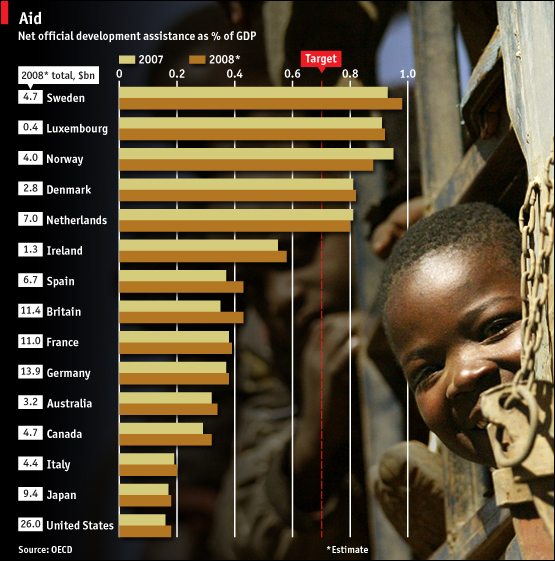
Editor’s Comment — In the midst of an economic crisis, the spirit “charity begins at home” always prevails. But in America on top of that there is a near universal assumption that the United States leads the world when it comes to foreign aid. That might be true as a raw number, but when it comes to aid as a proportion of GDP the US lags way behind the leading nations.

A key element of the crisis is a deficit of ethics

Financial crises are triggered when — partially due to the decline of correct ethical conduct — those working in the economic sector lose trust in its modes of operating and in its financial systems. Nevertheless, finance, commerce and production systems are contingent human creations which, if they become objects of blind faith, bear within themselves the roots of their own downfall. The only true and solid foundation is faith in the human person. For this reason all the measures proposed to rein in this crisis must seek, ultimately, to offer security to families and stability to workers and, through appropriate regulations and controls, to restore ethics to the financial world. [continued…]

Administration seeks an out on bailout rules for firms

The Obama administration is engineering its new bailout initiatives in a way that it believes will allow firms benefiting from the programs to avoid restrictions imposed by Congress, including limits on lavish executive pay, according to government officials.

Administration officials have concluded that this approach is vital for persuading firms to participate in programs funded by the $700 billion financial rescue package.

The administration believes it can sidestep the rules because, in many cases, it has decided not to provide federal aid directly to financial companies, the sources said. Instead, the government has set up special entities that act as middlemen, channeling the bailout funds to the firms and, via this two-step process, stripping away the requirement that the restrictions be imposed, according to officials. [continued…]

‘Holy hell’ over torture memos

A fierce internal battle within the White House over the disclosure of internal Justice Department interrogation memos is shaping up as a major test of the Obama administration’s commitment to opening up government files about Bush-era counterterrorism policy.

As reported by Newsweek, the White House last month had accepted a recommendation from Attorney General Eric Holder to declassify and publicly release three 2005 memos that graphically describe harsh interrogation techniques approved for the CIA to use against Al Qaeda suspects. But after the story, U.S. intelligence officials, led by senior national-security aide John Brennan, mounted an intense campaign to get the decision reversed, according to a senior administration official familiar with the debate. “Holy hell has broken loose over this,” said the official, who asked not to be identified because of political sensitivities.

Brennan is a former senior CIA official who was once considered by Obama for agency director but withdrew his name late last year after public criticism that he was too close to past officials involved in Bush administration decisions. Brennan, who now oversees intelligence issues at the National Security Council, argued that release of the memos could embarrass foreign intelligence services who cooperated with the CIA, either by participating in overseas “extraordinary renditions” of high-level detainees or housing them in overseas “black site” prisons. [continued…]

Federal judge to Obama DOJ: You’re wrong, Bagram Prisoners do have rights

Barack Obama’s Department of Justice made headlines in late February when it adopted the Bush administration’s notoriously unconstitutional stance on prisoners at Bagram Air Base, claiming that such “detainees” have no right to challenge their detention. As the Independent UK reported at the time, “less than a month after signing an executive order to close the Guantanamo Bay prison camp, President Barack Obama has quietly agreed to keep denying the right to trial to hundreds more terror suspects held at a makeshift camp in Afghanistan that human rights lawyers have dubbed ‘Obama’s Guantanamo.'”

Four prisoners at Bagram, however, have been challenging this position in court since before Obama took office — and today, three of them won a major victory.

In a momentous, 53-page decision by Judge John D. Bates of the U.S. District Court for the District of Columbia, a U.S. court concluded “for the first time,” according to the International Justice Network, “that detainees held indefinitely without charge in U.S. custody in Afghanistan are entitled to challenge their detentions in U.S. courts.” [continued…]

U.S. attacks ‘Sons of Iraq,’ its former allies

Less than a week after helping disarm and disband a Sunni paramilitary group that had once been on its payroll, the U.S. military has now directly clashed with some of its former allies.

Multi-National Division – Baghdad announced today that a U.S. aircraft targeted “Sons of Iraq” members who were spotted planting a roadside bomb last night north of Taji. According to a coalition news release, one man was killed in the strike; two others were found wounded in a nearby house. At least one of the men was identified has having served in the “Sons of Iraq.” That’s the largely Sunni tribal group, bankrolled by the U.S. to keep order in their neighborhoods — and to stop fighting American forces. Many of the “Sons” were former insurgents, and insurgent allies. If they flip back to being enemies of the government, the Iraq enterprise could be in deep, deep trouble. [continued…]

Outcry in Pakistan after video of a 17-year-old girl’s flogging by the Taliban is shown on TV

The Pakistani government has ordered an inquiry into the flogging of a 17-year-old woman by Taliban militants in the troubled Swat valley, after public outrage triggered by shocking video footage of the punishment.

The images, played yesterday on private television channels, show a burka-clad woman being pinned to the ground by two men while a third whips her backside 34 times. The woman is seen screaming and begging for mercy as a crowd of largely silent men look on. She is accused of having had an illegal sexual relationship, according to local law. Her brother is among those restraining her.

President Asif Ali Zardari led a wave of public condemnation, and ordered the arrest of the perpetrators. Prime minister Yousaf Raza Gilani termed it “shocking” and called for an immediate inquiry. At the supreme court, the newly reinstated chief justice, Iftikhar Chaudhry, summoned officials to a hearing scheduled for Monday to investigate the incident. [continued…]

Britain says U.S. doesn’t object to efforts to engage Hezbollah

The Obama administration is “comfortable” with the British government’s attempts to engage Hezbollah, the Iranian-backed group that the U.S. labels a terrorist organization, a senior British diplomat asserts.

Bill Rammell, Britain’s minister of state for foreign and Commonwealth affairs, said in a brief interview late last week in Damascus that despite protests to the contrary, the new U.S. administration does not object to the fledgling contacts with the political wing of the Lebanon-based Shiite Muslim group, which also has a heavily armed militia.

Britain likens the attempt to engage Hezbollah, launched quietly this year, to its outreach to political leaders of the Irish Republican Army — a move that helped quell the Northern Ireland conflict. [continued…]

Facebooktwittermail