
Daily Archives: September 15, 2009

Israel’s war against human rights

UN: Evidence Israeli ‘war crimes’ and ‘crimes against humanity’ a ‘result of deliberate planning and policy decisions’

A United Nations fact-finding mission investigating the three-week war in Gaza issued a lengthy, scathing report [PDF] on Tuesday that concluded that both the Israeli military and Palestinian armed groups “committed actions amounting to war crimes,” and possibly crimes against humanity.

The four-member mission, led by Justice Richard Goldstone, a widely respected South African judge, also concluded that neither Israel nor the Palestinian groups had carried out any “credible investigations” into the alleged violations. If that did not change within six months, the United Nations Security Council should refer the situation to the International Criminal Court in the Hague for possible prosecution, the panel concluded.

“The prolonged situation of impunity has created a justice crisis in the Occupied Palestinian Territory that warrants action,” the members said in their 574-page report on the war, during which some 1,200 Palestinians were killed, including at least several hundred civilians, and 13 Israelis died, 10 soldiers and 3 civilians. [continued…]

Editor’s Comment — Perhaps the report’s most disturbing finding says less about the past than it portends for Gaza and Israel’s future:

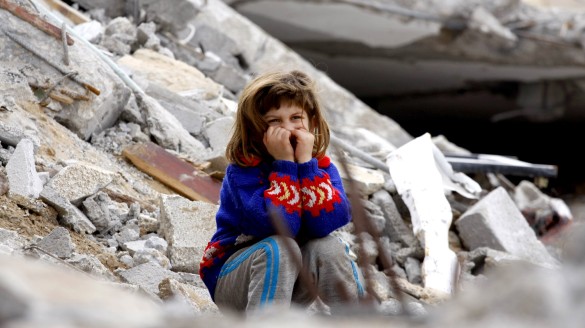
Some 30 per cent of children screened at UNRWA schools had mental health problems, while some 10 per cent of children had lost relatives or friends or lost their homes and possessions. WHO estimated that some 30,000 children would need continued psychological support and warned of the potential for many to grow up with aggressive attitudes and hatred.

Judge Goldstone and the pollution of argument

The despicable attacks on human rights organisations investigating Israel’s Gaza offensive in January confirm Churchill’s observation: “A lie gets halfway around the world before the truth has a chance to get its pants on.” The mission led by the South African judge Richard Goldstone to investigate international human rights and international humanitarian law violations during Israel’s offensive, established by the UN Human Rights Council (UNHRC), is the latest victim. His findings are about to be made public. The knives have been out for the mission for months. Now they are being plunged into him and his colleagues. Until the report is out Goldstone can’t defend it. So the smears and misrepresentation are left free to pollute public discourse.

The New York-based Human Rights Watch (HRW) has assiduously responded to a deluge of scurrilous attacks on its credibility and staff, yet totally unfounded allegations – for example, about accepting Saudi government funding and failing to give a critical report to the Israel Defence Forces before releasing it to the public – are constantly being recycled. HRW messed up by failing to see that the nerdy and, to most people, disturbing hobby of its weapons expert Marc Garlasco (he collects German and American second world war memorabilia) could be used to discredit his role as author of highly critical reports of Israel’s military conduct in Gaza. But when this story broke last week, the equation implied in some allegations – “Nazi” object-collector plus “Israel-basher” equals “antisemite” – was baseless and defamatory. That he also worked on reports critical of Hamas and Hezbollah was ignored. As another excuse to attack HRW, and deflect attention from its reports’ findings, the Garlasco affair was a gift.

The human rights world is not beyond reproach. UNHRC has hardly been impartial on Israel. Goldstone accepted his role only after the council president agreed to the alteration of the mission’s mandate to cover all parties to the conflict, not just Israel. But mistrust alone does not explain the extraordinary scale of the attacks on human rights organisations, including all Israeli ones, for their reports on Israel. [continued…]


Facebooktwittermail

Withdrawal without winning?

Withdrawal without winning?

Most discussion about Afghanistan has concentrated on whether and how we can defeat the Taliban. Less attention has been paid to the probable consequences of a withdrawal without winning, an option toward which I incline. What is most striking is not that what I take to be the majority view is wrong, but that it has not been adequately defended. This is especially important because the U.S.has embarked on a war that will require great effort with prospects that are uncertain at best. Furthermore, it appears that Obama’s commitment to Afghanistan was less the product of careful analysis than of the political need to find a “tough” pair to his attacks on the war in Iraq during the presidential campaign. It similarly appears that in the months since his election he has devoted much more attention to how to wage the war than to whether we need to wage it.

The claim that this is a “necessary war” invokes two main claims and one subsidiary one. The strongest argument is that we have to fight them there so that we don’t have to fight them here. The fact that Bush said this about Iraq does not make it wrong, and as in Iraq, it matters what we mean by “them.” Presumably if we withdrew the Taliban would take over much of southern and eastern Afghanistan.This would be terrible for the inhabitants, but would it harm us? I don’t think anyone believes that the Taliban would launch attacks against us or our allies, so that the menace is not a direct one.

Instead, the fear is of a repetition of the pre-2001 situation in which al Qaeda would have bases that would facilitate attacks. Obviously,this is a danger, but how great a one? The Taliban would not want to repeat what happened after 2001, and so I do not think one can simply assume that Taliban control would automatically lead to al Qaeda control. Nor is Afghanistan the only country that might permit an al Qaeda presence. Somalia is perhaps as troublesome, and yet no one calls for the U.S.to re-intervene there. Furthermore, al Qaeda has some sort of base of operations in Pakistan now (and is not likely to lose it even in the best outcome across the border); how much worse would it be if we withdrew? Continue reading

Facebooktwittermail

UN chief Peter Galbraith is removed in Afghanistan poll clash

UN chief Peter Galbraith is removed in Afghanistan poll clash

America’s top diplomat at the United Nations mission in Afghanistan has been ordered out of the country after a row with his boss over how to respond to last month’s fraud-riddled presidential elections, it has been alleged.

The alleged quarrel is threatening to spark a mutiny within the UN mission. At least a dozen senior staff are backing the American, Peter Galbraith, in the dispute with his Norwegian superior, Kai Eide.

Mr Galbraith, a close friend of the US special envoy Richard Holbrooke, left for Boston on Sunday after a heated meeting with Afghan election officials. His “pointed” questions to the Independent Election Commission (IEC) were evidence of a much tougher line towards the Afghan authorities than the “softly-softly” approach of Mr Eide, who heads the UN mission to Kabul.

“The relationship between Kai and Peter has completely broken down,” said a diplomat in Kabul. “Peter has left the country. The official line is that he’s on a three-week mission to New York. But Kai just turned round to Peter and said, ‘I want you out’.” [continued…]

Facebooktwittermail

U.S. kills top Qaeda militant in southern Somalia

U.S. kills top Qaeda militant in southern Somalia

American commandos killed one of the most wanted Islamic militants in Africa in a daylight raid in southern Somalia on Monday, according to American and Somali officials, an indication of the Obama administration’s willingness to use combat troops strategically against Al Qaeda’s growing influence in the region.

Western intelligence agents have described the militant, Saleh Ali Saleh Nabhan, as the ringleader of a Qaeda cell in Kenya responsible for the bombing of an Israeli hotel on the Kenyan coast in 2002. Mr. Nabhan may have also played a role in the attacks on two American embassies in East Africa in 1998.

American military forces have been hunting him for years, and on Monday, around 1 p.m., villagers near the town of Baraawe said four military helicopters suddenly materialized over the horizon and shot at two trucks rumbling through the desert.

The trucks were carrying leaders of the Shabab, an Islamist extremist group fighting to overthrow Somalia’s weak but internationally recognized government. The Shabab work hand-in-hand with foreign terrorists, according to Western and Somali agents, and in the past few months, as the battle for control of Somalia has intensified, the group seems to be drawing increasingly close to Al Qaeda. [continued…]

Facebooktwittermail

Iran agrees to meeting on nuclear program

Iran agrees to meeting on nuclear program

The Obama administration, hoping to persuade Tehran to curtail its nuclear program and initiate a dialogue that focuses on other issues, will have its first formal meeting since it took office with Iran on Oct. 1.

The four other United Nations Security Council permanent members — China, Russia, France, and the U.K. — along with Germany will participate in the meeting, which was brokered Monday in a call between Javier Solana, the European Union’s foreign-policy chief, and Saeed Jalili, Iran’s main nuclear negotiator.

The event, whose location hasn’t been decided, won’t be a “formal negotiation,” a spokeswoman for Mr. Solana said. There will be no set agenda or specific goals. Instead, she said, it will serve as an opportunity to question Iran on a proposal it released last week calling for a discussion with the international community on a range of security and development issues. [continued…]

Facebooktwittermail

Terror group builds big base under Pakistani officials’ noses

Terror group builds big base under Pakistani officials’ noses

A Pakistani terrorist group that’s allied with al Qaida and sends jihadists to Afghanistan to fight U.S. and government troops is building a huge new base in full view of the authorities in Pakistan’s most heavily populated province, locals and officials told McClatchy.

Jaish-e-Mohammad (“Army of Mohammad”), which is linked to a series of atrocities, including an attack on the Indian parliament in Delhi and the murder of American journalist Daniel Pearl, has walled off a 4.5-acre compound three miles outside the town of Bahawalpur in the far south of the Pakistan’s heartland Punjab province.

Jaish, which the State Department designated a “foreign terrorist organization” in December 2001 and Pakistan banned in 2002, already has a headquarters and a seminary in the town’s center. However, the new facility, surrounded by a high brick and mud wall, has a tiled swimming pool, stabling for more than a dozen horses, an ornamental fountain and even swings and a slide for children. [continued…]

Pakistan army said to be linked to Swat killings

Two months after the Pakistani Army wrested control of the Swat Valley from Taliban militants, a new campaign of fear has taken hold, with scores, perhaps hundreds, of bodies dumped on the streets in what human rights advocates and local residents say is the work of the military.

In some cases, people may simply have been seeking revenge against the ruthless Taliban, in a society that tends to accept tit-for-tat reprisals, local politicians said.

But the scale of the retaliation, the similarities in the way that many of the victims have been tortured and the systematic nature of the deaths and disappearances in areas that the military firmly controls have led local residents, human rights workers and some Pakistani officials to conclude that the military has had a role in the campaign. [continued…]

Facebooktwittermail

Iraqi shoe thrower says he was tortured in jail

Iraqi shoe thrower says he was tortured in jail

Hours after his release from prison, the Iraqi journalist who hurled his shoes at former President George W. Bush said that he had been tortured while in jail, and his family said that he would flee Iraq, fearing for his life.

“Here I am free, and my country is still captured,” said the journalist, Muntader al-Zaidi, during a news conference Tuesday at the television station where he had worked.

He said that he was beaten with pipes and steel cables, and that he received electric shocks while in custody. He added that there were many who would like to see him dead, including members of unidentified American intelligence agencies. [continued…]

Facebooktwittermail