
Daily Archives: November 7, 2009

U.S. State Department: Israel is not a tolerant society

U.S. State Department: Israel is not a tolerant society

Israel dismally fails the requirements of a tolerant pluralistic society, according to a new report from the U.S. State Department.

Despite boasting religious freedom and protection of all holy sites, Israel falls short in tolerance toward minorities, equal treatment of ethnic groups, openness toward various streams within society, and respect for holy and other sites.

The comprehensive report, written by the State Department’s Bureau of Democracy, Human Rights and Labor, says Israel discriminates against groups including Muslims, Jehova’s Witnesses, Reform Jews, Christians, women and Bedouin.

The report says that the 1967 law on the protection of holy places refers to all religious groups in the country, including in Jerusalem, but “the government implements regulations only for Jewish sites. Non-Jewish holy sites do not enjoy legal protection under it because the government does not recognize them as official holy sites.” [continued…]

Israel… just another state

One would think that the bitterness [among Israelis] towards the current president of America has to do with the fears about potential damage to Israel being realized. However, in practice, America’s confused policy brought grimmer results than our failed soccer team, while serving Netanyahu’s vision for four years of slumber at office.

From the very first moment, Israelis sensed the “he’s not one of us” feeling about Obama. Yet even this does not fully explain the acrimony.

It is clear that Obama is not getting on his knees and kissing the ground we walk on, yet even the paranoid Israeli public will find it difficult to present hard evidence that he is persecuting us.

And perhaps this is where the problem lies: It’s not about Obama being against us; rather, it’s the fact that he doesn’t care about us. He’s just indifferent. [continued…]
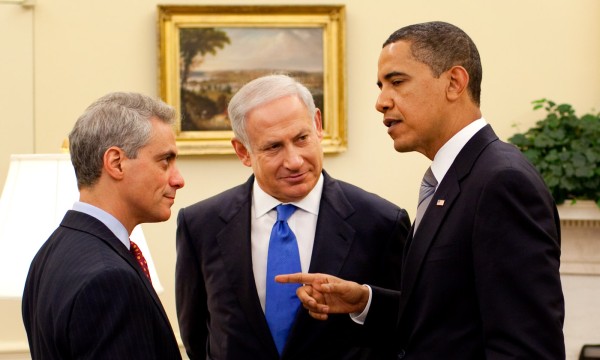
Half a meeting

Netanyahu is sure that he knows who is to blame [for strained US-Israeli relations]: White House Chief of Staff Rahm Emanuel. He heard inside information, from the White House, verified information. Emanuel drips venom. My sources may be less good, but the picture they paint is different. Netanyahu’s problem, they say, is not Emanuel. It is Obama.

Netanyahu is convinced that since the first day of his term, Emanuel has been plotting to isolate Israel from America, to shrink it in the eyes of its voters and to destroy it politically. This step failed. Support for Israel in American public opinion has only increased. It’s not Israel that is isolated in America, but rather the Palestinians. Personal admiration for him also increased. It increased in wake of his speech at the UN General Assembly. There are no other leaders in the world today that speak to Americans in their own language. They’ve known him in America for 30 years now. [continued…]

Good riddance, Abbas

The announcement that Mahmoud Abbas has decided not to stand for re-election as head of the Palestinian Authority should come as a relief to all Palestinians. In fact, Abbas’s departure will open a much-needed opportunity to take stock of where things stand and assess the future course of the Palestinian struggle.

Never an appealing or charismatic figure, Abbas has been losing popular support since his first day in office five years ago (his term technically expired in January 2009). Since the 1993 Oslo Accords, in which he played a prominent role, the official Palestinian leadership has been pursuing a formula for peace — the two-state solution — that has yielded nothing more than the intensification of the Israeli occupation of Palestinian territory. Those 16 years have been characterized by the further immobilization and immiseration of the Palestinian people, and an ever-growing list of civilian casualties, most recently in Gaza.

We are left with no other conclusion than this: that the so-called peace process with which Abbas has been indelibly associated, albeit as the Israelis’ junior assistant, was calculated to produce exactly these results. The very first step of the Oslo process, undertaken with Abbas’s assent in 1993, was to fragment and separate the occupied territories into shards of land, disconnected from each other and from the outside world, under total, institutionalized Israeli domination. Take one look at a map and you can’t miss the separation of Gaza from the West Bank and East Jerusalem, and the further internal splintering of the West Bank, all of which is the direct result of Oslo. [continued…]


Facebooktwittermail

Prospect of more U.S. troops worries Afghan public

Prospect of more U.S. troops worries Afghan public

As Americans, including President Obama’s top advisers, tensely debate whether to send more American troops to Afghanistan, Afghans themselves are having a similar discussion and voicing serious doubts.

In bazaars and university corridors across the country, eight years of war have left people exhausted and impatient. They are increasingly skeptical that the Taliban can be defeated. Nearly everyone agrees that the Afghan government must negotiate with the insurgents. If more American forces do arrive, many here say, they should come to train Afghans to take over the fight, so the foreigners can leave.

“What have the Americans done in eight years?” asked Abdullah Wasay, 60, a pharmacist in Charikar, a market town about 25 miles north of Kabul, expressing a view typical of many here. “Americans are saying that with their planes they can see an egg 18 kilometers away, so why can’t they see the Taliban?” [continued…]

The generals’ revolt

In early October, as President Obama huddled with top administration officials in the White House situation room to rethink America’s failing strategy in Afghanistan, the Pentagon and top military brass were trying to make the president an offer he couldn’t refuse. They wanted the president to escalate the war — go all in by committing 40,000 more troops and another trillion dollars to a Vietnam-like quagmire — or face a full-scale mutiny by his generals.

Obama knew that if he rebuffed the military’s pressure, several senior officers — including Gen. David Petraeus, the ambitious head of U.S. Central Command, who is rumored to be eyeing a presidential bid of his own in 2012 — could break ranks and join forces with hawks in the Republican Party. GOP leaders and conservative media outlets wasted no time in warning Obama that if he refused to back the troop escalation being demanded by Gen. Stanley McChrystal, the commander overseeing the eight-year-old war, he’d be putting U.S. soldiers’ lives at risk and inviting Al Qaeda to launch new assaults on the homeland. The president, it seems, is battling two insurgencies: one in Afghanistan and one cooked up by his own generals. [continued…]

The Pentagon’s building boom in Afghanistan indicates a long war ahead

In recent weeks, President Obama has been contemplating the future of U.S. military operations in Afghanistan. He has also been touting the effects of his policies at home, reporting that this year’s Recovery Act not only saved jobs, but also was “the largest investment in infrastructure since [President Dwight] Eisenhower built the Interstate Highway System in the 1950s.” At the same time, another much less publicized U.S.-taxpayer-funded infrastructure boom has been underway. This one in Afghanistan.

While Washington has put modest funding into civilian projects in Afghanistan this year — ranging from small-scale power plants to “public latrines” to a meat market — the real construction boom is military in nature. The Pentagon has been funneling stimulus-sized sums of money to defense contractors to markedly boost its military infrastructure in that country.

In fiscal year 2009, for example, the civilian U.S. Agency for International Development awarded $20 million in contracts for work in Afghanistan, while the U.S. Army alone awarded $2.2 billion — $834 million of it for construction projects. In fact, according to Walter Pincus of the Washington Post, the Pentagon has spent “roughly $2.7 billion on construction over the past three fiscal years” in that country and, “if its request is approved as part of the fiscal 2010 defense appropriations bill, it would spend another $1.3 billion on more than 100 projects at 40 sites across the country, according to a Senate report on the legislation.” [continued…]

Facebooktwittermail

The predator war

What are the risks of the CIA’s covert drone program?

On August 5th, officials at the Central Intelligence Agency, in Langley, Virginia, watched a live video feed relaying closeup footage of one of the most wanted terrorists in Pakistan. Baitullah Mehsud, the leader of the Taliban in Pakistan, could be seen reclining on the rooftop of his father-in-law’s house, in Zanghara, a hamlet in South Waziristan. It was a hot summer night, and he was joined outside by his wife and his uncle, a medic; at one point, the remarkably crisp images showed that Mehsud, who suffered from diabetes and a kidney ailment, was receiving an intravenous drip.

The video was being captured by the infrared camera of a Predator drone, a remotely controlled, unmanned plane that had been hovering, undetected, two miles or so above the house. Pakistan’s Interior Minister, A. Rehman Malik, told me recently that Mehsud was resting on his back. Malik, using his hands to make a picture frame, explained that the Predator’s targeters could see Mehsud’s entire body, not just the top of his head. “It was a perfect picture,” Malik, who watched the videotape later, said. “We used to see James Bond movies where he talked into his shoe or his watch. We thought it was a fairy tale. But this was fact!” The image remained just as stable when the C.I.A. remotely launched two Hellfire missiles from the Predator. Authorities watched the fiery blast in real time. After the dust cloud dissipated, all that remained of Mehsud was a detached torso. Eleven others died: his wife, his father-in-law, his mother-in-law, a lieutenant, and seven bodyguards.

Pakistan’s government considered Mehsud its top enemy, holding him responsible for the vast majority of recent terrorist attacks inside the country, including the assassination of former Prime Minister Benazir Bhutto, in December, 2007, and the bombing, last September, of the Marriott Hotel in Islamabad, which killed more than fifty people. Mehsud was also thought to have helped his Afghan confederates attack American and coalition troops across the border. Roger Cressey, a former counterterrorism official on the National Security Council, who is now a partner at Good Harbor, a consulting firm, told me, “Mehsud was someone both we and Pakistan were happy to see go up in smoke.” Indeed, there was no controversy when, a few days after the missile strike, CNN reported that President Barack Obama had authorized it.

However, at about the same time, there was widespread anger after the Wall Street Journal revealed that during the Bush Administration the C.I.A. had considered setting up hit squads to capture or kill Al Qaeda operatives around the world. The furor grew when the Times reported that the C.I.A. had turned to a private contractor to help with this highly sensitive operation: the controversial firm Blackwater, now known as Xe Services. Members of the Senate and House intelligence committees demanded investigations of the program, which, they said, had been hidden from them. And many legal experts argued that, had the program become fully operational, it would have violated a 1976 executive order, signed by President Gerald R. Ford, banning American intelligence forces from engaging in assassination.

Hina Shamsi, a human-rights lawyer at the New York University School of Law, was struck by the inconsistency of the public’s responses. “We got so upset about a targeted-killing program that didn’t happen,” she told me. “But the drone program exists. ” She said of the Predator program, “These are targeted international killings by the state.” The program, as it happens, also uses private contractors for a variety of tasks, including flying the drones. Employees of Xe Services maintain and load the Hellfire missiles on the aircraft. Vicki Divoll, a former C.I.A. lawyer, who now teaches at the U.S. Naval Academy, in Annapolis, observed, “People are a lot more comfortable with a Predator strike that kills many people than with a throat-slitting that kills one.” But, she added, “mechanized killing is still killing.” [continued…]

Facebooktwittermail

Iraq on the edge

Iraq on the edge

Iraqis prefer checkpoints manned by Iraqis—as I observed time and again, they have learned how to navigate them. They often appear to know one of the security men—perhaps a distant relation or a friend of a friend. They know how to butter up the checkpoint guards with a kind word or humorous turn of phrase, and get past them even if they lack official permission. By contrast, they find American (or Peruvian) checkpoints, with their large signs in hortatory English and poorly rendered Arabic, bewildering, arbitrary, and humiliating. Over the years, many an altercation has occurred in these places owing to misunderstandings, impatience, or simply ill will.

Conversely, many Americans dislike, distrust, and resent Iraqi checkpoints. In a recent incident reported by Anthony Shadid in The Washington Post, Iraqi soldiers allegedly beat four American DynCorps contractors who refused to follow their orders at one of the entrances to the Green Zone[1] —a reminder that the tables are turning. I had flashed only two pieces of ID on my first visit to the Green Zone. But on my second day, Iraqi soldiers at the checkpoint one encounters when entering the Green Zone from the 14th of July Bridge insisted that I also produce an official bahtch or, failing that, procure a US Department of Defense escort, since I had told them I was on my way to meet General Raymond Odierno, who has succeeded David Petraeus as the US commanding officer in Iraq.

An American soldier lingering nearby, with no apparent mission other than to monitor the Iraqi soldiers, sauntered up to find out why I was being denied access to the Green Zone. After listening to my explanation that the Iraqis, now joined by an officer, required that I have an escort, he launched a verbal offensive that was as deeply insulting to the Iraqis’ national self-esteem (“This is why we were able to defeat them in two days”) as it was disrespectful and crude (“We could easily kill them all”).

The Iraqis, while knowing no English, could not possibly have misinterpreted the soldier’s abrasive body language, and I ended up trying to calm them down in the row that followed. When a DOD escort arrived, the American wandered off, leaving in his wake injured pride and burning anger over a relationship that had never worked. [continued…]

Facebooktwittermail