
Daily Archives: December 15, 2009

British court issued Gaza arrest warrant for former Israeli minister Tzipi Livni

British court issued Gaza arrest warrant for former Israeli minister Tzipi Livni

A British court issued an arrest warrant for Israel’s former foreign minister over war crimes allegedly committed in Gaza this year – only to withdraw it when it was discovered that she was not in the UK, it emerged today.
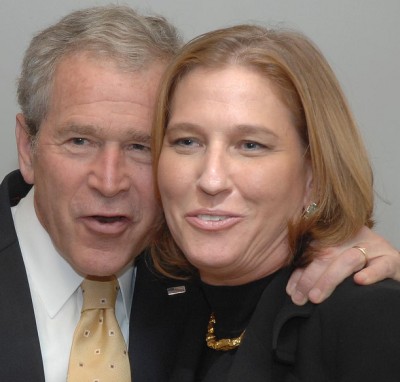
Tzipi Livni, a member of the war cabinet during Operation Cast Lead, had been due to address a meeting in London on Sunday but cancelled her attendance in advance. The Guardian has established that Westminster magistrates’ court issued the warrant at the request of lawyers acting for some of the Palestinian victims of the fighting but it was later dropped.

The warrant marks the first time an Israeli minister or former minister has faced arrest in the UK and is evidence of a growing effort to pursue war crimes allegations under “universal jurisidiction”. Israel rejects these efforts as politically motivated, saying it acted in self-defence against Hamas rocket attacks from Gaza. [continued…]

U.S. tax dollars fund rabbi who excused killing gentile babies

The White House condemns the torching of a mosque, yet respectable Americans contribute to a yeshiva whose rabbi said it’s okay to kill gentile babies. It is no surprise that the American administration tacitly, if unenthusiastically, accepted the excuse that the map of national priority zones the cabinet approved on Sunday does not violate the decision to freeze construction in the settlements.

How can President Barack Obama object to furthering education in a settlement like Yitzhar, located in the heart of the West Bank? After all, his own tax revenues contribute to the flourishing of the Od Yosef Chai Shechem yeshiva, the settlement’s crowning glory.

This is the same yeshiva whose rabbi said it is permissible to kill gentile babies because of “the future danger that will arise if they are allowed to grow into evil people like their parents.” In his latest book, the head of the yeshiva, Yitzhak Shapira, who bears the honorable title of rabbi, even permits killing anyone “who, through his remarks and so forth, weakens our kingdom” (Obama, beware!). [continued…]

How Israel’s system of Jewish apartheid operates in Jerusalem

Green Zone from Nimrod Zin on Vimeo.

Green Zone – is a 20 minute long documentary, exploring Israel’s discriminatory policies in occupied East Jerusalem. Since 1967 urban planning has been used by the Israeli establishment as a tool to contain the growth of the Palestinian population in the mixed city. The impact of these policies has been catastrophic for many Palestinian residents, resulting in an average of 100 house demolitions every year. The film incorporates interviews with Israeli and Palestinian residents, architects, journalists and politicians, in an attempt to present this complex situation, which has significant ramifications to the whole peace process.

Lawless settlers are an inseparable part of Israel

The dogs of Shiloh run about, excited. Barking loudly, they try to chase after the long convoy of security vehicles passing the doghouses. But they aren’t going anywhere: They’re collared to long iron chains.

No sight could better illustrate the futile journey of the inspectors and police officers through the West Bank this week.

They’re here to deliver the building freeze orders, to people who rip them up in front of the cameras. This week, they traveled from one settlement to the next, and we followed, an odd convoy of armored vehicles from the Civil Administration, the Yasam special police forces and the Border Police, two cars full of journalists and one car driven by a settler activist reporting to his friends from the field and giving advance notice.

Some settlements the convoy passed quickly, without stopping, which raised even more speculation about the objective of this shadowy trip. At other settlements, its way was blocked. When the convoy parked at one West Bank junction, a few Palestinian passersby from a nearby village stared. They had no idea where it was headed; it seemed like the members of the secured convoy weren’t so sure either. [continued…]

Far-right yeshiva head: My duty is to tell troops to refuse orders

The head rabbi of a far-right West Bank yeshiva declared Monday after his school was ousted from the Israel Defense Forces hesder program that he encouraged his students to refuse settlement evacuation orders because he had an obligation to “speak his inner truth.”

Rabbi Eliezer Melamed, whose Har Bracha Yeshiva’s status was revoked late Sunday, wrote in an article published on Arutz 7 that he had skipped a critical hearing on the matter with Defense Minister Ehud Barak because he would not give in to “governmental pressure.”

“Although I knew by the Defense Minister’s rudeness that this could cause the end of the arrangement with Yeshiva Har Bracha,” wrote Melamed. “And despite all of the harsh significance that it entailed, I was obligated to stick to my independent principles and not give in.” [continued…]

Israel votes new funding for settlements

Israeli Prime Minister Benjamin Netanyahu’s cabinet voted more funding for Jewish settlements on Sunday as violence over a temporary settlement building freeze in enclaves in the occupied West Bank increased.

Defense Minister Ehud Barak voted against the plan, saying it would reward settlers living in parts of the West Bank where Palestinians have lately come under attack, such as a village where parts of a mosque was torched at the weekend.

Netanyahu condemned the burning of carpets and copies of the Koran at Yasuf village near Nablus, where graffiti scrawled in Hebrew called the act “a price tag.” It was similar to a slogan left by suspected settlers after other acts of vandalism. [continued…]


Life behind The Wall

Facebooktwittermail

Obama refuses to rule out drone attacks in Quetta

Obama refuses to rule out drone attacks in Quetta

President Barack Obama has warned that the United States would launch strikes inside Pakistan if it had actionable intelligence about the presence of top Al Qaeda and Taliban leaders in a particular area.

His statement – included in the transcript of an interview released on Monday – contradicts earlier US media reports that President Obama opposed drone attacks at suspected Taliban targets in and around Quetta.

Mr Obama made the statement when he was reminded that for almost a year officials in his administration had been saying that the Taliban leadership was now somewhere in Quetta and yet he was reluctant to call in drones to target those leaders. [continued…]

Supplying troops in Afghanistan with fuel is challenge for U.S.

President Obama’s decision to send more troops to Afghanistan will magnify one of the Pentagon’s biggest challenges: getting aviation and diesel fuel to U.S. air and ground forces there.

As the number of U.S. and coalition troops grows, the military is planning for thousands of additional tanker truck deliveries a month, big new storage facilities and dozens of contractors to navigate the landlocked country’s terrain, politics and perilous supply routes. And though Obama has vowed to start bringing U.S. forces home in 18 months, some of the fuel storage facilities will not be completed until then, according to the contract specifications issued by the Pentagon’s logistics planners.

“Getting into Afghanistan, which we need to do as quickly as we can possibly do it, is very difficult because . . . next to Antarctica, Afghanistan is probably the most incommodious place, from a logistics point of view, to be trying to fight a war,” Ashton Carter, the undersecretary of defense for acquisition, technology and logistics, said recently. “It’s landlocked and rugged, and the road network is much, much thinner than in Iraq. Fewer airports, different geography.”

Navy Vice Adm. Alan S. Thompson, who directs the Defense Logistics Agency, earlier this year called support for operations in landlocked Afghanistan “the most difficult logistics assignment we have faced since World War II.”

The military’s fuel needs are prodigious. According to the Government Accountability Office, about 300,000 gallons of jet fuel are delivered to Afghanistan each day, in addition to diesel, motor and aircraft gasoline. A typical Marine corps combat brigade requires almost 500,000 gallons of fuel per day, according to a recent study by Deloitte Analysis, a research group. Each of the more than 100 forward operating bases in Afghanistan requires a daily minimum of 300 gallons of diesel fuel, the study said. [continued…]

Facebooktwittermail

Evidence of Iran’s nuclear arms expertise mounts

Evidence of Iran’s nuclear arms expertise mounts

Long denied access to foreign technology because of sanctions, Iran has nevertheless learned how to make virtually every bolt and switch in a nuclear weapon, according to assessments by U.N. nuclear officials in internal documents, as well as Western and Middle Eastern intelligence analysts and weapons experts.

Iran’s growing technical prowess has been highlighted by a secret memo, leaked to a British newspaper over the weekend, that purportedly shows Iranian scientists conducting tests on a neutron initiator, one of the final technical hurdles in making a nuclear warhead, weapons analysts said Monday.

There was no way to establish the authenticity or original source of the document, which is being assessed by officials at Western intelligence agencies and the U.N. nuclear watchdog. Even so, former intelligence officials and arms-control experts said that if it is a genuine Iranian government document, it is a worrisome indication of an ongoing, clandestine effort to acquire nuclear weapons capability. Iran has steadfastly denied seeking nuclear arms. [continued…]

Israeli MI chief: Iran has enough nuclear material for bomb

Military Intelligence Chief Amos Yadlin said Tuesday that Iran has over the last year accumulated enough materials to create a nuclear bomb and warned: “The technological clock has almost finished winding.”

Speaking at The Institute for National Security Studies, Yadlin said that Iran had embarked on a “measured and sophisticated strategy for a solid nuclear infrastructure, by spreading out in facilities both overt and covert, while simultaneously developing a military capability that would allow a breakthrough when it so decides.”

According to Yadlin, there are three clocks now ticking with regard to Iran’s contentious nuclear program — those of technology, diplomacy, and of the stability of the Islamic regime. [continued…]

Iran intends to go forward with espionage trial of 3 Americans

Three Americans who were accused of espionage after entering Iran illegally during a hiking trip will be put on trial, Iran’s foreign minister said Monday, raising the stakes in a case likely to exacerbate tensions with the United States.

The announcement comes after Iran last week demanded the release of 11 Iranians who it says are being held by the United States — a possible signal that Tehran wants to use the Americans as bargaining chips. The development also coincides with an international stalemate over Tehran’s nuclear program. The Obama administration has warned Iran that it faces tougher sanctions over its uranium-enrichment activities unless it accepts a proposed deal by Dec. 31.

Foreign Minister Manouchehr Mottaki did not say when the trial would begin or specify the charges, saying only that the Americans had “entered Iran illegally, with suspicious objectives.” [continued…]

Ayatollah Rafsanjani? Not anymore, it appears

“Fararu,” an Iranian news website, has posted a directive that is said to be from the deputy news director of Iran’s official news agency IRNA.

The directive reportedly calls on the agency’s news sections to refer to Iran’s former President Akbar Hashemi Rafsanjani, an ayatollah and a rival of Iran’s current president, Mahmud Ahmadinejad, as hojatoleslam, which is a lower religious title.

The directive also notes that Rafsanjani’s job title is the head of Iran’s Expediency Council and says the move is aimed at unifying the reporting of Rafsanjani’s titles by the new agency. (Rafsanjani also heads the Assembly of Experts, which is in charge of selecting and dismissing Iran’s supreme leader.)

But some analysts believe the IRNA directive is part of a government campaign against Rafsanjani. Rafsanjani has backed the opposition, criticized the crackdown against opposition members, and said publicly that the Islamic republic is facing a crisis. [continued…]

Facebooktwittermail

Are crippling droughts the next great threat to Iraq?

The dust bowl of Babylon

From his mud brick home on the edge of the Garden of Eden, Awda Khasaf has twice seen his country’s lifeblood seep away. The waters that once spread from his doorstep across a 20% slab of Iraq known as the Marshlands first disappeared in 1991, when Saddam Hussein diverted them east to punish the rebellious Marsh Arabs. The wetlands have been crucial to Iraq since the earliest days of civilization — sustaining the lives of up to half a million people who live in and around the area, while providing water for almost two million more.

The waters vanished after the First Gulf War due to a dictator’s wrath; over the next 16 years, they ebbed and flowed, but slowly started to return to their pre-Saddam levels. By 2007, with no more sabotage and average rains, almost 70% of the lost water had been recovered. Now it’s gone again. This time because of a crisis far more endemic: a devastating drought and the water policies of neighboring Turkey, Iran, and Syria. These three nations have effectively stopped most of the headwaters of the three rivers — the Tigris, Euphrates, and Karoon — that feed these marshes.

“Once in a generation was bad enough,” says Awda, a tribal head and local sheikh in the al-Akeryah Marshlands, who also advises the Nasiriyah governorate on water issues. “Twice could well be God’s vengeance.”

In a land where fundamental interpretations of monotheistic scripts often determine the tone of public discourse, particular attention is now being paid to the biblical Book of Revelation, in which the Euphrates River drying up was prophesized as a harbinger for the end of the world. It is not doomsday yet in Iraq, but the water shortage here has not been worse for at least the last two centuries — and possibly for several millennia more. Government estimates suggest close to two million Iraqis face severe drinking water shortages and extremely limited hydropower-generated electricity in a part of the country where most households get by on no more than eight hours of supplied power per day, in the best of times. [continued…]

U.S. firms lag in bids for Iraqi oil

Chinese, Russian and European companies won the right this weekend to develop major oil fields in Iraq, while U.S. firms made a paltry showing at auctions that represent the first major incursion of foreign oil companies into Iraq in four decades.

The companies that secured 10 contracts in auctions held over the weekend and in June stand to profit handsomely, but they are taking a significant gamble.

Iraq has the third-largest proven crude reserves in the world, but the country remains perilous; it suffers from chronic corruption and acrimonious politics that have prevented the passing of new laws to regulate the sector.

Of the seven U.S. companies that registered for the auctions, only one emerged as the leading partner in a consortium that won a contract. Another U.S. company has a minority stake in a contract. [continued…]

Facebooktwittermail

Relations with Turkey kindle hopes in Syria

Relations with Turkey kindle hopes in Syria

Ever since Syria and Turkey lifted their visa restrictions in September, Turkish visitors have poured into this picturesque northern city. Hawkers in Aleppo’s ancient souk now call out to shoppers in Turkish, and cross-border commerce has soared. The two countries have embarked on a very public honeymoon, with their leaders talking about each other like long-lost friends.

But this reconciliation is about far more than trade, or the collapse of old Turkish-Arab enmities. At a time of economic and political uncertainty here, the new warmth with Turkey has stirred hopes about Syria’s future direction, in areas that include religion, oil and gas, and peace with Israel.

For some here, the new closeness with secular, moderate Turkey represents a move away from Syria’s controversial alliance with Iran. For others, it suggests an embrace of Turkey’s more open, cosmopolitan society. And for many — including Syria’s president, Bashar al-Assad — it conjures different dreams of a revitalized regional economy, less vulnerable to Western sanctions or pressure.

“It’s much more than an economic relationship,” said Samir al-Taqi, director of the Orient Center for International Studies in Damascus. “It’s about regathering the region, and a feeling that the West is much weaker, less liable to do anything here. I think Syria has lots of ambitions to redefine its geopolitical position.” [continued…]

Facebooktwittermail