Afghans fleeing Taliban are flooding Tajikistan
By Isabel Gorst, Washington Post, December 17, 2009
The night his 11-year-old son escaped from kidnappers, Abdul Aziz bundled a few belongings into a car and drove his family 18 miles north across the Afghan border into Tajikistan. “It is too frightening to live in Afghanistan anymore,” he said, standing in the bare, unlit room he now rents outside Dushanbe, the Tajik capital. “We are never going back.”
A growing number of refugees are fleeing escalating violence and lawlessness in Afghanistan for safety in Tajikistan, the most visible sign yet that the fallout from the Taliban insurgency is threatening to undermine Central Asia’s security, too.
The U.N. High Commissioner for Refugees says that more than 3,600 Afghans have fled to Tajikistan since January 2008.
Until recently, Tajikistan, Central Asia’s poorest country, attracted little international attention. A violent, six-year civil war after the Soviet Union’s demise stymied development. Unlike its post-Soviet peers, Tajikistan has insufficient oil resources to attract major investors. Its economy is kept afloat by aluminum and cotton exports and remittances from migrants working abroad that account for about 40 percent of its gross domestic product.
But as the Taliban has advanced north this year into the previously peaceful Afghan province of Kunduz, Tajikistan has become the front line between the insurgency and Central Asia. [continued…]
U.S. steps up special operations mission in Afghanistan
By Julian E. Barnes, Los Angeles Times, December 16, 2009
The U.S. military command has quietly shifted and intensified the mission of clandestine special operations forces in Afghanistan, senior officials said, targeting key figures within the Taliban, rather than almost exclusively hunting Al Qaeda leaders.
As a result of orders from Army Gen. Stanley A. McChrystal, the top U.S. and allied commander in Afghanistan, the special operations teams are focusing more on killing militants, capturing them or, whenever possible, persuading them to turn against the Taliban-led insurgency.
The number of raids carried out by such units as the Army’s Delta Force and Navy’s SEAL Team Six in Afghanistan has more than quadrupled in recent months. The teams carried out 90 raids in November, U.S. officials said, compared with 20 in May. U.S. special operations forces primarily conduct missions in eastern and southern Afghanistan.
The numbers reflect the evolving strategy and increased pressure on U.S. military leaders to show swift results against the Taliban.
The move marks the first major change in mission for the nation’s most elite military units since they were sent to Afghanistan after the Sept. 11 attacks. It comes as the Taliban has tightened its grip on key parts of Afghanistan, where only a few dozen Al Qaeda operatives are thought to remain.
The shift could be controversial among some administration officials and lawmakers who want the U.S. military to focus primarily on the long-term fight against terrorism and on eradicating Al Qaeda. Senior military leaders, however, believe that rolling back Taliban gains has become the overriding short-term priority. [continued…]
U.N. officials say Galbraith plotted to replace Karzai
By James Glanz and Richard A Oppel Jr, New York Times, December 17, 2009
As widespread fraud in the Afghanistan presidential election was becoming clear three months ago, the No. 2 United Nations official in the country, the American Peter W. Galbraith, proposed enlisting the White House in a plan to replace the Afghan president, Hamid Karzai, according to two senior United Nations officials.
Mr. Karzai, the officials said, became incensed when he learned of the plan and was told it had been put forth by Mr. Galbraith, who had been installed in his position with the strong backing of Richard C. Holbrooke, the top American envoy to Afghanistan. Mr. Holbrooke had himself clashed with the Afghan president over the election.
Mr. Galbraith abruptly left the country in early September and was fired weeks later. Mr. Galbraith has said that he believes that he was forced out because he was feuding with his boss, the Norwegian Kai Eide, the top United Nations official in Kabul, over how to respond to what he termed wholesale fraud in the Afghan presidential election. He accused Mr. Eide of concealing the degree of fraud benefiting Mr. Karzai.
Mr. Galbraith said in an interview that he discussed but never actively promoted the idea of persuading Mr. Karzai to leave office. [continued…]
US silent about Taliban guarantee offer on al-Qaeda
By Gareth Porter, IPS, December 16, 2009
The Barack Obama administration is refusing to acknowledge an offer by the leadership of the Taliban in early December to give “legal guarantees” that it will not allow Afghanistan to be used for attacks on other countries.
The administration’s silence on the offer, despite a public statement by Secretary of State Hillary Clinton expressing skepticism about any Taliban offer to separate itself from al-Qaeda, effectively leaves the door open to negotiating a deal with the Taliban based on such a proposal.
The Taliban, however, has chosen to interpret the Obama administration’s position as one of rejection of its offer.
The Taliban offer, included in a statement dated Dec. 4 and e-mailed to news organizations the following day, said the organization has “no agenda of meddling in the internal affairs of other countries and is ready to give legal guarantees if foreign forces withdraw from Afghanistan.” [continued…]
The price of pushing our troops too far
By William Astore, TomDispatch, December 15, 2009
Quietly, almost imperceptibly, our Army is hollowing out. Such is the predictable result of eight years of ceaseless deployments in support of ill-advised wars. Remarkably, the Army has, so far, managed to maintain its combat effectiveness, in part by its recourse to a “Stop Loss” policy — essentially a backdoor draft (only recently curtailed by Secretary of Defense Robert Gates) that involuntarily extended the enlistments of 60,000 troops. It has also relied heavily on the use and reuse of the Reserves and the National Guard. Governor Ed Rendell of Pennsylvania noted last month on Meet the Press that “our troops are tired and worn out. [With respect to the] Pennsylvania National Guard, most of our guardsmen have been to either Iraq [or] Afghanistan, over 85 percent, and many of them have gone three or four times and they’re wasted.”
Signs of severe strain, of being “wasted,” are often not visible to the American public. Nevertheless, they are ominous and growing. Suicides have hit record highs in the Army. Cases of Post-Traumatic Stress Disorder (PTSD) and depression, having reached an alarming 300,000 in 2008, according to Invisible Wounds of War, a RAND study, continue to escalate, constituting a mental health crisis for the Army. Traumatic brain injuries from IEDs and other explosive shocks in our war zones, difficult to diagnose and even more difficult to treat, may already exceed 300,000, another health crisis exacerbated by a lack of treatment available to veterans. Divorce rates among active duty troops continue to climb. An epidemic of domestic violence and crime has been linked to returning veterans and to the difficulty of readjusting to “normal” life after months, or years, in combat zones. These are just five of the better documented signs of an Army that’s struggling to cope with wars of unprecedented length and still uncertain outcomes. [continued…]
Congress investigating charges of ‘protection racket’ by Afghanistan contractors
By Walter Pincus, Washington Post, December 17, 2009
A House oversight subcommittee said Wednesday that it has begun a wide-ranging investigation into allegations that private security companies hired to protect Defense Department convoys in Afghanistan are paying off warlords and the Taliban to ensure safe passage.
“If shown to be true, it would mean that the United States is unintentionally engaged in a vast protection racket and, as such, may be indirectly funding the very insurgents we are trying to fight,” said Rep. John F. Tierney (D-Mass.), chairman of the House oversight subcommittee on national security and foreign affairs.
Two weeks ago, Secretary of State Hillary Rodham Clinton described the same situation before a Senate committee while discussing the truck convoys that bring supplies into landlocked Afghanistan. “You offload a ship in Karachi [Pakistan]. And by the time whatever it is — you know, muffins for our soldiers’ breakfast or anti-IED equipment — gets to where we’re headed, it goes through a lot of hands,” she said. “And one of the major sources of funding for the Taliban is the protection money.”
A preliminary inquiry by Tierney’s investigators determined that the allegations warranted a full-scale inquiry, focused initially on eight trucking companies that share a $2.2 billion Defense Department contract to carry goods and material from main supply points inside Afghanistan — primarily Bagram air base — to more than 100 forward operating bases and other military facilities in the country. The eight companies have completed 40,000 missions since May, carrying food, water, fuel, equipment and ammunition, according to Tierney. [continued…]

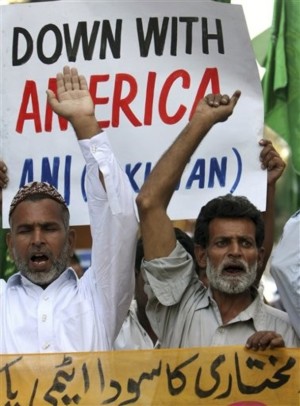 arts of the Pakistani military and intelligence services are mounting what American officials here describe as a campaign to harass American diplomats, fraying relations at a critical moment when the Obama administration is demanding more help to fight the Taliban and Al Qaeda.


