“We had no choice,” has become Israel’s national mantra.
But to say “we had no choice,” is to say our actions are not the fruit of our intentions. We are now the instrument of the will of others. Hamas made us do this.
There would be more moral clarity in simply declaring that Israel is a mighty power that has no compunction about the effects of its ruthless efforts to crush its enemies.
Instead, Israel wants to have it both ways: to demonstrate its might even while portraying itself as a helpless victim.
From Avi Shlaim we learn that this moral two-step actually has a name in Hebrew: bokhim ve-yorim. It means “crying and shooting.”
As always, mighty Israel claims to be the victim of Palestinian aggression but the sheer asymmetry of power between the two sides leaves little room for doubt as to who is the real victim. This is indeed a conflict between David and Goliath but the Biblical image has been inverted – a small and defenceless Palestinian David faces a heavily armed, merciless and overbearing Israeli Goliath. The resort to brute military force is accompanied, as always, by the shrill rhetoric of victimhood and a farrago of self-pity overlaid with self-righteousness. In Hebrew this is known as the syndrome of bokhim ve-yorim, “crying and shooting”.
In one of the latest examples of Israel’s abnigation of responsibility for its own actions, we learn that several children have spent the last few days starving as they huddle next to the bodies of their dead mothers. The Washington Post reports:
The International Committee of the Red Cross said Thursday that it had found at least 15 bodies and several children — emaciated but alive — in a row of shattered houses in the Gaza Strip and accused the Israeli military of preventing ambulances from reaching the site for four days.
Red Cross officials said rescue crews had received specific reports of casualties in the houses and had been trying since Saturday to send ambulances to the area, located in Zaytoun, a neighborhood south of Gaza City. They said the Israeli military did not grant permission until Wednesday afternoon.
In an unusual public statement issued by its Geneva headquarters, the Red Cross called the episode “unacceptable” and said the Israeli military had “failed to meet its obligation under international humanitarian law to care for and evacuate the wounded.”
When rescue workers from the Red Cross and the Palestinian Red Crescent arrived at the site, they found 12 corpses lying on mattresses in one home, along with four young children lying next to their dead mothers, the Red Cross said. The children were too weak to stand and were rushed to a hospital, the agency said.
This is what happens when a military force, its commanders, its government and the population cheering on this war believes that it has “no choice.”
This is the twilight zone of moral paralysis in which evil takes on the disguise of “necessity.”
The only way to make sense of Israel’s senseless war in Gaza is through understanding the historical context. Establishing the state of Israel in May 1948 involved a monumental injustice to the Palestinians. British officials bitterly resented American partisanship on behalf of the infant state. On 2 June 1948, Sir John Troutbeck wrote to the foreign secretary, Ernest Bevin, that the Americans were responsible for the creation of a gangster state headed by “an utterly unscrupulous set of leaders”. I used to think that this judgment was too harsh but Israel’s vicious assault on the people of Gaza, and the Bush administration’s complicity in this assault, have reopened the question.
I write as someone who served loyally in the Israeli army in the mid-1960s and who has never questioned the legitimacy of the state of Israel within its pre-1967 borders. What I utterly reject is the Zionist colonial project beyond the Green Line. The Israeli occupation of the West Bank and the Gaza Strip in the aftermath of the June 1967 war had very little to do with security and everything to do with territorial expansionism. The aim was to establish Greater Israel through permanent political, economic and military control over the Palestinian territories. And the result has been one of the most prolonged and brutal military occupations of modern times.
Four decades of Israeli control did incalculable damage to the economy of the Gaza Strip. With a large population of 1948 refugees crammed into a tiny strip of land, with no infrastructure or natural resources, Gaza’s prospects were never bright. Gaza, however, is not simply a case of economic under-development but a uniquely cruel case of deliberate de-development. To use the Biblical phrase, Israel turned the people of Gaza into the hewers of wood and the drawers of water, into a source of cheap labour and a captive market for Israeli goods. The development of local industry was actively impeded so as to make it impossible for the Palestinians to end their subordination to Israel and to establish the economic underpinnings essential for real political independence.
Gaza is a classic case of colonial exploitation in the post-colonial era. Jewish settlements in occupied territories are immoral, illegal and an insurmountable obstacle to peace. They are at once the instrument of exploitation and the symbol of the hated occupation. In Gaza, the Jewish settlers numbered only 8,000 in 2005 compared with 1.4 million local residents. Yet the settlers controlled 25% of the territory, 40% of the arable land and the lion’s share of the scarce water resources. Cheek by jowl with these foreign intruders, the majority of the local population lived in abject poverty and unimaginable misery. Eighty per cent of them still subsist on less than $2 a day. The living conditions in the strip remain an affront to civilised values, a powerful precipitant to resistance and a fertile breeding ground for political extremism.
In August 2005 a Likud government headed by Ariel Sharon staged a unilateral Israeli pullout from Gaza, withdrawing all 8,000 settlers and destroying the houses and farms they had left behind. Hamas, the Islamic resistance movement, conducted an effective campaign to drive the Israelis out of Gaza. The withdrawal was a humiliation for the Israeli Defence Forces. To the world, Sharon presented the withdrawal from Gaza as a contribution to peace based on a two-state solution. But in the year after, another 12,000 Israelis settled on the West Bank, further reducing the scope for an independent Palestinian state. Land-grabbing and peace-making are simply incompatible. Israel had a choice and it chose land over peace. [continued…]
Once more, kind hosts among the Palestinian community in Amman provided food and hotel accommodation for us, as well as a full programme of rallies and press conferences. Many of our hosts invited volunteers to their houses, where they enjoyed home-cooked food and convivial company.
By now, the convoy had become a major news story (in some cases the lead story) across the Middle East. The Turkish president even appeared on Syrian TV asking Egypt to facilitate its smooth passage.
Sadly, however, this appeal seems to have fallen on deaf ears. Despite Viva Palestina’s organisers spending months trying to coordinate and cooperate with the Egyptian authorities regarding the convoy’s passage from the Red Sea to Rafah (only half a day’s drive), at the last minute, the Egyptian consulate in Aqaba announced that all aid for Gaza must either be handed over to UNWRA, travel through Israel, or be approved by Israel (!) before coming to Rafah, and that therefore we would not be allowed to land at Nuweiba.
In a meeting with the convoy volunteers on Christmas morning, George Galloway pointed out that if we thought UNWRA was up to the job, we could have simply written them a cheque months ago! He also reiterated that we had no intention of asking Israel for its permission to deliver aid to a sovereign people via a third, also sovereign, country. He begged the Egypian authorities to change their minds, emphasising that on Sunday 27 December, the anniversary of the bombardment of Gaza, the world’s attention should be on Israel and its war crimes, not on Egypt, a fellow Arab nation. [continued…]
Maybe it seems beside the point, even on the eve of Christmas, to ask ourselves what would Jesus do in the Holy Land today. The narrow confines of Gaza, Jerusalem, Judea, and Samaria are places where God’s love was long ago supplanted by war for land and ill will among men. It has been a year now since the bloody and fruitless Israeli effort to crush Hamas in what amounts to a massive prison for a million people. Peacemakers in the Middle East are rarely blessed, and often reviled; just ask special envoy George Mitchell. And the truth rarely sets anyone free, as proved most recently by the fact-filled United Nations report by South African Judge Richard Goldstone, which was dissed by Washington and dismissed by Israel.
But given that it’s Barack Obama who’s president of the United States, the Jesus question has a relevance today it wouldn’t have had even a year ago. No, Obama is not the messiah. I’m not saying that. But Obama actually uses the word love in a way that Jesus would have understood. So while the question of what Christ might do in today’s Holy Land is hypothetical, the question of what Obama will do is not. And some of his most cherished ideas about peace, love, and understanding could be put to the test Dec. 31 when activists are hoping to stage a massive Gaza Freedom March. [continued…]
We, representing 1,362 individuals from 43 countries arriving in Cairo to participate in the Gaza Freedom March, are pleading to the Egyptians and your reputation for hospitality.
We are peacemakers. We have not come to Egypt to create trouble or cause conflict. On the contrary. We have come because we believe that all people — including the Palestinians of Gaza — should have access to the resources they need to live in dignity. We have gathered in Egypt because we believed that you would welcome and support our noble goal and help us reach Gaza through your land.
As individuals who believe in justice and human rights, we have spent our hard-earned, and sometimes scarce, resources to buy plane tickets, book hotel rooms and secure transportation only to stand in solidarity with the Palestinians of Gaza living under a crushing Israeli blockade.
We are doctors, lawyers, students, academics, poets and musicians. We are young and old. We are Muslims, Christians, Jews, Buddhists and secular. We represent civil society groups in many countries who coordinated this large project with the civil society in Gaza. [continued…]
As the days of December 2009 draw in, two events which each have a role to play in world peace draw closer. The first is on the 27th and is commemorating the start of the 22 day attacks on Gaza, an operation which targeted unarmed civilians, schools, hospitals, journalists and emergency staff. The second, The Gaza Freedom March will take place on the 31st. The Gaza Freedom March is a historic moment, the magnitude of which has not been seen in Palestine since 1967. Chiseled on the lessons learnt from South Africa’ struggle for liberation against apartheid and from Gandhi’ Satyagraha approach during the campaign for India’ independence, the Gaza Freedom March is walking in the same shoes.
In order to find out more about the Gaza Freedom March I met up with Dr. Haidar Eid, a member of the Steering Committee for the March in Gaza. [continued…]
Only 2 days to go before our attempt at trending #GAZA on twitter to raise global awareness on commemorating one year since the massive Israeli assault and siege. You can read the initial post here. Here are some updates and instructions I thought would be useful for all of us involved in the campaign:
How does a topic trend on twitter and why is that important?
At every given time, twitter lists a number of “trending,” i.e. popular topics being discussed frequently by a large number of people. These topics get a lot of needed attention – especially if we know they are otherwise going to be ignored by mainstream mass media. With all the odds against the Gaza Freedom March and Viva Palestina, we need to make sure that we are reporting the news of what’s happening with their campaigns, as well as reminding the world of the one-year commemoration. Topics trend on twitter when a large number of people mention it frequently over a substantial period of time. It also depends on the percentage of tweets, the hour, how active the twit-o-sphere is, etc. Based on a little research I did today, here’s how we can get it done: [continued…]
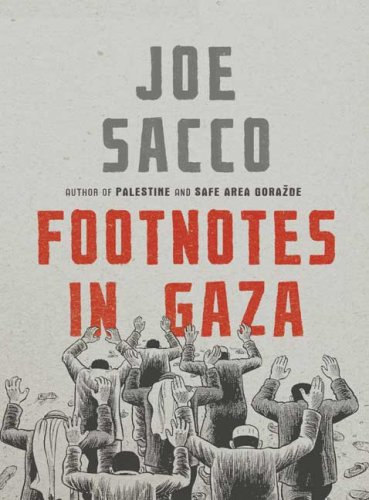
Joe Sacco’s gripping, important book about two long-forgotten mass killings of Palestinians in Gaza stands out as one of the few contemporary works on the Israeli-Palestinian struggle likely to outlive the era in which they were written.
Sacco will find readers for “Footnotes in Gaza” far into the future because of the unique format and style of his comic-book narrative. He stands alone as a reporter-cartoonist because his ability to tell a story through his art is combined with investigative reporting of the highest quality.
His subject in this case is two massacres that happened more than half a century ago, stirred up little international attention and were forgotten outside the immediate circle of the victims. The killings took place during the Suez crisis of 1956, when the Israeli Army swept into the Gaza Strip, the great majority of whose inhabitants were Palestinian refugees. According to figures from the United Nations, 275 Palestinians were killed in the town of Khan Younis at the southern end of the strip on Nov. 3, and 111 died in Rafah, a few miles away on the Egyptian border, during a Nov. 12 operation by Israeli troops. Israel insisted that the Palestinians were killed when Israeli forces were still facing armed resistance. The Palestinians said all resistance had ceased by then. [continued…]
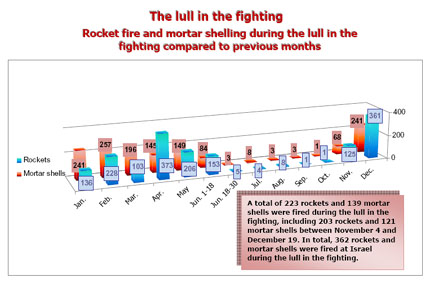
(UPDATE: Since the graphs appearing below have been removed from the Israeli Ministry of Foreign Affairs (MFA) website, some readers might have doubts about there authenticity. However, Jeffrey Goldberg who blogs at the Atlantic, has kindly alerted me to the source that the MFA continues to cite for its statistics on rocket fire from Gaza in 2008. The graphs I reproduced can be found in that document.
Goldberg writes: “Israel’s Ministry of Foreign Affairs cites this report [PDF] that claims that 362 rockets and mortars were fired into Israel from Gaza into Israel during what the report calls the ‘lull’ in the fighting. I think it’s fair to say that, though the numbers of rocket and mortar attacks dropped off dramatically during the ceasefire, there were, indeed, attacks.”
What Goldberg fails to point out is that of these 362 rockets and mortars fired, 324 were launched after Israel broke the ceasefire on November 4, 2008. During the period in which the ceasefire was being maintained by both Hamas and Israel from June 18 until November 4, there were a total of 38 fired. This averages 8.5 rocket and mortar attacks per month. As far as I am aware, none of these were conducted by Hamas and the level of attacks can be seen as a measure of the effectiveness (not absolute) with which Hamas was able to reign in other militant groups such as Islamic Jihad.)
_____
For four months, from Summer into Fall, the truce between Israel and Hamas was a stunning success. Indeed, if Israel doubted Hamas’ ability or willingness to engage in a truce, the Jewish state would have had no reason to request that the truce be extended as its expiration approached and passed in late December.
But now is a time of war and not only is talk of a truce being ruled out by the authors of this war but history is being re-written in order to degrade the value of a ceasefire. The memory of a period of recent calm that was the most durable peace that the residents of southern Israel have experienced in recent years must now be erased.
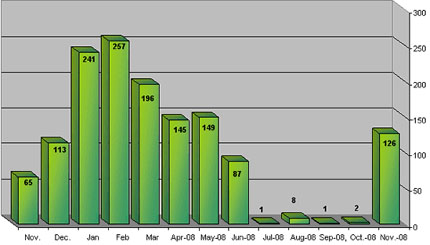
The Israeli government’s own graphical representation of the calm told the story in terms that even a child could understand. This is the graph that the Israel Ministry of Foreign Affairs displayed on its web site demonstrating that from July to October, rocket fire, if not reduced to a perfect zero, came stunningly close. From an average of 179 rockets per month in the preceding period of 2008, the number fell to just three per month:
Now that the Israeli propaganda machine is revved up to full throttle, the image of an effective truce no longer suits the Israeli government’s purposes. Instead it has become more convenient to try and hide the numbers — with numbers! The foreign ministry has thus removed the simple graph shown above and replaced it with this:
In the earlier image, graph blocks dramatically portrayed the rise and fall in rocket fire rates. In the revised image, blocks of equal size (containing numbers) are used to obscure the graph. The effect, clearly intended, is to try and portray the lull as really nothing more than a minor undulation in a period of unremitting attacks.
The message Israel now wants to sell is that the truce never really worked. Instead of acknowledging that the truce effectively collapsed when Israel launched Operation “Double Challenge” on November 5, the rocket fire that followed that Israeli raid is being used to obscure the fact that rocket fire had effectively been curtailed up to that point.*
On the IDF Spokesman web site, a post on rocket statistics simply omits the part of the record that Israel now finds inconvenient to acknowledge:
Between Hamas’ takeover and the start of the Tahadiya (State of Calm), (June 14, 2007 – June 16, 2008), there was an average of over 361 attacks per month—an increase of an additional 350%.
On Nov. 4 – 5, Israel launched Operation “Double Challenge”, targeting a tunnel Hamas was building as part of a plan to kidnap Israeli soldiers.
From the end of Operation “Double Challenge” until the end of the Tahadiya, (Nov. 4 – Dec. 19, 2008) a period of only a month and a half, there were 170 mortars, 255 Qassams, and 5 Grads fired upon Israel’s civilian population centers.
Since the end of the Tahadiya (Dec. 19, 2009) until the beginning of Operation “Cast Lead,” (Dec. 27, 2008) a period of little more than a week, there were approximately 300 mortars and rockets fired onto Israel.
Since the begining of Operation “Cast Lead”, there have been an additional 500 launches, 284 of which have been verified as rockets (both Qassams and Grads), and 113 as mortars.
Was four months of calm really worthless? Given that it became the precursor to war, the answer now apparently is yes.
But it didn’t have to turn out this way. The effectiveness with which Hamas enforced a truce should have provided the impetus for Israel to lift its economic siege of Gaza.
Instead, we are once again witness to Israel’s seemingly insatiable appetite for war, even while it never tires of professing its love of peace.
* Should anyone doubt that the Israeli raid (official declarations about Israel’s commitment to the truce notwithstanding) constituted a unilateral breach of the truce, consider what Israel and the world’s response would have been in the event that the raid had been launched from Gaza. Hamas gunmen conducted a raid inside Israeli territory, killing six Israeli soldiers.
That wouldn’t have been described as a breakdown in the truce; it would have been regarded as an act of war.
“After the Second Lebanon War, we learned some very valuable lessons. We learned that we had been living in an imaginary world and that the most dangerous type of war is the one that you call peace. We learned that we are not in fact in a ‘peace process’ at all. We are at war.
“Today the question is still asked, ‘But how do we WIN?’ And that is another question coming directly from a Western mindset. There is no such thing as winning in this new kind of war. The war is ongoing, with periods of more violence and periods of less violence, during which the enemy regroups and plans his next attack. When we feel the enemy is getting strong, we must be prepared to make preemptive strikes, hard and fast at key targets, with viciousness, as the enemy would do to us. Only then can we acquire, not peace, but sustained periods of relative calm.” — Ariel Siegelman
The Gaza experience was very different from the Lebanon War and even those of us who were there are trying to fully understand why. Lebanon was a wake-up call for Israelis and was the result of many years of foolish thinking. Since the so-called “Middle East Peace Process” began in the early 1990s with the Oslo Accords, many Palestinian children were raised on ideals of jihad (holy war) and hatred of Israel and the West, while Israeli children were generally taught that “peace is on the horizon”. A euphoric and asinine attitude persisted on the Israeli street throughout the 1990s, leading to the problems that we experienced in Lebanon. The Israeli political echelons and the upper ranks of the army had not established any real plans for entering Lebanon because they wanted to believe that, just like Jordan and Egypt, we had another border about which we could begin to relax. The Israeli public wanted to believe that we really were getting closer to peace. Not only was the army unprepared on a tactical level, but, since the threat was largely marginalized, the equipment that was available to reservists during the Second Lebanon War was far from adequate. Furthermore, the reservists themselves were generally psychologically and physically unprepared for war. They had lived for at least six years—since Israel pulled out of southern Lebanon in 2000—in a bubble of “peace”. In 2004, the army had claimed that we would never go back to Lebanon.
A New Kind of War
After the Second Lebanon War, we learned some very valuable lessons. We learned that we had been living in an imaginary world and that the most dangerous type of war is the one that you call peace. We learned that we are not in fact in a “peace process” at all. We are at war. On their own accord, many reservists began formidable fitness programs. The army invested in state-of-the-art equipment for us. We began planning for possible wars and attacks that might occur at any or all of our borders. And the whole army became much more serious about training again. The debacle of Lebanon set the stage for the success of Gaza. If there is one thing that Israelis are good at, it is taking lessons from their losses and being creative on the battlefield.
The Israel Defense Force (IDF) developed a different mentality toward Gaza. Lebanon, before the war, was very quiet and even boring, giving the perception that it was not a threat. Gaza, on the other hand, was always considered a hot zone. Certainly since Lebanon, we were told that “it [was] not a matter of IF, it [was] a matter of WHEN.” As Special Forces operators we were often crossing into the Strip and we knew the enemy. Now, after the Gaza war, the world has developed a perception that Hamas is not nearly on the level of Hezbollah. That in itself shows how successful we were—and lucky. Hamas is NOT a ragtag group of thugs. They are a vicious, well-trained, well-supplied, motivated, and creative fighting force. They are an unconventional army, no less capable than Hezbollah. The difference between Lebanon and Gaza is simply how Israel adapted to the enemy. Lebanon reminded each individual soldier that he has to be a warrior. It reminded the army that good intelligence and well thought out plans with realistic goals are key elements to the solution. It reminded the home front that we are still in a “war process” and it reminded the government that ego has no place in war and that politicians who are incompetent at military actions should step aside and allow those who know to take charge.
A new kind of enemy has become formidable over the last ten years. Western armies can look to Lebanon and Gaza to gain lessons for operating against this enemy. Even now, the Western concept of warfare is quite conventional, prompting us to think that if we can capture territory, and certainly if we can neutralize the enemy’s leadership, we will win. And we are confused when, no matter how well we do on the battlefield, the enemy continues and even increases its attacks. What we have not yet come to grips with is that the enemy is not playing by our rules. The new war is unconventional and is motivated by ideology. The enemy cannot hope to match Western technology, so he operates in a way to make the technology relatively meaningless. He simply refuses to meet the conventional army on the battlefield. The Western army invades enemy lands with almost no resistance, even captures the enemy’s leadership, developing the erroneous conception that victory has been achieved. Only then do the conventional soldiers begin being blown up by an enemy that cannot be identified or differentiated from the civilian population. The conventional soldier has no idea of how to operate in this environment because he is looking for a uniformed foe. A nine year-old child with a bomb does not fit the Western model of “combatant” and takes soldiers by surprise. The conquest of territory by a Western army only brings new targets closer to the terrorist so that he does not need to travel as far to blow up Western targets. It does not serve to bring the enemy to his knees. Likewise, Middle Eastern societies are tribal in nature and are fiercely proud of their ideology. They will not play chess with a conventional army, accepting defeat simply because their king is captured or their territory is occupied.
Lebanon: What NOT to do
Lebanon is a perfect example of the wrong way to confront the problems that the West faces in this new kind of war. The challenges that US forces face in Iraq are comparable. Let’s forget about the lack of Israeli leadership in 2006 and simply analyze the strategy. Israeli soldiers understood that the goals upon entering Lebanon were to destroy Hezbollah and end rocket attacks from the northern border. These goals were difficult to achieve and set Israel up for failure. Hezbollah, like any terrorist movement, is an ideology, and unless you are willing to kill everyone, an ideology cannot be toppled through military conquest. There only had to be one vigilant team left alive who held to its creed for Israel to fail in achieving its goals. Likewise, the moment that one rocket hit Israel from Lebanon after it withdrew to its own borders, Hezbollah would be victorious. Israel fell into the age-old trap that has caused much larger and seemingly stronger armies to be defeated by their unconventional foes: a poor evaluation of the enemy. It made no difference how much destruction Lebanon incurred or how many men Hezbollah lost. Perception is the deciding factor in this new kind of war. Hezbollah came out of the war appearing strong and, therefore, gained the respect of the world. Once the Israeli army entered from the south, the only real strategy for achieving its elusive goals was to reach the Litani River with ground forces, sweeping through Lebanese villages and towns. The Western military model had the Israelis convinced that by moving from one line on the map to another, all of the territory in between would be “conquered”. In the unconventional model, every moment that the army was moving forward, they provided ample targets to Hezbollah, who were attacking while retreating. They did not have to hold territory and they did not need to kill or injure huge numbers of Israeli soldiers. They only had to instill fear in the conventional force, a sense of hopelessness in the Israeli home front, and frustration in the military ranks. There are no front lines or rear lines in the new kind of war; the enemy will hit you from behind just as quickly (if not more quickly) as he will hit you from the front, and if you understand how the enemy operates, you can combat his ability to achieve his objectives.
Gaza: The Learning Curve
The lessons of Lebanon were immediately put into practice in preparing for the next conflict. The Special Forces (SF) were always very adept at urban warfare tactics, and during missions in the West Bank we operated ferociously, pulling missions almost every night. This combat experience produced a very high level of operational knowledge which trickled down through army doctrine for how to deal with our enemies. The regular army, and certainly the reserves, were lacking in their fighting skills in general until after Lebanon. In 2006, army leadership put new policies into action. The army supplied new gear to almost all combat units. Reservists had never seen such good equipment and their duty stopped being a vacation and became intensified training. The construction of an urban warfare training facility was completed in the desert, at about the same time that the Second Lebanon War was being fought. This facility is, perhaps, the most advanced urban warfare training facility in the world. It is built like the other facilities that we use, just much bigger. It resembles a real Arab city with Middle Eastern architecture, complete with mosques, schools, hospitals, large multi-story buildings, streets, squares, alleys, and vehicles. This offered the first opportunity for large scale training that allowed us to practice the concert of war, with SF, regular infantry, tanks, and artillery all operating together as a symphony. There is a strict training rotation that has all combat units drilling open-field combat techniques and urban warfare every few months. For almost three years, there were no illusions; we knew that we were training for Gaza. Unlike Lebanon, we knew that when we entered Gaza, the military goals and the execution of the missions in order to reach those goals would be methodical and well-prepared.
The IDF entered Gaza with realistic goals—significantly reduce Hamas’ ability to inflict damage on Israel and Israeli targets. We were told specifically that our goal was NOT to topple Hamas and was NOT to destroy all of its capabilities. Those goals would have been too difficult to achieve and would have set us up for defeat and a blow to the morale of the army and the nation. Likewise, the tactics would be unconventional. We were not to think in terms of conquest and holding territory. Concepts of front and rear lines had no place in this war. We were to frustrate and attack at the morale of the enemy, fighting much like he would fight us. The only rule was, don’t fight by the rules. The IDF went in, simply to wreak havoc on Hamas without getting into any situations that could afford our enemies the opportunity to achieve anything that would resemble a victory. We were to keep them at arm’s length, not attempt to engage them in combat, and use anything within our means to destroy them. And when Israel decided the desired perception had been reached (because perception is everything in these kinds of conflicts), we pulled out. Unlike Hezbollah, Hamas came out of this conflict without the world taking them very seriously. Even though Hamas was still shooting missiles into Israel, in a desperate attempt to save face, its capabilities had been seriously reduced and Israel had achieved its goals.
A New Kind of Success
It is not good training, technology, or strategy that makes bullets miss their targets or causes your eye to notice a trip-wire. For those experiences, I have to thank the Big Guy upstairs. He and I became very close during those cold nights. With all of our training and preparation, we were still afraid to go into Gaza. We knew the enemy and we had lost men even in the last year to their ambushes. When we were entering the Strip, we were fully prepared for high casualties. In Gaza they were waiting for us; they were looking for a fight. There were snipers, teams that were waiting to ambush us with anti-tank rockets, Improvised Explosive Devices (IEDs), booby traps, and mortars falling around us.
The successes that we saw in Gaza resulted from a combination of an appropriate response to the new kind of enemy, a healthy Israeli attitude that fiercely guarded its men and its right to stop intolerable attacks against its people, and protection from the Almighty, which some people call “luck”. I saw an attitude that I have been waiting to see for a long time from a nation that has too often apologized for every move that it makes. Today the question is still asked, “But how do we WIN?” And that is another question coming directly from a Western mindset. There is no such thing as winning in this new kind of war. The war is ongoing, with periods of more violence and periods of less violence, during which the enemy regroups and plans his next attack. When we feel the enemy is getting strong, we must be prepared to make preemptive strikes, hard and fast at key targets, with viciousness, as the enemy would do to us. Only then can we acquire, not peace, but sustained periods of relative calm.
Ariel Siegelman is Vice President of Security Training for The Draco Group, a service provider in advanced security and training. He served in the Israel Defense Force, Special Forces, as a counter terror operative, counter terror sniper and counter terror instructor, and remains active in these capacities in the Reserves. He can be reached at ariel@thedracogroup.com
This article originally appeared on The Colloquium, a US Army Combined Arms Center blog, March, 2009.

 e had no choice,” has become Israel’s national mantra.