
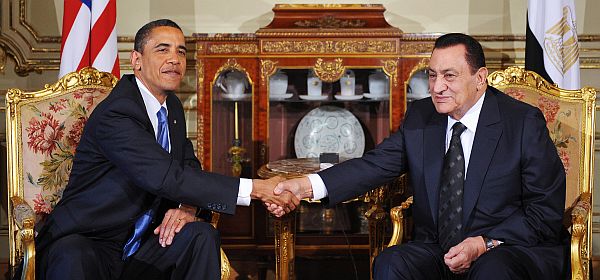
In Washington, when a cabinet level official is facing calls for his resignation, he is likely to take cover behind that regal phrase, “I serve at the president’s pleasure.” Most of the Arab world’s autocratic leaders could use the same expression since most would find their positions untenable without American support.
Last Wednesday, when Hillary Clinton said “we are not taking sides,” as demonstrators clashed with Tunisian security forces, she could have dispensed with protocol and said with more honesty, “we are no longer taking sides.”
Up until that moment the United States had unequivocally taken sides with Tunisia’s dictatorial ruler, Zine el-Abidine Ben Ali, but thereafter he knew he was on his own. He rapidly lost his grip on power.
The Obama administration’s relationship with the Tunisian regime was mirrored on a smaller scale by that of the Washington Media Group, a consulting firm that severed its contract with the Tunisian government on January 6.
“We felt on principle that we could not work for a government that was shooting its own citizens and violating their civil rights with such abuse,” said WMG’s President Gregory L. Vistica. Was he claiming that his client’s record had suddenly taken a turn for the worse, or that his firm had only just discovered it had principles?
The point is that WMG, just like the US government, prefers to blur the distinction between statements of principle and actions of self-interest.
On Friday, when President Obama said, “I applaud the courage and dignity of the Tunisian people,” observers across the region might have appreciated the sentiment yet seen no reason to attach much gravity to his words. After, Ben Ali had already fled.
“No one thinks Obama is serious about democracy,” says Shadi Hamid from Brookings Doha Center. “In some ways they have given up hope. And that I think is one of the key post-Cairo Speech stories: that after a lot of optimism about Obama’s election, people realized that when it comes to the issue of democracy-promotion in the Arab world — and that is a very important one for many Arabs — Obama’s really not on board.”
What more damning an indictment could be made against an American president than to say that he does not support democracy?
Hamid is joined in conversation with fellow Middle East analyst Issandr El Amrani from The Arabist, for a fascinating discussion on the implications on the people’s uprising in Tunisia.




“We felt on principle that we could not work for a government that was shooting its own citizens and violating their civil rights with such abuse,”
Yeah, that’s the job of the US.
When it come to democracy, no one takes the USA seriously.
As pointed out by N. Chomsky, just look at the US’s historical record as a ‘democracy promoter’. It has no credentials.
I Brazil, we had 25 years of military dictatorship sompsored by the criminals in Washington.
Most recently, just look at Honduras!!! Check what the War Crminal Hullary Clinton calls ‘democracy’.
Insulting is to have the war criminals B. Clinton and W.C. Bush responsible for ‘humanitarian reconstruction’ in Haiti. Both dogs were responsible for the destruction of Democracy in Haiti.
Obama is just another north american war criminal…
“What more damning an indictment could be made against an American president than to say that he does not support democracy?”
Who wrote this? Have they been paying attention? It’s just as damning as calling a whore a prostitute.