Ali Alaswad writes: When 100,000 or more people take to the streets in protest, governments in most parts of the world would see it as a sign that they need to change course – especially in a country with only about 600,000 citizens.
But Bahrain is no ordinary country. Its prime minister, Khalifa bin Salman Al Khalifa, has been in office for more than 40 years and his nephew, King Hamad, insists there is no opposition as such: “We only have people with different views… and now they are talking with their brothers.”
So far, though, there has been no move towards serious dialogue, instead just a campaign of repression that has claimed at least 80 lives and created hundreds of political prisoners.
We in the opposition have reiterated time and again our calls for “meaningful dialogue”, as President Obama put it. We stand ready to move the country forward towards a democratic future, but the only engagement from the authorities has been violence, not discussion.
Rather than address our demands, the government has resorted to peddling lies to discredit our movement internationally – a strategy it has used since day one of this crisis, which shows its complete refusal to reform. Last October we published The Manama Document to show our roadmap to reform. The government has ignored this and we have received no official response.
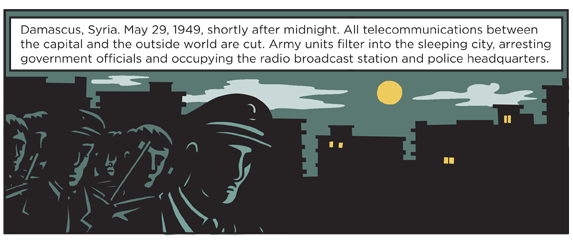
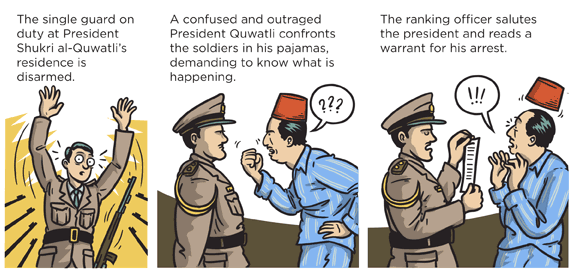
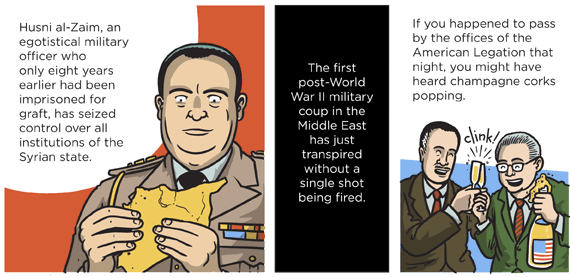
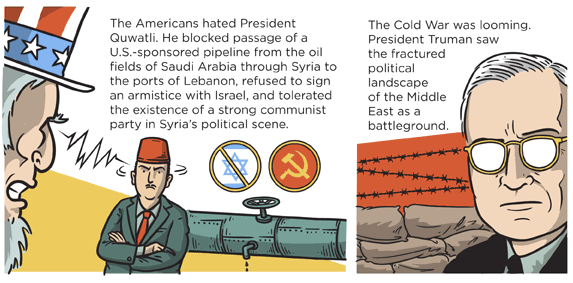
The cartoonist, Andy Warner, presents illustrated guide to the 1949 coup—possibly CIA-assisted—that plunged the country into decades of political turmoil.

Karen Leigh writes: Near a busy intersection where burqa-clad women beg for spare change at car windows, Mahmoud Saikal, Afghanistan’s former deputy foreign minister, sat under a photo of this capital city’s crowded hillside neighborhoods in the stately living room of his compound.
“If you are from Kabul,” he says, “you can find your place of birth in this photo.”
It’s the only landscape not changing in Afghanistan.
A series of American blunders in the past few months has raised questions about whether the decade-long U.S. mission in Afghanistan is doomed to failure. In February, reports that copies of the Quran had been burnt at a NATO base sparked protests across the country that left dozens dead. And last month, Staff Sgt. Robert Bales murdered 17 Afghan civilians in cold blood — returning to his base in Kandahar province mid-massacre before going out to kill again. Meanwhile, the Afghan security forces are increasingly turning on their trainers: Three NATO soldiers were killed by Afghan police and military members on March 26 — the latest of more than 80 coalition troops who have lost their lives in this way since 2007.
The escalating string of disasters has led to an increasingly contentious debate within President Hamid Karzai’s inner circle between officials who say Afghanistan is better off without the United States and those who see the American presence as necessary for security. But even among America’s erstwhile allies, there is a profound disappointment at the gap between the grandiose U.S. pledges and the dismal reality on the ground in Afghanistan.
Robet Mackey reports: As my colleague Declan Walsh reports, the United States announced on Monday that it is offering a reward of up to $10 million for “information leading to the arrest and conviction of” Hafiz Saeed, a Pakistani militant leader accused of orchestrating the 2008 Mumbai attacks.
Theoretically, the American bounty should make information about Mr. Saeed’s whereabouts as potentially valuable as the home address of the Afghan Taliban leader Mullah Muhammad Omar, who is rumored to live in Pakistan. Unlike the Taliban leader, though, Mr. Saeed lives openly in Lahore and even managed to attend a protest in the Pakistani capital, Islamabad, last week, frustrating efforts by the police to keep him from attending.
A separate reward of up to $2 million was offered for information leading to the capture of Hafiz Abdul Rahman Makki, Mr. Saeed’s brother-in-law, which moved him in to 39th place on the American list of most valuable militants.
Within hours of the American announcement, Mr. Saeed mocked the idea that he and his relatives are in hiding by saying in a telephone interview with Al Jazeera: “We’re not hiding in caves for rewards to be set on finding us. We are addressing hundreds of thousands of people daily in Pakistan.”
Tony Karon writes: That which has not been achieved on the battlefield can rarely be achieved at the negotiation table, and the harsh reality facing Syria’s opposition is that the regime of President Bashar al-Assad has not been defeated, nor is it in danger of imminent collapse. Assad has promised, former U.N. Secretary General Kofi Annan announced Monday, to begin a partial implementation of Annan’s peace plan by withdrawing troops and heavy weaponry from opposition-stronghold cities on April 10. In response, Western powers were left warning of unspecified “consequences” for failure to do so, and citing the history of Assad breaking promises. Skepticism from opposition activists on the ground was hardly surprising, but had little effect — they haven’t exactly been party to shaping Annan’s plan, which in itself is a reflection of their relative weakness in the power equation right now. Formulating a strategy in response to Assad appears to be the role of the Western and Arab powers who’ve backed the exile-based Syrian National Council, and after last weekend’s inconclusive Friends of Syria meeting in Istanbul, they don’t appear yet to have achieved a strategic consensus.
The Assad regime may, in fact, be feeling pretty smug: Its foreign adversaries were unable to prevent its brutal pummeling of cities controlled by opposition fighters, which scattered those fighters and forced the rebels to abandon an insurrectionist strategy of seizing control of whole towns in the hope of prompting mass defections that would bring down the regime. It has proved impossible, thus far, for the rebels to hold ground against counter-offensives by regime forces whose advantage in weaponry is overwhelming. Instead, the insurgency is on its back foot, struggling to find the arms and ammunition to sustain the confrontation, and reduced to waging a more diffuse campaign of guerrilla attacks and terror strikes. The regime, meanwhile, has remained largely intact with its core security forces remaining focused and motivated by the sectarian dimension of the war. Nor does the regime appear likely to collapse internally in the near term, even if the repression it has unleashed precludes it restoring long-term stability.
The Annan peace plan reflects the reality that the opposition and its international backers have been unable to impose terms on Assad on the ground. Western and Arab powers have been forced to walk back from the demand that Assad stand down as a pre-condition for resolving the crisis; Annan’s plan involves a cease-fire, demilitarizing the conflict and creating space for peaceful political opposition, but its key dimension is the recognition that the political negotiations over Syria’s future will be conducted with the regime, rather than after it has been dispatched.
Wolfram Lacher writes: “Eastern Libya declares autonomy.” In spite of international headlines such as this one, talk of the country’s impending disintegration is misleading. Although the participants at the March 6 Barqa Conference (Barqa is the Arabic name for Cyrenaica, or the region of northeastern Libya) claimed the right to speak for their region, the initiative for self-administration and the move toward federalism triggered furious reactions in Cyrenaica. Given this lack of support in the region itself, the push is unlikely to succeed.
Foreign media coverage of reactions to the initiative focused on anti-federalism demonstrations in Tripoli and the angry response of the chairman of the National Transitional Council, Mustafa Abdul Jalil. But this emphasis on the tension between the central government and proponents of northeastern autonomy is misguided. More important were the reactions against the decisions in the northeast itself. The local councils of the area’s major cities – Benghazi, Darna, Bayda and Tobruk, which also saw large demonstrations against federalism – all immediately made clear their opposition to the Barqa Conference’s declaration and refused to recognize its proposed regional council.
In addition, the Muslim Brotherhood – which has an important base in northeastern Libyan cities – called the declaration the work of narrow-based and personal interests. Furthermore, the initiative has not received significant backing from the disparate armed entities that are controlling the northeast. For instance, the region’s most powerful militia grouping, the Union of Revolutionary Brigades (Tajammu Saraya al-Thuwwar), opposed the conference, and the Barqa Military Council (an unofficial grouping of several army units situated in the region) distanced itself from the conference, declaring that it would not get involved in politics.
Proponents of federalism undoubtedly have an influence in Cyrenaica – perhaps more so than in other regions. Leading figures at the Barqa conference included tribal notables as well as intellectuals. The most prominent of these was Ahmad Zubair al-Sanusi. He is a member of the royal family that ruled Libya from 1951 to 1969, and was appointed to head the regional council. But without the local support of the region it claims to govern, the regional council has little chance of actually governing Cyrenaica.

In this series of four Landsat images, the agricultural fields are about one kilometer across. Healthy vegetation appears bright green while dry vegetation appears orange. Barren soil is a dark pink, and urban areas, like the town of Tubarjal at the top of each image, have a purple hue. Credit: NASA/GSFC
NASA reports: Saudi Arabia is drilling for a resource possibly more precious than oil.
Over the last 24 years, it has tapped hidden reserves of water to grow wheat and other crops in the Syrian Desert. This time series of data shows images acquired by three different Landsat satellites operated by NASA and the U.S. Geological Survey.
The green fields that dot the desert draw on water that in part was trapped during the last Ice Age. In addition to rainwater that fell over several hundred thousand years, this fossil water filled aquifers that are now buried deep under the desert’s shifting sands.
Saudi Arabia reaches these underground rivers and lakes by drilling through the desert floor, directly irrigating the fields with a circular sprinkler system. This technique is called center-pivot irrigation.
Because rainfall in this area is now only a few centimeters (about one inch) each year, water here is a non-renewable resource. Although no one knows how much water is beneath the desert, hydrologists estimate it will only be economical to pump water for about 50 years.

Tony Karon writes: ‘I believe there is a window of time to solve this diplomatically but that window is closing,” President Barack Obama said last week about the nuclear standoff with Iran. The “window closing” phrase was then echoed on Friday by Secretary of State Hillary Clinton, who insisted: “We are determined to prevent Iran from obtaining a nuclear weapon.”
But hang on a minute. Three weeks ago, Mr Obama warned that he would take military action if it became necessary to stop Iran from acquiring a nuclear weapon. But in the same breath, he pointed out that Iran was not building a nuclear weapon, and had not in fact taken a decision to do so despite steadily amassing infrastructure that would enable it. Mr Obama quoted approvingly from a recent speech in which Supreme Leader Ayatollah Ali Khamenei reiterated his long-standing fatwa declaring that the construction, stockpiling and use of nuclear weapons was a “sin against Islam”.
So, if Mr Obama himself has emphasised that Iran is not moving towards his trip-line for military action, unless there’s been a qualitative shift towards weaponisation in Iran’s nuclear work in the past three weeks, who is closing the metaphorical “window” for diplomacy?
There may be three related elements at work. First, there is Israel threatening unilateral military action based on its own red lines and on its own timetable unless Iran yields. Then there’s the fact that Mr Obama’s Iran strategy was designed by Dennis Ross, who has since returned to his old job at a think tank created by the pro-Israel lobby Aipac. Mr Ross believes the only way to achieve diplomatic results with Iran is to pin it in a chokehold of sanctions, and make it believe worse is to come.
And then there’s Mr Obama’s concern with securing his re-election in November, which requires tough-guy posturing on Iran to counter charges from his Republican opponents, egged on by Israel’s alarmism, about being “weak” in the face of an Iranian “danger”.
Jefferson Morley writes: So you want to be a drone pilot? Have a seat in the operator’s control station that guides the remotely piloted aircraft. You could be sitting in a trailer on Creech Air Force Base in Nevada or doing your duty at CIA headquarters in Langley, Va. From this perch, you can see a battle space on the other side of the world. You are virtually on the front lines of war.
One of the screens in front of you has a live full-motion video feed from the aircraft (perhaps showing the home of an anti-American sheik and his family in Pakistan or Afghanistan). A second screen has mission data like the altitude of the drone and its fuel level. A third screen displays multilayered menus of more data. You can steer the drone with the joystick in your right hand; the pedals beneath your feet control its rudder. But if you want to turn on the autopilot, it will require 22 keystrokes on one of several available keyboards.
Your partner, the “sensor operator” seated next to you, controls the camera. He or she can zoom in on the face of the man you are hunting. Is this target a danger to the United States? The keyboard in front of you enables you to communicate with a JAG (or a CIA lawyer) to make sure that your target qualifies under the Rules of Engagement. You have audio contact with the Combat Air Command Center in Qatar, which must authorize the firing of missiles. When it does, you push the button on the joystick and send the missile on its way. Then, an explosion. If you want, the sensor operator can train the camera on the wreckage.
If you don’t feel comfortable in this seat, you’re not alone. When the U.S. Air Force Scientific Advisory Board studied the drone operator control stations last year, it found no less than 17 flaws in the “poorly designed” system, including “poor ergonomics” and ill-conceived input systems, like the autopilot activation. While much of the drone war remains shrouded in official secrecy, the Air Force’s ongoing campaign to improve the ground control station provides a window into America’s newest way of war.
David Wearing writes: Every so often, a memorable phrase enters the discourse, providing a telling insight into some of the deeper assumptions held in our political culture. One such term, now mostly forgotten, is the “Vietnam syndrome.”
The Vietnam war claimed the lives of 58,000 US soldiers, seriously damaged Washington’s prestige as an imperial power and caused untold hundreds of thousands of civilian deaths in Indochina, which had been subjected by America’s forces of liberation to levels of aerial bombing last seen in the second world war.
Over subsequent years, those keen to see the US again exert its military might in the world lamented the stubborn persistence of a “Vietnam syndrome” among the public and many policymakers. The latter were increasingly unconvinced of the practical feasibility of military action, while the former saw the potential human costs as intolerable and, in many cases, were resolved to actively oppose a repeat of the Vietnam experience.
It is worth reflecting on the fact that a widespread popular aversion to the horrors of war – something one might regard as quite healthy – should come to be repeatedly described as a “syndrome”; a collective psychological defect that would hopefully be overcome at some future date. This is perhaps unsurprising, given that state violence has long been a highly valued policy tool, as indicated by the vast resources devoted to it, out of all proportion to genuine needs of “defence.”
After the comprehensive defeat of a disobedient former ally, Saddam Hussein, in the 1991 Gulf war, George HW Bush declared euphorically, “by God, we’ve kicked the Vietnam syndrome once and for all!” Many senior Republicans spent the next few years cultivating various fantasies about what could be achieved the next time an opportunity arose to let US forces off the leash. Such an opportunity was presented to them on 11 September 2001.
Issandr El Amrani writes: Since a little over a week ago, when the Islamist majority in Egypt’s parliament rushed through the appointment of a constituent assembly without any serious attempt at building a broader consensus, the country’s already ailing transition began to appear that much more fraught. The Muslim Brotherhood’s decision on Saturday to nominate its strongman, Khairat Al Shater, as a presidential candidate delivered another shock wave that could end whatever chance Egypt had left at achieving a stable democratic transition.
It should first be noted that the Muslim Brothers are perfectly within their rights to have chosen this course of action. The constitutional declaration in place since the end of March 2011, accepted by most political forces despite some doubts about its legality, gives parliament the right to appoint the constitutional assembly.
In allying with the Salafist Nour Party, with which it controls over 70 per cent of parliament, the Brotherhood’s Freedom and Justice Party (FJP) could very well control the process and outcome of the nomination process for the assembly. Likewise, even if it had repeatedly stated that it would not field a presidential candidate, and even expelled members who disagreed with this decision, it has the right to change its mind according to the changing political context.
Nonetheless, the decision to abandon any pretence of inclusiveness in the appointment of the constituent assembly is a mistake – one that might be explained by the distrust that reigns between the military junta now ruling Egypt and the Brotherhood, but a mistake nonetheless.
What it shows first and foremost, as the Brotherhood stands on the threshold of the political power it has sought for over eight decades, is a contempt for other political forces at a time when Egypt is sorely in need of a consensus that can support the momentous changes ahead. The question, for now, is not so much what the Brotherhood and other Islamists intend to do about the constitution – even if they can be expected to maximise the role that Sharia will play in the new Egypt.
In fact, unlike Salafists, the Brotherhood has provided few details of what its ideal constitution would look like, and not even a clear position on contentious issues such as the implementation of traditional Islamic punishments or the treatment of non-Muslims.
Adele M. Stan writes: Were there a way for a few billion clams to wipe a week off the calendar, one imagines that Charles and David Koch, the multibillionaire principals of Koch Industries, would like to see the final week of March 2012 vaporized, at least in the public mind. For the Kochs, it was a week of bad news: a new documentary about their political activity and corporate negligence was making a splash — on the same day a story broke announcing an FBI investigation of two Wisconsin groups tied to Americans for Prosperity, the political ground organization they founded and fund. (Full disclosure: AlterNet is a supporter of the documentary, Koch Brothers Exposed, and I appear in the film.)
Things got even worse the next day, Friday, March 30, when the billionaire brothers learned that a federal court handed down a decision that may ultimately require certain non-profit groups, such as Americans for Prosperity, to reveal their full donor list, and the New Yorker’s Jane Mayer, who wrote a devastating profile of the brothers last year, reported on the Kochs’ involvement in a barrage of anti-Obama ads sponsored by a tax-exempt non-profit called the American Energy Alliance, which may also now be required to reveal its donor list.
On the very same day, another federal court struck down portions of Wisconsin’s controversial law that stripped collective bargaining rights from most of the state’s public employees — a law championed by Americans for Prosperity, and rammed through the state legislature a year ago by the AFP-supported Gov. Scott Walker. Here, we take a closer look at the Kochs’ very bad week. [Continue reading…]
Mia de Graaf writes: In the UK, Big Brother is known for turning fame-hungry contestants – the Nadias, Chantelles and Jade Goodys of this world – into instant celebrities. Though normally no more high-brow, Israel’s equivalent has this year achieved a surprising twist, by making a superstar out of “Palestine sympathiser” Saar Szekely.
Szekely, 27, is the wild-card candidate whose stated objective was to voice leftwing views on prime-time television. In a house full of reactionaries and with a predominantly rightwing audience, Szekely’s mission looked certain to be short-lived. But for all the Facebook pages clamouring for his annihilation, the Tel Aviv-based artist has made it to tomorrow night’s final, and along the way become something of a heart-throb.
Entering the house in January, Szekely was, for the first few weeks, overshadowed by the usual extreme eccentrics – a newlywed couple, a prostitute, a “transfer-housemate” from Big Brother Argentina. Nine weeks into the show, however, his conversations started to get more air time, and have become the focus of the series.
“I like the way he expresses himself,” says one viewer, Shelly Malnick, 23, from Haifa. “I don’t agree with everything he says. There are harsh things he has said about soldiers that were really hard to listen to. But he doesn’t stoop to bickering – he has a backbone and he never steps down from a well-mannered discussion. That is why most Israelis love him.” It helps, she says, that he is “very good looking”. More leftwing viewers, needless to say, are smitten.
But it was the development of his unlikely friendship with housemate Eran Tartakovsky – a former Israeli army officer – that, according to the Maariv Daily’s deputy editor, Shai Golden, sparked Szekely’s success. “Eran embracing him was like giving him a kosher stamp,” said Golden.
Eran, who claimed in his audition tape to “hate Arabs more than I hate cancer”, was Szekely’s hawkish counterpart on the show. But the ploy backfired when the pair bonded: “They became close. It took the leftist extremism out of Saar and put the man in front.”
In the following clip, Szekely does most of the talking while Tartakovsky, the man in black shorts lying on his back, mostly listens.
The Guardian reports: American scientists have drawn up plans for a new generation of nuclear-powered drones capable of flying over remote regions of the world for months on end without refuelling.
The blueprints for the new drones, which have been developed by Sandia National Laboratories – the US government’s principal nuclear research and development agency – and defence contractor Northrop Grumman, were designed to increase flying time “from days to months” while making more power available for operating equipment, according to a project summary published by Sandia.
“It’s pretty terrifying prospect,” said Chris Coles of Drone Wars UK, which campaigns against the increasing use of drones for both military and civilian purposes. “Drones are much less safe than other aircraft and tend to crash a lot. There is a major push by this industry to increase the use of drones and both the public and government are struggling to keep up with the implications.”
The highly sensitive research into what is termed “ultra-persistence technologies” set out to solve three problems associated with drones: insufficient “hang time” over a potential target; lack of power for running sophisticated surveillance and weapons systems; and lack of communications capacity.
The Sandia-Northrop Grumman team looked at numerous different power systems for large- and medium-sized drones before settling on a nuclear solution. Northrop Grumman is known to have patented a drone equipped with a helium-cooled nuclear reactor as long ago as 1986, and has previously worked on nuclear projects with the US air force research laboratory. Designs for nuclear-powered aircraft are known to go back as far as the 1950s.