



Greg Smith is resigning today as a Goldman Sachs executive director and head of the firm’s United States equity derivatives business in Europe, the Middle East and Africa. In an op-ed for the New York Times, Smith describes as the company’s toxic and destructive culture.
What are three quick ways to become a leader? a) Execute on the firm’s “axes,” which is Goldman-speak for persuading your clients to invest in the stocks or other products that we are trying to get rid of because they are not seen as having a lot of potential profit. b) “Hunt Elephants.” In English: get your clients — some of whom are sophisticated, and some of whom aren’t — to trade whatever will bring the biggest profit to Goldman. Call me old-fashioned, but I don’t like selling my clients a product that is wrong for them. c) Find yourself sitting in a seat where your job is to trade any illiquid, opaque product with a three-letter acronym.
Today, many of these leaders display a Goldman Sachs culture quotient of exactly zero percent. I attend derivatives sales meetings where not one single minute is spent asking questions about how we can help clients. It’s purely about how we can make the most possible money off of them. If you were an alien from Mars and sat in on one of these meetings, you would believe that a client’s success or progress was not part of the thought process at all.
It makes me ill how callously people talk about ripping their clients off. Over the last 12 months I have seen five different managing directors refer to their own clients as “muppets,” sometimes over internal e-mail. Even after the S.E.C., Fabulous Fab, Abacus, God’s work, Carl Levin, Vampire Squids? No humility? I mean, come on. Integrity? It is eroding. I don’t know of any illegal behavior, but will people push the envelope and pitch lucrative and complicated products to clients even if they are not the simplest investments or the ones most directly aligned with the client’s goals? Absolutely. Every day, in fact.
It astounds me how little senior management gets a basic truth: If clients don’t trust you they will eventually stop doing business with you. It doesn’t matter how smart you are.
These days, the most common question I get from junior analysts about derivatives is, “How much money did we make off the client?” It bothers me every time I hear it, because it is a clear reflection of what they are observing from their leaders about the way they should behave. Now project 10 years into the future: You don’t have to be a rocket scientist to figure out that the junior analyst sitting quietly in the corner of the room hearing about “muppets,” “ripping eyeballs out” and “getting paid” doesn’t exactly turn into a model citizen.
Al-Akhbar reports: Protests have spread to a number of cities in Saudi Arabia following the suppression of a demonstration held by female students at a university last Wednesday, the Arab Network for Human Rights Information (ANHRI) said on Tuesday.
The Cairo-based NGO released a statement saying the anger of students has spread and “gone beyond [the city of] Abha to larger parts of the Kingdom of Saudi Arabia,” where “several protests have taken place in the cities of Riyadh, al-Namas, Ar’ar, Qatif, and al-Rabeeah.”
Tensions have been high since security forces cracked down on a group of female students demanding reform at the King Khaled University last week.
The Associated Press reports: In northern Syria, the Observatory and another activist group, the Local Coordination Committees, reported intense clashes between government troops and rebels in the town of Maaret al-Numan, in Idlib province, on Sunday night.
The U.N. refugee agency said 230,000 Syrians have fled their homes since the uprising against Assad’s regime began last year. The U.N. says more than 7,500 people have been killed in the past 12 months.
Panos Moumtzis, the UNHCR’s coordinator for Syria said 30,000 people have already fled to Turkey, Lebanon and Jordan and “on a daily basis hundreds of people are still crossing into neighboring countries.”
Moumtzis said at least 200,000 people were also displaced within the country, according to the Syrian Arab Red Crescent.
BBC diplomatic correspondent Jonathan Marcus writes: Since the outset of the Syria crisis in March 2011 there has been little appetite for outside military intervention. This has been based on two assessments.
Firstly, that the situation on the ground in Syria is in many ways very different from that in Libya – the opposition is much more divided, the government’s security forces are much stronger, and Syria’s air defences are more effective.
Secondly, there has been a view that the implications of toppling President Bashar al-Assad could prompt a much wider wave of instability in the region.
Unlike Libya, Syria – both politically and geographically – is a central player in the Arab world, and sectarianism and instability there could threaten both Lebanon and Iraq.
Then, of course, there is the fundamental legal problem. Constrained by Russian and Chinese vetoes at the UN Security Council, there is no possibility of getting a resolution to authorise force.
That has not always mattered in the past. Nato troops went into Kosovo, after all, to halt systematic abuses by Serbian forces.
But the absence of legal authorisation certainly precludes action when there is little enthusiasm for it in the first place.
So what are we to make of calls from senior Republican politicians in the US, like Senator John McCain, urging air strikes against Syrian security forces?
Joshua Landis, director of the Centre for Middle East Studies at the University of Oklahoma, says: “Despite the growing chorus of politicians calling for US leadership in Syria, the Obama administration is adamant that Washington should not take the lead, but follow regional partners, Saudi Arabia and Turkey.”
Mr Landis argues that the simple fact is that the Obama administration sees no strong reason to intervene.
“US officials are unanimous in arguing that the Assad regime is doomed and can only hang on for a limited time, with or without increased US support for the Syrian opposition. I think they are right in this analysis.”
“This means that the US has no compelling national security interest in jumping into the Syrian civil war that is emerging. The regime’s days are numbered.”
John Stoehr writes: Karl Marx never visited the United States, but he nevertheless understood the country, because he understood capitalism. As you know, there’s no American ideology that’s mightier than capitalism. Equality, justice and the rule of law are nice and all, but money talks.
In their 1846 book The German Ideology, Marx and co-author Frederick Engels took a look at human history and made a plain but controversial observation. In any given historical period, the ideas that people generally think are the best and most important ideas are usually the ideas of the people in charge. If you have a lot of money and own a lot of property, then you have the power to propagandise your worldview and you have incentive to avoid appearing as if you’re propagandising your worldview. Or, as Marx and Engels would put it: The ruling ideas of every epoch are the ideas of the ruling class.
The ideas of the one per cent become the dominant ideas because the one per cent convinces the 99 per cent that its ideas are the only rational and universally valid ideas. Consider free-market capitalism. The idea says that growth provides prosperity to all, that government governs best when it governs least, so there’s no need to discuss the redistribution of wealth. That’s neoliberalism and that idea has been the only acceptable economic policy since the Clinton era. Former Federal Reserve Chairman Alan Greenspan was its greatest champion. After the collapse of the housing market, he said he was dead wrong. Even so, the idea remains dominant. Why? Forgive me for pointing out the obvious, but the ruling class happens to make a lot of money from a free market.
Americans tend to look askance at Marx and I don’t blame them. He was, after all, the father of socialism, as well as the guy associated with Josef Stalin, who was, you know, a homicidal totalitarian dictator. But as philosopher John Gray has noted, Marx got a lot wrong about Marxism but he got a lot right about capitalism. He understood that ideas don’t exist in bubbles – they have a concrete material context and have a human cost.
The late Steve Jobs, for instance, was a man of ideas. He was widely considered a visionary and a prophet of technology, and Jobs took great pains to encourage that way of thinking. After his death, however, Mike Daisey, the acclaimed playwright and monologuist, revealed something about Jobs that should have been plain to see – Jobs’ prophecies came at the expense of poor Chinese sweatshop workers who make iPads and other Apple products for middle-class Americans to buy at affordable prices. The Great Man theory of history is more like intellectual cover (or what Marx called the illusions of the ruling class), for the exploitation of labour. [Continue reading…]
Tony Karon writes: Such is the chasm between Washington and Tehran that last week’s comments by Iran’s Supreme Leader Ayatullah Ali Khamenei on President Barack Obama’s recent speech verged on geopolitical flirting: “We heard two days ago that the U.S. president said that (they) are not thinking about war with Iran,” said Khamenei. “These words are good words and an exit from delusion.” He also spoke of a “window of opportunity” for a diplomatic solution to the standoff over Iran’s nuclear program — echoing President Obama’s sentiments in his address to the America Israel Public Affairs Committee (AIPAC).
Nobody expects that the exchange marks the beginning of a beautiful friendship, of course, but both sides may have reasons to at least keep the other interested in a protracted courtship.Obama had certainly issued something of a diplomatic come-on, noting appreciatively in an interview with The Atlantic that the Supreme Leader had reiterated just weeks ago that nuclear weapons are “a sin against Islam” and that Iran doesn’t want them. “The point is that for them to prove to the international community that their intentions are peaceful and that they are, in fact, not pursuing weapons, is not inconsistent with what they’ve said,” Obama said. “So it doesn’t require them to knuckle under to us. What it does require is for them to actually show to the world that there is consistency between their actions and their statements.”
Such soothing words across the epic divide are hardly naive: Both men are well aware of the difficulty they’ll face in securing any rapprochement, and neither may be particularly interested in a long-term relationship. Obama emphasized that Iran would have to earn the trust of the international community regardless of its statements, and his Administration also painted Khamenei’s comments on nuclear weapons being “sinful” as if they had come in response to the growing pain inflicted by sanctions. (In fact, Khamenei was simply reiterating a position he’d first publicized in an August 2005 fatwa.) Khamenei scolded Obama for suggesting that sanctions would bring Iran to its knees, and warned that Iran would not bow under pressure and threats.
The fact that both sides are expressing some openness to tamping down tensions — and plan to resume nuclear talks through the format of the P5+1, a group comprising the U.S., Britain, France, Germany, China and Russia that negotiates nuclear issues with Iran — has certainly reassured oil markets, which fell last week on the news of renewed negotiations after being ratcheted up by war talk. Curiously enough, though, whereas Iran is typically accused of “playing for time” at the negotiating table, this time around the P5+1 may have their own reasons for taking things slowly. While Iran is steadily acquiring the technological capability that would enable it to create a bomb, Western powers don’t believe Tehran is racing to build nuclear weapons. And they have become increasingly concerned in recent months about stopping Israel from launching a potentially disastrous war by bombing Iran’s nuclear facilities.
What was initially described as an operation designed to foil a “major terror attack” is now being described as a “mini-drill” in preparation for an Israel attack on Iran, Reuters reports.
Israel has emerged from the past few days of fighting with Palestinians in Gaza more confident that its advanced missile shield and civil defenses can perform well in any war with Iran.
Describing how the flare-up in violence had provided an impromptu opportunity to test out Israel’s defenses, one Israeli official said on Tuesday it gave useful indicators for any potential conflict with Tehran: “In a sense, this was a mini-drill,” the official said, speaking on condition of anonymity.
“There are significant differences, of course, but the basic principles regarding the ‘day after’ scenarios are similar,” the official added, alluding to Iran’s threat to respond to any “pre-emptive strike” on its nuclear facilities by firing missiles at Israel.
Employing a similar doctrine of pre-emption against Palestinians, Israel killed two senior militants in a Gaza air strike on Friday, accusing them of planning a major attack on its citizens through the territory of neighboring Egypt.
Subsequent violence killed another 23 Palestinians and wounded three Israelis before a truce took hold on Tuesday.
That southern Israel weathered the scores of short-range rockets coming in from Gaza, with sirens summoning around a million citizens to cover and the Iron Dome aerial shield providing extra protection, was savored – warily – by Israeli defense officials.
“The Israeli home front has shown once more that it can deal with the challenges,” the armed forces’ commander, Lieutenant-General Benny Gantz, told reporters.
Though he described the cumulative threat from surrounding armies and guerrillas as “significant and abundant”, Gantz said: “I am convinced that our enemies understand the balance we have between a comfortable defense capability and our offensive capabilities, which we will use as required.”
Joshua Holland writes: Terror wars tend to lead to blow-back on domestic populations. Not only do they come with almost inevitable restrictions of civil liberties, but hard-right political factions also capitalize on the specter of terrorism to gain legitimacy and win power. Israel is no exception – the country’s far-right has gained an enormous amount of influence in recent years, and has used it to enact a series of laws that many on the left call a dire threat to Israeli democracy.
This week, Max Blumenthal – author of Republican Gomorrah: Inside The Movement That Shattered The Party — appeared on the AlterNet Radio Hour to explain what is happening to “the only democracy in the Middle East.” Below is a transcript that has been lightly edited for clarity (you can also listen to the show here).
Joshua Holland: Max, I don’t want to talk about Iran today. I don’t want to talk about the Israeli lobby in the United States, and I don’t want to talk about the Occupation. I want to talk about something I don’t think gets enough attention in this country, which is the sharp rightward turn of the Israeli government.
One of the great non-sequiturs of our political discourse is that Israel is the only democracy in the Middle East. And I say it’s a great non-sequitur because it’s usually used as a response to, for example, criticism of the Occupation. You say this Occupation is terrible, and people say it’s the only democracy in the Middle East.
Anyway, Tzipi Livni, the leader of the opposition Kadima Party, accused Benjamin Netanyahu recently of, “an attempt to transform Israel into a type of dictatorship.” Kadima lawmakers said that recent legislation passed by the Knesset represented, “the gravest challenge to democracy since the establishment of the state in 1948.” Tell me about the sharp rightward lurch. When did this happen, because I remember when I was a kid Israel was almost a socialist country.
Max Blumenthal: Well, by not wanting to talk about Iran you’re an anti-Semite and I condemn that.
JH: Max, I’m a self-loathing Jew — please get this straight.
MB: Part of Netanyahu’s goal in focusing on Iran is taking the Palestinian question off the table, and so it’s good that you’re talking about this. Israel has never been a democracy in the sense that we think about a democracy. It’s a settler, colonial state that privileges the Jewish majority, which it created through violent methods of demographic manipulation over the indigenous Palestinian outclass.
That’s true even inside Israel. So when you hear people like Tzipi Livni — who is for now the head of the Kadima Party but soon to be ousted, and actually came out of the Likud Party and was aide to Arial Sharon – when you hear liberal Zionists, people on the Zionist left, warning that Israel is turning into a fascist state what they’re talking is the occupation laws creeping back over the green line, and that these right-wing elements are actually starting to crack down on the democratic rights that have been afforded to the Jewish master class inside Israel. So Jews who are left-wingers, who are dissidents and speak out against state policy are actually beginning to feel a slight scintilla of the kind of oppression that Palestinians have felt since the foundation of the state of Israel. That’s where this criticism is coming from.
I think we really need to get beyond the discourse of occupation and the discourse of fascism, and instead to talk about institutional discrimination and apartheid, which is what has been present since the foundation of the state of Israel. [Continue reading…]
Rory Stewart writes: Afghanistan is a tragedy: but it is not one the West can end. For a decade Nato has tried to fix a failed state and defeat the Taliban. This strategy required three things: preventing the Taliban from finding safe haven and supplies in Pakistan, creating an effective Afghan government, and winning the support of the Afghan people.
None of this has worked. The house-to-house shooting of women and children by a US soldier yesterday feels like a terrible, final symbol. But it follows many dramatic public examples of failure. There was the anger after the burning of the Korans two weeks ago. There was the discovery, last year, that Bin Laden had been living next to a Pakistan military academy. There was President Karzai’s statement last week supporting conservative social codes, targeted at women — on International Women’s Day.
Did our mission go wrong because Nato had too few troops; or because it sent too many? Could a different strategy have fixed the situation; or was it always impossible? The reason no longer matters. Whatever the explanation, things will not improve: Nato will not “solve the relationship with Pakistan”; it will never create “an effective, credible, legitimate Afghan government”; and in most parts of the country it has already lost “the hearts and minds” of the Afghan people.
The New York Times reports: Displaced by the war, Abdul Samad finally moved his large family back home to this volatile district of southern Afghanistan last year. He feared the Taliban, but his new house was nestled near an American military base, where he considered himself safe.
But when Mr. Samad, 60, walked into his mud-walled dwelling here on Sunday morning and found 11 of his relatives sprawled in all directions, shot in the head, stabbed and burned, he learned the culprit was not a Taliban insurgent. The shooting suspect was a 38-year-old United States staff sergeant who had slipped out of the base to kill.
The American soldier is accused of killing 16 people in all in a bloody rampage that has further tarnished Afghan-American relations and devastated Mr. Samad, a respected village elder whose tired eyes poured forth tears one minute and glared ahead in anger the next.
Once a believer in the offensive against the Taliban, he is now insistent that the Americans get out. “I don’t know why they killed them,” said Mr. Samad, a short, feeble man with a white beard and white turban, as he struggled in an interview to come to terms with the loss of his wife, four daughters between the ages of 2 and 6, four sons between 8 and 12, and two other relatives.
“Our government told us to come back to the village, and then they let the Americans kill us,” Mr. Samad said outside the military base, known as Camp Belambay, with outraged villagers who came to support him.
The New York Times also reports: The Obama administration is discussing whether to reduce American forces in Afghanistan by at least an additional 20,000 troops by 2013, reflecting a growing belief within the White House that the mission there has now reached the point of diminishing returns.
Accelerating the withdrawal of United States forces has been under consideration for weeks by senior White House officials, but those discussions are now taking place in the context of two major setbacks to American efforts in Afghanistan — the killings on Sunday of Afghan civilians attributed to a United States Army staff sergeant and the violence touched off by burning of Korans last month by American troops.
Administration officials cautioned on Monday that no decisions on additional troop cuts have been made, and in a radio interview President Obama reaffirmed his commitment to the Afghan mission in spite of the recent setbacks, warning against “a rush for the exits” amid questions about the American war strategy. “It’s important for us to make sure that we get out in a responsible way, so that we don’t end up having to go back in,” Mr. Obama said in an interview with KDKA in Pittsburgh.
Any accelerated withdrawal would face stiff opposition from military commanders, who want to keep the bulk of the remaining American troops in Afghanistan until the end of 2014, when the NATO mission in Afghanistan is supposed to end. Their resistance puts Mr. Obama in a quandary, as he balances how to hasten what is increasingly becoming a messy withdrawal while still painting a portrait of success for NATO allies and the American people.
In a debate which has been dominated by Israel’s security concerns, Peter Beaumont poses a question that too few analysts ask: What does Iran really want?
Writing in 2009, Kayhan Barzegar, an expert on Iran who has taught both in Tehran and in the US, described what he called the “paradox of Iran’s nuclear consensus“. He was attempting to lay bare the complex and competing historical, political and strategic considerations behind the theocratic regime’s nuclear decision-making processes.
Referencing two centuries of internal criticism of Iran’s failure “to acquire substantial power, influence and wealth”, Barzegar cites more recent history that has persuaded many Iranians, not least in the country’s elites, that the west, and Britain and America in particular, have long conspired to throw obstacles in the way of Iran’s development both economically and as a major regional player.
From an Iranian point of view, there is ample evidence of this: from the overthrow of Mohammed Mossadegh’s government in a CIA and MI6-led coup in 1953, after he nationalised the Anglo-Iranian Oil Company, to western resistance to the shah’s Esfahan steel manufacturing project to President Clinton’s killing off a $1bn deal for the US energy company Conoco to develop offshore oil fields. It is a suspicion that has been amplified by the country’s post-Islamic revolution politics.
Indeed, one of the bleakest of historical ironies is that the early revolution under Ayatollah Khomeini actually halted the western-supported civil nuclear programme in place under the shah and it was only persuaded that it needed to acquire nuclear weapons technology because of Iran’s massive losses in the war with Iraq, then supported by the US, which saw Iran targeted with chemical weapons.
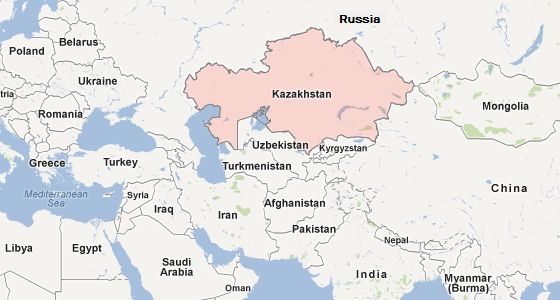
Steve Horn and Allen Ruff report: December 16, 2011, should have been, at minimum, a fairly bright day for the people of Kazakhstan marking the country's Independence Day and 20th birthday.
But rather than being a moment of celebration, it became a day of brutal repression and death, a bloody scene in the regional center of Zhanaozen paralleling those that occurred at the hands of US-supported dictatorial regimes during the uprisings now commonly referred to as the Arab Spring.
The victims of the state's crackdown were striking oil workers protesting subsistence wages and poor working conditions in the city of 51,000 citizens 75 miles east of the Caspian Sea.
Kazakhstan's state media reported police shot and killed ten workers, wounding more than 80 strikers. Independent journalist Mark Ames translated an account of a Russian reporter who estimated approximately 70 dead, with 500 to 800 wounded. Scores more were jailed, likely the victims of beatings and torture.
Following the shootings and arrests, Zhanaozen, home to the state-owned oil company, KazMunaiGas (KMG), was placed under a state of emergency. Authorities cut off Internet and communications access nationwide and the city was inundated with additional thousands of police. KMG has ongoing business ownership partnerships with the US-based multinational energy giants Chevron and ExxonMobil, which hold significant concessions in the country.
EurasiaNet's Joshua Kucera reported the attacks on the strikers were carried out by police armed with US-supplied weaponry. Some of the 114 Humvees given to Kazkahstan since 2002 as part of the US-funded Kazakhstan Peacekeeping Brigade (KAZBRIG) were filmed on the streets during the height of the repression.
That same cold, dark December day at Aktau, 75 miles to the west, police cracked down on rallies held in solidarity with the Zhanaozen workers. Human Rights Watch documented that, "police detained about 100 protesters and took them to a temporary detention center … Workers in Aktau reported heavy police surveillance at the protest, which was held in front of the regional mayor's office."
Human Rights Watch responded to the abuse of civil liberties by calling for an investigation into the use of state violence and called for the restoration of telecommunications services.
The repression was conducted by a police apparatus built up under the dictatorial reign of President Nursultan Nazarbayev, the country's leader and "winner" of fixed election after election since the Central Asian Republic became independent following the break-up of the Soviet Union in 1991.
Later, parliamentary elections took place on January 15, with Nazarbayev initially barring those living in Zhanaozen from participating. He later revoked that decision, but that didn't matter, since the elections are consistently rigged to begin with under what is essentially a one-party state.
The December repression of oil workers, and the political situation at large in Kazakhstan, call for a deeper examination into the geopolitical situation of a country located at the heart of what has long been referred to as the historic Silk Road trade route and what investigative journalist Pepe Escobar refers to as Pipelineistan.
Four times the size of Texas and larger than western Europe, a massive country of over 16 million at the heart of Central Asia, resource-rich Kazakhstan has increasingly become a vital centerpiece of US strategic interest, "soft power" and "hard power" regional influence.
The country has become case study for US deployment of the so-called "three D's": diplomacy, development and defense – as part of the broader ongoing long-war effort delineated in the Pentagon's April 2011 National Strategic Narrative and elsewhere. [Continue reading…]

Glenn Greenwald writes: We now have an extraordinary situation that reveals the impunity with which political elites commit the most egregious crimes, as well as the special privileges to which they explicitly believe they — and they alone — are entitled. That a large bipartisan cast of Washington officials got caught being paid substantial sums of money by an Iranian dissident group that is legally designated by the U.S. Government as a Terrorist organization, and then meeting with and advocating on behalf of that Terrorist group, is very significant for several reasons. New developments over the last week make it all the more telling. Just behold the truly amazing set of facts that have arisen:
In June, 2010, the U.S. Supreme Court issued its 6-3 ruling in the case of Holder v. Humanitarian Law. In that case, the Court upheld the Obama DOJ’s very broad interpretation of the statute that criminalizes the providing of “material support” to groups formally designated by the State Department as Terrorist organizations. The five-judge conservative bloc (along with Justice Stevens) held that pure political speech could be permissibly criminalized as “material support for Terrorism” consistent with the First Amendment if the “advocacy [is] performed in coordination with, or at the direction of, a foreign terrorist organization” (emphasis added). In other words, pure political advocacy in support of a designated Terrorist group could be prosecuted as a felony — punishable with 15 years in prison — if the advocacy is coordinated with that group.
This ruling was one of the most severe erosions of free speech rights in decades because, as Justice Breyer (joined by Ginsberg and Sotomayor) pointed out in dissent, “all the activities” at issue, which the DOJ’s interpretation would criminalize, “involve the communication and advocacy of political ideas and lawful means of achieving political ends.” The dissent added that the DOJ’s broad interpretation of the statute “gravely and without adequate justification injure[s] interests of the kind the First Amendment protects.” As Georgetown Law Professor David Cole, who represented the plaintiffs, explained, this was literally “the first time ever” that “the Supreme Court has ruled that the First Amendment permits the criminalization of pure speech advocating lawful, nonviolent activity.” Thus, “the court rule[d] that speech advocating only lawful, nonviolent activity can be made a crime, and that any coordination with a blacklisted group can land a citizen in prison for 15 years.” Then-Solicitor-General Elena Kagan argued the winning Obama DOJ position before the Court.
Whatever one’s views are on this ruling, it is now binding law. To advocate on behalf of a designated Terrorist group constitutes the felony of “providing material support” if that advocacy is coordinated with the group. [Continue reading…]
The Telegraph reports: Syria’s opposition has accused security forces of killing 47 women and children in Homs and urged the UN Security Council to hold an emergency meeting to discuss the killings.
Hadi Abdallah, a Syrian activist in the besieged central city, said the bodies of 26 children and 21 women, some with their throats slit and others bearing stab wounds, were found in the Karm el-Zaytoun and Al-Adawiyeh neighbourhoods.
“Some of the children had been hit with blunt objects on their head, one little girl was mutilated and some women were raped before being killed,” he said.
The main opposition group, the Syrian National Council (SNC), called for an emergency UN Security Council meeting to discuss the “massacre”, which it said took place on Sunday.
“The Syrian National Council is making the necessary contacts with all organisations and countries that are friends with the Syrian people for the UN Security Council to hold an emergency meeting,” the SNC said in a statement.
And in a clear reference to Russia and China, the SNC said that allies of Syria’s President Bashar al-Assad shared responsibility for the “crimes” committed by his regime.
State television blamed “armed terrorist gangs” for the killings, saying they had kidnapped residents of Homs, killed them and then made video footage of the bodies in an attempt to discredit Syrian forces.
News of the killings came after UN-Arab League peace envoy Kofi Annan left Damascus on Sunday without managing to secure an accord to end bloodletting monitors say has claimed more than 8,500 lives since March last year.
Annan departed at the end of a two-day mission during which he said he presented Assad with “concrete proposals” to halt the unrest that has rocked Syria since pro-democracy protesters rose up against his regime on March 15, 2011.
On the ground, more than 150 people – 61 of them civilians caught in the crossfire – were killed weekend clashes between armed rebels and regular soldiers in various flashpoint areas, according to figures of rights monitors.
AFP reports: Syrian regime stalwart and former defence minister Mustafa Tlass has arrived in Paris with one of his sons but they are not defecting, opposition representatives told AFP on Monday.
Tlass arrived in France from Syria with his businessman son Firas, the Paris-based opponents said. His other son Manaf, an officer in the Syrian regime’s military, is believed still to be in Damascus.
Mohamad al-Rashdan, member of the National Committee for Support of the Syrian Revolution, told AFP: “He has been in France for five days after having an argument with Assef Shawkat, President Bashar al-Assad’s brother-in-law.”
Shawkat is the current deputy defence minister and husband of President Assad’s sister Bushra.
A source close to the Syrian community in exile told AFP: “Tlass and his son Firas arrived in Paris yesterday (Sunday). I don’t think this is a defection. He will be here awhile, but it is with the regime’s authorisation.”
Other Syrian regime opponents confirmed Tlass’s presence in France but denied reports that he was about to announce his defection or that he was meeting with opposition members.
A Sunni Muslim, Tlass was Syrian defence minister from 1972 to 2004, having befriended Bashar’s father and predecessor as Syrian president, Hafez, at military academy.
Joshua Landis quotes an anonymous source saying:
Word in Lebanon is that Mustafa Tlass was trying to recruit people here to overthrow Bashar, and the regime found out about it. They let him and his one son leave, to France, but the other son is in the Army and they are basically keeping him as a hostage to prevent Tlass from joining the rebels.
Landis also posts a letter from one of his readers who recently visited Latakia, Syria’s principal port city.
I am a christian Syrian living abroad. Last month I went back to Syria and spent a week with my parents in Lattakia. Here are some observations.
The son of my 2nd grade teacher is in prison. He was caught distributing pro opposition fliers. A few days ago, his flat burned down and his 3 kids died in the fire. His wife is in a critical condition.
A relative of my family lawyer, a university student was arrested couple weeks ago in Damascus. She was released the day I arrived.
Another guy from our neighborhood, though known to be pro regime, was picked up by the secret police at the university as he was leaving his mid term exam room. He disappeared for 2 weeks. He was just released…. Some name miss match they explained.
I was stopped at the airport. Was called to Damascus for questioning by an officer in one of the security branches. Without my father’s connections I am sure I would ve not been able to get the travel permission and to leave on time. I still don’t know what they wanted from me.
We hear stories about kidnappings taking place in the eastern part of the country near Deir Ezzor, in Homs and on the outskirts of Damascus in exchange of ransom.
Lattakia is one of the cities the least affected by the events. It’s kept under tight control by a strong pro regime presence. The government is doing all it can to show that it’s business as usual. They do amazing cleaning job after each Friday clashes. As I hang out with some friends at a coffee shop in the afternoon, life seems to go on as usual in the busy streets… but something weird is felt in the air… a thick layer of pessimism and anxiety is hanging over the city… everybody feels that it is boiling and it might explode at any moment. You can’t miss the signs:
My high school has become an army base. The main city square, less than 1000 yards from my parents flat and a center of protests in the early days, is now filled with soldiers and sand bags. “Al Assad soldiers” they proudly painted on the walls.
My friends drove me by the Ramel neighborhood. One of the hot areas in town. Army check points with sand bags control all streets entering the neighborhood. “POLICE” is painted on them. We all know it is the army who controls them and not the police.
Gunmen in civilian clothing are present at all hospital entrances. They are there to arrest wounded protesters seeking treatment.
4×4 trucks with armed men and mounted machine guns pass by every now and then.
Electricity is cut off 6 hours a day, 3 in the morning and 3 in the afternoon. It is setting the rhythm for business hours. – Today Electricity is off 12 hours a day. it’s on and off every 3 hours.
The price for heating fuel has sky rocketed. The price for cooking gas has doubled. It s cold in my parents and my friends flats. It’s been one of the coldest and rainiest winters in Syria. People wear many layers indoors and sleep with thick wool covers- these are still the privileged neighborhoods. I can’t imagine the living conditions in rebelled areas.
I have just come back from a week stay in Syria. I left as the bombing of Homs was about to begin.
Ahmed Rashid writes: The Afghan people are exhausted by a war that has gone on in one form or other since 1979, when most US soldiers now in Afghanistan were not even born. Increasing numbers of Afghans would agree with what the Taliban have been arguing for almost a decade: that the western presence in Afghanistan is prolonging the war, causing misery and bloodshed. The hundreds of civilians killed already this year across the country are almost forgotten now in the aftermath of the killing of children by a farengi, or foreigner.
Moreover, faced with an increasingly corrupt and incompetent government, Afghans are seeing fewer improvements on the ground. So-called “nation building” has ground to a halt, simple justice and rule of law is unobtainable and a third of the population is suffering from malnutrition. The people blame not just the Americans but equally Hamid Karzai and his inner circle, which gives him conflicting and contradictory advice, leading him to flip and flop on policy issues.
The Afghan president’s desire to seek a strategic partnership agreement with the US is becoming more and more unacceptable to the Afghan people. At the same time he also wants to make peace with the Taliban, but they have no desire for a pact with Washington. His dilemma, which he still refuses to understand, is that he can either ask for a long-term US presence or peace with the Taliban, but not both.
According to an Afghan guard at the base who spoke to the BBC, the soldier who conducted a massacre outside Kandahar last night, left his base twice, returning for an hour and a half after the first stage in his killing spree only to head out again for another two hours.
An official told ABC News that the soldier has suffered a mild traumatic brain injury (TBI) in the past, either from hitting his head on the hatch of a vehicle or in a car accident. He went through the advanced TBI treatment at Fort Lewis and was deemed to be fine.
He also underwent mental health screening necessary to become a sniper and passed in 2008. He had routine behavioral health screening after that and was cleared, the official said.
When the soldier returned from his last deployment in Iraq he had difficulty reintegrating, including marital problems, the source told ABC News. But officials concluded that he had worked through those issues before deploying to Afghanistan.
The shooting occurred at 3 a.m. in three houses in two villages in the Panjway district of southern Kandahar province, an area that was once a Taliban safe haven but has recently become more safe after a surge of troops in 2009.
The soldier left the base in the middle of the night and wore night-vision goggles during the alleged rampage, according to a source.
The first village was more than a mile south of the base. While there, he allegedly killed four people in the first house. In the second house, he allegedly killed 11 family members — four girls, four boys and three adults.
He then walked back to another village past his base where he allegedly killed one more person, according to a member of the Afghan investigation team and ABC News’ interviews with villagers.
BBC News reports: Initial reports said that the soldier simply walked to the villages, which were located about 500 (546 yds) from the military base in Panjwai district.
But local journalists say that the villages of Najeeban and Alkozai are about 5-7km (3-4 miles) apart. This immediately raises questions about accounts which said he completed his deadly circuit on foot.
An Afghan guard at the Nato base told the BBC that the soldier left the base twice. He returned at 00:30 local time (20:00 GMT) after the first trip out and was out between 02:00 and 04:00 for the second trip.