The New York Times reports: Tens of thousands of people poured into the streets of a Syrian city on Saturday for the funeral of a celebrated Kurdish opposition leader whose assassination the day before unleashed fury in the country’s Kurdish regions and threatened to open a new theater of opposition to President Bashar al-Assad’s rule.
The crowds attending the funeral of the Kurdish leader, Mashaal Tammo, a prominent figure who had escaped an attempt on his life only a month before, constituted some of the biggest gatherings in weeks in the nearly seven-month uprising against Mr. Assad.
Activists said at least five people were killed when security forces opened fire on the funeral in Qamishli, a city in northeastern Syria, igniting anger among a long restive Kurdish community that the government had tried to avoid provoking.
The government has demonstrated little political strategy in coping with the revolt so far, relying almost exclusively on violence since August, deepening opposition in virtually every region of the country, and provoking extended clans in eastern and southern Syria.
Yet picking a full-fledged fight with the Kurdish minority would add a new, dangerous facet to a revolt that has ebbed but remained resilient despite a crackdown that, by a United Nations count, has killed more than 2,900.
“My father’s assassination is the screw in the regime’s coffin,” said Fares Tammo, who spoke by telephone from the Kurdish city of Irbil in neighboring Iraq. “They made a big mistake by killing my father.”
Author Archives: News Sources
Eyewitness account of the violence in Cairo
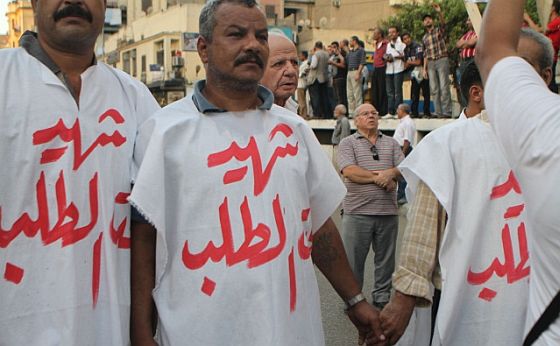
Sarah Carr writes: The march from the Cairo district of Shubra was huge, like the numbers on 28 January. In the front row was a group of men in long white bibs, “martyr upon demand” written on their chests. A tiny old lady walked among them, waving a large wooden cross: “God protect you my children, God protect you.”
The march started down Shubra Street around 4 pm, past its muddle of old apartment buildings, beat up and sad but still graceful compared with the constructions from the Mubarak era next to them – brutish and unfinished-looking.
A man explained why there were bigger numbers than the march last week in response to the attack on the St. George’s Church in Aswan: the army had hit a priest while violently dispersing Coptic protesters in front of the Maspiro state TV building on Wednesday. A video posted online showed a young man being brutally assaulted by army soldiers and riot police.
At a traffic underpass at the end of Shubra Street, at around 6 pm, there was the sudden sound of what sounded like gunfire. Protesters at the front told those behind to stop – the march was under attack. Rocks rained down from left and right and from the bridge, underneath which protesters were taking shelter.
Some threw stones back. Behind them, protesters chanted, “The people want the removal of the Field Commander.” The stone throwing eventually stopped sufficiently for the march to continue. A teenage boy crossed himself repeatedly as he moved forward toward the rocks.
Darkness fell just as the march reached Galaa Street. “This is our country,” protesters chanted, led by a man on a pickup truck full of speakers. An illuminated cross floated through the darkness. At the headquarters of state daily newspaper Al-Ahram, a single rock was thrown at the door, likely a comment on its coverage of violence against Copts.
Outside the Ramsis Hilton Hotel, the chanting stopped momentarily – the exuberance of having escaped the attack in Shubra faded as the march rounded the corner toward Maspiro.
It was immediately met with gunfire in the air. As protesters continued moving forwards, the gunfire continued.
Suddenly, there was a great surge of people moving back, and something strange happened. Two armored personnel carriers (APCs) began driving at frightening speed through protesters, who threw themselves out of its path. A soldier on top of each vehicle manned a gun, and spun it wildly, apparently shooting at random although the screams made it difficult to discern exactly where the sound of gunfire was coming from.
It was like some brutal perversion of the military show the armed forces put on for the 6th of October celebration three days before. The two vehicles zigzagged down the road outside Maspiro underneath the 6th of October Bridge and then back in synchronicity, the rhythm for this particular parade provided by the “tac tac tac” of never-ending gunfire, the music the screams of the protesters they drove directly at.
And then it happened: an APC mounted the island in the middle of the road, like a maddened animal on a rampage. I saw a group of people disappear, sucked underneath it. It drove over them. I wasn’t able to see what happened to them because it then started coming in my direction.
Later, as riot police fired tear gas at another small attempt at a demonstration and fires burned around Maspiro, I found on the floor part of one of the white “martyrs upon demand” bibs the men had been wearing, and took it home. It had been ripped in half.
Egypt army and police massacre protesters in Cairo — updated
The New York Times reports: A demonstration by Christians angry about a recent attack on a church touched off a night of violent protests here against the military council now ruling Egypt, leaving 24 people dead and more than 200 wounded in the worst spasm of violence since the ouster of President Hosni Mubarak in February.
The sectarian protest appeared to catch fire because it was aimed squarely at the military council that has ruled Egypt since the revolution, at a moment when the military’s latest delay in turning over power has led to a spike in public distrust of its authority.
When the clashes broke out, some Muslims ran into the streets to help defend the Christians against the police, while others said they had come out to help the army quell the protests in the name of stability, turning what started as a march about a church into a chaotic battle over military rule and Egypt’s future.
Nada el-Shazly, 27, who was wearing a surgical mask to deflect the tear gas, said she came out because she heard state television urge “honest Egyptians” to turn out to protect the soldiers from Christian protesters, even though she knew some of her fellow Muslims had marched with the Christians to protest the military’s continued hold on power.
“Muslims get what is happening,” she said. The military, she said, was “trying to start a civil war.”
Issandr El Amrani sees the turn of events as worrisome for multiple reasons.
This marks the first time that the army has taken such an aggressive posture against a predominantly Christian protest, which will easily lead the framing of today’s events as the first time that the military chooses to kill protesting Christians.
Worrisome because state television has behaved thus far tonight much as it did during the 18 days of the Egyptian uprising this winter. In other words, it has deployed propaganda, unverifiable allegations, talk of “foreign agendas” and “outside hands”, and extremely partial reporting. It has repeatedly used sectarian language, with presenters referring to protestors as “the Copts” and using sentences such as “The Copts have killed two soldiers.” On top of this, the military cut off the live TV feeds of several satellite TV stations, including 25TV, al-Hurra, and at a later point al-Jazeera, reducing the independent reporting of an unfolding event. And most of all because TV presenters were urging Egyptians to “protect the army from the Copts.”
Worrisome because many appear to have responded to that call, and tonight on one of Cairo’s main thoroughfares you could see young men marching to that chant of “There is no God but God”, or a woman being attacked simply because she was wearing a cross, or simply because sectarianism has reared its ugly head again after last May’s Imbaba church arson.
Worrisome because this is all happening at a time when the political class is in crisis, its confidence in the SCAF at an all-time low, and the general population is so fed up of all the uncertainty and chaos that it is having buyer’s remorse about the overthrow of Hosni Mubarak.
Most worrisome of all because, taken altogether, this paints a picture of the Egyptian military as resorting to sectarian impulses almost reflexively. It is the flipside of its continued unwillingness, after the sectarian clashes (between civilians as well as between police, military and civilians once fighting had already broken out) of earlier this year, to end once and for all the official discrimination that Copts face when building, expanding or renovating places of worship. SCAF, which rules by decree, could have acted, but did not — and acted weakly in the face of the arson of a church in Aswan last week, which was the cause of today’s protests. And because from so many sides we are getting the old passing of the buck to “foreign agendas” and “foreign hands” in what was.
Muslim and Christian graves desecrated in Israeli city of Jaffa
The Guardian reports: Dozens of gravestones have been desecrated at Muslim and Christian cemeteries and a firebomb thrown at a synagogue in Jaffa, Israel, on Yom Kippur, the Jewish Day of Atonement.
At least five tombs were smashed and around 20 others sprayed with Hebrew graffiti, including ‘Death to Arabs’ and ‘Price Tag’ – a slogan used by militant Jewish settlers in the occupied West Bank and their supporters.
The “price-taggers” have vowed to avenge any move by Israel to uproot West Bank settlement outposts built without Israeli government permission, and have set fire to mosques and vandalised both Israeli and Palestinian property.
Police spokesman Micky Rosenfeld said a firebomb thrown on to the roof of a synagogue in the Jaffa area caused no damage or casualties. He said an investigation had been launched and that patrols had been stepped up.
A few dozen Israelis and Palestinians turned out in a show of protest against the attacks and a local councillor blamed settlers. Jaffa is the ancient part of Tel Aviv, with a mixed Jewish and Arab population, including Christians and Muslims.
“All these extreme settlers are doing different activities and they are not paying a price for anything,” said Sami Abu-Shehadi, a member of the Tel Aviv-Jaffa municipality council. “Settlers have been saying that they want to bring the conflict inside [Israel] and this is exactly what they are doing now,” he said.
Palestinian officials tell Tony Blair to quit
Drone warfare — does America want to live in the world it is creating?
Scott Shane writes: the Zhuhai air show in southeastern China last November, Chinese companies startled some Americans by unveiling 25 different models of remotely controlled aircraft and showing video animation of a missile-armed drone taking out an armored vehicle and attacking a United States aircraft carrier.
The presentation appeared to be more marketing hype than military threat; the event is China’s biggest aviation market, drawing both Chinese and foreign military buyers. But it was stark evidence that the United States’ near monopoly on armed drones was coming to an end, with far-reaching consequences for American security, international law and the future of warfare.
Eventually, the United States will face a military adversary or terrorist group armed with drones, military analysts say. But what the short-run hazard experts foresee is not an attack on the United States, which faces no enemies with significant combat drone capabilities, but the political and legal challenges posed when another country follows the American example. The Bush administration, and even more aggressively the Obama administration, embraced an extraordinary principle: that the United States can send this robotic weapon over borders to kill perceived enemies, even American citizens, who are viewed as a threat.
“Is this the world we want to live in?” asks Micah Zenko, a fellow at the Council on Foreign Relations. “Because we’re creating it.”
What was a science-fiction scenario not much more than a decade ago has become today’s news. In Iraq and Afghanistan, military drones have become a routine part of the arsenal. In Pakistan, according to American officials, strikes from Predators and Reapers operated by the C.I.A. have killed more than 2,000 militants; the number of civilian casualties is hotly debated. In Yemen last month, an American citizen was, for the first time, the intended target of a drone strike, as Anwar al-Awlaki, the Qaeda propagandist and plotter, was killed along with a second American, Samir Khan.
If China, for instance, sends killer drones into Kazakhstan to hunt minority Uighur Muslims it accuses of plotting terrorism, what will the United States say? What if India uses remotely controlled craft to hit terrorism suspects in Kashmir, or Russia sends drones after militants in the Caucasus? American officials who protest will likely find their own example thrown back at them.
The financial deregulation monster that Margaret Thatcher unleashed
[Editor’s note — “The City” is London’s financial district, Britain’s equivalent of Wall Street. In 1986, West Germany’s counterpart was in Frankfurt, on the US-friendly side of the Iron Curtain.]
The Observer reports: Back in 1986, as the City broker L Messel was being acquired by a fast-expanding investment bank called Lehman Brothers, a young, ambitious financier was parachuted into London from Wall Street and put in charge of European expansion.
That man was Dick Fuld, who later achieved notoriety as the captain of the investment bank as it went down with all hands, but even in the mid 1980s he was demonstrating a deftness of touch.
At an early meeting, Messel executives told their new thrusting boss that if he was serious about achieving his aggressive growth plans, they really needed to supplement the London office with another in Frankfurt.
“No way,” fired back the earnest American. “We’re never going behind the iron curtain!”
Many of the Messel staff present have dined out on that one ever since, but it is only one of many anecdotes about the events leading up to what will forever be known in the City as the Big Bang.
This month marks the 25th anniversary of that radical Thatcherite reshaping of the City, a period in which the Americans arrived to snap up ancient City institutions for huge premiums, leading to the clubby atmosphere of the Square Mile being replaced with the rapacious, bonus-grabbing culture of the investment bank.
“Nobody could quite believe how much the Americans wanted to pay,” recalls Adam Pollock, now head of corporate broking at Panmure Gordon, then a banker at Lazard. “It brought with it a renewed vigour and enthusiasm, with everybody working a lot harder. But that ended some traditions. It used to be de rigueur to have a big lunch.”
The Big Bang was partly about modernisation – ensuring that the City used up-to-date technology such as computers. But it also dismantled the barriers between the separate, narrowly focused firms in the City, the stockbrokers, advisers and “jobbers” who created the markets in shares. Afterwards, all these services could exist under one roof and ultimately, some would argue, it led to the catastrophe of the credit crunch, whose effects the UK is still living through. “Big Bang was the start of investment banking in the UK,” says Tony Dolphin, chief economist at the Institute for Public Policy Research.
With the Glass-Steagall Act, separating investment banking and deposit-taking, still in force in the US, Britain’s laxer regime brought an influx of US firms, with their chinos, booze-free lunch-breaks and bumper bonuses, helping to bust open the old City cliques.
With them, argues City veteran Tony Greenham of the New Economics Foundation thinktank, came deep-seated conflicts of interest.
“On the plus side, the Americans brought a more meritocratic culture,” he says. “But they also brought the idea that, instead of being client-based, it was a transaction-based business. You change from long-termism to short-termism, from looking after the long-term interests of your client to making the biggest buck out of today’s deal.”
German general says NATO Afghan mission has ‘failed’
Der Spiegel reports: It was 10 years ago that the United States, together with its NATO allies, marched into Afghanistan to put an end to Taliban rule and begin the hunt for al-Qaida chief Osama bin Laden. A decade later, the terrorist leader is dead. But, says Harald Kujat, former general inspector of the German military, the mission has been a failure.
“The mission fulfilled the political aim of showing solidarity with the United States,” Kujat told the German daily Mitteldeutsche Zeitung. “But if you measure progress against the goal of stabilizing a country and a region, then the mission has failed.”
Kujat said that it was ignored for too long that “the opponent was fighting a military battle and we needed to do the same.” In reference to claims from German political leaders, among others, he said “the argument that it was a stabilization mission was maintained for too long.” The result, he said, is that soldiers were not given what they needed in order to effectively fight the enemy.
Kujat is hardly the first to criticize the Afghanistan war. But his words carry weight in Germany. He was a leading planner of the German mission to Afghanistan and served as general inspector of the German military — the Bundeswehr’s [German armed forces] highest-ranking soldier — from 2000 to 2002. Part of his job included advising both the German government and the Defense Ministry on military matters.
The former Bundeswehr leader also took aim at Germany’s plan to complete withdrawal of all of its 5,000 combat troops from Afghanistan by 2014, a timeline that was reiterated on Friday by Germany’s special representative for Afghanistan, Michael Steiner.
“If we withdraw from Afghanistan in 2014,” said Kujat, “then the Taliban will take over power again within just a few months.”
The Associated Press reports: They were the first Americans into Afghanistan after the Sept. 11 attacks and will probably be the last U.S. forces to leave.
As most American troops prepare to withdraw in 2014, the CIA and military special operations forces to be left behind are girding for the next great pivot of the campaign, one that could stretch their war up to another decade.
The war’s 10th anniversary Friday recalled the beginnings of a conflict that drove the Taliban from power and lasted far longer than was imagined.
“We put the CIA guys in first,” scant weeks after the towers in New York fell, said Lt. Gen. John Mulholland, then a colonel with U.S. special operations forces, in charge of the military side of the operation. U.S. Special Forces Green Berets, together with CIA officers, helped coordinate anti-Taliban forces on the ground with U.S. firepower from the air, to topple the Taliban and close in on al-Qaida.
Recent remarks from the White House suggest the CIA and special operations forces will be hunting al-Qaida and working with local forces long after most U.S. troops have left.
When Afghan troops take the lead in 2014, “the U.S. remaining force will be basically an enduring presence force focused on counterterrorism,” said National Security Advisor Tom Donilon, in remarks in Washington in mid-September. That will be augmented by teams that will continue to train Afghan forces, added White House spokesman Tommy Vietor.
The White House insists this does not mean abandoning the strategy of counterinsurgency, in which large numbers of troops are needed to keep the population safe. It simply means replacing the surge of 33,000 U.S. troops, as it withdraws over the next year, with newly trained Afghan ones, according to senior White House Afghan war adviser Doug Lute
It also means U.S. special operators and CIA officers will be there for the next turn in the campaign. That’s the moment when Afghans will either prove themselves able to withstand a promised Taliban resurgence, or find themselves overwhelmed by seasoned Taliban fighters.
The strong and steady heartbeat of Occupy Wall Street is spreading across America
The New York Times reports: What began as a small group of protesters expressing their grievances about economic inequities last month from a park in New York City has evolved into an online conversation that is spreading across the country on social media platforms.
Inspired by the populist message of the group known as Occupy Wall Street, more than 200 Facebook pages and Twitter accounts have sprung up in dozens of cities during the past week, seeking volunteers for local protests and fostering discussion about the group’s concerns.
Some 900 events have been set up on Meetup.com, and blog posts and photographs from all over the country are popping up on the WeArethe99Percent blog on Tumblr from people who see themselves as victims of not just a sagging economy but also economic injustice.
I don’t want to be rich. I don’t want to live a lavish lifestyle,” wrote a woman on Tumblr, describing herself as a college student worried about the burden of student debt. “I’m worried. I’m scared, thinking about the future shakes me. I hope this works. I really hope this works.
The online conversation has grown at the same time that street protests have taken place in several other cities last week, including Boston, Los Angeles, Chicago and Washington. A Web site, Occupy Together, is trying to aggregate the online conversations and the off-line activities.
We are not coordinating anything,” said Justin Wedes, 26, a former high school science teacher from Brooklyn who helps manage one of the movement’s main Twitter accounts, @OccupyWallStNYC. “It is all grass roots. We are just trying to use it to disseminate information, tell stories, ask for donations and to give people a voice.
Obama, the loner president
Scott Wilson writes: Beyond the economy, the wars and the polls, President Obama has a problem: people.
This president endures with little joy the small talk and back-slapping of retail politics, rarely spends more than a few minutes on a rope line, refuses to coddle even his biggest donors. His relationship with Democrats on Capitol Hill is frosty, to be generous. Personal lobbying on behalf of legislation? He prefers to leave that to Vice President Biden, an old-school political charmer.
Obama’s circle of close advisers is as small as the cluster of personal friends that predates his presidency. There is no entourage, no Friends of Barack to explain or defend a politician who has confounded many supporters with his cool personality and penchant for compromise.
Obama is, in short, a political loner who prefers policy over the people who make politics in this country work.
“He likes politics,” said a Washington veteran who supports Obama, “but like a campaign manager likes politics, not a candidate.” The former draws energy from science and strategy, the latter from contact with people.
Which raises an odd question: Is it possible to be America’s most popular politician and not be very good at American politics?
The 1%: Why CEOs who under-perform get over-payed
The Washington Post reports: As the board of Amgen convened at the company’s headquarters in March, chief executive Kevin W. Sharer seemed an unlikely candidate for a raise.
Shareholders at the company, one of the nation’s largest biotech firms, had lost 3 percent on their investment in 2010 and 7 percent over the past five years. The company had been forced to close or shrink plants, trimming the workforce from 20,100 to 17,400. And Sharer, a 63-year-old former Navy engineer, was already earning lots of money — about $15 million in the previous year, plus such perks as two corporate jets.
The board decided to give Sharer more. It boosted his compensation to $21 million annually, a 37 percent increase, according to the company reports.
Why?
The company board agreed to pay Sharer more than most chief executives in the industry — with a compensation “value closer to the 75th percentile of the peer group,” according to a 2011 regulatory filing.
This is how it’s done in corporate America. At Amgen and at the vast majority of large U.S. companies, boards aim to pay their executives at levels equal to or above the median for executives at similar companies.
The idea behind setting executive pay this way, known as “peer benchmarking,” is to keep talented bosses from leaving.
But the practice has long been controversial because, as critics have pointed out, if every company tries to keep up with or exceed the median pay for executives, executive compensation will spiral upward, regardless of performance. Few if any corporate boards consider their executive teams to be below average, so the result has become known as the “Lake Wobegon” effect.
Iran reactor disaster warning from whistleblower
How does a disreputable newspaper identify its reputable sources? As soon as I saw the headline, I assumed this article must come from The Times. Maybe it’s rock solid reporting — who knows?
Iran’s first nuclear power station is unsafe and will probably cause a “tragic disaster” according to a document apparently written by an Iranian whistleblower.
The Bushehr reactor is likely to cause the next nuclear catastrophe after Chernobyl and Fukushima, says the document, passed to The Times by a reputable source and attributed to a former member of the Atomic Energy Organisation of Iran’s legal department.
It claims Bushehr, which began operating last month after 35 years of intermittent construction, was built by “second-class engineers” who bolted together Russian and German technology from different eras; that it sits in one of the world’s most seismically active areas but could not withstand a major earthquake; and that it has “no serious training program” or a contingency plan for accidents.
The document’s authenticity cannot be confirmed, but nuclear experts see no reason to doubt it. It also echoes fears in the nuclear industry about the safety of a secretive project to which few outsiders have had access. Iran is the only country with a nuclear plant that has not joined the Convention on Nuclear Safety, which obliges signatories to observe international safety standards.
Lifting the Veil: Obama and the Failure of Capitalist Democracy
Sit back — the following film is 1hr 53min long.
Confronting the malefactors
Paul Krugman writes: There’s something happening here. What it is ain’t exactly clear, but we may, at long last, be seeing the rise of a popular movement that, unlike the Tea Party, is angry at the right people.
When the Occupy Wall Street protests began three weeks ago, most news organizations were derisive if they deigned to mention the events at all. For example, nine days into the protests, National Public Radio had provided no coverage whatsoever.
It is, therefore, a testament to the passion of those involved that the protests not only continued but grew, eventually becoming too big to ignore. With unions and a growing number of Democrats now expressing at least qualified support for the protesters, Occupy Wall Street is starting to look like an important event that might even eventually be seen as a turning point.
What can we say about the protests? First things first: The protesters’ indictment of Wall Street as a destructive force, economically and politically, is completely right.
A weary cynicism, a belief that justice will never get served, has taken over much of our political debate — and, yes, I myself have sometimes succumbed. In the process, it has been easy to forget just how outrageous the story of our economic woes really is. So, in case you’ve forgotten, it was a play in three acts.
Vanity, machismo and greed have blinded us to the folly of Afghanistan
Simon Jenkins writes: Ten years of western occupation of Afghanistan led the UN this week to plead that half the country’s drought-ridden provinces face winter starvation. The World Food Programme calls for £92m to be urgently dispatched. This is incredible. Afghanistan is the world’s greatest recipient of aid, some $20bn in the past decade, plus a hundred times more in military spending. So much cash pours through its doors that $3m a day is said to leave Kabul airport corruptly to buy property in Dubai.
Everything about Afghanistan beggars belief. This week its leader, Hamid Karzai, brazenly signed a military agreement with India, knowing it would enrage his neighbour, Pakistan, and knowing it would increase the assault on his capital by the Haqqani network, reported clients of Islamabad’s ISI intelligence agency. Meanwhile, in Washington, the Pentagon is exulting over its new strategy of drone killing, claiming this aerial “counter-terrorism” can replace the “hearts and minds” counter-insurgency. Down in Helmand, visiting British journalists gather to recite the defence ministry’s tired catechism: “We are making real progress on the ground.”
The opening decade of the 21st century has been marked by two epic failures by the western powers that so recently claimed victory in the cold war; failures of both intellect and leadership. One is the inability to use the limitless resources of modern government to rescue the west’s economy from prolonged recession. The other is the use of an attack on America by a crazed Islamist criminal as an excuse for a retaliatory war embracing a wide swath of the Muslim world. The decade-long punishment of Afghanistan for harbouring Osama bin Laden has been an act of biblical retribution. The demand that it also abandons the habits of history and adopt democracy, capitalism and gender equality was imperial arrogance.
What happened in Afghanistan in the autumn of 2001 has spawned an industry of hindsight, with over a hundred titles of wisdom after the event. We learn of the post-9/11 arguments within the Taliban, many of them old CIA allies. We learn of the possible role of Abdul Haq in Kabul, of Pakistan’s intelligence double-dealing, and of the Kandahar jirga of October 2001 which came close to evicting Osama bin Laden.
Yet every counsel of caution in dealing with Afghanistan was disregarded in America’s rush for vengeance – even the warning of Donald Rumsfeld that America “had no dog in the Afghan fight” and should avoid nation-building after a punitive raid. A great surge of imperial eagerness seemed to overwhelm Washington, London and Nato, as if the whole of western liberalism were craving a role in the world.
Computer virus hits U.S. drone fleet
Noah Shachtman reports: A computer virus has infected the cockpits of America’s Predator and Reaper drones, logging pilots’ every keystroke as they remotely fly missions over Afghanistan and other warzones.
The virus, first detected nearly two weeks ago by the military’s Host-Based Security System, has not prevented pilots at Creech Air Force Base in Nevada from flying their missions overseas. Nor have there been any confirmed incidents of classified information being lost or sent to an outside source. But the virus has resisted multiple efforts to remove it from Creech’s computers, network security specialists say. And the infection underscores the ongoing security risks in what has become the U.S. military’s most important weapons system.
“We keep wiping it off, and it keeps coming back,” says a source familiar with the network infection, one of three that told Danger Room about the virus. “We think it’s benign. But we just don’t know.”
Military network security specialists aren’t sure whether the virus and its so-called “keylogger” payload were introduced intentionally or by accident; it may be a common piece of malware that just happened to make its way into these sensitive networks. The specialists don’t know exactly how far the virus has spread. But they’re sure that the infection has hit both classified and unclassified machines at Creech. That raises the possibility, at least, that secret data may have been captured by the keylogger, and then transmitted over the public internet to someone outside the military chain of command.
Think Occupy Wall Street is a phase? You don’t get it
Douglas Rushkoff writes: Like the spokesmen for Arab dictators feigning bewilderment over protesters’ demands, mainstream television news reporters finally training their attention on the growing Occupy Wall Street protest movement seem determined to cast it as the random, silly blather of an ungrateful and lazy generation of weirdos. They couldn’t be more wrong and, as time will tell, may eventually be forced to accept the inevitability of their own obsolescence.
Consider how CNN anchor Erin Burnett, covered the goings on at Zuccotti Park downtown, where the protesters are encamped, in a segment called “Seriously?!” “What are they protesting?” she asked, “nobody seems to know.” Like Jay Leno testing random mall patrons on American History, the main objective seemed to be to prove that the protesters didn’t, for example, know that the U.S. government has been reimbursed for the bank bailouts. It was condescending and reductionist.
More predictably perhaps, a Fox News reporter appears flummoxed in this outtake from “On the Record,” in which the respondent refuses to explain how he wants the protests to “end.” Transcending the shallow partisan politics of the moment, the protester explains “As far as seeing it end, I wouldn’t like to see it end. I would like to see the conversation continue.”
To be fair, the reason why some mainstream news journalists and many of the audiences they serve see the Occupy Wall Street protests as incoherent is because the press and the public are themselves. It is difficult to comprehend a 21st century movement from the perspective of the 20th century politics, media, and economics in which we are still steeped.
In fact, we are witnessing America’s first true Internet-era movement, which — unlike civil rights protests, labor marches, or even the Obama campaign — does not take its cue from a charismatic leader, express itself in bumper-sticker-length goals and understand itself as having a particular endpoint.
Al Jazeera’s chief extols virtues of ‘journalism for the people’
Roy Greenslade writes: The revolutionary fervour of the Arab Spring came alive last night at City University London in a lecture by Wadah Khanfar, the former director general of Al-Jazeera.
In describing his reaction to the various uprisings, particularly in Egypt and Libya, he illustrated just what is meant by a journalism of attachment or commitment.
Exhibiting an unashamed passion throughout his talk, he told a packed audience:
“In our search for a fixed pivotal point around which our editorial mission is centred we find nothing better than the people with their collective mind and their instinctive opposition to oppression, arbitrariness and corruption…
I learned from my experience as a reporter, and then as director of a media institution, an important basic fact: that we should always posit people at the centre of our editorial policy.
I don’t say this simply to reiterate a beautiful slogan with which we decorate our literature or market our institutions. I truly believe this to be a moral commitment, a scientific approach and an essential interest.”
Khanfar, the first non-Western journalist to deliver the James Cameron memorial lecture, cast Al-Jazeera’s journalism as a sort of democratic mission.
He told how the Egyptian regime’s early response to the gatherings in Tahrir Square was to close down the network’s offices and to ban its reporters and crews from working.
So the broadcaster sent a message to its Egyptian viewers telling them: “If the authorities have banned our reporters from working, then every single one of you is an Al-Jazeera reporter.”
That led, he said, to hundreds of activists supplying the network with a stream of news and video clips via social network sites.