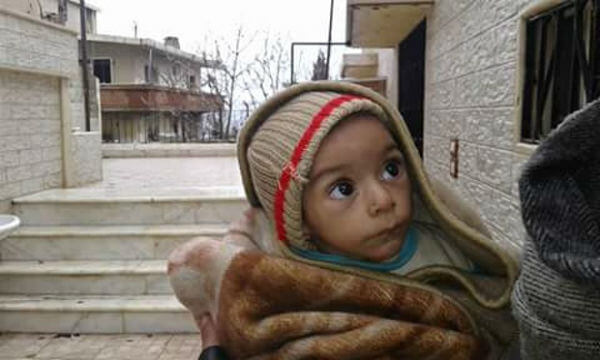
The hashtag #متضامن_مع_حصار_مضايا, meaning “solidarity with the siege of Madaya”, has sparked a new wave of outrage over the continuing crisis, with those using it condemned as “sadistic” and “unbelievably disgusting”.
Photos showed people posting with sumptuous-looking spreads of food including kebabs, grilled prawns, whole fish, chips, salad and mountains of bread. [Continue reading…]
Christopher Dickey writes: For most of the last two centuries, Europeans have been puzzling over their American cousins’ totemic obsession with guns and their passion for concealed weapons. And back in the decades before the American Civil War, several British visitors to American shores thought they’d discerned an important connection: People who owned slaves or lived among them wanted to carry guns to keep the blacks intimidated and docile, but often shot each other, too.
In 1842, the novelist Charles Dickens, on a book tour of the United States, saw a link between the sheer savagery of slave ownership and what he called the cowardly practice of carrying pistols or daggers or both. The author of Oliver Twist listened with a mixture of horror and contempt as Americans defended their utterly indefensible “rights” to tote guns and carry Bowie knives, right along with their “right” to own other human beings who could be shackled, whipped, raped, and mutilated at will.
As damning evidence of the way slaves were treated, in his American Notes Dickens published texts from scores of advertisements for the capture of runaways. Often these public notices described the wanted men and women by their scars. One especially memorable example:
“Ran away, a negro woman and two children. A few days before she went off, I burnt her with a hot iron, on the left side of her face. I tried to make the letter M.”
Dickens also compiled a list of several shooting incidents, not all of them in the South: a county councilman blown away in the council chamber of Brown County, Wisconsin; a fatal shootout in the street in St. Louis; the murder of Missouri’s governor; two 13-year-old boys defending their “honor” by dueling with long rifles, and other examples.
What could one expect, he asked, of those who “learn to write with pens of red-hot iron on the human face” but that they carry guns and daggers to use on each other. “These are the weapons of Freedom,” Dickens wrote with brutal irony. “With sharp points and edges such as these, Liberty in America hews and hacks her slaves; or, failing that pursuit, her sons devote themselves to a better use, and turn them on each other.” [Continue reading…]
Financial Times reports: President Bashar al-Assad’s forces are making a new push in southern Syria with the help of Russian air cover in a move that could not only weaken one of the country’s remaining rebel strongholds, but also threaten the balance of power on a combustible border with Israel.
The growing Russian role in the south has surprised many regional diplomats who believed Moscow had an understanding with Syria’s southern neighbours, Jordan and Israel, not to extend into their sphere of influence.
Rebels from Syria’s Southern Front alliance say they too were surprised to become the target of the new campaign: their forces are directly supplied by the Military Operations Command (MOC), an operations room staffed by Arab and western military forces, including the US.
“They (MOC) should be nervous,” says Abu Ghayath al-Shami, a spokesman for the Southern Front’s Seif al-Sham Brigades. “This area was one of their last cards, the one area where there was still a functioning relationship between the rebels and the international community.” [Continue reading…]
Lina Khatib writes: Horrific images and stories of starving children have suddenly flooded the media as the reality of life in the town of Madaya in Syria, besieged by Syrian regime sources and Hezbollah, has surfaced. But what is perhaps more shocking than the images is how the deliberate targeting of the population of Madaya has been taking place since July 2015 without the international community noticing.
This is despite activists in Madaya desperately trying to direct global attention to the atrocities committed there by the Syrian regime and its ally Hezbollah. It is only when the situation in Madaya reached the level of mass starvation that the international media have paid attention.
The Syrian regime and Hezbollah have put Madaya under siege for more than six months now as a response to the siege of the northern towns of Fua and Kefraya by anti-regime forces. In besieging Madaya and neighbouring Zabadani on the Lebanese border, the regime is trying to pressure its rebel opponents to agree to a population transfer between the two sets of towns that would consolidate regime control over Syrian towns bordering Lebanon. The regime’s plan is to empty Zabadani and Madaya from Sunni residents and populate them with Shia who would be brought in from Fua and Kefraya. This “sectarian cleansing” would allow the Shia Hezbollah to consolidate its control over areas serving as supply lines for regime strongholds in Damascus and the Syrian coast (the Sahel) as well as for Hezbollah itself. [Continue reading…]
The Guardian reports: The past six months have not been good for Isis. In addition to mounting losses on the battlefield, the organisation has been struggling to dominate the information war despite the enormous resources it devotes to shaping its message.
Central to Isis’s anger has been the activist group Raqqa Is Being Slaughtered Silently (RBSS). It numbers roughly 100 members who for more than a year have chronicled airstrikes, terror attacks, executions and other events in the Syrian city, often in real time. Life in the so-called caliphate is detailed without gloss or spin. No one else has been able to offer such insight into the organisation’s stronghold. And none have paid a bigger price for trying.
Late last year, Isis cut the internet and satellite television connections to Raqqa. It announced that anyone caught collaborating with the group would be killed, and it set about trying to weed out agents across the city and within its own ranks. According to one Isis member spoken to by the Guardian, the group has put extra resources into counter-espionage.
Since then at least four prominent activists and journalists have been killed, including three who were living and working in Turkey.
“The situation is getting more and more difficult, especially after the assassinations in Turkey,” said one member of the Raqqa group. “We are under immense pressure inside and outside Syria. Many activists have shut down their accounts and reduced their work in the areas under Isis control. Others [have remained] more driven to challenge Isis and continue their work relying on Thuraya phones and constantly changing their locations and contact details. We can still manage to get information from inside Isis but video has become more difficult now. They have built tremendous fear inside people.”
Another member of the group, who also insisted on remaining anonymous, said: “We have been receiving lots of death threats since 2012 but the situation right now is extremely dangerous. All I can do is move house every month or so and move cities. We ran away from Syria to Turkey for a safe place to work and live in but now Turkey has become as dangerous as Syria. [Continue reading…]
Syria Deeply sought the opinion of several experts. Nader Hashemi said: In broad terms, the recent fallout only serves to entrench existing positions. These positions have long solidified over the course of the past five years. The recent deterioration of relations and antagonism between Saudi Arabia and Iran do not, in my reading, fundamentally change this dynamic.
The fallout at this stage does not completely undermine the Vienna Peace Process. Both Saudi and Iran, over a series of several meetings, basically agreed to a broad framework that was enshrined in a U.N. Security Council Resolution 2254 on December 18. Now the ball is out of the court of the Iranians and Saudis and is in the court of the Syrian actors and Staffan de Mistura. That’s the next stage of the Vienna process – to try and bring Syrians from both the Assad regime and the opposition around the table. Thus, at this stage, Iran and Saudi Arabia really don’t have much to contribute. Perhaps, as a result of recent events, they might decide to take a more hardline stance when it comes to determining which Syrian rebel groups are terrorists and can have a seat at the table and which cannot.
I’m very skeptical about the Vienna Process. I think it was essentially dead on arrival because it assumes that after five years of a neo-genocidal war, and having already gone down this road before in Switzerland in January 2014 with Lakhdar Brahimi, that somehow something substantial has changed. Why should anyone assume that just because the regional and international powers have agreed to a broad framework, all of the Syrian participants in this conflict are going to meet in Geneva at the end of January, kiss and make up, and agree to some unity government and peace plan? There is little room for optimism on this point. [Continue reading…]
TSG IntelBrief: In a region beset with chronic and widespread problems, ranging from poor governance, war, violent extremism, and resource scarcity, one threat stands above the rest in terms of potential for destruction and cost in opportunity: the use of sectarianism as a geopolitical weapon. Sectarianism encourages extremist rhetoric and violence and serves to distract a populations from economic and social concerns by providing a convenient enemy on which to focus. While the Sunni-Shi’a divide is as old as Islam, current divisions are driven far more by regional rivalries and political gamesmanship than by religion, though the latter remains a primary factor.
While sectarianism as a geopolitical weapon is nothing new, its use is reaching new heights while its consequences find new lows. The current era of sectarianism stems, in part, from the 2003 Iraq War. The shift in Sunni-Shi’a power dynamics in Iraq triggered regional quakes that are still being felt today. It is difficult to overstate how Saudi Arabia’s fears of an ascendent Iran—now, with an Iraqi ally—have led to more than a decade of Saudi maneuvers driven by sectarian concerns. The sectarian war wanted so badly by Abu Mus’ab al-Zarqawi—founder of the group that would become the so-called Islamic State—has metastasized far from Anbar and Baghdad, and morphed into both direct and proxy warfare. [Continue reading…]
Guy Verhofstadt writes: t is highly likely that David Cameron’s British referendum on membership of the European Union will take place at some point in 2016. Despite the fact that the respective “leave” and “remain” campaigns have yet to begin in earnest, a host of world leaders, including Barack Obama and those of most European and many commonwealth countries, have been privately urging David Cameron and his Conservative party against a “Brexit”.
Despite the economically illiterate central tenets of the leave campaign – that a Brexit will somehow enable Britain to “go global” – it is striking that very few countries, if any, have been campaigning for Britain to leave the EU. This is perhaps because a significant number of countries have committed time and resources to negotiating trade agreements with the EU, of which Britain is such an important part.
Thanks to the hard work of the many British civil servants in Brussels, the EU is now negotiating fully fledged free-trade agreements with Australia, New Zealand, Japan and the US. A deal with Canada is already concluded. The notion that these countries would relish the possibility of negotiating a separate trade agreement with Britain, or indeed that Britain would secure preferential trade deals by leaving the world’s largest common market, is absurd.
British people should reflect on the fact that the only leader who would stand to gain from a British withdrawal from the European Union is Vladimir Putin. There are several reasons for thinking this. [Continue reading…]
Perhaps we are too fearful of appearing worthy or hectoring to express our concerns, or maybe the issues seem too complex and overwhelming. Or we have grown tired of seeing polar bears floating on melting icebergs. Whatever the reasons for our reticence, however, it is hard to see how a global impetus for public engagement and action can be realised if it remains out of bounds for discussion by all but an interested few.
The Paris summit meant climate change was headline news for a week or two. Perhaps you did find yourself reflecting on the unusual weather or the fate of low-lying Pacific nations. But now that Christmas has come and gone, are you still worrying about these things? The discussion can’t tail off from here – after Paris, we need public conversation about climate change more than ever before. Whether you think the agreement was a resounding success or are troubled by its limitations, it is clear that the hard work still lies ahead.
Patrick Tucker writes: Shortly after North Korea claimed it had tested a hydrogen bomb—a weapon potentially hundreds of times more powerful than the fission bombs the country had already set off—seismologists at the United States Geological Survey, or USGS, went to work trying to understand the event. Their early findings suggest that a nuclear-bomb test did occur but that it wasn’t a hydrogen bomb. So how do you tell the difference?
First, you try to rule out the possibility that North Korea was just trying to claim credit for an earthquake. Geologists and seismologists look at several factors to determine whether a seismic event is natural or manmade. One is the location: Is it on a known fault line, a place where there’s a lot of mining activity, etc.? Another factor is the seismological waveform itself—the waving lines that appear on the seismograph. An explosion forms wiggles that are different from the ones generated by an earthquake, according to USGS seismologist Paul Earle.
Lay a Slinky on the floor, grab one end, and move it back and forth to create a wave that propagates down its length. This is called shear wave propagation, the kind created by tectonic plates slipping beneath the surface of the earth. “That side-to-side motion, you’ll get less of it in an explosion,” said Earle. [Continue reading…]
Chotiner: Some analysts have suggested that Saudi Arabia and Iran are in a sense seeking out this crisis because it is helpful for hard-liners in both countries. Do you agree with that analysis?
Sadjadpour: I sometimes think we ascribe too much strategic forethought to governments in the Middle East. I don’t share the view that Saudi Arabia had a sophisticated regional strategy in executing Sheikh Nimr. They were executing about four dozen Sunni radicals, which was going to alienate some segment of society. So they executed a few prominent Shia at the same time.
So there was no broader strategic thinking? It was a pretty big decision.
I think when you look at the arenas where Saudi Arabia and Iran are in conflict, whether Syria or Bahrain or Lebanon or Yemen or Iraq, Iran has an upper hand. When you look at it in a broader regional context, the increasing prevalence of sectarianism benefits Saudi Arabia because they have more numbers. Eighty-five percent of the region’s Muslims are Sunni. For the Saudis, if sectarian politics outweigh anti-imperialist politics, that is beneficial. But at the same time, we are not talking about a Saudi government run by Wahhabi Kissingers or Brzezinskis. This government does not have a deep bench of strategic thinkers. They are not playing a game of chess. [Continue reading…]
The New York Times reports: Amid mounting international dismay over reports of starvation deaths and images of skeletally thin children in the besieged, rebel-held Syrian town of Madaya, the Syrian government agreed Thursday to allow the delivery of humanitarian aid, according to the United Nations.
But no firm date was set, and senior United Nations officials said that while they welcomed the government’s decision to allow the aid to enter, 42,000 people in Madaya remained “at risk of further hunger and starvation, citing “credible reports of people dying from starvation and being killed while trying to leave.”
The announcement came after Syrian opposition leaders issued a blistering statement declaring that silence and inaction from powerful nations and international organizations made them “complicit in starving civilians.” In recent days, Syrians had mounted a social media campaign sharing painful photos and videos: an 8-year-old boy who said he had not eaten for 10 days and longed for sweets; the shriveled body of a man who starved to death, his rib cage jutting out over a caved-in stomach.
Numerous residents of Madaya interviewed in recent days described living on grass and leaves, and seeing family members dying of hunger or killed by snipers as they tried to escape the town, which is surrounded by pro-government forces, primarily from Hezbollah, the Lebanese Shiite group that is allied with the Syrian president, Bashar al-Assad. [Continue reading…]
Human Rights Watch reports: Saudi Arabia-led coalition forces airdropped cluster bombs on residential neighborhoods in Yemen’s capital, Sanaa, early on January 6, 2016. It is not yet clear whether the attacks caused civilian casualties, but the inherently indiscriminate nature of cluster munitions makes such attacks serious violations of the laws of war. The deliberate or reckless use of cluster munitions in populated areas amounts to a war crime.
“The coalition’s repeated use of cluster bombs in the middle of a crowded city suggests an intent to harm civilians, which is a war crime,” said Steve Goose, arms director at Human Rights Watch. “These outrageous attacks show that the coalition seems less concerned than ever about sparing civilians from war’s horrors.”
Residents of two Sanaa neighborhoods described aerial attacks consistent with cluster bomb use. A resident of al-Zira`a Street told Human Rights Watch that his family was awakened at 5:30 a.m. on January 6 by dozens of small explosions. He said that he had been at work, but that his wife told him that when the family fled they saw many homes and a local kindergarten with newly pockmarked walls and broken windows. [Continue reading…]
Paula J. Dobriansky and David B. Rivkin Jr. write: Although international relations are not conducted under Marquess of Queensberry rules and political satire can be expected from one’s foes, intensely personal attacks on foreign leaders are uncommon except in wartime. While Soviet-era anti-American propaganda could be sharp, it did not employ slurs. But in recent years racist and scatological salvos against foreign leaders have become a staple of official Russian discourse.
Turkish, German and Ukrainian officials are cast as sycophantic stooges of the United States. While slamming Ankara at a December news conference for shooting down a Russian plane that violated Turkish airspace, Russian President Vladimir Putin opined that “the Turks decided to lick the Americans in a certain place.” Sergey Glaziev, a senior adviser to Putin, has called Ukrainian President Petro Poroshenko “a Nazi Frankenstein,” and Deputy Prime Minister Dmitry Rogozin compared Ukrainian Prime Minister Arseniy Yatsenyuk to “a rubber doll from a sex shop.”
The ugliest vilification campaign, however, has been reserved for President Obama. Anti-Obama tweets come openly from government officials. Rogozin, while commenting on Obama’s 2015 State of the Union address, compared Obama to a Tuzik, Russian slang for a pathetic small dog. Irina Rodnina , a well-known Duma member, tweeted doctored images of Barack and Michelle Obama staring longingly at a banana.
Nobody in Russia gets to freelance propaganda-wise. Thus, anti-Obama rants, even when coming from prominent individuals outside government, have Putin’s imprimatur. Russian media personalities, including Dmitry Kiselyov, the host of the widely viewed “News of the Week” TV roundup, often deliver racist slurs, as compiled by Mikhail Klikushin on the Observer Web magazine. Evgeniy Satanovskiy, a Russian academic and frequent guest on Kiselyov’s program, recently also referred to Obama as a “monkey,” prompting derisive laughter and applause from the audience. Meanwhile, the famous nationalist comedian Mikhail Zadornov regularly deploys the term “schmoe” — a slang Russian prison acronym for a person who is so debased he deserves to be defecated upon — alongside Obama’s name. “Obama schmoe” has become ubiquitous enough to be scrawled on the runway of Russia’s Latakia air base in Syria. [Continue reading…]
North Korea claims to have successfully tested a miniaturized hydrogen nuclear device which, if this indeed happened, would mark a major advance in its weapons program. The announcement is being viewed with some skepticism.
Reuters reports: South Korean intelligence officials and several analysts, however, questioned whether Wednesday’s explosion was indeed a full-fledged test of a hydrogen device.
The device had a yield of about 6 kilotons, according to the office of a South Korean lawmaker on the parliamentary intelligence committee – roughly the same size as the North’s last test, which was equivalent to 6-7 kilotons of TNT.
“Given the scale, it is hard to believe this is a real hydrogen bomb,” said Yang Uk, a senior research fellow at the Korea Defence and Security Forum.
“They could have tested some middle stage kind (of device) between an A-bomb and H-bomb, but unless they come up with any clear evidence, it is difficult to trust their claim.”
Joe Cirincione, a nuclear expert who is president of Ploughshares Fund, a global security organization, said North Korea may have mixed a hydrogen isotope in a normal atomic fission bomb.
“Because it is, in fact, hydrogen, they could claim it is a hydrogen bomb,” he said. “But it is not a true fusion bomb capable of the massive multi-megaton yields these bombs produce”.
The United States Geological Survey reported a 5.1 magnitude quake that South Korea said was 49 km (30 miles) from the Punggye-ri site where the North has conducted nuclear tests in the past.
North Korea’s last test of an atomic device, in 2013, also registered at 5.1 on the USGS scale.
The test nevertheless may mark an advance of North Korea’s nuclear technology. The claim of miniaturizing, which would allow the device to be adapted as a weapon and placed on a missile, would also pose a new threat to the United States and its regional allies, Japan and South Korea. [Continue reading…]
Comparison: 2016 North Korean nuclear test and 2005 M5.0 earthquake, both at similar distances from seismometer. pic.twitter.com/1ZuMYBJbZN
Jeffrey Lewis, who teaches a class on the evolution of China’s nuclear weapons program at the Middlebury Institute of International Studies, points out that current assessments of North Korea’s technical capabilities should not lead to false assumptions about their aspirations. He writes:
One of the major themes of the early part of China’s nuclear program is how committed China was to matching the other nuclear powers in the possession of intercontinental-range ballistic missiles armed with multi-megaton thermonuclear weapons. A lot of Americans had trouble accepting this idea. We thought of China as being too backward to have such aspirations. That was, I argue, precisely why China wanted such weapons: because China’s communist leaders had a different vision of China’s place in the world and the development of thermonuclear weapons was a way of achieving that vision.
I think something similar is happening with North Korea. We think of the country as impoverished, both in terms of economy and leadership. Well, that’s not how the government in North Korea sees itself—and anyone who does, keeps such thoughts to himself. Pyongyang’s propaganda apparatus argues—and this is what Kim was saying—that North Korea is a technological powerhouse. The North Korean propaganda line argues that this power is demonstrated by a series of achievements culminating in space launches, nuclear weapons and, yes, even thermonuclear weapons.
So, while a staged thermonuclear weapon is likely more than North Korea can, at the moment, achieve technically, it is a mistake to rule out the aspiration by Pyongyang. An H-bomb might not conveniently fit our perception of North Korea, but perhaps that is Kim’s point.
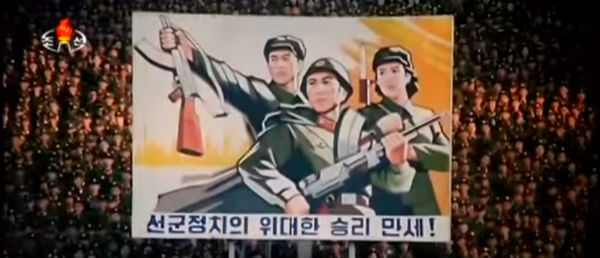
This is today’s announcement being made on North Korean state television:
IBT reports: A home for the blind and the Chamber of Commerce in Sanaa are among the sites that have been destroyed by the latest round of Saudi Arabia-led airstrikes in Yemen. The conflict between Iranian-backed Houthi fighters and the Saudi-led coalition has re-intensified after a short ceasefire ended on 2 January.
Airstrikes on Tuesday 5 January damaged a number of military and civilian sites, although no casualties were reported.
Abdullah Ahmed Banyan, a patient at the Noor Centre for the Blind, said: “People with disabilities are being struck in their residence. Around 1.30am, two missiles hit the live-in quarters of a home for the blind. Can you imagine they are striking the blind? What is this criminality? Why? Is it the blind that are fighting the war?” [Continue reading…]
Lost count, too many bombs dropped & too many jets past hour. It's not Saudi's monstrosity many won't forget, it's world's silence. #Yemen
Der Spiegel reports:British-American terror expert Charles Lister believes that al-Qaida ally Jabhat al-Nusra is more dangerous than Islamic State. In an interview, he warns that most Syrian rebel groups will abort the peace process should Bashar Assad remain in power.
SPIEGEL: A surprising conclusion in your new book [The Syrian Jihad: Al-Qaeda, the Islamic State and the Evolution of an Insurgency] is that while Islamic State (IS) and the regime of Syrian President Bashar Assad are obvious obstacles to ending the Syrian war, in your view the biggest problem is Jabhat al-Nusra, which is allied with al-Qaida. Why is that?
Charles Lister: In the West, the threat posed by IS has become an understandable, but convenient obsession. However, Jabhat al-Nusra has embedded itself so successfully within the Syrian opposition — within the revolution for a long time — that in my view it has become an actor that will be much more difficult to uproot from Syria than IS. Islamic State is all about imposing its will on people, whereas al-Nusra has for the last five years been embedding itself in popular movements, sharing power in villages and cities, and giving to people rather than forcing them to do things. That has lent it a power IS just doesn’t have. The reason I call IS a convenient obsession is that I don’t think anybody in the West knows what to do about Jabhat al-Nusra. There was a period of time where it was relatively clear that al-Nusra had a foreign attack wing that was plotting attacks in the West. They have never let go of their foreign vision, they have explicitly said they want to establish Islamic emirates in Syria, and they belong to an organization, al-Qaida, whose avowed goal is to attack and destroy the West. Not to establish an “Islamic State” and gradually expand it like IS, but explicitly to destroy the West.
SPIEGEL: Yet it was IS that killed 130 people in Paris on Nov. 13, carrying out the bloodiest terrorist attack on foreign soil since 9/11. Are these attacks a sign of strength or a sign of them being under pressure in Syria?
Lister: If these attacks were indeed centrally planned by IS, they have to be a sign of strength. Islamic State certainly is not weakening in Syria and Iraq. Yes, it has lost territory, but as a movement it is in no weaker position than it was 18 months ago. It still has sustainable sources of income, it has large amounts of territory under its control, and now, for the first time it has demonstrated a real ability to carry out what one might call spectacular attacks in the West, with real geopolitical repercussions. It shows its ability to shape international affairs. That in itself is a sign of strength. [Continue reading…]
This website or its third-party tools use cookies, which are necessary to its functioning. By closing this banner, you agree to the use of cookies.