Author Archives: News Sources

Iraq, Turkey vow to work together against ISIS

The Associated Press reports: Iraq’s prime minister said on Thursday that his country and neighboring Turkey have agreed on closer security and intelligence cooperation in the face of the threat posed by the Islamic State group.

“We have a key agreement to exchange information and have full security cooperation,” Prime Minister Haider al-Abadi told a news conference after talks with his visiting Turkish counterpart, Ahmet Davutoglu. “The Turkish prime minister also wants us to have military cooperation in the face of terrorism and Daesh and we welcome that,” said al-Abadi, using the Arabic acronym for the Islamic State group.

Davutoglu confirmed the two sides’ agreement on closer security cooperation.

“I can say that Daesh threatens both Iraq and Turkey, but we will cooperate and do everything we can to stand up to terrorism,” he said. “There is a new page in relations between Turkey and Iraq and that is why I hope that there will be close cooperation between our security and intelligence agencies to defeat terrorism.”

The Turkish prime minister also rejected charges that his country facilitated the transit of militants through its territory to Syria. [Continue reading…]

Facebooktwittermail

The regional conditions that are helping ISIS survive and grow

The Soufan Group’s 66-page Special Report on ISIS makes the following observations: From late 2011 The Islamic State has shown itself both tactically and strategically adept. After years of surviving as a persistently violent criminal/terrorist gang able to mount multiple synchronized attacks in-built up areas in Iraq but little more, it managed to break into the big time when the collapse of government in northern and eastern Syria allowed it to expand across the border. At the same time, the sectarian approach of the then Prime Minister Nouri al Maliki had made the Sunni minority in Iraq ready to support any group that appeared to have the potential to reverse its increasing marginalization. Sunni tribal support continues to be essential to the viability of The Islamic State.

The rapid expansion of The Islamic State on both sides of the Iraq/Syria border after 2011 pushed it along the continuum from terrorism to insurgency. Its underground cells became military divisions and its hit-and-run tactics became campaigns to conquer and hold territory. These changes required leaders with different skills, and it was fortunate for The Islamic State that many in its top echelons were ex-Ba’athists who had held senior positions under Saddam Hussein. Nonetheless, military leaders do not necessarily make good civilian administrators, and the challenge of governing territory is likely to prove the State’s undoing, unless it can temper the ruthless totalitarianism that appears to motivate its core fighters with a degree of tolerance and pragmatism that might reassure its unwilling subjects.

Despite the original secularism of its Ba’athist leaders, The Islamic State claims religious legitimacy for its actions. This is based on an extreme salafist/takfiri interpretation of Islam that essentially means that anyone who opposes its rule is by definition either an apostate (murtad) or an infidel (kafir). Although much of the Muslim Middle East is salafist, takfirism is widely considered a step too far, and the absolutism of The Islamic State has already attracted criticism, even from ideologues who support al Qaeda. Nonetheless, although The Islamic State is not exactly winning friends, various factors help it to survive, and will continue to do so for so long as they exist.

The first is the deep sectarian fault line that has been a major determinant of Middle East politics since the Iranian revolution of 1979, but of particular importance since the growth of Iranian regional influence following the US invasion of Iraq in 2003. Despite the menace of The Islamic State to the stability of the whole region, states on either side of the sectarian divide continue to see it as a lesser danger than the regional dominance of their rivals. Until this calculation changes, The Islamic State will not face major regional opposition.

The second is the complete lack of confidence in the Arab world of the ruled in the capacity of their rulers to treat them fairly. This extends beyond Iraq and Syria to the many countries of the Middle East and North Africa where the idea of government according to the teachings of the Quran is hugely appealing – at least until it comes up against the reality of The Islamic State. For so long as governance in so many countries fails to meet the expectations of the people, there will be a steady flow of hopeful recruits to the ranks of The Islamic State; and many others who lack the means or opportunity to travel may be tempted to follow its directives within their own countries. The consequent fear of terrorism, whether domestic or imported, is likely to lead to further repression and other
deficiencies in governance in all but the most confident and forward looking states.

The third is that the international coalition led by the United States of over 60 partners and nations who oppose the practices and objectives of The Islamic State, provides further evidence for many Muslims around the world that there is a Western-led onslaught on their religion and independence. The Islamic State itself is incandescent with rage that the West will not just leave it alone to establish the Utopia that it believes within its reach. It is hard at work persuading potential supporters that the non-Muslim world will do whatever it can to protect local rulers and so ensure that their discriminatory and irreligious polices remain in force. Not enough is being done on the ground to counter this narrative.

The fourth is that the little being done to counter the narrative of The Islamic State does not penetrate the information bubble created by its actual or potential supporters. The State devotes a great deal of time and effort to propagating a positive image of itself, reinforced by a strong ideology. Despite the many weaknesses of the literal approach to religious texts adopted by The Islamic State, including its apocalyptic vision of the imminent end of times, its message is stronger, clearer and more consistent than that of its opponents. It offers a complete break with what has gone before as opposed to its enemies who just offer more of the same. For all its violence, The Islamic State promises its recruits adventure and intense engagement with an exciting new venture. There are no competing voices offering anything comparable.

The fifth, also connected with the narrative promoted by The Islamic State, is the lack of attractive alternatives for local and foreign fighters who decide to join The Islamic State as a way to find identity, purpose, belonging or spiritual fulfillment. Thus both the pull and push factors that motivate foreign fighters remain unaddressed. Furthermore, the lack of a positive counter narrative that also exploits the negative aspects of the propaganda of The Islamic State, leaves those who are attracted by its message – but concerned about its activities – without a clear understanding that it is just not possible to engage with the State without also signing up to its worst aspects.

The sixth is that despite the international opposition to the discriminatory and repressive practices of the Syrian and, to a lesser extent, the Iraqi Governments, nothing convincing is being done to force a change. In this respect, The Islamic State appears more effective and better motivated than any actor on the other side. Unless political reform is able to draw away this soft support, The Islamic State will over time bring it closer by entwining the fortunes of the local population and tribal leaders with its own.

Finally, the cultural, educational and religious stagnation evident in so much of the Middle East and North Africa does not encourage any new way of thinking about the future beyond a desire to return to the past and start again.

Facebooktwittermail

ISIS: The downside of foreign fighters

The Soufan Group IntelBrief: Last week, in the northeast Syrian city of Raqqa — the capital of the Islamic State’s self-proclaimed caliphate — internal violence served as an example of the problems the group faces in managing the unmanageable. A group of Uzbek fighters, who had set up residence in several luxury houses along a lake outside of Raqqa, had gone to fight for the Islamic State in Iraq. Upon their return, they found that the houses they thought they had claimed as spoils of war were now occupied by Chechen and Arab foreign fighters. Uzbek and Chechen fighters are highly regarded for their fighting prowess, as seen most recently in Afghanistan and Pakistan; however, this does not translate into an equally effective ability to negotiate or mediate conflict. The situation escalated and after snipers and assault rifles entered the fray, at least six Islamic State fighters were dead. Leadership became involved, through both the group’s sharia courts and direct intervention.

This incident is significant because it illustrates the downside of Islamic State recruiting efforts. The idea of a global collection of individually-motivated fighters is far from the reality of handling such a diverse group. Twitter helps the Islamic State attract international recruits but it doesn’t keep them from fighting with each other and everyone else. It is difficult enough to manage a fighting group bound by local ties and goals — as seen in the failure of the Free Syrian Army. It is nearly impossible to do so with a group whose goals vary from martyrdom to marriage, in 20 different languages. The same difficulties that beset the anti-Islamic State coalition — competing goals, petty rivalries, language barriers—also beset the Islamic State, which has less of an ability to mitigate those problems as it also deals with airstrikes and ground attacks. [Continue reading…]

Facebooktwittermail

Inside ISIS’s oil empire: how captured oilfields fuel insurgency

The Guardian reports: Islamic State has consolidated its grip on oil supplies in Iraq and now presides over a sophisticated smuggling empire with illegal exports going to Turkey, Jordan and Iran, according to smugglers and Iraqi officials.

Six months after it grabbed vast swaths of territory, the radical militant group is earning millions of dollars a week from its Iraqi oil operations, the US says. Coalition air strikes against tankers and refineries controlled by Isis have merely dented – rather than halted – these exports, it adds.

The militants control around half a dozen oil-producing oilfields. They were quickly able to make them operational and then tapped into established trading networks across northern Iraq, where smuggling has been a fact of life for years. From early July until late October, most of this oil went to Iraqi Kurdistan. The self-proclaimed Islamic caliphate sold oil to Kurdish traders at a major discount. From Kurdistan, the oil was resold to Turkish and Iranian traders. These profits helped Isis pay its burgeoning wages bill: $500 (£320) a month for a fighter, and about $1,200 for a military commander. [Continue reading…]

Facebooktwittermail

Video shows French ISIS fighters calling for attacks in France

The New York Times reports: A new propaganda video from the militant group Islamic State shows three French fighters calling on Muslims in France to carry out attacks in France or to join the group’s fight in Iraq and Syria, according to a jihadist monitoring organization.

The seven-minute film, released on Wednesday by Al Hayat Media Center, an affiliate of the Islamic State, also shows what appear to be French jihadist fighters burning their French passports. The video appears to be part of an intensifying propaganda effort by the Islamic State, also known as ISIS or ISIL, to use foreign fighters to recruit members and to encourage the spread of violence. [Continue reading…]

Facebooktwittermail

CIA organizational changes could lead to massive expansion of agency

The Washington Post reports: CIA Director John Brennan is considering sweeping organizational changes that could include breaking up the separate spying and analysis divisions that have been in place for decades to create hybrid units focused on individual regions and threats to U.S. security, current and former U.S. intelligence officials said.

The proposal would essentially replicate the structure of the CIA’s Counterterrorism Center and other similar entities in the agency — an idea that reflects the CTC’s expanded role and influence since the Sept. 11, 2001 attacks.

U.S. officials emphasized that the proposal is in its preliminary stages, and could still be scaled back or even discarded. Already the idea has encountered opposition from current and former officials who have voiced concern that it would be too disruptive and might jeopardize critical capabilities and expertise.

But if Brennan moves forward, officials said, the changes would be among the most ambitious in CIA history — potentially creating individual centers focused on China, Latin America and other regions or issues for which personnel are now dispersed across difference parts of the agency. [Continue reading…]

Facebooktwittermail

Top Senators oppose CIA move to destroy email

The Wall Street Journal reports: The top Democrat and Republican on the Senate intelligence committee announced Wednesday their opposition to a move by the Central Intelligence Agency to eventually destroy email of all but a small number of top agency officials.

The bipartisan opposition to the proposal may derail the CIA’s plans for the eventual elimination of email of all but the highest ranking 22 CIA officials, a move that comes at a time when the Obama administration has been vowing greater transparency by intelligence agencies.

The CIA’s email plans were tentatively approved in August by the U.S. National Archives and Records Administration, which oversees U.S. government document-retention policies. It spent nearly seven months evaluating the proposal. [Continue reading…]

Facebooktwittermail

NSA phone data collection could go on, even if a law expires

The New York Times reports: A little-known provision of the Patriot Act, overlooked by lawmakers and administration officials alike, appears to give President Obama a possible way to keep the National Security Agency’s bulk phone records program going indefinitely — even if Congress allows the law on which it is based to expire next year.

Senate Republicans on Tuesday night used a filibuster to block consideration of a bill to end and replace the N.S.A. phone records program. The debate about what may happen next has played out based on a widely held premise: that the legal basis for the program, Section 215 of the Patriot Act, will expire on June 1, so if Congress remains gridlocked, the program will automatically shut down.

“I believe that if we do not pass this bill, the metadata program is at risk because the 215 program sunsets next year,” Senator Dianne Feinstein, Democrat of California, said in Tuesday night’s debate. But that premise may be incorrect. If the summer arrives and the program is facing a shutdown, Mr. Obama could invoke the provision to ask the Foreign Intelligence Surveillance Court to keep it going.

Several executive branch officials said the administration had not been studying that option and expressed doubt that Mr. Obama would take such a step, or that the Surveillance Court would agree to it if he tried. Still, the mere existence of a potential way for the program to keep going without congressional action could recast the debate. [Continue reading…]

Facebooktwittermail

Egypt prosecutor asks for death sentence for ousted President Morsi in espionage trial

The Associated Press reports: Egypt’s state news agency says prosecutors have asked for the death sentence for ousted Islamist President Mohammed Morsi and other Muslim Brotherhood leaders on trial on espionage charges.

Prosecutor Emad el-Sharawy said in closing remarks Wednesday that Morsi and his aides leaked state security documents to foreign intelligence agencies, naming Iran, while in office for one year. The military removed Morsi from office in July 2013 following mass protests against him accusing him and the Brotherhood of monopolizing power.

El-Sharawy said the defendants, who include Brotherhood leader Mohammed Badie and 34 others, cooperated with militant groups, including Gaza’s Hamas, to destabilize Egypt. [Continue reading…]

Facebooktwittermail

The despair behind Palestinian silence

Amira Hass writes: Palestinian Authority President Mahmoud Abbas condemned the synagogue attack. His condemnation was honest and genuine, for both moral and pragmatic reasons. In besieged, destroyed Gaza, spokesmen for several Palestinian organizations congratulated the martyrs and voiced support and understanding for their deed. But among the broader public, the main reaction was silence.

When PLO and Fatah representatives are making the rounds of European capitals to encourage votes in favor of recognizing a Palestinian state, most people understand that such an attack could undermine the Palestinian cause, if only for a few weeks. Killing Jewish worshippers in a synagogue looks bad when Palestinian human rights groups are pushing Abbas to join the International Criminal Court so Israeli officials can be indicted for war crimes and violating international law.

Palestinians believe that all means, including armed struggle, are legitimate to fight the occupation. But in private conversations, even those who support killing Israelis seem embarrassed by an attack on civilians at prayer.

So why are those who oppose murdering civilians at prayer keeping silent now? Because they share the despair and anger that pushed the Abu Jamals to attack Jews in a synagogue. Like the Abu Jamals, they feel themselves under assault: The Israeli nation is constantly attacking them with all the tools at its disposal.

The Har Nof neighborhood, where the attack took place, is built on the lands of the former Palestinian village of Deir Yassin. Those who are keeping silent now see the murder as a response to an Israeli policy toward the Palestinians that has been one long chain of attacks, dispossessions and expulsions since 1948.

Facebooktwittermail

New Kurdish offensive targets ISIS in Iraq

The Associated Press reports: Kurdish peshmerga forces launched a new offensive Wednesday targeting Islamic State group extremists in Iraq, even as a suicide bomber killed at least five people in the Kurds’ regional capital.

The operation came as Turkish President Recep Tayyip Erdogan said details haven’t been finalized for a deal that would have his country to train rebels to battle the Islamic State in Syria, where the militants also hold territory. That will be a major topic for retired Marine Gen. John Allen, the U.S. envoy for the international coalition to counter Islamic State group, during planned talks Wednesday in Ankara.

The new peshmerga offensive targeted areas in Diyala and Kirkuk provinces seized by the extremists in their August offensive that saw them capture a third of Iraq, said Jaber Yawer, a spokesman for Kurdish forces.

In Diyala, peshmerga forces worked in coordination with Iraqi security forces to retake the towns of Saadiya and Jalula, Yawer said. In Kirkuk, Kurdish forces backed by U.S.-led airstrikes launched attacks to retake territory near the town of Kharbaroot, located 35 kilometers (22 miles) west of the city of Kirkuk. [Continue reading…]

Facebooktwittermail

New report reveals the strategy behind ISIS’s brutality

Zack Beauchamp reports: Scattered reports from inside ISIS-controlled territory have painted an awful picture of life under the militant group’s rule. But a brand-new UN report, compiled from interviews with 300 people who have lived or currently are living in ISIS-controlled Syria, gives us a systematic look at the militant group’s reign.

And it is horrifying.

This isn’t just because the behavior documented is terrible, though it is. It’s that the UN report documents a strategy, not just random brutality or religious fanaticism. ISIS’s ultraviolence is designed to cement its rule by terrifying the population into submission. And it might be working.

Consider this testimony from an anonymous father living in Deir ez Zor, in the eastern part of the country. Walking with his son, he saw two men strung up on a cross. “Both victims’ hands were tied to each side of the improvised cross,” the man reports. “I went to read the placards. On the first one it read, ‘This is the fate of those who fight against us.'”

He somehow had to explain this to his child. “I realized that my 7-year-old son was next to me, still holding my hand and watching this horrifying scene. He later asked me, ‘Why were they there? Why was their blood on the heads and bodies?’ I had to lie to him and say they were waiting for ambulances to come and rescue them.” [Continue reading…]

The Guardian adds: The size and breadth of the Isis arsenal provides the group with durable mobility, range and a limited defense against low-flying aircraft. Even if the US-led bombing campaign continues to destroy the group’s vehicles and heavier weapons, the UN report states, it “cannot mitigate the effect of the significant volume of light weapons” Isis possesses.

Those weapons “are sufficient to allow [Isis] to continue fighting at current levels for six months to two years”, the UN report finds, making Isis not only the world’s best-funded terrorist group but among its best armed.

Isis, along with its former rival turned occasional tactical ally the Nusra Front, are sufficiently armed to threaten the region “even without territory”, the report concludes. [Continue reading…]

Facebooktwittermail

ISIS colonies expanding across North Africa

Der Spiegel reports: The caliphate has a beach. It is located on the Mediterranean Sea around 300 kilometers (186 miles) south of Crete in Darna. The eastern Libya city has a population of around 80,000, a beautiful old town and an 18th century mosque, from which the black flag of the Islamic State flies. The port city is equipped with Sharia courts and an “Islamic Police” force which patrols the streets in all-terrain vehicles. A wall has been built in the university to separate female students from their male counterparts and the disciplines of law, natural sciences and languages have all been abolished. Those who would question the city’s new societal order risk death.

Darna has become a colony of terror, and it is the first Islamic State enclave in North Africa. The conditions in Libya are perfect for the radical Islamists: a disintegrating state, a location that is strategically well situated and home to the largest oil reserves on the continent. Should Islamic State (IS) manage to establish control over a significant portion of Libya, it could trigger the destabilization of the entire Arab world.

The IS puts down roots wherever chaos reigns, where governments are weakest and where disillusionment over the Arab Spring is deepest. In recent weeks, terror groups that had thus far operated locally have quickly begun siding with the extremists from IS.

In September, it was the Algerian group Soldiers of the Caliphate that threw in its lot with Islamic State. As though following a script, the group immediately beheaded a French mountaineer and uploaded the video to the Internet. In October, the “caliphate” was proclaimed in Darna. And last week, the strongest Egyptian terrorist group likewise announced its affiliation with IS. [Continue reading…]

Facebooktwittermail

Remote warfare handicapped by being remote

U.S. News & World Report: The 480th operates one of many hubs the Air Force uses to receive, process and disseminate intelligence, surveillance and reconnaissance information from spy aircraft it flies, known in military jargon as a Distributed Common Ground System. It works with all branches of the U.S. military and with some allied countries, and receives requests from all levels of the chain of command for the detailed intelligence it provides, such as images, videos or live information.

Right now, U.S. troops are embedded with the land component of the Iraqi army to teach its fighters how to file an efficient request for the Air Force’s information.

[Air Force Gen. Herbert “Hawk” Carlisle, the commander of Air Combat Command] points to the intense difficulty of managing so much information about environments as ethnically complex as the Middle East, a task some say is further hampered by the mandate passed down from President Barack Obama: No U.S. combat troops will be deployed to Iraq or Syria. That includes Joint Terminal Attack Controllers, or JTACs – special operations forces who work in deep enemy territory to help find targets and call in airstrikes from above .

“It does make it more difficult” to develop intelligence without human sources on the ground, said Jennifer, a senior master sergeant, who like many of her fellow analysts could not reveal her last name for security reasons. A personal perspective can lead to much stronger intelligence.

“They’re the ones feeling and smelling and tasting better than we can,” she said. “The closest thing to human intelligence we have is the embassy.”

These analysts instead must rely on seasoned veterans with multiple tours of Iraq – many of them now back home and serving in the Air Force Reserve – to provide some on-the-ground insights.

The number of clear targets in the conflict also may be shrinking. U.S. warplanes have conducted more than 9,500 flights over Iraq and Syria since Aug. 8 when combat operations began, 950 of which have resulted in direct strikes. But the Islamic State group has quickly learned it can no longer operate out in the open, waving its ominous black banner. Fighters now must hide themselves among innocent civilian populations that fear them. [Continue reading…]

Facebooktwittermail

Religious extremism main cause of terrorism, according to report

The Guardian reports: Religious extremism has become the main driver of terrorism in recent years, according to this year’s Global Terrorism Index.

The report recorded 18,000 deaths in 2013, a rise of 60% on the previous year. The majority (66%) of these were attributable to just four groups: Islamic State (Isis) in Iraq and Syria, Boko Haram in Nigeria, the Taliban in Afghanistan and al-Qaida.

Overall there has been a fivefold increase in deaths from terrorism since the 9/11 suicide attacks.

The report’s authors attribute the majority of incidents over the past few years to groups with a religious agenda. [Continue reading…]

Facebooktwittermail

The drone war in Pakistan

Steve Coll writes: At the Pearl Continental Hotel, in Peshawar, a concrete tower enveloped by flowering gardens, the management has adopted security precautions that have become common in Pakistan’s upscale hospitality industry: razor wire, vehicle barricades, and police crouching in bunkers, fingering machine guns. In June, on a hot weekday morning, Noor Behram arrived at the gate carrying a white plastic shopping bag full of photographs. He had a four-inch black beard and wore a blue shalwar kameez and a flat Chitrali hat. He met me in the lobby. We sat down, and Behram spilled his photos onto a table. Some of the prints were curled and faded. For the past seven years, he said, he has driven around North Waziristan on a small red Honda motorcycle, visiting the sites of American drone missile strikes as soon after an attack as possible.

Behram is a journalist from North Waziristan, in northwestern Pakistan, and also works as a private investigator. He has been documenting the drone attacks for the Foundation for Fundamental Rights, a Pakistani nonprofit that is seeking redress for civilian casualties. In the beginning, he said, he had no training and only a cheap camera. I picked up a photo that showed Behram outdoors, in a mountainous area, holding up a shredded piece of women’s underwear. He said it was taken during his first investigation, in June, 2007, after an aerial attack on a training camp. American and Pakistani newspapers reported at the time that drone missiles had killed Al Qaeda-linked militants. There were women nearby as well. Although he was unable to photograph the victims’ bodies, he said, “I found charred, torn women’s clothing—that was the evidence.”

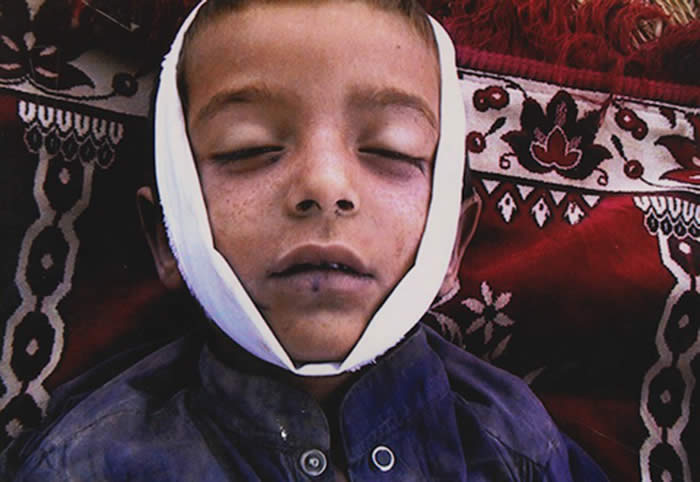
Syed Wali Shah, a seven-year-old boy was killed in a 2009 drone strike, along with his parents.

Since then, he went on, he has photographed about a hundred other sites in North Waziristan, creating a partial record of the dead, the wounded, and their detritus. Many of the faces before us were young. Behram said he learned from conversations with editors and other journalists that if a drone missile killed an innocent adult male civilian, such as a vegetable vender or a fruit seller, the victim’s long hair and beard would be enough to stereotype him as a militant. So he decided to focus on children.

Many of the prints had dates scrawled on the back. I looked at one from September 10, 2010. It showed a bandaged boy weeping; he appeared to be about seven years old. There was a photo of a girl with a badly broken arm, and one of another boy, also in tears, apparently sitting in a hospital. A print from August 23, 2010, showed a dead boy of perhaps ten, the son of an Afghan refugee named Bismillah Khan, who lived near a compound associated with the Taliban fighting group known as the Haqqani network. The boy’s skull had been bashed in. [Continue reading…]

Facebooktwittermail

Iran will do a deal with the West — but only if there’s no loss of dignity

Hooman Majd writes: Iran and what we would once have called the great powers – the five permanent members of the UN security council plus Germany – have been engaged in negotiations over the Iranian nuclear programme for well over a decade now. At times the US has been directly involved, and at other less friendly times, indirectly – but never in the years since, to great alarm if not outright panic, the world discovered that Iran possessed a nuclear programme have we been as close to resolving its fate as we are now.

The reasons are myriad; certainly primary among them is the election of a pragmatist US president in 2008, one who, unlike his we-don’t-talk-to-evil predecessor, promised to engage directly with Iran on its nuclear program as well as on other issues of contention between the two countries, and the election of an Iranian president in 2013 who, unlike his predecessor, promised to pursue a “win-win” solution to the crisis. There are other reasons long debated in foreign policy circles. None of them, however, correctly stated or not, are important now.

What is important is to recognise that with only days left to reach a comprehensive agreement – one that would satisfy the minimum requirements of the US and Iran (and the truth is that it is only theirs that matter, despite the presence of other powers at the table) – there may not be another opportunity for a generation. This is the diplomatic perfect storm, if you will, to begin the process of US-Iranian reconciliation. [Continue reading…]

Facebooktwittermail

Iran uses China bank to transfer funds to Quds-linked companies

Reuters reports: There is no trace of Shenzhen Lanhao Days Electronic Technology Co Ltd at its listed address in the beige and pink-tiled “Fragrant Villa” apartment complex in this southern Chinese city. The building’s managers say they’ve never heard of it.

But a Western intelligence report reviewed by Reuters says Shenzhen Lanhao is one of several companies in China that receives money from Iran through a Chinese bank. Such transfers help to finance international operations of the Islamic Revolutionary Guards Corps’ elite Quds Force, the report said.

The Quds provides arms, aid and training for pro-Iranian militant groups in the Middle East, such as Hezbollah, Hamas and Shi’ite Muslim militias in Iraq. They have also armed and trained government forces in Syria’s civil war in violation of a U.N. arms embargo, U.S. and European officials say. [Continue reading…]

Facebooktwittermail