Author Archives: News Sources

When the United States looked the other way on chemical weapons

Glenn Kessler reports: One of the administration’s main arguments for attacking Syria is because the government crossed an important line by using chemical weapons against its own people.

Rep. Nancy Pelosi, a strong supporter of military strikes, echoed that argument on Tuesday. She noted that as far back as 1925, nearly 40 nations had joined together to ban the first use of chemical weapons when the Geneva Protocol was signed. (Her mention of 170 countries appears to refer to the 1993 Chemical Weapons Convention, which seeks to prohibit the production of chemical weapons and mandates their destruction; Syria has refused to sign the treaty, though 189 other countries have signed it.)

Such treaties generally do not have mechanisms for enforcement. As far as we know, no nation has ever attacked another to punish it for the use of chemical weapons, so Obama’s request is unprecedented.

Indeed, Syria’s chemical weapons stockpile results from a never-acknowledged gentleman’s agreement in the Middle East that as long as Israel had nuclear weapons, Syria’s pursuit of chemical weapons would not attract much public acknowledgement or criticism. (The Fact Checker, when serving as The Washington Post’s diplomatic correspondent, learned of this secret arrangement from Middle Eastern and Western diplomats, but it was never officially confirmed.) These are the sorts of trade-offs that happen often in diplomacy. After all, Israel’s nuclear stockpile has never been officially acknowledged, and Syria in the 1980s and 1990s was often supportive of U.S. interests in the region, even nearly reaching a peace deal with Israel.

But there is an even more striking instance of the United States ignoring use of the chemical weapons that killed tens of thousands of people — during the grinding Iraq-Iran war in the 1980s. As documented in 2002 by Washington Post reporter Michael Dobbs, the Reagan administration knew full well it was selling materials to Iraq that was being used for the manufacture of chemical weapons, and that Iraq was using such weapons, but U.S. officials were more concerned about whether Iran would win rather than how Iraq might eke out a victory. Dobbs noted that Iraq’s chemical weapons’ use was “hardly a secret, with the Iraqi military issuing this warning in February 1984: ”The invaders should know that for every harmful insect, there is an insecticide capable of annihilating it . . . and Iraq possesses this annihilation insecticide.” [Continue reading…]

Just in case anyone doubts that Bashar al-Assad has genocidal intentions much like those of Saddam Hussein, in an interview this week he made it clear that the only way he thinks he can deal with his opponents is “to annihilate them.”

Syrian President Bashar al-Assad has said there is no longer hope for a political solution to the conflict in Syria and that the only way to deal with the rebels challenging his leadership “is to annihilate them.”

In an interview with Le Figaro, a French newspaper, Assad claimed that rebel forces had been almost entirely infiltrated by al-Qaeda.

“We are fighting terrorists,” he said. “80-90% of those we are fighting belong to al-Qaeda. They are not interested in reform or in politics. The only way to deal with them is to annihilate them.”


Facebooktwittermail

Israel lobby strongly supports attack on Syria

Haaretz reports: The American Jewish establishment jumped off the fence on Tuesday and came out in full support of Congressional approval of President Barack Obama’s plans to launch a military strike against Syria’s chemical weapon capacity.

And Israeli Ambassador Michael Oren took the unusual step of expressing support for elements of President Obama’s statements on Syria, including his assertion that the Assad regime must be held accountable and that there should be “international consequences” for his use of chemical weapons.

The sudden unified burst of support for Obama’s request for Congressional authorization for a strike against Syria follows almost two weeks in which Jewish organizations have maintained a low profile on the August 21 chemical attack near Damascus and the American response to it.

Jewish leaders told Haaretz that the public support expressed in the past two days by leading Republican figures such as Representatives John Boehner and Eric Cantor, as well as the qualified backing shown by Senator John McCain, allayed concerns that the Jewish groups would be accused of taking sides in a political feud between the two parties. “The dynamics changed overnight,” one source said.

The Conference of Presidents of Major Jewish Organizations said in a statement that “failing to take action would damage the credibility of the U.S. and negatively impact the effort to prevent Iran from achieving a nuclear weapons capacity.”

The American Jewish Committee sent a letter to all members of Congress expressing support for Obama’s request for “limited military action” against Syria and warning that “acquiescence in the face of the crimes evidently committed by the Assad regime would doubtless have wide-ranging consequences for U.S. interests and influence in the Middle East and around the world.”

The pro-Israel lobby AIPAC urged Congress to “grant the president the authority to protect America’s security interests.” The lobby’s statement said that “barbarism on a mass scale must not be given a free pass.” And sources said that AIPAC would henceforth lobby Congress to support the use of force against Bashar Assad.

The Anti-Defamation League went a step further, lauding Obama’s “demonstration of U.S. leadership” and calling on Congress to “swiftly add its voice to hold Assad accountable for the wanton slaughter of his own citizens.”

ADL National Director Abe Foxman told Haaretz that from a “moral perspective” there was “nothing to debate” because of “our own people’s experience with gas.” In addition, he said, the threat to America’s national security interests in the Middle East, in which Israel has such a high stake, “go above and beyond any political consideration.”

Malcolm Hoenlein, Executive Vice President of the Conference of Presidents, said yesterday that the statement reflects the “general consensus” of the American Jewish organizations. He said that some organizations expressed concerns about taking sides in a political battle, but that briefings by the Administration helped to forge the Conference’s statement, which reflects the “middle ground” of various Jewish opinions.

The sources said that their support also stemmed from conversations with Israeli leaders who expressed concern about the negative ramifications of a Congressional veto on Obama’s proposals both for Israel and for America’ standing in the Middle East.

Facebooktwittermail

German intelligence supports view that the Assad regime launched chemical attacks

Der Spiegel reports: Germany has said in no uncertain terms that it will not participate in a strike on Syria without the backing of the United Nations Security Council. But the country’s foreign intelligence agency, the Bundesnachrichtendienst (BND), agrees with the US position which holds Syrian President Bashar Assad responsible for the poison gas attacks near Damascus on Aug. 21. In a secret briefing to select lawmakers on Monday, BND head Gerhard Schindler said that while there is still no incontestable proof, analysis of the evidence at hand has led his intelligence service to believe that Assad’s regime is to blame.

In the briefing, Schindler said that only the Assad regime is in possession of binary chemical weapons such as sarin. The BND believes that regime experts would be the only ones capable of manufacturing such weapons and deploying them with small missiles. The BND believes that such weapons had been used several times prior to the attack on Aug. 21, which is believed to have killed more than 1,400 people. Schindler said in the earlier attacks, however, the poison gas mixture was diluted, explaining the much lower death tolls in those assaults.

During his 30-minute presentation, Schindler offered up scenarios to explain why the Assad regime resorted to chemical weapons use, including, he said, the possibility that Assad sees himself involved in a crucial battle for Damascus. The city is besieged by rebel groups, with particular pressure coming from the east. Schindler believes it is possible that the regime ordered the use of poison gas as a way of intimidating the rebels. It could also be the case that errors were made in mixing the gas and it was much more potent than anticipated, he said. [Continue reading…]

Facebooktwittermail

Now the Israel lobby has told Congress how to vote, why should Obama care about public opposition to military strikes?

Oh, how about for this reason: That grandiose title, “leader of the free world,” is supposed to signal that America is a democracy and its democratically elected representatives are supposed to take into consideration the views of the people they represent. So, public opinion should matter on the question about authorizing military strikes on Syria. But that’s now all irrelevant because the Israel lobby has spoken and members of Congress no longer need to think too much about which way to cast their votes.

Pew Research: President Obama faces an uphill battle in making the case for U.S. military action in Syria. By a 48% to 29% margin, more Americans oppose than support conducting military airstrikes against Syria in response to reports that the Syrian government used chemical weapons.

The new national survey by the Pew Research Center, conducted Aug. 29-Sept. 1 among 1,000 adults, finds that Obama has significant ground to make up in his own party. Just 29% of Democrats favor conducting airstrikes against Syria while 48% are opposed. Opinion among independents is similar (29% favor, 50% oppose). Republicans are more divided, with 35% favoring airstrikes and 40% opposed.

The public has long been skeptical of U.S. involvement in Syria, but an April survey found more support than opposition to the idea of a U.S.-led military response if the use of chemical weapons was confirmed. The new survey finds both broad concern over the possible consequences of military action in Syria and little optimism it will be effective. [Continue reading…]

Facebooktwittermail

U.S. considers stepping up its effort to make the war in Syria drag on for as long as possible

The Wall Street Journal reports: The Obama administration is considering putting the Pentagon in charge of arming and training moderate rebel forces in Syria, a move that could help expand the effort significantly beyond the limited scope of the current Central Intelligence Agency program, U.S. officials said.

These internal discussions come as Congress begins a debate over a resolution to authorize limited strikes against Syria in response to the alleged use of chemical weapons last month.

The move would substantially revamp one of the administration’s most secretive and controversial undertakings in the 2½-year-old civil war. President Barack Obama authorized the CIA program in June after Hezbollah’s large-scale entry into the conflict on Syrian President Bashar al-Assad’s side and a U.S. determination that Syrian forces had used chemical arms in small amounts in earlier clashes.

The idea of giving the Pentagon a greater role in the effort has gained traction in recent weeks among some in Congress and in the administration who say the CIA’s arming and training program is too small and slow-moving.

Administration officials have privately told lawmakers they don’t want to tip the balance against the Assad regime for fear Islamist groups in the opposition with links to al Qaeda could seize large swaths of the country and Mr. Assad’s weapons. At the same time, the White House says it wants to build up moderate elements in the hope they will one day play a leadership role in a post-Assad Syria. [Continue reading…]

Facebooktwittermail

Previous U.S. ‘limited’ military strikes all backfired

Reuters reports: President Barack Obama’s national security team is trying to make the case to sceptical U.S. lawmakers for a limited strike against the Syrian government over its alleged use of chemical weapons on August 21.

Following are details of missile strikes and other limited military action taken by the United States over the past 30 years and what transpired afterwards:

* Lebanon 1983 – In September 1983, U.S. battleships anchored in the Mediterranean Sea off Lebanon shelled Syrian, Palestinian and Druze forces in the Shouf Mountains outside Beirut in support of the Lebanese army, during the complex civil war that began in 1975.

It was one of several actions that created a perception that the United States was taking sides in the war. A month later, Shi’ite Muslim suicide bombers blew up the U.S. Marine and French barracks in Beirut, killing 241 Marines and 58 French paratroopers. President Ronald Reagan pulled U.S. forces out of Lebanon in February 1984. Lebanon’s civil war raged on until 1990.

* Libya 1986 – U.S. bomber aircraft struck sites in the Libyan cities of Tripoli and Benghazi, 10 days after the deadly bombing of West Berlin’s LaBelle nightclub frequented by American soldiers, which Washington blamed on Libya. Libyan leader Muammar Gaddafi’s adopted daughter was alleged to have been killed, and his sons were reported injured.

Libya was not linked to another major terrorist attack until the 1988 bombing of Pan Am Flight 103 over Lockerbie, Scotland, which killed 259 passengers and crew and 11 people on the ground. Libyan Abdel Basset al-Megrahi, who denied involvement in downing the jet, was convicted of the bombing in a court in the Netherlands 2001. Gaddafi ruled Libya until his ouster in August 2011. [Continue reading…]

Facebooktwittermail

Egypt bans Al Jazeera and other satellite channels

Mada Masr reports: An Administrative Court ordered on Tuesday to stop the broadcasting of a number of satellite channels including Al-Jazeera, local media reported.

Other channels banned from broadcasting include Al-Quds, Al-Yarmouk and Ahrar 25 January channels, the state-run Egynews portal reported.

The court also ordered the closure of their offices.

The cases were raised by Mahmoud Farghali, head of the Social Justice Party against the ministers of investment and information, as well as the heads of the channels. The case claimed that the accused have no licenses to broadcast while they have also been broadcasting false information that are conducive to destabilizing Egypt and causing divisions.

According to Al-Masry Al-Youm, a privately owned daily, permits are issued to channels by the ministers of investment, communication and information technology and information. In a joint statement issued last Thursday, these ministers said that Al-Jazeera has no legal document that justifies its work in Egypt. [Continue reading…]

Facebooktwittermail

NSA surveillance in Latin America

The Economist: When David Miranda, the Brazilian partner of Glenn Greenwald, an American journalist, was stopped and questioned by the police for nine hours in Heathrow airport last month, tempers in his home country flared. The law invoked by his detainers does not require them to give grounds for their actions. But then it is only supposed to be used against suspected terrorists, which Mr Miranda clearly is not. What he did do was carry materials relating to Mr Greenwald’s reporting on documents passed to him by Edward Snowden, a former contractor for America’s National Security Agency (NSA) and now a fugative whistleblower.

Mr Miranda was set free to continue his journey to Rio de Janeiro, where he and Mr Greenwald live, but only after his laptop and hard drive were confiscated. The incident angered Brazil’s government, already incensed by the revelations, co-written by Mr Greenwald and published on July 7th by O Globo, a Brazilian newspaper, that the NSA had allegedly been monitoring Brazilian citizens’ telecoms and internet activity for a decade.

On September 1st the row escalated further. TV Globo, the paper’s sister television network, aired a programme presenting documents provided by Mr Greenwald that suggest the NSA had spied not only on ordinary Latin American citizens but on Enrique Peña Nieto and Dilma Rousseff (pictured), the presidents of Mexico and Brazil, respectively. Among them was an NSA slide dated June 2012 displaying passages of what were said to be text messages sent by Mr Peña, who was still a presidential candidate at the time, in which he mentioned planned ministerial appointments. Though no content purporting to come from Ms Rousseff was shown, the programme detailed how the NSA filtered electronic communications and tracked e-mail, telephone calls and text messages sent between people close to her. [Continue reading…]

Facebooktwittermail

Thrown in jail for posting a link

TechDirt: We’ve covered the immensely troubling case against Barrett Brown a few times here. Brown is the journalist and activist who was arrested on a series of highly questionable charges, mostly focused on taking the astounding step of copying a URL pointing to a bunch of Stratfor emails that people in Anonymous had hacked, and placing it in a chat room that Brown managed, to try to crowdsource information about intelligence community contractors, known as Project PM. No one has accused Brown of being responsible for the hack — but rather just posting the link to the hacked contents, which the feds are claiming is a federal crime, in part because the data it pointed to contained credit card info. There are two other charges, including concealing evidence (he put his laptop in his mother’s dish cabinet) and “threatening a federal agent” based on a rambling video he had posted to YouTube, which was probably inappropriate, but was in response to being constantly harassed and threatened himself for merely reporting on the various information that had been leaked. Glenn Greenwald’s summary from earlier this year is well worth reading.

The incredible thing is that the linking to leaked materials, including those that reveal hacked documents and things like passwords is fairly common. As the EFF pointed out a few weeks back, if what Brown did with the link to Stratfor emails was a crime then plenty of other publications are guilty of the same thing, including The Daily Beast and Buzzfeed, who both posted links to what some claimed were passwords for email accounts of Congressional staffers. [Continue reading…]

Facebooktwittermail

Senate’s war resolution gives Obama 90 days to strike Syria

The Daily Beast reports: Late Tuesday evening, Senate leaders reached a compromise on a resolution to authorize President Obama to use military force against Syria for up to 60 days with a one-time optional 30 day extension, according to a copy of the document obtained by The Daily Beast.

The resolution, the result of a negotiation between Senate Foreign Relations Committee heads Robert Menendez (D-NJ) and Bob Corker (R-TN), also would prohibit Obama from putting American boots on the ground, limits the mission to attacking Bashar al-Assad’s chemical weapons capabilities, and requires a report to Congress laying out the administration’s plan for aiding the moderate elements of the armed Syrian opposition within 30 days. The limits on the duration of the president’s authorization are in line with the War Powers Resolution of 1973 and Congress would have to grant any extension after the initial 90 day period.

The committee will hold a business meeting Wednesday at 11:30 to review and vote on the resolution to send it to the Senate floor. That means committee members will have to make up their minds before a scheduled classified briefing by Secretary of State John Kerry and Director of National Intelligence James Clapper. [Continue reading…]

Facebooktwittermail

U.N. chief says only Security Council can order airstrikes on Syria

The Los Angeles Times reports: Any faction found to have used chemical weapons “must be brought to justice,” U.N. Secretary-General Ban Ki-moon said Tuesday. But the head of the world body also warned that any use of force to punish perpetrators would be legal only in self-defense or with U.N. Security Council authorization.

Ban appealed for patience among U.N. member states while an investigative team that returned from Syria over the weekend completes analysis of biomedical and environmental samples it collected.

The team, which spent four days in search of evidence that chemical attacks occurred Aug. 21, will have delivered all of its forensic evidence to European labs for analysis by Wednesday, Ban said at U.N. headquarters in New York at a webcast news conference.

“We need to emphasize the importance of not jeopardizing the scientific timelines needed for accurate analysis,” he said, without providing any specifics on when the results will be available and made public.

The U.N. investigators, led by Swedish scientist Ake Sellstrom, were tasked solely with determining whether chemical weapons were used, not who used them, in attacks in Damascus suburbs that U.S. intelligence reports say killed more than 1,400 people.

Asked whether threatened U.S. military action to punish Syrian President Bashar Assad’s government would be legal, Ban insisted that “the Security Council has primary responsibility for international peace and security.” [Continue reading…]

Facebooktwittermail

In Syria, it’s a case of all or nothing

Patrick Cockburn asks: What can be done to end the appalling and ever-growing miseries of the 23 million Syrian people? The answer is to make either war or peace effectively. Limited missile strikes on Syrian military bases are not going to compel President Assad to negotiate his own departure from power. The only military action that might do this is a full-scale assault including a no-fly zone and a no-drive zone. This means giving the rebels an air umbrella, as was done for the anti-Taliban Northern Alliance in Afghanistan in 2001, the Kurdish peshmerga fighters in northern Iraq in 2003 and the anti-Gaddafi militiamen in Libya in 2011. And thus fighting a full-scale war with the likelihood that Russia, Iran and Hezbollah will increase their support for Assad. Anything less than this full-scale military commitment simply stokes the war and increases the violence. It gives the opposition hope (particularly since so many of its official leaders reside safely abroad) that one day there will be a Libyan-type intervention by Nato on their behalf.

Limited intervention means that the stalemate will continue. One of the best chances for peace – the day of mutual exhaustion and realisation that nobody is going to win on the battlefield – is postponed. The analogy with Kosovo in 1999 is shallow and misleading since defeat was only admitted by an isolated Serbia after a 78-day air bombardment and the threat of a Nato land invasion.

If all-out war is not feasible, could peace come by negotiation? Here America and Britain’s stance has been hypocritical, publicly supporting peace talks while offering only surrender terms to the Assad government at a time when it controls most of Syria. This was largely the result of a miscalculation by world leaders in 2011-12 whereby they underestimated the staying power of the Assad government. Its collapse was gleefully predicted, a role for Assad in Syria’s political transition ruled out, while Iran, an important player, was to be excluded. A peace conference so out of keeping with the real balance of power is not going to stop any wars. But bringing Iran in would undermine the US, European and Israeli effort to isolate it over its development of nuclear power. The US would effectively have to recognise Tehran as a regional power, which would infuriate the Israelis and the Gulf monarchies.

Even then, peace would not come easily, if at all. The best interim solution could be a UN-monitored ceasefire as briefly occurred under the Kofi Annan plan in 2012. All sides are dependent on outside backers, and even those who most want to fight need weapons, ammunition and money. Heavy pressure could be put on them to agree to a peace conference and a temporary ceasefire.

This would be a Lebanese-style truce – unsatisfactory but better than full-scale war. A peace conference on this basis could be the political and diplomatic counterpart to the limited US military strike President Obama is contemplating. In practice there has been a stalemate in most of Syria for the last year. If the Syrian army did use poison gas, it shows it does not have the strength to retake even the inner rebel-held suburbs of Damascus. It is better therefore for the battle lines to be frozen under some form of UN supervision. Long-term solutions will only begin to be feasible when Syrians are no longer at the mercy of what Northern Ireland politicians used to call “the politics of the last atrocity”.

Facebooktwittermail

‘America only talks about the Islamiyeen as if everyone else in Syria doesn’t count’

Reem Salahi writes: Traveling into “liberated” (i.e. rebel-controlled) Syria, I was initially struck by the appearance of normality. Olive groves bloomed, kids played on the street and food and drink stands peppered the roadways. Absent were the pictures and statutes of Bashar and his father Hafez al-Assad that I had come to expect from my many trips to Syria. Also missing were the regime flags and any other sign of Baathist rule.

The deeper we went into Syria, though, the more abnormal things became. Tinted and unlicensed SUVs with the insignia of a Free Syrian Army (FSA) or Islamist brigade were readily prevalent. Men with guns strapped to their backs wearing military fatigues and long beards rode on motorcycles. Demolished factories and bombed stores were more frequent sights than open and functioning stores. And FSA checkpoints secured the entry and exit points of most towns. As we drove deeper into Idlib Province, I found myself thinking of Dorothy’s line in the Wizard of Oz: “Toto, I’ve a feeling we’re not in Kansas anymore.”

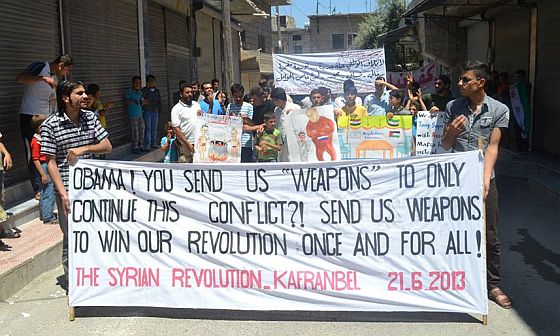
Entering Kafranbel — a small yet internationally-known town due to its witty posters and weekly protests — I was awestruck by the painted walls with messages of “rEVOLution”.

The media center was abuzz with foreign journalists and local activists as they prepared their posters for the Friday protest. The English and Arabic posters as well as the drawings depicting Barack Obama and Vladimir Putin were calculated to speak to local and global audiences. The activists spent hours strategizing how best to express their dissatisfaction with the U.S.’s failure to provide anti-aircraft missiles and heavy weaponry that could strike down government planes that terrorized the “liberated” areas.

Yet in the subsequent days, I experienced the more honest banality of life. Despite not having a physical presence in the “liberated” areas, the government still controlled the utilities and cut the electricity for 20 or more hours a day as both a carrot (a reminder that it remained in power) and a stick. There was no phone service and Internet was rare; jobs were even rarer. At times, it seemed that the only activity was in the sky from helicopters transporting soldiers or dumping loads of explosives on “liberated” towns or in the hospitals that assumed the consequent casualties.

As we lazily sat around during the long hot summer days drinking one cup of sweetened tea after another and doing little else, I was surprised to hear Syrians state they had “no time.” I soon understood that it was not the physical demand for time but the lack of mental clarity for solutions to the intractable conflict that had left Syrian towns with no formal governance and little resources; their residents, without exception, were left psychologically scarred and emotionally taxed. As one young man expressed to me: “everyone wants to train me in transitional justice and documenting human rights abuses but no one has offered to train me on how to overthrow the Regime. It’s been over two years and I still don’t know how to do the very thing that got me involved in this Revolution in the first place.” [Continue reading…]

Facebooktwittermail

Syrian refugees long to return home

Robin Yassin-Kassab visited Atmeh, a Syrian refugee camp close to the Turkish border which currently houses 22,000 refugees: Some tents are fire-resistant; some are plastic; some are concoctions of canvas and blankets. Some have been distributed by the United Nations’ refugee agency, some by Turkish and expatriate Syrian charities. Some tents are pitched among the silvery olive trees, but the area closer to the barbed wire, where tents are set unshaded on the baked and stony earth, is much grimmer. There are toilets (unpleasant and not nearly enough of them), rough shower blocks, and daily deliveries of clean water. But there are also streams of green liquid filth, which the children fall into as they play. Many children have something that sounds like a bad smoker’s cough but is most probably tuberculosis — a disease, like typhoid and leishmaniasis, once defeated in Syria but now resurgent.

A “main street” in Atmeh features stalls set up in tents that sell cigarettes, soda, and sandwiches for those who can afford them; there are also barbers in tents and of course a tented mosque. A “ready meal” breakfast is sent in by the Turks each morning, and a simple lunch — lentil soup, for instance — is prepared in communal kitchens and distributed in buckets around the camp. There is no dinner.

Most impressively, a civil society infrastructure has been established — something that was effectively forbidden in Assad’s Syria. Atmeh has its own Coordination Committee — an extension of the committees that sprang up across Syrian cities and villages from the revolution’s first days in order to provide services the state wouldn’t and to organize protests and media work. Over half the assembled members and speakers at the meeting I attended were women, a fact which illustrates both the expanded social role of women in the revolution and the disproportionate numbers of women (and children) in the camp, because so many men are dead, imprisoned, or fighting.

One of the committee’s duties is to help set up schools for the camp’s children. I saw three schools: the Revolution House, which was a single-room concrete shack; the Ghurabaa (“Strangers”) School, run by Salafi Islamists and disapproved of by many because it entirely ignores the old Syrian curriculum in favor of a purely “Islamic” education; and the Return School, which serves 500 children, cramming 40 at a time in stifling tent classrooms.

The Return School was where I gave my storytelling workshop as part of the Maram and Karam foundations’ Camp Zeitouna project, which included workshops in calligraphy, art, dental care, and soccer skills. We were assisted by some of the school’s 20 unsalaried teachers and inspired by the laughing, shouting children. Some of these children have had only one month of schooling in the last two years. Some are physically scarred and emotionally traumatized. They responded well to the workshops and of course to the soccer field and playground constructed by Maram. They responded best of all, simply, to attention.

One of the trip’s highlights was sitting in the dust on the new soccer grounds and being sung to by a group of boys and girls — a surreal mix of revolutionary nationalist, jihadi, and romantic songs. One of the low points was meeting Manar, a woman whose two children died in a tent fire caused by a fallen candle. Another woman said she’d prefer to be dead than living in such conditions. American teenagers say such things in English, and it means nothing much. In Arabic it means a great deal.

Tamador, a volunteer psychologist, does her rounds. She advises a woman whose husband has abandoned her for another wife, but still turns up to take her money. She hears about a man who sexually abuses his son’s wife. Pre-existing social problems have been immeasurably exacerbated by war trauma, unemployment, entrapment, and the forced proximity of the extended family.

Muhammad Ojjeh, our soccer coach and professional photographer, went down on one knee with his long lens to shoot a picture of a child. The child screamed in terror, turned, and ran. His mother shouted after him, “It’s a camera, stupid, not a gun.”

A woman welcomed us to her tent shamefacedly. “We’ve become Bedouins,” she apologized. Deprived for so long of influence on the public space, Syrians of all classes take inordinate pride in their carefully ordered homes. Now this, too, is denied them.

An angry man reacted badly to the playground under construction. “What’s the use of this?” he complained. “We don’t want to stay here. The insects are eating us! We want to return to our homes. We need weapons. We need help.” [Continue reading…]

Facebooktwittermail

U.S. still hasn’t armed Syrian rebels

The Wall Street Journal reports: In June, the White House authorized the Central Intelligence Agency to help arm moderate fighters battling the Assad regime, a signal to Syrian rebels that the cavalry was coming. Three months later, they are still waiting.

The delay, in part, reflects a broader U.S. approach rarely discussed publicly but that underpins its decision-making, according to former and current U.S. officials: The Obama administration doesn’t want to tip the balance in favor of the opposition for fear the outcome may be even worse for U.S. interests than the current stalemate.

U.S. officials attribute the delay in providing small arms and munitions from the CIA weapons program to the difficulty of establishing secure delivery “pipelines” to prevent weapons from falling into the wrong hands, in particular Jihadi militants also battling the Assad regime.

Allied rebel commanders in Syria and congressional proponents of a more aggressive military response instead blame a White House that wants to be seen as responsive to allies’ needs but fundamentally doesn’t want to get pulled any deeper into the country’s grinding conflict.

The administration’s view can also be seen in White House planning for limited airstrikes—now awaiting congressional review—to punish Syrian President Bashar al-Assad for his alleged use of chemical weapons.

Pentagon planners were instructed not to offer strike options that could help drive Mr. Assad from power: “The big concern is the wrong groups in the opposition would be able to take advantage of it,” a senior military officer said. [Continue reading…]

Facebooktwittermail

Obama decision on Syria good for U.S. democracy, but his case is weak

Peter Beinart writes: Everything about President Obama’s decision to ask Congress to approve military action in Syria is terrific — except for the action he’s asking it to approve.

By going to Congress, Obama is doing something profound. He’s acknowledging that the rules of the foreign policy game must change. Over the past 40 years, America’s presidents have gutted two key restraints on their ability to go to war. In 1973, Richard Nixon created an all-volunteer military, thus confining the direct burdens of war to a small subset of Americans who were legally barred from political protest and virtually ensuring that nothing as noisy and chaotic as the anti-Vietnam movement would occur again. Then, in the 1980s, Ronald Reagan and George H.W. Bush cut out Congress—launching invasions of Grenada and Panama on their own authority despite efforts by Congress itself (the War Powers Act) and the framers of the Constitution (Article One, Section Eight) to make certain it couldn’t happen.

The result was the creation of a “hubris bubble” in foreign policy analogous to the one that grew during the same stretch of time on Wall Street. Like the titans of Wall Street, America’s presidents kept making bets that paid off: Grenada, Panama, Gulf War, Bosnia, Kosovo. And the more they did, the more dismissive they became of the need for public oversight. It all went swimmingly. Until Iraq, when the deregulation of presidential war-making powers produced the foreign policy equivalent of a stock market crash. [Continue reading…]

Facebooktwittermail

For Syria’s sake, end Iran’s isolation

Shirley Williams writes: President Obama’s decision to consult Congress before taking any military action against the Syrian government offers a brief opportunity for diplomatic efforts to construct a political settlement. That decision has been welcomed by many in the Middle East, among them the new president of Iran, Hassan Rouhani.

It is astonishing that, apart from by the Conservative MP Rory Stewart, Iran was hardly mentioned in the debates in parliament last week – given that it has a vital role in the region and is the key to a negotiated outcome. It is the most important ally that Syria has, as a recent report by the Rand corporation points out. With a population of 75 million, and with oil and natural resources, it is the most important Shia Muslim state in the world.

Iran is also a country that has suffered more cruelly than any other from chemical weapons. During the Iran-Iraq war in the 1980s, Iran lost tens of thousands of young men, many to the obscene effects of chemical weapons used by Iraq, which was never condemned by the west.

Iran has repeatedly condemned the use of chemical weapons, most recently in a statement by President Rouhani about the attack on the eastern Ghouta district of Damascus. He was careful not to associate the attack with a particular perpetrator, but the president’s detestation of chemical weapons was plain.

In the UN, Iran has been active in advocating the chemical weapons convention. President Rouhani has been bold in calling for negotiations with the western allies, and in committing himself to a foreign policy of “reason and moderation”. His foreign minister, Mohammad Javad Zarif, has stressed the need for consultation and co-operation on Syria. In a country anxious about its own security, in a region where it feels threatened, it takes courage to speak in these terms. Iran’s political leaders are constrained by divided public opinion and by the views of its military elite, the Revolutionary Guard, which has close links with Syria. Iran’s president needs a constructive response from the west. [Continue reading…]

Facebooktwittermail

Beyond Syria: five Middle East stories you may have missed

Brian Whitaker writes: Have you been missing something in the Middle East? As the newspapers are full of Syria at the moment, we are hearing little else from the world’s most turbulent region. For once, that’s probably how it should be. The Syrian tragedy is urgent and important, and the debates in Britain and the US over what to do about chemical weapons, no matter how they end, will shape foreign policy for years to come. But that doesn’t mean there’s nothing else happening. Here are five stories you may not have noticed:

1. Remember Libya? They said it was all about oil. Well, it is now. Production in the country’s most vital industry has dropped to around 10% of capacity because of disruption by armed groups, security guards and oil workers – costing $2bn in lost revenue so far.

Part of this is the long-running problem of militias. After the fall of Gaddafi it was hoped they would settle down if given proper jobs, and thousands were recruited into the petroleum facility guards where they have continued causing trouble.

In the past week strikes have spread to the western coastal ports and armed groups have also closed taps on pipelines from major oil fields, Reuters reports. AP adds that the armed men “have no connection to the pipelines and are demanding money and vehicles in return for allowing oil to resume flowing”.

Apart from the attempts to extort money, this is seen as part of a wider tussle for power between the still-fragile central government, tribal elements and those calling for federalism (who some suspect are really aiming for separatism).

2. The big story from Egypt at the weekend was the arrest of a bird – some reports said it was a duck, others a swan – on suspicion of spying. The bird, actually a white stork, was found with a mysterious electronic device attached, hence the belief that it was up to no good.

The stork refused to utter a single word under interrogation and was finally released because it had a perfect alibi. The electronic thing was a tracking device and you can see all the stork’s movements here or read more about them (if you happen to understand Hungarian).

Silly as this story was, there’s a serious point. It’s one example of the paranoia and conspiracy theories swirling around in Egypt at present. Among these are claims that President Obama is not only a secret Muslim (as the American Tea Party asserts) but also a secret member of the Muslim Brotherhood.

Since the military takeover, crazy tales have been appearing almost everywhere in the Egyptian media. When al-Ahram, the leading pro-government daily, implicated the US ambassador in one of these conspiracies she sent a stiff letter to the editor which included the immortal line: “This article isn’t bad journalism; it isn’t journalism at all.”

3. News from Iraq is much the same as ever. In August, 804 people were killed and a further 2,030 wounded, according to the UN. That, however, was an improvement on July – the worst month so far this year with 1,057 dead.

Considering the level of violence there, Iraq is probably now the most under-reported country in the region. [Continue reading…]

Facebooktwittermail