



The Associated Press reports: The McClatchy news organization asked National Intelligence Director James Clapper on Tuesday whether U.S. intelligence agencies monitored cellphone calls between a McClatchy freelance reporter and his sources in Afghanistan.
In a letter to Clapper, Anders Gyllenhaal, McClatchy’s vice president of news, and Karole Morgan-Prager, vice president, corporate development and general counsel, called the allegations that U.S. intelligence agencies helped target a journalist working for a U.S. news organization “disturbing.”
“Absent a well-founded, good faith belief that a journalist is engaged in terrorist activities, compiling and analyzing a journalist’s metadata would violate core First Amendment principles, and U.S. law,” Gyllenhaal and Morgan-Prager wrote.
They asked Clapper whether any U.S. intelligence agencies helped in the “collection, use or analysis” of any metadata from McClatchy freelancer Jon Stephenson’s cellphone while he worked in Afghanistan last year.
The Guardian reports: The bipartisan leaders of a powerful Senate committee questioned the truthfulness of the US intelligence community in a heated Wednesday morning hearing as intelligence officials conceded that their controversial bulk phone records collection of millions of Americans was not “the most important tool”.
“We need straightforward answers, and I’m concerned we’re not getting them,” said Patrick Leahy, the Vermont Democrat and chairman of the Senate judiciary committee.
Leahy, joined by ranking Republican Chuck Grassley of Iowa, blasted James Clapper, the US director of national intelligence, for making untruthful statements to Congress in March about the bulk phone records collection on Americans, and NSA director Keith Alexander for overstating the usefulness of that collection for stopping terrorist attacks.
Grassley called Clapper’s recent apology to senator Ron Wyden and the intelligence community “especially disturbing”.
“Nothing can excuse this kind of behavior from a senior administration official,” Grassley said. “Especially on a matter of such importance.” [Continue reading…]
The Washington Post reports: The conviction of Army private Bradley Manning on espionage charges Tuesday makes it increasingly likely that the United States will prosecute WikiLeaks founder Julian Assange as a co-conspirator, according to his attorney and civil liberties groups.
Judge Denise Lind, an Army colonel, found Manning guilty of several violations of the Espionage Act, and he could face life in prison. Press freedom advocates said the verdict adds to their alarm that the Obama administration’s aggressive pursuit of leakers will discourage whistleblowers from providing critical information on military and intelligence matters.
Military prosecutors in the court-martial portrayed Assange as an “information anarchist” who encouraged Manning to leak hundreds of thousands of classified military and diplomatic documents. And they insisted that the anti-secrecy group cannot be considered a media organization that published the leaked information in the public interest.
Defense attorneys denied “the claim that Bradley Manning was acting under the direction of WikiLeaks and Julian Assange, but the government kept trying to bring that up, trying to essentially say that Julian was a co-conspirator,” said Michael Ratner, Assange’s American attorney and the president emeritus of the Center for Constitutional Rights in New York. “That’s a very bad sign about what the U.S. government wants to do to Julian Assange.” [Continue reading…]
The Guardian: Bradley Manning, a 25-year-old US private, downloaded more than 700,000 classified documents from US military servers and passed them to WikiLeaks. The Guardian was one of several news organisations to publish a series of stories based on the contents of the files. Below are 10 of the most revelatory: [Continue reading…]
Time reports: Aaron Swartz’s father is sharply critical of the Massachusetts Institute of Technology’s new report on the school’s role in the criminal investigation and subsequent death of his son. Aaron, a celebrated young computer programmer and Internet activist, committed suicide in January. He was facing a federal prison sentence on felony data-theft charges for downloading academic articles using MIT’s network. Swartz’s death triggered an outpouring of grief in the technology and Internet community, and prompted soul-searching questions among policy experts, lawmakers and MIT officials.
MIT has come under intense criticism for its handling of the Swartz affair. Two days after Swartz’s death, MIT president L. Rafael Reif asked Hal Abelson, a professor of electrical engineering and computer science at MIT, to conduct an investigation into MIT’s actions leading up to Swartz’s suicide. Abelson’s 182-page report, which was released Tuesday, asserts that MIT remained neutral throughout the Swartz investigation, and did not publicly advocate on Swartz’s behalf because to do so “might make circumstances worse” for Swartz.
In an interview with TIME, Robert Swartz, Aaron’s father, praised Abelson for assembling the facts, but said that a clear reading of those facts shows that MIT was not neutral in Aaron’s case. “The report is a contradiction because it says that MIT was neutral, and yet it makes very clear that MIT was actually not neutral,” Robert Swartz said. “MIT called in the police and then violated the law by providing the government with information and material from Aaron’s computer without a court order. Then they lied to me about those facts.” [Continue reading…]
Center for Constitutional Rights: While the “aiding the enemy” charges (on which Manning was rightly acquitted) received the most attention from the mainstream media, the Espionage Act itself is a discredited relic of the WWI era, created as a tool to suppress political dissent and antiwar activism, and it is outrageous that the government chose to invoke it in the first place against Manning. Government employees who blow the whistle on war crimes, other abuses and government incompetence should be protected under the First Amendment.
We now live in a country where someone who exposes war crimes can be sentenced to life even if not found guilty of aiding the enemy, while those responsible for the war crimes remain free. If the government equates being a whistleblower with espionage or aiding the enemy, what is the future of journalism in this country? What is the future of the First Amendment?
Manning’s treatment, prosecution, and sentencing have one purpose: to silence potential whistleblowers and the media as well. One of the main targets has been our clients, WikiLeaks and Julian Assange, for publishing the leaks. Given the U.S. government’s treatment of Manning, Assange should be granted asylum in his home country of Australia and given the protections all journalists and publishers deserve.
We stand in solidarity with Bradley Manning and call for the government to take heed and end its assault on the First Amendment.
Following the Bradley Manning verdict, Dan Gillmor writes: The ever-more-essential field of national security journalism was already endangered. It remains so. The Obama administration’s war on leaks and, by extension, the work of investigative reporters who dare to challenge the most secretive government in our lifetimes, has been unrelenting.
The Manning verdict had plenty of bad news for the press. By finding Manning guilty of five counts of espionage, the judge endorsed the government’s other radical theories, and left the journalism organization that initially passed along the leaks to the public, Wikileaks, no less vulnerable than it had been before the case started. Anyone who thinks Julian Assange isn’t still a target of the US Government hasn’t been paying attention; if the US can pry him loose from Ecuador’s embassy in London and extradite him, you can be certain that he’ll face charges, too, and the Manning verdict will be vital to that case.
The military tried its best to make life difficult for journalists covering the Manning trial, but activists – not traditional journalists – were the ones who fought restrictions most successfully. Transcripts weren’t provided by the government, for example. Only when the Freedom of the Press Foundation crowd-sourced a court stenographer did the public get a record, however flawed, of what was happening.
That public included most of the press, sad to say. Only a few American news organizations (one is the Guardian’s US edition) bothered to staff the Manning trial in any serious way. Independent journalists did most of the work, and did it as well as it could be done under the circumstances. [Continue reading…]
Reuters: Military judge Col. Denise Lind on Tuesday found U.S. soldier Bradley Manning not guilty of aiding the enemy – the most serious charge he faced for handling over documents to WikiLeaks. She found him guilty of most of the other 20 criminal counts in the biggest breach of classified information in the nation’s history.
The U.S. government was pushing for the maximum penalty for what it viewed as a serious breach of national security, which included battlefield reports from the Iraq and Afghanistan wars, while anti-secrecy activists praised Manning’s action as shining a light on shadowy U.S. operations abroad.
Army prosecutors contended during the court-martial that U.S. security was harmed when the WikiLeaks anti-secrecy website published combat videos of an attack by an American Apache helicopter gunship, diplomatic cables and secret details on prisoners held at Guantanamo Bay that Manning provided the site while he was a junior intelligence analyst in Iraq in 2009 and 2010.
The Guardian reports: Colonel Denise Lind, the military judge presiding over the court martial of the US soldier, delivered her verdict in curt and pointed language, writes Ed Pilkington from Fort Meade: “Guilty, guilty, guilty, guilty,” she repeated over and over, as the reality of a prolonged prison sentence for Manning on top of the three years he has already spent in detention dawned.
The one ray of light in an otherwise bleak outcome for the Army private was that he was found not guilty of the single most serious charge against him – that he knowingly “aided the enemy”, in practice al-Qaida, by disclosing information to the WikiLeaks website that in turn made it accessible to all users including enemy groups. Lind’s decision to avoid setting a precedent by applying the swingeing “aiding the enemy” charge to an official leaker will invoke a sigh of relief from news organisations and civil liberties groups who had feared a guilty verdict would send a chill across public interest journalism.
Lind also found Manning not guilty of having leaked an encrypted copy of a video of a US airstrike in the Farah province of Aghanistan in which many civilians died. Manning’s defence team had argued vociferously that he was not the source of this video, though the soldier did admit to later disclosure of an unencrypted version of the video and related documents.
The judge also accepted Manning’s version of several of the key dates in the WikiLeaks disclosures, and took off some of the edge from other less serious charges. But the overriding toughness of the verdict remains: the soldier was found guilty in their entirety of 17 out of the 22 counts against him, and of an amended version of four more.
Nicky Hager* reports: The New Zealand military received help from US spy agencies to monitor the phone calls of Kiwi journalist Jon Stephenson and his associates while he was in Afghanistan reporting on the war.
Stephenson has described the revelation as a serious violation of his privacy, and the intrusion into New Zealand media freedom has been slammed as an abuse of human rights.
The spying came at a time when the New Zealand Defence Force was unhappy at Stephenson’s reporting of its handling of Afghan prisoners and was trying to find out who was giving him confidential information.
The monitoring occurred in the second half of last year when Stephenson was working as Kabul correspondent for the US McClatchy news service and for various New Zealand news organisations.
The Sunday Star-Times has learned that New Zealand Defence Force personnel had copies of intercepted phone “metadata” for Stephenson, the type of intelligence publicised by US intelligence whistleblower Edward Snowden. The intelligence reports showed who Stephenson had phoned and then who those people had phoned, creating what the sources called a “tree” of the journalist’s associates.
New Zealand SAS troops in Kabul had access to the reports and were using them in active investigations into Stephenson.
The sources believed the phone monitoring was being done to try to identify Stephenson’s journalistic contacts and sources. They drew a picture of a metadata tree the Defence Force had obtained, which included Stephenson and named contacts in the Afghan government and military.
The sources who described the monitoring of Stephenson’s phone calls in Afghanistan said that the NZSIS has an officer based in Kabul who was known to be involved in the Stephenson investigations.
And since early in the Afghanistan war, the GCSB has secretly posted staff to the main US intelligence centre at Bagram, north of Kabul. They work in a special “signals intelligence” unit that co-ordinates electronic surveillance to assist military targeting. It is likely to be this organisation that monitored Stephenson. [Continue reading…]
*Nicky Hager is an investigative journalist from New Zealand who has been exposing the NSA’s global surveillance operations since the 1990s, and is the author of Secret Power (1997) which can be downloaded as a free e-book here.
Glenn Greenwald writes: Numerous polls taken since our reporting on previously secret NSA activities first began have strongly suggested major public opinion shifts in how NSA surveillance and privacy are viewed. But a new comprehensive poll released over the weekend weekend by Pew Research provides the most compelling evidence yet of how stark the shift is.
Among other things, Pew finds that “a majority of Americans – 56% – say that federal courts fail to provide adequate limits on the telephone and internet data the government is collecting as part of its anti-terrorism efforts.” And “an even larger percentage (70%) believes that the government uses this data for purposes other than investigating terrorism.” Moreover, “63% think the government is also gathering information about the content of communications.” That demonstrates a decisive rejection of the US government’s three primary defenses of its secret programs: there is adequate oversight; we’re not listening to the content of communication; and the spying is only used to Keep You Safe™.
But the most striking finding is this one:
“Overall, 47% say their greater concern about government anti-terrorism policies is that they have gone too far in restricting the average person’s civil liberties, while 35% say they are more concerned that policies have not gone far enough to protect the country. This is the first time in Pew Research polling that more have expressed concern over civil liberties than protection from terrorism since the question was first asked in 2004.”
For anyone who spent the post-9/11 years defending core liberties against assaults relentlessly perpetrated in the name of terrorism, polling data like that is nothing short of shocking. [Continue reading…]
Margaret Sullivan writes: Sometimes James Risen feels like Jean Valjean, the beleaguered protagonist of “Les Miserables,” hounded for years by the authorities.
“They just keep coming at me,” Mr. Risen, a Times reporter in Washington, told me by phone last week. It has been 10 years since he learned of a secret C.I.A. program to interfere with Iran’s quest for nuclear weapons, and six since he got an ominous FedEx package containing a government subpoena. Since then, it has been one legal hurdle after another, trying to stay out of court.
Just over a week ago, another blow came: A federal appeals court panel ruled, 2 to 1, against his effort to avoid testifying in the government’s case against Jeffrey Sterling, a former C.I.A. official charged with leaking secret information about the matter.
Mr. Risen’s lawyers, backed by a flotilla of press organizations and journalists, argue that his testimony isn’t necessary and that First Amendment protections, combined with legal precedent, should keep him out of court.
Unwilling to testify, Mr. Risen may end up in jail. Meanwhile, the distractions and the continued scrutiny of government investigators — sure to make sources skittish — have hurt his ability to do his job. That’s a shame given the importance of his work: it was Mr. Risen and his Times colleague Eric Lichtblau who disclosed the Bush administration’s eavesdropping on American citizens without warrants, and the recent revelations of National Security Agency surveillance have built on that foundation.
The chilling ruling by the United States Court of Appeals for the Fourth Circuit said that even though a journalist has promised confidentiality to a source, “there is no First Amendment testimonial privilege, absolute or qualified, that protects a reporter from being compelled to testify by the prosecution or the defense in criminal proceedings about criminal conduct that the reporter personally witnessed or participated in.” National security necessitates that those who illegally leak classified information be brought to justice, the court said. It added that it saw no clear legal justification for treating a reporter differently than any other citizen, and that “other than Sterling himself, Risen is the only witness who can identify Sterling as a source (or not) of the illegal leak.”
Jill Abramson, executive editor of The Times, told me she was “bitterly disappointed in the court’s decision,” calling it a blow to “the ongoing important work that journalists do in holding powerful institutions and the government accountable to the people.”
The case has real-world consequences not only for journalists but for all Americans. It is part of a troubling trend that includes unprecedented numbers of criminal investigations involving leaked information; the obtaining of reporters’ phone records; and even one government claim that a journalist “aided and abetted” a leak. [Continue reading…]
The Guardian reports: Egypt’s interim government was accused of attempting to return the country to the Mubarak era on Monday, after the country’s interior ministry announced the resurrection of several controversial police units that were nominally shut down following the country’s 2011 uprising and the interim prime minister was given the power to place the country in a state of emergency.
Egypt’s state security investigations service, Mabahith Amn ad-Dawla, a wing of the police force under President Mubarak, and a symbol of police oppression, was supposedly closed in March 2011 – along with several units within it that investigated Islamist groups and opposition activists. The new national security service (NSS) was established in its place.
But following Saturday’s massacre of at least 83 Islamists, interior minister Mohamed Ibrahim announced the reinstatement of the units, and referred to the NSS by its old name. He added that experienced police officers sidelined in the aftermath of the 2011 revolution would be brought back into the fold.
Police brutality also went unchecked under Morsi, who regularly failed to condemn police abuses committed during his presidency. But Ibrahim’s move suggests he is using the ousting of Morsi – and a corresponding upsurge in support for Egypt’s police – as a smokescreen for the re-introduction of pre-2011 practices. [Continue reading…]
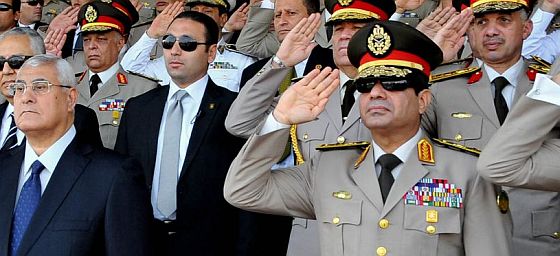
Gen. Abdel-Fattah el-Sissi
The Associated Press reports: In dark sunglasses and a uniform studded with medals, Egypt’s top general is everywhere, looking down from posters and banners proclaiming him “lion of the nation.” Adoring songs vow “We are behind you.”
Barely a month after he removed the elected president, Gen. Abdel-Fattah el-Sissi is riding a wave of adulation, drawing comparisons between him and modern Egypt’s first charismatic strongman, former President Gamal Abdel-Nasser. State media and pro-military TV channels and newspapers have done everything they can to fuel the fervor.
But some warn that the personality cult could pave the way to new authoritarianism after a coup that the army and its supporters insist was aimed at promoting democracy.
“I worry about el-Sissi and the possible arrogance of the victor. And I fear him if he decides that the army is stronger than any future president that he will control like a puppet,” wrote Mohammed Fathy, a columnist in the newspaper Al-Watan. “The admiration for him has gone beyond normal levels and is now more like deifying him.”
The hype has swelled to the point that some are convinced el-Sissi will take off his uniform and run for president in elections due to take place early next year. A military spokesman denied el-Sissi has any intention to do so. That has done nothing to end the speculation by those for and against the idea.
“Bottom line, el-Sissi will be president because he has no choice but to be. People have already started treating him as such and because he is de facto ruler,” Fathy wrote in a column on Monday, adding that media are depicting the general as “Nasser 2013.”
The raving over el-Sissi is rooted in the satisfaction many Egyptians took from his July 3 coup removing President Mohammed Morsi. It came after four days of massive protests by millions nationwide demanding the president step down, accusing him of failing to manage the country and handing power over to his Islamist allies. [Continue reading…]

The Washington Post reports: The European Union’s Catherine Ashton has met with deposed Egyptian president Mohamed Morsi. The Monday night meeting marked the first visit that Morsi has had from an outside official since he was ousted from power in a July 3 coup.
The visit signaled for the first time that Egypt’s military, which is holding Morsi, may be willing to work with him towards a political solution to the country’s ongoing crisis, which has seen waves of violence between security forces and Morsi’s supporters since his ouster.
Last week, prosecutors announced that Morsi was being investigated for allegations of espionage and murder; charges that his supporters in the Muslim Brotherhood have dismissed as politically motivated, but which could carry the death penalty.
Ashton would not go into detail about her two-hour conversation with Morsi on Monday night, but she said Tuesday that the deposed president had access to newspapers and television, and was in good condition.
“He’s well, and we had a friendly and open and very frank discussion,” Ashton said at a brief press conference on Tuesday. She did not say where Morsi, who has been held incommunicado for four weeks, was being held. [Continue reading…]