BBC News reports: Bolivia has accused European countries of an “act of aggression” for refusing to allow its presidential jet into their airspace, amid suggestions US fugitive Edward Snowden was on board.
Bolivia said France, Portugal, Spain and Italy had blocked the plane from flying over their territory.
President Evo Morales was flying back to Bolivia from Moscow when the plane was diverted to Vienna.
The jet was reportedly searched for Mr Snowden, wanted for leaking US secrets.
He was apparently not on board and is still believed to be in Moscow’s Sheremetyevo airport, from where he is seeking asylum in Bolivia and several other countries.
Bolivia’s UN envoy Sacha Llorenti told reporters in Geneva that he would complain to the UN about the European countries’ actions.
Author Archives: News Sources
Obama owes Germans an explanation
Gregor Peter Schmitz writes: Mick Jagger, 69, might be a father of seven and a grandfather of four, but he can still pull off the role of the eternally youthful rebel. The Rolling Stones recently gave a concert in Washington, just a few kilometers away from the White House. “I don’t think President Obama is here, but I’m sure he’s listening in,” the Stones frontman quipped.
The audience laughed out loud because Barack Obama — the man who carried so much hope and was long believed to be a very European US president — has become the butt of jokes. Some view him as the embodiment of the very “Big Brother” once sketched by George Orwell, the dictator who spies on, monitors and controls every citizen without any scruples.
But how much of that is a cliché, and how much truth is there to it? Given the revelations published by SPIEGEL in recent days showing evidence of a US spying program that is directed at European Union institutions, and monitoring an almost inconceivable number of communications connections — 500 million a month in Germany alone — you can’t blame a person for thinking the worst. Even if Obama has explicitly ensured that Americans needn’t fear some kind of “Big Brother,” the “3rd Party Partners,” as Germany was categorized in top secret NSA documents, are now asking if the same applies to Europeans. [Continue reading…]
Rethinking surveillance
Kenneth Roth writes: As a federal prosecutor in the 1980s, I used to think nothing of scooping up the phone numbers that a suspect called. I viewed that surveillance as no big deal because the Supreme Court had ruled in Smith v. Maryland (1979) that we have no reasonable expectation of privacy in the phone numbers we dial, as opposed to the content of the calls. And in any event, I had limited time or practical ability to follow up on those numbers.
Today, by contrast, when I look at the government’s large-scale electronic surveillance of private communications, I see an urgent need to rethink the rationale — and legal limits — for such intrusion. The government now has the technology to collect, store, and analyze information about our communications cheaply and quickly. It can assemble a picture of everyone we call or email — essentially our entire personal and professional lives — with a few computer commands. In addition, given the pervasive presence of geo-locators on our smart phones, the government is able to electronically monitor and reconstruct virtually every place we visit — a capacity that will only increase with the growing practice of photographing our license plates and the rapid improvement of facial-recognition software in combination with proliferating video cameras.
The government claims this enhanced capacity to monitor our metadata has helped to foil terrorist plots. But officials have been hard-pressed to identify cases in which broad, unfocused electronic surveillance has made a decisive difference. Meanwhile, US law has not kept up with the dramatic new intrusions on our privacy made possible by current technology. [Continue reading…]
U.S. drone strikes more deadly to Afghan civilians than manned aircraft
The Guardian reports: A study conducted by a US military adviser has found that drone strikes in Afghanistan during a year of the protracted conflict caused 10 times more civilian casualties than strikes by manned fighter aircraft.
The new study, referred to in an official US military journal, contradicts claims by US officials that the robotic planes are more precise than their manned counterparts.
It appears to undermine the claim made by President Obama in a May speech that “conventional airpower or missiles are far less precise than drones, and likely to cause more civilian casualties and local outrage”.
Drone strikes in Afghanistan, the study found, according to its unclassified executive summary, were “an order of magnitude more likely to result in civilian casualties per engagement.”
Larry Lewis, a principal research scientist at the Center for Naval Analyses, a research group with close ties to the US military, studied air strikes in Afghanistan from mid-2010 to mid-2011, using classified military data on the strikes and the civilian casualties they caused. Lewis told the Guardian he found that the missile strikes conducted by remotely piloted aircraft, commonly known as drones, were 10 times more deadly to Afghan civilians than those performed by fighter jets. [Continue reading…]
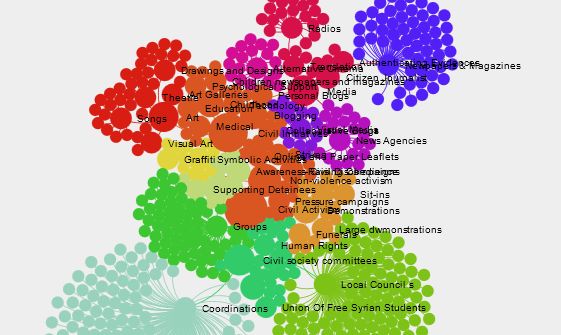
A map of non-violent activism in Syria
Kristyan Benedict writes: Non violent resistance in Syria? Don’t make me laugh. Those trying to topple Assad are all cannibals and head choppers….or so the likes of the academic “Angry Arab”, Asad Abu Khalil would, it would seem at times, try to convince you.
The reality is Syrians in their tens of thousands continue to resist the Assad regimes brutality (and sometimes resist certain armed opposition groups) through non-violent methods of staggering diversity and creativity. The extremely grim and brutal reality which regime apologists and quite often the mainstream media present is but one, extremely narrow perspective of what is going on in Syria. It is far from the whole truth.
A Syrian activist friend of mine, Omar al Assil, has recently produced a beautiful, interactive map of non-violent resistance in Syria. It was created with his colleagues in the Syrian Non Violence Movement including their members inside Syria.
I mention Abu Khalil as he was the first to respond to the map when the social commentator, Sultan Sooud Al-Qassemi posted it on his Facebook wall on June 21. Abu Khalil responded smugly: “Very convincing. Is there a special color for beheadings?”.
Pulse Media’s Muhammad Idrees Ahmad responded eloquently in the same thread to Abu Khalil’s customary inelegance: “He wants you to make blanket generalisations; to make no distinction between the Syrian majority who oppose the regime peacefully, the minority who defend themselves with arms, or the few who commit unpardonable crimes. They must all be judged by the standard of the lowest among them. Find the most criminal action, and extrapolate it onto the whole opposition.”
That extrapolation is a common reaction by many who only want to amplify the negatives of those opposed to the Assad regime. [Continue reading…]
Turkey: AKP may have gotten message from Gezi Park
Mustafa Akyol writes: It has now been a month from the beginning of the Gezi Park crisis and the subsequent anti-government protests that shook Turkey. Most observers, including myself, have concluded that the Justice and Development Party (AKP) government led by Prime Minister Recep Tayyip Erdogan have both misunderstood and mismanaged the crisis. However, I also think that the AKP elites have learned some lessons and are willing to take some helpful steps.
For sure, the misunderstanding still goes on, and at its heart lies the AKP propaganda, if not self-delusion, that all the protests were orchestrated by “dark powers” which wanted to sabotage Turkey’s glorious progress. A film prepared by the AKP public-relations department lays out this scheme very clearly, by explaining how Erdogan’s success provoked a long list of conspirators, ranging from the interest-rate lobby to foreign companies and their domestic “spies.” Uncritically pro-Erdogan commentators in the media take these conspiracy theories to new heights every day, blaming almost every political actor in the world except the AKP itself. According to one popular theory, for example, one of the conspirators was the German Lufthansa, which wanted to take on revenge Turkey for the success of Turkish Airlines and the construction of Istanbul’s third airport, which promises to be Europe’s largest.
There are also worrying signs of a probable witchhunt against the protesters. In fact, we should grant that some of them — especially those who come from the far left — were inexcusably violent as they tried to storm the prime minister’s office or set AKP buildings on fire. In other words, the police is justified in investigating such criminals. But other steps by the authorities, such as the government’s demand from public offices the lists of public servants who joined the protests, are concerning. Similarly worrying are Erdogan’s public threats against businessmen who supported the protests. The government has to understand that while vandalism is a crime, peaceful protests are perfectly legitimate and no one can be tried for joining them. [Continue reading…]
Morsi clings to legitimacy
The New York Times reports: Brushing aside a military ultimatum and his deepening isolation, President Mohamed Morsi of Egypt declared on Tuesday that he was the legitimate leader of the country and blamed the spiraling and violent national crisis on what he repeatedly called the corrupt “remnants of the former regime” overthrown in the 2011 revolution.
In an emotional and rambling speech broadcast live on state television that extended past midnight into Wednesday morning, Mr. Morsi called on both his supporters and opponents to put aside their disagreements and unite behind him, and and hinted strongly that the country could fall into chaos if they did not.
“I am the president of Egypt,” Mr. Morsi said, invoking again and again what he called his constitutional mandate to remain in power.
“The remnants of the former regime, they are fighting against our democracy,” he said, referring to the toppled government of his predecessor, Hosni Mubarak. “If they come back to the people they will be rejected. They are accustomed to corruption, rigging elections sucking dry the blood of the people.” He added: “They cannot thrive in democracy.”
It was Mr. Morsi’s most extensive rebuttal to the growing calls on him to resign from an ever-widening spectrum of the Egyptian population after a year-long tenure that has been riven with turmoil and growing disenchantment with him and his Islamist supporters.
Mr. Morsi also demanded that the Egyptian military rescind its ultimatum against him, which his supporters have described as the prelude to a military coup.
Mr. Morsi’s defiant message came amid a new outbreak of armed and lethal political violence as protesters massed to call for his ouster. As the clock ticked on the military’s two-day ultimatum for the president to ease the crisis, high-ranking aides abandoned him and dozens of his s supporters were hit by birdshot. At least seven people were reported killed. [Continue reading…]
Laura Rozen reports: The White House on Tuesday pushed back on a report that American officials are urging Egyptian President Mohammad Morsi to call early elections, in response to the largest anti-government demonstrations Egypt has ever witnessed. The comments seem intended to reduce any perception that Washington is trying to dictate any particular course of action to the Egyptian leadership.
“It is not accurate that the United States is ‘urging’ President Morsy to call early elections,” National Security Council spokeswoman Bernadette Meehan said in an e-mail Tuesday to Al-Monitor.
“President Obama has encouraged President Morsy to take steps to show that he is responsive to the concerns of the Egyptian people and underscored that the current crisis can only be resolved through a political process,” Meehan continued. “As the President has made clear since the revolution, only Egyptians can make the decisions that will determine their future.”
The White House comment, responding to a CNN report Tuesday, didn’t seem to rule out that US officials may be discussing the option of early elections with Egyptian officials behind closed doors.
“We are saying to him, ‘Figure out a way to go for new elections,’” a senior US official told CNN. “That may be the only way that this confrontation can be resolved.”
The Muslim Brotherhood fights for its legacy, not for Morsi
Al-Monitor reports: As millions of protesters converged on the streets of Egypt on June 30 to peacefully yet boisterously demand the downfall of Egypt’s first elected president, Mohammed Morsi, deadly clashes broke out in several spots across the volatile nation. Around midnight, the Muslim Brotherhood’s international headquarters, located in Cairo’s upscale Moqattam district, was in flames.
The six-story building declared as the Muslim Brotherhood General Center in 2011 — after decades of underground operations and being hunted down by Hosni Mubarak, Anwar Sadat, and Gamal Abdel Nasser’s security — was attacked by dozens of rock- and Molotov cocktail-hurling protesters. The attacks ensued despite the obvious security precautions taken by the Brotherhood youth over the past week: they covered the building’s windows with street-war like sandbags, chain-locked the gates, wielded their weapons and bunkered inside.
As massive clouds of smoke blew out of the iconic Guidance Bureau of the worldwide organization, the movement’s disciplined, listen-and-obey youth continued to fire live ammunition at the assaulters. No more Brotherhood reinforcements arrived at the burning headquarters, and armored vehicles of the Interior Ministry stood watching from a distance, a clear message that the police would no longer protect the ruling clique.
Eight anti-Morsi protesters were killed by live bullets, mostly to the head and neck, and more than 35 were wounded by live rounds and birdshot. Calls for blood donations to the battle-neighboring hospital continued to circulate social media websites for hours. How the Muslim Brotherhood fighters evacuated their positions remains unknown, but one of them was caught by protesters trying to escape and was brutally stripped naked and stabbed before reaching the police station in critical condition. [Continue reading…]
Egypt: Morsi’s final hours in power?
Reuters reports: President Mohamed Mursi clung to office on Tuesday after rebuffing an army ultimatum to force a resolution to Egypt’s political crisis, and the ruling Muslim Brotherhood sought to mass its supporters to defend him.
But the Islamist leader looked increasingly isolated, with ministers resigning, the liberal opposition refusing to talk to him and the armed forces, backed by millions of protesters in the street, giving him until Wednesday to agree to share power.
In a defiant 2 a.m. statement, Mursi’s office said the president had not been consulted before the armed forces chief-of-staff set a 48-hour deadline for a power-sharing deal and would pursue his own plan for national reconciliation.
Newspapers across the political spectrum saw the military ultimatum as a turning point. “Last 48 hours of Muslim Brotherhood rule,” the opposition daily El Watan declared. “Egypt awaits the army,” said the state-owned El Akhbar.
Al-Masry Al-Youm reports: Sovereign bodies have given instructions to security authorities at Cairo International Airport to prevent Muslim Brotherhood and Wasat Party leaders, as well as former members of the People’s Assembly and the Freedom and Justice Party, from traveling until they are given the green light, private news agency ONA reports.
The ban was imposed due to reports filed against them.
Sovereign bodies is a term that usually refers to senior security authorities, such as members of the Egyptian intelligence service.
Meanwhile, security authorities at the airport have said that no orders were given to seize the presidential plane or to prevent President Mohamed Morsy from traveling abroad.
Christopher Dickey reports: Many on the ground in Cairo regard this drama as little more than a military coup with well-orchestrated protests giving the army the pretext to make a move. But neither the anti-government demonstrators calling for the army to intervene nor the officers in the high command itself actually want the military to rule. The army’s interests have always been to maintain its independence, its prestige, and its highly profitable industries while avoiding the dirty business of running a nearly ungovernable country with an economy on the verge of implosion.
Robert Springborg at the U.S. Naval Postgraduate School, an authority on the Egyptian military, says the situation is further complicated by the disarray of the opposition, which has now proved, once again, it can gather people in the street but lacks the organization able to run a government. Springborg believes the military would like the Brotherhood-dominated government to make a host of concessions, including liberalization of the Constitution and opening the way to new elections. “I think Morsi himself is expendable,” says Springborg. “Morsi is now dead weight for them.”
But adding to the complications are possible divisions within the military itself, where al-Sisi is tainted by his past close cooperation with the once-fearsome and now feckless Islamist party. [Continue reading…]
Edward Snowden’s dwindling asylum options
The Guardian lists the response Edward Snowden has received so far in his search for asylum — so far the only positive hint comes from Venezuela.
According to a statement from WikiLeaks, the US whistleblower Edward Snowden has applied for asylum in a total of 21 countries. Snowden, who has been charged under espionage laws in the US after leaking top-secret documents on US surveillance programmes, has been trapped in Moscow’s Sheremetyevo airport since 23 June after flying in from Hong Kong. He has yet to receive a positive response to his applications for asylum. Some countries have yet to respond but a number have already rejected his request. [Continue reading to see each country’s response.]
Reuters adds: [W]hile country after country denied his asylum requests on technical grounds, Venezuela, part of an alliance of leftist governments in Latin America, said it was time to stop berating a man who has “done something very important for humanity”.
“He deserves the world’s protection,” President Nicolas Maduro told Reuters during a visit to Moscow.
“He has a right to protection because the United States in its actions is persecuting him…Why are they persecuting him? What has he done? Did he launch a missile and kill someone? Did he rig a bomb and kill someone? No. He is preventing war.”
Maduro said he would consider an asylum application. Snowden’s request for safety in Ecuador, which has sheltered the founder of antisecrecy group WikiLeaks Julian Assange in its London embassy, has seemingly ended.
Edward Snowden’s latest statement, published by Wikileaks:
One week ago I left Hong Kong after it became clear that my freedom and safety were under threat for revealing the truth. My continued liberty has been owed to the efforts of friends new and old, family, and others who I have never met and probably never will. I trusted them with my life and they returned that trust with a faith in me for which I will always be thankful.
On Thursday, President Obama declared before the world that he would not permit any diplomatic “wheeling and dealing” over my case. Yet now it is being reported that after promising not to do so, the President ordered his Vice President to pressure the leaders of nations from which I have requested protection to deny my asylum petitions.
This kind of deception from a world leader is not justice, and neither is the extralegal penalty of exile. These are the old, bad tools of political aggression. Their purpose is to frighten, not me, but those who would come after me.
For decades the United States of America has been one of the strongest defenders of the human right to seek asylum. Sadly, this right, laid out and voted for by the U.S. in Article 14 of the Universal Declaration of Human Rights, is now being rejected by the current government of my country. The Obama administration has now adopted the strategy of using citizenship as a weapon. Although I am convicted of nothing, it has unilaterally revoked my passport, leaving me a stateless person. Without any judicial order, the administration now seeks to stop me exercising a basic right. A right that belongs to everybody. The right to seek asylum.
In the end the Obama administration is not afraid of whistleblowers like me, Bradley Manning or Thomas Drake. We are stateless, imprisoned, or powerless. No, the Obama administration is afraid of you. It is afraid of an informed, angry public demanding the constitutional government it was promised — and it should be.
I am unbowed in my convictions and impressed at the efforts taken by so many.
Edward Joseph Snowden
Monday 1st July 2013
The NSA is watching. So are Google and Facebook
The Los Angeles Times reports: Not long before headlines exposed National Security Agency programs that secretly collect records of Americans’ phone calls, another surveillance system got far less attention: Nordstrom, the department store chain, acknowledged it was tracking customers without their knowledge in 17 stores.
Nordstrom had hired a company to log a unique number emitted by shoppers’ smartphones, which automatically connected to Wi-Fi systems as they moved through the stores. A day after a Dallas TV station broke the story last month, Nordstrom announced it was discontinuing the program.
The Palo Alto company that sold the tracking service, Euclid Analytics, has tracked 50 million devices in 4,000 locations for 100 corporate and other customers, its founder has said. Shoppers are free to opt out, but the process is complex — they must enter their phone’s media access control address, known as a MAC address, on Euclid’s website.
Self-confessed leaker Edward Snowden’s disclosures about domestic spying by the NSA have sparked a broad debate about whether the government is using sophisticated surveillance and data-mining techniques on its own citizens without sufficient oversight.
But information gathered and exploited by Internet giants such as Google, Amazon and Facebook — and traded by lesser-known data brokers such as Datalogix and Acxiom — can be more revealing than what the NSA can legally collect on most Americans. Few consumers understand what data are being shared, with whom, or how the information is being used. [Continue reading…]
A trail of official lies about NSA spying
The Washington Post reports: Amid the cascading disclosures about National Security Agency surveillance programs, the top lawyer in the U.S. intelligence community opened his remarks at a rare public appearance last week with a lament about how much of the information being spilled was wrong.
“A lie can get halfway around the world before the truth gets its boots on,” said Robert Litt, citing a line often attributed to Mark Twain. “Unfortunately, there’s been a lot of misinformation that’s come out about these programs.”
A week earlier, President Obama, in a television interview, asserted that oversight of the surveillance programs was “transparent” because of the involvement of a special court, even though that court’s sessions and decisions are sealed from the public. “It is transparent,” Obama said of the oversight process. “That’s why we set up the FISA court.”
A remark by Litt’s boss, Director of National Intelligence James R. Clapper Jr., has perhaps drawn the most attention. Asked during a congressional hearing in March whether the NSA collected data on millions of Americans, Clapper replied, “No, sir.” [Continue reading…]
America’s totalitarian inclinations
In Der Spiegel, Laura Poitras, Marcel Rosenbach and Holger Stark write: Now that Snowden has afforded the world a glimpse of the inner workings of the NSA, it has become clear that Obama is, at best, telling only a small portion of the truth. With evidence indicating that the NSA bugged EU offices and summits in Brussels attended by world leaders, the fight on terror is no longer a valid excuse. Luxembourg’s Foreign Minister Jean Asselborn, President of the European Commission Jose Manuel Barroso and European Parliament President Martin Schulz don’t seriously pose a threat to anyone.
The Americans’ colossal spying operation smacks of totalitarianism. SPIEGEL has viewed an internal NSA presentation which lays out a vision of “Information Superiority”: a worldwide dominance of information networks. This vision was drawn up several years ago and it seems safe to assume that the US has come a significant step closer to implementing it since then. In it, the NSA openly refers to Germany as both a friend and a foe. “We can, and often do, target the signals of most third party foreign partners,” it boasts.
The NSA’s totalitarian ambition regarding information-gathering does not affect just states and authorities. It does not affect just businesses. It affects us all. It even affects those who think they have nothing to hide.
A constitutional state cannot allow it. None of us can allow it. [Continue reading…]
Video: Sharif Abdel Kouddous on the Egyptian army’s threat to oust Morsi
Edward Snowden breaks silence to threaten new U.S. leaks
Reuters reports: Former U.S. spy agency contractor Edward Snowden has broken his silence for the first time since he fled to Moscow eight days ago to say he remains free to make new disclosures about U.S. spying activity.
In a letter to Ecuador, Snowden said the United States was illegally persecuting him for revealing its electronic surveillance program, PRISM. He also thanked Ecuador for helping him get to Russia and for examining his asylum request.
“I remain free and able to publish information that serves the public interest,” Snowden said in an undated Spanish-language letter sent to President Rafael Correa of Ecuador, seen by Reuters.
“No matter how many more days my life contains, I remain dedicated to the fight for justice in this unequal world. If any of those days ahead realize a contribution to the common good, the world will have the principles of Ecuador to thank,” part of the text read, according to a translation.
A Russian Foreign Ministry official tells the Los Angeles Times that Snowden has reached out to 15 countries for political asylum: “It was a desperate measure on his part after Ecuador disavowed his political protection credentials,” said the official, speaking on condition of anonymity. “In the document [he handed to Russian officials] Snowden reiterated once again that he is not a traitor and explained his actions only by a desire to open the world’s eyes on the flagrant violations by U.S. special services not only of American citizens but also citizens of European Union including their NATO allies.”
The New York Times reports: President Vladimir V. Putin said on Monday that Edward J. Snowden, the former national security staffer accused of espionage, would not receive political asylum in Russia unless he stopped publishing classified documents that hurt the interests of the United States.
At a news conference here, Mr. Putin said that since it appeared Mr. Snowden was going to continue publishing leaks, his chances of staying in Russia were slim. Mr. Putin also pushed back against efforts by the United States to persuade the Russian government to extradite Mr. Snowden, making it clear that Russia would not comply.
“Russia never gives up anyone to anybody and is not planning to,” Mr. Putin said.
Egypt: Army threatens to oust Morsi in 48 hours
The Washington Post reports: Egypt’s powerful military issued an ultimatum to the government of President Mohamed Morsi on Monday: resolve the crisis that has pitted hundreds of thousands of Morsi’s opponents against his supporters and ground this country to a political standstill — or the military will intervene.
Abdel Fatah al-Sissi, commander of Egypt’s armed forces, said the military may soon take action to enforce the demands of the masses of Egyptians who took to the streets on Sunday calling for the president’s ouster.
“The armed forces reiterates its call to meet the demands of the people, and it gives everyone 48 hours as a last chance to carry the burden of the ongoing historic circumstances that the country is going through,” Sissi said in a statement broadcast on national television.
“If the demands of the people are not met within the given period of time, [the military] will be compelled by its national and historic responsibilities, and in respect for the demands of Egypt’s great people, to announce a roadmap for the future, and procedures that it will supervise involving the participation of all the factions and groups.”
Anti-government activists have called repeatedly on the military in recent days to back them in their struggle against Morsi and his supporters in the Islamist Muslim Brotherhood. Many interpreted Sissi’s remarks on Monday as a victory for their cause.
“I think it’s highly unlikely that Morsi will be able to make a deal with the opposition in 48 hours. I don’t think anyone wants to deal with Morsi anymore,” said Wael Nawara, a longtime political activist, and the co-founder of the liberal Dustour party.
“So that effectively means that the military will basically appoint some kind of transition government,” he said.
The military had repeatedly signaled that it does not want to return to the helm of politics, which it commanded — turbulently — in the first year and a half after the ouster of longtime dictator Hosni Mubarak in February, 2011. But Sissi also said earlier this month that the army would step in if Egypt’s political crisis worsened.
AFP adds: In Tahrir Square, anti-Morsi protesters erupted in joy after the army’s statement.
“Come down Sisi, Morsi is not my president,” the protesters chanted, urging the country’s army chief, Abdel Fattah al-Sisi, to intervene.
An official from Morsi’s Muslim Brotherhood said the powerful movement was “studying” the army’s statement.
Key US-EU trade pact under threat after more NSA spying allegations
The Guardian reports: The prospects for a new trade pact between the US and the European Union worth hundreds of billions have suffered a severe setback following allegations that Washington bugged key EU offices and intercepted phonecalls and emails from top officials.
The latest reports of NSA snooping on Europe – and on Germany in particular – went well beyond previous revelations of electronic spying said to be focused on identifying suspected terrorists, extremists and organised criminals.
The German publication Der Spiegel reported that it had seen documents and slides from the NSA whistleblower Edward Snowden indicating that US agencies bugged the offices of the EU in Washington and at the United Nations in New York. They are also accused of directing an operation from Nato headquarters in Brussels to infiltrate the telephone and email networks at the EU’s Justus Lipsius building in the Belgian capital, the venue for EU summits and home of the European council.
Without citing sources, the magazine reported that more than five years ago security officers at the EU had noticed several missed calls apparently targeting the remote maintenance system in the building that were traced to NSA offices within the Nato compound in Brussels.
The impact of the Der Spiegel allegations may be felt more keenly in Germany than in Brussels. The magazine said Germany was the foremost target for the US surveillance programmes, categorising Washington’s key European ally alongside China, Iraq or Saudi Arabia in the intensity of the electronic snooping.
Germany’s justice minister, Sabine Leutheusser-Schnarrenberger, called for an explanation from the US authorities. “If the media reports are true, it is reminiscent of the actions of enemies during the cold war,” she was quoted as saying in the German newspaper Bild. “It is beyond imagination that our friends in the US view Europeans as the enemy.” [Continue reading…]
Europe furious over NSA spying on EU facilities
Der Spiegel reports: Europeans are furious. Revelations that the US intelligence service National Security Agency (NSA) targeted the European Union and several European countries with its far-reaching spying activities have led to angry reactions from several senior EU and German politicians.
“We need more precise information,” said European Parliament President Martin Schulz. “But if it is true, it is a huge scandal. That would mean a huge burden for relations between the EU and the US. We now demand comprehensive information.”
Schulz was reacting to a report in SPIEGEL that the NSA had bugged the EU’s diplomatic representation in Washington and monitored its computer network (full story available on Monday). The EU’s representation to the United Nations in New York was targeted in a similar manner. US intelligence thus had access to EU email traffic and internal documents. The information appears in secret documents obtained by whistleblower Edward Snowden, some of which SPIEGEL has seen. [Continue reading…]