Author Archives: News Sources

The rise of the Iranian moderates

Seyed Hossein Mousavian, a former spokesman for Iran’s nuclear negotiators, writes: Political infighting and factionalism has become a cynical characteristic of Iranian politics since the 1979 Islamic Revolution, specifically in the last 16 years. This phenomenon escalated with the sweeping victory of the traditional left wing of the revolution relabeled as Islahtalaban, or “Reformists,” in the presidential election of 1997. During the eight years of President Mohammad Khatami’s administration from 1997 to 2005, the right wing of the revolution — relabeled as Usulgarayan, or “Principalists” or “Conservatives” — was progressively sidelined and replaced by Reformists. Khatami, while disapproving of factionalism, could not withstand the tide of change toward a Reformist-dominated administration. This left many Principalists alienated and bitter from the experience they faced at the hands of the Reformists.

The surprise win for the Principalist candidate, Mahmoud Ahmadinejad, in the 2005 presidential election turned the tide against the Reformists. This time around, the purge of Reformists from the administration was swift and almost total, ushering in a period of dominance in the administration by one faction for the next eight years.

During both periods of extreme political polarization and dominance by one faction, there existed moderates within Islahtalaban and Usulgarayan. Ayatollah Hashemi Rafsanjani — early on in Khatami’s presidency — voiced his concern over the growing trend toward factionalism. As one of the key founders of the Islamic Republic, he cautioned that such political infighting would ultimately endanger the whole establishment. Rafsanjani instead called for like-minded politicians in both camps to create a new political movement in Iran, under the banner of moderation or centrist. Subsequently, then-Deputy Foreign Minister Mahmoud Vaezi, MP Mohammad Bagher Nobakht, Deputy Cultural Minister Ali Jannati and I met with Rafsanjani to realize the initiative. In that meeting, Rafsanjani told us, “Ruling the country with one faction would be a disaster for the country, and instead all moderates within both major factions should unite and advance economic-political development to strengthen the pillars of the Islamic Republic.” In the same meeting, we decided to establish a party, the Hezbe Etedal va Tosehe, or “Moderate and Development Party.” The best candidate to lead the party, according to Rafsanjani’s advice, was Hassan Rouhani. In 1999, the party and its central committee was established and led by Rouhani. [Continue reading…]


Facebooktwittermail

Venezuela offers asylum to Snowden

The New York Times reports: President Nicolás Maduro of Venezuela said Friday that he would offer asylum to the fugitive intelligence contractor Edward J. Snowden, who has been stranded in a Moscow airport searching for a safe haven.

“I have decided to offer humanitarian asylum to the young American Edward Snowden,” Mr. Maduro said during a televised appearance at a military parade marking Venezuela’s independence day.

Mr. Maduro said he had decided to act “to protect this young man from the persecution unleashed by the world’s most powerful empire.”

It was not immediately clear, however, how Mr. Snowden could reach Venezuela or if Mr. Maduro was willing to help transport him.

Also on Friday, Daniel Ortega, the president of Nicaragua, said he was open to taking in Mr. Snowden. “It is clear that if the circumstances permit we will take in Mr. Snowden with pleasure and give him asylum in Nicaragua,” Mr. Ortega said in Managua.

Facebooktwittermail

Edward Snowden is a whistleblower, not a spy — but do our leaders care?

Spencer Ackerman writes: According to US legislators and journalists, the surveillance whistleblower Edward Snowden actively aided America’s enemies. They are just missing one essential element for the meme to take flight: evidence.

An op-ed by Representative Mike Pompeo (Republican, Kansas) proclaiming Snowden, who provided disclosed widespread surveillance on phone records and internet communications by the National Security Agency, “not a whistleblower” is indicative of the emerging narrative. Writing in the Wichita Eagle on 30 June Pompeo, a member of the House intelligence committee, wrote that Snowden “has provided intelligence to America’s adversaries“.

Pompeo correctly notes in his op-ed that “facts are important”. Yet when asked for the evidence justifying the claim that Snowden gave intelligence to American adversaries, his spokesman, JP Freire, cited Snowden’s leak of NSA documents. Those documents, however, were provided to the Guardian and the Washington Post, not al-Qaeda or North Korea.

It’s true that information published in the press can be read by anyone, including people who mean America harm. But to conflate that with actively handing information to foreign adversaries is to foreclose on the crucial distinction between a whistleblower and a spy, and makes journalists the handmaidens of enemies of the state.

Yet powerful legislators are eager to make that conflation about Snowden. [Continue reading…]

Facebooktwittermail

Demoting democracy in Egypt

Shadi Hamid writes: When Mohamed Morsi became Egypt’s first democratically elected president last year, it was an especially sweet victory for the Muslim Brotherhood, the region’s oldest and most influential Islamist movement. After a long history of repression, the Brotherhood had finally tasted triumph. But their short-lived rule ended Wednesday when Egypt’s army deposed Mr. Morsi.

The Brotherhood’s fall will have profound implications for the future of political Islam, reverberating across the region in potentially dangerous ways. One of the most important political developments of recent years was the decision of Islamist parties to make peace with democracy and commit to playing by the rules of the political game. Leaders counseled patience to their followers. Their time would come, they were told.

Now supporters of the Brotherhood will ask, with good reason, whether democracy still has anything to offer them. Mr. Morsi’s removal will breathe new life into the ideological claims of radicals. Al Qaeda and its followers have long argued that change can’t come through the democracy of “unbelievers”; violence is the only path. As the Qaeda leader Ayman al-Zawahri once said, “What is truly regrettable is the rallying of thousands of duped Muslim youth in voter queues before ballot boxes instead of lining them up to fight in the cause of Allah.”

Al Qaeda’s intellectual forebears emerged in the 1950s and 1960s, and were shaped by events that bear an eerie similarity to those of this week. In 1954, a popularly backed Egyptian Army moved against the Muslim Brotherhood, arresting thousands and dismantling the organization. Prison had a radicalizing effect on Sayyid Qutb, a leading Brotherhood ideologue, who experienced torture at the hands of his captors before being executed in 1966. Many of Mr. Qutb’s followers later left the Brotherhood’s embrace and went their own way, setting up militant organizations that would begin perpetrating acts of terrorism.

In 1954, no one could have guessed that the brutal crackdown against the Brotherhood would set in motion a chain of events that would have terrible consequences for the region and America. [Continue reading…]

Facebooktwittermail

NSA looking for recruits — finding would-be whistleblowers

The NSA came to recruit at a language program at the University of Wisconsin:

Madiha R. Tahir: This is not just a word game [defining who counts as an “adversary” of the United States] and you understand that as well as I do. So, it’s very strange that you’re selling yourself here in one particular fashion when it’s absolutely not true.

NSA female recruiter: I don’t think we’re selling ourselves in an untrue fashion.

Tahir: Well, this is a recruiting session and you are telling us things that aren’t true. We also know that the NSA took down brochures and fact sheets after the Snowden revelations because those brochures also had severe inaccuracies and untruths in them. So, how are we supposed to believe what you’re saying?

[pause]

Student A (female): I have a lifestyle question that you seem to be selling. It sounds more like a brochure smallercolonial expedition. You know the “globe is our playground” is the words you used, the phrasing that you used and you seem to be saying that you can do your work. You can analyze said documents for your so-called customers but then you can go and get drunk and dress up and have fun without thinking of the repercussions of the info you’re analyzing has on the rest of the world. I also want to know what are the qualifications that one needs to become a whistleblower because that sounds like a much more interesting job. And I think the Edward Snowdens and the Bradley Mannings and Julian Assanges of the world will prevail ultimately.

Listen to the whole exchange — an exchange between a thoughtful and intelligent group of students and two robotic servants of the U.S. government:

Facebooktwittermail

Der Shitstorm

The Economist says that following revelations about the NSA spying on America’s so-called allies, the “noun ‘Der Shitstorm’ made a timely entrance to the official German lexicon this week.”

As the Shitstorm mounts, Germany is sending a delegation to Washington (some think it should be the other way round). Politicians are struggling to explain what they knew and when they knew it. Federal prosecutors are opening inquiries. Sigmar Gabriel, an opposition leader, says they should interview Mr Snowden and if necessary offer him “witness protection” in Germany. The head of the domestic security agency says he knew nothing of the NSA’s schemes, but his service may have benefited from the results.

The fear in Europe is that, once so many data are in American hands, who is to say that they will not be misunderstood, leaked or misused? The information may help catch terrorists and gangsters today, but become part of American power politics (or commercial advantage) tomorrow. European policymakers took a lot of persuading before they agreed to share data on financial transactions and airline passenger lists with America. Now European Parliament members are threatening to suspend the deals. Another potential casualty is a proposed transatlantic free-trade deal, on which talks are due to start on July 8th (see article). France (never enthusiastic) and left-wing politicians in other countries want them halted, pending full clarification of the espionage programmes.

Facebooktwittermail

Bolivia threatens U.S. embassy closing after Snowden search

Bloomberg reports: Bolivia threatened to close the U.S. embassy as presidents from across the region met to show solidarity with President Evo Morales after the global manhunt for fugitive leaker Edward Snowden diverted his flight.

“We don’t need them, we’ve got other allies,” Morales, 53, said yesterday at an emergency summit of Latin American leaders in the highland Bolivian town of Cochabamba. “We don’t need the pretext of cooperation and diplomatic relations so that they can come and spy on us.”

Presidents from Argentina, Ecuador, Suriname, Uruguay and Venezuela met with Morales to demand Spain, France, Portugal and Italy apologize and explain why they denied the Bolivian leader’s presidential jet permission to fly through their airspace July 2. The incident led the plane to make an emergency landing in Vienna after a fuel gauge stopped working correctly, Morales said.

The group called for a new meeting of South American presidents on July 12 in Montevideo, Uruguay to discuss further retaliation against the European countries for the “flagrant violation” of international law, according to a statement read by Bolivia’s Foreign Minister David Choquehuanca at the end of the meeting yesterday. Brazilian President Dilma Rousseff, Chile’s Sebastian Pinera, Colombian President Juan Manuel Santos and Peru’s Ollanta Humala skipped the summit.

Facebooktwittermail

Climate change led to 370,000 deaths over last decade

Imagine if the headline said “terrorism” instead of climate change. Most Western democracies would have imposed martial law. The culture of fear would have been ramped up to an unimaginable scale and ordinary people would be fortifying their homes and limiting their forays into public places. But since instead these were deaths caused by our energy-gluttonous lifestyle, then this is news that won’t even make the front pages.

Nature World News reports: The United Nations’ World Meteorological Organization (WMO) released its decadal climate report Tuesday, which corroborated what many already believe to be true: the world is getting warmer, marked by a decade of unprecedented climate extremes.

The 10-year period between 2001 and 2010 was the warmest decade on record since modern meteorological records began around 1850, the report stated.

Those 10 years accounted for more record-breaking temperatures than any previous decade, and sea levels were said to have risen about twice as fast as the trend in the last 100 years.

Average air temperature on Earth during the study decade was nearly half a degree Celsius warmer than the average temperature from 1961-1990. Nine of the decade’s years were among the 10 warmest on record, with 2010 being the warmest year ever recorded.

The report “gives a snapshot of much longer term behavior of the climate system,” said Omar Baddour, coordinator for WMO climate system monitoring.

Baddour said that over the past four decades global temperatures have shown a “pronounced increase.”

Michel Jarraud, the WMO Secretary General, said that the rate of temperature increase “between 1991-2000 and 2001-2010 was unprecedented.” [Continue reading…]

Facebooktwittermail

Police state: U.S. Postal Service logging all mail for law enforcement

The New York Times reports: Leslie James Pickering noticed something odd in his mail last September: a handwritten card, apparently delivered by mistake, with instructions for postal workers to pay special attention to the letters and packages sent to his home.

“Show all mail to supv” — supervisor — “for copying prior to going out on the street,” read the card. It included Mr. Pickering’s name, address and the type of mail that needed to be monitored. The word “confidential” was highlighted in green.

“It was a bit of a shock to see it,” said Mr. Pickering, who with his wife owns a small bookstore in Buffalo. More than a decade ago, he was a spokesman for the Earth Liberation Front, a radical environmental group labeled eco-terrorists by the Federal Bureau of Investigation. Postal officials subsequently confirmed they were indeed tracking Mr. Pickering’s mail but told him nothing else.

As the world focuses on the high-tech spying of the National Security Agency, the misplaced card offers a rare glimpse inside the seemingly low-tech but prevalent snooping of the United States Postal Service.

Mr. Pickering was targeted by a longtime surveillance system called mail covers, a forerunner of a vastly more expansive effort, the Mail Isolation Control and Tracking program, in which Postal Service computers photograph the exterior of every piece of paper mail that is processed in the United States — about 160 billion pieces last year. It is not known how long the government saves the images.

Together, the two programs show that postal mail is subject to the same kind of scrutiny that the National Security Agency has given to telephone calls and e-mail. [Continue reading…]

Facebooktwittermail

Hints surface that NSA building massive, pervasive surveillance capability

McClatchy reports: Despite U.S. intelligence officials’ repeated denials that the National Security Agency is collecting the content of domestic emails and phone calls, evidence is mounting that the agency’s vast surveillance network can and may already be preserving billions of those communications in powerful digital databases.

A McClatchy review of public records, statements by Obama administration officials and interviews with cyber and telecom security experts lends credence to assertions that the capability for such surveillance exists.

— FBI Director Robert Mueller told a Senate committee on March 30, 2011, that “technological improvements” now enable the bureau “to pull together past emails and future ones as they come in so that it does not require an individualized search.”

— The administration is building a facility in a valley south of Salt Lake City that will have the capacity to store massive amounts of records – a facility that former agency whistleblowers say has no logical purpose if it’s not going to be a vault holding years of phone and Internet data.

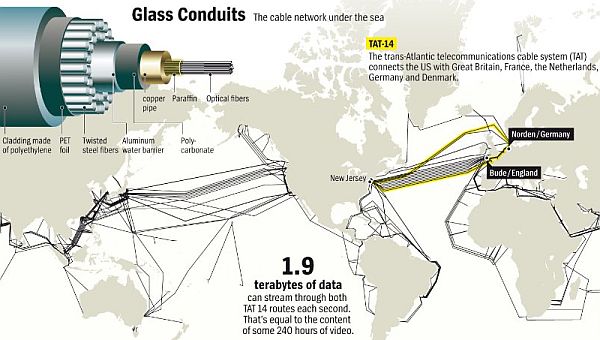
— Security experts, including a former AT&T engineer, say that the NSA has tapped into fiber-optic cables carrying phone and Internet data in cities across the country. [Continue reading…]

Facebooktwittermail

Tahrir Square’s military coup

Wendell Steavenson writes: The crowds on the street in Egypt over the past days have been overwhelming — they have numbered in the millions. Waving flags and tooting whistles, trumpeting vuvuzelas, drumming and shouting and chanting and honking and singing — Tahrir reached such a noisy level of jubilation that people were joking, “Did Egypt win the World Cup?” Walking among them, dodging fireworks, it felt upside down: a popular protest to oust President Mohammed Morsi, the Muslim Brotherhood leader who was democratically elected, in which, since Monday, the military has taken the side of the protesters. From one perspective, what is happening in Egypt represents an extraordinary repudiation of political Islam. From another, it is an outright military coup — a repudiation of the process of politics itself. Whatever the air of joyousness, dozens of people have died across the country. The danger did not dissipate with the announcement by the military, on Wednesday night, that Morsi was not President any longer and that the Constitution had been suspended.

The crowd in Tahrir has been varied: families, including women; people with prayer calluses and Afros, some wearing plastic sandals and others Gucci sunglasses; farmers and accountants. But there’s no doubt that there are many from the middle-class “couch party”: people who were more or less O.K. with Mubarak, who tend to trust the Army, and who had not been out to protest before. Police were hoisted onto shoulders. Overhead, military helicopters dropped flags for the cheering masses. On TV — the military had taken control of state media — aerial footage of the immense throngs played on a loop to a soundtrack of martial victory music.

On Monday, Abdul-Fattah el-Sisi, the Head of the Supreme Council of the Armed Forces, issued an ultimatum: the two sides, government and opposition, had forty-eight hours to come up with a compromise plan or else the military would step in with its own “roadmap.” The crowds on the street went wild, taking it as a sign that they had already won. But this was also very clearly a coup. (Twitter captured the national sense of humor — only Egyptians could announce a coup forty-eight hours in advance!) As much as the generals say they are honoring the will of the people, they engineered a showdown, and got one. The Muslim Brotherhood’s supporters, if outnumbered, were also gathering in the streets. Among the anti-Morsi crowds that kept coming, to fill practically every square and intersection in the country, people seemed to think that the Army was not like it had been before, that it was not the Army of Hosni Mubarak and military trials. Sisi would not “sit on the chair” — that is, take the throne.

Morsi addressed the nation at 11:30 P.M. on Tuesday. He spoke with passion, sometimes with anger, and he was defiant. He used the word “legitimacy” so many times that it began to sound like a fist thumping on the table. He reiterated that he was democratically elected — and that was that. It was the feloul, he said, the remnants of the old régime and the deep state, who were taking advantage of the protests for their own schemes. He complained that the bad economy — a major complaint against him — was the fault of the previous government. He might have been right about all of that. But he did not directly address the public’s grievances, other than with a brief aside about a possible reconciliation committee or amendments to the Constitution and getting the youth involved. None of that was new: the opposition — itself fractious and divided — has thrown up its hands at these kind of pluralistic assurances. He did not mention the protests. It was as if he was living in a parallel universe, shut in a room where his own arguments bounced off the walls and echoed back to him. [Continue reading…]

Video, apparently showing Morsi’s arrest yesterday — this being the nature of a coup: those in high office get arrested for being in high office and then some bogus ‘crimes’ get discovered. Morsi is now being accused of having ‘insulted’ the judiciary:

Reuters reports: Egyptian judicial authorities opened an investigation on Thursday into accusations that deposed President Mohamed Mursi and 15 other Islamists had insulted the judiciary, investigating judge Tharwat Hammad said, imposing a travel ban on all of them.

It was second formal order banning Mursi from leaving the country since the military removed the Muslim Brotherhood politician from power on Wednesday.

Facebooktwittermail

Where does the Muslim Brotherhood go from here?

Nathan Brown writes: The final, desperate hours of Mohamed Morsi, the Egyptian president ousted by the military on Wednesday, were in one sense merciful, but also pathetic. After a brief feint that called to mind the image of Salvadore Allende picking up a gun to defend his presidency, Morsi resorted instead to a series of increasingly desperate verbal signals, including ineffectual crises about his own legitimacy and attempts to grasp expired offers of compromise. The result made him seem less like a martyr than a property owner waving his deed at a wrecking-ball operator who has already destroyed his home.

Waving that deed—or, less metaphorically, attempting to fall back on constitutional text and electoral legitimacy—would have much to persuade a neutral observer if any such creature still exists. Yes, it is true that the Brotherhood did well in elections; that it was not able to govern fully but still saddled with responsibility for Egypt’s insurmountable problems; that important state actors never accepted its authority; that its opposition was unified only by a desire to make the Brotherhood fail; and that Egypt’s rumor mill transformed preposterous rumor into established fact with breathtaking speed.

But it is also undeniable that Morsi and the Brotherhood made almost every conceivable mistake—including some (such as reaching too quickly for political power or failing to build coalitions with others) that they had vowed they knew enough to avoid. They alienated potential allies, ignored rising discontent, focused more on consolidating their rule than on using what tools they did have, used rhetoric that was tone deaf at best and threatening at worst. Had they hired a consultant from the Nixon White House, they would have done a more credible job, at least by being efficient.

The Morsi presidency is without a doubt one of the most colossal failures in the Brotherhood’s history. What lesson will the movement learn from it, if any?

In studying Islamist movements over the last decade, I generally found that the most rewarding time to speak to leaders was about a year or so after an election. During the heat of the political battle, they made decisions like most politicians do (on the fly, often overreacting to yesterday’s headlines) and spoke like most politicians do (providing glib spin than reflective analysis). But at calmer moments, they spoke less like politicians and more openly. And there was a reason why: The movements prided themselves (justifiably) on an ability to learn. [Continue reading…]

Facebooktwittermail

U.S. declines to criticize Egypt’s military as it ousts Morsi

Reuters reports: The United States declined on Wednesday to criticize Egypt’s military, even as it was ousting Egyptian President Mohamed Mursi from power.

Minutes before Egypt’s army commander announced that Mursi, the country’s first democratically elected president, had been deposed and the constitution suspended, the U.S. State Department criticized Mursi, but gave no public signal it was opposed to the army’s action.

Asked whether the Egyptian army had the legitimacy to remove Mursi from power, State Department spokeswoman Jen Psaki said, “We’re not taking sides in this.”

The muted U.S. response – at least thus far – to the dramatic events in Cairo suggested that Washington may be willing to accept the military’s move as a way of ending a political crisis that has paralyzed Egypt, a long-time U.S. ally.

Still, the distant attitude toward Mursi, who has come under U.S. criticism in recent days, could open up President Barack Obama to complaints he has not supported democracy in the Arab world.

There was no immediate reaction from the White House or the State Department to the military’s announcement that it was installing a technocratic government to eventually be followed by new elections.

Facebooktwittermail

Egypt: Top Morsi aide says coup is under way

The New York Times reports: A top adviser to President Mohamed Morsi issued an open letter Wednesday afternoon lamenting what he called the imminent takeover of Egypt’s first freely elected government.

“As I write these lines I am fully aware that these may be the last lines I get to post on this page,” the adviser, Essam el-Haddad, wrote on his Facebook page. “For the sake of Egypt and for historical accuracy, let’s call what is happening by its real name: Military coup.”

Mr. Haddad and his family went to the streets two years ago to help oust former President Hosni Mubarak, he wrote. “We stood, and we still stand, for a very simple idea: given freedom, we Egyptians can build institutions that allow us to promote and choose among all the different visions for the country. We quickly discovered that almost none of the other actors were willing to extend that idea to include us,” he wrote, charging that the opposition and bureaucracy had refused to collaborate with elected leaders from the Muslim Brotherhood.

“Today only one thing matters,” he wrote. “In this day and age no military coup can succeed in the face of sizable popular force without considerable bloodshed. Who among you is ready to shoulder that blame?”

And he warned with new force that the president’s Islamist supporters would not go quietly. “Hundreds of thousands of them have gathered in support of democracy and the Presidency,” he wrote. “And they will not leave in the face of this attack. To move them, there will have to be violence. It will either come from the army, the police, or the hired mercenaries. Either way there will be considerable bloodshed.” [Continue reading…]

Facebooktwittermail

In Egypt, all eyes are on the army

Magdi Abdelhadi writes: There was no way this could end well. Mohamed Morsi and his supporters thought God was on their side, and their opponents concluded that they were up against religious fascists who would turn Egypt into another Taliban-ruled Afghanistan. The hyperbole reflects an intensely polarised society and highly charged political atmosphere, where the voice of reason and moderation has been drowned out by the clamour for jihad on one side and for the military to rescue the country on the other.

Morsi clearly thought his speech last night (most probably his last) would be perceived as a heroic stand for democracy. Instead, it was seen by the people he most needed to persuade of his sincerity as a coded message to his most militant followers to unleash war on their fellow Egyptians, viewed as “enemies of the true faith”.

Reactions on social media were almost instantaneous as he delivered his speech on state television, word by word and gesture by gesture. Many were angry that the army had not prevented this man from delivering a speech that in their eyes amounted to incitement to violence. His readiness to die in defence of legitimacy (a word he uttered nearly 200 times) was interpreted as the code word for action by Muslim Brotherhood activists against their political enemies. Instead, it was his supporters near Cairo university who came under attack, and 16 were killed overnight. [Continue reading…]

Facebooktwittermail

Egypt army plan would scrap constitution, parliament

Reuters reports: Egypt’s armed forces would suspend the constitution and dissolve an Islamist-dominated parliament under a draft political roadmap to be pursued if Islamist President Mohamed Mursi and his opponents fail to reach a power-sharing agreement by Wednesday, military sources said.

The sources told Reuters the Supreme Council of the Armed Forces (SCAF) was still discussing details of the plan, intended to resolve a political crisis that has brought millions of protesters into the streets. The roadmap could be changed based on political developments and consultations.

Chief-of-staff General Abdel Fattah El-Sisi called in a statement on Monday for Mursi to agree within 48 hours on power-sharing with other political forces, saying the military would otherwise set out its own roadmap for the country’s future.

MENA reports: Diplomats and their families are leaving Cairo as the grace period the army gave to political powers to resolve the current impasse draws to a close, state-run news agency MENA reports.

Flights to and from Cairo have also decreased.

Diplomatic staff left the country on civilian flights or private jets dispatched by their home countries, while security intensified in departure and arrival halls.

Over 200 American families from the embassy’s staff left Cairo on more than 15 flights.

Among them, the husband of the US ambassador, the wife of the Turkish ambassador and his two sons, and 22 of the embassy’s staff who headed to Istanbul.

Facebooktwittermail

The U.S. communications hegemony

The Associated Press reports: The saga of Edward Snowden and the NSA makes one thing clear: The United States’ central role in developing the Internet and hosting its most powerful players has made it the global leader in the surveillance game.

Other countries, from dictatorships to democracies, are also avid snoopers, tapping into the high-capacity fiber optic cables to intercept Internet traffic, scooping their citizens’ data off domestic servers, and even launching cyberattacks to win access to foreign networks.

But experts in the field say that Silicon Valley has made America a surveillance superpower, allowing its spies access to massive mountains of data being collected by the world’s leading communications, social media, and online storage companies. That’s on top of the United States’ fiber optic infrastructure — responsible for just under a third of the world’s international Internet capacity, according to telecom research firm TeleGeography — which allows it to act as a global postmaster, complete with the ability to peek at a big chunk of the world’s messages in transit.

“The sheer power of the U.S. infrastructure is that quite often data would be routed though the U.S. even if it didn’t make geographical sense,” Joss Wright, a researcher with the Oxford Internet Institute, said in a telephone interview. “The current status quo is a huge benefit to the U.S.” [Continue reading…]

Facebooktwittermail