John Cassidy writes: As the repercussions of Edward Snowden’s leaks about domestic surveillance continue to be debated, law professors and lawyers for the Bush and Obama Administrations are out in force, claiming that the spying agencies have done nothing wrong and it’s all much ado about nothing.
In the Financial Times, Philip Bobbitt, a law professor at Columbia who has worked in Democratic and Republican administrations, argued that the National Security Agency, in sweeping up a big part of the nation’s phone records, was upholding the law rather than subverting it. At the influential Lawfare blog, Joel F. Brenner, a legal consultant who between 2006 and 2009 was the head of counterintelligence at the White House, trotted out similar arguments and claimed that the United States “has the most expensive, elaborate, and multi-tiered intelligence oversight apparatus of any nation on Earth.” On the op-ed page of the Wall Street Journal, Michael Mukasey, who served as Attorney General in the Bush Administration, questioned whether there has even been a meaningful infringement of privacy, writing, “The claims of pervasive spying, even if sincere, appear not merely exaggerated, but downright irrational.”
To which, my reply is: Lord save us from lawyers, especially the big shots who graduate from élite law schools and advise administrations. (Brenner is a Harvard man; Bobbitt and Mukasey are Yalies.) With some honorable exceptions, their primary function is protecting the interests of the political and corporate establishments, often by finding some novel and tendentious way to legitimate their self-interested actions. When lesser mortals object, they turn around and accuse them of being ignorant of the law. [Continue reading…]
Author Archives: News Sources
Inside the NSA’s ultra-secret China hacking group
Matthew M. Aid writes: This weekend, U.S. President Barack Obama sat down for a series of meetings with China’s newly appointed leader, Xi Jinping. We know that the two leaders spoke at length about the topic du jour — cyber-espionage — a subject that has long frustrated officials in Washington and is now front and center with the revelations of sweeping U.S. data mining. The media has focused at length on China’s aggressive attempts to electronically steal U.S. military and commercial secrets, but Xi pushed back at the “shirt-sleeves” summit, noting that China, too, was the recipient of cyber-espionage. But what Obama probably neglected to mention is that he has his own hacker army, and it has burrowed its way deep, deep into China’s networks.
When the agenda for the meeting at the Sunnylands estate outside Palm Springs, California, was agreed to several months ago, both parties agreed that it would be a nice opportunity for President Xi, who assumed his post in March, to discuss a wide range of security and economic issues of concern to both countries. According to diplomatic sources, the issue of cybersecurity was not one of the key topics to be discussed at the summit. Sino-American economic relations, climate change, and the growing threat posed by North Korea were supposed to dominate the discussions.
Then, two weeks ago, White House officials leaked to the press that Obama intended to raise privately with Xi the highly contentious issue of China’s widespread use of computer hacking to steal U.S. government, military, and commercial secrets. According to a Chinese diplomat in Washington who spoke in confidence, Beijing was furious about the sudden elevation of cybersecurity and Chinese espionage on the meeting’s agenda. According to a diplomatic source in Washington, the Chinese government was even angrier that the White House leaked the new agenda item to the press before Washington bothered to tell Beijing about it.
So the Chinese began to hit back. Senior Chinese officials have publicly accused the U.S. government of hypocrisy and have alleged that Washington is also actively engaged in cyber-espionage. When the latest allegation of Chinese cyber-espionage was leveled in late May in a front-page Washington Post article, which alleged that hackers employed by the Chinese military had stolen the blueprints of over three dozen American weapons systems, the Chinese government’s top Internet official, Huang Chengqing, shot back that Beijing possessed “mountains of data” showing that the United States has engaged in widespread hacking designed to steal Chinese government secrets. This weekend’s revelations about the National Security Agency’s PRISM and Verizon metadata collection from a 29-year-old former CIA undercover operative named Edward J. Snowden, who is now living in Hong Kong, only add fuel to Beijing’s position.
But Washington never publicly responded to Huang’s allegation, and nobody in the U.S. media seems to have bothered to ask the White House if there is a modicum of truth to the Chinese charges. [Continue reading…]
The South China Morning Post interviewed Snowden yesterday: Snowden believed there had been more than 61,000 NSA hacking operations globally, with hundreds of targets in Hong Kong and on the mainland.
“We hack network backbones – like huge internet routers, basically – that give us access to the communications of hundreds of thousands of computers without having to hack every single one,” he said.
“Last week the American government happily operated in the shadows with no respect for the consent of the governed, but no longer. Every level of society is demanding accountability and oversight.”
Snowden said he was releasing the information to demonstrate “the hypocrisy of the US government when it claims that it does not target civilian infrastructure, unlike its adversaries”.
“Not only does it do so, but it is so afraid of this being known that it is willing to use any means, such as diplomatic intimidation, to prevent this information from becoming public.”
Obama’s failure to defend the U.S. Constitution
Micah Zenko writes: When asked last September if he personally chose which individual terrorist suspects could be targeted with lethal force, President Barack Obama gave a response that would have astounded the founding fathers: “What is absolutely true is that my first job, my most sacred duty, as president and commander in chief, is to keep the American people safe.” This is false. As the presidential “Oath or Affirmation” in the Constitution reads: “I do solemnly swear (or affirm) that I will faithfully execute the Office of the President of the United States, and will to the best of my Ability, preserve, protect and defend the Constitution of the United States.”
It is troubling that someone who lectured on constitutional law for a dozen years at the University of Chicago Law School would misidentify the president’s primary pledge and obligation. To be fair, his predecessor was similarly guilty. George W. Bush told a cheering crowd at the 2004 Republican National Convention: “I believe the most solemn duty of the American president is to protect the American people.” This interpretation was supposed to be corrected with the 2008 presidential election; then-Senator Obama had declared during the campaign: “I was a constitutional law professor, which means, unlike the current president, I actually respect the Constitution.”
Now in his second term, President Obama insists that his counterterrorism policies differ markedly from Bush’s. However, there are far more similarities than differences with regards to: non-battlefield targeted killings (an estimated 50 under Bush, and 387 under Obama); indefinite detention of suspected terrorists (approved by both through executive orders); broad surveillance authorities (as former NSA and CIA director Michael Hayden admitted on Sunday, “NSA is actually empowered to do more things than I was empowered to do under President Bush’s special authorization”); and overclassification of government information (largely unchanged). Ari Fleischer, Bush’s former spokesperson and now public defender, recently tweeted: “Drone strikes. Wiretaps. Gitmo. O is carrying out Bush’s 4th term. Yet he attacked Bush 4 violating Constitution. #hypocrisy.”
The essential and enduring feature of both post-9/11 presidents has been their shared contention that their core objective — and by extension, that of the executive branch — is to protect U.S. citizens from one particular form of harm: terrorist violence. Both success and failure at achieving this objective have justified the expansion of additional authorities and tools. If there are no terrorist attacks, then all policies in place must remain, but when terrorist plots are revealed or the rare attack occurs, then additional tools and secrecy are mandated. Like a ratchet wrench, it only works in one direction. It does not matter if these presidential powers erode individual civil liberties or the ability of citizens to comprehend or evaluate the activities of the national security state. Again, the executive branch’s obligation is less to protect citizens’ constitutional rights than it is to protect citizens’ lives, but only from terrorists. [Continue reading…]
Snowden’s choice of Hong Kong: ‘I am not here to hide from justice; I am here to reveal criminality’
The South China Morning Post reports: Edward Snowden says he wants to ask the people of Hong Kong to decide his fate after choosing the city because of his faith in its rule of law.
The 29-year-old former CIA employee behind what might be the biggest intelligence leak in US history revealed his identity to the world in Hong Kong on Sunday. His decision to use a city under Chinese sovereignty as his haven has been widely questioned – including by some rights activists in Hong Kong.
Snowden said last night that he had no doubts about his choice of Hong Kong.
“People who think I made a mistake in picking Hong Kong as a location misunderstand my intentions. I am not here to hide from justice; I am here to reveal criminality,” Snowden said in an exclusive interview with the South China Morning Post.
“I have had many opportunities to flee HK, but I would rather stay and fight the United States government in the courts, because I have faith in Hong Kong’s rule of law,” he added.
Europe warns U.S.: you must respect the privacy of our citizens
The Guardian reports: European Union officials have demanded “swift and concrete answers” to their requests for assurances from the US that its mass data surveillance programmes do not breach the fundamental privacy rights of European citizens.
The European commission’s vice-president, Viviane Reding, has sent a letter with seven detailed questions to the US attorney general, Eric Holder Jr, demanding explanations about Prism and other American data snooping programmes.
Reding warns him that “given the gravity of the situation and the serious concerns expressed in public opinion on this side of the Atlantic” she expects detailed answers before they meet at an EU-US justice ministers’ meeting in Dublin on Friday.
She also warns Holder that people’s trust that the rule of law will be respected – including a high level of privacy protection for both US and EU citizens – is essential to the growth of the digital economy, including transatlantic business and the nature of the US response could affect the whole transatlantic relationship. [Continue reading…]
Snowden saw what I saw: surveillance criminally subverting the constitution
Thomas Drake writes: What Edward Snowden has done is an amazingly brave and courageous act of civil disobedience.
Like me, he became discomforted by what he was exposed to and what he saw: the industrial-scale systematic surveillance that is scooping up vast amounts of information not only around the world but in the United States, in direct violation of the fourth amendment of the US constitution.
The NSA programs that Snowden has revealed are nothing new: they date back to the days and weeks after 9/11. I had direct exposure to similar programs, such as Stellar Wind, in 2001. In the first week of October, I had an extraordinary conversation with NSA’s lead attorney. When I pressed hard about the unconstitutionality of Stellar Wind, he said:
“The White House has approved the program; it’s all legal. NSA is the executive agent.”
It was made clear to me that the original intent of government was to gain access to all the information it could without regard for constitutional safeguards. “You don’t understand,” I was told. “We just need the data.”
In the first week of October 2001, President Bush had signed an extraordinary order authorizing blanket dragnet electronic surveillance: Stellar Wind was a highly secret program that, without warrant or any approval from the Fisa court, gave the NSA access to all phone records from the major telephone companies, including US-to-US calls. It correlates precisely with the Verizon order revealed by Snowden; and based on what we know, you have to assume that there are standing orders for the other major telephone companies.
It is technically true that the order applies only to meta-data. The problem is that in the digital space, metadata becomes the index for content. And content is gold for determining intent. [Continue reading…]
Snowden overstated claims on NSA leaks, officials say
The Los Angeles Times reports: [A]nalysts said that Snowden seems to have greatly exaggerated the amount of information available to him and people like him.
Any NSA analyst “at any time can target anyone, any selector, anywhere,” Snowden told the Guardian. “I, sitting at my desk, certainly had the authorities to wiretap anyone from you or your accountant to a federal judge to even the president if I had a personal email.”
Robert Deitz, a former top lawyer at the NSA and CIA, called the claim a “complete and utter” falsehood.
“First of all it’s illegal,” he said. “There is enormous oversight. They have keystroke auditing. There are, from time to time, cases in which some analyst is [angry] at his ex-wife and looks at the wrong thing and he is caught and fired,” he said.
NSA analysts who have the authority to query databases of metadata such as phone records — or Internet content, such as emails, videos or chat logs — are subject to stringent internal supervision and also the external oversight of the foreign surveillance court, former NSA officials said.
“It’s actually very difficult to do your job,” said a former senior NSA operator, who also declined be quoted by name because of the sensitive nature of the case. “There are all these checks that don’t allow you to move agilely enough.”
For example, the former operator said, he had go through an arduous process to obtain FISA court permission to gather Internet data on a foreign nuclear weapons proliferator living abroad because some of the data was passing through U.S. wires.
“When he’s saying he could just put any phone number in and look at phone calls, it just doesn’t work that way,” he said. ” It’s absurd. There are technical limits, and then there are people who review these sorts of queries.”
He added, “Let’s say I have your email address. In order to get that approved, you would have to go through a number of wickets. Some technical, some human. An individual analyst can’t just say, ‘Oh, I found this email address or phone number.’ It’s not simple to do it on any level, even for purely foreign purposes.”
The former senior government official said that as a computer expert, Snowden could have gained access on the NSA computer network to some of the documents he purportedly leaked. But other documents he claims that he provided to the Guardian and the Washington Post, such as the FISA order, are in theory supposed to be kept more tightly held, he said.
One of the issues investigators will be examining is “what access was he granted and what access did he gain” himself in order to obtain the documents, the former official said.
Samantha Power reversal: Another Israel lobby win
M.J. Rosenberg writes: The month of March 2002 was a terrible time in both Israel and the West Bank. Some 100 Israelis were killed by Palestinian suicide bombers. In response, Prime Minister Ariel Sharon launched a military operation in the West Bank allegedly killing some 500 Palestinians. Children made up a significant number of the victims on both sides. The prospects for an end to violence, let alone peace, appeared lower than at any time previously.
It was against that background that Harvard professor, Samantha Power, now President Obama’s nominee to serve as U.N. ambassador, spoke of the need for U.S. intervention.
She told an interviewer that she did not believe that Prime Minister Ariel Sharon or Palestinian President Yasir Arafat would ever stop the killing on their own and that “external intervention is required.” She specifically called on the United States to “put something on the line,” by which she meant the “imposition of a solution on unwilling parties.” Admitting that the idea of imposing a settlement was “fundamentally undemocratic,” she said it was preferable to “deference” to leaders who seem “politically destined to destroy the lives of their own people.”
This was not surprising coming from Power. She is the leading advocate of what is known as “liberal interventionism.” She has said that as a child she was shaken by the world’s indifference to the Holocaust. Her feelings were deepened by her experiences as a journalist in Bosnia. Ever since, most notably in the case of Libya, Power has recommended “going in” to stop the killing of innocents. Right or wrong, it’s who she is.
Unfortunately for Power, the reality of U.S. politics dictates that the Israeli-Palestinian conflict be exempted from rules or theories one applies elsewhere. That is why some of the most aggressively anti-war, pro-human rights progressives in Congress, the media and the blogosphere simply go silent, at best, on the subject of the Israeli occupation or, at worst, openly support military actions like Israel’s wars in Gaza. They know that the Israel lobby will make life very difficult for those who insist on applying the same moral yardstick to Israel as to other nations.
Power alluded to that fact of life in the same interview in which she called for intervention. Right after calling on the United States to impose a peace settlement, she added that “might mean alienating a domestic constituency of tremendous political and financial import.”
It did. Six years later when Democratic Presidential candidate Barack Obama listed Power as one of his foreign policy advisors, members of the lobby crowd went ballistic. [Continue reading…]
The war in Syria and Turkey’s protests
Sophia Jones writes: The names of the dead are taped to Sycamore trees in Istanbul’s Gezi Park: Fatma Erboz, age 3. Ahmet Uyar, 45.
These trees — threatened by government redevelopment plans that have in turn inspired mass protests around Turkey — have been transformed into memorials for the more than 50 people who died in twin car bombings last month in Reyhanli, a Turkish town on the border of Syria.
On Tuesday morning, police attempted to drive protestors out of the park with water cannons and tear gas — perhaps signaling an end to the popular and mostly peaceful demonstrations that have spread across Turkey over the past two weeks. But the issues that have fueled the turmoil — from complaints over the Islamist government’s conservative social policies to demands for greater democracy — are not likely to dissipate so quickly. And that is particularly true of one issue that has inflamed many protesters’ anger at Turkish Prime Minister Recep Tayyip Erdogan: The government’s stance on the war ravaging Syria, which has now claimed over 80,000 lives.
The war in Syria is polarizing Turkey. According to a recent study by MetroPOLL Strategic and Social Research Center, based in Ankara, only 28 percent of the Turkish public supports the prime minister’s policies on Syria. Since the start of the conflict, the government has strongly condemned Syrian President Bashar al-Assad. From early on, Erdogan has vocally supported the Free Syrian Army (FSA), the rebel group battling the regime, and has urged the United States to supply them with weapons and to establish a no-fly zone.
Turkey is crucial for the rebels. It offers refuge for their families as well as a safe zone where they can plan and launch attacks over the border. Turkish businesses supply the rebels with everything from medicine to uniforms to cigarettes. But many Turks have long worried that this would make them subject to retaliation by the Syrian government — a fear that, for many, was confirmed by the attacks in Reyhanli. The leader of Turkey’s main opposition has repeatedly confronted Erdogan over his pro-rebel policies, accusing the prime minister of supporting Syrian “terrorists.” [Continue reading…]
Hezbollah tips Syria power balance, polarizes Lebanon
Reuters reports: Lebanese have long viewed the Hezbollah guerrilla army as a state-within-a-state. But having watched it launch a military adventure in Syria and brutality on the streets of Beirut, they feel ever more hostage to the Islamist group’s regional agenda.
Within minutes of a busload of unarmed demonstrators arriving on Sunday at the Iranian embassy in Beirut to protest against Iran and Hezbollah’s military involvement in Syria, Hezbollah enforcers surrounded the building and scattered the crowd with batons and gunfire, leaving one dead.
The small demonstration by an anti-Hezbollah crowd showed that the “Party of God”, armed and financed by Iran, is not prepared to contemplate even the smallest level of threat.
Such visibly frayed nerves in Lebanon’s capital follow the Shi’ite group’s dramatically increased involvement in the two-year-old Syrian civil war, helping troops loyal to President Bashar al-Assad retake the border town of Qusair.
ACLU files lawsuit challenging constitutionality of NSA phone spying program
The American Civil Liberties Union and the New York Civil Liberties Union today filed a constitutional challenge to a surveillance program under which the National Security Agency vacuums up information about every phone call placed within, from, or to the United States. The lawsuit argues that the program violates the First Amendment rights of free speech and association as well as the right of privacy protected by the Fourth Amendment. The complaint also charges that the dragnet program exceeds the authority that Congress provided through the Patriot Act.
“This dragnet program is surely one of the largest surveillance efforts ever launched by a democratic government against its own citizens,” said Jameel Jaffer, ACLU deputy legal director. “It is the equivalent of requiring every American to file a daily report with the government of every location they visited, every person they talked to on the phone, the time of each call, and the length of every conversation. The program goes far beyond even the permissive limits set by the Patriot Act and represents a gross infringement of the freedom of association and the right to privacy.”
Click the “read more” link to see an interactive graphic examining the secret FISA Court order revealed last week. Continue reading
The government almost always abuses its surveillance powers

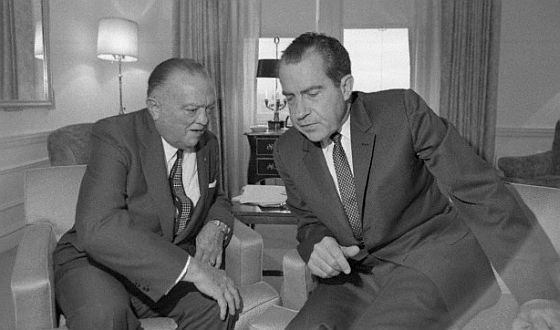
FBI Director J. Edgar Hoover confering with then President-elect Richard M. Nixon, 1968.
Beverly Gage writes: Since last week’s revelations about the NSA, skeptics have questioned whether expansive intelligence powers might really lead to civil liberties abuses. From a historical perspective, there’s no need to ask: Such abuses have occurred many, many times.
Over the past century, American intelligence agencies have performed some amazing feats, outing Soviet infiltrators, hunting down terrorists, and keeping the homeland reasonably safe from its enemies. They have also used their powers to spy on millions of people engaged in legitimate political activity, and to go after critics in Congress, the media, and the public at large. Given this track record, it’s worth asking not whether such abuses might again occur, but whether we have sufficient reason to believe that they are not going to happen this time around.
To say that the expansion of surveillance powers comes with a high — and historically well-documented — risk of abuse is not to say that the NSA is interested in your cat photos. If you’ve never expressed an edgy political idea, you’re probably not at great personal risk. The people swept into the net at moments of expanded intelligence powers have almost always been outspoken political dissenters or critics of the intelligence establishment. The basic premise of the civil libertarian stance is that what happens to those people matters to all of us — not only because “we might be next” but because the free exchange of political ideas and criticism is the heart of American democracy. [Continue reading…]
Meet the contractors analyzing your private data
Tim Shorrock writes: Amid the torrent of stories about the shocking new revelations about the National Security Agency, few have bothered to ask a central question. Who’s actually doing the work of analyzing all the data, metadata and personal information pouring into the agency from Verizon and nine key Internet service providers for its ever-expanding surveillance of American citizens?
Well, on Sunday we got part of the answer: Booz Allen Hamilton. In a stunning development in the NSA saga, Guardian reporter Glenn Greenwald revealed that the source for his blockbuster stories on the NSA is Edward Snowden, “a 29-year-old former technical assistant for the CIA and current employee of the defense contractor Booz Allen Hamilton.” Snowden, it turns out, has been working at NSA for the last four years as a contract employee, including stints for Booz and the computer-services firm Dell.
The revelation is not that surprising. With about 70 percent of our national intelligence budgets being spent on the private sector – a discovery I made in 2007 and first reported in Salon – contractors have become essential to the spying and surveillance operations of the NSA.
From Narus, the Israeli-born Boeing subsidiary that makes NSA’s high-speed interception software, to CSC, the “systems integrator” that runs NSA’s internal IT system, defense and intelligence, contractors are making millions of dollars selling technology and services that help the world’s largest surveillance system spy on you. If the 70 percent figure is applied to the NSA’s estimated budget of $8 billion a year (the largest in the intelligence community), NSA contracting could reach as high as $6 billion every year. [Continue reading…]
I can never trust the Turkish police and government again
Can Oz writes: I am scared. With every speech that prime minister Recep Tayyip Erdoğan gives, I feel the hatred and disgust against me and young people of my generation increase. All we are after is a bit of freedom, a bit of space to live and a few trees. It reminds me of a line from Jimi Hendrix’s If 6 Was 9: “I’m the one that has to die when it’s time for me to die, so let me live my life the way I want to.”
Today I was in Taksim Square again, a few hours after the police cleared the area with water cannon, tear gas and rubber bullets, and protesters hurled fireworks and fire bombs. Some say the protesters’ firebomb attack was staged, and while I don’t have certain proof that this was the case, it wouldn’t surprise me: over the past few days I have witnessed so many lies from the police and government that I don’t think I can ever trust them again. I have spent days with the protesters – withstanding another gas attack, cheering, singing chants and sharing food in the park – and I haven’t encountered any signs of weapons or violence on their behalf. These people made me feel like I’m living a dream.
The purpose of my visit to Taksim Square was to listen to the press conference the Taksim Solidarity movement had prepared; and I was confident that I could trust the chief of police and Istanbul mayor’s assurance that the park would not be attacked. Then, right before the press conference was about to start, gas rained down over our heads once again. It was a moment of crushing disappointment. Coughing, wiping tears out of my eyes, practically blind, I realised that our government would never understand the meaning of the passive resistance that Martin Luther King Jr and Mahatma Gandhi were famous for. That’s when I ran out of the park.
I am the owner of the biggest literary publishing house in the country. In the past few days I have received hate mail and death threats, just because I was publicly part of this passive resistance movement. [Continue reading…]
BNP leader Nick Griffin arrives in Syria after invitation from Assad regime
The Guardian reports: The British National party leader, Nick Griffin, has paid a surprise visit to Syria after being invited by the regime of the president, Bashar al-Assad, to take part in a fact-finding visit to the war-torn country.
Writing on Twitter, Griffin said he wanted to highlight the risk that the UK government’s support for opposition fighters seeking to oust Assad could plunge the Middle Eastern state into an “Iraq-style hell of sectarian hate“.
He linked the kind of Islamist militancy espoused by some of the rebels with the murder of the soldier Lee Rigby in Woolwich last month.
The BNP spokesman Simon Darby said Griffin, who is an MEP for North-West England, was invited to Damascus as part of a delegation of European politicians, including MEPs and MPs from Belgium, Russia and Poland. [Continue reading…]
Video: Downfall – NSA’s PRISM revealed to dear leader
Edward Snowden: saving us from the United Stasi of America
Daniel Ellsberg writes: In my estimation, there has not been in American history a more important leak than Edward Snowden’s release of NSA material – and that definitely includes the Pentagon Papers 40 years ago. Snowden’s whistleblowing gives us the possibility to roll back a key part of what has amounted to an “executive coup” against the US constitution.
Since 9/11, there has been, at first secretly but increasingly openly, a revocation of the bill of rights for which this country fought over 200 years ago. In particular, the fourth and fifth amendments of the US constitution, which safeguard citizens from unwarranted intrusion by the government into their private lives, have been virtually suspended.
The government claims it has a court warrant under Fisa – but that unconstitutionally sweeping warrant is from a secret court, shielded from effective oversight, almost totally deferential to executive requests. As Russell Tice, a former National Security Agency analyst, put it: “It is a kangaroo court with a rubber stamp.”
For the president then to say that there is judicial oversight is nonsense – as is the alleged oversight function of the intelligence committees in Congress. Not for the first time – as with issues of torture, kidnapping, detention, assassination by drones and death squads –they have shown themselves to be thoroughly co-opted by the agencies they supposedly monitor. They are also black holes for information that the public needs to know.
The fact that congressional leaders were “briefed” on this and went along with it, without any open debate, hearings, staff analysis, or any real chance for effective dissent, only shows how broken the system of checks and balances is in this country.
Obviously, the United States is not now a police state. But given the extent of this invasion of people’s privacy, we do have the full electronic and legislative infrastructure of such a state. If, for instance, there was now a war that led to a large-scale anti-war movement – like the one we had against the war in Vietnam – or, more likely, if we suffered one more attack on the scale of 9/11, I fear for our democracy. These powers are extremely dangerous. [Continue reading…]
The private branch of government
The New York Times reports: Edward J. Snowden’s employer, Booz Allen Hamilton, has become one of the largest and most profitable corporations in the United States almost exclusively by serving a single client: the government of the United States.
Over the last decade, much of the company’s growth has come from selling expertise, technology and manpower to the National Security Agency and other federal intelligence agencies. Booz Allen earned $1.3 billion, 23 percent of the company’s total revenue, from intelligence work during its most recent fiscal year.
The government has sharply increased spending on high-tech intelligence gathering since 2001, and both the Bush and Obama administrations have chosen to rely on private contractors like Booz Allen for much of the resulting work.
Thousands of people formerly employed by the government, and still approved to deal with classified information, now do essentially the same work for private companies. Mr. Snowden, who revealed on Sunday that he provided the recent leak of national security documents, is among them.
As evidence of the company’s close relationship with government, the Obama administration’s chief intelligence official, James R. Clapper Jr., is a former Booz Allen executive. The official who held that post in the Bush administration, John M. McConnell, now works for Booz Allen.
“The national security apparatus has been more and more privatized and turned over to contractors,” said Danielle Brian, the executive director of the Project on Government Oversight, a nonprofit group that studies federal government contracting. “This is something the public is largely unaware of, how more than a million private contractors are cleared to handle highly sensitive matters.”
It has gone so far, Ms. Brian said, that even the process of granting security clearances is often handled by contractors, allowing companies to grant government security clearances to private sector employees. [Continue reading…]