Chris Hedges writes: The military trial of Bradley Manning is a judicial lynching. The government has effectively muzzled the defense team. The Army private first class is not permitted to argue that he had a moral and legal obligation under international law to make public the war crimes he uncovered. The documents that detail the crimes, torture and killing Manning revealed, because they are classified, have been barred from discussion in court, effectively removing the fundamental issue of war crimes from the trial. Manning is forbidden by the court to challenge the government’s unverified assertion that he harmed national security. Lead defense attorney David E. Coombs said during pretrial proceedings that the judge’s refusal to permit information on the lack of actual damage from the leaks would “eliminate a viable defense, and cut defense off at the knees.” And this is what has happened.
Manning is also barred from presenting to the court his motives for giving the website WikiLeaks hundreds of thousands of classified diplomatic cables, war logs from Afghanistan and Iraq, and videos. The issues of his motives and potentially harming national security can be raised only at the time of sentencing, but by then it will be too late.
The draconian trial restrictions, familiar to many Muslim Americans tried in the so-called war on terror, presage a future of show trials and blind obedience. Our email and phone records, it is now confirmed, are swept up and stored in perpetuity on government computers. Those who attempt to disclose government crimes can be easily traced and prosecuted under the Espionage Act. Whistle-blowers have no privacy and no legal protection. This is why Edward Snowden—a former CIA technical assistant who worked for a defense contractor with ties to the National Security Agency and who leaked to Glenn Greenwald at The Guardian the information about the National Security Council’s top-secret program to collect Americans’ cellphone metadata, e-mail and other personal data—has fled the United States. The First Amendment is dead. There is no legal mechanism left to challenge the crimes of the power elite. We are bound and shackled. And those individuals who dare to resist face the prospect, if they remain in the country, of joining Manning in prison, perhaps the last refuge for the honest and the brave. [Continue reading…]
Author Archives: News Sources
Former drone operator says he’s haunted by his part in more than 1,600 deaths
NBC News: A former Air Force drone operator who says he participated in missions that killed more than 1,600 people remembers watching one of the first victims bleed to death.
Brandon Bryant says he was sitting in a chair at a Nevada Air Force base operating the camera when his team fired two missiles from their drone at three men walking down a road halfway around the world in Afghanistan. The missiles hit all three targets, and Bryant says he could see the aftermath on his computer screen – including thermal images of a growing puddle of hot blood.
Edward Snowden’s search for asylum
The Guardian has a video “presenting two expert views on Edward Snowden’s decision to seek refuge in Hong Kong and the likelihood or not of his finding such refuge there.”
Timothy B. Lee notes: If Snowden had chosen to stay in the United States, he would have faced a stark choice: accept a multi-year prison sentence for actions he believed to be in the public interest or go to trial and risk decades in prison if the courts were not persuaded by his legal and constitutional arguments. The American activist Aaron Swartz was facing exactly that choice when he committed suicide in January.
Because of the government’s misconduct in the Ellsberg case, the courts never reached the legal and constitutional merits of prosecuting a whistleblower under the Espionage Act. But as he was going to trial, he would have had reason to be optimistic that the courts would see things his way. The Supreme Court had declared warrantless wiretapping unconstitutional in 1967 and refused to block publication of the Pentagon Papers in 1971.
The current Supreme Court is less sympathetic to civil liberties. For example, earlier this year, the justices threw out a constitutional challenge to the FISA Amendments Act because the plaintiffs could not prove that they had personally been targets of surveillance. Because of the documents Snowden released, we now know that the FISA Amendments Act is the basis for the NSA’s PRISM program.
Julian Borger reports: Just before sovereignty over Hong Kong passed from Britain to China in 1997, the US signed a new extradition treaty with the semi-autonomous territory. Under that treaty, both parties agree to hand over fugitives from each other’s criminal justice systems, but either side has the right of refusal in the case of political offences.
Beijing, which gave its consent for Hong Kong to sign the agreement, also has a right of veto if it believes the surrender of a fugitive would harm the “defence, foreign affairs or essential public interest or policy” of the People’s Republic of China. In short, the treaty makes Snowden’s fate a matter of political expediency not just in Hong Kong but in Beijing.
In his Guardian interview, Snowden denied that his decision to fly to Hong Kong to make his allegations on NSA intrusion and infringement of American civil liberties was intended as a vote of confidence in Chinese human rights. But he noted that the people of Hong Kong have “a spirited commitment to free speech and the right of political dissent”.
Certainly in comparison with mainland China, Hong Kong is an island of press freedom and political tolerance. When the UK ended 156 years of colonial rule and Hong Kong became China’s first ‘special administrative region’, it was given special status under the principle of “one country, two systems”. Most importantly, Hong Kong passed its own constitution, its Basic Law, giving it a “high degree of autonomy” on all issues except foreign relations and defence.
Rand Paul planning class action lawsuit against surveillance programs
The Washington Post reports: Sen. Rand Paul (R-Ky.) said Sunday that he plans to file a class action lawsuit against the Obama administration for its “unconstitutional” surveillance programs.
On “Fox News Sunday,” Paul said he wants to get the support of 10 million Americans.
“I’m going to be seeing if I can challenge this at the Supreme Court level,” Paul said, according to a rush transcript. “I’m going to be asking all the Internet providers and all of the phone companies, ask your customers to join me in a class action lawsuit. If we get 10 million Americans saying we don’t want our phone records looked at, then somebody will wake up and say things will change in Washington.”
Paul noted that public outcry over two pieces of legislation that raised Internet privacy concerns — known as SOPA and PIPA — proved very successful.
Crowdfunding campaign to help Edward Snowden
Rory Carroll reports: The campaign on Crowdtilt, an alternative to Kickstarter, has raised over $4,700 and is aiming for $15,000, urging would-be donors: “We should set a precedent by rewarding this type of extremely courageous behavior.”
Dwight Crow, a Facebook employee from San Francisco’s bay area, said he launched the initiative to reward and encourage whistleblowing and because he heard Snowden’s accounts had been frozen.
Former FM suggests British intelligence could have broken the law accessing NSA intel
The Guardian reports: [T]he former foreign secretary Sir Malcolm Rifkind said Britain’s electronic eavesdropping centre would have been in breach of the law if it asked for data about UK citizens without the approval of ministers
As the shadow foreign secretary, Douglas Alexander, said he would challenge Hague to explain the legal basis on which GCHQ operated, Rifkind indicated that he would ask the US National Security Agency (NSA) about the matter this week.
Rifkind, the chairman of parliament’s security and intelligence committee, was speaking after Edward Snowden confirmed he leaked sensitive NSA documents to the Guardian. Snowden said these showed that US agencies had embarked on blanket monitoring of personal data from websites.
The documents suggested that GCHQ had generated 197 intelligence reports from the NSA-run Prism last year. The system would appear to allow GCHQ to bypass formal legal processes to access personal material, such as emails and photographs, from the world’s biggest internet companies.
Rifkind, who was responsible for overseeing GCHQ as foreign secretary between 1995 and 1997, said Snowden had broken the law. He told the Today programme on BBC Radio 4: “If you work for an intelligence agency you are required, as are the rest of us, to obey the law of the land. Revealing classified information is normally a criminal offence and leads to various consequences.”
But he indicated that GCHQ might have also fallen foul of the law if it accepted information from the NSA on British citizens. “One of the big questions that is being asked is if British intelligence agencies want to seek to know the content of emails can they get round the normal law in the UK by simply asking an American agency to provide that information?” he said.
Also revealed by Verizon leak: How the NSA and FBI lie with numbers
Wired: Here’s a seemingly comforting statistic: In all of 2012, the Obama administration went to the secretive Foreign Intelligence Surveillance Court only 200 times to ask for Americans’ “business records” under the USA Patriot Act.
Every year, the Justice Department gives Congress a tally of the classified wiretap orders sought and issued in terrorist and spy cases – it was 1,789 last year. At the same time, it reports the number of demands for “business records” in such cases, issued under Section 215 of the USA Patriot Act. And while the number of such orders has generally grown over the years, it has always managed to stay relatively low. In 2011, it was 205. There were 96 orders in 2010, and only 21 in 2009.
Thanks to the Guardian’s scoop, we now know definitively just how misleading these numbers are. You see, while the feds are required to disclose the number of orders they apply for and receive (almost always the same number, by the way), they aren’t required to say how many people are targeted in each order. So a single order issued to Verizon Business Solutions in April covered metadata for every phone call made by every customer. That’s from one order out of what will probably be about 200 reported in next year’s numbers.
The public numbers are the one bit of accountability around the surveillance court, and the Justice Department used them to misdirect the public away from a massive domestic NSA spying operation that, as several Senators approvingly noted today, has been running for seven years. [Continue reading…]
If the NSA trusted Edward Snowden with our data, why should we trust the NSA?
Whenever we think about America’s seemingly super-powerful intelligence community, we should be less in awe of its capabilities and much more alert to its incompetence.
Farhad Manjoo makes an excellent argument: Edward Snowden sounds like a thoughtful, patriotic young man, and I’m sure glad he blew the whistle on the NSA’s surveillance programs. But the more I learned about him this afternoon, the angrier I became. Wait, him? The NSA trusted its most sensitive documents to this guy? And now, after it has just proven itself so inept at handling its own information, the agency still wants us to believe that it can securely hold on to all of our data? Oy vey!
According to the Guardian, Snowden is a 29-year-old high-school dropout who trained for the Army Special Forces before an injury forced him to leave the military. His IT credentials are apparently limited to a few “computer” classes he took at a community college in order to get his high-school equivalency degree — courses that he did not complete. His first job at the NSA was as a security guard. Then, amazingly, he moved up the ranks of the United States’ national security infrastructure: The CIA gave him a job in IT security. He was given diplomatic cover in Geneva. He was hired by Booz Allen Hamilton, the government contractor, which paid him $200,000 a year to work on the NSA’s computer systems.
Let’s note what Snowden is not: He isn’t a seasoned FBI or CIA investigator. He isn’t a State Department analyst. He’s not an attorney with a specialty in national security or privacy law.
Instead, he’s the IT guy, and not a very accomplished, experienced one at that. If Snowden had sent his résumé to any of the tech companies that are providing data to the NSA’s PRISM program, I doubt he’d have even gotten an interview. Yes, he could be a computing savant anyway — many well-known techies dropped out of school. But he was given access way beyond what even a supergeek should have gotten. As he tells the Guardian, the NSA let him see “everything.” He was accorded the NSA’s top security clearance, which allowed him to see and to download the agency’s most sensitive documents. But he didn’t just know about the NSA’s surveillance systems—he says he had the ability to use them. “I, sitting at my desk, certainly had the authorities [sic] to wiretap anyone from you or your accountant to a federal judge to even the president if I had a personal email,” he says in a video interview with the paper.
Because Snowden is now in Hong Kong, it’s unclear what the United States can do to him. But watch for officials to tar Snowden — he’ll be called unpatriotic, unprofessional, treasonous, a liar, grandiose, and worse. As in the Bradley Manning case, though, the more badly Snowden is depicted, the more rickety the government’s case for surveillance becomes. After all, they hired him. They gave him unrestricted access to their systems, from court orders to PowerPoint presentations depicting the crown jewels of their surveillance infrastructure. [Continue reading…]
Edward Snowden: the whistleblower behind revelations of NSA surveillance
The Guardian reports: The individual responsible for one of the most significant leaks in US political history is Edward Snowden, a 29-year-old former technical assistant for the CIA and current employee of the defence contractor Booz Allen Hamilton. Snowden has been working at the National Security Agency for the last four years as an employee of various outside contractors, including Booz Allen and Dell.
The Guardian, after several days of interviews, is revealing his identity at his request. From the moment he decided to disclose numerous top-secret documents to the public, he was determined not to opt for the protection of anonymity. “I have no intention of hiding who I am because I know I have done nothing wrong,” he said.
Snowden will go down in history as one of America’s most consequential whistleblowers, alongside Daniel Ellsberg and Bradley Manning. He is responsible for handing over material from one of the world’s most secretive organisations – the NSA.
In a note accompanying the first set of documents he provided, he wrote: “I understand that I will be made to suffer for my actions,” but “I will be satisfied if the federation of secret law, unequal pardon and irresistible executive powers that rule the world that I love are revealed even for an instant.” [Continue reading…]
NSA whistleblower believes his exposure is inevitable
Washington Post reporter Barton Gellman: “The source believes that exposure is inevitable and was prepared to face that consequence –”
“The source believes that he or she will be exposed?”
“Yes. The source does not believe that it’s possible to stay masked forever, and I don’t even think wants to stay masked forever. I think the source believes himself to be a — because I said in the story it’s “he” — he believes himself to be a whistleblower, that he’s operating out of conscience. He thinks that what the NSA is doing exceeds all reasonable boundaries of privacy or necessity. And I think he wants to stand up and say that. But in order to even be in a position to get word out, he had to be stealthy for a while or he simply would have been preempted. He would have been arrested and preempted and that would have been the end of that.”
Reuters reports: A U.S. intelligence agency requested a criminal probe on Saturday into the leak of highly classified information about secret surveillance programs run by the National Security Agency, a spokesman for the intelligence chief’s office said.
Confirmation that the NSA filed a “crimes report” came a few hours after the nation’s spy chief, Director of National Intelligence James Clapper launched an aggressive defense of a secret government data collection program.
Is Twitter a tool for ‘the terrorists’?
Jonathan Schanzer writes: Sensational reports in the Guardian and Washington Post recently blew the lid off of the National Security Agency’s (NSA) electronic surveillance efforts, which have harvested everything from phone calls to Facebook posts for intelligence purposes.
Curiously, Twitter still appears outside the grasp of the NSA’s PRISM program, which gathers information from major U.S. Internet companies. But a group of lawmakers are concerned that the popular microblogging service has become too hospitable an environment for terrorist groups. The platform hosts a number of official feeds for terrorist groups, including Somalia’s al-Shabab, the North African al Qaeda in the Islamic Maghreb, Syria’s Jabhat al-Nusra, the Taliban, and Hamas.
Rep. Ted Poe (R-TX), who currently serves as the chairman of the House Foreign Affairs Subcommittee on Terrorism, Nonproliferation and Trade, is looking to curtail terrorist activity on Twitter. Poe is mindful of free speech concerns, but believes terrorist organizations are not entitled to the same free speech protections. As he argued last year, after watching Hamas use the platform for propaganda purposes during its November war with Israel, “Twitter must recognize sooner rather than later that social media is a tool for the terrorists.”
First Amendment activists will almost certainly cry foul. But they will not be alone: This would be one of their rare moments of harmony with the U.S. intelligence community, which has used Twitter feeds of extremists to monitor their messaging for strategies, tactics, and policies. America’s spies also monitor the feeds of extremist personalities and groups to see who follows them and who sympathizes with them, with the goal of identifying potential security threats at home or abroad. In fact, Twitter has made it possible for official bodies to interact with a banned group — even if those interactions haven’t been pleasant. [Continue reading…]
Twitter’s non-participation in PRISM might have provided the company with a small PR coup — in defense of civil liberties and all that — but it probably has just as much to do with the fact that the intelligence community is already perfectly happy with how the platform operates. The front door is wide open. Who needs a back door? Why should we not simply assume that the NSA is already merrily harvesting every single tweet?
From the war on terror to austerity: a lost decade for women and human rights
Heather McRobie writes: A recurring theme at the Nobel Women’s Initiative conference in Belfast has been a reflection on the last decade in terms of its global impact on women and human rights. A picture emerged of a period wherein the excuse of ‘war on terror’ as a justificatory narrative for exclusivist identities, state violence and violence against women gave way to official austerity narratives that, in their own way, entrench inequalities and disempower women. Central to the decade was the elevation of the sanctity of the nation state’s security or perceived security, often – paradoxically – at the expense of both its citizens and those outside its borders.
Several speakers reflected on the ‘war on terror’ period in terms of its interrelated assault on human rights and women. The human rights violations and mass violation of human dignity enacted under the guise of the ‘war on terror’ runs from arbitrary detention to drone-strikes, from Guantanamo to Yemen to the encroachment of the rights of ‘citizens’ in the homelands that those who instigated the ‘war on terror’ were claiming to ‘protect’. The attack on women was similarly wide-sweeping: from the neo-colonial appropriation of the discourse of ‘women’s rights’ – toothless and sanitised in its neo-con costume – as an empty vessel to further the cause of militarism in Afghanistan and Iraq, to the ossification of rigid binary gender roles in the ‘homeland’ of America; rapes were committed by occupying soldiers at sites of invasion while in countries such as Yemen and Pakistan women’s lives were eroded by the chaos in their lives caused by the ‘war on terror’.
Amina Mama, Director of the Women and Gender Studies programme at UC Davis, spoke at the conference about how the process of militarisation works in tandem with the construction and reinforcement of rigid, exclusivist gender roles, creating matrixes of power-structures in favour of the nation state and military and against alternative, non-hierarchical ways of being. The epidemic levels of sexual assault within the US military itself – while due to its own complex set of causes – in some sense plays out this dynamic in microcosm, in the interlocking of patriarchy and militarism that is central to the dominant conception of Western statecraft. [Continue reading…]
Syria is now Saudi Arabia’s problem
Hassan Hassan writes: Hezbollah can finally claim a victory in Syria. The town of Qusayr, adjacent to the Lebanese border, has fallen to the Lebanese militia after nearly a month of fierce battles with Syrian rebels. Dozens of Hezbollah’s fighters have been killed, despite air cover and ground support from Bashar al-Assad’s regime.
The Qusayr battle has been constantly, and wrongly, described as a turning point in the Syrian war. Why has this small town of some 30,000 residents become “strategic,” as it is constantly described in the press, all of a sudden? The town had previously been run by its Sunni residents for more than a year, with little mention of its strategic benefits.
Hezbollah’s open military intervention in Syria partly explains the publicity the Qusayr battle has received. As a result, the “Party of God” has lost much of its political and ideological capital in the region — a capital the militia had painstakingly acquired from its three-decade career of “resisting” Israel.
But beyond the supposed military benefits of Qusayr, the battle for the town carried important consequences for the balance of power within the Syrian opposition. Qusayr is arguably the first battle in Syria to be completely sponsored by Saudi Arabia, marking the kingdom’s first foray outside its sphere of influence along the Jordanian border. Riyadh has now taken over Qatar’s role as the rebels’ primary patron: In one sense, the Saudis can also claim a victory in Qusayr, as they have successfully put various rebel forces under the command of their ally in the Free Syrian Army (FSA), Chief of Staff Gen. Salim Idriss. [Continue reading…]
Hezbollah’s Vietnam?
Michael Young writes: Hezbollah’s deepening involvement in the Syrian war is a high-risk venture. Many see this as a mistake by the party, and it may well be. Qusayr will be small change compared to Aleppo, where the rebels are well entrenched and benefit from supply lines leading to Turkey. In the larger regional rivalry between Iran and Turkey, the Turkish army and intelligence services have an interest in helping make things very difficult for Hezbollah and the Syrian army in northern Syria, particularly after the car-bomb attack in Reyhanli in May.
Many will be watching closely to see how the current crisis in Turkey affects Prime Minister Recep Tayyip Erdogan’s ability to react to the Syrian situation, particularly if the epicenter of the fighting shifts to Aleppo. Erdogan has faced the displeasure among many in Turkey’s southern border areas with their government’s policy in Syria. At the same time, a defeat of the Syrian rebels in and around Aleppo is not something that Turkey can easily swallow so near to its borders, particularly if Hezbollah is instrumental in the fighting.
Hezbollah is willing to take heavy casualties in Syria, if this allows it to rescue the Assad regime. The real question is what time frame we are talking about, and how this affects the party’s vital interests elsewhere. For now, Hezbollah has entered Syria with no exit strategy. [Continue reading…]
‘Boundless Informant’: the NSA’s secret tool to track global surveillance data
The Guardian reports: The National Security Agency has developed a powerful tool for recording and analysing where its intelligence comes from, raising questions about its repeated assurances to Congress that it cannot keep track of all the surveillance it performs on American communications.
The Guardian has acquired top-secret documents about the NSA datamining tool, called Boundless Informant, that details and even maps by country the voluminous amount of information it collects from computer and telephone networks.
The focus of the internal NSA tool is on counting and categorizing the records of communications, known as metadata, rather than the content of an email or instant message.
The Boundless Informant documents show the agency collecting almost 3 billion pieces of intelligence from US computer networks over a 30-day period ending in March 2013. One document says it is designed to give NSA officials answers to questions like, “What type of coverage do we have on country X” in “near real-time by asking the SIGINT [signals intelligence] infrastructure.” [Continue reading…]
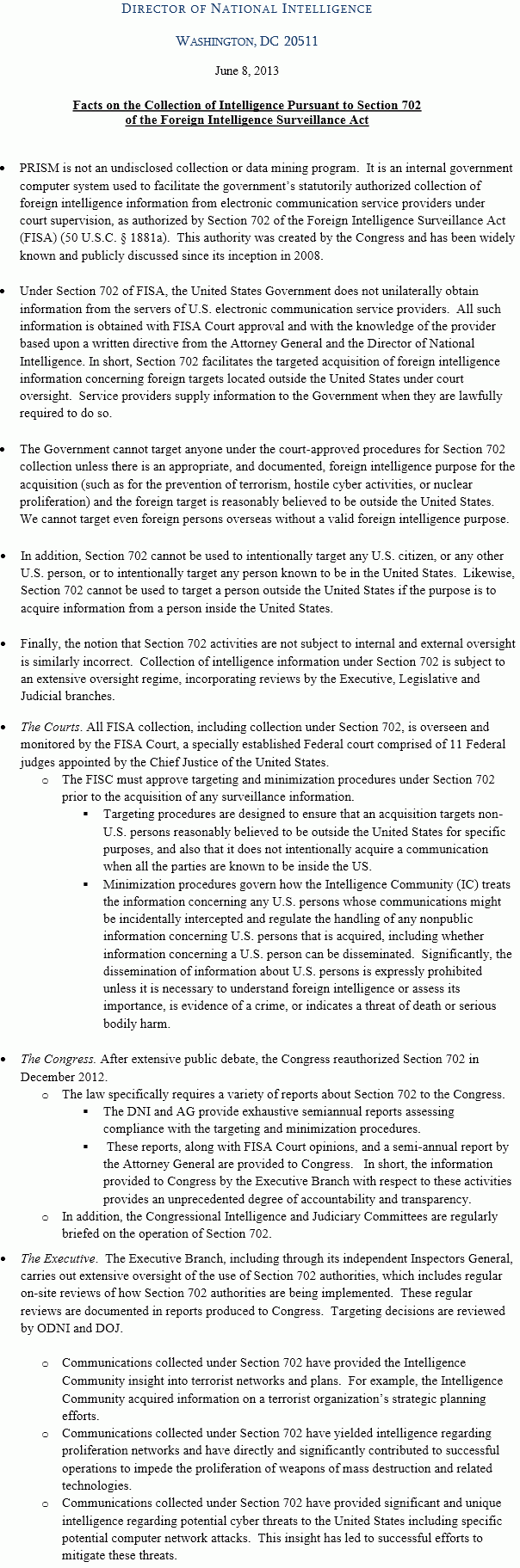
Statement on PRISM from the DNI
The Intel-Tech Complex
The New York Times reports: When government officials came to Silicon Valley to demand easier ways for the world’s largest Internet companies to turn over user data as part of a secret surveillance program, the companies bristled. In the end, though, many cooperated at least a bit.
Twitter declined to make it easier for the government. But other companies were more compliant, according to people briefed on the negotiations. They opened discussions with national security officials about developing technical methods to more efficiently and securely share the personal data of foreign users in response to lawful government requests. And in some cases, they changed their computer systems to do so.
The negotiations shed a light on how Internet companies, increasingly at the center of people’s personal lives, interact with the spy agencies that look to their vast trove of information — e-mails, videos, online chats, photos and search queries — for intelligence. They illustrate how intricately the government and tech companies work together, and the depth of their behind-the-scenes transactions.
The companies that negotiated with the government include Google, which owns YouTube; Microsoft, which owns Hotmail and Skype; Yahoo; Facebook; AOL; Apple; and Paltalk, according to one of the people briefed on the discussions. The companies were legally required to share the data under the Foreign Intelligence Surveillance Act. People briefed on the discussions spoke on the condition of anonymity because they are prohibited by law from discussing the content of FISA requests or even acknowledging their existence.
In at least two cases, at Google and Facebook, one of the plans discussed was to build separate, secure portals, like a digital version of the secure physical rooms that have long existed for classified information, in some instances on company servers. Through these online rooms, the government would request data, companies would deposit it and the government would retrieve it, people briefed on the discussions said.
The negotiations have continued in recent months, as Martin E. Dempsey, chairman of the Joint Chiefs of Staff, traveled to Silicon Valley to meet with executives including those at Facebook, Microsoft, Google and Intel. Though the official purpose of those meetings was to discuss the future of the Internet, the conversations also touched on how the companies would collaborate with the government in its intelligence-gathering efforts, said a person who attended.
Twitter, Google and other companies have typically fought aggressively against requests they believe reach too far. Google, Microsoft and Twitter publish transparency reports detailing government requests for information, but these reports do not include FISA requests because they are not allowed to acknowledge them.
Yet since tech companies’ cooperation with the government was revealed Thursday, tech executives have been performing a familiar dance, expressing outrage at the extent of the government’s power to access personal data and calling for more transparency, while at the same time heaping praise upon the president as he visited Silicon Valley.
Even as the White House scrambled to defend its online surveillance, President Obama was mingling with donors at the Silicon Valley home of Mike McCue, Flipboard’s chief, eating dinner at the opulent home of Vinod Khosla, the venture capitalist, and cracking jokes about Mr. Khosla’s big, shaggy dogs.
The Guardian reports: At the end of the first day of the his summit with the Chinese premier Xi Jinping in California, the president described disclosures about the National Security Agency’s access to telephone and internet data as “a very limited issue”.
However in comments that appeared more emollient than his remarks earlier in the day, when he criticised “leaks” and “hype” in the media, Obama tried to deflect criticism, saying internet privacy posed “broad implications for our society”. He said privacy concerns also related to private corporations, which he said collect more data than the federal government.
How Obama turned into Bush
The Washington Post reports: As a junior senator with presidential aspirations, Barack Obama built his persona in large part around opposition to Bush administration counterterrorism policies, and he sponsored a bill in 2005 that would have sharply limited the government’s ability to spy on U.S. citizens.
That younger Obama bears little resemblance to the commander in chief who stood on a stage here Friday, justifying broad programs targeting phone records and Internet activities as vital tools to prevent terrorist attacks and protect innocent Americans.
The former constitutional law professor — who rose to prominence in part by attacking what he called the government’s post-Sept. 11 encroachment on civil liberties — has undergone a philosophical evolution, arriving at what he now considers the right balance between national security prerogatives and personal privacy.
“I came in with a healthy skepticism about these programs,” Obama said in San Jose on Friday. “My team evaluated them. We scrubbed them thoroughly. We actually expanded some of the oversight, increased some of safeguards. But my assessment and my team’s assessment was that they help us prevent terrorist attacks.”
“On net,” the president added, “it was worth us doing.”
As Obama strived to reassure the American people following startling revelations this week about top-secret federal data-mining and surveillance programs, he said that he, too, has long been torn on the issue and that there is no easy answer.
“You can’t have 100 percent security and also then have 100 percent privacy and zero inconvenience,” he said. “We’re going to have to make some choices as a society.”
But are Americans in large numbers or any numbers calling for or expecting 100 percent security? An expectation of perfect security is no more realistic than the expectation that citizens will have perfect trust in their government and the absence of a basis for such perfect trust is exactly why the powers of government must always be constrained.