Author Archives: News Sources

Flight records say Russia sent Syria tons of cash

By Dafna Linzer, Michael Grabell and Jeff Larson, ProPublica, November 26, 2012

This past summer, as the Syrian economy began to unravel and the military pressed hard against an armed rebellion, a Syrian government plane ferried what flight records describe as more than 200 tons of “bank notes” from Moscow.

The records of overflight requests were obtained by ProPublica. The flights occurred during a period of escalating violence in a conflict that has left tens of thousands of people dead since fighting broke out in March 2011.

The regime of Bashar al-Assad is increasingly in need of cash to stay afloat and continue financing the military’s efforts to crush the uprising. U.S. and European sanctions, including a ban on minting Syrian currency, have damaged the country’s economy. As a result, Syria lost access to an Austrian bank that had printed its bank notes.

“Having currency that you can put into circulation is certainly something that is important in terms of running an economy and more so in an economy that is become more cash-based as things deteriorate,” said Daniel Glaser, Assistant Secretary of the Treasury for Terrorist Financing and Financial Crimes.  “It is certainly something the Syrian government wants to do, to pay soldiers or pay anybody anything.”

According to the flight records, which are in English and Farsi, eight round-trip flights between Damascus International Airport and Moscow’s Vnukovo Airport each carried 30 tons of bank notes back to Syria.

Syrian and Russian officials did not respond to ProPublica’s questions about the authenticity and accuracy of the flight records. It is not possible to know whether the logs accurately described the cargo or what else might have been on board the flights. Nor do the logs specify the type of currency.

But ProPublica confirmed nearly all of the flights took place through international plane-tracking services, photos by aviation enthusiasts, and air traffic control recordings. 

Each time the manifest listed “Bank Notes” as its cargo, the plane traveled a circuitous route. Instead of flying directly over Turkish airspace, as civilian planes have, the Ilyushin-76 cargo plane, operated by the Syrian Air Force, avoided Turkey and flew over Iraq, Iran, and Azerbaijan.

The flight path between Syria and Russia described in the manifests.

Tensions have been rising between Syria and Turkey since the spring. Last month, Turkey forced down a Syrian passenger plane traveling from Moscow. Turkey suspected the flight of carrying military cargo but officials have not said what, if anything, was confiscated.

If the flight manifests are accurate, a total of 240 tons of bank notes moved from Moscow to Damascus over a 10-week period beginning July 9th and ending on September 15th.

U.S. officials interviewed said evidence of monetary assistance, like military cooperation, point to a pattern of Russian support for Assad that extends from concrete aid to protecting Syria from U.N. sanctions.

In September, 2011, six months into the violence, the European Union imposed sanctions that prohibited its members from minting or supplying new Syrian coinage or banknotes. In a statement, the EU said the sanctions aimed “to obstruct those who are leading the crackdown in Syria and to restrict the funding being used to perpetrate violence against the Syrian people.” At the time, Syria’s currency was being minted by Oesterreichische Banknoten- und Sicherheitsdruck GmbH, a subsidiary of Austria’s Central Bank.

President Obama has issued five Executive Orders that prevent members of the Assad regime from entering the United States and accessing the U.S. financial system.

 “Increasingly, it is more difficult to finance the war machine and the cost of the war is becoming more expensive for the Assad regime,” said one U.S. official who spoke on the condition of anonymity. “Targeted sanctions on those leading the violence are working and start to bite into their pocket books.”

Russia appears to be helping Syria blunt the impact of the sanctions.

This past June, Reuters reported that Russia had begun printing new Syrian pounds and that an initial shipment of bank notes had already arrived.  The report was denied by the Syrian Central Bank, which claimed the only new money in circulation were bills that had replaced damaged or worn bank notes. Such a swap, the bank contended, would have no effect on the economy.

On August 3rd, the official Syrian news agency SANA, reporting from a news conference in Moscow with Syrian and Russian economic officials, quoted Syrian officials acknowledging that Russia is printing money. Qadr Jamil, Syria’s deputy prime minister for Economic Affairs, was quoted by SANA as calling the deal with Russia a “triumph,” over sanctions.

Syrian Finance Minister Mohammad al-Jleilati said that Russia was providing both replacement notes and additional currency to, as SANA put it, “reflect the country’s changing GDP.”  

Al-Jleilati said the money would have no effect on inflation. Printing new notes beyond simply replacing old ones could undermine Syria’s already battered currency.

At the time of the meeting, at least 30 tons of currency had already been delivered, according to the flight records, and another 210 tons would be delivered in subsequent flights.

In its regional economic outlook released earlier this month, the International Monetary Fund noted that Syria’s currency has lost 44 percent of its value since March 2011, trading for about 70 pounds to the dollar compared with about 47 pounds when the conflict began.

Ibrahim Saif, a political economist based in Jordan and a resident scholar at the Carnegie Middle East Center said 30 tons of bank notes twice a week is a significant amount for a country like Syria.

“I truly believe it’s not only that they’re exchanging old money for new notes. They are printing money because they need new notes,” Saif said.

“Most of the government revenue that comes from taxes, in terms of other services, it’s almost now dried up,” noted Saif. Yet, “they continue to pay salaries. They have not shown any signs of weakness in fulfilling their domestic obligations. The only way they can do this is to get some sort of cash in the market.”

Before the unrest broke out, Syria had about $17 billion in foreign currency reserves. Saif said he and other economists in the region estimate they now have about $6-8 billion in reserves, dwindling about $500 million a month for salaries and supplies to keep the government running.

In Moscow, the Syrian finance minister had said that his country required additional foreign currency reserves, which Russia may provide in the form of loans.

“It’s possible the Syrians are acquiring foreign currency reserves, either Euros or US dollars, which they would need to conduct any serious commerce,” said Juan Zarate, who served as Assistant Secretary of the Treasury for Terrorist Financing and Financial Crimes during the Bush administration.

Zarate noted that other countries, when faced with economic sanctions, have leaned on allies for foreign currency reserves. China supplied North Korea with such funds in the past and Venezuela agreed to sell reserves to Iran.

Syria’s currency is still traded on open markets, but there is limited on-the-ground information about the economy, including inflation.  

Officials at the IMF “have not been able to get direct information about Syria for at least a year,” Masood Ahmed, director of the group’s Middle East and Central Asia department, told reporters at a conference in Tokyo last month.

Glaser, at Treasury, declined to put a figure on Syria’s current reserves but said the Syrian economy is suffering in part from a lack of tourism and a ban on oil sales, both of which provided Damascus with foreign currency. “There is significant inflation in the country. It can be caused by adding new currency or not having foreign reserves to prop up the existing currency.”

Quinn Norton contributed to this story.


Facebooktwittermail

Barak preferred to be the master of his own political fate

In an analysis on defense minister Ehud Barak’s sudden announcement that he is withdrawing from Israeli politics, Anshel Pfeffer wrotes:

[I]n recent weeks, Barak has finally realized that his chances of remaining Netanyahu’s defense minister are increasingly slim. Not because Bibi doesn’t want him by his side; it’s simply because the odds are against him.

Barak has long been a hate-figure for the right-wing element in the Likud who blame him for blocking construction in the settlements and occasionally dismantling outposts. For months, while rumors said that Netanyahu might award him a spot on the Likud list – the prime minister had voiced the possibility that as party leader he would be allowed to “parachute” his own candidates into the list, which widely assumed to be for Barak’s benefit – he faced mounting pressure from his own party ranks against the motion. They didn’t really care whether Barak would become a Likud member or not; they just didn’t want to see him in the next cabinet altogether. One reason why former IDF Chief of Staff and Likud minister Moshe Ya’alon was expected to do well in the Likud primaries is that many members want to make it clear to Netanyahu that he is their candidate for defense minister.

Barak realized that even if Atzmaut would succeed in securing him a seat in the next Knesset, an outcome far from assured, Netanyahu would be unable to reappoint him to the only cabinet position he has any interest in. That was the moment he knew he had to resign and become master of his political fate.

Facebooktwittermail

Rising seas, vanishing coastlines

Benjamin Strauss and Robert Kopp write: The oceans have risen and fallen throughout Earth’s history, following the planet’s natural temperature cycles. Twenty thousand years ago, what is now New York City was at the edge of a giant ice sheet, and the sea was roughly 400 feet lower. But as the last ice age thawed, the sea rose to where it is today.

Now we are in a new warming phase, and the oceans are rising again after thousands of years of stability. As scientists who study sea level change and storm surge, we fear that Hurricane Sandy gave only a modest preview of the dangers to come, as we continue to power our global economy by burning fuels that pollute the air with heat-trapping gases.

This past summer, a disconcerting new scientific study by the climate scientist Michiel Schaeffer and colleagues — published in the journal Nature Climate Change — suggested that no matter how quickly we cut this pollution, we are unlikely to keep the seas from climbing less than five feet.

More than six million Americans live on land less than five feet above the local high tide. (Searchable maps and analyses are available at SurgingSeas.org for every low-lying coastal community in the contiguous United States.) Worse, rising seas raise the launching pad for storm surge, the thick wall of water that the wind can drive ahead of a storm. In a world with oceans that are five feet higher, our calculations show that New York City would average one flood as high as Hurricane Sandy’s about every 15 years, even without accounting for the stronger storms and bigger surges that are likely to result from warming. [Continue reading…]

Facebooktwittermail

Gaza grabs the headlines as Congo once more descends into chaos

Ian Birrell writes: Once again, the apparently insoluble struggle between Israel and Palestine has flared up before flickering into uneasy standoff. As usual, world leaders issued fierce warnings, diplomats flew in and the media flooded the region to cover the mayhem as both sides spewed out the empty cliches of conflict. After eight days of fighting, nearly 160 people lay dead.

Meanwhile, 2,300 miles further south, events took a sharp turn for the worse in another interminable regional war. This one also involves survivors of genocide ruthlessly focused on securing their future at any cost. But the resulting conflict is far bloodier, far more brutal, far more devastating, far more destructive – yet it gains scarcely a glance from the rest of the world.

Such is the cycle of despair in the Democratic Republic of the Congo – scene of massacres, of mass rape, of children forced to fight, of families fleeing in fear again and again, so many sordid events that rarely make the headlines. It can seem a conflict of crushing complexity rooted in thorny issues of identity and race, involving murderous militias with an alphabet of acronyms and savagely exploited by grasping outsiders. But consider one simple fact: right now, there is the risk of another round breaking out in the deadliest conflict since the Second World War.

If you missed the fleeting news reports, a rebel army of 1,500 men waltzed into Goma, a city of one million people, on Tuesday. In doing so, they humiliated not just the useless Congolese government but also the hapless blue helmets of the biggest United Nations peacekeeping mission, costing nearly £1bn a year. There are so many peacekeepers and development agencies in Goma it has become a boom town, home to some of the most expensive housing in Africa. Yet again, all these people proved impotent.

The leaders of this insurgent force, the M23, have declared their aim to march across this vast country to capture the capital, Kinshasa. Since it is backed by Rwanda and Uganda, which used proxy armies to do this once before in 1997, such threats cannot be dismissed. Joseph Kabila, the Congolese president, who, through fear of a coup, corruption and incompetence, castrated his own military, is reported to have responded by asking Angola to send troops to save him.

It is all a dismal echo of the Great African War, which officially ended in 2003 but dribbled on for another five years. This began when Rwanda and Uganda invaded in 1998, saw 11 countries from Angola to Zimbabwe involved and left more than five million dead and millions more displaced. There were war crimes on all sides as armies brutalised those unfortunate people living above the fabulous seams of minerals that fuelled the fighting. [Continue reading…]

Facebooktwittermail

War’s silent scourge: sexual violence against women

Melanne Verveer and Peter Westmacott write: Nearly 40,000 people have died already in Syria’s civil war, and close to 100 are still being killed each day. Homes, hospitals, water infrastructure, and sanitation systems have been destroyed. But one element of this ongoing brutality has been largely overlooked in the media: the appalling sexual violence being visited on the Syrian people by government and militia forces. Such use of sexual violence as a tactic of war is shocking — yet depressingly familiar.

Today, Nov. 25, marks International Day for the Elimination of Violence Against Women, the beginning of the 16 days of Activism Against Gender Violence. These awareness-raising campaigns are vital, both because, as U.S. Secretary of State Hillary Clinton has repeated time and again, women’s rights are human rights; and because, without accountability for sexual violence and other acts of severe violence against women and girls—which are often designed to humiliate and degrade victims and the groups with which they identify — security and development are impossible.

William Hague, the British foreign secretary, has referred to sexual violence as the “silent scourge of war.” The sheer scale of the brutality, and the lack of accountability surrounding it, is nothing short of sickening. During the Bosnian War, between 20,000 and 50,000 women were raped, many of them in camps specifically designed for the purpose. But this tidal wave of systematic brutality has resulted in only 30 convictions. All this took place in Europe within the past two decades.

Elsewhere the numbers are even starker. In the 100 days of the 1994 Rwandan genocide, up to half a million women are estimated to have been raped, a staggering figure in a total population of only 6 million people at the time. Of the 14,200 cases of sexual violence recorded in neighboring South Kivu province of the Democratic Republic of the Congo between 2005 and 2009, fewer than 1 percent were ever heard in court. It has been estimated that in some conflicts as many as 90 percent of cases of sexual violence go unreported because of stigma, weak legal and judicial systems, or fear of retribution. Gender-based violence constitutes a global epidemic that persists today in both conflict and nonconflict settings. [Continue reading…]

Facebooktwittermail

Why Israel didn’t win

Adam Shatz writes: The ceasefire agreed by Israel and Hamas in Cairo after eight days of fighting is merely a pause in the Israel-Palestine conflict. It promises to ease movement at all border crossings with the Gaza Strip, but will not lift the blockade. It requires Israel to end its assault on the Strip, and Palestinian militants to stop firing rockets at southern Israel, but it leaves Gaza as miserable as ever: according to a recent UN report, the Strip will be ‘uninhabitable’ by 2020. And this is to speak only of Gaza. How easily one is made to forget that Gaza is only a part – a very brutalised part – of the ‘future Palestinian state’ that once seemed inevitable, and which now seems to exist mainly in the lullabies of Western peace processors. None of the core issues of the Israel-Palestine conflict – the Occupation, borders, water rights, repatriation and compensation of refugees – is addressed by this agreement.

The fighting will erupt again, because Hamas will come under continued pressure from its members and from other militant factions, and because Israel has never needed much pretext to go to war. In 1982, it broke its ceasefire with Arafat’s PLO and invaded Lebanon, citing the attempted assassination of its ambassador to London, even though the attack was the work of Arafat’s sworn enemy, the Iraqi agent Abu Nidal. In 1996, during a period of relative calm, it assassinated Hamas’s bomb-maker Yahya Ayyash, the ‘Engineer’, leading Hamas to strike back with a wave of suicide attacks in Israeli cities. When, a year later, Hamas proposed a thirty-year hudna, or truce, Binyamin Netanyahu dispatched a team of Mossad agents to poison the Hamas leader Khaled Meshaal in Amman; under pressure from Jordan and the US, Israel was forced to provide the antidote, and Meshaal is now the head of Hamas’s political bureau – and an ally of Egypt’s new president, Mohamed Morsi.

Operation Pillar of Defence, Israel’s latest war, began just as Hamas was cobbling together an agreement for a long-term ceasefire. Its military commander, Ahmed al-Jabari, was assassinated only hours after he reviewed the draft proposal. Netanyahu and his defence minister, Ehud Barak, could have had a ceasefire – probably on more favourable terms – without the deaths of more than 160 Palestinians and five Israelis, but then they would have missed a chance to test their new missile defence shield, Iron Dome, whose performance was Israel’s main success in the war. They would also have missed a chance to remind the people of Gaza of their weakness in the face of Israeli military might. The destruction in Gaza was less extensive than it had been in Operation Cast Lead, but on this occasion too the aim, as Gilad Sharon, Ariel’s son, put it in the Jerusalem Post, was to send out ‘a Tarzan-like cry that lets the entire jungle know in no uncertain terms just who won, and just who was defeated’.

Victory in war is not measured solely in terms of body counts, however. And the ‘jungle’ – the Israeli word not just for the Palestinians but for the Arabs as a whole – may have the last laugh. Not only did Hamas put up a better fight than it had in the last war, it averted an Israeli ground offensive, won implicit recognition as a legitimate actor from the United States (which helped to broker the talks in Cairo), and achieved concrete gains, above all an end to targeted assassinations and the easing of restrictions on the movement of people and the transfer of goods at the crossings. [Continue reading…]

Facebooktwittermail

Despite the sabre-rattling, an attack on Iran is now unlikely

Patrick Cockburn writes: No sooner was Israel’s bombardment of Gaza over than Israeli and US officials started to ratchet up the prospects of an Israeli air attack on Iran in the next few months.

This is scarcely surprising. The threat has served Tel Aviv and Washington well in the past because it enabled them to persuade the rest of the world to impose swingeing sanctions on Iran as the only alternative to war. Even so, claims that a final confrontation with Iran is only months away are looking a bit dog-eared, given that this must be one of the most frequently postponed wars in history.

Within hours of the ceasefire being announced, anonymous Israeli and American sources were claiming that the air strikes on Gaza were a dry run for an assault on Iran. Michael Oren, the Israeli ambassador in Washington, compared what happened in Gaza this month to the Cuban missile crisis in 1962. He said that “in the Cuban missile crisis, the US was not confronting Cuba, but rather the Soviet Union. In Operation Pillar of Defence [Israel’s name for its Gaza operation] Israel was not confronting Gaza, but Iran.”

This flatters the Iranians who, at best, are only a regional power and nowhere near a superpower like the old Soviet Union. And even as a regional power it is in retreat as its main ally in the Arab world, Syria, collapses into civil war. The backers of Hamas in Gaza these days are not Iran and Syria but a powerful array of Sunni states including Egypt, Qatar, Turkey, Tunisia and others. [Continue reading…]

Facebooktwittermail

Hamas grants amnesty in reconciliation gesture

The Ma’an News Agency reports: The Hamas government in the Gaza Strip on Sunday indicated they would free prisoners affiliated to their West Bank rivals Fatah, giving further momentum to reconciliation efforts since the Israeli war on the coastal enclave.

Government spokesman Taher al-Nunu said the government would grant an amnesty to all suspects and prisoners related to its conflict with Fatah in 2006.

The government will set up a committee to implement this measure, he said.

Al-Nunu said the government decided to leave the period of the division behind them out of respect for national unity.

The parties fought bitterly after Hamas won parliamentary elections in 2006, splitting into separate governments in Gaza and the West Bank a year later.

Reconciliation talks have repeatedly stumbled, but Israel’s eight-day war on the Gaza Strip which ended Wednesday gave political impetus to ending the division. [Continue reading…]

Facebooktwittermail

To break the deadlock, Morsi wields a clumsy hammer

Issandr El Amrani writes: There is a legend about how Alexander the Great solved an intractable problem he came across during his conquests. An ox cart in the ancient kingdom of Phrygia (in today’s Anatolia) had been attached by a knot to a post by Zeus. The man who could untie the knot, an oracle had prophesied, would have the approval of the gods to rule. When Alexander arrived in Phrygia, like previous would-be conquerors, he struggled to untie it. His solution, ultimately, was to draw his sword and cut the rope.

This parable is alternatively interpreted as being about ingenuity and thinking outside the box, or as an argument that might makes right. This is also the debate now raging in Egypt after President Mohammed Morsi, in an extraordinary executive decree, took the right to rule without constraints.

Mr Morsi and his supporters – mostly Islamists – argue that the step was a necessary solution given an intractable problem: Egypt’s transition has languished far too long, hostage to politicking and the whims of an unreformed judiciary hostile to the new president.

The courts’ power to cancel the results of elections, like June’s disbanding of the lower house of parliament, or possibly dissolve the assembly now drafting a new constitution, was too disruptive to restoring normality and order in a country that sorely needs to move forward.

The presidential decree announced on Thursday evening also offered some welcome moves. The deadline for the writing of the constitution has been extended by two months, offering an opportunity for the third of the constituent assembly’s members who walked out last week to return and negotiate. Mr Morsi has also appointed a new public prosecutor, replacing an unpopular official he had tried to sack last month, and ordered retrials in cases of police violence in the 2011 uprising, including the case of his predecessor, Hosni Mubarak.

The decree was preceded by cryptic leaks to the press that Mr Morsi would be taking bold measures. The Muslim Brotherhood dispatched its cadres to hold a demonstration at the Cairo High Court – a stand-in for the judiciary – and rumours spiralled as to what Mr Morsi might do. In the local and international press, praise was lavished on him for his handling of the Gaza crisis and his reconciliation with a US president who only two months ago was unwilling to describe the new Egypt as an ally.

Mr Morsi’s administration may have been in trouble over its handling of various issues, from the constitutional debate to transport disasters, but personally Mr Morsi was on top of the world. This, it was expected, would have been his chance to pivot from a foreign-policy success and break the deadlock in Egypt’s domestic politics.

Or so he thought. [Continue reading…]

Reuters adds: Egyptian share prices plunged on Sunday, with the main market index falling by nearly 10 percent in the first trading session since President Mohamed Mursi ignited a political crisis by expanding his powers.

The price falls were the biggest since March 2011, when the market reopened after the popular uprising that ousted Hosni Mubarak, with the EGX30 index down 9.45 percent by 0945 GMT.

“We’re not the same Egypt. Investors know that Mursi’s decisions will not be accepted and that there will be clashes on the street,” said Osama Mourad of Arab Financial Brokerage.

Facebooktwittermail

Syria’s new opposition in race to convince skeptical Islamists

Reuters reports: Syria’s new opposition leaders are struggling to win over powerful Islamist rebel combat units, whose radical elements question whether the “hotel warriors” of the fledgling coalition can offer their fighters any real support.

Islamists have established themselves as the most effective, best armed and fastest growing units in the 20-month-old uprising against President Bashar al-Assad.

Many of them are wary of the National Coalition for Syrian Opposition and Revolutionary Forces, set up earlier this month in an attempt to unify Assad’s fractured opponents and win greater international support.

“They are the hotel warriors, we are the men in the trenches. No one should be allowed to marginalize us, politically or militarily. These coalitions are just fighting over us and not for us,” said Yassir al-Karaz, a leader in the rebel Tawheed Brigade in northern Aleppo province.

Most rebels are conservative but politically moderate and willing to work with diverse opposition groups. But they were left to their own devices for months in an uprising they dubbed an “orphan revolution” and the challenge to bring them into the fold is made bigger by the rising role of radicals, including al Qaeda-style fighters in Syria.

The problem for the new coalition is maintaining the backing of this crucial bloc of Syrian fighters on the ground while bolstering support from Western powers wary of funding a movement that may be linked to extremist groups.

While the coalition has won formal recognition from Turkey, France, Britain and Gulf Arab states, the response from many Islamist fighters has been skeptical or downright dismissive.

“We are with the coalition – for now. We want to see what it is going to do for us,” said a fighter from one of the biggest Islamist brigades in the capital Damascus.

“It is known that we want weapons, we want a no-fly zone. Can it do that? We will see. We are not going to wait forever. With or without them, we are fighting and we are going to win.” [Continue reading…]

Facebooktwittermail

Against the odds, Syrian rebels begin to chip away at regime’s air advantage

Christian Science Monitor reports: Syrian opposition fighters have long decried their lack of anti-aircraft weapons and called on the international community to arm them with something that can counter the the Syrian regime’s military’s jets and helicopters. Such support has yet to come – and there are few indicators that it will arrive anytime soon.

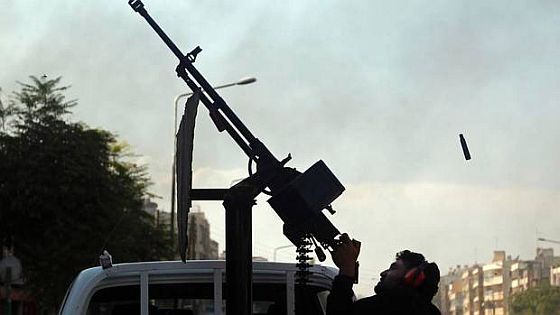
Still, those in the Free Syrian Army fighting for control of Aleppo province say that they’re making some progress in the battle for the skies. Using truck-mounted, DShK heavy machine guns, more commonly referred to as dushkas, FSA fighters say that they’ve managed to establish anti-air defenses capable of challenging jets.

Dushkas are one of the more difficult weapons for FSA fighters to acquire and in almost all cases must be captured from the regime forces or brought over by defectors. The anti-air defense network has grown slowly over the last several months, but many now say it’s reached a point where it can effectively challenge airplanes and helicopters.

“We control 70 percent of the sky, because if you compare the situation now to two months ago there are a lot less airplanes,” says Khlief Abu Allah, a dushka gunner who worked in an anti-aircraft unit in the Syrian Army during his obligatory military service before the revolution started.

While airstrikes remain a major threat in Aleppo, residents and FSA fighters say there’s been a noticeable drop in the number of attacks in recent weeks. [Continue reading…]

Facebooktwittermail

Syrian rebels capture three military bases in a week

The Guardian reports: Syrian rebels’ success in seizing three military bases in less than a week has underscored the growing difficulty faced by Damascus in securing its outposts and stopping a rebel encroachment that has claimed large swaths of the east and north of the country.

Attacks on the bases, one north-east of Aleppo, a second at Mayedin in the far east and a third near Damascus, yielded a large number of weapons, which had been in desperately short supply, especially in positions across Syria’s second city.

The impact of the new weapons seemed to have been felt immediately along northern frontlines, where Kurdish groups loyal to the Assad regime were on Friday engaged in their heaviest clashes yet with rebel forces and jihadists, near the border town of Ras al-Ain. [Continue reading…]

Facebooktwittermail

With Syria’s eastern oilfields in rebel hands, a brisk business in pirated crude grows

McClatchy reports: Syrian rebels have captured two of the three major oilfields in the country’s southeastern Deir al Zour province and are extracting oil that they say is helping to support their rebellion.

“We are at the beginning of winter, and people need oil to run the bakeries and to heat their homes. The weather is very cold here,” said a rebel leader here who, for security reasons, identifies himself by his nom de guerre, Abu Mohamed.

The capture of the fields is another blow to the Syrian government’s attempt to offset inflation and shortages of various goods in the areas it still controls. It also has set off a booming oil trade in this impoverished area. Dozens of trucks wait in line 24 hours a day to fill up at rebel-held wells, which produce a light crude that can be burned without refining, though the result is dense smoke. Some farmers insist the unrefined crude can be used to power farm equipment, though it seems primarily to be used for heat.

Some of those waiting in line at one well this week said they’d been waiting for days. Along roadsides and at intersections all over the area, men could be seen reselling the oil from improvised tanker trucks and barrels loaded into the backs of pickups.

Abu Mohammed said the price at which the rebels sell the oil is largely a symbolic one, and prices at the various wells in operation appeared to be about $5 a barrel, far below the world price that hovers above $80 a barrel. [Continue reading…]

Facebooktwittermail

Morsi’s wrongheaded power grab

David Rohde writes: After helping end the fighting in Gaza, impressing President Barack Obama, and negotiating a $4.8 billion loan from the International Monetary Fund, Egyptian President Mohammed Morsi has fallen victim to what Bill Clinton calls “brass.”

Morsi’s hubristic post-Gaza power grab on Thursday was politically tone deaf, strategic folly and classic over-reach. It will deepen Egypt’s political polarization, scare off desperately needed foreign investment and squander Egypt’s rising credibility in the region and the world.

Television images of renewed clashes in Cairo, Alexandria, Port Said, and Suez will play into stereotypes that the Middle East is not ready for democracy. They will bolster suspicions inside and outside Egypt that the Muslim Brotherhood cannot be trusted.

I disagree with the skeptics and believe democracy can still be established in Egypt. But Morsi’s moves won’t help Egypt make the difficult transition.

“There was a disease but this is not the remedy,” Hassan Nafaa, a liberal political science professor and activist at Cairo University, told Reuters Friday. “We are going towards more polarization between the Islamist front on one hand and all the others on the other. This is a dangerous situation.”

An alarming dynamic is taking hold in Egypt. Power-grabs, brinksmanship and walk-outs are becoming the norm, as a bitter struggle plays out among newly empowered Islamists, vestiges of the Mubarak regime and the country’s deeply divided liberals. Political paralysis is the result — with rule by presidential decree, overreach by the judiciary, and a deadlocked constitutional assembly. As polarization deepens, desperately needed economic, political, and judicial reforms stall.

Friday’s street protests were relatively small compared to the massive Arab spring demonstrations.. But the trend is in the wrong direction. [Continue reading…]

The Guardian adds: Egypt’s most senior judges have condemned President Mohamed Morsi for granting himself sweeping new powers which they say amount to an “unprecedented assault” on the independence of the judiciary.

The supreme judicial council said work would be suspended in all courts and prosecution offices until the decree passed by the president earlier this week was reversed.

The announcement by the top judges, most of whom were appointed by former President Hosni Mubarak, came after tens of thousands of Egyptians took to the streets on Friday to protest against Morsi’s decree.

Facebooktwittermail

What evangelicals get wrong about Israel and the Palestinians

Kirsten Powers writes: “Blessed are the peacemakers.”

Sadly, this isn’t Scripture you hear many evangelicals quoting when discussing the Israeli-Palestinian conflict, though Jesus uttered the words in the Sermon on the Mount. Instead of making peace, American evangelicals have mostly picked sides and offered unquestioning, blind loyalty to Israel, with little to no regard for the plight of the Palestinian people.

“Declaring that evangelical Christians are ‘on the front line of defense for Israel in the United States of America,’ the Rev. John Hagee brought delegates to the Christians United for Israel Washington Summit 2012 to their feet with loud cheering and even the sounds of shofars being blown,” The Times of Israel reported in April 2012.

That same month, Richard Land, president of the Southern Baptist Convention’s Ethics and Religious Liberty Commission, told NBC News of evangelical support of Israel, “American evangelicals have it in their DNA: God blesses those who bless the Jews and curses whoever curses the Jews.”

During the GOP primary, many evangelicals expressed support for Newt Gingrich, who called Palestinians “invented people.” Someone from a country that is a few hundred years old complaining about “invented” national identities would be comical if the crux of his message weren’t so offensive. Such despicable nonsense is spouted for one reason: to dehumanize Palestinians. After all, if they are just invented, pretend people, then who cares what happens to them?

Since when is dehumanizing people — God’s creation — an acceptable Christian view? [Continue reading…]

Facebooktwittermail

The Gaza war was not Iran’s war

Meir Javedanfar writes: After eight days of fighting, on the 21st of November, Israel and Hamas declared a ceasefire.

One of the questions which has been addressed since the start of the recent round of fighting has been: what has been the role of Iran?

Iran’s role has mainly been that of a weapon supplier and not much else. According to a statement made by Iran’s Islamic Revolutionary Guards chief, Gen. Mohammad Ali Jafari, Iran provided technological know-how to the “Palestinian resistance movement.” Although Jafari said that Iran had only supplied the technology, the Palestinian Islamic Jihad movement’s deputy leader stated that the Fajr missiles fired at Israel were produced by Iran.

On the day of the ceasefire, the Iranian government through parliamentary speaker Ali Larijani went a step further by stating that as well as military assistance, Iran “proudly” also provided financial assistance to Palestinian groups.

Such declarations by Gen. Jafari and Ali Larijani had their own logic. The Iranian regime is feeling isolated and threatened in the region. The regime’s domestic legitimacy is at one of its lowest since the start of the revolution while infighting between its ranks rages on. It needs to show muscle and openly declaring that it had managed to get weapons and money into Gaza is a show of strength to its own population and its allies in the region.

However, by making such a public declaration, Mr. Larijani and Gen. Jafari have also provided a major strategic gift to the government of the state of Israel and others in the region who want to see the Iranian regime isolated, namely Saudi Arabia. For years, both governments have accused Iran of providing assistance to militant groups, however lack of evidence has been one of their major handicaps. The fact that Iran played a sophisticated cat and mouse game whereby it succeeded in not leaving its fingerprints made the job for Israel, Saudi Arabia and the US government all the more frustrating.

Now that such high-ranking officials openly admit to having supplied weapons to groups in Gaza, the job of isolating Iran will be even easier than before. This is a gift from Tehran which the Israeli government and AIPAC will loathe to see go to waste. It’s not difficult to imagine that armed with such evidence they are now going to call for more sanctions against the Iranian regime, and thanks to the evidence from Tehran, they will have a higher chance of success.

The Saudis are also likely to use the admissions of support for Gaza groups as evidence to place pressure on the Morsi government to control the weapons supply tunnels into Gaza. So far, since coming to power, Morsi has already destroyed many Gaza tunnels. It’s quite possible that now more pressure will be placed on him by the Saudis to stem the flow of weapons into Gaza. With Egypt’s economy requiring much-needed financial support from various sources including the Saudis, it’s very possible that in the future Morsi will try to stem the flow of weapons into Gaza with more vigor.

Apart from supplying weapons, Iran did not have any other influence. If it did, and Hamas was acting as its proxy, the latter would not have agreed to a cease-fire and instead done everything to force Israel to launch a land invasion in Gaza. Such an outcome would have many benefits for Iran and, in fact, this is what Iran’s military and political leaders wanted. They wanted to see Israel stuck in a quagmire in Gaza, with its economy and diplomatic standing suffering heavily while its relations with Egypt reached breaking point. Unfortunately for the Iranian regime, it did not get its wish precisely because Hamas is not its proxy, nor does it have any political influence over Hamas. Otherwise, the story would have been different. [Continue reading…]

Facebooktwittermail

Iran’s activists jailed and beaten for speaking out

The Guardian reports: When the Iranian student activist Arash Sadeghi was temporarily released from Tehran’s Evin prison in November 2010, he anticipated a little respite from a year of harsh beatings and agony in jail.

Instead, within a few days, security officials had raided his home in middle of the night. As they broke their way into the house, Sadeghi’s mother, who was alone with her daughter, suffered a heart attack.

The officials continued their search as she laid unconscious on the floor, ransacking the house and trying to find Sadeghi, who was at his grandfather’s house that night. When the officials left, Farahnaz Dargahi was taken to hospital. She died within a few days.

“My father, my sister and my entire family and relatives blame me for her death,” Sadeghi told the news website Roozonline at the time. “Our house has become hell … My father tells me that you killed your mother and I don’t want you at home … I prefer to go back to jail.”

In no time, Sadeghi, a 26-year-old student of philosophy at Tehran’s Allameh Tabatabai University, was indeed taken back to prison. Since then he has spent all but one month in jail. For the past 11 months, Sadeghi has been held in solitary confinement without access to a lawyer.

His father, Hossein Sadeghi, works for the Iranian army and lives in a house given to his family by the state. Having initially blamed his son for what happened to their family, now that he has witnessed the injustices he has suffered Hossein is ready to risk his job and even arrest to speak out for the first time.

“I regret what I said about him in the past,” he told the Guardian on the phone from Tehran. “I haven’t been able to see him and tell him myself … but I’m sorry.” [Continue reading…]

Facebooktwittermail