Author Archives: News Sources

Thousands fill Tahrir on Friday to protest Morsi’s new ‘dictatorial powers’

Al Ahram reports: By Friday night, the number of the protesters, who began arriving in Tahrir Square for ‘Eyes of Freedom’ Friday throughout the morning, had reached tens of thousands after rallies from Talaat Harb Street, Shubra, Sayyida Zeinab, and Mustafa Mahmoud Square in Giza reached Tahrir.

While many protesters had started leaving the square, others were just arriving.

For one, Ultras football fans arrived in torrents at sundown, adding thousands to the square.

Protesters chanted “The people want to topple the regime,” “Do not be afraid, Morsi has to leave,” and “Down with the Brotherhood’s Supreme Guide.”

Over 30 opposition political groups took part in the protest. Their demands include the dismissal of Morsi’s cabinet, prosecuting police officers responsible for killing and injuring protesters, and a purge and restructuring of the police.

However, a new Constitutional Declaration announced by president Mohamed Morsi on Thursday altered the focus of the expected rallies.

The declaration gained the ire of liberal and leftist forces across the country who charge that the president has awarded himself dictatorial powers since the new rules stipulate that no presidential decision taken since 30 June when he assumed office can be appealed.

The declaration also angered many Egyptians since it shields the Islamist-dominated Constituent Assembly and Shura Council (upper house of parliament) from possible dissolution by pending court orders.

A video appearing at the Telegraph shows demonstrators at the headquarters of the Brotherhood’s political front, the Freedom and Justice Party, in Alexandria:

Facebooktwittermail

More than 40,000 killed since start of Syria conflict

Reuters reports: More than 40,000 people have been killed in 20 months of conflict between Syrian President Bashar al-Assad’s forces and those fighting for his overthrow, a violence monitoring group said on Friday.

Rami Abdelrahman, head of the Syrian Observatory for Human Rights, said about half the fatalities were civilians and the other half split about evenly between rebels and government soldiers.

“The figure is likely much higher as the rebels and the government lie about how many of their forces have died to make it look like they are winning,” Abdelrahman told Reuters.

Robert King writes: Today the dazed and grieving medical staff of Aleppo’s Dar al-Shifa Hospital, which just weeks ago I documented for VICE’s Ground Zero series, wandered around their razed makeshift medical facility, searching the rubble for victims of yesterday’s rocket attack launched by one of Assad’s fighter jets.

While some news reports claim that the destroyed building was adjacent to the hospital, they are incorrect. I have eaten lunch in that building several times. It housed the hospital’s administrative offices and doubled as its instrument-sanitization facility. Regardless, Dar al-Shifa’s operating facilities were also destroyed. It’s all gone, and anyone who is reporting that it is a lie or propaganda doesn’t know anything worthwhile. As with many times during my reporting in Syria, I was the only reporter on the scene who wasn’t also an activist.

Family members of the deceased stood in the street, waiting in agony for their love ones to be recovered. The exact death toll has yet to be confirmed, but today’s estimates put it at 40 and climbing.

Bulldozers worked through the night to move the debris so volunteers could extract the dead. Among the fallen were Dr. Abu Faisal, a newly married nurse Mrs. Bushra, the hospital’s information manager, and two of their security guards. Five additional nurses were wounded in the attack.

Earlier today I interviewed Dr. Osman, the head doctor of the now destroyed hospital, while he was surveying the damage. “Dar al-Shifa Hospital is now finished but in the future we will rebuild,” he said. “[Our] message was never the building itself, the message of Dar al-Shifa is [its] people and the doctors, and we will continue to save lives and relieve pain.”

Despite the obstacle Dr. Osman said that he expects to have a working hospital up in running in 48 hours. Until then many civilians in Aleppo are on their own in a war without any moral boundaries whatsoever.

Watch King’s interview with Dr Osman in this recent report:

Facebooktwittermail

Gaza ceasefire: Syria’s shrinking influence now exposed

Ian Black writes: No one is taking bets on how solid the ceasefire between Israel and the Palestinians will prove to be. But the Gaza conflict has highlighted one apparently permanent change in the Middle East – the shrinking influence of Syria, stuck in a bloody and unstoppable war.

If Mohamed Morsi, the Egyptian president, is now basking in glory as the indispensable mediator between Hamas and Israel, his counterpart in Damascus, Bashar al-Assad, looks distinctly like yesterday’s man.

Syrian state media focused intensely on Israel’s onslaught against the Palestinians in Gaza. But Assad’s Arab critics have been doing some bleak calculations: in the eight days of Operation Pillar of Defence 160 Palestinians were killed by Israel. In the same period, Syrian forces killed 817 civilians and injured thousands. Last Monday alone, says the opposition, 150 Syrians died.

Al-Arabiya, the Saudi-owned TV channel, drove home the point about double standards nicely by quoting an Israeli rabbi who publicly urged his army to “learn from the Syrians how to slaughter and crush the enemy.”

Any sense that the Gaza crisis was providing a handy diversion from the global attention to Syria was shortlived. [Continue reading…]

Facebooktwittermail

Egyptian president assumes sweeping new powers

Nathan Brown writes: In a series of moves, President Morsi has used the nearly absolute authority he assumed last August to try to put that absolute authority beyond reach, at least on a temporary basis.

He may very well succeed. The potential opponents to his move are legion but they are also divided and many are politically clueless. By careful timing and a series of carrots for various actors, Morsi may have outmaneuvered any opposition. Internationally, he has just won plaudits for his role in ending the fighting between Israel and Hamas; that likely offers him a bit of insulation from international criticism and some vague domestic capital for showing Egypt’s centrality. Offering cash to the revolution’s victims and retrials for their attackers seems designed to placate street activists. Non-Islamist forces in the Constituent Assembly are seeing one of their fundamental demands — an extension on the clock — met. And an obvious source of opposition — the judiciary, whose role is dramatically evicted from the transition process—may be a bit confused on how to respond. After all, it is leaders of the “judicial independence” movement from within their ranks that appears to be leading some of Morsi’s charge (Morsi’s vice president, the minister of justice, and the new prosecutor general are all members of that clique that stood so resolutely against the old regime’s judicial manipulations).

And the substance of the decisions is not all bad news for those who hope for a democratic transition. The prosecutor general who has been dismissed was an old-regime holdover trusted by few people. The Constituent Assembly, constantly threatened with dissolution by court order, was working in a manner that seemed to deepen divisions. Non-Islamists were having trouble breaking themselves of the habit of praying for foreign, military, or judicial intervention and Islamists had depleted the very limited supply of amity they had brought to the transition. Trials of old regime elements had clearly gone awry and victims of military and security force brutality been abandoned. Morsi’s moves work to address these issues.

But whatever the desirability of elements of these decisions, today’s overall message might be summed up: “I, Morsi, am all powerful. And in my first act as being all powerful, I declare myself more powerful still. But don’t worry — it’s just for a little while.” [Continue reading…]

Facebooktwittermail

Algeria to exploit controversial shale gas

AFP reports: Algeria, the world’s fourth-largest gas exporter, has decided to develop its shale gas potential, but experts fear this could cause severe environmental problems.

Officials say the country’s shale gas reserves are 600 trillion cubic feet (17 trillion cubic meters), or around four times greater than its current known gas reserves.

Algeria may be the world’s eighth-largest natural gas producer in 2011, according to the BP Statistical Review of Energy, but domestic consumption is surging. Official forecasts say that, from 2019, local demand will eat up all the country’s production.

At present, 50 years after it gained independence, the country remains almost totally dependent on hydrocarbons, which account for 90 percent of its exports.

So as long as it fails to diversify its export base, it has no alternative than to develop shale gas, an unconventional fossil fuel, to secure its energy future, experts say.

A new hydrocarbons bill, to be introduced in parliament in the coming weeks, encourages the exploration of unconventional gas and oil resources.

However, the effect on the environment of the production of shale gas is of great concern to ecologists.

Chems Eddine Chitour, director of fossil energy development at Algiers’ Ecole Polytechnique, is concerned that the method used for obtaining the fuel trapped in formations of shale rock could be geologically dangerous and also put a strain on the largely desert country’s water supplies. [Continue reading…]

Facebooktwittermail

Hacking the president’s DNA

Andrew Hessel, Marc Goodman and Steven Kotler write: This is how the future arrived. It began innocuously, in the early 2000s, when businesses started to realize that highly skilled jobs formerly performed in-house, by a single employee, could more efficiently be crowd-sourced to a larger group of people via the Internet. Initially, we crowd-sourced the design of T‑shirts (Threadless.com) and the writing of encyclopedias (Wikipedia.com), but before long the trend started making inroads into the harder sciences. Pretty soon, the hunt for extraterrestrial life, the development of self-driving cars, and the folding of enzymes into novel proteins were being done this way. With the fundamental tools of genetic manipulation—tools that had cost millions of dollars not 10 years earlier — dropping precipitously in price, the crowd-sourced design of biological agents was just the next logical step.

In 2008, casual DNA-design competitions with small prizes arose; then in 2011, with the launch of GE’s $100 million breast-cancer challenge, the field moved on to serious contests. By early 2015, as personalized gene therapies for end-stage cancer became medicine’s cutting edge, virus-design Web sites began appearing, where people could upload information about their disease and virologists could post designs for a customized cure. Medically speaking, it all made perfect sense: Nature had done eons of excellent design work on viruses. With some retooling, they were ideal vehicles for gene delivery.

Soon enough, these sites were flooded with requests that went far beyond cancer. Diagnostic agents, vaccines, antimicrobials, even designer psychoactive drugs — all appeared on the menu. What people did with these bio-designs was anybody’s guess. No international body had yet been created to watch over them.

So, in November of 2016, when a first-time visitor with the handle Cap’n Capsid posted a challenge on the viral-design site 99Virions, no alarms sounded; his was just one of the 100 or so design requests submitted that day. Cap’n Capsid might have been some consultant to the pharmaceutical industry, and his challenge just another attempt to understand the radically shifting R&D landscape — really, he could have been anyone — but the problem was interesting nonetheless. Plus, Capsid was offering $500 for the winning design, not a bad sum for a few hours’ work.

Later, 99Virions’ log files would show that Cap’n Capsid’s IP address originated in Panama, although this was likely a fake. The design specification itself raised no red flags. Written in SBOL, an open-source language popular with the synthetic-biology crowd, it seemed like a standard vaccine request. So people just got to work, as did the automated computer programs that had been written to “auto-evolve” new designs. These algorithms were getting quite good, now winning nearly a third of the challenges.

Within 12 hours, 243 designs were submitted, most by these computerized expert systems. But this time the winner, GeneGenie27, was actually human — a 20-year-old Columbia University undergrad with a knack for virology. His design was quickly forwarded to a thriving Shanghai-based online bio-marketplace. Less than a minute later, an Icelandic synthesis start‑up won the contract to turn the 5,984-base-pair blueprint into actual genetic material. Three days after that, a package of 10‑milligram, fast-dissolving microtablets was dropped in a FedEx envelope and handed to a courier.

Two days later, Samantha, a sophomore majoring in government at Harvard University, received the package. Thinking it contained a new synthetic psychedelic she had ordered online, she slipped a tablet into her left nostril that evening, then walked over to her closet. By the time Samantha finished dressing, the tab had started to dissolve, and a few strands of foreign genetic material had entered the cells of her nasal mucosa.

Some party drug — all she got, it seemed, was the flu. Later that night, Samantha had a slight fever and was shedding billions of virus particles. These particles would spread around campus in an exponentially growing chain reaction that was—other than the mild fever and some sneezing — absolutely harmless. This would change when the virus crossed paths with cells containing a very specific DNA sequence, a sequence that would act as a molecular key to unlock secondary functions that were not so benign. This secondary sequence would trigger a fast-acting neuro-destructive disease that produced memory loss and, eventually, death. The only person in the world with this DNA sequence was the president of the United States, who was scheduled to speak at Harvard’s Kennedy School of Government later that week. Sure, thousands of people on campus would be sniffling, but the Secret Service probably wouldn’t think anything was amiss.

It was December, after all—cold-and-flu season.

The scenario we’ve just sketched may sound like nothing but science fiction — and, indeed, it does contain a few futuristic leaps. Many members of the scientific community would say our time line is too fast. But consider that since the beginning of this century, rapidly accelerating technology has shown a distinct tendency to turn the impossible into the everyday in no time at all. Last year, IBM’s Watson, an artificial intelligence, understood natural language well enough to whip the human champion Ken Jennings on Jeopardy. As we write this, soldiers with bionic limbs are returning to active duty, and autonomous cars are driving down our streets. Yet most of these advances are small in comparison with the great leap forward currently under way in the biosciences — a leap with consequences we’ve only begun to imagine.

More to the point, consider that the DNA of world leaders is already a subject of intrigue. According to Ronald Kessler, the author of the 2009 book In the President’s Secret Service, Navy stewards gather bedsheets, drinking glasses, and other objects the president has touched — they are later sanitized or destroyed — in an effort to keep would‑be malefactors from obtaining his genetic material. (The Secret Service would neither confirm nor deny this practice, nor would it comment on any other aspect of this article.) And according to a 2010 release of secret cables by WikiLeaks, Secretary of State Hillary Clinton directed our embassies to surreptitiously collect DNA samples from foreign heads of state and senior United Nations officials. Clearly, the U.S. sees strategic advantage in knowing the specific biology of world leaders; it would be surprising if other nations didn’t feel the same.

While no use of an advanced, genetically targeted bio-weapon has been reported, the authors of this piece — including an expert in genetics and microbiology (Andrew Hessel) and one in global security and law enforcement (Marc Goodman) — are convinced we are drawing close to this possibility. Most of the enabling technologies are in place, already serving the needs of academic R&D groups and commercial biotech organizations. And these technologies are becoming exponentially more powerful, particularly those that allow for the easy manipulation of DNA. [Continue reading…]

Facebooktwittermail

Khaled Meshaal interview on CNN

This is an interesting interview with the leader of Hamas, Khaled Meshaal. Christiane Amanpour, however, is flat wrong when she emphatic claims that “international agreements” have settled the question of the right of return. Just like the status of Jerusalem, this is an unresolved issue. No Palestinian has signed any agreement renouncing the right of return.

AMANPOUR: Under the international agreements every Palestinian who’s living in the diaspora is not going to be able to come back to Israel.

MESHAAL (through translator): Who said that? Who said that?

AMANPOUR: That’s what are the parameters.

Facebooktwittermail

Seven takeaways from the Gaza ceasefire

Daniel Levy lists his takeaways: 1) And the winner… is President Morsi

That Egypt’s new president has emerged from this episode strengthened both internally and externally appears to be something of a consensus. Mohammed Morsi is being widely praised for having struck the right balance between a pragmatism that enabled him to deliver the goods on a ceasefire and a principled stand in support of the Palestinians, which guaranteed that he could not be cast as Mubarak II. Unsurprisingly, there is domestic criticism of Morsi’s role suggesting both that Morsi was back to playing Egypt’s old role as America’s policeman and/or that he was insufficiently focused on Egypt’s needs at home. Neither critique, though, is likely to gain much traction. If anything, the timing of the criticism also worked rather well for Morsi, enabling him to claim a win against the backdrop of a difficult domestic climate with the tragic train crash in southern Egypt (which otherwise would have dominated the news and led to severe criticism of the government), with revolutionaries and police clashing in Cairo, and with a potential constitutional crisis still in the offing (which just deepened today).

Morsi emerges from his mediating role with increased credit in the bank, both metaphorically — the international community relied on Morsi’s team to broker the truce — and literally, with the IMF approving a $4.8 billion loan to Egypt, coincidentally on the same day of this diplomatic achievement (and on terms which would make many a European state green with envy). Much has been made of the close Egyptian-U.S. coordination throughout the crisis and especially of the six phone calls held between the Egyptian and American presidents during the past week. Morsi was able to manage the U.S. relationship, the Hamas relationship and to have his security officials broker an arrangement with Israeli counterparts while at the same time expressing unequivocal and distinctly un-Mubarak support for the Palestinian cause, and opposition to Israeli policies, recalling his ambassador from Israel and dispatching his Prime Minister to appear with Gazan Prime Minster Haniyeh in a show of solidarity with a Gaza from where rockets were being launched at Israel.

All of which does not add up to a trouble-free future for Morsi’s Egypt in the Israel-Palestine arena. Egypt now has a degree of responsibility for preventing violence between two actors over which its control is very, very limited (Hamas and Israel). It also still has the headache of security in the Sinai to address. But Morsi is likely to remind his Western friends that if they are unable to use a period of quiet to deliver broader progress on Israeli de-occupation, then he cannot be held fully responsible for the consequences later on. [Continue reading…]

Facebooktwittermail

Assad forces destroy Dar al Shifa hospital in Aleppo

Vice, November 21: Today, the Dar al Shifa field hospital in Aleppo — which was the subject of the VICE documentary Ground Zero Syria: Aleppo Field Hospital [see Ground Zero Part 3, below] — was bombed into rubble by Assad’s MIG jets. The FSA’s Aleppo media center is reporting 15 dead, 20 wounded, and many still under the rubble. Two of the dead were allegedly hospital staff and two were children. An unconfirmed rumor is circulating that a Canadian film crew was also inside at the time of the bombing. Our correspondent Robert King was 100 yards away when the bombs dropped. The air was thick with smoke and debris, like a thick fog—the hospital was nowhere to be seen because it had been completely leveled. Grown men stumbled around shellshocked, covered in dust. Grieving Syrians shouted “Allahu Akhbar” and gathered the wounded from the rubble, wrapping up the dead and throwing their bodies in the backs of minitrucks. As the cease-fire between Israel and Gaza devours headlines, the bombs continue to fall in Aleppo and Idlib province. VICE’s Robert King will remain in Aleppo, documenting the ongoing civil war.

Facebooktwittermail

Israel’s fences

Rachel Shabi writes: It’s hard to shake off the image of them staring into space. On benches and dried-out grass in south Tel Aviv’s Levinsky Park, small rows of men and women sit in wide-eyed silence. They are in shock. Many of them don’t offer details of their journey into Israel: ‘It was terrible,’ they say, and then stop. Refugees from mostly South Sudan, Eritrea, Sudan and also the Ivory Coast and the Congo, they entered the country through the Sinai Desert’s border with Egypt. ‘There were bad things, very bad things,’ one South Sudanese woman ventures, looking at her solemn seven-year-old daughter: they crossed the border a few years ago, and the girl barely spoke for months afterward.

Refugee organisations report that if people do speak of the journey, it is of unspeakable things: beatings, torture, rape, extortion, and imprisonment. A recent Human Rights Watch report catalogues nightmare cruelties at the hands of human traffickers in the Sinai. One practice is to beat migrants while playing their screams to relatives back home, for money.

When refugees from sub-Saharan Africa survive the trip to Israel, and the trauma that goes with it, they might end up functioning, working in menial jobs and living in overcrowded slums. That they put up with this semi-existence after the tortures of getting to the country tells us only that there is no alternative.

Israel, of course, is not unusual in being panicky over migrants, especially dark-skinned migrants from the ‘developing world’. But when Jews from all over the world migrate to Israel, it is given a Hebrew term, aliyah, or ‘ascent’, to make clear that this relocation is not really immigration but rather a welcomed homecoming. In a nation numbering almost 8 million, there are some 1.6 million Palestinian citizens, who stayed in Israel after the 1948 war that created the nation. Four per cent of the population is ‘other’. Meanwhile, the collapse of the Soviet Bloc in the early 1990s brought close to a million Russian Jews to Israel, though non-Russian Israelis sometimes moan that many of these are not ‘really’ Jewish. However, they are Jewish enough for official Israel, which is obsessively preoccupied with what is viewed as the existential imperative of boosting Jewish demographics.

Many Israelis, now sharing space with some 60,000 refugees from the sub-Saharan region, are making their reluctance known, with hate graffiti, verbal abuse, and demonstrations calling for the eviction of African refugees from the Jewish state. The migrants have been coming since 2005. Given no status, no rights, no work permits, they have crowded into run-down parts of Tel Aviv. In May this year, there were pogrom-style attacks against African migrants, smashed windows and burned buildings — the hate on the street stoked by equally hateful words from government ministers. Miri Regev, of the right-wing Likud party, for example, described the refugees as ‘a cancer in the body’ of the nation.

Rami Gudovitch, an Israeli activist who works with the refugees in south Tel Aviv, has described what he sees as ‘open, explicit and humiliating racism’. The attacks on refugee populations, he said, are ‘physical, verbal, brutal, serious, and endless’. What’s more, he is attacked, too, for siding with the migrants and speaking out about their plight. Watching from further afield, some have wondered how Israel — a nation of desperate, traumatised refugees — could be so unfeeling and closed to another set of desperate, traumatised refugees. But that’s the wrong question. That isn’t how it works.

In creating a Jewish homeland, Israel’s founders sought both a refuge from and an erasure of the brutal history of Jewish persecution in Europe. They wanted to do away with any idea of a scraping, craven, Diaspora Jew and replace it with a strong, confident, ‘new Jew’ belonging to this new nation. Alongside that, of course, was another erasure: of the people already on the land earmarked for the Jewish state — an air-brushing instantly surmised in the early Zionist slogan for Mandate Palestine: ‘A land without a people, for a people without a land.’

Zionism was always a bit obsessed with hygiene, mirroring the way that Europeans — colonisers and settlers of that time — were finicky and aloof about the supposedly unwashed, disease-riddled developing world. Israeli writers such as Amos Oz have described, with dark humour, the germ-averse fretfulness of their forebears upon arrival to then-Palestine, a fear of the ‘dirty’ Orient. But there’s another purity drive in Israel — not to do with grime and infestation. Much of the country’s 64-year history has been a chronicle of its attachment to erasures: to wiping things clean and out of the way. [Continue reading…]

Facebooktwittermail

Behind the pillars of cloud

Rami Zurayk and Anne Gough write: Since its creation in 1948, Israel has used food and nutrition as a means to entrench its military and territorial occupation of Palestine. While all eyes are turned today to the savage eradication of children and entire families in Gaza through operation “Pillar of Cloud”, Israel pursues its long-term goal of decimating the means of food production, livelihoods and the ability of those in Gaza to make economic and political decisions about what they grow and what they eat.

Gaza and the rest of Occupied Palestine is being restructured as an entity where malnutrition is endemic, access to food is denied and people are forced to live under the constant fear of not having enough to eat.

In the last eight days, the food and farming sector in Gaza has been severely maimed, worsening the condition of an agricultural sector impaired by six years of Israeli imposed siege, military campaigns and decades of occupation.

In the first five days of the assault, the Ministry of Agriculture in Gaza estimated losses to the agriculture and fishing sectors to be above US $50 million.

According to our colleague Mohammad El Bakri, who is with the Union of Agricultural Work Committees, and other agricultural specialists in Gaza, farmers are in the midst of the crucial olive harvest and olive oil production season and the destruction is a disastrous blow for food and economic security in Gaza. [Continue reading…]

Facebooktwittermail

How not to talk about Gaza

Colin Dayan writes: Talking about Gaza is like talking about God. We face the ineffable. We cannot talk about what we see. Or if we do, we are accused of lacking common sense, failing to take a realistic approach to an unmanageable problem.

What is that problem? Palestinians are the problem. Like so many others in our world today, Palestinians are labeled as “terrorists” by the powerful, so that lethal force is the rule and extreme violence — or exemplary disregard — may be directed indiscriminately against civilians and non-civilians alike. The problem is not a simple one. If we pretend it is, then we risk validating those who hold Israel to an unfair standard, or worse, who question its right to exist. And in protesting Israeli government policy, expressing horror at its brutal excesses, we risk being condemned as “anti-Semitic” or worse, as “self-hating Jews.”

The tired debates about the history of Zionism and the threat of the Palestinian national movement—or, put more bluntly, about the end of Israel and what Jonathan S. Tobin calls “a war with Palestinian Islamists that has no end in sight” — ignore what is specific about more than four decades of Israeli domination in the Occupied Territories. Especially masked in these debates are the unique and various forms of violence used to control the West Bank and Gaza Strip since the eruption of the second Palestinian intifada in September 2000. In the name of “security,” Israel has implemented something like a permanent state of emergency. Brute force coexists with, to a sometimes-calamitous degree, a systematic practice of discrimination, surveillance, and disappearance. Behind the barriers — and they are everywhere — live the confined, sealed off from the zone of inclusion, the Israeli state. [Continue reading…]

Facebooktwittermail

Top ten steps that are necessary for lasting Gaza-Israel peace (or, good luck!)

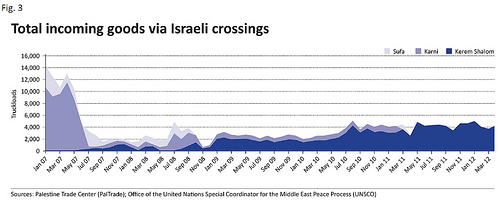
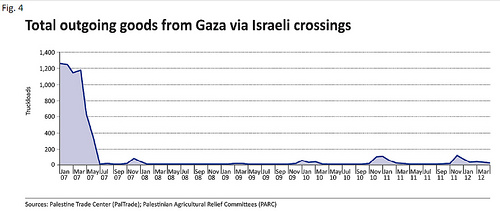
Juan Cole writes: 1. The Israeli blockade on Gaza exports and non-military imports must be lifted altogether. Ben White points out that the restrictions on goods brought into Gaza via Israel are still very substantial, despite Israeli assertions that the blockade has been eased.

And, the blockade on exports is almost complete, with some minor exceptions, and is devastating to the Gaza economy. Real per capita income among Palestinians in the Gaza Strip is less today than in the early 1990s!

These Israeli policies are a form of collective punishment imposed by an Occupying power on a noncombatant occupied population. Israel also imposes restrictions on Palestinian travel outside the Strip (even, sometimes, unconscionable delays for patients seeking specialist medical care– delays that lead to their deaths). Collective punishment, obstacles to free movement as part of an Apartheid regime, and occasional Israeli attacks that show blatant disregard for civilian life are not only illegal in international law but constitute a set of systematic war crimes that rise to the level of crimes against humanity as defined by the Rome Statutes.

While it is unfortunate that small homemade rockets are sometimes fired by small militant groups from Gaza into Israel, it is impossible to expect social peace from a people being economically strangled. [Continue reading…]

Facebooktwittermail

How the Gaza truce makes Egypt’s Muslim Brotherhood a peace player

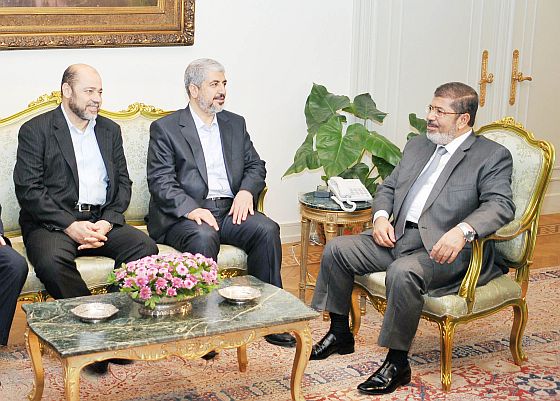
In July, Khaled Meshaal, the leader of Hamas, met Egypt's newly elected President Mohamed Morsy and hailed Morsy's election as the start of a "new era" for Egypt and the Palestinians.

Tony Karon writes: When a civilian bus was bombed in Tel Aviv on Wednesday, many feared the incident would derail negotiations for a truce in the latest conflict between Israel and Hamas. That proved not to be the case. The other anxiety was that an Egypt where the Muslim Brotherhood is in power would somehow jinx the prospects for peace. That fear proved to be groundless too. Indeed, the government of President Mohamed Morsy took the lead role in brokering the Gaza truce announced in Cairo Wednesday night, and will reportedly act as its guarantor. “It was unknown how Egypt would react,” Likud party legislator Yohanan Plesner told Britain’s Telegraph. “When the moment of truth came, the Egyptian leadership moved responsibly and clearly said they were trying to restore stability.” Not only that, says analyst Michael Wahid Hanna at the Century Foundation, “Egypt’s government has put its own international credibility on the line by effectively undertaking to ensure that Hamas observes the terms of its ceasefire — that’s a subtle but profoundly important change.”

Egypt’s Gaza role reflects the emerging contours of a Middle East profoundly changed by the Arab Spring, yet forced to confront decades-old challenges. The essential partnership in tamping down the Gaza violence, notes former U.S. Ambassador to Israel Martin Indyk, is the one “between the United States and Egypt — one using its influence with Israel, the other with Hamas — to put together a ceasefire package as the foundation for a wider resolution of the conflict.” Although Secretary of State Hillary Clinton may have played an important part in finessing the deal, Morsy and the Egyptians provide a service Washington cannot in dealing with Gaza. The U.S. is officially sworn to avoid engagement with Hamas — a movement it defines as a terrorist organization. And while Washington has a preferred Palestinian interlocutor–President Mahmoud Abbas who is based in the West Bank–Abbas has no influence over events in Gaza, where his rivals in Hamas hold sway. And so, the Obama Administration turned to Egypt, urging it to use the Muslim Brotherhood’s political ties with Hamas and the Egyptian intelligence service’s long-established relationship with its Israeli counterparts to broker a truce.

Unlike former President Hosni Mubarak who deemed Hamas an enemy, the Muslim Brotherhood government sees the movement as its own political progeny, and is therefore not shackled by a need to prevent Hamas making political gains from a truce. On the contrary, while Egypt seeks a cease-fire that ends Palestinian rocket fire from Gaza and Israeli air strikes on the territory, Cairo’s mediation also offers Hamas a pathway out of the blockade that has choked off Gaza’s economy for the past five years. Even Israeli leaders have praised the response from Cairo, notwithstanding Egypt’s unprecedented public acts of solidarity with Hamas.

Morsy had made clear, when he addressed the U.N. General Assembly in September, that his government would both abide by the 1978 Camp David peace treaty with Israel but also challenge the status quo in the Palestinian territories. “I say it loudly to those wondering about our position vis-a-vis the international agreements and conventions that we have previously adhered to: we are committed to what we have signed on,” Morsy said at the time. “We also support the inalienable rights of the Palestinian people and are determined to pursue all efforts side by side with them until they regain their rights.” [Continue reading…]

Facebooktwittermail

The view from the West Bank

The Economist‘s Middle East blog: In Cities across the West Bank, Palestinian youth inspired by the fighting in Gaza have been skirmishing with Israeli forces as a new spirit of activism takes hold. Clouds of tear-gas hang over the night-time streets of Bethlehem and Qalandia, the main terminal blocking the West Bank’s access to East Jerusalem, as Israeli soldiers seek to disperse demonstrators. Increasingly, the army resorts to lethal force to repel Palestinians hurling Molotov cocktails so numerous they are reaching intifada levels. Casualties are rising as the army deploys reservists, often ill-trained in crowd control to replace soldiers transferred from the West Bank to the Gaza front. Two Palestinians have been killed following clashes in Hebron, a southern West Bank city and the stronghold of the clan of Ahmad Jabari, the head of Hamas’s military wing, whose assassination on November 14th led to the Israeli offensive, and Nabi Saleh, a village near Ramallah.

With Palestinians in the West Bank rallying in support of Gaza, West Bank politicians talk of an approaching intifada to match those that began in 1987 and in 2000. Israeli observers speak of mounting concern that their country’s assault on Gaza could precipitate a new wave of West Bank unrest. In an attempt to contain it, Israel’s security forces have detained dozens, including in East Jerusalem, where Palestinians have also rallied in support of Hamas. The streets of the old city and the adjoining neighbourhood of Silwan echoed with gunfire in the evening of November 16th as police sought to disperse protesters distributing sweets in celebration of a rocket that landed on the outskirts of Jerusalem. Hamas possesses only a minute fraction of Israel’s fire power, but its rocket attacks on Israel’s cities, including its commercial capital, Tel Aviv, are winning it renewed support amongst Palestinians, gleeful that in however small a measure, their armed militias are redressing the balance of fear.

“No longer are we just helpless refugees,” says Mahmoud, a shopkeeper on Saladin Street, the main shopping district of Israeli-occupied East Jerusalem. “After years of going nowhere, we are starting to look as if we have an army of our own.” Elsewhere on the street, moneychangers put out bowls of sweets for their customers. My normally dour falafel-fryer shook my hand in delight. “Now it is not only Palestinians who are afraid,” he said. [Continue reading…]

Facebooktwittermail

Hamas has more powerful friends in changing Middle East

Reuters reports: Hamas leader Khaled Meshaal looked like a man at home in Cairo this week as he used the Egyptian capital to declare terms for a ceasefire with Israel, his confidence reflecting the historic changes shaping an Arab world more supportive of his cause.

In Cairo for talks on the Gaza crisis, the bearded Hamas leader in exile has been warmly received in a country where officials viewed his movement with suspicion bordering on outright hostility when Hosni Mubarak was in power.

In stark contrast to those days, a smiling Meshaal was photographed on Monday meeting President Mohamed Mursi, the head of a new Egyptian administration shaped by the Muslim Brotherhood, Hamas’ spiritual mentor. Mursi, unlike Mubarak, is taking a personal interest in truce talks Egypt is overseeing.

Behind the scenes, Hamas leaders are finding a very different attitude from the Egyptian mediators. In Mubarak’s days, the Palestinians often complained that Egyptian intelligence chief Omar Suleiman, who died earlier this year, would try to impose Israel’s terms on them.

“The Egyptian brothers in the intelligence service have always helped in truce matters, this time they are being more helpful because President Mursi is in charge,” said a source close to Hamas. “The former regime used to pressure us more than they did Israel,” the source said.

The changes buoying Hamas have started to become clear in the tone from other Arab states too – a delegation of eight Arab ministers arrived in Gaza on Tuesday in the latest visit to express solidarity with the Palestinians.

The shift marks a challenge to the policies of Western governments including the United States. They shun Hamas as a terrorist group, dealing instead with the Palestinian Authority, from which Hamas seized control of Gaza in 2007.

It also shows that public opinion is starting to have an impact on the foreign policies of Arab states long run by autocrats who have paid scant attention to the views of populations broadly supportive of the Palestinians.

Facebooktwittermail

Hamas leader criticizes execution of suspected collaborators

Ynet reports: Hamas’ Deputy Politburo chief Mousa Abu Marzook posted a message on his Facebook page condemning the execution of six people accused of being Israel collaborators.

He demanded that those behind the act be tried. “The way these collaborators were killed and the images after their death are totally unacceptable and those responsible must be indicted. These events must never repeat themselves,” he wrote.

Abu Marzook further added, “We endorse punishments to spies and especially to those who took part in the death of our commander and undermine our resistance but they should only be punished by law.”

Palestinian gunmen shot dead six alleged collaborators in the Gaza Strip who “were caught red-handed,” according to a security source quoted by Hamas’ Aqsa radio on Tuesday.

Facebooktwittermail