Reuters reports: The alleged organiser of the Taliban shooting of a Pakistani schoolgirl was captured during a 2009 military offensive against the hard-line Islamist group but released after three months, two senior officials told Reuters.
They identified the man who planned the attack on 14-year-old Malala Yousufzai only as Attaullah, and said he was one of the two gunmen who shot her on a school bus this month in the Swat Valley, northwest of Islamabad.
Believed to be in his 30s, Attaullah is on the run and may have fled to neighbouring Afghanistan, they said. He organised the attack on the orders of one of the Taliban’s most feared commanders, Maulana Fazlullah, officials said.
Critics say Pakistan’s low conviction rate of militants, even high-profile ones who carried out major attacks, is one reason why extremism has spread in the South Asian nation.
Author Archives: News Sources
Up to 28,000 Syrians have ‘disappeared’ since uprising began
The Guardian reports: Up to 28,000 Syrians have disappeared over the past 19 months, with civilians snatched from the streets or forcibly abducted by government troops or security forces, human rights groups say.
Relatives had been unable to discover the fate of their loved ones. Many of those abducted were almost certainly dead, while others were alive and being held in Syrian prisons or secret detention centres where they were tortured, the groups claimed.
Since the uprising against President Bashar al-Assad began in March 2011, government forces had “disappeared” peaceful protesters on an unprecedented scale, the groups said. Some campaigners have estimated the number of those who have vanished could be as high as 80,000.
A harrowing film released on Thursday by the global campaign network Avaaz shows disturbing footage of forced disappearances. In one incident, three soldiers grab two women dressed in black abayas walking down a street. They hit them and drag them away. In another, soldiers abduct a Syrian man, yanking him by the hair past a tank.
U.N.: 150,000 Syrian refugees have fled to Egypt
The Associated Press reports: The U.N. refugee agency said Thursday the number of Syrian refugees who have fled their country’s civil war and found shelter in Egypt has now topped 150,000 – a significant jump from last month’s figure of 95,000.
The director of UNHCR in Egypt, Mohamed Dayri, said that despite the growing number of refugees in Egypt, only 4,800 Syrians have registered with the agency in Cairo. He called on Egyptian authorities to help UNHCR deal with the “rising emergency” of Syrian refugees here.
A U.N. official, speaking on the condition of anonymity because they were not authorized to brief the media, suggested Syria’s neighbors who have taken in refugees – Turkey, Lebanon, Iraq and Jordan – are “reaching (the) saturation point,” prompting an influx into Egypt, where the cost of living is cheaper.
Divided Palestinians hold municipal elections without Hamas
Reuters reports: Palestinians in the West Bank go to the polls on Saturday in long-delayed municipal elections that have already highlighted deep divisions in the occupied territory and stoked complaints about a lack of leadership.
The October 20 ballot will hold up a cracked mirror to a political landscape clouded by financial crises, failure to reconcile the major Palestinian factions and stalemate in peacemaking efforts with Israel.
The powerful Islamist group Hamas is boycotting the election and preventing voting from taking place in the Gaza Strip, leaving the field largely clear for the mainstream Fatah party in the race to take charge of 94 West Bank towns and villages.
But, as has happened so often in the past, President Mahmoud Abbas’s nationalist Fatah movement has failed to present a united face, with party rivals presenting their own candidates.
For Benghazi diplomatic security, U.S. relied on small British firm
Reuters reports: The State Department’s decision to hire Blue Mountain Group to guard the ill-fated U.S. diplomatic mission in Benghazi, Libya, entrusted security tasks to a little-known British company instead of the large firms it usually uses in overseas danger zones.
The contract was largely based on expediency, U.S. officials have said, since no one knew how long the temporary mission would remain in the Libyan city. The cradle of last year’s uprising that ended Muammar Gaddafi’s 42-year rule, Benghazi has been plagued by rising violence in recent months.
Security practices at the diplomatic compound, where Blue Mountain guards patrolled with flashlights and batons instead of guns, have come under U.S. government scrutiny in the wake of the September 11 attack in Benghazi that killed U.S. Ambassador J. Christopher Stevens and three other Americans.
Federal contract data shows that the Benghazi security contract, worth up to $783,284, was listed as a “miscellaneous” award, not as part of the large master State Department contract that covers protection for overseas embassies.
The role of Ansar al-Sharia in the attack on the U.S. consulate in Benghazi
The New York Times reports: Libyan authorities have singled out Ahmed Abu Khattala, a leader of the Benghazi-based Islamist group Ansar al-Sharia, as a commander in the attack that killed the American ambassador to Libya, J. Christopher Stevens, last month, Libyans involved in the investigation said on Wednesday.
Witnesses at the scene of the attack on the American Mission in Benghazi have said they saw Mr. Abu Khattala leading the assault, and his personal involvement is the latest link between the attack and his brigade, Ansar al-Sharia, a puritanical militant group that wants to advance Islamic law in Libya.
The identity and motivation of the assailants has become an intense flash point in the American presidential campaign. Republicans have sought to tie the attack to Al Qaeda to counter President Obama’s claim that by killing Osama bin Laden and other leaders his administration had crippled the group; Mr. Abu Khattala and Ansar al-Sharia share Al Qaeda’s puritanism and militancy, but operate independently and focus only on Libya rather than on a global jihad against the West.
On Monday, the New York Times reported: To those on the ground, the circumstances of the attack are hardly a mystery. Most of the attackers made no effort to hide their faces or identities, and during the assault some acknowledged to a Libyan journalist working for The New York Times that they belonged to the group. And their attack drew a crowd, some of whom cheered them on, some of whom just gawked, and some of whom later looted the compound.
The fighters said at the time that they were moved to act because of the video, which had first gained attention across the region after a protest in Egypt that day. The assailants approvingly recalled a 2006 assault by local Islamists that had destroyed an Italian diplomatic mission in Benghazi over a perceived insult to the prophet. In June the group staged a similar attack against the Tunisian Consulate over a different film, according to the Congressional testimony of the American security chief at the time, Eric A. Nordstrom.
At a news conference the day after the ambassador and three other Americans were killed, a spokesman for Ansar al-Shariah praised the attack as the proper response to such an insult to Islam. “We are saluting our people for this zeal in protecting their religion, to grant victory to the prophet,” the spokesman said. “The response has to be firm.” Other Benghazi militia leaders who know the group say its leaders and ideology are all homegrown. Those leaders, including Ahmed Abu Khattala and Mohammed Ali Zahawi, fought alongside other commanders against Col. Muammar el-Qaddafi. Their group provides social services and guards a hospital. And they openly proselytize for their brand of puritanical Islam and political vision.
They profess no interest in global fights against the West or distant battles aimed at removing American troops from the Arabian Peninsula.
Nevertheless, the group’s motivation became a source of disagreement. At last week’s Congressional hearing, Mr. Nordstrom tried to contradict lawmakers who insisted that the group was at least “loosely affiliated with Al Qaeda.”
Representative Dan Burton, Republican of Indiana, cut him off. “Don’t split words,” he said. “It is a terrorist organization.”
Some analysts argue that the White House, meanwhile, sought to play down any potential characterization of the assault as a Qaeda attack, because that would undercut its claims to have crushed Al Qaeda.
Libyan guards at the Benghazi compound and other witnesses told journalists working for The New York Times as early as Sept. 12 that the streets outside the mission were quiet in the moments before the attack had begun, without any prior protests.
Other Benghazi militia leaders who know Ansar al-Shariah say it was capable of carrying out the attack by itself with only a few hours’ planning, and as recently as June one of its leaders, Mr. Zahawi, declared that it could destroy the American Mission.
The Wall Street Journal adds: In Libya, the Americans have only a threadbare presence and thin security ties. The FBI team in Tripoli is interacting primarily with the nascent Libyan intelligence agency headed by former U.S. citizen Salem al-Hasi, a veteran Libyan political dissident who for decades lived in the Atlanta area and taught Arabic to U.S. soldiers, according to several Libyan officials.
Mr. Hasi has no direct control over the existing security bodies in Benghazi, whose commanders have forces to make arrests there. In Tripoli, meanwhile, civilian leaders are struggling to form a new government, leaving the nation without strong ministers of the interior or defense.
Other aspects of the American investigation, including the treatment of witnesses, are also generating criticism among Libyans.
Some witnesses from Benghazi have traveled at their own expense to meet with FBI investigators and share information with them. Three of these witnesses say the Americans have offered them no protection in exchange for their cooperation, prompting two of them to say they are trying to dissuade other Libyans from talking to the bureau. The FBI team has spent only a handful of hours on the ground in Benghazi, saying the city is too insecure.
For those who share Rep. Burton’s perspective, it matters little who conducted the attack since differentiating between different groups, their affiliations and their ideologies amounts, supposedly, to splitting hairs. But as the Century Foundation’s Michael Hanna pointed out to the New York Times, those who are linking the attack to al Qaeda are making “promiscuous use” of the term. “It can mean anything or nothing at all.”

How Obama is operating in unprecedented secrecy — while attacking the secret-tellers
Dan Froomkin writes: It’s a particularly challenging time for American national security reporting, with the press and public increasingly in the dark about important defense, intelligence and counterterrorism issues.
The post-post-9/11 period finds the U.S. aggressively experimenting with two new highly disruptive forms of combat — drone strikes and cyberattacks — for which our leaders appear to be making up the rules, in secret, as they go along.
Troubling legal and moral issues left behind by the previous administration remain unresolved. Far from reversing the Bush-Cheney executive power grab, President Barack Obama is taking it to new extremes by unilaterally approving indefinite detention of foreign prisoners and covert targeted killings of terror suspects, even when they are American citizens.
There is little to none of the judicial and legislative oversight Obama had promised, so the executive branch’s most controversial methods of violence and control remain solely in the hands of the president — possibly about to be passed along to a leader with less restraint.
More than a decade after it started, we still have no clue how much the government is listening in on us or reading our email, despite the obvious Fourth Amendment issues.
And the government’s response to this unprecedented secrecy is a war on leaks. [Continue reading…]
Video — Iran: The impact and limits of sanctions
How Israel planned to push Palestinians to the brink of starvation
BBC News reports: An Israeli court has forced the release of government research detailing the number of calories Palestinians in Gaza need to consume to avoid malnutrition.
The study was commissioned after Israel tightened its blockade of the territory after Hamas came to power in June 2007.
The UN said if the research reflected a policy intended to cap food imports, it went against humanitarian principles.
But the Israeli government said the study was only ever a draft and was never used to determine policy.
‘Daily humanitarian portion’The Israeli human rights group Gisha, which campaigns against Israel’s Gaza blockade, fought a long legal battle to get the Israeli ministry of defence to release this document.
Dated from 2008 and entitled, “Food Consumption in the Gaza Strip – The Red Lines“, it is a detailed study of how many calories Palestinians needed to eat to avoid malnutrition.
Banished Palestinian fighter: ‘I had the right to fight this occupation’
At Electronic Intifada, Joe Catron writes: “Why doesn’t the international community support the fighters of Palestine?” Iyad Abu Khaizaran asked, sitting in his Gaza apartment.
Abu Khaizaran, 41, was one of 477 detainees freed on 18 October 2011 in the first phase of Hamas’s prisoner exchange with Israel, and one of 205 banished by Israel from their homes in the West Bank. Like 163 others, Abu Khaizaran, a native of Tubas, was forcibly relocated to the Gaza Strip.
Hamas had reached the deal with Israel to free, in two phases, over a thousand Palestinian prisoners in exchange for an Israeli soldier they had captured in 2006.
A day before the exchange, two Palestinian human rights organizations, Addameer and Al-Haq, said in a statement that the “terms violate Article 49 of the Fourth Geneva Convention, which prohibits forcible transfers and deportations of protected persons, a proscription that is part of customary international humanitarian law.”
The organizations added: “Unlawful deportation or transfer also constitutes a grave breach of the Fourth Geneva Convention and qualifies as one of the most serious war crimes” (“Between a rock and a hard place: the fate of Palestinian political prisoners,” 17 October 2011).
However, Abu Khaizaran was less interested in discussing his own banishment than the Palestinian struggle. “I had the right to fight this occupation,” he said. “International law allowed me to do that.”
“I didn’t care about the length of my sentence, or how many years I would spend inside Israeli jails,” he added. “Our struggle was just. For this reason, I was never sad during my imprisonment.” [Continue reading…]
Israelis recognizing the Nakba

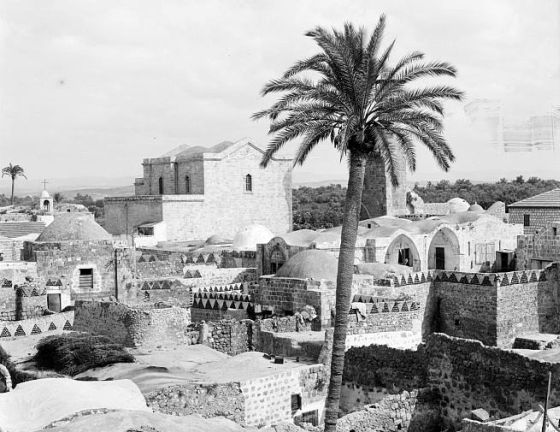
Rooftop view of Lydda and the Church of St George in the background, circa 1920.

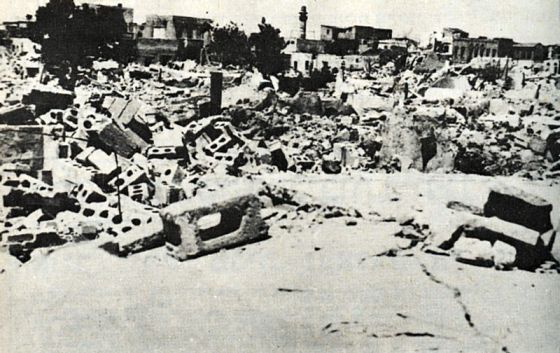
Ruins of Lydda, 1948.
Raja Shehadeh writes: Last Friday, some 40 Israeli Jews and Arabs gathered in Lydda, a small mixed Arab-Israeli city less than 10 miles southeast of Tel Aviv, for “a study tour” featuring “Zionist testimonies from 1948.” It was part of the project Towards a Common Archive, sponsored by Zochrot (Hebrew for remembering), an Israeli organization that hopes to bring “awareness and recognition of the Nakba” to Jewish Israelis so that they can take “responsibility for this tragedy.”
The Nakba refers to the expulsion of the Palestinians from the newly minted state of Israel. On no issue do Israelis and Palestinians differ more. Israelis celebrate May 15, 1948, as their day of independence; for Palestinians, it marks the “catastrophe.” That an Israeli group like Zochrot should organize a trip to a city where some of the Nakba’s worst atrocities occurred is an important and necessary attempt to bridge this nagging gap in perceptions.
During three and a half hours we got a description — in both Arabic and Hebrew — of the Arab city as it existed before 1948. We visited the old town, the church and the mosque where some Arab inhabitants hid in July 1948 to avoid expulsion. We also visited the site of the ghetto where 5,000 of the town’s 50,000 residents (including refugees from neighboring villages) were confined for one year after the Nakba, surrounded by barbed wire and guarded by Israeli soldiers. (They eventually became Israeli citizens and were allowed to stay in Israel.)
The group listened in respectful silence as the Palestinian guide, Ziad Abu Hamad, a descendant of Lydda’s few remaining original residents, described what his parents had told him about their hardships. A woman in her late 60s and other Arab residents approached us, pointing to the buildings that had been their family homes and which they have had to rent or buy back from those who took them away.
Wherever we stopped, members of Zochrot put up commemorative signs describing in Arabic and Hebrew what had happened at the sites. When I asked how long the posts would remain, I was told: until nightfall at best, or until some Israeli right-winger destroys them.
Present-day Lydda (which Israelis call Lod) is known for being one of the most violent cities in Israel and a center of drug addiction, and I expected our group to be stopped or heckled. But we made it through the dark history of the city in the clear midday sun without a hitch.
At the end we wound up in the hall of an old stone building where we were shown videos of two Israeli fighters from the elite Jewish force, the Palmach, testifying about their role in the Nakba.
Yerachmiel Kahanovich described how he had dug a hole in the wall of the Dahmash Mosque in the center of Lydda, where more than 150 Palestinians had taken shelter, and shot an anti-tank shell through it. Asked what had happened to the Palestinians, he said they were all crushed against the walls by the pressure from the blast. [Continue reading…]
Turkey cannot enter Syria unilaterally
The Turkish Radikal (translation by Al Monitor) reports: If anyone wants to advocate intervention in Syria he should first explain to us Henri Barkey’s concerns and that air defense system.
We have been debating Syria for months. Are you pro-war or pro-Assad? Shall we enter or not? Shall we set up a buffer zone with the United States or go to Damascus by ourselves in three hours?
Talking is free of charge. Everybody talks. But look what Barkey [a Turkey analyst at Lehigh University], was telling [Radikal journalist] Ezgi Basaran in their interview yesterday: “The Turkish army doesn’t have enough experience to set up a buffer zone.”
And then he lists the bitter truths.
To those who might ask who Henri Barkey is, let me remind them: He speaks Turkish better than most Turks, has worked in the US State Department and is a highly respected academic close to the Democratic Party. What does he say?
“Turkey cannot enter Syria unilaterally even if it wants to.”
Why not?
“Turkey’s aim to create a kind of buffer zone coupled with a no-fly zone in Syria. This is why it is pressing on the US [to get involved] because it can’t do this by itself. So why aren’t Americans doing it? The Syrian air defense system is highly sophisticated. America has to put hundreds of planes in the air to suppress that system. Since that air defense system was designed for use against Israel, it is developed far more than you may think. Yes, we can create a buffer zone in Syria but they will definitely shoot down some of our planes. This is not a game.” [Continue reading…]
Pakistani Taliban declare war on media
Sami Yousafzai reports: Malala Yousafzai has taken one more step in her very long and difficult journey. Separated from her family for now, the 14-year-old Pakistani schoolgirl arrived today at Birmingham’s Queen Elizabeth Hospital, Britain’s primary receiving facility for military casualties returning from overseas. Doctors say she still has not regained consciousness since being shot in the head by a Pakistani Taliban gunman who forced his way into a van full of schoolgirls, asked for her by name, and opened fire.
The attack has provoked unprecedented levels of public outrage, both in Pakistan and Afghanistan—even among people who have in the past sympathized with the militants. “First of all, attempting to kill a 14-year-old girl is a low act,” says Mullah Yahya, who was a high-ranking Afghan Information Ministry official back in the 1990s, when Mullah Mohammed Omar’s regime was in power. “Second, claiming responsibility for it is a sign that the [Pakistani] Taliban are not aware of the media’s importance. I have seen more anger against the religious elements in the past week than in all my 40 years of life.” Pakistan’s interior minister, Rehman Malik, says the government has posted a $1 million bounty on Ehsanullah Ehsan, the Pakistani Taliban spokesman who claimed responsibility for the shooting.
So how are the Pakistani Taliban responding to so much public condemnation? By declaring war on individual journalists and the media, of course. “For days and days, coverage of the Malala case has shown clearly that the Pakistani and international media are biased,” says a Pakistani Taliban commander in South Waziristan. “The Taliban cannot tolerate biased media.” The commander, who calls himself Jihad Yar, argues that death threats against the press are justified: he says “99 percent” of the reporters on the story are only using the shooting as an excuse to attack the Taliban. [Continue reading…]
Hamas redefines itself after leaving Syria for new allies
Dalia Hatuqa reports: This month, Hamas’s political leader Khaled Meshaal took part in a conference hosted by Turkey’s ruling AKP party. A commentator on Syria’s state-run Al Dunya television channel compared Mr Meshaal to “an orphan” looking for shelter after being rebuffed by other countries, further admonishing the group’s leader for his seeming ingratitude to Syria.
The commentary displayed just how frayed relations have become between Mr Meshaal and the state that granted him sanctuary after Jordan expelled him in 1999. Syria had long provided Hamas with a safe haven in addition to economic and logistical support. Despite the stark differences between the Baathists’ secular mandate and Hamas’s religiosity, the two parties found common ground in their opposition to Israel.
In February, after months of standing on the sidelines of the uprisings gripping the Middle East, Hamas was forced to make a defining decision. The party declared it was closing up shop in Damascus, signalling a tectonic shift between Hamas and its Syrian hosts.
The implications of this shift for Hamas’s relationship with its other traditional patrons in Iran is open to question. Speaking to the Egyptian daily Al Masry Al Youm, Mousa Abu Marzouk, the deputy chief of Hamas’s political bureau, acknowledged a change in relations with Tehran as a consequence of events in Syria, but still took a distinctly diplomatic tack on related questions. Mr Meshaal and Khaled Ghadoumi, the chief of Hamas’s political bureau in Iran, recently affirmed the strategic relationship. [Continue reading…]
A field guide to Syria’s jihadi groups
Aron Lund writes: Eighteen months into the Syrian uprising, the country’s Sunni Arab insurgency is now fighting a largely sectarian war against a regime dominated by religious minorities, most notably the Alawite sect to which the Assad family belongs. While the exiled opposition movement in Turkey and elsewhere remains reasonably pluralistic, the armed insurgency that took off in mid-to-late 2011 has always been a Sunni Muslim Arab affair.
This climate of sectarian polarization has triggered a slow but certain “Islamization” of the armed movement. Ultraconservative Salafi-jihadis, in particular, have made rapid inroads among the rebels. They tend to organize in small, close-knit groups, but their ideological impact is visible across the rebel movement, with other factions increasingly adopting their religious discourse.
Even the most well-known insurgent alliance, the Free Syrian Army (FSA), a loose umbrella term used by several inter-related insurgent networks, is hardly the secular movement it is portrayed as in the West, where it is represented by a small coterie of exiled military defectors. In Syria, the main body of FSA networks has come to resemble a Sunni sectarian movement, which is increasingly influenced by Islamist ideology. For example, when a group of Western-backed FSA commanders established a Joint Command recently, they were seen to represent the most “secular” element of the armed uprising. But virtually all of the participants were Sunni Arabs, and in a nasty slap to minority sensibilities, they invited as their guest of honor Adnan al-Arour, a Salafi preacher infamous for his incitement against non-Sunni religious groups.
The reasons for this shift towards overt sectarianism and Islamic radicalism are complex and interrelated. The war’s sectarian polarization is a self-reinforcing process, which automatically brings religious distinctions to the fore. Fighters are naturally drawn to religion as a tool to cope with the strains of war — there are no atheists in foxholes, as the saying goes. Foreign funding is also a factor, with most major donors (including Salafi networks, Syrian expats, and the governments of Turkey, Qatar and Saudi Arabia) favoring Islamist rebels over more moderate groups. As the New York Times reported Monday, most of the weapons donated or financed by conservative Gulf Arab states have gone to hard-line Islamists of one stripe or another. Finally, the growing trickle of foreign fighters coming in through Turkey contributes not only resources and guerrilla know-how, but also an aggressive strain of religious radicalism. [Continue reading…]
Syria and the battle for regional control
David Hearst writes: Two years on, they are still haggling over the name. An Arab spring? Springs are seasonal, and tumultuous though transitional government is, what they have in Egypt and Tunisia is a long way away from an Arab winter. If the wave of revolt sweeping across the postcolonial borders of the Arab world looks as irreversible as the one that brought down the Soviet empire, revolution does not fit the bill either.
Revolutions topple monarchs. This one has gone through republican dictators like a dose of salts but has yet to have the same effect on the royal families of Saudi Arabia, Bahrain and Jordan, although of course the royal households are rightly petrified that it still will. How about the Arab awakening? Few words can do justice to the street battles of Syria, where 150 to 200 people, most of them civilians, die each day, but awakening is not one of them. This needs a label as brutal and as clinical as the daily trade of aerial bombardment and suicide bombings. An ethno-sectarian conflict?
Words matter. Turkey’s prime minister Recep Tayyip Erdogan tore into the UN, and by implication Russia, which wields the veto at the security council, for not intervening in Syria at a conference in Istanbul on Saturday. In Bosnia, he said, the UN claimed it did not know what was going on, but in Syria they lack even this fig leaf.
However, the same conference, the Istanbul World Forum, heard that if Syria follows the trajectory of other ethnic conflicts, Erdogan may be right to keep the rhetoric high, and the military response low. Turkey’s response to a series of border skirmishes with the Syrian army has been muted – at least by the standards of the Turkish army.
Steven Heydemann of the US Institute for Peace rattled off some stylised facts about ethno-sectarian conflicts: they last on average between four and four-and-a-half years; foreign intervention extends the life of a civil war by 156%. Where the conflict ends by one side winning militarily, the average number of deaths is 133,000, as opposed to 86,000 if the conflict is concluded by negotiation. Most of the countries that have gone through civil war relapse into violence. And a transition to democracy is least likely to be final.
The conclusion is bleak. If Syria follows this path, the 33,000 deaths it has so far caused may just be the start of what is to come. Heydemann’s logic isn’t necessarily anti-intervention. If you look at the 70% of the Syrian countryside that is liberated from government control, the transition from dictatorship to democracy is already happening and the longer this conflict goes on, he argues, the more pressure Obama will come under to protect this part of the Syrian population which is vulnerable from the air.
What emerges loud and clear from Istanbul is that toppling Assad is not the problem. With the right weapons, it could be over in two months. It’s the makeup and allegiance of the post-Assad government that Syria’s regional neighbours are really fighting for. The proxy war being waged in Syria is a battle not for Syrians, but for regional control. [Continue reading…]
Iraqi Shi’ite militants fight for Syria’s Assad
Reuters reports: Scores of Iraqi Shi’ite militants are fighting in Syria, often alongside President Bashar al-Assad’s troops, and pledging loyalty to Iran’s supreme Shi’ite religious leader, according to militia fighters and politicians in Iraq.
Iraqi Shi’ite militia involvement in Syria’s conflict exposes how rapidly the crisis has spiraled into a proxy war between Assad’s main ally Shi’ite Iran and the Sunni Arab Gulf states supporting mostly Sunni rebels fighting the president.
The conflict has already drawn in a stream of Sunni Islamist fighters from across the region attracted to the rebel cause, while on the other side Syrian rebels accuse Lebanon’s Shi’ite Hezbollah of supporting Assad’s troops on the ground.
For Iraqi Shi’ites who follow Iran’s Ayatollah Ali Khamenei, the uprising in Syria threatens Shi’ite influence and Iraqis fighting there say they see a duty to help Assad because of their loyalty to the Islamic Republic’s highest authority.
Among them are defectors and former fighters from anti-U.S. Iraqi cleric Moqtada al-Sadr’s Mehdi Army, the Iran-backed Badr group and Asaib al-Haq and Kata’ib Hezbollah, militias who once waged a bloody war on American troops, Shi’ite militants and Iraqi politicians say.
U.S. says Hezbollah is increasing support for Syria’s Assad and is now part of his ‘war machine’
The Associated Press reports: The United States said Monday that Lebanon’s Hezbollah militia is stepping up support for the Syrian government and has become part of President Bashar Assad’s “killing machine.”
U.S. Ambassador Susan Rice told the U.N. Security Council’s monthly meeting on the Mideast that Hezbollah leaders are also continuing to plot new measures with Iran to keep Assad in power.
Rice’s comments — and those of Israel’s U.N. Ambassador Ron Prosor — gave the clearest indication that Hezbollah, which fought a war against Israel in 2006 and is a major political and military force in Lebanon, is sending an increasing number of fighters to help the embattled Syrian regime.