The Washington Post reports: The phrase “organized crime” typically conjures up images of drug trafficking or stolen-car rings. But it turns out that the illegal logging trade is just as lucrative — and far more destructive. Between 50 to 90 percent of forestry in tropical areas is now controlled by criminal groups, according to a new report (pdf) from the United Nations and Interpol.
Across the globe, deforestation is a major contributor to climate change, responsible for one-fifth of humanity’s emissions. Farming and logging both play big roles. What makes this area so difficult to regulate, however, is that a great deal of logging simply takes place illegally — much of it in tropical areas such as the Amazon Basin, Central Africa, and Southeast Asia. The U.N. estimates that illicit logging is now worth between $30 billion to $100 billion, or up to 30 percent of the global wood trade.
These rogue lumberjacks are growing more sophisticated, evading the efforts of countries to crack down. For instance, in the mid-2000s, it appeared as if illegal logging was on the wane in countries such as Indonesia, thanks to stepped-up law enforcement. But the numbers were deceptive. Illicit logging was either migrating to other tropical nations — such as Papua New Guinea or Myanamar — or simply eluding detection.
Corruption helps. A well-placed bribe can help groups obtain logging permits illegally, or cut beyond what their permits allow. Crime syndicates can mask their activities by pretending they’re engaged in plantation development or road construction. Chaotic conflict zones, like in the Congo, are ripe for exploitation. And, unlike ivory or cocaine, it’s easy to ship timber without getting caught — simply bundle up illegal logs with legal ones. [Continue reading…]
The UN/Interpol report states: In the last five years, illegal logging has moved from direct illegal logging to more advanced methods of concealment and timber laundering. In this report more than 30 ways of conducting illegal logging, laundering, selling and trading illegal logs are described. Primary methods include falsification of logging permits, bribes to obtain logging permits (in some instances noted as US$ 20–50,000 per permit), logging beyond concessions, hacking government websites to obtain transport permits for higher volumes or transport, laundering illegal timber by establishing roads, ranches, palm oil or forest plantations and mixing with legal timber during transport or in mills.
The much heralded decline of illegal logging in the mid- 2000s in some tropical regions was widely attributed to a short-term law enforcement effort. However, long-term trends in illegal logging and trade have shown that this was temporary, and illegal logging continues. More importantly, an apparent decline in illegal logging is due to more advanced laundering operations masking criminal activities, and not necessarily due to an overall decline in illegal logging.
Matt Stoller writes: Let me just start by saying I hate horse race electoral analysis, because it’s bullshit. Not just meaningless, it’s frequently done by analysts who are on the payroll in one way or another of Wall Street or telecoms or pharma or whoever. More than that, the data is terrible. Despite the vaunted social scientists who claim, essentially, that elections can be manipulated through exquisitely crafted micro-targeting, we just don’t know that much about how voters behave. And more than that, politicians and pollsters don’t want to know. In 2008, it was obvious that foreclosures were going to have a massive impact on the electoral landscape. From 2008-2011, I counted one, yes, just one, paper looking at this problem. Tom Ferguson and Jie Chen showed that housing price declines were the main reason for Scott Brown’s capture of Ted Kennedy’s Senate seat. The only other study I’ve seen took place this year, showing that 60% of Milwaukee’s black voters from 2008 have disappeared.
You can’t run a control America in which an economic crisis happened, and a non-control America in which one didn’t happen. So you can’t know what kind of impact the financial crisis and foreclosure crisis have had on voters, until after the election. But the fact that there is almost no analysis of the foreclosure crisis in the electoral context shows that political elites just don’t want to know what’s really going on. Field people, who are in charge of door knocking, know exactly how bad it is, because they know that if you can’t find your voters, you can’t get them to the polls. But if this were acknowledged, then the foreclosure crisis would have to be acknowledged, and then the banking oligarchs would have to be acknowledged. Better to run shitty campaigns based on poor data promoted dishonestly by hacks getting speaking fees from various trade associations. So recognize, first of all, that nearly all the prognostication you’re hearing on TV and radio, which is done by an intentionally ignorant professional class who just wants their team to win. It’s Jeff Connaughton’s “blob”, sliming its way through our broadcast media infrastructure.
That said, here’s my horse race electoral analysis!
A debate happened, and Obama didn’t do well. Prior to tonight, the conventional wisdom was that debates don’t determine elections. I have no idea if this is true going forward, and the only way to know is to watch the polls over the next few days. If every registered voter watched this debate and made a decision about who to vote for based on this debate, Mitt Romney would win. But who watched the debate? And do people decide based on this debate (or the post-debate spin)? Only Gallup can tell. Still, it’s useful to know what happened, and why, because at the very least, Obama and his team was embarrassed tonight. We’re in an election season, so the press is probably going to turn to this as An Important Moment (see the CNN headline: Romney Shakes Up Race) [Continue reading…]
Peter Beaumont writes: The continuing currency crisis in Iran, which has seen the rial go into freefall, has been cited, with some celebration in certain quarters, as proving that US-led sanctions are “working” against Tehran. Increasingly shut out from international banking and struggling to sell its oil, Iran has been forced to sell more cheaply while buying raw materials at a higher cash price. This, in turn, has led to currency speculation that the government has done nothing to halt, and to sharp devaluation.
But what does “sanctions are working” actually mean? Some hawks have read it as the possible beginning of the end for Iran’s nuclear programme and the collapse of the clerical regime. For others, including those anxious to avoid conflict over Iran, it has been seized on as a suggestion that the crisis might be resolved through negotiation and non-military pressure.
The reality is that the political, economic and social impact of sanctions can produce very different results from those allegedly desired, more often than not hurting ordinary people. And there is a third scenario, in which sanctions might actually make the confrontation with Iran more dangerous still.
The increasing popularity of economic sanctions, as Britain’s former ambassador to the UN, Sir Jeremy Greenstock, has observed, is due to the perception that no other tool exists “between words and military action if you want to bring pressure upon a government”.
When three academics – Gary Clyde Hufbauer, Jeffrey Scott and Kimberly Ann Elliott – examined the history of sanctions between 1914 and 1990, in Economic Sanctions Reconsidered they determined that out of 115 cases that they looked at, only a third had seen any measure of success. The US political scientist Robert Pape has challenged even this measure, claiming that of the 40, only five can be determined genuine successes for sanctions. [Continue reading…]
Many merchants in the bazaar had already shut down their stores since Monday, claiming that they do not know what prices they should be charging their customers. The sudden fall in the rial’s value has brought it to a level unthinkable only a week ago.
“The problem is that the exchange rate always sends a signal about market stability and government reliability,” said Muhammad, an economic activist. He adds, “With the rial in freefall, many believe that the situation is simply out of control.”
He explains the dilemma faced by the merchants. “Many in the bazaar save in dollars and need hard currency to import the products they sell. If the products are produced domestically then they need hard currency to import the material needed in the production process. The machinery and other services cost too, and usually we have to pay companies who use the [open-market] dollar-rial exchange rate to estimate their costs.”
Babak, a graduate student, is worried about his upcoming sabbatical trip abroad. “With the hard currency rising so fast, I am not sure if I can afford it anymore.” He also cannot wait much longer to make a decision — the deadline to apply for a visa is fast approaching.
Businesses face similar decisions about whether to renew their orders and sell their inventories. Mahmoud, an apprentice in the bazaar, wants people to know that “we would like to work, but how can you work when you do not know what will happen tomorrow.”
Ahmad Reza, a dealer in Persian rugs, is mad at the government. “They ruined everything. They wasted all the revenues generated by oil and now they are not supplying the market with hard currency…. Every day, something new happens: one day it is sanctions; the next, new banking regulations. The authorities always need to be greased with some extra cash.” The challenge of keeping his business going is making him infuriated. “Some days, I just want to go to the Sahara and just yell. I do not know why I come to this store anymore.”
Hamid, a social science teacher who lives near the bazaar just south of central Tehran, believes that the “bazaaris have always been unhappy and frustrated. Almost every government has found ways to interfere with them and to tell them what to do.” What is different now “is that Ahmadinejad has become more vulnerable.” Hamid observes that criticizing his administration is no longer equivalent to opposing the regime as a whole. On his way home, he saw people had set fire to garbage and other flammables. “Bazaaris usually hate governments, but I think they hate the current administration the most.”
Tony Karon writes: Don’t expect to hear about it in the presidential campaign debates, but the U.S. will leave Afghanistan locked in an escalating civil war when it observes the 2014 deadline for withdrawing combat troops set by the Obama Administration — and supported by Gov. Mitt Romney. The New York Timesreported Tuesday that the U.S. military has had to give up on hopes of inflicting enough pain on the Taliban to set favorable terms for a political settlement. Instead, it will be left up to the Afghan combatants to find their own political solution once the U.S. and its allies take themselves out of the fight.
Washington has known for years that it had no hope of destroying the Taliban, and that it would have to settle for a compromise political solution with an indigenous insurgency that remains sufficiently popular to have survived the longest U.S. military campaign in history. Still, as late as 2009, the U.S. had hoped to set the terms of that compromise, and force the Taliban to find a place for themselves in the constitutional order created by the NATO invasion and accept a Karzai government it has long dismissed as “puppets.” This was the logic behind President Obama’s “surge,” which sent an additional 30,000 U.S. troops into the Taliban’s heartland, with the express purpose of bloodying the insurgents to the point that their leaders would sue for peace on Washington’s terms. But the surge ended last month with the Taliban less inclined than ever to accept U.S. terms as the 2014 departure date for U.S. forces looms.
Now, according to the Times, the best case scenario has been reduced to on in which, as a result of NATO’s training and armaments, “the Taliban find the Afghan Army a more formidable adversary than they expect and [will] be compelled, in the years after NATO withdraws, to come to terms with what they now dismiss as a ‘puppet’ government.” Some would see that as another in a long line of optimistic assessments. The Afghan security forces, or at least its ethnic Tajik core, may well find the political will to fight the Pashtun-dominated Taliban, and the means to prevent themselves from being overrun. But it’s a safe bet that the security forces will control considerably less Afghan territory than NATO forces currently do. [Continue reading…]
Reuters reports: Libya hopes to start implementing its new Islamic banking law by the end of the year and expects strong demand among the public for sharia-compliant financial services, Libyan central bank governor Saddek Omar Elkaber said on Monday.
The country approved an Islamic banking law in May and has been working to amend its legislation to attract foreign investment and stimulate its private sector following last year’s war that ousted Muammar Gaddafi.
“The demand is so high in Libya so we set up a higher committee for Islamic finance…Now they are working to set up a road map for Islamic finance in Libya,” Elkaber told reporters on the sidelines of an Arab central bankers’ conference in Kuwait.
Asked when Libya might be able to start implementing the rules, he said: “Hopefully very soon. Hopefully this year.”
He said the authorities envisaged several options for Islamic banking services. One would be to allow conventional banks to open branches or windows for Islamic finance; another would be permitting conventional banks to become Islamic. Libya is also looking at introducing a special licence for Islamic banking, he said.
The licensing option is still under discussion because authorities have yet to agree on capital requirements, he added.
Apparently for ideological reasons, Gaddafi did not support the development of Islamic banking, which follows religious principles such as bans on interest and pure monetary speculation.
Syria Comment: Aleppo and Damascus are the two geese that lay Syria’s golden eggs. The revolutionaries must take them from the regime. The problem is that the regime cannot allow the opposition to have them alive. It will have to kill the golden geese rather than give them alive to the enemy. Both sides will grind Syria’s two commercial and political capitals into dust rather then permit the other side to own them and harvest their golden eggs. Aleppo and Damascus produce much of Syria’s wealth. Even more importantly they are the two centers that extract that wealth from the rest of the country. During Ottoman times, it has been estimated that taxes on peasants were 4 times higher than on city dwellers.
The country folk that have fought much of this rebellion waited for a Tahrir Square moment. They waited for the city people to rise up and come to their aid. Unfortunately, Aleppo and Damascus did not rise up or couldn’t. Over the last several months the revolutionaries have been taking the revolution to the cities. They cannot be allowed to sit out this revolt or the regime will win. Amn wa Istiqrar – security and stability – has been the montra of this regime for 40 years. The revolution cannot allow it to go on. By taking the fight to the city centers, they will deny the wealthier urbanites the security and safety they have always been willing to settle for.
There is a strong class element to this struggle. It is not only about sect and religion. For the rural Syrians that make up so much of the militias, destroying the city centers is a price that they must extract to set the city folk on fire. Of course Assad’s army cannot allow the cities to pass into the hands of the opposition. Whoever owns the cities, owns Syria.
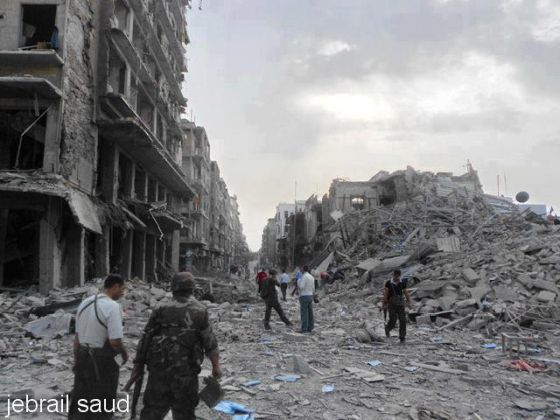
Two car bombs rocked Saadallah al-Jabri Square in Aleppo, causing much damage and death. 40 reported dead so far. VOA story. The obliterated building to the right of the picture is a well known coffee shop that occupies the corner of the street facing the Siyahi hotel, which is seen at the left of the picture. The real target, however, was undoubtedly the “officers club” or “nadi Al-zubbat” which is located directly to the right of the coffee shop. Other pictures of the scene, clearly show that the club was totally destroyed by the blast.” Another explosion took place near Aleppo’s Chamber of Commerce.
Paul Mason writes: “Independence for Catalonia? Over my dead body… and those of many soldiers.” That was how Francisco Alaman reacted to the 1.5 million strong demonstration in Barcelona last month, with many calling for independence for the region.
It’s a view. Quite strongly held not just on the right in Spain but on the centre left. However Alaman is a serving soldier: a colonel. And it wasn’t the only incendiary thing he said.
In the week tens of thousands of protesters surrounded parliament, he told the website Alerta Digital:
“The current situation is very similar to 1936, but without blood. Unfortunately, the data indicate that the situation will only get worse in the coming months and years.”
Economics journalists have learned, (thanks to the work of the FT’s Gillian Tett), to ask a very brutal and searching question as we parachute into the latest theatre of crisis: look for the social silence. What is staring you in the face but nobody wants to talk about it?
Well Colonel Alaman has answered it.
During the early years of Spanish democracy, forgetting about the Civil War (1936-39) was not just a psychological necessity – it was a political choice.
The “pact of silence” instituted after the fall of General Franco was seen as a price worth paying for rapid, peaceful transition to a functioning democracy – a democracy that, moreover, found space to accommodate a strong, previously clandestine Communist Party alongside the rapidly moderating socialists of the PSOE (Spanish Socialist Workers’ Party).
The approach was codified into law, with the 1977 Amnesty Law guaranteeing a blanket immunity from prosecution for those suspected of crimes against humanity during the Franco era and the Civil War.
With Spain now reeling from austerity, its riot police dispensing truncheon blows and rubber bullets against demonstrators and passers-by, the “pact of silence” is falling apart. [Continue reading…]
The Associated Press reports: A Hezbollah commander and several fighters have been killed inside Syria, a Lebanese security official said Tuesday, a development that could stoke already soaring tensions over the Lebanese militant group’s role in the civil war next door.
Hezbollah’s reputation has taken a beating over its support for the Syrian regime, but any sign that the group’s fighters are taking part in the battle raises fears that the conflict could expand into a wider fight engulfing the region.
Hezbollah has stood by Syrian President Bashar Assad since the uprising began 18 months ago, even after the group supported revolts in Egypt, Tunisia, Libya and Bahrain.
Assad’s fall would be a dire scenario for Hezbollah. Any new regime led by Syria’s majority Sunni Muslims would likely be far less friendly — or even outright hostile — to Shiite Muslim Hezbollah. Iran remains the group’s most important patron, but Syria is a crucial supply route. Without it, Hezbollah will struggle to get money and weapons as easily.
The Syrian uprising has left Assad deeply isolated — making his remaining allies such as Iran and Russia all the more important. At last week’s gathering of world leaders at the United Nations, dozens of nations excoriated the Assad regime for its role in a conflict that activists estimate has killed at least 30,000 Syrians.
It was not immediately clear how the Hezbollah militants were killed or whether they had been fighting alongside the Syrian army. But Hezbollah’s newspaper al-Intiqad said Hezbollah commander Ali Hussein Nassif, who is also known as Abu Abbas, was killed “while performing his jihadi duties.” It did not say when or where he was killed.
A Lebanese security official said Nassif was killed in Syria and his body was returned to Lebanon through the Masnaa border crossing on Sunday. Speaking on condition of anonymity because he is not authorized to speak to the media, the official said the bodies of several other Hezbollah fighters have been brought back to Lebanon in recent days. [Continue reading…]
Hezbollah has a problem: how does a resistance movement defend the status quo?
The New York Times reports: State television in Syria issued a withering attack late Monday on a longtime ally, the leader of the Palestinian militant group Hamas, Khaled Meshal, declaring him an ungrateful child and a corrupt traitor, saying he was having a “romantic emotional crisis” over the Syrian uprising and accusing him of selling out “resistance for power.”
The extraordinary reproof, a departure from the blander tone of most Syrian official statements, was the government’s first broadside against Hamas since the organization distanced itself from the embattled President Bashar al-Assad earlier this year, when most Hamas leaders left their refuge in Damascus and shuttered their office there.
The attack was a television editorial delivered by a newscaster in alternately stern and mocking tones, who reminded Mr. Meshal that he was “orphaned” by Arab countries who would not take him in when he fled Jordan in 1999. She implied that he must have sold out to Israel, saying that was the only explanation for the willingness of Qatar, his new host, to accept him.
Damascus seemed to be striking back after Mr. Meshal appeared at a news conference of the party of Turkey’s prime minister, Recep Tayyip Erdogan, and after Mr. Erdogan and Egypt’s president, Mohamed Morsi, pointedly declared their shared priorities of opposing Mr. Assad and supporting the Palestinians — a blow to Mr. Assad’s longstanding and domestically compelling persona as the champion of Palestinian resistance against Israel.
Damascus is likely particularly furious that Mr. Meshal has taken up residence in Qatar, one of the countries, along with Saudi Arabia and the United States, that it accuses of bankrolling the insurgency. [Continue reading…]
IPS reports: When world leaders packed their bags and headed home last week, there was one lingering memory of the General Assembly’s high-level debate: Benjamin Netanyahu’s dramatic presentation of a cartoonish nuclear red line, which hit the front pages of most mainstream newspapers in the United States.
The Israeli prime minister warned Iran against crossing that red line even though the Jewish state itself had crossed it when it went nuclear many moons ago.
As Mouin Rabbani, contributing editor to the Middle East Report, told IPS, “The real absurdity of Netanyahu lecturing the world about nuclear weapons was precisely that – an Israeli leader lecturing the world about the dangers of nuclear proliferation in the Middle East.”
The fact of the matter is that not only is Israel the region’s sole nuclear power, and not only has it on previous occasions all but threatened to use these weapons of mass destruction, but it has since its establishment consistently and steadfastly rejected ratification of the Nuclear Non-Proliferation Treaty (NPT), Rabbani said.
“It’s a bit like listening to (Hustler magazine publisher) Larry Flynt denouncing pornography – though to be fair to Flynt, it’s unlikely he will reach the levels of hypocrisy displayed by Netanyahu,” said Rabbani, a Middle East expert who has written extensively on the politics of the volatile region. [Continue reading…]
The Independent reports: Stockpiles of arms, including anti-aircraft and anti-tank missiles, are being held in Turkey for use by rebels in Syria’s civil war, but their distribution is being held up because of disunity and feuding between the different groups of fighters, The Independent has learned.
In high-level discussions, Qatari and Turkish suppliers told opposition representatives that heavy weapons would not be made available until the various factions agreed to form a coherent command structure.
After 18 months of fighting and an estimated 30,000 people dead, rebel fighters are convinced that the time for a negotiated end to the conflict is over. But they have been forced back from many areas by tanks, artillery and air strikes. The regime, meanwhile, has not faced any significant shortage of supplies, with US officials claiming that daily flights bearing arms are coming in from President Bashar al-Assad’s ally, Iran.
One attempt to set up an arms supply chain took place in the Turkish capital, Ankara, in early August. Opposition representatives were seeking weapons for Aleppo where the regime forces were beginning to push forward and recapture areas held by the rebels. According to those present, the Turks were acting as facilitators while the Qataris controlled the flow of material. Both the Qataris and Turks are said to have stressed to the opposition emissaries that the revolutionaries in the main cities, starting with Aleppo, needed to form structured military councils and come up with co-ordinated operational plans. [Continue reading…]
McClatchy reports: Austin Tice, an American freelance journalist in Syria who hasn’t communicated with family and colleagues since mid-August, is shown alive and in the custody of armed men in a video posted on YouTube.
In the 47-second clip, headlined “Austin Tice still alive,” he’s shown blindfolded and disoriented, mangling an Islamic prayer before crying out, “Oh, Jesus.” Masked gunmen who act like militant Islamists surround him, calling out “God is great!” and wearing the baggy traditional outfits of fighters operating in Afghanistan.
The video was posted Wednesday but it escaped notice until early Monday, when a link to it appeared on a Facebook page that appears to support the Syrian government of President Bashar Assad. Tips and other evidence previously gathered by the news organizations to which Tice contributed have suggested that he’s in the custody of the Syrian government.
[…]
Murad Batal al Shishani, a London-based analyst of jihadists who’s monitored extremist groups since the early 1990s, said many aspects of the video didn’t jibe with the communiques that al Qaida-style extremists typically sent out. The call-and-response rhythm in the cries of “God is great” seems off, he said, and it would be unusual for jihadists to include Tice’s mangled prayer, or to release such a low-quality clip when they’re known for slickly produced videos distributed via their own media wings.
“If it was a jihadi video, they have their own platforms. They wouldn’t release it on YouTube,” Shishani said.
The YouTube user who posted the video hadn’t previously uploaded to the site, suggesting that the account may have been created to disseminate the video. Analysts also pointed out that the captions include English and Arabic, which would be unusual – but not unheard of – for a jihadist group.
The clip was later shared on a Facebook page and Twitter account associated with a group called “the Media Channel for Assad’s Syria,” which echoes the government’s line that opposition rebels are terrorists intent on destabilizing Syria. The group’s tweet reads, “Important, please publish and share our clip on the truth about the disappearance of the American journalist Austin Tice.”
The Facebook page posting asserts that “the American journalist Austin Tice is with the Nusra Front gangs and al Qaida in Syria,” a reference to Jabhat al Nusra, a jihadist group that’s part of the opposition forces fighting Assad’s troops. For weeks, U.S. analysts have sounded alarm about the presence of an avowed jihadist group on the battlefield, a development that rattles not only Assad’s regime but also the non-Islamist Syrian opposition and its Western allies.
Jabhat al Nusra boasts a sophisticated media wing that produces a Twitter feed and videos that are clearly labeled and edited. The group repeatedly has said that any release outside its established platforms should be considered fake, said Aaron Zelin, who researches militants for the Washington Institute for Near East Policy and blogs about them at Jihadology.net.
A typical Nusra video, Zelin said, “would start out with a graphic of the media outlet, then a Quranic verse written out, then a series of videos of attacks or someone reading his last words before going out on a suicide mission, a martyrdom operation.”
McCants, the former government terrorism adviser, echoed that observation.
“Everything about the video is uncharacteristic of a polished al Qaida group like Nusra,” he said. “It doesn’t mean it wasn’t them, but there’s nothing that points in that direction.”
Robert Mackey adds:Joseph Holliday, a former United States Army intelligence officer who tracks Syrian rebel groups for the Institute for the Study of War in Washington, told The Post that it seemed strange that the armed men around Mr. Tice were wearing what appear to be salwar kameez, traditional clothing worn in Afghanistan, which looked very clean. “It’s like a caricature of a jihadi group,” he said. “My gut instinct is that regime security guys dressed up like a bunch of wahoos and dragged him around and released the video to scare the U.S. and others about the danger of Al Qaeda extremists in Syria. It would fit their narrative perfectly.”
In a post Tice put up on his Facebook page on July 25, he wrote:
Every person in this country fighting for their freedom wakes up every day and goes to sleep every night with the knowledge that death could visit them at any moment. They accept that reality as the price of freedom. They realize there are things worth fighting for, and instead of sitting around wringing their hands about it, or asking their lawyer to file an injunction about it, they’re out there just doing it. And yeah most of them have little idea what they’re doing when they pick up a rifle, and yes there are many other things I could complain about, but really who cares. They’re alive in a way that almost no Americans today even know how to be. They live with greater passion and dream with greater ambition because they are not afraid of death.
Neither were the Pioneers. Neither were our granddads. Neither was Neil Armstrong. And neither am I.
No, I don’t have a death wish – I have a life wish. So I’m living, in a place, at a time and with a people where life means more than anywhere I’ve ever been – because every single day people here lay down their own for the sake of others. Coming here to Syria is the greatest thing I’ve ever done, and it’s the greatest feeling of my life.
As a proudly declared partisan, who would see Tice as a threat? A jihadi group — or any other opponent of Assad? I don’t think so.
The Syrian government no doubt has a file on every foreign journalist in Syria whose presence they are aware of. Tice — a freelancer willing to venture places that most newspapers are reluctant send their own reporters — would probably look like an attractive target to authorities who want to intimidate other reporters yet sustain doubt about the identity of Tice’s captors.
Alireza Nader writes: Iran’s response to Israeli or U.S. air strikes is likely to feature unconventional tactics that would not necessarily lead to battlefield successes, such as defeat of the U.S. Fifth Fleet. But its strategy could theoretically achieve an overall political and psychological victory.
The Islamic Republic’s reaction would incorporate lessons learned from the eight-year Iran-Iraq War in the 1980s and the 34-day war between Israel and Hezbollah in 2006 — two of the defining conflicts of the late 20th century. The Gulf War was the longest and deadliest modern Middle East conflict. And Hezbollah, with aid and arms from Iran, fought the longest modern war with Israel. Iran would almost certainly also factor in past U.S. military operations in the region.
Despite their boasting, Iranian leaders are well aware that they cannot defeat the U.S. military in a face-to-face conflict. But as Hezbollah’s 2006 war with Israel demonstrated, battlefield losses (or draws) can be turned into psychological victories. The Islamic Republic has devoted substantial information and media resources to fight a psychological war (jang e ravani). Hezbollah was able to withstand the Israeli military and shoot missiles into Israeli cities throughout the conflict — and thus convince many Arabs that it had won.
Iran could again try to claim a victory simply by withstanding an assault and retaining much of its nuclear know-how and technology, even if it sustained significant losses. But Israel and the United States have also learned from the 2006 Hezbollah war. Regardless, any war with Iran could be long, costly and ultimately unsuccessful in eliminating Iran’s nuclear drive. [Continue reading…]
The New York Times reports: With the surge of American troops over and the Taliban still a potent threat, American generals and civilian officials acknowledge that they have all but written off what was once one of the cornerstones of their strategy to end the war here: battering the Taliban into a peace deal.
The once ambitious American plans for ending the war are now being replaced by the far more modest goal of setting the stage for the Afghans to work out a deal among themselves in the years after most Western forces depart, and to ensure Pakistan is on board with any eventual settlement. Military and diplomatic officials here and in Washington said that despite attempts to engage directly with Taliban leaders this year, they now expect that any significant progress will come only after 2014, once the bulk of NATO troops have left.
“I don’t see it happening in the next couple years,” said a senior coalition officer. He and a number of other officials spoke on the condition of anonymity because of the delicacy of the effort to open talks.
“It’s a very resilient enemy, and I’m not going to tell you it’s not,” the officer said. “It will be a constant battle, and it will be for years.”
The failure to broker meaningful talks with the Taliban underscores the fragility of the gains claimed during the surge of American troops ordered by President Obama in 2009. The 30,000 extra troops won back territory held by the Taliban, but by nearly all estimates failed to deal a crippling blow.
Critics of the Obama administration say the United States also weakened its own hand by agreeing to the 2014 deadline for its own involvement in combat operations, voluntarily ceding the prize the Taliban has been seeking for over a decade. The Obama administration defends the deadline as crucial to persuading the Afghan government and military to assume full responsibility for the country, and politically necessary for Americans weary of what has already become the country’s longest war. [Continue reading…]
Boston Magazine reports: Barack Obama embraces his Chicago ties, George W. Bush is so Texan he clears brush for fun, and Bill Clinton was the Man from Hope. But Romney has, at best, an awkward relationship with our commonwealth. According to a MassInc poll from the summer, 52 percent of Massachusetts residents currently view him unfavorably, while just 35 percent see him in a positive light. By contrast, fellow Republican Scott Brown has the reverse numbers: 48 percent favorable, 30 percent unfavorable. Romney is expected to lose Massachusetts by 15 to 20 points in November.
When he does talk about his time here as governor, it’s usually to pump up his bipartisan bona fides or brag about how he balanced the budget without raising taxes. (Strictly speaking, this is true, though helpfully devoid of context: All Massachusetts governors are constitutionally required to balance the budget, and while Romney technically may not have raised taxes, he did hike fees on a variety of government services.) What he does not discuss are the hugely successful bills he passed, like universal healthcare and an assault-weapons ban. Obviously, he also does not mention just how unpopular he was when he left office.
So please, America, pay attention. There’s been too little talk about Romney’s time as governor of Massachusetts, and now that you’re deciding whether to make him our next president, it’s worth understanding just how and why he alienated the voters who know him best. [Continue reading…]
Ari Berman reports: The state of Florida has an unfortunate history of disenfranchising voters. We all remember the “hanging chads” of 2000. Less well-known is how Florida wrongly labeled 12,000 eligible voters as felons, 41 percent of whom were African-Americans, and kicked them off the voting rolls that year, which could have very well cost Al Gore the election. Florida attempted another controversial voter purge in 2004, but was forced to scrap the plan after public outcry (history is repeating itself this year). The 2008 election, however, was noticeably smooth in the Sunshine State, producing a surprising victory for Barack Obama.
Following the 2010 election, Florida Republicans concluded that it was a little too easy to vote in the state. “I want the people in the State of Florida to want to vote as bad as that person in Africa who is willing to walk 200 miles for that opportunity he’s never had before in his life,” said GOP State Senator Michael Bennett. “This should not be easy.”
Upon taking office in 2011, Florida Governor Rick Scott and the Republican legislature drastically changed the state’s election laws by preventing ex-felons from being able to cast a ballot after serving their time, cutting back early voting from fourteen to eight days, and severely restricting voter registration drives. [Continue reading…]
This website or its third-party tools use cookies, which are necessary to its functioning. By closing this banner, you agree to the use of cookies.