Author Archives: News Sources

U.S. more than doubles previous record in global weapons sales

In the last two years, American arms manufacturers have profited massively from increased tension between Gulf states and Iran, thanks in large part to repeated threats of war emanating from Israel.

The New York Times reports: Weapons sales by the United States tripled in 2011 to a record high, driven by major arms sales to Persian Gulf allies concerned about Iran’s regional ambitions, according to a new study for Congress.

Overseas weapons sales by the United States totaled $66.3 billion last year, or more than three-quarters of the global arms market, valued at $85.3 billion in 2011. Russia was a distant second, with $4.8 billion in deals.

The American weapons sales total was an “extraordinary increase” over the $21.4 billion in deals for 2010, the study found, and was the largest single-year sales total in the history of United States arms exports. The previous high was in fiscal year 2009, when American weapons sales overseas totaled nearly $31 billion.

A worldwide economic decline had suppressed arms sales over recent years. But increasing tensions with Iran drove a set of Persian Gulf nations — Saudi Arabia, the United Arab Emirates and Oman — to purchase American weapons at record levels. [Continue reading…]

Facebooktwittermail

The U.S. Navy adviser who thwarted a plan to provoke war with Iran

Jeff Stein reports: Gwenyth Todd had worked in a lot of places in Washington where powerful men didn’t hesitate to use sharp elbows. She had been a Middle East expert for the National Security Council in the Clinton administration. She had worked in the office of Defense Secretary Dick Cheney in the first Bush administration, where neoconservative hawks first began planning to overthrow Iraqi dictator Saddam Hussein.

But she was not prepared a few years later in Bahrain when she encountered plans by high-ranking admirals to confront Iran, any one of which, she reckoned, could set the region on fire. It was 2007, and Todd, then 42, was a top political adviser to the U.S. Navy’s 5th Fleet.

Previous 5th Fleet commanders had resisted various ploys by Bush administration hawks to threaten the Tehran regime. But in spring 2007, a new commander arrived with an ambitious program to show the Iranians who was boss in the Persian Gulf.

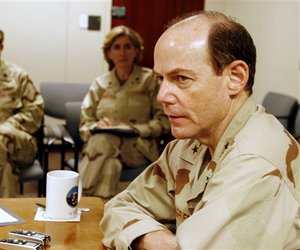
Vice Adm (Ret) Kevin J. Cosgriff now sits on the board of the Washington DC think tank, the Stimson Center.

Vice Adm. Kevin J. Cosgriff had amassed an impressive résumé, rising through the ranks to command a cruiser and a warship group after the Sept. 11, 2001, terrorist attacks. Following a customary path to three stars, he had also spent as much time in Washington as he had at sea, including stints at the Defense Intelligence Agency and as director of the Clinton White House Situation Room.

Cosgriff — backed by a powerful friend and boss, U.S. Central Command (Centcom) chief Adm. William J. “Fox” Fallon — was itching to push the Iranians, Todd and other present and former Navy officials say.

“There was a feeling that the Navy was back on its heels in dealing with Iran,” according to a Navy official prohibited from commenting in the media. “There was an intention to be far more aggressive with the Iranians, and a diminished concern about keeping Washington in the loop.”

Two people who were there said Cosgriff mused in a staff meeting one day that he’d like to steam a Navy frigate up the Shatt al Arab, the diplomatically sensitive and economically crucial waterway dividing Iraq and Iran. In another, they said, he wanted to convene a regional conference to push back Iran’s territorial claims in the waterway, a flash point for the bloody Iran-Iraq war in the 1980s.

Then he presented an idea that not only alarmed Todd, but eventually, she believes, launched the chain of events that would end her career.

Cosgriff declined to discuss any of these meetings on the record. This story includes information from a half-dozen Navy and other government officials who demanded anonymity because of the sensitivity of the matter, many parts of which remain classified.

According to Todd and another witness, Cosgriff’s idea, presented in a series of staff meetings, was to sail three “big decks,” as aircraft carriers are known, through the Strait of Hormuz — to put a virtual armada, unannounced, on Iran’s doorstep. No advance notice, even to Saudi Arabia and other gulf allies. Not only that, they said, Cosgriff ordered his staff to keep the State Department in the dark, too.

To Todd, it was like something straight out of “Seven Days in May,” the 1964 political thriller about a right-wing U.S. military coup. [Continue reading…]

Facebooktwittermail

One man against the Wall Street lobby

Simon Johnson writes: Two diametrically opposed views of Wall Street and the dangers posed by global megabanks came more clearly into focus last week. On the one hand, William B. Harrison, Jr. – former chairman of JP Morgan Chase – argued in the New York Times that today’s massive banks are an essential part of a well-functioning market economy, and not at all helped by implicit government subsidies.

On the other hand, there is a new powerful voice who knows how big banks really work and who is willing to tell the truth in great and convincing detail. Jeff Connaughton – a former senior political adviser who has worked both for and against powerful Wall Street interests over the years – has just published a page-turning memoir that is also a damning critique of how Wall Street operates, the political capture of Washington, and our collective failure to reform finance in the past four years. “The Payoff: Why Wall Street Always Wins,” is the perfect antidote to disinformation put about by global megabanks and their friends.

Specifically, Mr. Harrison makes six related arguments regarding why we should not break up our largest banks. Each of these is clearly and directly refuted by Mr. Connaughton’s experience and the evidence he presents.

First, Mr. Harrison claims that megabanks are the natural outgrowth of requests from customers, rather than the result of extraordinary resources spent on lobbying over the past 30 years. Mr. Connaughton’s book contains all you need to know – and more than you can stomach – about the realities of how the influence industry has worked diligently to build and defend megabanks. The people who really wanted the banks to become bigger were the executives in charge of those organizations – like Mr. Harrison. They spent a lot of money to make this happen. [Continue reading…]

Facebooktwittermail

Assad forces accused of massacre in Damascus suburb

The New York Times reports: Mass burials in this Damascus suburb on Sunday showed the carnage of the past few days in gruesome detail: scores of bodies lined up on top of each other in long thin graves moist with mud.

A video of what activists described as the fifth grave to be filled showed two small children near the edge. Up close, in the field where there were more bodies than people to wash and prepare them for burial, the scent of decay swirled and gunshot wounds could be seen in the heads of many men.

“The Assad forces killed them in cold blood,” said Abu Ahmad, 40, a resident of Daraya, where the Syrian government has waged a campaign it described as a “cleansing.” “I saw dozens of dead people, killed by the knives at the end of Kalashnikovs, or by gunfire. The regime finished off whole families, a father, mother and their children. They just killed them without any pretext.”

Several other witnesses here and two activist groups have now offered accounts of what has begun to look like one of the deadliest and focused short-term assaults by the Syrian military since the uprising started nearly 18 months ago. Residents described how the Syrian Army first closed off the town, keeping civilians from fleeing, then methodically began a campaign of heavy shelling and house-to-house searches.

Even as many of the details are still difficult to verify or determine — the exact number killed, how many were executed or died from shelling — evidence of what activists described as a massacre continues to mount.

The death toll, rising all week, grew again on Sunday. A day after two activist networks, the Local Coordination Committees and the Syrian Observatory for Human Rights, said that more than 200 bodies had been found in the town, activists said another 15 bodies were discovered in the basement of a home in the area. That put the death toll for the week at more than 630 in the city, said the Local Coordination Committees, including 300 people reported executed. [Continue reading…]

Facebooktwittermail

Hamas declines invite to Iran summit, citing Palestinian unity

Reuters reports: The Hamas Islamist government in Gaza said it had declined an invitation to a meeting of 120 developing nations in Tehran this week, heading off a potential confrontation with rival Palestinian leaders in the West Bank.

Ismail Haniyeh, Hamas’s leader in Gaza, had accepted the invite over the weekend but backtracked on Sunday “in order that the participation would not be an introduction to deepening a Palestinian, Arab and Muslim division over the Palestinian cause,” said spokesman Taher al-Nono.

Iran’s call for Hamas to attend the annual Non-Aligned Movement conference had infuriated the Western-backed Palestinian Authority (PA), which sees itself as the sole legitimate representative of all Palestinians.

PA leader President Mahmoud Abbas has been at loggerheads with Hamas since his forces lost control of Gaza in a brief 2007 war with the Islamist movement. He has since governed only in the occupied West Bank.

Abbas had also accepted an invitation to the conference. But his aides had earlier mulled cancelling the trip if Haniyeh attended.

“We won’t allow Palestinian representation to be ripped up – we won’t allow anyone to do this,” Abbas told a cheering crowd at a civic event in the West Bank capital of Ramallah earlier on Sunday.

“We are capable of looking after ourselves and our dignity, and we want unity and want to return to this unity,” he added.

Facebooktwittermail

Libyan congress seeks answers in attacks on Sufi shrines

The Wall Street Journal reports: Libya’s newly elected congress held an emergency session on Sunday about the destruction over the weekend of two of the country’s most revered Sufi shrines by suspected religious extremists, who some lawmakers allege may have undertaken their actions in collusion with security officials.

The brazen attacks in two cities underscore the shaky nature of the emerging democracy in Libya, where elected officials have little sway over security forces. The destruction has raised fears that conservative religious groups—whose candidates were soundly beaten in the country’s July election—may attempt to sabotage Libya’s transition to a secular, modern state.

At sunrise on Saturday, Libyan adherents of the rigid Salafi school of Islam brought bulldozers into the center of Tripoli and flattened the expansive, centuries-old Sidi Al-Sha’ab shrine. Uniformed members of at least two separate government security divisions that answer to the Interior Ministry barricaded the busy seafront road where the religious complex was located and allowed the daylong demolition to continue, according to witnesses.

That destruction followed vandalism Friday night at Libya’s most revered Sufi mosque in Zlitan, west of the capital, and the burning of an adjoining library that housed hundreds of theological treatises dedicated to the mystical branch of Islam that historically has been practiced across much of North Africa.

Mohamed Almagariaf, head of Libya’s new congress, denounced the violence as crimes against Islam, and demanded answers from the ministers of interior and defense as to why the buildings hadn’t been protected by the forces under their command.

“These kinds of actions are unacceptable and condemned by our religion,” Mr. Magariaf said in a televised statement. “What is truly regrettable and suspicious is that some of those who took part in these destruction activities are supposed to be of the security forces.”

On Sunday evening, Interior Minister Fawzi Abdel A’al announced his resignation in an interview with Arabic news station Al Jazeera, saying he rejected the criticism leveled by lawmakers against his security forces. Mr. A’al told the network that his forces have done an excellent job keeping the nation safe from threats.

No one from the Interior Ministry appeared at Sunday’s closed session of congress, despite demands from Mr. Magariaf for their attendance and a chorus of outraged speeches from numerous lawmakers, some of whom compared the weekend destruction to the desecration by the Taliban of Afghanistan’s giant Buddha statues. An official from the Defense Ministry appeared, but it wasn’t immediately clear what information he provided to the lawmakers.

Deputy Prime Minister Mustafa Abushagour said the defense and interior ministers failed to obey his order to protect the shrines. He said those who were responsible for the destruction “would be held accountable.”

It remained unclear on Sunday whether an official investigation had been opened into the violence. [Continue reading…]

Facebooktwittermail

Israel breaks silence over army abuses

Donald Macintyre reports: Hafez Rajabi was marked for life by his encounter with the men of the Israeli army’s Kfir Brigade five years ago this week. Sitting beneath the photograph of his late father, the slightly built 21-year-old in jeans and trainers points to the scar above his right eye where he was hit with the magazine of a soldier’s assault rifle after the patrol came for him at his grandmother’s house before 6am on 28 August 2007.

He lifts his black Boss T-shirt to show another scar running some three inches down his back from the left shoulder when he says he was violently pushed – twice – against a sharp point of the cast-iron balustrade beside the steps leading up to the front door. And all that before he says he was dragged 300m to another house by a unit commander who threatened to kill him if he did not confess to throwing stones at troops, had started to beat him again, and at one point held a gun to his head. “He was so angry,” says Hafez. “I was certain that he was going to kill me.”

This is just one young man’s story, of course. Except that – remarkably – it is corroborated by one of the soldiers who came looking for him that morning. One of 50 testimonies on the military’s treatment of children – published today by the veterans’ organisation Breaking the Silence – describes the same episode, if anything more luridly than Hafez does. “We had a commander, never mind his name, who was a bit on the edge,” the soldier, a first sergeant, testifies. “He beat the boy to a pulp, really knocked him around. He said: ‘Just wait, now we’re taking you.’ Showed him all kinds of potholes on the way, asked him: ‘Want to die? Want to die right here?’ and the kid goes: ‘No, no…’ He was taken into a building under construction. The commander took a stick, broke it on him, boom boom. That commander had no mercy. Anyway the kid could no longer stand on his feet and was already crying. He couldn’t take it any more. He cried. The commander shouted: ‘Stand up!’ Tried to make him stand, but from so much beating he just couldn’t. The commander goes: ‘Don’t put on a show,’ and kicks him some more.”

Two months ago, a report from a team of British lawyers, headed by Sir Stephen Sedley and funded by the UK Foreign Office, accused Israel of serial breaches of international law in its military’s handling of children in custody. The report focused on the interrogation and formal detention of children brought before military courts – mainly for allegedly throwing stones.

For the past eight years, Breaking the Silence has been taking testimonies from former soldiers who witnessed or participated in human rights abuses in the occupied territories. Most of these accounts deal with “rough justice” administered to minors by soldiers on the ground, often without specific authorisation and without recourse to the military courts. Reading them, however, it’s hard not to recall the Sedley report’s shocked reference to the “belief, which was advanced to us by a military prosecutor, that every Palestinian child is a ‘potential terrorist'”.

The soldier puts it differently: “We were sort of indifferent. It becomes a kind of habit. Patrols with beatings happened on a daily basis. We were really going at it. It was enough for you to give us a look that we didn’t like, straight in the eye, and you’d be hit on the spot. We got to such a state and were so sick of being there.”

Some time ago, after he had testified to Breaking the Silence, we had interviewed this soldier. As he sat nervously one morning in a quiet Israeli beauty spot, an incongruous location he had chosen to ensure no one knew he was talking, he went through his recollections about the incident – and several others – once again. His account does not match the Palestinian’s in every detail. (Hafez remembers a gun being pressed to his temple, for example, while the soldier recalls that the commander “actually stuck the gun barrel in the kid’s mouth. Literally”.) [Continue reading…]

Facebooktwittermail

Our revolution was civil and pluralistic

Rami G Khouri writes: Mass demonstrations in Tahrir Square and street battles in Syria form the dramatic heart of the uprisings and revolutions that define many Arab lands these days, but the soul and the brain of the Arab world to come are being shaped in the epic battles now taking place to write new constitutions.As has happened regularly since December 2010, we must look back to Tunisia and Egypt for insights into this critical realm. The lessons to date are enlightening and heartening, as we see these days from passionate debates about issues like the status of women, the role of journalists, and the place of Islam and religion in state institutions and public life.

The fine points of writing new constitutions are often tedious and just slightly more captivating than Law of the Sea deliberations. So it is surprising perhaps to see street demonstrations and much political passion in Egypt and Tunisia over elements of the constitutional process, whether the composition of the bodies drafting the constitutions or the actual texts being formulated. This is not so surprising, though, in view of the widespread demands for constitutional reform across the entire Arab world, even in countries where no significant street demonstrations have taken place.

One of the telltale signs of the high importance that Arabs attach to this process is that calls for changing or reforming governments across the region have always been coupled with demands for new constitutions. These are important to the citizenry because they spell out in concrete and unambiguous terms the equal rights of every citizen, and they provide enforcement and accountability mechanisms to make sure that those rights are actually practiced. Arab constitutions for the past century (in fact since the first modern Arab constitution was promulgated in 1861 in … Tunisia) have all promised a full range of rights and freedoms; but these rights were never fully enforced, leaving it to security-minded governments and narrow ruling elites to monopolize power in a manner that deeply disenfranchised most citizens.

So it is important to note that beyond Tunisia, Egypt, Libya and Yemen, where lifelong autocratic leaders and their elites are being replaced by more legitimate elected governments, countries like Jordan, Morocco and Oman have started tinkering with their mechanisms of power and rule, in response to populist demands for constitutional reform and more egalitarian and participatory governance systems. The changes are limited and often superficial, but they do reflect both the nature of the populist demands for constitutional changes and the reality that long-serving regimes must respond to those demands in some manner. [Continue reading…]

Facebooktwittermail

Turkey’s Syria conundrum

Sinan Ulgen writes: Syria used to be the poster child for Ankara’s “zero problems with neighbors” policy. At the peak of their rapprochement, Turkey and Syria were holding joint cabinet meetings and talking about spearheading a common market in the Middle East. Then the Arab wave of reforms reached Damascus. The relationship turned hostile as the Syrian leadership resisted reforms and engaged in large-scale massacres to subdue the opposition.

With the support of Prime Minister Erdogan, Turkey’s foreign minister Davutoglu positioned Ankara in the vanguard of the community of nations seeking regime change in Syria. Thus Ankara gave support to the Syrian National Council and harbored the Free Syrian Army. Even when former UN secretary-general Annan’s plan for a political settlement was announced, the Turkish leadership made it clear that there could be no solution with Assad in power.

With this policy of direct confrontation, Ankara not only strove to obtain the moral high ground. It also sought to precipitate the fall of Assad while building a relationship with the future leadership of Syria by heavily investing in the Muslim Brotherhood-dominated Syrian National Council.

Today, this policy of forcefully pushing the regime change agenda in Syria is under criticism domestically as some of the risks of a post-Assad world are becoming clearer.

The fear in Turkey is of Syria’s disintegration into ethnically and religiously purer ministates, with a Kurdish entity in the north, an Alawite entity in the west and a Sunni entity in the rest. The Kurdish opposition’s recent unilateral power grab in northeastern Syria rekindled Turkish concerns about the emergence of an independent Kurdish entity linking the north of Iraq to the north of Syria.

The right policy response to this threat would certainly have been for the Turkish body politic to finally and permanently address Turkey’s own Kurdish problem. But the Justice and Development Party (AKP) leadership’s prevailing populist tendencies seem to preclude this option despite a well-intentioned effort undertaken before the 2011 elections. The fact that even the highly popular AKP, facing no imminent threat to its rule, backed away from tackling this complex issue does not bode well for the prospects of a lasting settlement. [Continue reading…]

Facebooktwittermail

Syrian regime hits back in Damascus as ill-equipped rebels struggle

The Guardian reports: With Syria’s second city, Aleppo, consumed by violence, war has returned with a vengeance to its capital. But in Damascus, the regime, rather than rebel groups, is on the attack. The summer offensive that rebel leaders envisaged is, so far, not going to plan.

Nationwide, the intensity of violence and number of dead and wounded is now at its highest level since the uprising began more than 18 months ago. Western officials, activists and rights groups estimate that close to 5,000 people have died during the past month alone. “It was a good Ramadan for the regime,” said one western official. “If you can call 5,000 dead people good.”

In Aleppo, savage fighting along several front lines is claiming around 30-60 victims per day, including government soldiers. The city looks and feels abandoned. Most citizens who live in the rebel-held eastern half have either left, or have bunkered down in their homes, where few supplies are reaching them from regime-held areas to the south.

Siege is crippling the opposition areas of the city. And a well-chronicled withering rain of shells from tanks and jets is wearing down both fighters and the few residents who have remained.

As Aleppo has been burning, however, Damascus has also re-ignited, but with much less attention.

The rebel insurrection in the capital, which struck fear into the heart of the regime from 18 July, with the killing of three security chiefs, was put down by loyalist forces around 10 days later, and does not at present appear to have lived up to expectations.

The assault on the capital had led to large numbers of desertions and defections and sharply bolstered rebel morale in other areas of the country, especially in Aleppo where the charge was led by forces who had rapidly ousted loyalists from security bases in the hinterland.

For the first time since the start of the uprising, the regime had appeared rattled. Its inner sanctum, watertight for four decades, started to creak and the number of defectors or deserters from Syria’s 300,000-strong army is believed by Turkish and western observers to have topped 50,000.

Since then attacks on rebel strongholds in Damascus have intensified and the opposition’s capacity to counter them seems to have tapered off.

“We don’t know what’s going on in Damascus,” said one rebel leader in Aleppo this week. “All we know is that there’s a big fight happening here.”

While rebel forces have shown more of an ability to co-ordinate operations – the summer offensive on the two leading cities is a case in point – they remain unable to make effective use of the officers who held command and control positions in the regime army and who have since sided with them.

“These officers cross the border into Turkey and then we don’t see them again,” said Sheikh Tawfiq Abu Sleiman, who commands a Free Syria Army unit in northern Aleppo. “They never come back to the battlefield to join us. And even if they did, many people here would not accept them.”

Neither are defecting soldiers on the Aleppo battlefield being used as reinforcements. “They go to Turkey,” said Radwan Surmeidi, a rebel who had just received three regime defectors last weekend. “They don’t join us straight away. And maybe never.”

The rebel forces’ inability to receive reinforcements is not helping them against a standing military that continues to outman and outgun them. Nor are new weapons coming their way, after the flush of guns and bombs taken in raids on regime depots abandoned by fleeing forces in late-July.

A trickle of assault weapons and ammunition comes over the border from Turkey, with the help of Saudi Arabia, Qatar and Turkish intelligence officials. However, the heavy weapons that rebel leaders have been calling for, especially anti-aircraft guns, have not arrived. [Continue reading…]

Facebooktwittermail

Why Afghanistan isn’t a campaign issue: Neither Obama nor Romney have a solution

Tony Karon writes: “Just don’t talk about the war!” was the motto evinced by John Cleese’s comic British innkeeper Basil Fawlty when entertaining German tourists at his establishment. The same motto seems to have been embraced by both candidates in the 2012 U.S. presidential election — and not simply because it’s difficult to detect significant differences on their policies for ending the longest war in America’s history. Neither President Barack Obama, nor Governor Mitt Romney can offer the electorate the prospect of a plausible outcome in Afghanistan that won’t leave many Americans wondering what was achieved in 11 years of a war that this week claimed its 2,000th American combat casualty. Opinion polls routinely find a substantial majority of Americans opposed to remaining militarily engaged in Afghanistan, which may be why the bipartisan consensus envisages most U.S. troops coming home by the end of 2014, handing security responsibility to the Afghan forces whose training and mentoring is rapidly becoming the mission’s prime focus. The Taliban won’t be defeated by the time the U.S. leaves, in other words, and it takes a leap of faith to envisage Afghan security forces finding the political will to fight the Taliban on behalf of a widely discredited Afghan regime once the U.S. leaves — and that was before the emergence of what the U.S. military calls a “systemic problem” of uniformed Afghans turning their weapons on their U.S. and NATO mentors. Afghanistan, for U.S. presidential campaign purposes, is a huge downer.

At least 40 times this year alone, U.S. and NATO soldiers have been killed by gunfire from allied security personnel in ostensibly safe bases. And the scale of of “green-on-blue” violence — although the Pentagon now prefers “insider attacks” — is difficult to determine, because such attacks are only reported when Western personnel are killed.

Insider attacks, deemed a “systemic problem” by the Pentagon, have already killed 23 Americans this year. And the vulnerability of Western troops is expected to actually increase in the coming months as a combat mission continues its transformation into one that deploys smaller groups of U.S. and NATO troops to mentor Afghan forces, exposing them to greater risk of attack from uniformed Afghans. [Continue reading…]

Facebooktwittermail

Rafael Correa hits back over Ecuador’s press freedom and charge of hypocrisy

The Guardian reports: The president of Ecuador, Rafael Correa, has hit back at critics who accuse him of hypocrisy for granting asylum to Julian Assange while launching lawsuits and verbal attacks on his country’s own media.

In an interview with the Guardian, Correa defended his approach towards free speech, saying it was necessary to rein in private newspaper, radio and TV owners who had enjoyed too much power for too long, and comparing his campaign to the investigations into Rupert Murdoch’s newspapers in the UK.

“We won’t tolerate abuses and crimes made every day in the name of freedom of speech. That is freedom of extortion and blackmail,” he said in response to concerns about recent crackdowns on private news organisations.

Days before the Ecuadorean government granted asylum to the WikiLeaks founder and promoted itself as a guardian of freedom of expression, riot police in Quito raided the offices of one of the country’s leading magazines, Vanguardia. They confiscated journalists’ computers and prevented publication for a week, ostensibly as a punishment for labour law violations.

It was the second time in less than two years that Vanguardia had been raided. Its journalists are also getting death threats after being denounced by the president during his weekly TV show, and the magazine’s editorial director was recently sued by Correa for $10m in “moral damages” for suggesting the president knew his brother was making millions of dollars from state contracts.

After a public outcry, the president withdrew one suit and issued a pardon in the other, but he defended his right to take such action: “Do we have an unwritten law that we can’t sue a journalist? Since when? So nobody should sue Murdoch and his partners in crime in Britain?”

The editorial director of Vanguardia, Juan Carlos Calderón, had earlier told the Guardian he was being targeted for criticising the administration, and accused Correa of double standards. “The government said it has granted asylum to Assange because he is politically persecuted for defending freedom of expression. But the same thing happens to us,” he said. “This is not a country with the free press described by Correa.”

He is not alone. The domestic press watchdog Fundamedios describes the situation in Ecuador as a low-intensity war on journalists that appears to be escalating. Last year, it recorded 151 cases of physical aggression against reporters, up from 101 in 2009. It says this increase is largely the result of the constant abuse directed at journalists by Correa during his weekly TV broadcast, which is carried by almost every channel.

It also notes that 17 radio stations have been shut down this year for transgressing regulations and that the government has recently issued new rules that will oblige internet service providers to provide the IP addresses of their users to the authorities, even without a court order.

“There is a huge gap between what Correa says about press freedom and reality,” said César Ricaurte, head of Fundamedios. “If Assange were Ecuadorean, I dare say he would already be in jail.” International free press campaigners, including the Committee to Protect Journalists (CPJ) and Reporters Without Borders, have also accused Correa of trying to discredit and intimidate critics.

Correa said such judgments were misguided. “The Ecuadorean and Latin American press is not like the European or North American press, which has some professional ethics. They are used to being above the law, to blackmail, to extort. I am sorry about good people on an international level who defend this kind of press.”

He denied that radio station closures were politically motivated, saying some were simply music channels that failed to conform to broadcasting rules. This will open up space for more public channels.

An insight into Correa’s strategy was given by his chief communications adviser, Fernando Alvarado who described the media as “weeds that need to be cleaned” and replaced by flowers (public and community media outlets) in a recent interview with the Mexican publication Gatopardo.Since Correa – a US-educated economist who describes himself as a moderate leftist – came to power in 2007, there has been a wider range of state and private ownership of newspapers and TV stations. There is more scope for critical non-governmental organisations and greater access to senior officials. The interviews given by Correa on Thursday were carefully staged in terms of lighting and camera work, but unscripted.

Media watchers said Correa’s approach -– particularly in his weekly live broadcasts – was as confrontational as that adopted by Hugo Chávez in Venezuela, but less destructive. “In some regards, it is like Chávez. But Chávez went too far. Though there is confrontation here, no TV stations have been closed, which was the case in Venezuela,” said Maurice Cerbino, a professor at Andina Simon Bolivar University. The confrontation, he said, was understandable given the previous situation in Ecuador in which the private media colluded with the government. [Continue reading…]

Facebooktwittermail

Attacking Iran would destroy Israel’s economy

M.J. Rosenberg writes: A couple of years before Binyamin Netanyahu was elected prime minister of Israel in 2009, I participated in a small meeting with him as a staffer for Israel Policy Forum, an organization that lobbied for the “two-state” solution.

Netanyahu was ebullient. He seemed certain that he would soon be prime minister and was bursting with plans he had developed for his return to the job he had in the late 1990s. All of those plans were about the economy (standard Milton Friedman boilerplate).

In those heady days before the worldwide economic crash of 2008, Netanyahu said he was looking forward to sustained economic growth of 8 percent, a very impressive figure. He said that Israel would soon be in the same economic category as the so-called Asian Tiger economies of South Korea, Taiwan, Hong Kong and Singapore.

Netanyahu spoke for 10 minutes and devoted not a single word to security issues. It was all economics without even a reference to the Palestinians, Iranians or effects of the occupation.

When he opened up for questions, the leader of our delegation asked if his sunny view of the future allowed for the possibility of war or another intifada. He shrugged at that, merely noting that obviously security developments would have an effect. But he didn’t foresee any problems that would alter his forecast.

Netanyahu seemed utterly sincere. He clearly believed that Israel’s security situation was fine, that there were no obvious threats looming. As for Iran, a standard component of Netanyahu speeches then as now, he didn’t even bother with his usual gloom and doom in this intimate setting with people he knew well. He talked about the economy because that is what he was focused on. He wanted to dismantle the remnants of the Labor Party-created welfare state and let business run the show.

That is, in fact, what he has done as prime minister (which is one reason why Israel is now, for the first time, the scene of mass protests against growing economic inequality).

Given his focus on the economy, it is odd that Netanyahu seems oblivious to the likely economic effects of an attack on Iran. [Continue reading…]

Facebooktwittermail

Gruesome killings mark escalation of violence in Damascus

The Washington Post reports: Scores of mutilated, bloodied bodies have been found dumped on the streets and on waste ground on the outskirts of Damascus in recent days, apparently the victims of a surge of extrajudicial killings by Syrian security forces seeking to drive rebel fighters out of the capital and its suburbs.

The scale of the current violence in Damascus eclipses the far-better-publicized battle that is underway for control of Syria’s commercial capital, Aleppo, in the north, where gains by rebel forces have enabled journalists to reach the front lines and where government artillery and aerial bombardments are causing most of the civilian casualties.

Activists say the Damascus killings reflect a new government strategy to deter support for the opposition Free Syrian Army by punishing and intimidating civilians living in areas under rebel control. Videos posted online and accounts from residents point to summary executions occurring on a scale unprecedented since the start of the 17-month-old uprising against the rule of President Bashar al-Assad.

According to the Center for the Documentation of Violations in Syria, which lists victims of violence who have been identified, 730 civilians have been killed in Damascus this month and 529 in Aleppo, a disparity that has increased over the past week as the bodies have piled up in the Syrian capital. [Continue reading…]

Facebooktwittermail

Whereabouts of journalist Austin Tice, McClatchy contributor, unknown in Syria

McClatchy reports: Austin Tice, a freelance American journalist who has contributed to McClatchy, The Washington Post and other media outlets from Syria, has been incommunicado for more than a week, his whereabouts unknown since exchanging email with a colleague.

Tice, a Georgetown University law student who served as U.S. Marine Corps infantry officer before leaving active duty in January, was one of the few foreign journalists to report from inside Syria as the civil war intensified. He entered the country in May and traveled extensively through central Syria, filing battlefield dispatches before arriving in Damascus in late July.

Tice’s reporting earned him a 2,000-strong following on Twitter, where fans of his work noted his disappearance when he stopped tweeting after Aug. 11 – when he’d recounted spending his 31st birthday listening to Taylor Swift music with rebel fighters from the Free Syrian Army.

His subsequent silence didn’t raise immediate alarm because he’d planned to leave that week, on a journey to the border that often takes days because of the fighting en route. The Damascus suburb where he was last known to have been has faced heavy bombardment in recent days, making communications difficult.

Tice’s family and colleagues are concerned for his safety and are asking anyone with knowledge of his whereabouts to come forward.

“We understand Austin’s passion to report on the struggle in Syria, and are proud of the work he is doing there. We trust that he is safe, appreciate every effort being made to locate him, and look forward to hearing from him very soon,” Tice’s parents, Marc and Debra, said in a statement from Houston, his hometown.

Tice’s editors said they were working with U.S. government agencies and Syrian intermediaries to retrace his movements. Colleagues praised Tice’s work, saying his experience as a Marine gave him particular insight into the capabilities of both government and rebel forces as the uprising spiraled into a civil war.

Facebooktwittermail

The Breivik verdict and Europe’s far right

Harvey Morris writes: The smirk on Anders Behring Breivik’s face was an indication that the Norwegian mass murderer got the verdict he wanted. By sentencing him to 21 years in jail, an Oslo court judged he was sane when he killed 77 people in a bomb and gun rampage a year ago.

It raises the alarming question of how many other sane people might be out there, prepared to murder and maim in pursuit of their far-right extremist beliefs.

Far-right groups and individuals in Europe, including those cited as sources of inspiration in Mr. Breivik’s manifesto, ran for cover in the wake of the Norway killings, distancing themselves from his murderous response to multiculturalism, if not from his ideas.

But the shock felt in Norway and elsewhere when Mr. Breivik struck appears to have done little to reverse the growth of the far-right groups in Europe, where their activities are seen as posing an enduring threat to the Continent’s democratic societies.

A day before the Norwegian verdict, the German police launched raids across the state of North Rhine-Westphalia that were aimed at breaking up a network of far-right extremists, as my colleague Melissa Eddy reported from Berlin.

“These groups are dangerous,” Burkhard Freier, the head of the state’s domestic intelligence agency, said. “We have noticed they are attracting ever more young people to their ideals.”

The rise of the far right has been variously cited to explain Europe’s harsh economic climate and on an Islamophobic response to fundamentalist Islamist terrorism that post-dates the Qaeda attacks of Sept. 11, 2001.

Matthew Goodwin, a British expert on the far right, challenged those assumptions in an academic paper last September that noted populist extremist parties continued to rally large and durable levels of support and had even joined coalition governments.

“They emerged before the terrorist attacks on 11 Sept. 2001 and the recent financial crisis,” Dr. Goodwin wrote. “They have rallied support in some of the most economically secure and highly educated regions of Europe.”

He said supporters of all these groups shared one core feature: their profound hostility towards immigration, multiculturalism and rising cultural and ethnic diversity. “Contrary to the conventional wisdom that these citizens are motivated by feelings of economic competition from immigrants and minority groups, feelings of cultural threat are the most important driver of their support.” [Continue reading…]

Facebooktwittermail

Jerusalem attack a ‘microcosm of a national problem’: Jewish racism

The Times of Israel reports: Last week’s attack on Arab youth in the heart of Jerusalem was a symptom of a larger national issue, Knesset Speaker Reuven Rivlin (Likud) said on Thursday.

Rivlin visited 17-year-old Jamal Julani, who was hospitalized after being severely beaten by a group of Jewish teenagers last week in the widely publicized incident.

“I came here to apologize,” Rivlin told Julani and his parents, who hail from East Jerusalem. “We believed that incidents like this were on the fringes, but that is not the case.”

Rivlin called the occurrence, in which a group of Arabs were assaulted by around 15 Jewish teenagers in the heart of Jerusalem while dozens of bystanders looked on, a “microcosm of a national problem that could endanger Israeli democracy.”

Yossi Gurvitz amplifies on the nature of the problem: Israel officially condemned last week the fact Jewish terrorists attacked a Palestinian vehicle with Molotov cocktails, wounding six of its passengers. Prime Minister Netanyahu quickly had an envoy call Palestinian President Abbas, and promised him Israel would put those responsible on trial. If Abbas is buying this, given Israel’s record regarding the price-taggers, then I have some juicy bridges to sell him at very reasonable prices.

This attack took place on Thursday afternoon. Several hours later, a gang of proud Jewish hoodlums tried to lynch three Palestinians in Jerusalem. The attackers, most of whom appear to have been juveniles, were uttering cries like “a Jew is a soul, an Arab is a son of a whore” and the all-time crowd pleaser, “Death to Arabs.” The goons also tried to prevent emergency forces from treating the victims. One of them is critically wounded.

During the attack on the dorms of Palestinian students in Safed two years ago, inspired by the town’s rabbi Shmuel Eliahu’s ban on renting apartments to non-Jews, the calls of “A Jew is a soul” were heard (Hebrew). The same cry is common (Hebrew) among the fans of racist group Beitar Jerusalem (which sidelines as a soccer team). The supremacists we’re dealing with have nothing to be proud of aside from the fact of their Jewishness, used in the minimalist Orthodox sense of thinking every Jew is a priori superior to every non-Jew.

Hence the speaking of “souls” as a battle cry: a common Orthodox concept is that non-Jews do not have souls. This concept is very strong in Kabbalah (I guess Madonna is in for some nasty shock; being not just a gentile but a woman makes her a particular object of hatred), but exists elsewhere (such as in the Talmudic concept of “you [Jews] are human, they [non-Jews] are not, and Yehuda Halevi’s Kuzari, which rates being on an “inanimate-vegetable-animal-speaking being-Jew” scale).

The attackers quickly spread the lie that they went on the warpath because one of the victims tried to flirt with a Jewish girl. This fiction, the attempt to violate a pure-blooded female of the master race, is well known to us from any racism regime, from the American South to Nazi Germany. [Continue reading…]

Facebooktwittermail