Michael Moore and Oliver Stone write: We have spent our careers as filmmakers making the case that the news media in the United States often fail to inform Americans about the uglier actions of our own government. We therefore have been deeply grateful for the accomplishments of WikiLeaks, and applaud Ecuador’s decision to grant diplomatic asylum to its founder, Julian Assange, who is now living in the Ecuadorean Embassy in London.
Ecuador has acted in accordance with important principles of international human rights. Indeed, nothing could demonstrate the appropriateness of Ecuador’s action more than the British government’s threat to violate a sacrosanct principle of diplomatic relations and invade the embassy to arrest Mr. Assange.
Since WikiLeaks’ founding, it has revealed the “Collateral Murder” footage that shows the seemingly indiscriminate killing of Baghdad civilians by a United States Apache attack helicopter; further fine-grained detail about the true face of the Iraq and Afghanistan wars; United States collusion with Yemen’s dictatorship to conceal our responsibility for bombing strikes there; the Obama administration’s pressure on other nations not to prosecute Bush-era officials for torture; and much more.
Predictably, the response from those who would prefer that Americans remain in the dark has been ferocious. Top elected leaders from both parties have called Mr. Assange a “high-tech terrorist.” And Senator Dianne Feinstein, the California Democrat who leads the Senate Select Committee on Intelligence, has demanded that he be prosecuted under the Espionage Act. Most Americans, Britons and Swedes are unaware that Sweden has not formally charged Mr. Assange with any crime. Rather, it has issued a warrant for his arrest to question him about allegations of sexual assault in 2010.
All such allegations must be thoroughly investigated before Mr. Assange moves to a country that might put him beyond the reach of the Swedish justice system. But it is the British and Swedish governments that stand in the way of an investigation, not Mr. Assange. [Continue reading…]
Author Archives: News Sources
What do Egypt’s new top generals think of Amreeka?
Issandr El Amrani writes: Some of the military officers who have risen to prominence after the recent shuffle/purge/power grab in the senior ranks of the Egyptian military are pretty unknown. The military is an isolated institution, and only a few of its members became very public figures over the last year and a half. There have been many rumors that the new top honchos are American favorites, chiefly on the spurious ground that they have been in contact with the US in the past. The truth is we don’t know much about them, or specifically how they feel about the United States.
Wouldn’t it be nice if one of these guys had written, say, a 10,000 word essay on his views of the future of US strategy in the Middle East?
Well it turns out one of them — no less than Sedky Sobhy, the new Chief of Staff of the Armed Forces, the number two in the hierarchy — did just that while studying in a military school in the US, as many Egyptian officers do. And he’s written a rather thoughtful essay advocating for one of my pet causes: a complete US military withdrawal from the Middle East. It’s titled “THE U.S. MILITARY PRESENCE INTHE MIDDLE EAST: ISSUES AND PROSPECTS” and was carried out as part of a Masters in Strategic Studies at the US Army War College in 2005, when he was Brigadier General. It’s available on a US army website.
Here’s the basic gist from his conclusion:
The future challenges and prospects ofthe U.S. military presence inthe Middle East in general and Gulf in particular are inseparable from the overall U.S. national security strategy in this region. This national security strategy cannot define the issues within the narrow geographic context of the Gulf region and its oil resources, or the narrow confines of rather outdated “containment” concepts. It is this author’s opinion that the security challenges for the U.S. interests inthe Middle East and the Gulf, including Iraq, are interlinked with the ideological foundations that underpin these challenges. The solutions of security challenges inthe Gulf will not necessarily be solely found in Baghdad or in the Gulf itself. These solutions will find their ideological underpinning ifthe U.S. were to truly work for a permanent settlement of the Palestinian-Israeli conflict. The U.S. can continue to pursue its current strategy in the Gulf that is largely based on its U.S. military presence and potential. This strategy will not lead to the solution of political problems that are deeply rooted in ideological, religious, and cultural causes. The U.S. and its willing partners will continue to be immersed in a long-term asymmetric military conflict without clear political and ideological goals. Truly international cooperation, and heeding the ideological, religious, and cultural concerns of the Arab and Muslim world, can successfully change the current course of events.
I don’t agree with everything but I like the way he thinks. [Continue reading…]
Lynch mob attacked Palestinians in Jerusalem as hundreds of bystanders did nothing
The New York Times reports: Seven Israeli teenagers were in custody on Monday, accused of what a police official and several witnesses described as an attempted lynching of several Palestinian youths, laying bare the undercurrent of tension in this ethnically mixed but politically divided city. A 15-year-old suspect standing outside court said, “For my part he can die, he’s an Arab.”
The police said that scores of Jewish youths were involved in the attack late Thursday in West Jerusalem’s Zion Square, leaving one 17-year-old unconscious and hospitalized. Hundreds of bystanders watched the mob beating, the police said — and no one intervened.
Two of the suspects were girls, the youngest 13, adding to the soul-searching and acknowledgment that the poisoned political environment around the Israeli-Palestinian conflict has affected the moral compass of youths growing up within it.
“If it was up to me, I’d have murdered him,” the 15-year-old suspect told reporters outside court on Monday. “He cursed my mother.” The young man who was beaten unconscious, Jamal Julani, remained in the hospital.
The mob beating came on the same day that a Palestinian taxi on the West Bank was firebombed, apparently by Jewish extremists, though there have been no arrests. The two episodes, along with a new report by the United States State Department labeling attacks by Jews on Palestinians as terrorism, have opened a stark national conversation about racism, violence, and how Israeli society could have come to this point.
“There appears to be a worryingly high level of tolerance — whether explicit or implicit — for such despicable acts of violence,” The Jerusalem Post editorialized on Monday. “A clear distinction must be made between legitimate acts of self-defense aimed at protecting Israel as a Jewish and democratic state, and pointless, immoral acts of violence.”
In the popular Yediot Aharonot newspaper, a commentator asked of the 13-year-old suspect, “Where on earth does a bar-mitzvah-age child find so much evil in himself?” The article said parents should be held responsible.
But on Channel 1 news Monday night, Nimrod Aloni, the head of the Institute for Educational Thought at a Tel Aviv teachers college, said, “this cannot just be an expression of something he has heard at home.”
“This is directly tied to national fundamentalism that is the same as the rhetoric of neo-Nazis, Taliban and K.K.K.,” Mr. Aloni said. “This comes from an entire culture that has been escalating toward an open and blunt language based on us being the chosen people who are allowed to do whatever we like.”
Climate change and the Syrian uprising

The Syrian drought has displaced more than 1.5 million people, with subsistence farmers losing up to 90% of their income.
Shahrzad Mohtadi writes: Two days short of Egyptian leader Hosni Mubarak’s resignation, Al Jazeera published an article, headlined “A Kingdom of Silence,” that contended an uprising was unlikely in Syria. The article cited the country’s “popular president, dreaded security forces, and religious diversity” as reasons that the regime of Bashar al-Assad would not be challenged, despite the chaos and leadership changes already wrought by the so-called Arab Spring. Less than one month later, security forces arrested a group of schoolchildren in the Syrian city of Dara’a, the country’s southern agricultural hub, for scrawling anti-government slogans on city walls. Subsequent protests illustrated the chasm between the regime’s public image — encapsulated in the slogan “Unity, Freedom and Socialism” — and a reality of widespread public disillusion with Assad and his economic policies.
Among the many historical, political, and economic factors contributing to the Syrian uprising, one has been devastating to Syria, yet remains largely unnoticed by the outside world. That factor is the complex and subtle, yet powerful role that climate change has played in affecting the stability and longevity of the state.
The land now encompassed by Syria is widely credited as being the place where humans first experimented with agriculture and cattle herding, some 12,000 years ago. Today, the World Bank predicts the area will experience alarming effects of climate change, with the annual precipitation level shifting toward a permanently drier condition, increasing the severity and frequency of drought.
From 1900 until 2005, there were six droughts of significance in Syria; the average monthly level of winter precipitation during these dry periods was approximately one-third of normal. All but one of these droughts lasted only one season; the exception lasted two. Farming communities were thus able to withstand dry periods by falling back on government subsidies and secondary water resources. This most recent, the seventh drought, however, lasted from 2006 to 2010, an astounding four seasons — a true anomaly in the past century. Furthermore, the average level of precipitation in these four years was the lowest of any drought-ridden period in the last century.
While impossible to deem one instance of drought as a direct result of anthropogenic climate change, a 2011 report from the National Oceanic and Atmospheric Administration regarding this recent Syrian drought states: “Climate change from greenhouse gases explained roughly half the increased dryness of 1902-2010.” Martin Hoerling, the lead researcher of the study, explains: “The magnitude and frequency of the drying that has occurred is too great to be explained by natural variability alone. This is not encouraging news for a region that already experiences water stress, because it implies natural variability alone is unlikely to return the region’s climate to normal.” The Intergovernmental Panel on Climate Change predicts that global warming will induce droughts even more severe in this region in the coming decades.
It is estimated that the Syrian drought has displaced more than 1.5 million people; entire families of agricultural workers and small-scale farmers moved from the country’s breadbasket region in the northeast to urban peripheries of the south. The drought tipped the scale of an unbalanced agricultural system that was already feeling the weight of policy mismanagement and unsustainable environmental practices. Further, lack of contingency planning contributed to the inability of the system to cope with the aftermath of the drought. Decades of poorly planned agricultural policies now haunt Syria’s al-Assad regime.
Hafez al-Assad — the father of the current president, Bashar al-Assad — ruled Syria for three decades in a fairly non-religious and paradoxical way. To some degree, he modernized the nation’s economy and opened it to the outside world; at the same time, his regime was infamous for repression and the murder of citizens. The elder al-Assad relied on support from the rural masses to maintain his authority, and during his rule, the agricultural sector became one of the most important pillars of the economy. In a 1980 address to the nation, he said: “I am first and last — and of this I hope every Syrian citizen and every Arab outside of Syria will take cognizance — a peasant and the son of a peasant. To lie amidst the spikes of grain or on the threshing floor is, in my eyes, worth all the palaces in the world.” Hafez al-Assad assured the Syrian people of their right to food security and economic stability, granting subsidies to reduce the price of food, oil, and water. The regime emphasized food self-sufficiency, first achieved with wheat in the 1980s. Cotton, a water-intensive crop requiring irrigation, was heavily promoted as a “strategic crop,” at one point becoming Syria’s second-largest export, after oil. As agricultural production swelled, little to no attention was paid to the environmental effects of such short-term, unsustainable agricultural goals.
With a steadfast emphasis on quick agricultural and industrial advancements, the Baathist regime did little to promote the sustainable use of water. As Francesco Feria and Caitlin Werrell state: “The al-Assad regime has, by most accounts except their own, criminally combined mismanagement and neglect of Syria’s natural resources, which have contributed to water shortages and land desertification.” [Continue reading…]
Azmi Bishara criticizes the outsiders who have failed to support the Syrian revolution
The Palestinian intellectual and former member of the Knesset, Azmi Bishara, who has been forced to live in exile since 2007, challenges those who find fault with Syria’s revolutionaries:
Those who abandoned the revolutionaries at their time of need have no right to lecture them on who their sources of support are, especially if nobody is able to persuade the regime to carry out any kind of meaningful process of reform towards democracy, or even to hand over power gradually.
There is no fault in the people seeking their own dignity and freedom; there is no sin for those youth who have taken up arms in the face of the regime’s barbarity. The only culprit here is the regime. Writing off the earliest protests as a foreign conspiracy, and dismissing Arab diplomatic moves for a gradual transfer of power — such as the now seemingly fanciful August, 2011 plan for a National Unity Government which would usher in Presidential elections in 2014, and a January, 2012 plan for power to be handed over to the Vice-President — this regime refused them all. None of these proposals ever sought to undo Syria’s army, or to undermine the army’s morale.
The duty of the revolution’s leadership and the political opposition at this point is to remain vigilant with regards to those powers which are supporting their efforts, and the political ends for which they do this. It falls on this revolutionary leadership to preserve the sovereignty and identity of Syria, preventing foreign support for their revolution from turning into a bridgehead for those foreign powers’ ulterior plans.
In spite of all of the above, I can understand the confusion and anguish felt by a wide number of Arab patriots about the events presently unfolding in Syria. It is not only the anguish shared by those who are shocked by the fate of large swathes of this part of the Arab homeland, at the way the regime has chosen to go with the Samson option, but rather a more nuanced, political anguish. Looking at those states which presently support the Syrian revolution, or at least claim to, one can see countries which have never been democratic, and have in fact stood in the way of all of the other Arab revolutions. Doubtlessly, these states are doing so for an entirely different set of reasons: Syria’s foreign policy and the country’s long-standing support for the resistance movements in Palestine and Lebanon. The use of sectarianism to fan the flames of the revolution are also here, deeply troubling: in our part of the world, sectarianism is not only disgusting, it is deadly. Yet no matter how anguished and confused an outside observer feels on these issues, anguish and confusion cannot be the policy of the Syrian people, and the Syrian revolution. The Syrian people are not an outside observer, they must choose between either moving forward, or falling back and having to deal with an emboldened, despicable new set of thugs. The Syrian people cannot afford to fret over the identity of those supporting their revolution, their only worries are about the limited number of those supporters, and the limited, cautious nature of that support.
(H/t Pulse)
Obama warns of military action on Syria over chemical weapons
The New York Times reports: President Obama on Monday threatened military action against Syria if there was evidence that the government of President Bashar al-Assad was moving its stocks of chemical or biological weapons. It was Mr. Obama’s most direct warning of American intervention in Syria, where Mr. Assad’s military is fighting an 18-month-old rebellion.
“We cannot have a situation in which chemical or biological weapons are falling into the hands of the wrong people,” Mr. Obama said in an impromptu appearance in the White House briefing room. “We have put together a range of contingency plans. We have communicated in no uncertain terms with every player in the region that that’s a red line for us.”
The president said he was deeply troubled by the possibility that the safekeeping of such weapons was now at risk in the Assad government’s increasingly harsh effort to crush the uprising. “That’s an issue that doesn’t just concern Syria,” Mr. Obama declared. “It concerns our close allies in the region, including Israel. It concerns us.”
Meanwhile, BBC News reports: The new UN special envoy to Syria has rejected criticism from opposition groups for refusing to say whether President Bashar al-Assad must resign.
Lakhdar Brahimi told the BBC that he was “not in a position to say yet” but was “committed to finding a solution”.
Mr Brahimi, a former Algerian foreign minister, last week succeeded Kofi Annan who resigned after both sides largely ignored his peace plan.
On Sunday, UN observers ended their mission to verify its implementation.
Their departure came after the UN Security Council agreed to allow their mandate to expire at midnight, and instead set up a new civilian office in Damascus to pursue political contacts that might lead to peace.
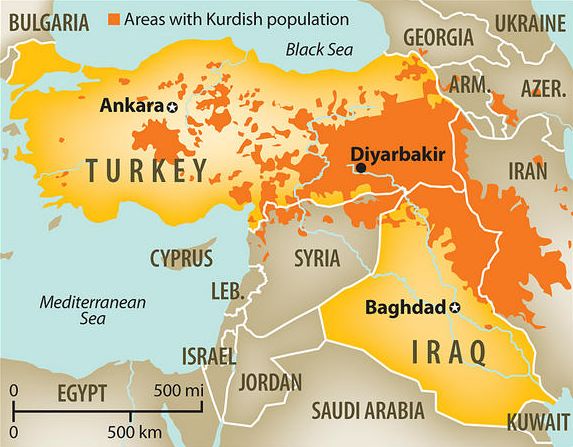
Assad’s Kurdish strategy
Joshua Landis writes: Assad’s Kurdish strategy appears to be to help the PKK to take control of the Kurdish regions of Syria in the North East. His aim is to hurt both the Free Syrian Army and Turkey, which are leading the opposition against him. In general, his strategy is to weaken the Sunni Arabs of Syria. On July 19, the Syrian Army withdrew from the town of Kobani followed by Efrin, Derik and Amuda as PYD forces swept in to take its place. Many claimed this peaceful transfer of power was orchestrated by the Assad regime and PYD leaders. There was no fighting and no casualties were incurred, according to the PYD , which said the party essentially issued an ultimatum that prompted Syrian government forces to withdraw from their positions.
The PKK, masquerading as the Democratic Union Party (PYD), is the wing of the Kurdish movement that is most anti-Turkish and therefor anti-Free Syrian Army. It is also vocally pan-Kurdish in contrast to many of the other Kurdish parties in Syria, which have positioned themselves, at least for the time-being, around the more limited goal of seeking Kurdish national rights enshrined in an autonomous region within Syria. The Kurdistan Workers’ Party is blamed by Turkish authorities for the death of 40,000 Turks and Kurds over the last several decades due to their separatist agenda and insurgent tactics. Because the PKK is better armed and more militant than other Kurdish groups, it has advantages because it is more prepared for war and the use of force.
The Kurdish National Council (KNC) represents most of the Kurdish parties that oppose the PYD strategy. It is looking for an accommodation with the Free Syrian Army and Syrian opposition forces as a means to gaining national rights and freedom for Kurds. The KNC is a fractious coalition, that is not well armed or organized.
The Kurdish parts of Syria will undoubtedly become the focus of the power struggle that is emerging in the region over Syria. Sunni Arabs and Turks will line up against it. Shiite forces will be inclined to encourage Kurdish independence if only to hurt the Sunni Arabs by playing minorities of every stripe against the against the FSA, Saudi Arabia, Turkey and the US.
But what should the Kurds do? All Kurds are looking to take advantage of the collapse of central authority in Syria. They see this as an historic opportunity to press for their freedom and national rights. But how hard should they press and how fast? Should they work with Turkey against Assad or should they fight Turkey and ally with Assad? Is this a moment for caution or for audacity? Should they side with the Syrian opposition and Turkey against the Assad regime based on the notion that the Syrian revolt is about freedom versus dictatorship? Or should they side with Syria’s religious minorities against Sunni Arabs, based on the understanding that this uprising is largely sectarian. If this is the case, perhaps Kurds, being an ethnic minority, should stick with minorities in general against Sunni Arabs, who will present the greatest future obstacle to Kurdish ambitions? For decades the Assad regime has stood for Arab chauvinism and the denial of Kurdish national rights. Now that Assad and the Arab Baath Party are losing power, some Kurds calculate that the Free Syrian Army will inherit the banner of Arab Nationalism.
Syria’s Kurds are understandably divided over how to pursue the struggle for Kurdish national rights and freedoms. The Syrian revolution is only in its infancy. The forces on the ground are changing with great speed to meet the challenges of the battlefield. Along with the emergence of new combatants and the transformation of the Syrian Army into an Alawite militia, ideologies are changing as rapidly as the faces of the leading fighters. Trying to keep up with the emerging forces in Syria is a full-time job. Kurds are having as much trouble picking their way through the dynamic battlefield and defining a strategy as everyone else. Their many factions are also fighting furiously among themselves for primacy in what many see as an emerging Kurdish state.

Netanyahu and Barak have been defeated in their push for war — at least for now
Shai Feldman argues that the push for war led by Benjamin Netanyahu and Ehud Barak has stalled, but not so much because of fears about the regional repercussions in the event of an Israeli strike on Iran. The balance has been tipped because of what are now widely held fears inside Israel’s political and security establishment that such an attack would present a serious threat to U.S.-Israeli relations.
For all practical purposes this weekend ended the Israeli debate on attacking Iran. What tipped the scales were two developments. The first was the decision of the country’s president, Shimon Peres, to make his opposition to a military strike public. The second was an interview given by a former key defense advisor of Defense Minister Ehud Barak, questioning for the first time publically whether his former superior and Prime Minister Benjamin Netanyahu are fit to lead Israel in time of war.
Using every possible media outlet on the occasion of his 89th birthday, President Peres made clear last Thursday that “going it alone” — attacking Iran without a clear understanding with the United States — would be catastrophic. Peres did a great service to his country by focusing the debate away from some of the weaker arguments offered by opponents of a strike. Thus, the supposedly limited time that would be gained by such a strike was never convincing because in both previous experiences with such preventive action — against Iraq’s nuclear reactor in 1981 and against the Syrian reactor in 2007 — Israel ended up gaining more time than even the most optimistic proponents of these strikes had anticipated.
Similarly, the warnings that an attack on Iran’s nuclear installations would ignite a regional war were not persuasive in the absence of Arab states volunteering to join such a war. Iran’s only regional state ally is Syria, but President Bashar al-Assad would not be able to direct his armed forces to attack Israel when these forces are mired in a civil war and barely control a third of the country’s territory.
Hezbollah, Iran’s principle non-state ally, might react to an Israeli strike by launching its rockets against Israel, but with Iran weakened from the attack and Syria unable to protect it, such an assault would be suicidal. Certainly none of the region’s Sunni Arab countries — Egypt, Jordan, Saudi Arabia, and the smaller Gulf Cooperation Council (GCC) states — will come to Iran’s aid. None of these countries uttered a word when in 2007 Israel destroyed the nuclear reactor of Sunni-Arab Syria. Why the same countries would be expected to ignite the region in the event that the nuclear facilities of a Shiite Persian country would be attacked, was never clear.
Avoiding repetition of these weak arguments, Peres clarified what is really at stake in the event of an attack on Iran’s nuclear facilities in the next few months: Israel’s relations with the United States. The basic divide is not the two countries’ different time constraints due to very different capacities to deal militarily with Iran’s nuclear installations. Instead, it has to do with two issues. The first is the U.S. electoral timetable. The presidential election creates an imperative for U.S. President Barack Obama to avoid any unexpected fallouts — economic or otherwise — of a military strike against Iran. Peres understands that ignoring Obama’s concerns and instead banking on a victory by Republican candidate Mitt Romney in November, as Netanyahu seems to have done, is very risky if not irresponsible.
The second issue concerns the timeline for the drawdown of U.S. forces in the region. Clearly, the Joint Chiefs are worried about the prospects of becoming embroiled in a military conflict with another Muslim country as long as U.S. forces continue to be deployed in Afghanistan and hence exposed to Iranian retaliation. [Continue reading…]
The war in the shadows
Chris Hedges writes: A Swedish documentary filmmaker released a film last year called “Last Chapter—Goodbye Nicaragua.” In it he admitted that he unknowingly facilitated a bombing, almost certainly orchestrated by the Sandinista government of Nicaragua, which took the lives of three reporters I worked with in Central America. One of them, Linda Frazier, was the mother of a 10-year-old son. Her legs were torn apart by the blast, at La Penca, Nicaragua, along the border with Costa Rica, in May of 1984. She bled to death as she was being taken to the nearest hospital, in Ciudad Quesada, Costa Rica.
The admission by Peter Torbiornsson that he unwittingly took the bomber with him to the press conference was a window into the sordid world of espionage, terrorism and assassination that was an intimate part of every conflict I covered. It exposed the cynicism of undercover operatives on all sides, men and women who lie and deceive for a living, who betray relationships, including between each other, who steal and who carry out murder. One knows them immediately. Their ideological allegiances do not matter. They have the faraway eyes of the disconnected, along with nebulous histories and suspicious and vague associations. They tell incongruous personal stories and practice small deceits that are part of a pathological inability to tell the truth. They can be personable, even charming, but they are also invariably vain, dishonest and sinister. They cannot be trusted. It does not matter what side they are on. They were all the same. Gangsters.
All states and armed groups recruit and use members of this underclass. These personalities gravitate to intelligence agencies, terrorist cells, homeland security, police departments, the special forces and revolutionary groups where they can live a life freed from moral and legal constraints. Right and wrong are banished from their vocabulary. They disdain the constraints of democracy. They live in this nebulous underworld to satisfy their lusts for power and violence. They have no interest in diplomacy and less in peace. Peace would put them out of business; for them it is simply the temporary absence of war, which they are sure is inevitable. Their job is to use violence to purge the world of evil. And in the United States they have taken as hostages our diplomatic service and our foreign policy establishment. The CIA has become a huge private army, as Chalmers Johnson pointed out in his book “Nemesis: The Last Days of the American Republic,” that is “unaccountable to the Congress, the press or the public because everything it does is secret.” C. Wright Mills called the condition “military metaphysics”—“the cast of mind that defines international reality as basically military.”
Since the attacks of 9/11 the U.S. Special Operations Command (USSOCOM)—which includes the Green Berets, the Army Rangers and the Navy SEALs—has seen its budget quadrupled. There are now some 60,000 USSOCOM operatives, whom the president can dispatch to kill without seeking congressional approval or informing the public. Add to this the growth of intelligence operatives. As Dana Priest and William M. Arkin reported in The Washington Post, “Twenty-four [new intelligence] organizations were created by the end of 2001, including the Office of Homeland Security and the Foreign Terrorist Asset Tracking Task Force. In 2002, 37 more were created to track weapons of mass destruction, collect threat tips, and coordinate the new focus on counterterrorism. That was followed the next year by 36 new organizations; and 26 after that; and 31 more; and 32 more; and 20 or more each in 2007, 2008, and 2009. In all, at least 263 organizations have been created or reorganized as a response to 9/11.”
There are now many thousands of clandestine operatives, nearly all of them armed and equipped with a license to kidnap, torture and kill, working overseas or domestically with little or no oversight and virtually no transparency. We have created a state within a state. [Continue reading…]
Obama needs U.S. debate before making pledges to Israel about attacking Iran
Peter Beinart writes: For years now, Israelis have been noisily debating military action against Iran. And their conclusion, according to polls, is that America should do it. That’s somewhat ironic given that self-reliance — never again putting Jewish destiny in non-Jewish hands — is core to the Zionist ideal. But it’s also quite rational: an American strike would likely set back Tehran’s nuclear progress far more than an Israeli one would. And an American strike would not leave Israel as isolated in the world.
The problem is that back here in the United States, we haven’t been noisily debating military action against Iran. Yes, we’ve watched the Israeli debate voyeuristically. Countless pundits have weighed in on whether the Iranian regime would really risk its own survival to end Israel’s, on what Israel’s military capacities really are, on how Iran might strike back. But there’s been much less discussion of whether an attack on Iran is in America’s interest. And that needs to change.
It needs to change because Israel keeps nudging the U.S. closer to war. During his trip to Washington this spring, Benjamin Netanyahu hinted that Israel was close to launching a strike and reportedly urged President Obama to more explicitly pledge military action to prevent Iran from attaining a nuclear bomb. Obama did just that, rejecting a policy of containing a nuclear Iran and telling The Atlantic’s Jeffrey Goldberg that his threat to use military action to prevent Iran from going nuclear was not a “bluff.”
Now Israel reportedly is on the verge of attacking yet again and pushing for an even blunter pledge that America will attack, perhaps by next summer. “They are aiming for a specific thing,” former Obama defense official Colin Kahl recently told The Washington Post. “They may be trying to push the Obama administration into a much greater declaration of red lines, an even more declarative statement about the use of force.”
This is nuts. In our political system, presidents are not empowered to promise to launch wars in backroom negotiations with foreign leaders. [Continue reading…]
Video: Israelis concerned war on Iran might be too expensive
Robin Yassin-Kassab et al discuss recent developments in Syria on BBC World Service
The following edition of “World Have Your Say” was broadcast on August 14.
Please note, the BBC's podcast website says today, August 20, that this broadcast is available for just two more days.
Video: Rebels dealing with divisions as they unite in fight for Syria
Syria conflict: British fighters seek jihad
BBC News reports: However vague the picture in Syria may have been before this conflict began, the blood of many thousands has now muddied it further still.
But in this complex web of armed civilians, defected soldiers, paramilitary units and bloodthirsty militias, a further dynamic is growing in strength: militants from outside Syria joining the fray.
Foreign fighters have been heading to Syria for some time – many of Syrian descent but living in Europe or the US, keen to help their brothers in arms. A similar pattern emerged in Libya, where young western Libyans joined the battle against [late leader Col Muammar] Gaddafi.
However, a different, more dangerous contingent is joining this struggle now.
Militant groups thought to be linked to al-Qaeda are operating in the country. Among their ranks, a small number of young British men – at this stage, probably only running into the dozens – are joining this fundamentalist fringe, having been recruited from towns and cities across the UK.
Driving along the Asian district of Coventry Road in his Birmingham constituency, local MP Khalid Mahmood explained that from amongst the Muslim communities in Britain that have embraced the Syrian cause, a small number have taken their grievances a step further.
“I’m extremely concerned at the moment because I see similar things to those that happened in Afghanistan. We encouraged people to fight – to fight for the jihad. In the Syrian situation, similar messages are going out. Quite a number in Birmingham are heading out.
“Some are of Syrian origin, others of South Asian origin – for whom religion is the main pull. As this conflict goes on, I would anticipate greater numbers going forward.”
Malik al-Abdeh, a prominent Syrian journalist based in the UK, explained why the conflict in Syria has pulled in these young fighters.
“Most of these people are essentially thrill-seekers wanting to experience the jihad, which for some people is a lot of fun. They get to carry a gun for the first time in their lives. They get trained up and it’s exciting.
“I think it’s inevitable that people from the UK would go to Syria. Fighting for God and fighting for Islam is one of the pillars of being a Muslim.
“There was an opportunity against the Soviets in Afghanistan, against the Russians in Chechnya, against the Serbs in Bosnia and now against the Alawites in Syria.
“They see it as another stop on the jihadi tour, if you like. And they have to be there otherwise they are missing out on a big opportunity.”
So far, says Mr Abdeh, the numbers are limited because mainstream rebel groups do not want them in the country.
“The phenomenon so far of non-Syrians going to fight in Syria is quite limited simply because people within Syria don’t want those people coming to fight.
“Actually these foreigners hamper the effort. You have the language barrier, different cultures and no knowledge of the local area.”
But their differences could grow into armed confrontation, as British photographer John Cantlie found after having been abducted by an extremist group in Syria. It was the Free Syrian Army (FSA) who rescued him. He paints a similar picture of embittered and disillusioned British youths seeking to find purpose.
“They were hostile to us, I believe, because many of these were disenchanted young men from Britain. And I believe we represented everything that they were disenchanted about.
“They were young, they were impressionable and they were united under an extremist flag in Syria. And I think the sight of genuine western hostages excited them; it fulfilled their concept of what jihad was about.”
Why the U.S. punched Israel’s leaders in the face
Attila Somfalvi writes: Once every few years Israel needs a slap in the face to remember where it stands in the world. On Tuesday it was US Chairman of the Joint Chiefs of Staff General Martin Dempsey who assumed the role of the responsible adult and slapped Prime Minister Benjamin Netanyahu and Defense Minister Ehud Barak, the duo orchestrating the national hysteria surrounding the possibility of an attack in Iran.
Israel can “delay but not destroy Iran’s nuclear capabilities,” he said while sitting next to Defense Secretary Leon Panetta, who visited Israel a few weeks ago to allay the concerns of the leadership in Jerusalem.
Dempsey’s comments should be taken seriously, as should the stern message conveyed by Panetta, the White House and the American security establishment: If we can’t reason with you, the Israelis, we will have to get tough.
The general’s remark was not a slip-of-the-tongue. It was a calculated statement from a general of Irish descent and character. His words constituted a slap in Israel’s face, a punch in the face, and a kick to the most sensitive part of the body. To be more precise, the US slammed Israel’s head against the wall and said: “Shut up. Stop babbling about Iran. Without us there is not much you can do, and don’t assume for a second that we are dancing to your tune. You shouldn’t do anything stupid, and stop driving the entire world crazy.”
This was the message behind Dempsey’s comment. You don’t believe it? Just imagine what would have happened had an American general, after decades of ambiguity, would have held a press conference and announced that Israel does not have nuclear weapons, or that it does.
Now think again about the meaning of Dempsey’s statement, which was made after months and even years in which Israel was building up its image as an omnipotent power in the Middle East. Dempsey’s comments can even be considered earth-shattering: The US, Israel’s closest ally and confidante, has decided to bring the Jewish state’s leadership to its knees and hurt our exaggerated self-confidence and undermine our deterrence. No less.
Dempsey was painfully clear. He basically said that Israel should not disregard the opinions of its top security officials, stop the constant chatter on Iran and refrain from any acts that may have an adverse effect on the global economy. The general also meant to tell Israel that it mustn’t believe that Netanyahu has any control over the US because he has friends in the Republican Party. Dempsey laid down the facts: Israel is not America, it does not possess the same capabilities, and if Netanyahu and Barak continue wreaking havoc – Israel won’t have America either.
It will take a while before we will be able to gauge the depth of the current crisis between Israel and the US (and between Netanyahu and Obama). Washington made a strategic decision to show Israel who is the mentor and who is the protégé. The US hit Israel’s most sensitive nerve: The pride in its military power. But it appears that the US had no other choice. After weeks of belligerent headlines, President Obama had enough of Netanyahu’s inclination to play with fire. We should start getting used to it.
Washington embarrassed by its lack of influence over Iraq
When the United States invaded Iraq in 2003, the neocons were so intoxicated by own assessment of the breadth and depth of American global power, they overlooked an outcome to the war that anyone could predict: that Iraq’s Shia majority, if provided with the power to rule, would forge close ties with Iraq’s Shia neighbor, Iran. The fact that Iraq now falls within Iran’s sphere of influence and largely outside America’s sphere of influence, has many implications. The New York Times reports on one:
When President Obama announced last month that he was barring a Baghdad bank from any dealings with the American banking system, it was a rare acknowledgment of a delicate problem facing the administration in a country that American troops just left: for months, Iraq has been helping Iran skirt economic sanctions imposed on Tehran because of its nuclear program.
The little-known bank singled out by the United States, the Elaf Islamic Bank, is only part of a network of financial institutions and oil-smuggling operations that, according to current and former American and Iraqi government officials and experts on the Iraqi banking sector, has provided Iran with a crucial flow of dollars at a time when sanctions are squeezing its economy.
The Obama administration is not eager for a public showdown with the government of Prime Minister Nuri Kamal al-Maliki over Iran just eight months after the last American troops withdrew from Baghdad.
Still, the administration has held private talks with Iraqi officials to complain about specific instances of financial and logistical ties between the countries, officials say, although they do not regard all trade between them as illegal or, as in the case of smuggling, as something completely new. In one recent instance, when American officials learned that the Iraqi government was aiding the Iranians by allowing them to use Iraqi airspace to ferry supplies to Syria, Mr. Obama called Mr. Maliki to complain. The Iranian planes flew another route.
In response to questions from The New York Times, David S. Cohen, the Treasury Department’s under secretary for terrorism and financial intelligence, provided a written statement saying that Iran “may seek to escape the force of our financial sanctions through Iraqi financial institutions.” But he added that “we will pursue, and are actively pursuing, efforts to prevent Iran from evading U.S. or international financial sanctions, in Iraq or anywhere else.”
Some current and former American and Iraqi officials, along with banking and oil experts, say that Iraqi government officials are turning a blind eye to the large financial flows, smuggling and other trade with Iran. In some cases, they say, government officials, including some close to Mr. Maliki, are directly profiting from the activities.
“Maliki’s government is right in the middle of this,” said one former senior American intelligence official who now does business in Iraq.
In announcing that he was “cutting off” Elaf Islamic Bank, Mr. Obama said it had “facilitated transactions worth millions of dollars on behalf of Iranian banks that are subject to sanctions for their links to Iran’s illicit proliferation activities.”
But the treatment the bank has received in Baghdad since it was named by Mr. Obama suggests that the Iraqi government is not only allowing companies and individuals to circumvent the sanctions but also not enforcing penalties for noncompliance. [Continue reading…]
Egypt’s president to visit Iran
The Associated Press reports: Egypt’s President Mohammed Morsi will attend a summit in Iran later this month, a presidential official said on Saturday, the first such trip for an Egyptian leader since relations with Tehran deteriorated decades ago.
The visit could mark a thaw between the two countries after years of enmity, especially since Egypt signed its 1979 peace treaty with Israel and Iran underwent its Islamic revolution. Under Morsi’s predecessor Hosni Mubarak, Egypt, predominantly Sunni Muslim, sided with Saudi Arabia and other Sunni-dominated Arab states in trying to isolate Shiite-led Iran.
The official said that Morsi will visit Tehran on Aug. 30 on his way back from China to attend the Non-Aligned Movement Summit, where Egypt will transfer the movement’s rotating leadership to Iran. He spoke on condition of anonymity because he was not yet authorized to make the announcement.
The trip is no surprise — it came days after Morsi included Iran in a proposal for a contact group to mediate an end to Syria’s escalating civil war. The proposal for the group, which includes Egypt, Saudi Arabia and Turkey, was made at the Organization of Islamic Cooperation summit in Saudi Arabia’s holy city of Mecca.
The idea was welcomed by Iran’s state-run Press TV, and a leading member of Egypt’s Muslim Brotherhood said that Tehran’s acceptance of the proposal was a sign Egypt was beginning to regain some of the diplomatic and strategic clout it once held in the region.
After the fall of Egypt’s longtime strongman Hosni Mubarak in a popular uprising last year, officials have expressed no desire to maintain Mubarak’s staunch anti-Iranian stance.
Last July, former Egyptian foreign minister Nabil Elaraby, who also heads the Arab League, delivered a conciliatory message to the Islamic Republic, saying “Iran is not an enemy,” and noted that post-Mubarak Egypt would seek to open a new page with every country in the world, including Iran.