Author Archives: Paul Woodward

EDITORIAL: Obama assists in the general atmospherics of Middle East diplomacy

Obama assists in the general atmospherics of Middle East diplomacy

Remember back on the campaign trail when Hillary Clinton said she helped bring peace to Northern Ireland? A bit of fact checking soon revealed that her rather minor role amounted to no more than assisting with “the general atmospherics.” That’s worth keeping in mind while Washington’s foreign policy elite smothers Obama with praise after his appearance on Al-Arabiya.

“It’s impossible to exaggerate the symbolic importance of Barack Obama choosing an Arabic satellite television station for his first formal interview as President,” gushed Marc Lynch in response to the implementation of his own recommendations.

“By most accounts, Obama’s decision — shocking to some, refreshing to others — to talk to the Muslim world in his first formal, sit down press interview hit the ball out of the park,” Steve Clemons said in an equally enthusiastic review.

“We support Israel’s right to self-defence. The (Palestinian) rocket barrages which are getting closer and closer to populated areas (in Israel) cannot go unanswered,” Hillary Clinton said in her first news conference at the State Department.

And there’s the rub. How does the US marry it’s “we can feel your pain” message, with “but it’s OK if Israel inflicts some more”?

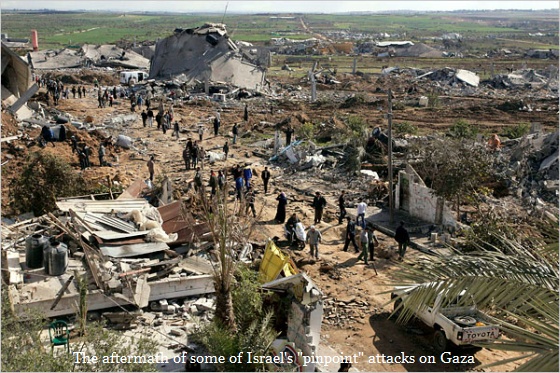
For Obama to give his first interview to Al-Arabiya was a positive step in changing the tone of US relations with the Muslim world, but let’s not get carried away. Soothing words provide no relief to the victims of Israeli atrocities committed in Gaza.

Talking to a Saudi-owned television station no doubt went down well with Saudi Arabia’s rulers, but if Obama wants to engage with the largest audience he’ll need to have the courage to go on Al Jazeera. The response of the most widely watched network to Obama’s first step was quite telling. They barely mentioned it.

But if Washington wants to remain close to its old friends in Riyadh, it should also head their advice. Just a few days ago, Prince Turki al-Faisal directed a passionate plea at the new president:

Let us all pray that Mr Obama possesses the foresight, fairness and resolve to rein in the murderous Israeli regime and open a new chapter in this most intractable of conflicts.

It’s nice that Obama has had the experience of living in a Muslim country, that he has Muslim relatives, and that he wants to pursue relations with the Muslim world based on mutual respect. But beyond the atmospherics, the people of the Middle East are looking for substance from America’s new celebrity president. He has a receptive audience, but they’ll only remain open if he can deliver.

Prince Turki laid out what is expected:

President Barack Obama must address the disaster in Gaza and its causes. Inevitably, he will condemn Hamas’s firing of rockets at Israel. When he does that, he should also condemn Israel’s atrocities against the Palestinians and support a UN resolution to that effect; condemn the Israeli actions that led to this conflict, from settlement building in the West Bank to the blockade of Gaza and the targeted killings and arbitrary arrests of Palestinians; declare America’s intention to work for a Middle East free of weapons of mass destruction, with a security umbrella for countries that sign up and sanctions for those that do not; call for an immediate withdrawal of Israeli forces from Shab’ah Farms in Lebanon; encourage Israeli-Syrian negotiations for peace; and support a UN resolution guaranteeing Iraq’s territorial integrity.

Mr Obama should strongly promote the Abdullah peace initiative, which calls on Israel to pursue the course laid out in various international resolutions and laws: to withdraw completely from the lands occupied in 1967, including East Jerusalem, returning to the lines of June 4 1967; to accept a mutually agreed just solution to the refugee problem according to UN resolution 194; and to recognise the independent state of Palestine with East Jerusalem as its capital. In return, there would be an end to hostilities between Israel and all Arab countries, and Israel would get full diplomatic and normal relations.

What the Saudis know is that they — and the US — are running out of time. George Mitchell’s patience may be an indispensable negotiating skill, but what the Middle East is looking for is Obama’s “fierce urgency of now” — not just the borrowed slogan but words embodied in actions.

Facebooktwittermail

NEWS & VIEWS ROUNDUP & EDITOR’S COMMENT: January 28

Abdullah II: The 5-State Solution

The virtues of this five-state solution — Palestine, Egypt, Jordan, Israel and Saudi Arabia — are numerous: Egypt and Jordan, the Arab states that have peace treaties with Israel, would act as transition guarantors that any Israeli withdrawal would not leave a security vacuum in the West Bank, Gaza or Arab Jerusalem that could threaten Israel. Israel would have time for a phased withdrawal of its settlements, and Palestinians would have the chance to do nation-building in an orderly manner. This would be an Arab solution that would put a stop to Iran’s attempts to Persianize the Palestinian issue. [continued…]

Editor’s Comment — Ever since 2002, Tom Friedman has seen himself as a messenger of peace, but with nothing to deliver this time other than the Friedman Peace Plan, I doubt whether his council will carry much weight. Indeed, his five-state solution, practical as it might sound, looks too much like a stepping stone towards Daniel Pipes’ no-state solution. Bring in Egypt and Jordan and if after five years a Palestinian state has not taken shape then Gaza absorbs into Egypt and the West Bank into Jordan. It’s not going to happen.

How to talk to Hamas without talking to Hamas

As George Mitchell, the United States’ new envoy for Middle East peace, arrived in Cairo, it was unclear whether a new chapter was opening in US diplomacy or whether the emphasis was on continuity with the efforts of the previous administration in Washington. A report in Ynet struck notes in familiar themes. The US would be attempting to bolster the Palestinian president Mahmoud Abbas and the Palestinian Authority. Mr Mitchell did not intend to meet with representatives from Hamas. Continue reading

Facebooktwittermail

NEWS & VIEWS ROUNDUP & EDITOR’S COMMENTS: January 27

Obama’s first interview as president (Al-Arabiya TV exclusive)

Editor’s Comment — President Obama said that the new way the US will approach the Middle East is to “start by listening.”

“[George Mitchell]’s going to be speaking to all the major parties involved…”

“– stop right there,” Hisham Melhem failed to interject. Had the interview been conducted by Al Jazeera instead of the Saudi-funded Al-Arabiya news channel, Obama might at this point have been pushed to provide clarification.

If Mitchell is going to be speaking to all the major parties involved, he’s going to be talking to Hamas? Correct, Mr President? Whatever else might be said about Hamas it is beyond dispute that they are one of the major parties. Only yesterday, Jimmy Carter reiterated what in foreign policy circles is by this point the mainstream position: Hamas has to be engaged.

No doubt the question was in Hisham’s mind. Was he too polite to ask? Was it a ground rule for the interview that this question wouldn’t be answered and therefore should not be posed? For how much longer is this charade going to continue? Hamas isn’t going away. Continue reading

Facebooktwittermail

THE BBC’S CAMPAIGN TO BLOCK HUMANITARIAN AID REACHING GAZA

The BBC’s campaign to block humanitarian aid reaching Gaza

The British Broadcasting Corporation is a publicly-funded media network. Under Director General Mark Thompson it has now assumed a governmental role in attempting to stem the flow of humanitarian aid to Gaza.

The Disasters Emergency Committee (DEC), a group of major British charities, wants the BBC to broadcast the following appeal for donations to provide relief for victims of the war:

Thompson says that if the BBC ran the appeal, “this could be interpreted as taking a political stance on an ongoing story,” but Thompson’s own impartiality can be questioned.

Just over two years ago, this short item appeared in The Independent:

The BBC is often accused of an anti-Israeli bias in its coverage of the Middle East, and recently censured reporter Barbara Plett for saying she “started to cry” when Yasser Arafat left Palestine shortly before his death.

Fascinating, then, to learn that its director general, Mark Thompson, has recently returned from Jerusalem, where he held a face-to-face meeting with the hardine Prime Minister Ariel Sharon.

Although the diplomatic visit was not publicised on these shores, it has been seized upon in Israel as evidence that Thompson, who took office in 2004, intends to build bridges with the country’s political class.

Sources at the Beeb also suspect that it heralds a “softening” to the corporation’s unofficial editorial line on the Middle East.

“This was the first visit of its kind by any serving director general, so it’s clearly a significant development,” I’m told.

“Not many people know this, but Mark is actually a deeply religious man. He’s a Catholic, but his wife is Jewish, and he has a far greater regard for the Israeli cause than some of his predecessors.”

Understandably, an official BBC spokesman was anxious to downplay talk of an exclusively pro-Israeli charm offensive.

Apopros this month’s previously undocumented trip, he stressed that Thompson had also held talks with the Palestinian leader, Mahmoud Abbas.

The position that the BBC has taken on the DEC Gaza appeal has drawn a huge amount of criticism in the UK. Critics include Archbishop of Canterbury, Rowan Williams, the Archbishop of York, John Sentamu, Scottish first minister Alex Salmond and justice minister Shahid Malik and several other ministers in the British government, 120 members of parliament from all parties.

Former Labour minister, Tony Benn, launched his own protest by making the appeal directly to BBC viewers:

In an editorial, the Financial Times, referring to Thompson’s decision, said:

Ordinary people, informed not least by the BBC’s own coverage of the destruction of the lives and livelihoods of Gazans, can distinguish for themselves the difference between acute humanitarian need and propaganda – on behalf of either side. For a man who is, ultimately, a public servant financed by a public levy to suggest otherwise is patronising.

The BBC should instead re-examine its oversensitivity to allegations of bias. Such allegations come with the territory for anyone who attempts detailed reporting and reasoned, contextual analysis of the Middle East. The BBC at times gives the impression it has lost its collective nerve in covering this region.

An independent panel on BBC coverage of the conflict, published in 2006 reported shortcomings that objectively favoured Israel: more coverage of Israeli fatalities; more Israeli spokesmen; and, above all, “the failure to convey adequately the disparity in the Israeli and Palestinian experience, reflecting the fact that one side is in control and the other lives under occupation”.

The British public is perfectly able to grasp this disparity without Auntie [the BBC] getting overwrought. It may even conclude that the BBC’s mechanical application of “balance” in the present controversy appears so to outweigh the normal considerations of accuracy, fairness and impartiality as to be detached from fundamental principles.

Facebooktwittermail

EDITORIAL: The peace process is irreversibly over

The peace process is irreversibly over

If you did not see it already, watch Bob Simon’s report (below), “Is Peace Out Of Reach?” from last night’s edition of 60 Minutes. In the history of American reporting on the Palestinian-Israeli conflict, this is an exceptional piece of journalism. But don’t just watch it — share it by email, embed it on your web site and do whatever else you can to enlighten other Americans who at this time understand so little about the core issues behind the conflict. (The following video is preceded by a 30-second commercial.)


Watch CBS Videos Online

As President Obama’s Middle East Envoy for Peace, George Mitchell, makes his way to the region this week, he should keep in mind a statement that Osama Hamdan, Hamas’s representative in Lebanon, made in a speech in Beirut yesterday. Hamdan said, “the peace process is irreversibly over.”

This bears repeating:

…the peace process is irreversibly over.

There are commentators who will say that this statement is an expression of intransigence and belligerence coming from a resistance movement dedicated to the destruction of Israel.

Far from it — it is merely a statement of fact. Indeed, it is an assessment of an objective reality that is remarkably lacking in venom.

Just suppose that we were at a juncture where 1,300 Israelis had just been brutally killed, 5,000 were wounded, many in a grave condition, 20,000 houses had been destroyed and tens of thousands were now homeless.

Suppose in such a situation Israel’s leaders were to declare that the peace process was irreversibly over, we would now be commenting on their remarkable composure. We would marvel that they would bother making a political statement and not simply a blood-curdling cry of vengeance.

Hamas on the other hand, in spite of the devastation of Gaza, is still committed to politics.

The political imperative of the moment is one of clarification. Hamas sees that Palestinian unity and a Palestinian national movement cannot be built on an illusory foundation.

Meanwhile, Tzipi Livni claims that the carnage in Gaza has advanced the peace process. This is an Orwellian, obscene, and outrageous insult to common sense. It displays a sociopathic view of human suffering.

But it also serves as a reminder and confirmation that Osama Hamdan is right: the peace process is irreversibly over.

If this is a conclusion which can commonly be agreed upon, where do we go from here? Is this not a conclusion that will feed utter despair or a justification for endless conflict?

I believe not.

Political change can only gain traction when it is rooted in objective reality. We can only advance from the conditions we actually inhabit.

For several years now the peace process has floundered because of a glaring contradiction between Israel’s stated aim — a two-state solution — and its actions, which consistently advanced in the opposite direction.

By its own choice, Israel has abandoned the goal of a two-state solution. The so-called peace process has provided the water and the sustenance that has allowed the occupation to flourish.

America has been the enabler. It has provided a stage upon which a pantomime of peace could be performed. It has quite effectively silenced those who would disrupt the performance and insisted that we all silently enjoy a show whose tedious enactment perpetually held out the promise of a happy ending.

“When Israel supports a solution of two states for two people, the pressure won’t be on Israel,” Tzipi Livni correctly observed over the weekend.

George Mitchell’s duty, the duty of the international community and of all Palestinian leaders, is to say: the game is up, the show is over. The charade has gone on for long enough. Israel has stated its position on the ground. It’s words have proved to be of no consequence.

Given the realities and ignoring the empty declarations, where does Israel want to go from here?

  • Democracy: a one-state solution in which Jews and Palestinians have equal rights;
  • Ethnic cleansing: a state that solidifies its Jewish identity by purging itself of every non-Jewish element; or
  • Apartheid: the explicit formalization of what is already a practical reality.

These, as Bob Simons correctly observers, are Israel’s choices. America can no longer serve as Israel’s shield in its efforts to conceal a painful reality.

Facebooktwittermail

NEWS & VIEWS ROUNDUP & EDITOR’S COMMENT: January 26

Israel’s lies

Western governments and most of the Western media have accepted a number of Israeli claims justifying the military assault on Gaza: that Hamas consistently violated the six-month truce that Israel observed and then refused to extend it; that Israel therefore had no choice but to destroy Hamas’s capacity to launch missiles into Israeli towns; that Hamas is a terrorist organisation, part of a global jihadi network; and that Israel has acted not only in its own defence but on behalf of an international struggle by Western democracies against this network.

I am not aware of a single major American newspaper, radio station or TV channel whose coverage of the assault on Gaza questions this version of events. Criticism of Israel’s actions, if any (and there has been none from the Bush administration), has focused instead on whether the IDF’s carnage is proportional to the threat it sought to counter, and whether it is taking adequate measures to prevent civilian casualties.

Middle East peacemaking has been smothered in deceptive euphemisms, so let me state bluntly that each of these claims is a lie. Israel, not Hamas, violated the truce: Hamas undertook to stop firing rockets into Israel; in return, Israel was to ease its throttlehold on Gaza. In fact, during the truce, it tightened it further. This was confirmed not only by every neutral international observer and NGO on the scene but by Brigadier General (Res.) Shmuel Zakai, a former commander of the IDF’s Gaza Division. In an interview in Ha’aretz on 22 December, he accused Israel’s government of having made a ‘central error’ during the tahdiyeh, the six-month period of relative truce, by failing ‘to take advantage of the calm to improve, rather than markedly worsen, the economic plight of the Palestinians of the Strip . . . When you create a tahdiyeh, and the economic pressure on the Strip continues,’ General Zakai said, ‘it is obvious that Hamas will try to reach an improved tahdiyeh, and that their way to achieve this is resumed Qassam fire . . . You cannot just land blows, leave the Palestinians in Gaza in the economic distress they’re in, and expect that Hamas will just sit around and do nothing.’ [continued…]

Hamas fights to rebuild Gaza in new battle for hearts and minds

A bitter struggle is taking place over the right to oversee the reconstruction of Gaza, even as the leadership of Hamas emerges from the rubble of areas that were devastated by 23 days of Israeli bombardment.

The international community insists that it cannot channel billions of dollars in reconstruction aid to Hamas, and is calling for the involvement of the more moderate Palestinian president, Mahmoud Abbas. But Hamas is insisting on sole control of Gaza’s rebuilding, as well as claiming moral leadership of the Palestinian people.

In the week since Israel and Hamas declared unilateral ceasefires to bring an end to more than three weeks of fighting, in which almost 1,500 Gazans died, the movement has acted rapidly to assert its control over assistance to civilians. [continued…]

This is not a test

The Palestinians are so fragmented politically and geographically that half of U.S. diplomacy is going to be about how to make peace between Palestinians, and build their institutions, so there is a coherent, legitimate decision-making body there — before we can make peace between Israelis and Palestinians.

Second, Hamas now has a veto over any Palestinian peace deal. It’s true that Hamas just provoked a reckless war that has devastated the people of Gaza. But Hamas is not going away. It is well armed and, despite its suicidal behavior of late, deeply rooted.

The Palestinian Authority led by Mahmoud Abbas in the West Bank will not make any compromise deal with Israel as long as it fears that Hamas, from outside the tent, would denounce it as traitorous. Therefore, Job 2 for the U.S., Israel and the Arab states is to find a way to bring Hamas into a Palestinian national unity government. [continued…]

Editor’s Comment — Here’s a measure of how serious the situation is: Thomas Friedman gets how serious it is. He is even bold enough to suggest something that thus far Obama officials have been too timid to acknowledge: Hamas has to be included in any political process.

But this is where Friedman runs into his own conceptual road blocks. His vision of Hamas being “merged” into a Palestinian government sounds very much like a vision of Hamas being pacified as though it poses a threat that merely needs defusing without actually being politically addressed.

And what’s Israel to do while the US focuses on knocking the Palestinians into shape? Oh yeah — fulfill that golden promise: freeze the settlements. As though merely freezing settlement growth would be such a stupendous political accomplishment that no greater feat could ever be expected of an Israeli government.

The US must expect so little from an Israel because it has so consistently delivered even less.

On the wrong side

If all the beautiful phrases in Barack Obama’s inauguration speech, these are the words that stuck in my mind: “You are on the wrong side of history.”

He was talking about the tyrannical regimes of the world. But we, too, should ponder these words

In the last few days I have heard a lot of declarations from Ehud Barak, Tzipi Livni, Binyamin Netanyahu, and Ehud Olmert. And every time, these eight words came back to haunt me: “You are on the wrong side of history!”

Obama was speaking as a man of the 21st century. Our leaders speak the language of the 19th century. They resemble the dinosaurs that once terrorized their neighborhood and were quite unaware of the fact that their time had already passed. [continued…]

Facebooktwittermail

GUEST CONTRIBUTOR – John Robertson: Surging into a perfect storm?

Surging into a perfect storm?

The British Independent‘s report Friday that new President Obama may be about to cut Afghan president Karzai adrift ought to be enough to make any informed observer physically ill – not because Karzai has been any great shakes as a leader (rampant corruption, plus a brother up to his neck in the Afghan narco-trade), but because it provides evidence of yet one more piece of a huge train-wreck – or maybe a perfect storm – that is slowly but surely approaching. And it has the potential to make the debacle in Iraq pale in comparison. Continue reading

Facebooktwittermail

The aftermath of the war on Gaza

Out of the rubble

Speaking to his people on January 18, hours after Hamas responded to Israel’s unilateral suspension of hostilities with a conditional ceasefire of its own, the deposed Palestinian Authority prime minister Ismail Haniyeh devoted several passages of his prepared text to the subject of Palestinian national reconciliation. For perhaps the first time since Hamas’s June 2007 seizure of power in the Gaza Strip, an Islamist leader broached the topic of healing the Palestinian divide without mentioning Mahmoud Abbas by name.

At a press conference the following day convened by Abu Ubaida, the spokesperson of the Martyr Izz al Din al Qassam Brigades, the Hamas military wing, the movement went one step further. “The Resistance”, Abu Ubaida intoned, “is the legitimate representative of the Palestinian people”.

What these statements make clear is that Hamas will no longer engage with Abbas, and is even less inclined to throw him a lifeline in the form of a national unity government he would appoint. These statements are not so much a direct challenge to his leadership as a confirmation that his legitimacy has been fatally damaged by the Gaza war. Even his hand-picked prime minister, Salam Fayyad, told journalists that the PA in Ramallah has been “marginalised”.

Israel’s war on the Gaza Strip has produced a transformational moment in Palestinian politics. It is a moment all too reminiscent of the period succeeding the 1967 War when the credibility of the prevailing Arab order collapsed and – deriving their legitimacy from the barrel of a gun – Yasser Arafat and a coalition of Palestinian guerrilla organisations seized control of the Palestine Liberation Organisation (PLO). [continued…]

The next step

The vast majority cheered loudly, the negligible minority shouted in silence, like a whistler in the dark. The overwhelming majority only wanted more and more, the inconsequential minority wanted only to stop. The absolute majority gorged, ordering pizzas and scenes of the bombing by VOD, and some stood on the rooftops opposite Gaza with their children to watch the massacre with their own eyes. The trifling minority tried to protest, cringing with shame and feelings of guilt at every image that arrived from Gaza.

Not since the summer of 1967 have we had such a uniform, brainwashed chorus – and back then it was not so nationalist and bestial, insensitive and blind. But now, as the dust clears over the ruins and there are not enough bandages to cover all the wounds; with the cemeteries full and the hospitals bursting; as the cripples, the incapacitated, the amputees, the traumatized and the bereaved, the thousands of wounded and tens of thousands of newly homeless try helplessly to rehabilitate whatever they can, the time has come to respond and say what can be done. Now it is time to elaborate on the alternative to the cruelest and most brutal war in Israel’s history, and one of the most unnecessary.

First, there is a different path, which Israel has never embarked on. Neither Oslo nor the disengagement was a sufficient step. With war the initial means and unrestrained violence the preferred choice, we have almost always spoken only with force, our only language. By force and stratagems we made war, another war. The force was supplied by the Israel Defense Forces, the stratagems by the media. Alternative proposals were inevitably condemned. Second, it is impossible to start from today. We have to remember the context, and the context is always twisted and distorted out of all recognition. [continued…]

No moderates left

he three leading candidates for prime minister are extremists. Tzipi Livni and Ehud Barak went to war in Gaza and are therefore as radical as can be. Benjamin Netanyahu is more radical in rhetoric only.

We must not be led astray in this election campaign and consider both Livni and Barak as moderates, in contrast to the “extremist” Netanyahu. This is a deception. Kadima and Labor, the center and left-wing parties, have led Israel to two awful wars within two years. Netanyahu has yet to go to war once. True, he speaks more radically than the other two, but so far it has only been words, while the “moderates” have taken radical, aggressive action.

“Bibi is unreliable and terribly right-wing,” Kadima’s electoral broadcast asserts. Is he? Livni and Barak are just the same. None of the people involved in the Gaza war can speak of peace now. Those who delivered such a brutal blow to the Palestinians, only to sow more hatred and fear among them, have no intention of making peace with them. Those responsible for firing white phosphorous shells into a civilian population and destroying thousands of homes cannot talk the following day about two states living peacefully side by side. [continued…]

A new Mideast approach

Rather than seeking to bolster the moderates in this conflict, the Obama administration should focus on moderating the extremists. The idea of eliminating Hamas could not be seriously proposed by anyone with any knowledge of domestic Palestinian politics. The notion that Hamas is a primarily militant organization based in Gaza ignores the movement’s vast support in the West Bank and elsewhere.

Dealing with Hamas and groups such as the Popular Front for the Liberation of Palestine and Islamic Jihad in arenas of legitimacy, such as elections, negates the possibility that outside parties will spoil peace negotiations.

Those who would resolve the conflict must understand that such parties and groups, often labeled rejectionist, are not primarily ideologically based and are not monolithic. They, like most political parties, are beholden to a constituency. [continued…]

Report: Turkey says Israel must really want peace for it to broker Syria talks again

Turkish Prime Minister Tayyip Erdogan has said that Ankara will only resume mediating Israel-Syria negotiations when Israel shows a real desire for peace, the pan-Arab newspaper Al-Hayat reported Sunday.

Turkey brokered indirect peace talks between the two enemy states last year, although their future has been unclear as Israel prepares to elect a new government that may break then off.

The paper also quoted Erdogan as saying that harsh comments he made during the recent hostilities in Gaza were not against Israel but merely expressed a principled position in opposition to the killing of civilians. [continued…]

Hamas ‘set for Gaza truce talks’

Members of the Palestinian Islamist group Hamas are due to meet Egyptian officials to discuss ways to shore up a fragile ceasefire in the Gaza Strip. [continued…]

Facebooktwittermail

NEWS & VIEWS ROUNDUP: January 25

Is Afghanistan going to be Obama’s Iraq?

President Barack Obama is facing warnings that the US risks repeating some of its errors in Iraq as the new administration turns its focus to Afghanistan, where Nato forces are engaged in a conflict which has already lasted longer than the Second World War.

Having received a briefing on his first day in office from General David Petraeus, the top US commander in the region, Mr Obama is preparing to meet his military chiefs to decide on the size and shape of the Afghanistan reinforcements he promised during his election campaign. The chairman of the joint chiefs of staff, Admiral Michael Mullen, said just before Christmas that up to 30,000 more troops could be sent by summer, nearly doubling the size of the US force in the country. Britain, the next largest contributor in the 41-nation international force, has fewer than 9,000 troops in Afghanistan, which means American dominance of the campaign against the Taliban is set to increase.

“There are fears that this could become a US war rather than a Nato one,” said Christopher Langton, senior fellow for conflict at the International Institute of Strategic Studies (IISS) in London. “With other Nato members already planning to scale back, the US could find itself isolated. Rather than being an international operation, it would become another ‘coalition of the willing’, as in Iraq – though with the crucial difference that the Afghan mission has had a United Nations mandate throughout.” [continued…]

In Afghanistan, terrain rivals Taliban as enemy

It was near sunset when the tire on one of the armored vehicles blew out on the way back through the village of Khuga Kheyl this month. The U.S. Army convoy stopped dead in a narrow, rocky cleft between two small mountains. A gang of Afghan boys ran down a nearby slope toward the convoy as it jerked to a halt near the border with Pakistan.

That morning, Capt. Jay Bessey had warned his platoon not to waste time and to stay tight. There was word that a suicide attacker might try to infiltrate his small base in a remote district in the eastern Afghan province of Nangahar. There was also a rumor that Taliban forces may have planted more than a dozen bombs along the convoy’s route near another isolated district close by.

A flat tire an hour before sunset was the last thing Bessey needed. Yet there he sat, waiting for another unit to arrive with a spare. The incident underscored what all U.S. forces operating near the 1,500-mile-long border know: that the tyranny of the terrain is almost as formidable an obstacle to their goals here as the treachery of the Taliban. [continued…]

Editor’s Comment — “… the tyranny of the terrain is almost as formidable an obstacle to their goals here as the treachery of the Taliban” — that a statement like this can be made eight years after 9/11 is tragically absurd. At that time any American capable of looking at a topographical map and understanding the tell-tale features of difficult terrain and who was willing to give a cursory glance at the history of military operations in the Hindu Kush, could have quickly concluded (as many of us did) that launching a war in this region would be an act of folly. All we needed to do was exercise the same level of military prudence that Hitler used in deciding not to invade Switzerland. There is no military might that is capable of crushing mountains.

Radio spreads Taliban’s terror in Pakistani region

Unlike the fringe tribal areas, Swat, a Delaware-size chunk of territory with 1.3 million residents and a rich cultural history, is part of Pakistan proper, within reach of Peshawar, Rawalpindi and Islamabad, the capital.

After more than a year of fighting, virtually all of it is now under Taliban control, marking the militants’ farthest advance eastward into Pakistan’s so-called settled areas, residents and government officials from the region say.

With the increasing consolidation of their power, the Taliban have taken a sizable bite out of the nation. And they are enforcing a strict interpretation of Islam with cruelty, bringing public beheadings, assassinations, social and cultural repression and persecution of women to what was once an independent, relatively secular region, dotted with ski resorts and fruit orchards and known for its dancing girls. [continued…]

Obama’s minimalist approach to Guantanamo

As majestic and spacious as it is vague, President Obama’s draft executive order directing the shuttering of the prison colony at Guantánamo is at once transformative and evasive.

Obama has taken a critical step in the right direction. But he has also evaded the hardest moral and legal quagmires of the Bush administration, denying both his critics a target and the many innocent detainees the swift relief they deserve. The result is a masterpiece of subtle political indirection — one that captures and exploits the moral poverty and specious reasoning of national debate over Guantánamo, even as it offers a promissory note for transformation in the future.

To understand the draft executive order’s acuity and its limits, it’s helpful to recall a term popularized by Cass Sunstein, a Harvard Law School professor, former Obama adviser, and the new head of the White House’s Office of Information and Regulatory Affairs — “minimalism.” [continued…]

Guantanamo case files in disarray

President Obama’s plans to expeditiously determine the fates of about 245 terrorism suspects held at Guantanamo Bay, Cuba, and quickly close the military prison there were set back last week when incoming legal and national security officials — barred until the inauguration from examining classified material on the detainees — discovered that there were no comprehensive case files on many of them.

Instead, they found that information on individual prisoners is “scattered throughout the executive branch,” a senior administration official said. The executive order Obama signed Thursday orders the prison closed within one year, and a Cabinet-level panel named to review each case separately will have to spend its initial weeks and perhaps months scouring the corners of the federal government in search of relevant material.

Several former Bush administration officials agreed that the files are incomplete and that no single government entity was charged with pulling together all the facts and the range of options for each prisoner. They said that the CIA and other intelligence agencies were reluctant to share information, and that the Bush administration’s focus on detention and interrogation made preparation of viable prosecutions a far lower priority. [continued…]

How many terrorists are really left at Guantanamo, anyway?

Everyone agrees that the order shuttering the camp is the easy part; figuring out what to do with the 245 detainees there is far tougher. Amid all the hooting and hollering you’ll be hearing from around the world today, hard questions linger about how many of the detainees left at the camp are the “worst of the worst” (in the parlance of former Secretary of Defense Donald Rumsfeld) and how many simply can’t be returned to sender. Are most of the detainees terrorist masterminds or just luckless wanderers? If the former is true, Sen. Sam Brownback, R-Kan., is right to be terrified that they will all be dropped off in his back yard at Leavenworth. If the latter is true, the Center for Constitutional Rights is correct in suggesting that closing the camp isn’t nearly as hard as it’s been made out to be. This is not a moral or political or existential question. It’s an empirical one, and presumably this matter can be resolved by the “prompt and thorough” review mandated by the president’s executive order.

One thing that will not help anyone, going forward, is the kind of hyperbole we’ve seen from both sides, suggesting that the whole camp is teeming with assassins or choirboys. So how many truly bad guys remain at Guantanamo? Here’s a start to sorting that out. [continued…]

Iraq election highlights ascendancy of tribes

Here [in Anbar], the new Iraq looks like the old one, imbued with politics that might be familiar to Gertrude Bell, the British diplomat and adventurer who drew the country’s borders after World War I.

There is a saying heard these days in Anbar: “Everyone claims they have the love of Laila, but Laila loves none of them.” In other words, Laila gets to choose. The same might be said of the tribes, whose mantle everyone claims and which often demand a tidy sum for their support. Coddled and cultivated, the tribes are kingmakers. [continued…]

No time for poetry

President Obama did not offer his patented poetry in his Inaugural Address. He did not add to his cache of quotations in Bartlett’s. He did not recreate J.F.K.’s inaugural, or Lincoln’s second, or F.D.R.’s first. The great orator was mainly at his best when taking shots at Bush and Cheney, who, in black hat and wheelchair, looked like the misbegotten spawn of the evil Mr. Potter in “It’s a Wonderful Life” and the Wicked Witch of the West.

Such was the judgment of many Washington drama critics. But there’s a reason that this speech was austere, not pretty. Form followed content. Obama wasn’t just rebuking the outgoing administration. He was delicately but unmistakably calling out the rest of us who went along for the ride as America swerved into the dangerous place we find ourselves now.

Feckless as it was for Bush to ask Americans to go shopping after 9/11, we all too enthusiastically followed his lead, whether we were wealthy, working-class or in between. We spent a decade feasting on easy money, don’t-pay-as-you-go consumerism and a metastasizing celebrity culture. We did so while a supposedly cost-free, off-the-books war, usually out of sight and out of mind, helped break the bank along with our nation’s spirit and reputation. [continued…]

Obama’s partisan, profane confidant reins it in

Early this month, Barack Obama was meeting with the House speaker, Nancy Pelosi, and other lawmakers when Rahm Emanuel, his chief of staff, began nervously cracking a knuckle.

Mr. Obama then turned to complain to Mr. Emanuel about his noisy habit.

At which point, Mr. Emanuel held the offending knuckle up to Mr. Obama’s left ear and, like an annoying little brother, snapped off a few special cracks.

The episode, confirmed by Mr. Emanuel’s office, underscores some essential truths about Mr. Emanuel: He is brash, has a deep comfort level with his new boss, and has been ever-present at Mr. Obama’s side of late, in meetings, on podiums and in photographs. [continued…]

Facebooktwittermail

NEWS & VIEWS ROUNDUP & EDITOR’S COMMENTS: January 23

Obama urges Israel to open Gaza borders

President Barack Obama urged Israel on Thursday to open its borders with Gaza.

The plea came in a speech that signalled the new US administration’s shift from Bush-era policy on the Middle East and the world as a whole. In a high-profile address on his second day in office, just hours after he signed an executive order to close the centre at Guantánamo Bay, Mr Obama proclaimed that the US would “actively and aggressively seek a lasting peace between Israel and the Palestinians” in the wake of this month’s Gaza war.

“The outline for a durable ceasefire is clear: Hamas must end its rocket fire: Israel will complete the withdrawal of its forces from Gaza: the US and our partners will support a credible anti-smuggling and interdiction regime, so that Hamas cannot re-arm,” the US president said.

“As part of a lasting ceasefire, Gaza’s border crossings should be open to allow the flow of aid and commerce, with an appropriate monitoring regime, with the international and Palestinian Authority participating.” [continued…]

Editor’s Comment — Anyone who’s been paying attention for long enough knows that one of the primary causes of the war on Gaza was Israel’s unwillingness to lift the siege. Hamas wasn’t firing Qassams at Sderot in the hope of destroying Israel; its aim was to get a crippling economic embargo lifted. So when Obama calls for the borders to open “to allow the flow of aid and commerce” he is posing to challenge to Israel. This really should be headline news for every major American newspaper. But it isn’t. This suggests that, at least when it comes to Israel-related issues, Obama is going to face an unprecedented task: how does an American president effectively use the bully pulpit in front of a press corps that willfully ignores what he’s saying?

Bush’s ‘war’ on terror comes to a sudden end

President Obama yesterday eliminated the most controversial tools employed by his predecessor against terrorism suspects. With the stroke of his pen, he effectively declared an end to the “war on terror,” as President George W. Bush had defined it, signaling to the world that the reach of the U.S. government in battling its enemies will not be limitless.

While Obama says he has no plans to diminish counterterrorism operations abroad, the notion that a president can circumvent long-standing U.S. laws simply by declaring war was halted by executive order in the Oval Office.

Key components of the secret structure developed under Bush are being swept away: The military’s Guantanamo Bay, Cuba, facility, where the rights of habeas corpus and due process had been denied detainees, will close, and the CIA is now prohibited from maintaining its own overseas prisons. And in a broad swipe at the Bush administration’s lawyers, Obama nullified every legal order and opinion on interrogations issued by any lawyer in the executive branch after Sept. 11, 2001. [continued…]

To each his own Obama

President Barack Obama intends to use conservative values for progressive ends. He will cast extreme individualism as an infantile approach to politics that must be supplanted by a more adult sense of personal and collective responsibility. He will honor government’s role in our democracy and not degrade it. He wants America to lead the world, but as much by example as by force.

And in trying to do all these things he will confuse a lot of people.

One of the wondrous aspects of Obama’s inaugural address is the extent to which those on the left and those on the right both claimed our new president as their own. [continued…]

A battle over what happened in Gaza

The graves are dug, the wounded tended, but the battle over what happened in the Gaza Strip during Israel’s 22-day offensive remains unfinished.

International organizations, citing videos and witnesses, say Israel may have committed war crimes in Gaza’s villages and city alleys. The Israel Defense Forces deny such allegations, issuing their own video clips and assessments.

Ninety-four percent of Israelis supported the campaign to stop Hamas from its long- standing practice of indiscriminately firing hundreds of rockets a week into southern Israel. Human rights organizations say the Palestinian militant group’s targeting of towns such as Sderot and Ashkelon also constitutes war crimes, as does the practice by Hamas leaders, regarded by the West and a number of Arab countries as terrorists, of using civilians as human shields.

The legal implications of the deaths of at least 1,300 Palestinians, more than half of them civilians, will be debated, with much of the wrangling likely to concern such issues as proportionality, targeting and how careful efforts to not harm the innocent can go horribly wrong when tank shells stray from their coordinates. [continued…]

No home to return to in Gaza

When members of the Sultan family ran from their home as an Israeli tank shelled its northern wall, there was no time to shut the front door. There was also no need.

The house, which family patriarch Samir al-Sultan began building at the age of 15, was all but destroyed as Israeli forces advanced into the Gaza Strip in early January, turning the house’s contents into a mangled mess of glass and mortar.

With no home to return to and no prospects for rebuilding, the Sultans on Thursday were among the thousands of Palestinians in Gaza searching for somewhere to go. [continued…]

Israel to approve aid for IDF officers accused of Gaza war crimes

The government is set to approve a bill Sunday to grant aid and support to Israel Defense Forces officers in cases where they face suits for alleged war crimes from Operation Cast Lead.

The bill, titled “strengthening the IDF’s hand after Operation Cast Lead”, was put forward by Defense Minister Ehud Barak, and coordinated by the Ministry or Defense, Ministry of Justice and State Prosecutor. There is growing concern at the Defense Ministry and the Ministry of Justice that Israeli officers will be singled out in a wave of suits for alleged human rights violations. [continued…]

Al Jazeera: Gaza in ruins (part one)

Al Jazeera: Gaza in ruins (part two)

Al Jazeera: Gaza in ruins (part three)

Mitchell wrong for Middle East referee?

Former Republican presidential candidate Gary Bauer, who serves on the executive board of Christians United for Israel, says Mitchell is not the right man for the job.

“George Mitchell has a reputation on his previous work in the Middle East as being evenhanded between Israel and the Palestinian extremists. And for me that means the appointment is bad because I don’t believe we should be evenhanded between Israel and the Palestinians,” he contends. “I think Israel is our only reliable ally in the Middle East. I believe that they are right in this ongoing war that is being waged against them.” [continued…]

Editor’s Comment — Gary Bauer joins Abe Foxman and others in an ongoing effort to attack the idea that the United States should play the role of honest broker in the Middle East. Instead, they assert that America’s sole responsibility is to stand up as Israel’s defender. By doing this, they are actually opening a space for an honest debate. They are correct in pointing to an ambiguity in the position of anyone who professes an unwavering commitment to Israel’s security at the same time as supporting impartial mediation between Israel and the Palestinians.

In fact, Israel’s national security should solely be the concern of the Israeli government. By making Israel’s security the concern of the US government, Washington allows itself to be held hostage to every Israeli policy and action that is done in the name of security. What the Obama administration needs to do is to say to Israel, as your ally we will support you in so far as you act both in your national interests and in the interests of regional peace. But when you fail to meet this measure, you will also lose our support. Our support is not unconditional.

Facebooktwittermail

EDITORIAL: Does Israel fear its friends more than its enemies?

Does Israel fear its friends more than its enemies?

On December 18, 2008, Tel Aviv’s Institute for National Security Studies welcomed an honored American guest who participated in the 2nd Annual International Conference: Security Challenges of the 21st Century.

Former US Senator George Mitchell presented, “The American Perspective.” Note the definite article — Mitchell was not simply presenting an American perspective. Indeed, Haaretz reported yesterday that the institute’s director, Oded Eran, “found out on the eve of the conference that Mitchell had been chosen as the next Mideast envoy, though the envoy-designate did not discuss his new position.”

Did Mitchell’s anticipated imminent return to the region as President Obama’s Middle East envoy provide an added incentive for Israel to launch its assault of Gaza? After January 20 the strain on US-Israeli relations would have been severe.

But what could be so threatening about such a renowned American elder statesman? How could someone with Mitchell’s track record — a pivotal role in bringing peace to Northern Ireland — not provide an invaluable contribution to a moribund peace process?

Among Israel’s leaders and some of its most influential supporters it is Mitchell’s virtues that present the most ominous threat.

In The Jerusalem Post, under the headline, “Mitchell: Every conflict can be solved,” Herb Keinon candidly exposes Israel’s fear of an honest broker. Citing the findings of Mitchell’s 2001 report on the causes of the Second Intifada, Keinon writes:

    The Mitchell Report called for an immediate cessation of violence and a resumption of Israeli-Palestinian Authority security cooperation, and a series of “confidence-building measures” to follow the cease-fire. The two key measures were that the PA had to “make clear through concrete action to Palestinians and Israelis alike that terrorism is reprehensible and unacceptable and that the PA will make a 100-percent effort to prevent terrorist operations and to punish perpetrators”; and that Israel had to “freeze all settlement activity, including the ‘natural growth’ of existing settlements.”
    One government official said Mitchell’s position on zero settlement construction, together with new National Security Adviser James Jones’s previous articulation of frustration at Israel’s inability to dismantle outposts, would likely put Israel and the new administration on a collision course.
    The official said that while Mitchell had been considered “a friend of Israel” when he was Senate majority leader from 1989-1995, his tenure as head of the Mitchell Committee left some in Jerusalem with the feeling that he was trying to be “too balanced.”
    The official said the apparent selection of Mitchell as special envoy, over more high-profile Jewish Middle East experts surrounding Obama – such as Dennis Ross, Daniel Kurtzer, Martin Indyk and Richard Holbrooke – might indicate that for the sake of balance, Obama did not want a Jew in that position.

Echoing the same fear that Mitchell’s appointment puts Israel at risk because he will be “too” fair, one of Israel’s most prominent American defenders was equally frank in revealing his doubts:

    “Sen. Mitchell is fair. He’s been meticulously even-handed,” said Abraham Foxman, national director of the Anti-Defamation League. “But the fact is, American policy in the Middle East hasn’t been ‘even handed’ — it has been supportive of Israel when it felt Israel needed critical U.S. support.
    “So I’m concerned,” Foxman continued. “I’m not sure the situation requires that kind of approach in the Middle East.”

In as much as George Mitchell provokes fear among Israelis, he also crystallizes what should now be under debate.

The peace process has become a facade. Behind this facade, inside Israel, there has arisen a hardening conviction that peace is not possible. Mitchell poses a direct challenge to that conviction because he comes in with the opposite view:

    …from my experience in Northern Ireland I formed the conviction that there is no such thing as a conflict that can’t be ended. Conflicts are created and conducted by human beings. They can be ended by human beings. I saw it happen in Northern Ireland although admittedly it took a very long time. I believe deeply that with committed, persevering and active diplomacy it can happen in the Middle East.

The real question that confronts Israel is not, what can advance the peace process? The question is much starker: does Israel still believe in the possibility of peace or has it become resigned to existing in a perpetual state of war?

Yet to pose this question is to expose the fragility of the security bubble inside which Israel currently chooses to reside. For as much as Israel likes to assume the posture of an indomitable military power, the simple truth is that Israel’s military might is utterly dependent on America’s patronage — hence the threat posed by America as honest broker, as opposed to loyal defender. As honest broker, America cannot perpetually provide Israel with the option of choosing war instead of peace.

Facebooktwittermail

GEORGE MITCHELL: The American Perspective

The American Perspective

The following speech was delivered by former Senator George J Mitchell at the 2nd Annual International Conference: Security Challenges of the 21st Century held at the Institute of National Security Studies in Tel Aviv on December 18, 2008. The focus of the conference was “The US and Israeli Roles in the Middle East under Changing Political Circumstances.” On January 22, 2009, Secretary of State Hillary Clinton named Mitchell as Special Envoy for Middle East Peace

Thank you, Professor. Mr. Lowy, distinguished guests, members of the Institute, it is an honor for me to be with you today to discuss the subject of this conference, the US-Israeli Alliance Under New Administrations. As we all know, on January 20th the United States will have a new president. Three weeks later Israel will elect a new Knesset and begin the process of forming a government. Whatever the administrations, the US-Israeli relationship will remain strong. As President Elect Obama said recently, “Our alliance is based on share interests and shared values. Those who threaten Israel threaten us. I will bring to the White House an unshakable commitment to Israel’s security”. This of course reaffirmed many similar statements by his predecessors. A strong relationship has always been America’s objective and policy.

As he takes office Obama confronts very serious problems at home. The United States currently faces its worst economic crisis since the great depression. Unemployment is surging, home prices have fallen sharply, and the federal budget deficit this fiscal year will be the largest ever by far. But even as he deals with these problems he will have to confront several difficult foreign policy issues. In this region, as he has made clear, he will give high priority to a resolution of the Israeli-Palestinian issue. He also will have to manage the withdrawal of US forces from Iraq and an increase in our focus on Afghanistan, including higher force levels there. Iran’s continuing ambitions in this region, including its drive to acquire nuclear weapons. Continuing tensions between India and Pakistan. And the ongoing threat of terrorism against the United States, its citizens and its allies. Of course, Israel has its own concerns. Among them are that the president of Iran continues to threaten Israel’s existence. Hamas controls Gaza and continues both its rocket attacks and its refusal to recognize Israel’s right to exist. Hizbullah has rearmed with weapons supplied by Iran and Syria. And there is growing pessimism among Israelis and Palestinians that a peace agreement can be reached in the near future.

As our two countries confront these challenges in a region filled with both peril and opportunity, it is essential that our president and your prime minister have a relationship of trust and confidence. Matters of tactics and timing are often subjects of disagreement, debate, of give and take between sovereign countries. This is inevitable, understandable and should trouble no one. But on the major issues, including a comprehensive and sustainable peace between Israel and its neighbors, and turning Iran away from nuclear weapons, it is important that our leaders work together and agree on objectives and strategy.

Much has happened in this region since I chaired the Sharm e-Sheikh fact finding committee in 2001. Seven years, or even sixty years, is a long time. But consider Northern Ireland, where last year the ancient conflict known as the troubles ended, when long time enemies came together to form a power-sharing government. This was almost eight hundred years after Britain began its domination of Ireland, eighty-six years after the partition of Ireland, thirty-eight years after the British Army formally began its most recent mission in Ireland, eleven years after the peace talks began and nine years after the peace agreement was signed. In the negations which led up to that agreement we had seven hundred days of failure and one day of success. I spent five years going to, coming from and working in Northern Ireland during which I chaired three separate sets of negotiations. For almost all of that time progress was very slow or mostly non-existent. So, for those of you in the Middle East who are discouraged, I understand your feelings. But from my experience in Northern Ireland I formed the conviction that there is no such thing as a conflict that can’t be ended. Conflicts are created and conducted by human beings. They can be ended by human beings. I saw it happen in Northern Ireland although admittedly it took a very long time. I believe deeply that with committed, persevering and active diplomacy it can happen in the Middle East.

It has been nearly a decade since the effective end of the Oslo Process. Thousands have died. Israel’s economy, despite impressive growth, is nevertheless not as strong as it would be without this conflict. The Palestinian economy has been very severely damaged. There are of course many many reasons to be doubtful, even skeptical, about the possibilities of an agreement here. But the pursuit of peace is so important that it demands our continued effort, no matter what the difficulties or the setbacks.

One key is the mutual commitment of the parties and the active participation of the United States Government, and the many other governments and institutions who want to help. Much is required of leaders who wish to achieve the goal of two democratic independent states living in peace. They must first reconcile the fact that the circumstances and the objectives of the two sides are different. Israel has a state but its people live in unbearable anxiety, so security for the people is an overriding objective. The Palestinians don’t have a state and they want one, an independent, economically viable and geographically integral state; that is their overriding objective. I believe that neither can attain its objective by denying to the other side its objectives. Israelis are not likely to have sustainable security if the Palestinians don’t have a state and Palestinians will never achieve a state until the people of Israel have some security. So with each launched missile or suicide bomb attack the prospect of a Palestinian state is delayed, not advanced. But there must be available to Palestinians the clear alternative, an alternative which they must seize of a non-violent path to a Palestinian state living in peace alongside a Jewish state. Palestinians in turn must accept that the Israeli demand for security is as real and as necessary as is their demand for a state.

Of course this has been and remains American policy. President Bush reiterated that earlier this year in Jerusalem when he said, and I quote: “The point of departure for permanent status negotiation to realize this vision seems clear. There should be an end to the occupation that began in 1967. The agreement must establish Palestine as a homeland for the Palestinian people, just as Israel is a homeland for the Jewish people. These negotiations must ensure that Israel has secure, recognized and defensible borders, and they must ensure that the state of Palestine is viable, continuous, sovereign and independent. It is vital that each side understand that satisfying the other’s fundamental objective is key to a successful agreement. Security for Israel and viability for the Palestinian state are the mutual interests of both parties”.

Unfortunately the positive attitude so carefully nurtured during the previous decade appear to have largely dissipated, replaced by a growing sense of futility, of despair, of the inevitability of conflict. Hamas’ electoral victory and its takeover of Gaza create political instability and increasing anxiety. Here in Israel there is political uncertainty as you look toward elections and a new government.

President Elect Obama also said recently that he intends to make progress on the Israeli-Palestinian conflict a key diplomatic priority. He went on to say that his administration will make a sustained push, working with Israelis and Palestinians, to achieve the goal of two states, a Jewish state in Israel and a Palestinian state living side by side in peace and security. I believe that this effort must be determined and persevering, backed up by political capital, economic resources and focused attention at the highest levels of government. This does not mean that it should be an American process or an American agreement. To the contrary, it must be firmly rooted in a shared vision of the people who live here for a peaceful future. But experience has shown that firm, constant and creative US diplomacy can be helpful. No two countries, no two conflicts are the same. So what happened in Northern Ireland cannot be precisely replicated here or anywhere else. But it does offer an example of what can happen when peace makes a better life possible.

I know that cynicism and fear are on the rise and that it will be very difficult to overcome the obstacles that are many and large. There is much history here to overcome. But there also was a lot of history in Northern Ireland. There decades of bitter, brutal sectarian warfare had created public attitudes that were deeply negative and filled with despair. Just four days before the agreement was reached, a public opinion poll reported that 83% of the public believed that no agreement was possible. Only 7% thought it possible; 10% had no opinion. But four days later we did get an agreement and it has held.

Competing claims, religious differences and many other factors have led to a grinding, demoralizing and destructive conflict here. The two sides can continue in conflict indefinitely, or they find a way to live side by side in peace and with stability. I believe with all my heart and soul that it can be done and it must be done, for the alternative is unacceptable and should be unthinkable.

Thanks for inviting me here to join with you. I look forward to your questions and comments. Thank you very much.

Facebooktwittermail

NEWS & VIEWS ROUNDUP: January 22

The One-State Solution

The shocking level of the last wave of Israeli-Palestinian violence, which ended with this weekend’s cease-fire, reminds us why a final resolution to the so-called Middle East crisis is so important. It is vital not just to break this cycle of destruction and injustice, but also to deny the religious extremists in the region who feed on the conflict an excuse to advance their own causes.

But everywhere one looks, among the speeches and the desperate diplomacy, there is no real way forward. A just and lasting peace between Israel and the Palestinians is possible, but it lies in the history of the people of this conflicted land, and not in the tired rhetoric of partition and two-state solutions.

Although it’s hard to realize after the horrors we’ve just witnessed, the state of war between the Jews and Palestinians has not always existed. In fact, many of the divisions between Jews and Palestinians are recent ones. The very name “Palestine” was commonly used to describe the whole area, even by the Jews who lived there, until 1948, when the name “Israel” came into use.

Jews and Muslims are cousins descended from Abraham. Throughout the centuries both faced cruel persecution and often found refuge with one another. Arabs sheltered Jews and protected them after maltreatment at the hands of the Romans and their expulsion from Spain in the Middle Ages.

The history of Israel/Palestine is not remarkable by regional standards — a country inhabited by different peoples, with rule passing among many tribes, nations and ethnic groups; a country that has withstood many wars and waves of peoples from all directions. This is why it gets so complicated when members of either party claims the right to assert that it is their land. [continued…]

A decisive loss for Israel

Israel’s objectives from the war on Gaza were set long before its launch: to remove the Hamas movement and government, achieve the reinstallation of the Fatah leader, Mahmoud Abbas, in Gaza, and end the armed resistance. Two other objectives were not announced. First, restore the Israeli public’s wavering confidence in its armed forces after its defeat by Hezbollah in 2006. Second, boost the coalition government in the coming elections.

Accordingly, we declare that Israel lost, and lost decisively. What did it achieve? The killing of large numbers of civilians, children and women, and the destruction of homes, ministry buildings and other infrastructure with the most advanced US weapons and other internationally banned chemical and phosphorous elements. Almost 2,000 children were killed and injured in desperate pursuit of political goals. Many international organisations called these attacks war crimes, yet barely a word of denunciation was uttered by any western leader. What message does the EU mean to send Palestinians by its shameful silence on these crimes, when it speaks incessantly on human rights?

If anything, the last three weeks, and previous 18 months, have proved that the Palestinians can never be broken by either starvation, economic strangulation or brutal attack. European leaders have only one option: to recognise the outcome of a democratic process they had called for and supported. [continued…]

Hamas leader urges West to talk

The political leader of Hamas, Khaled Meshaal, says that the time has come for the West to lift its boycott on his Palestinian Islamist movement.

In a speech aired on Arab satellite TV, the exiled chief said it was “time to start talking to Hamas”…

“I tell European nations… three years of trying to eliminate Hamas is enough. It is time for you to deal with Hamas, which has gained legitimacy through struggle,” Mr Meshaal said in a speech from the Syrian capital, Damascus. [continued…]

Tearing up Washington’s Middle East playbook

Lest President Barack Obama’s opportunistic silence when Israel began the Gaza offensive that killed more than 1,400 Palestinians (more than 400 of them children) be misinterpreted, his aides pointed reporters to comments made six months earlier in the Israeli town of Sderot. “If somebody was sending rockets into my house, where my two daughters sleep at night, I’m going to do everything in my power to stop that,” Obama had said in reference to the missiles Hamas was firing from Gaza. “I would expect Israelis to do the same thing.”

Residents of Gaza might have wondered what Obama would have done had he been unfortunate enough to be a resident of, say, Jabaliya refugee camp. What if, like the vast majority of Gazans, his grandfather had been driven from his home in what is now Israel, and barred by virtue of his ethnicity from ever returning? What if, like the majority of the residents of this refugee ghetto-by-the-sea, he had voted for Hamas, which had vowed to fight for his rights and was not corrupt like the Fatah strongmen with whom the Israelis and Americans liked to deal?

And what if, as a result of that vote, he had found himself under an economic siege, whose explicit purpose was to inflict deprivation in order to force him to reverse his democratic choice? What might a Gazan Obama have made of the statement, soon after that election, by Dov Weissglass, a top aide to Prime Minister Ehud Olmert, that Israel’s blockade would put him and his family “on [a] diet”?

“The Palestinians will get a lot thinner,” Weissglass had chortled, “but [they] won’t die.”

Starting last June, the Sderot Obama would have noticed that, as a result of a truce brokered by Egypt, the rocket fire from Gaza had largely ceased. For the Jabaliya Obama, however, the “Weissglass Diet” remained in place. Even before Israel’s recent offensive, the Red Cross had reported that almost half the children under two in Gaza were anemic due to their parents’ inability to feed them properly. [continued…]

Obama should quit war on terror, talk to Hamas and Taliban

Israeli’s leaders, the last practitioners of the Bush doctrine, might want to consider another course more in line with a key inaugural theme of President Barack Obama:

“Power alone cannot protect us, nor does it entitle us to do as we please, ” Obama declaimed on the Capitol steps. Instead, “our power grows through its prudent use, our security emanates from the justness of our cause, the force of our example, the tempering qualities of humility and restraint.”

(That, by the way, is pure Reinhold Niebuhr, the American theologian to whom Obama credits his worldview. His reflections on the use and limits of American power offer a better clue to where Obama is headed than any immediate policy decision which will necessarily be constrained by actions already set in motion by the previous administration.)

The place to start on a new course is to leave the “war on terror” behind and recognize that Hamas, Hezbollah and the Taliban — all of which have legitimate nationalist aspirations, but wrapped in Islamist garb — cannot be lumped into the same category as the cosmic terrorists of Al Qaeda who want to attack the US directly. The former you can negotiate with by addressing their grievances. You can’t deal with Al Qaeda because their claims are in another realm beyond this earth.

Dealing with Hamas or the Taliban doesn’t mean that if Obama talks to them they will roll over. It means that the use of force alone cannot work. It means that ignoring them won’t make them go away. [continued…]

Gaza war ended in utter failure for Israel

On the morrow of the return of the last Israeli soldier from Gaza, we can determine with certainty that they had all gone out there in vain. This war ended in utter failure for Israel.

This goes beyond the profound moral failure, which is a grave matter in itself, but pertains to its inability to reach its stated goals. In other words, the grief is not complemented by failure. We have gained nothing in this war save hundreds of graves, some of them very small, thousands of maimed people, much destruction and the besmirching of Israel’s image.

What seemed like a predestined loss to only a handful of people at the onset of the war will gradually emerge as such to many others, once the victorious trumpeting subsides. The initial objective of the war was to put an end to the firing of Qassam rockets. This did not cease until the war’s last day. It was only achieved after a cease-fire had already been arranged. Defense officials estimate that Hamas still has 1,000 rockets. [continued…]

On Palestinian question, tough choices for Obama

With the rule of Hamas in Gaza apparently unchallenged and its popularity growing in the West Bank, the new Obama administration faces an immediate policy choice: support a Palestinian unity government, as Egypt and the Palestinian president, Mahmoud Abbas, want, or continue to isolate Hamas and concentrate on building up the West Bank as a political alternative to radical Islam. [continued…]

Gaza war widens lead of Israel’s conservative Likud Party

With just three weeks before voters go to the polls, the center-left government is getting high marks from the Israeli public for its pounding offensive in Gaza. But Foreign Minister Tzipi Livni and her ruling centrist Kadima Party may fall victim to the military’s success. [continued…]

Obama to shut Guantánamo site and C.I.A. prisons

President Obama signed executive orders Thursday directing the Central Intelligence Agency to shut what remains of its network of secret prisons and ordering the closing of the Guantánamo detention camp within a year, government officials said. [continued…]

Obama seeks halt to legal proceedings at Guantanamo

In one of its first actions, the Obama administration instructed military prosecutors late Tuesday to seek a 120-day suspension of legal proceedings involving detainees at the naval base at Guantanamo Bay, Cuba — a clear break with the approach of the outgoing Bush administration. [continued…]

U.S. secures new supply routes to Afghanistan

Faced with the risk that Taliban attacks could imperil the main supply route for NATO troops in Afghanistan, the United States military has obtained permission to move troop supplies through Russia and Central Asia, Gen. David H. Petraeus, the top American commander in the Middle East, said on Tuesday. [continued…]

Facebooktwittermail

NEWS & VIEWS & EDITOR’S COMMENTS: January 21

Arabs in the Middle East should learn the lessons of Martin Luther King

Martin Luther King Day is celebrated. Barack Hussein Obama is inaugurated. The confluence of dates at the beginning of this week seems a culmination of hopes from the past, an auspicious omen for those with even greater hopes for the future. And in a general sense among Arabs and Muslims in the Middle East (whose satellite channels delight in using the new president’s middle name) there is a shared sense of new possibilities opening up. This, even though their attention—their fear, their anger—has been focused on the carnage in Gaza these last three weeks.

What the vast majority of Arabs have been slow to realize, however, is the profound connection that exists between the history of the struggle that opened the way for Obama to become president, and the future of their own fight for freedom and dignity, and not only in the face of Israeli occupation, but under the tyrannies of so many Arab dictators. We talk about remembering Martin Luther King because of the power of his vision, of his language, of his morality and of his faith. But mainly we remember him because he adopted a strategy of nonviolent confrontation with an insidious and pervasive system of repression—and broke it—and broke through it. We remember him because his way worked. [continued…]

Editor’s Comment — Resistance — whether it is violent or non-violent — carries the same message. It says: we cannot be crushed. The problem with violent resistance aimed at civilians (aside from its questionable morality) is that it allows the oppressor to cast himself as the victim. But the choice between violent and non-violent resistance should not be reduced to observations about which approach appears to be more effective.

In Gaza and the West Bank, a non-violent resistance movement — even if it springs up from the grass roots — will succeed or fail depending on its ability to establish itself as a mass movement that truly expresses Palestinian solidarity. That requires political leadership and Israel has demonstrated again and again its willingness to imprison or murder defiant Palestinian national political leaders.

From the perspective of Israel’s political leadership, Palestinian solidarity threatens Israel much more than Palestinian violence.

So, the question is not whether Palestinians can mobilize a non-violent resistance movement; it’s whether they can develop a robust solidarity movement and whether Israel will continue to succeed in thwarting such an effort. United we stand, divided we fall, is a timeless truth.

U.N. chief tours Gaza Strip, Israel town

As residents of the Gaza Strip continued to sift through the rubble and mourn their dead, United Nations Secretary-General Ban Ki-moon toured the seaside Palestinian enclave Tuesday and declared himself “deeply grieved by what I have seen today.”

Ban entered Gaza from Israel in a convoy of armored vehicles. Speaking to reporters in front of the smoldering remains of a U.N. food warehouse set ablaze last week by an Israeli tank shell, a somber Ban said he had witnessed “heartbreaking” scenes of destruction.

“I have seen only a fraction of the damage,” he said. “This is shocking and alarming.”

Ban later visited the southern Israeli town of Sderot, long a target for rockets fired from Gaza by Palestinian militants. He called the attacks against Israeli residents “appalling and unacceptable.” [continued…]

Editor’s Comment — Suppose that for the last eight years, an underground militia in Sderot had been contructing homemade rockets and firing them into Gaza. And suppose the firing rates and casualty and property damage rates on both sides were roughly the same.

In such a situation, neither Ban Ki-moon nor any other international political leader would be travelling to Sderot and saying how appalled they were at the suffering being inflicted on the residents of Sderot. Instead there would be a collective shrug as everyone wondered why this seemingly futile exchange of fire persisted.

What the UN Secretary-General and others do when they visit Sderot is to serve as Israel apologists who validate the sense of self-righteousness that provided the moral driving force that has been used to justify the massacre of Palestinians. When Ban goes to Gaza and says how appalled he is and then for the sake of diplomatic “balance” matches his response to the suffering of Israelis (real but miniscule in comparison), all his words end up ringing hollow.

Hard truths at the outset

The great danger for Barack Obama, with his natural charm and grace, is that he will try to please everyone. But he began his presidency with no glad hands — avoiding the easy applause lines and instead telling people things they might not want to hear.

The new president opened his inaugural address by reminding us how bad things are. He spoke not of sunny skies and amber waves but of “gathering clouds and raging storms.”

And he told us that it was partly our fault. The economic crisis wasn’t just a result of “greed and irresponsibility on the part of some” but a consequence of “our collective failure to make hard choices and prepare the nation for a new age.”

We all know the Pogo line about how “we have met the enemy, and he is us.” Obama implicitly seemed to embrace it. We have been an immature country; we want things that are in conflict. We favor lower taxes and more services; we want balanced budgets and more spending on entitlements. We want progress, so long as it doesn’t threaten the status quo. [continued…]

Editor’s Comment — As much as Obama’s arrival in the White House marks a genuine turning point in not only America’s history but also the history of the world, as Americans we should restrain ourselves from using this as an opportunity for undeserved self-praise.

America did not quite evolve to reach this point – it got lucky. Had the economic crisis struck a mere three months later, America in its collective wisdom could easily have put McCain and Palin in charge and made yet another catastrophic miscalculation of Titanic proportions.

In as much as such a mass of hope and optimism is currently being invested in Obama as he presents himself as a man exceptionally suited to this moment, his arrival does not represent the awakening of American consciousness. Can he become the catalyst for that to happen? I certainly hope so. But we aren’t there yet.

As Obama said, “the world has changed, and we must change with it.” We need to change because we haven’t changed yet.

Obama should tell Israel to face facts

For the past year the Palestinian Authority of Mahmoud Abbas has negotiated with Israel on a peace settlement, knowing full well that nothing would come out of it. Why bother? Palestinian officials insisted a “process” was worth pursuing if only to hand the new American administration something to work with as soon as it takes office.

Barack Obama will be dragged into the Middle East conflict from day one. Unfortunately, before he picks up a peace process, he has to manage the aftermath of a devastating Gaza crisis, where a fragile ceasefire needs urgent American attention, an enraged Middle East urgently needs calm, and America’s sinking image needs urgent damage control. [continued…]

Few Israelis near Gaza feel war achieved much

The wheat and potato fields of this kibbutz, or communal farm, in southern Israel stretch right up to the Gaza border fence. In almost surreal proximity on the other side rise the apartment buildings, water towers and minarets of the Palestinian village of Abasan.

Israel’s deadly offensive against Hamas in Gaza ended on Sunday, with each side having unilaterally declared a cease-fire. Yet there was little sense of triumph here in the days after, more a nagging feeling of something missed or incomplete.

Elad Katzir, a potato farmer, was nervous as he drove through the lush fields, agreeing to stop the car only behind clumps of trees or bushes as cover in case of sniper fire. By one thicket, nestled among wildflowers, was a memorial to a soldier who was shot dead here while on patrol seven years ago.

“I do not feel any victory,” Mr. Katzir said. “I still do not feel safe.” [continued…]

Israel slows withdrawal from Gaza

Israel slowed its withdrawal of forces from Gaza on Tuesday as the two-day cease-fire with Hamas suffered its first violations. Israeli troops twice came under fire, and eight mortar shells were shot at Israel, all falling short. Israel responded with airstrikes on launching sites.

Thousands of Palestinians supported Hamas at four rallies here while the United Nations secretary general, Ban Ki-moon, visited to express support for those who had suffered in the war. An Arab meeting in Kuwait aimed at helping Gaza ended in disarray.

Israel would not comment on the pace of withdrawal, but Israel Radio’s military affairs correspondent reported that some soldiers held positions in northern Gaza to make sure Hamas did not retake rocket-launching sites. [continued…]

Hurray! We lost!

Johann Cruyff was born in Amsterdam in 1947 and is still considered the best football player Holland ever produced. His name can be mentioned in the same breath with Beckenbauer, Pelé and Maradona. The Dutch honor him even today not only for his swift legs, but also for his original turns of phrase. When he was the coach of Ajax Amsterdam, he reportedly told his players before a match against a weaker team: “They cannot win against us, but we can lose against them.”

Israel finds itself in exactly this type of situation when it comes to Hamas. The Palestinians militants are never going to defeat the Israeli military. But the end of “Operation Cast Lead” has confirmed that Israel can lose to Hamas. By waging a war that has killed 1,300 Palestinians and wounded several thousand, Israel has not only succeeded in turning global public opinion against itself; it has also invited sanctions that will be much heavier than a few negative editorials in the New York Times or the Frankfurter Allgemeine Zeitung. [continued…]

The world must forge a new order or retreat to chaos

An international order will emerge if a system of compatible priorities comes into being. It will fragment disastrously if the various priorities cannot be reconciled.

The nadir of the international financial system coincides with simultaneous political crises around the globe. Never have so many transformations occurred at the same time in so many different parts of the world and been made accessible via instantaneous communication. The alternative to a new international order is chaos.

The financial and political crises are, in fact, closely related partly because, during the period of economic exuberance, a gap had opened up between the economic and the political organisation of the world. The economic world has been globalised. Its institutions have a global reach and have operated by maxims that assumed a self-regulating global market. The financial collapse exposed the mirage. It made evident the absence of global institutions to cushion the shock and to reverse the trend. Inevitably, when the affected publics turned to their political institutions, these were driven principally by domestic politics, not considerations of world order. Every major country has attempted to solve its immediate problems essentially on its own and to defer common action to a later, less crisis-driven point.

So-called rescue packages have emerged on a piecemeal national basis, generally by substituting seemingly unlimited governmental credit for the domestic credit that produced the debacle in the first place, so far without achieving more than stemming incipient panic. International order will not come about either in the political or economic field until there emerge general rules toward which countries can orient themselves. [continued…]

Five lessons in global diplomacy

The US is not just another country and its president is not just another politician. Who he is, the choices he makes, matter to billions of people around the globe.

There is no need to tell President Barack Obama that the world is messy and complicated or to list the many things that need to be done. We hope that Mr Obama and his team have also noted the places that have seen steady, sometimes dramatic, progress in recent years – China, Indonesia, Brazil and central Europe to name a few.

Successes can look after themselves. It is the problems and failures that he and others will have to focus on. In many cases, we understand the nature of the problem and even know what the solution looks like. Sometimes – in the Middle East, for example – we have known for years. The real question is how to implement it. [continued…]

The post-Gaza political battle

The distressed state of the Arab world was on full display last week on two fronts: The massive Arab emotional reaction against Israel’s ferocious attack on Gaza, and the slightly ridiculous holding of three separate Arab summit meetings — with not a single practical result expected from any of them. The deeper reality that plagues the Arab world is that the average Arab citizen faces an unsatisfying choice between a brand of Islamist-nationalist military resistance that triggers enormous Israeli attacks and Arab death and destruction, and a brand of Arab autocratic governance that breeds mediocrity, corruption and perpetual vulnerability and dependence.

The choice is stark: Hamas or Fateh in Palestine; Hizbullah or Hariri in Lebanon; Mubarak & Son or Muslim Brothers in Egypt — and the list continues through every Arab country. The slow gravitation and polarization of the modern Arab state system over the past three generations into two broad camps of status quo conservatives and resistance fighters is more apparent than ever, and equally frustrating.

The powerful Islamist-nationalist resistance and social-political movements that have come into being in recent decades are first and foremost a response to the poor performance and low credibility of the power elite that has dominated the modern Arab world. Movements like Hamas and Hizbullah have gained additional strength and legitimacy from fighting the Israeli occupation, which the established Arab power structure has not done very well in most cases, despite half a dozen wars since 1948. [continued…]

Turkey’s decisive role

Turkey’s value to Europe and the US as a close partner helping manage regional problems has been re-emphasised by the Gaza crisis. As the fighting threatened to spin out of control, Turkish diplomats showed they could reach parts other diplomats cannot by talking directly to the senior Hamas leader, Khaled Meshal, in Damascus.

Turkey’s prime minister, Recep Tayyip Erdogan, personally consulted Arab leaders in Saudi Arabia, Egypt, Jordan and Syria as part of a wider mediation effort. And it was Erdogan, a careful cultivator of relations with Tehran, who kept open lines of communication to Iran’s president, Mahmoud Ahmadinejad, an ardent Hamas supporter.

The successful expansion of Turkish influence in the Middle East and beyond under Erdogan’s moderate Islamist government has been dubbed “neo-Ottomanism”, suggesting a revival by other means of Turkey’s once extensive but now defunct empire. Hurriyet newspaper has claimed Turkish diplomacy has entered a new “golden age”, acting as a crossroads between east and west, Islam and secular Christendom. [continued…]

Facebooktwittermail

INAUGURATION DAY, JANUARY 20, 2008

Thank you Mr Bush – really

As America and much of the world now celebrates, let’s not forget the man who made all this possible: George W Bush. Had he been he merely been mediocre, merely a below-average president, America in its caution, America who — let’s not forget re-elected Bush and just a few months ago, at least for a few weeks, was quite enamored with Sarah Palin — this America, the one we’re still living in, might not have been ready to make the bold leap of electing an exceptional man of unquestionable talent. So let’s give thanks that George Bush really was the worst president ever and let’s give thanks that desperate times have become the catalyst for an imaginative leap.

On first full day, Obama will dive into foreign policy

President-elect Barack Obama will plunge into foreign policy on his first full day in office tomorrow, finally freed from the constraints of tradition that has forced him and his staff to remain muzzled about world affairs during the 78-day transition.

As one of his first actions, Obama plans to name former senator George J. Mitchell (D-Maine) as his Middle East envoy, aides said, sending a signal that the new administration intends to move quickly to engage warring Israelis and Palestinians in efforts to secure the peace.

Mitchell’s appointment will follow this afternoon’s expected Senate vote to confirm Hillary Rodham Clinton as secretary of state. And tomorrow afternoon, aides said, Obama will convene a meeting of his National Security Council to launch a reassessment of the wars in Iraq and Afghanistan. [continued…]

Editor’s Comment — Here’s a comment on George Mitchell’s appointment from my colleague, the co-director of Conflicts Forum, Mark Perry:

    Barack Obama has said that he would make Middle East peace a priority. George Mitchell’s appointment is a reflection of that commitment. There couldn’t be a better person to do this job.
    He couldn’t have made a better appointment.

Israel wanted a humanitarian crisis

The scale of Israel’s attack on the Gaza Strip, and the almost daily reports of war crimes over the last three weeks, has drawn criticism from even longstanding friends and sympathisers. Despite the Israeli government’s long-planned and comprehensive PR campaign, hundreds of dead children is a hard sell. As a former Israeli government press adviser put it, in a wonderful bit of unintentional irony, “When you have a Palestinian kid facing an Israeli tank, how do you explain that the tank is actually David and the kid is Goliath?”

Despite a mass of evidence that includes Israel’s targets in Operation Cast Lead, public remarks by Israeli leaders over some time, and the ceasefire manoeuvring of this last weekend, much of the analysis offered by politicians or commentators has been disappointingly limited, and characterised by false assumptions, or misplaced emphases, about Israel’s motivations.

First, to what this war on Gaza is not about: it’s not about the rockets. During the truce last year, rocket fire from the Gaza Strip was reduced by 97%, with the few projectiles that were fired coming from non-Hamas groups opposed to the agreement. Despite this success in vastly improving the security of Israelis in the south, Israel did everything it could to undermine the calm, and provoke Hamas into a conflict. [continued…]

The myth of Israel’s strategic genius

Many supporters of Israel will not criticize its behavior, even when it is engaged in brutal and misguided operations like the recent onslaught on Gaza. In addition to their understandable reluctance to say anything that might aid Israel’s enemies, this tendency is based in part on the belief that Israel’s political and military leaders are exceptionally smart and thoughtful strategists who understand their threat environment and have a history of success against their adversaries. If so, then it makes little sense for outsiders to second-guess them.

This image of Israeli strategic genius has been nurtured by Israelis over the years and seems to be an article of faith among neoconservatives and other hardline supporters of Israel in the United States. It also fits nicely with the wrongheaded but still popular image of Israel as the perennial David facing a looming Arab Goliath; in this view, only brilliant strategic thinkers could have consistently overcome the supposedly formidable Arab forces arrayed against them.

The idea that Israelis possess some unique strategic acumen undoubtedly reflects a number of past military exploits, including the decisive victories in the 1948 War of Independence, the rapid conquest of the Sinai in 1956, the daredevil capture of Adolf Eichmann in 1960, the stunning Israeli triumph at the beginning of the 1967 Six Day War, and the intrepid hostage rescue at Entebbe in 1976.

These tactical achievements are part of a larger picture, however, and that picture is not a pretty one. Israel has also lost several wars in the past — none of them decisively, of course — and its ability to use force to achieve larger strategic objectives has declined significantly over time. This is why Israelis frequently speak of the need to restore their “deterrent”; they are aware that occasional tactical successes have not led to long-term improvements in their overall security situation. The assault on Gaza is merely the latest illustration of this worrisome tendency. [continued…]

Gazans rally behind Hamas

sraeli Prime Minister Ehud Olmert, as he announced a cease-fire in Gaza over the weekend, said Israel’s military objectives against Hamas had been met. But at least initially, the militant group appears to have gained what Israel and its Bush administration allies had long hoped they could damp: popular support.

“Hamas is now our army, the only ones fighting to defend the Palestinian people,” said Gaza resident Ahmed al-Sultan, standing outside the rubble of the north Gaza City home his family has lived in for 40 years. “I saw how they fight, their courage and their sacrifice, and so I’ve changed my opinion about them.”

Israeli tanks and troops continued to pull out of Gaza on Monday, the first full day of a truce between the Jewish state and Hamas, which rules the enclave. Gazans emerged from their homes seeking drinking water, firewood and missing relatives.

Mr. Sultan’s neighborhood of Toam was a sprawling landscape of destruction. Blocks of Palestinian homes have been leveled. His mother and sisters sat despondently at his feet in the deep ruts left by an Israeli tank.

Eighteen months ago, Mr. Sultan fought against Hamas during the group’s bloody takeover of the coastal territory. He’s a longtime member of the Palestinian Authority’s security services, which are controlled by the Fatah party, now led by moderate and Western-leaning Palestinian President Mahmoud Abbas.

After it won control in Gaza, Hamas sentenced Mr. Sultan to death. He won a reprieve through a connected relative. Today, he calls the Palestinian Authority leaders he once served, who are based in the West Bank, “donkeys” and says Hamas, his onetime nemesis, are “rightful defenders of the Palestinian people.” [continued…]

Gaza operation weakens Palestinian Authority

With Israel and Hamas both claiming victory in the Gaza Strip, there is one clear loser: the U.S.-backed Palestinian Authority, which desperately wants a peace accord with Israel and a unified Palestine in Gaza and the West Bank.

Israel’s 22-day assault on Hamas-ruled Gaza made the West Bank-based Palestinian Authority look ineffective and marginalized, unable to stop the carnage. Popular support for its peace talks with Israel, already declining, now seems weaker than ever.

And a tentative cease-fire that left Hamas still in charge of Gaza threatens to reinforce the rift between the Palestinian territories, further setting back hopes for a settlement of the decades-old Middle East conflict.

At an Arab summit in Kuwait on Monday, Palestinian Authority President Mahmoud Abbas pleaded for a revival of the power-sharing arrangement that broke apart in 2007 when Hamas, an armed Islamist movement, ousted his secular Fatah forces from Gaza in a ruthless factional fight. [continued…]

Israel speeds withdrawal from Gaza

Israel accelerated its troop withdrawal from Gaza on Monday with the aim of finishing by the inauguration of Barack Obama on Tuesday, as Hamas reasserted control over the rubble-filled streets and tens of thousands of Palestinians sought to cope with destroyed homes and traumatized lives.

Decomposing bodies continued to be uncovered in the worst-hit areas, with the death toll for the 23-day conflict that ended on Sunday passing 1,300, according to health officials here, as the fragile cease-fire between Israel and Hamas held. Policemen took up positions directing traffic and a few bulldozers began the enormous task of clearing the ruins. Garbage was everywhere, devastation rampant.

Hamas held its first news conference since the war began on Dec. 27, with two government spokesmen standing in front of a destroyed compound that had housed a number of ministries and asserting that their movement had been victorious. [continued…]

Facebooktwittermail

NEWS & VIEWS & EDITOR’S COMMENTS: January 19

Saudi Arabia to donate $1 billion to rebuild Gaza

The Saudi king said Monday his country will donate $1 billion to help rebuild the Gaza Strip after the devastating Israeli offensive and told Israel that an Arab initiative offering peace will not remain on the table forever.

King Abdullah’s comments at an Arab economic summit in Kuwait City were his first since Israel and the Palestinian group Hamas declared a fragile cease-fire to halt three weeks of violence in Gaza that killed more than 1,250 Palestinians.

“Israel has to understand that the choice between war and peace will not always stay open and that the Arab peace initiative that is on the table today will not stay on the table,” said Abdullah during a speech. [continued…]

Editor’s Comment — Will Israel’s leaders be troubled by King Abdullah’s warning? I doubt it. What Saudi Arabia, Jordan (whose own Abdullah still insists the 18-year old peace process should not be abandoned) and Egypt have showcased over the last three weeks — whatever they might assert — is their own political impotence. If there is going to be any new initiative it seems more likely it will come from Ankara, Damascus of Doha.

Note:

    Turkish Prime Minister Tayyip Erdogan criticized world leaders for leaving Hamas out of the peace process, saying it was a democratically elected political party.

    He also warned that the situation in Gaza could take on a very different dimension if “Western countries” did not show appropriate sensitivity toward Hamas.

    “This political party Hamas won an election with nearly 75 percent of the vote. The West, which has shown no respect for this embracing of democracy, is responsible for this situation,” Erdogan told a news conference.

And:

    Syrian President Bashar Assad says he’s prepared to work with US President-elect Barack Obama. “The new American government must be prepared to engage in a serious peace process. We are prepared for any form of cooperation,” Assad told Spiegel in an interview. But he has a few conditions.

    Until now, Bashar Assad says, his country has waged war against Israel, viewed Americans as its opponents and offered Hamas political chief Khaled Mashaal and other top leaders exile as well as employment opportunities. Nevertheless, Assad says, he sees opportunities for less violence. “We would be happy to do our part to stabilize the region,” he told Spiegel in an interview to be published on Monday.

    But he also insisted that his country’s relations with Hamas, Hezbollah and Iran would not be dictated by outsiders.

    “Good relations with Washington cannot mean that we have bad ones with Tehran,” he said.

Parsing gains of Gaza war

The Israeli theory of what it tried to do here is summed up in a Hebrew phrase heard across Israel and throughout the military in the past weeks: “baal habayit hishtageya,” or “the boss has lost it.” It evokes the image of a madman who cannot be controlled.

“This phrase means that if our civilians are attacked by you, we are not going to respond in proportion but will use all means we have to cause you such damage that you will think twice in the future,” said Giora Eiland, a former national security adviser.

It is a calculated rage. The phrase comes from business and refers to a decision by a shop owner to cut prices so drastically that he appears crazy to the consumer even though he knows he has actually made a shrewd business decision.

The Palestinians in Gaza got the message on the first day when Israeli warplanes struck numerous targets simultaneously in the middle of a Saturday morning. Some 200 were killed instantly, shocking Hamas and indeed all of Gaza, especially because Israel’s antirocket attacks in previous years had been more measured.

When Hamas’s prime minister, Ismail Haniya, appeared on Hamas television from his hiding spot last Monday, he picked up on the Israeli archetype, referring in Arabic to the battle under way as “el harb el majnouna,” the mad or crazy war.

For most, of course, feeling abused like this has created deep rage at Israel.

“If you want to make peace with the Palestinians, they are tired of bombs, drones and planes,” said Mohammad Abu Muhaisin, a 35-year-old resident of the southern city of Rafah who is affiliated with Fatah, the rival to Hamas that rules in the West Bank and was ejected from Gaza in June 2007. “But a guy whose child has just been killed doesn’t want peace. He wants war.” [continued…]

Editor’s Comment — As Tzipi Livni makes her own personal assessment of gains from the war, she cannot have failed to notice that despite frequent reports that Kadima was being bolstered by the military campaign, their polling numbers have actually got worse. On December 27, AP reported:

    A poll by the Dahaf Research Institute showed Livni’s Kadima Party winning 29 of parliament’s 120 seats — the same number it has now — and Netanyahu’s Likud taking 26 if elections were held today. A TNS Teleseker survey gave Kadima 31 seats to Likud’s 29.

The Jerusalem Post today reports that a Channel 2/Ma’agar Mohot poll predicted a 31-23 Likud victory over Kadima, while a Channel 10/Dialog poll said Likud would win 29-26.

As for what Ehud Olmert hopes to gain from the war, perhaps it could be viewed as one of the most audacious efforts at jury tampering in history.

A return to square one

On Saturday evening, Israel announced not a ceasefire – in the sense of an agreement between the parties to end a conflict – but a decision that its forces will unilaterally halt their fire. It said it would await the Hamas response, any timetable for a withdrawal of Israeli forces being contingent on an end to rocket fire from Gaza.

Yesterday, the resistance movements in Gaza, including Hamas, unilaterally announced a cessation of military action for one week, by the end of which time they demand that all Israeli forces should have departed Gaza. Implicit in this initiative is the threat that, were they to fail to leave within seven days, Hamas and the other groups would resume the firing of rockets into Israel.

At one level, this unilateralist outcome resolves none of the core problems that were at the source of the conflict in the first place. Hamas remains in control in Gaza; its military capacity has not been substantially degraded: 40 missiles were fired at Israel on Saturday, and at least a further 16 were launched before Hamas announced the ceasefire yesterday. And nothing has been settled in terms of the opening of the crossings from Israel into Gaza, or in respect of the Rafah crossing from Egypt into Gaza. The release of Gilad Shalit, the Israeli captive, has not advanced. [continued…]

Israel fears wave of war crimes lawsuits over Gaza offensive

Israel is preparing for a wave of lawsuits by pro-Palestinian organizations overseas against Israelis involved in the Gaza fighting, claiming they were responsible for war crimes due to the harsh results stemming from the IDF’s actions against Palestinian civilians and their property.

Senior Israeli ministers have expressed serious fears during the past few days about the possibility that Israel will be pressed to agree to an international investigation of the losses among non-combatants during Operation Cast Lead; or alternately, that Israelis will be faced with personal suits, such as happened to Israeli officers who were accused of war crimes in Britain for their actions during the second intifada.

“When the scale of the damage in Gaza becomes clear, I will no longer take a vacation in Amsterdam, only at the international court in The Hague,” said one minister. It was not clear whether he was trying to make a joke or not. [continued…]

‘Tungsten bombs’ leave Israel’s victims with mystery wounds

Erik Fosse, a Norwegian doctor who worked in Gaza’s hospitals during the conflict, said that Israel was using so-called Dime (dense inert metal explosive) bombs designed to produce an intense explosion in a small space. The bombs are packed with tungsten powder, which has the effect of shrapnel but often dissolves in human tissue, making it difficult to discover the cause of injuries.

Dr Fosse said he had seen a number of patients with extensive injuries to their lower bodies. “It was as if they had stepped on a mine, but there was no shrapnel in the wounds,” he said. “Some had lost their legs. It looked as though they had been sliced off. I have been to war zones for 30 years, but I have never seen such injuries before.” However, the injuries matched photographs and descriptions in medical literature of the effects of Dime bombs.

“All the patients I saw had been hit by bombs fired from unmanned drones,” said Dr Fosse, head of the Norwegian Aid Committee. “The bomb hit the ground near them and exploded.” His colleague, Mads Gilbert, accused Israel of using the territory as a testing ground for a new, “extremely nasty” type of explosive. “This is a new generation of small explosive that detonates with extreme power and dissipates its power within a range of five to 10 metres,” he said.

According to military databases, Dime bombs are intended for use where conventional weapons might kill or injure bystanders – to kill combatants in a house, for example, without harming people next door. Instead of being made from metal, which sprays shrapnel across a wide area, the casing is carbon fibre. Part of the motive for developing the bombs was to replace the use of depleted uranium, but Dr Fosse said the cancer risk from tungsten powde was well known. “These patients should be followed up to see if there are any carcinogenic effects,” he said. [continued…]

Gazans confront shattered lives

All day, thousands of Gazans have been rushing back to their neighbourhoods to see what is left after Israel’s campaign of bombing and shelling.

Gaping holes and fire-blackened cars litter the streets in the areas hit hardest by the fighting.

I have spoken to some people who say they have not even been able to find their way round their bomb-damaged neighbourhoods, never mind find the remains of their homes.

Many simply turned round and returned to the UN-run schools they fled to amid the fighting.

But for some Gazans even attempting to return home is virtually unimaginable. [continued…]

Scale of Gaza destruction emerges

The full scale of devastation in Gaza following Israel’s three-week offensive is becoming clear, after both Israel and Hamas declared ceasefires.

UN official John Ging said half a million people had been without water since the conflict began, and huge numbers of people were without power.

Four thousand homes are ruined and tens of thousands of people are homeless. [continued…]

Another war, another defeat

Even before Hamas came to power, the Israelis intended to create an open-air prison for the Palestinians in Gaza and inflict great pain on them until they complied with Israel’s wishes. Dov Weisglass, Ariel Sharon’s closest adviser at the time, candidly stated that the disengagement from Gaza was aimed at halting the peace process, not encouraging it. He described the disengagement as “formaldehyde that’s necessary so that there will not be a political process with the Palestinians.” Moreover, he emphasized that the withdrawal “places the Palestinians under tremendous pressure. It forces them into a corner where they hate to be.”

Arnon Soffer, a prominent Israeli demographer who also advised Sharon, elaborated on what that pressure would look like. “When 2.5 million people live in a closed-off Gaza, it’s going to be a human catastrophe. Those people will become even bigger animals than they are today, with the aid of an insane fundamentalist Islam. The pressure at the border will be awful. It’s going to be a terrible war. So, if we want to remain alive, we will have to kill and kill and kill. All day, every day.”

In January 2006, five months after the Israelis pulled their settlers out of Gaza, Hamas won a decisive victory over Fatah in the Palestinian legislative elections. This meant trouble for Israel’s strategy because Hamas was democratically elected, well organized, not corrupt like Fatah, and unwilling to accept Israel’s existence. Israel responded by ratcheting up economic pressure on the Palestinians, but it did not work. In fact, the situation took another turn for the worse in March 2007, when Fatah and Hamas came together to form a national unity government. Hamas’s stature and political power were growing, and Israel’s divide-and-conquer strategy was unraveling.

To make matters worse, the national unity government began pushing for a long-term ceasefire. The Palestinians would end all missile attacks on Israel if the Israelis would stop arresting and assassinating Palestinians and end their economic stranglehold, opening the border crossings into Gaza. [continued…]

The violence network

After several days of following the Al-Jazeera coverage of Gaza, I’ve never seen a live interview with an Israeli, neither a politician nor a civilian. In the Al-Jazeera version, the Gaza conflict has only two participants: the Israeli army – an impersonal force represented as tanks and planes on the map – and the Palestinian civilians, often shown entering the hospital on makeshift stretchers. There are few Hamas rockets and no Israeli families. It’s not hard to see why Al-Jazeera is accused of deliberately inflaming regional enmity and instability.

But in a larger sense, Al-Jazeera’s graphic response to CNN-style “bloodless war journalism” is a stinging rebuke to the way we now see and talk about war in the United States. It suggests that bloodless coverage of war is the privilege of a country far from conflict. Al-Jazeera’s brand of news – you could call it “blood journalism” – takes war for what it is: a brutal loss of human life. The images they show put you in visceral contact with the violence of war in a way statistics never could.

For an American, to watch Al-Jazeera’s coverage of Gaza is to realize that you’ve become alienated not just from war, but even from the representation of war as a real thing. As Americans, we’re used to hearing the sound of heavy artillery, machine guns, and bombs in action films and video games. Yet here on the news, they seem strangely out of place. You could argue that Al-Jazeera uses images of civilian violence to foment public outrage against Israel. This might well be true. At the same time, these images acknowledge human suffering and civilian death and stand strongly against them – and in doing so, foment outrage against war itself. [continued…]

Hamas rising

I have just returned from the Middle East and witnessed how Israel’s assault on Gaza is radicalizing mainstream Muslim opinion. Shown endlessly on Arab and Muslim television stations, the massive killing of civilians is fueling rage against Israel and its superpower patron, the United States, among mainstream and moderate voices who previously believed in co-existence with the Jewish state. Now, they are questioning their basic assumptions and raising doubts about Israel’s future integration into the region.

Many professionals, both Christian and Muslim Arabs, previously critical of Hamas, are bitter about what they call Israel’s “barbaric conduct” against Palestinian noncombatants, particularly women and children. No one I have encountered believes Israel’s narrative that this is a war against Hamas, not the Palestinian people. A near consensus exists among Arabs and Muslims that Israel is battering the Palestinian population in an effort to force it to revolt against Hamas, just as it tried to force the Lebanese people to revolt against Hezbollah in the summer of 2006. But Hezbollah weathered that Israeli storm, acquired a sturdier immune system and became the most powerful institution in Lebanon. In so doing it shattered Israeli deterrence, delivered a blow to US Mideast policy and expanded the influence of Iran, Hezbollah’s main supporter in the region.

In my recent travels I was struck by the widespread popular support for Hamas — from college students and street vendors to workers and intellectuals. Very few ventured criticism of Hamas, and many said they felt awed by the fierce resistance put forward by its fighters. Israel’s onslaught on Gaza has effectively silenced critics of Hamas and politically legitimized the militant resistance movement in the eyes of many previously skeptical Palestinians and Muslims. Regardless of how this war ends, Hamas will likely emerge as a more powerful political force than before and will likely top Fatah, the ruling apparatus of President Mahmoud Abbas’s Palestinian Authority. [continued…]

Facebooktwittermail

HAMAS DECLARES A COUNTER-CEASEFIRE – Updated

Hamas announces cease-fire in Gaza, gives IDF week to leave

Hamas announced an immediate ceasefire by its militants and allied groups in Gaza on Sunday, giving Israel a week to pull out its troops from the coastal territory.

The move came after Israel announced a unilateral cease-fire late Saturday, ending its offensive against the Palestinian Islamist group in Gaza.

“Hamas and the factions announce a ceasefire in Gaza starting immediately and give Israel a week to withdraw,” said Ayman Taha, a Hamas official in Cairo for talks with Egypt on a truce deal.

Hamas also demanded that Israel open all of the Gaza Strip’s border crossings to allow in food and other goods to meet the “basic needs for our people.”

Damascus-based Hamas official Moussa Abu Marzouk confirmed the cease-fire on Syrian television. [continued…]

Editor’s Comment (updated) — It looks like Hamas has succeeded in grabbing the diplomatic initiative here by turning the tables on Israel. Israel said it will pull out of Gaza if the rocket fire stops but now Hamas is going to demonstrate that it retains command and control of Gaza by giving Israel a week to clear out. That leaves Israel in a bind. If they start pulling out right away they will appear to be complying with Hamas’ terms. If they drag their feet and as a consequence rocket fire resumes, they will appear to have squandered an opportunity to end the fighting.

The crucial element — from Hamas’ point of view — is that by maintaining a disciplined truce it provides a very visible demonstration that it retains control on the levers of power in Gaza. This sends a strong message to Israel and the rest of the world: Hamas was not crushed and it has the capacity and willingness to engage in a truce.

And the underlying message is the message that Israel and its allies have thus far been extraordinarily obstinate in refusing to learn: Hamas is not going away. They can either be fought or engaged but those who still cling to the fantasy of Hamas’ annihilation are nursing a destructive delusion.

UPDATE: Although Israel initially said it wanted “to allow the dust to settle and see how Hamas reacts” before it would start pulling troops out of Gaza, the fact that Israel began pulling troops back almost immediately after Hamas made its own ceasefire declaration, suggests — even if Israel won’t admit it — that they are implementing a deal. Both sides have a stake in maintaining an uncompromising posture but what we are witnessing now is mutually understood language being translated into actions.

Facebooktwittermail