Category Archives: Analysis

What the world owes to the Syrian people

Syria1

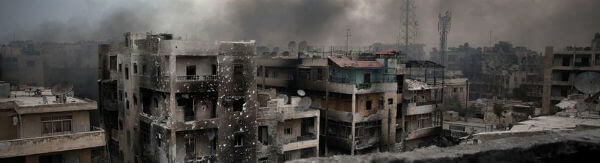
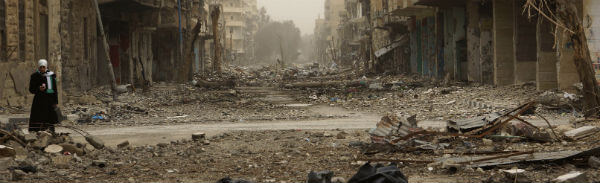
Elizabeth Shakman Hurd writes: The suffering of Syrians comes to those of us outside the country in words and images. Violent scenes and anguished accounts pervade the international media. Reporters tell us who is fighting, and commentators ask why. How should the United States and others respond? What should be done about ISIS? About refugees? There are days when it seems we have reached a saturation point. No more talking, please — no more words.

But that impulse, however understandable, is mistaken. In their new book Burning Country: Syrians in Revolution and War, journalist Robin Yassin-Kassab and human rights activist Leila Al-Shami provide a bracing and timely reminder that no matter how long the war rages or how unreachable a political settlement may appear, the world owes it to the Syrian people — especially the peaceful revolutionaries — to listen to their stories and support their cause. Burning Country is a portrait of the opposition, a movement of protest against Bashar al-Assad’s brutal regime, which has been nearly forgotten amid the humanitarian strife, factionalism, and power politics surrounding and driving the conflict.

The regime’s extraordinary cruelty is well known, thanks to reporting such as Janine de Giovanni’s The Morning They Came For Us: Dispatches from Syria (2016), the latest in a long line of works detailing Assad’s bloody response to the revolution for democratic reform, economic opportunity, and an end to corruption and institutionalized violence. This revolution has its own lesser-known backstory, though, which Yassin-Kassab and al-Shami helpfully emphasize. Contrary to popular perception, 2011 was not the beginning. Calls for change emerged with the political openings accompanying the Damascus Spring movement in the early 2000s and the 2005 Damascus Declaration for Democratic National Change. Prominent civil and political figures of all backgrounds — secular and religious, Arab and Kurdish; the opposition, Muslim Brotherhood, Communist Labor Party — signed on. When I visited Damascus in 2009, the potential for democratic reform was palpable, if unspoken. Within limits, one could discuss and even debate issues such as women’s rights and Syria’s role in the region. My sense was that many Syrians, though mindful of the dangers, wanted change.

To appreciate the tenacity of the Syrian revolutionaries in the face of the regime’s violence, it is important for those outside the country to understand this history: the Syrian uprising was not a spur-of-the-moment reaction to the Arab Spring. It percolated just beneath the surface — and just beyond the headlines — for at least a decade before March 2011, when anti-regime graffiti drawn by schoolboys in the southern city of Daraa provoked Assad’s violent crackdown. It is also critical to recognize the depth of many Syrians’ disillusionment with a regime that has imprisoned, abused, and violated them. One evening during my 2009 visit, I had dinner with two weary but warm Syrian Kurds who had spent the prime of their lives in prison. I asked what outsiders could do to help people in their situation. “Tell our stories,” they replied. This is exactly what Yassin-Kassab and al-Shami do. [Continue reading…]


Facebooktwittermail

The Morning They Came for Us reports on the hell of Syria

Syria5

Michiko Kakutani writes: The title of Janine di Giovanni’s devastating new book, “The Morning They Came for Us,” refers to those terrible moments in ordinary Syrians’ lives when the war in their country becomes personal. Those moments when there is a knock on the door and the police or intelligence services take a family member away. Those moments when a government-delivered barrel bomb falls on your home, your school, your hospital, and daily life is forever ruptured.

“The water stops, taps run dry, banks go, and a sniper kills your brother,” she writes. Garbage is everywhere because there are no longer any functioning city services, and entire neighborhoods are turned into fields of rubble. Victorian diseases like polio, typhoid and cholera resurface. Children wear rubber sandals in the winter cold because they do not have shoes. People are forced to do without “toothpaste, money, vitamins, birth-control pills, X-rays, chemotherapy, insulin, painkillers.”

In the five years since the Assad regime cracked down on peaceful antigovernment protests and the conflict escalated into full-blown civil war, more than 250,000 Syrians have been killed and some 12 million people — more than half the country’s prewar population — have been displaced, including five million who have fled to neighboring countries and to Europe in what the United Nations calls the largest refugee crisis since World War II. [Continue reading…]

Facebooktwittermail

‘My grandsons’ fight to avenge their father’: Child soldiers in Afghanistan

The Guardian reports: When Firoza handed her two grandsons Kalashnikovs and enlisted them in her militia, it was, she says, to give them a chance to avenge their father who was killed by the Taliban.

Known in Helmand by her nom de guerre – Hajani – 54-year-old Firoza fought for years to repel the militants from Sistani, in Marjah district, commanding a unit of the US-backed government militia called the Afghan Local Police (ALP). During the war, in which she lost three of her six adult sons, she armed most of her male family members, including two children.

The eldest, Nabi*, a shy boy with bags under his eyes, echoes his grandmother. “The enemy killed my father so I am also fighting,” he says.

According to Firoza, the government pays Nabi the standard 9,500 afghanis (£100) local police salary; his younger brother, Habib, is not paid.

Firoza says Nabi is 18. Many Afghans don’t know their age, but that claim seems improbable. Face smooth, voice unbroken, he looks perhaps 14. Firoza says she gave her grandsons weapons five years ago.

Despite government pledges to rid its armed forces of children, a growing number of minors are recruited to fight in the intensifying war, according to experts. [Continue reading…]

Facebooktwittermail

Taliban leader was made to ‘face the consequences’ of refusing to negotiate

The Wall Street Journal reports: President Barack Obama secretly ordered the strike on Mullah Mansour after first trying to bring him to the negotiating table. Initially, there was hope in Washington that Mullah Mansour would be more open to negotiations than his predecessor, Mullah Mohammad Omar.

Obama administration officials were divided over whether the Pakistanis were capable or willing to deliver Mullah Mansour for the negotiations.

U.S. officials said the Pakistanis tried and grew frustrated in February by Mullah Mansour’s refusal to send representatives to meet with the Afghan government.

Around the same time, people who maintain contacts with the Taliban began to report that Mullah Mansour had left Pakistan and was spending time in Iran.

U.S. intelligence agencies received information that allowed them to track Mullah Mansour’s movements, including details about devices he used for communications, U.S. officials said.

That allowed the spy agencies to present policy makers with a choice: If and when Mullah Mansour were located in Pakistan, should the U.S. strike?

Mullah Mansour’s travels made it easier to find him. In contrast, the Central Intelligence Agency spent years looking in vain for an opportunity to kill the reclusive cleric he replaced, Mullah Omar.

An April 19 Taliban attack in Kabul targeted Afghanistan’s secret service, killing more than 60 people and underlining for the Americans the extent to which Mullah Mansour had chosen a military course. A decision was made that he should “face the consequences” of his refusal to negotiate, a senior administration official said. [Continue reading…]

Facebooktwittermail

Egypt’s long history of air-disaster denial

Dorian Geiger writes: “I rely on God.”

That’s what Gameel Al-Batouti, the co-pilot of EgyptAir Flight 990, repeated — 11 times in Arabic — before the aircraft he was operating mysteriously plunged into the icy waters of the Atlantic Ocean off the coast of Massachusetts on Oct. 31, 1999.

That audio, captured by the recovered flight recorder, was a key piece of evidence for U.S. authorities and the National Safety Transportation Board (NTSB), which concluded that Al-Batouti was suicidal and had purposefully brought the airliner down while the first officer was out of the cockpit. The Egyptian Civil Aviation Agency was adamant, however, that mechanical error was to blame and dismissed the NTSB investigation as “flawed and biased.” Egypt still officially denies that Al-Batouti committed suicide.

Now Egypt is once again under scrutiny to deliver answers in the disappearance of EgyptAir Flight 804, which crashed into the Mediterranean with 66 people on board on May 19. This time, in contrast to past air disasters, the Egyptian government initially suggested that it was terrorism, even though the exact cause of the crash remains unclear and no terrorist group has claimed responsibility. As it has done previously, Cairo appears to want to deflect blame onto other countries. A terrorist attack would reflect poorly on France’s airport security, whereas a technical issue with the plane would leave EgyptAir to blame. But Egyptian officials later walked that suggestion back and disputed reports that the small size of the body parts found indicated that a large explosion had brought down the plane.

The equivocation from Cairo was a reminder anyone expecting to get to the bottom of the tragedy should reflect on Egypt’s lack of transparency in previous investigations. “There has been a very checkered past in terms of Egyptian openness,” says says Adam Schiff, a California Congressman and House Permanent Select Committee on Intelligence who has long criticized Egypt’s lack of cooperation in international investigations. “They have not always been open and forthcoming with the investigation results and often have sought to control access to wreckage and the flow of information during the course of the investigation.” [Continue reading…]

Facebooktwittermail

For Washington, stability in Egypt matters more than human rights

The Wall Street Journal reports: After two years of cool relations between the U.S. and Egypt, the October terrorist attack on a Russian passenger plane over the Sinai Peninsula triggered a flurry of visits here by U.S. officials, who called for increased military aid to shore up President Abdel Fattah Al Sisi.

The downing of that jet was claimed by an Islamic State affiliate based in the Sinai. The possibility that the mysterious crash of an Egyptian airliner last week was another act of terrorism has only intensified worries that Mr. Sisi is unable to contain the threat, according to a U.S. official, a Western diplomat and other experts.

“An incident like this on the heels of another airline disaster is always going to speed up any cooperation on security even if the cause is not yet clear,” the Western diplomat said.

Regardless of what actually caused the EgyptAir flight from Paris to Cairo to crash, Michael Hanna, an Egypt expert at the Century Foundation, said recent traffic from Washington suggests the U.S. will seek to increase support for the Sisi regime despite deep concerns about its human-rights record.

The goal is to avoid having Egypt — long a U.S. ally under longtime authoritarian leader Hosni Mubarak — follow the downward spiral of Iraq, Syria and neighboring Libya, where terrorists have exploited security vacuums in recent years.

“Egypt is too big to fail in the eyes of the U.S. and Europe,” Mr. Hanna said. [Continue reading…]

Facebooktwittermail

5 ways Bernie Sanders may impact the Democratic Party platform

Jason Linkins writes: Every four years, as Democrats and Republicans plan for their national conventions, party leaders come together to decide on how to best dust off and shine up their respective parties’ platform — that catch-all proclamation that signals their political priorities and policy goals. Typically, the publication of these platforms results in a couple days of news stories, in which noteworthy alterations are documented and the other side levies partisan objections.

But this year, there’s an interesting twist: Bernie Sanders — the presumptive second-place finisher in the Democratic primary — has been granted the opportunity to play a role on the platform committee. Which means that the Democratic Party’s platform document may receive up to four days of coverage. Perhaps even five.

If this seems like a cynical way of viewing what is ostensibly an important party document, I invite you to muddle through the last Democratic party platform, authored in President Barack Obama’s re-election year. A red-hot manifesto it is not. Over the course of some 25,000-or-so words, the party outlines, in the safest possible terms, what it stands for. Everything is poll-tested to within an inch of its literary life.

Along the way, the platform is salted with marketing bromides and vague political platitudes. Credit is given to Obama for many accomplishments which need to, in the eyes of the party, continue being accomplished. And, in keeping with recent Democratic Party election-year strategies, much effort is undertaken to cast the GOP in a bad light (“The other guys are crazy!”). It’s a tradition that will no doubt continue now that the presumptive Republican Party nominee is reality TV personality and North Pacific Subtropical Gyre garbage patch Donald Trump.

The objectionable nature of Trump’s candidacy may be one thing on which this year’s platform committee might be able to quickly agree. In an unusual move, Democratic National Committee Chairwoman Debbie Wasserman-Schultz is allowing Sanders to name five appointees to the 15-member committee, instead of reserving the right to name the entire committee for herself. Under this arrangement, presidential rival Hillary Clinton‘s campaign will get to pick six members and Wasserman-Schultz will name four, including the committee chair, Rep. Elijah Cummings (D-Md.).

As Mother Jones’ Kevin Drum points out, the buried news may be that Sanders is signaling that he understands he won’t win this nomination. Whether or not this is true, the independent Vermont senator is hailing this as a major, substantive concession. And he’s named a quintet of unconventional-by-party-insider standards as his emissaries: Rep. Keith Ellison (D-Minn.), environmental campaigner Bill McKibben, Native American activist Deborah Parker, racial justice advocate (and Obama critic) Cornel West and DNC member James Zogby.

Clinton’s picks are decidedly more in keeping with her “barrier-breakers” theme: American Federation of State, County and Municipal Employees union leader Paul Booth, former EPA head Carol Browner, Rep. Luis Gutiérrez (D-Ill.), Ohio state Rep. Alicia Reece, former State Department official Wendy Sherman and Center for American Progress head Neera Tanden.

So, one way in which this arrangement will generate more news than is typically created by the platform committee will be watching West and Tanden co-author a document. But beyond the soap opera aspect of this collaboration, there are several areas in which Sanders’ representatives could alter what’s traditionally a very staid and cautious party declaration in significant ways. [Continue reading…]

Facebooktwittermail

The radical future of interrogation

shadow16

Robert Kolker writes: The trouble with modern interrogation technique… is that, despite its scientific pose, it has almost no science to back it up. Reid and Inbau [authors of Criminal Interrogation and Confessions, which in 1962 set the mold for police interrogations in America] claimed, for instance, that a well-trained investigator could catch suspects lying with 85 percent accuracy; their manual instructs detectives to conduct an initial, nonaccusatory “behavioral analysis interview,” in which they should look for physical tells like fidgeting and broken eye contact. But when German forensic psychologist Günter Köhnken actually studied the matter in 1987, he found that trained police officers were no better than the average person at detecting lies. Several subsequent studies have cast doubt on the notion that there are any clear-cut behavioral tells. (Truth tellers often fidget more than liars.) In fact, the more confident police officers are about their judgments, the more likely they are to be wrong.

But the scientific case against police interrogations really began to mount in the early 1990s, when the first DNA-based exonerations started rolling in. According to the Innocence Project, a group dedicated to freeing the wrongfully imprisoned, about a third of the 337 people who’ve had their convictions overturned by DNA evidence confessed or incriminated themselves falsely. These and other exonera­tions furnished scientists with dozens of known false-confession cases to study, giving rise to a veritable subfield of social psychology and the behavioral sciences. (At least one confession elicited by John Reid himself — in a 1955 murder case — turned out to be inaccurate; the real killer confessed 23 years later.)

Researchers have even broken down these false confession cases into categories. There are “voluntary” false confessions, like the many presumably unstable people who claimed credit for the Lindbergh baby kidnapping in order to get attention. Then there are “compliant,” or “coerced,” false confessions, in which people are so ground down by an intense interrogation that, out of desperation and naïveté, they think that confessing will be better for them in the long run. The third category, “persuaded,” or “internalized,” false confessions, may be the most poignant. Here, the interrogator’s Reid-style theming is so relentless, the deployment of lies so persuasive, that suspects — often young and impressionable or mentally impaired — end up believing they did it, however fleetingly. [Continue reading…]

Facebooktwittermail

Did Obama just carry out an experimental execution?

Reuters reports: U.S. President Barack Obama approved the drone strike that killed Mullah Akhtar Mansour because the Taliban leader was overseeing plans for new attacks on American targets in Kabul, the Afghan capital, U.S. officials said on Monday. [Continue reading…]

Drone strikes are always carried out in the name of necessity. From the president on down, everyone wants to be able to claim that the decision to launch a deadly attack was driven by an imminent threat, there being no legal basis for indiscriminate killing or vengeance.

In the case of the assassination of the Taliban leader, Mullah Akhtar Mansour, in Pakistan over the weekend, Obama’s comments on the killing suggest that this actually had less to do with preventing an imminent attack, than it was a kind of experiment.

No one knows what the consequence of killing Mansour will be, but Obama apparently thought that the potential benefits outweighed the risks.

An otherwise risk-averse president always seems confident about the bets he places when they involve Hellfire missiles.

The Wall Street Journal reports: Mr. Obama, speaking Monday during a visit to Hanoi, said the drone strike against Mr. Mansour did not constitute a “shift” in the U.S. mission. “We are not re-entering the day-to-day combat operations that are currently being conducted by Afghan forces,” he said.

He stressed Saturday’s airstrike was an opportunity for the Taliban to shift direction in favor of reconciliation talks, because Mr. Mansour for months has been against those talks.

Whether Mr. Mansour’s death changes things remains to be seen, according to those who track the group. Some believe his death could lead to a power struggle, accelerating the Taliban’s breakup. A main breakaway group already is being funded by the Afghan government as part of an effort to splinter the movement, The Wall Street Journal reported.

It was disclosed last year that the former Taliban leader, Mullah Mohammad Omar, had died two years earlier.

However, the infighting is unlikely to encourage the group to negotiate with the Afghan government, according to those familiar with its operations. Mr. Mansour’s death actually may make it difficult for moderates among the Taliban to negotiate. [Continue reading…]

Facebooktwittermail

My son the ISIS executioner

BuzzFeed reports: When El Shafee Elsheikh was a little boy, after his father had left, his mother would find him at the workbench by the summerhouse at the bottom of the garden in White City, west London, tinkering endlessly with engine motors, bicycle parts, and old computers. Elsheikh was slight and elfin-featured, with wide almond eyes and pointed ears under a cloud of dark curls. He cut a sombre figure, intently turning the parts over in his small hands, finding out what made things work, how to fix them when they got broken. On warm nights, his mother says, he liked to sleep alone down here, in the makeshift old wooden summerhouse with a sheet drawn over the door.

Years later, in 2011, when Elsheikh had a grown into a striking young man in his early twenties, his mother found him here skulking with his CD player, listening to a torrent of hate. The words streaming out of his headphones, when she snatched them from him, were those of the notorious al-Qaeda-affiliated west London preacher Hani al-Sibai. By now Elsheikh had qualified as a mechanical engineer and was earning his living fixing cars and fairground rides. He was quiet, studious, and devoted to his family, and he made his mother proud. But on that day in the garden, she says, she feared for the first time that she was losing him to an ideology she did not understand.

Now, five years on, Maha Elgizouli stands down here by the summerhouse, struggling to conceive of how the son she still calls her “little one” turned into one of the world’s most wanted terrorists. Elsheikh has just been identified by BuzzFeed News and the Washington Post as a member of the notorious ISIS execution cell of four British guards known as the “Beatles” and responsible for beheading 27 hostages and torturing captives with electric shocks, waterboarding, and mock executions. He is the fourth and final member of the terror cell to be named, following the unmasking of the group’s knife-wielding executioner “Jihadi John” as Mohammed Emwazi, and the two other guards as fellow west Londoners Alexanda Kotey and Aine Davis. [Continue reading…]

Facebooktwittermail

A beleaguered Britain takes comfort in nostalgia for empire

british-empire

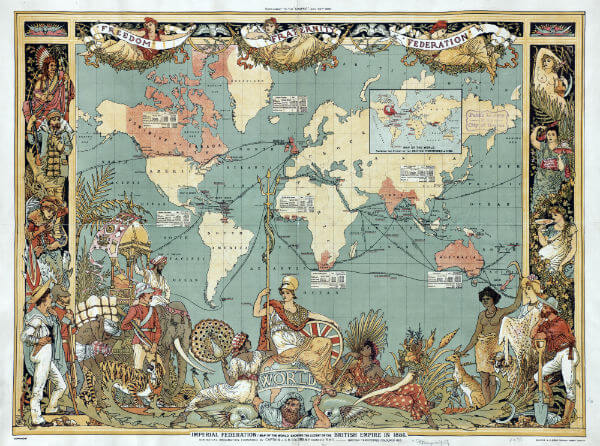
Paul Harris writes: The British empire never lacked contradictions. A global juggernaut standing with its military boot on millions of necks, practising commercial coercion and diplomatic cynicism, it nonetheless routinely thought of itself as a plucky underdog. Its heroes were the handful of redcoats at Rorke’s Drift fighting off the Zulu masses, or General Charles Gordon of Khartoum, going down against the odds in a last stand against religious zealots in the Sudan.

British soldiers, diplomats and traders pictured themselves as almost accidental conquerors, vanquishing a quarter of the planet’s landmass in between tea, tiffin and cricket matches. They maintained a detached stiff upper lip and publicly ignored the unpleasant reality of the Maxim gun – a luxury not afforded to the locals on its business end.

Britain preferred to see its dominance of a fifth of the world’s population as some sort of benevolent, God-given mission to bring law, order and free trade to benighted corners of the world. As George Bernard Shaw complained: ‘The ordinary Britisher imagines that God is an Englishman.’

It was a powerful notion and it has not gone away. Even though the Empire is reduced to a scattering of tiny islands with names few Britons would recognise, the imperial past remains implausibly popular. Early this year, a poll showed that a full 44 per cent of Britons were proud of colonialism, far outnumbering the mere 21 per cent who regretted their country’s imperial past. The survey was not an outlier. A 2014 report showed a mere 15 per cent of Britons thought the colonised might just have been left worse off by the experience. [Continue reading…]

Facebooktwittermail

Syria’s doctors on the frontline

Borzou Daragahi reports: Just a few more days, the pediatrician assured his friend, and he would come back. Doctor Hatem, as he is known in the tight-knit community of Syria war physicians, had an important exam to take in Istanbul, a half-hearted attempt at career development in the midst of the chaos that had engulfed his homeland. Hatem asked his fellow pediatrician and friend, Muhammad Waseem Moaz, to delay his own long-planned break a little while longer so he could sit for the test.

“You stay, and I will change places with you later,” he promised his friend.

The last couple weeks of April had been a particularly stressful stretch of the war. A shaky cessation of hostilities between pro- and anti-Syrian regime forces was crumbling in Aleppo, Syria’s commercial capital and largest city. Casualties were mounting again as helicopters and planes pounded the city with barrel bombs. One day a missile landed in the city, barely missing the Children’s Hospital, where Hatem is the senior doctor.

Then there was the daily battle to stock up on essential supplies. Transit routes to opposition-held territory in eastern Aleppo had closed as rebels lost control to fighters from the regime of Bashar al-Assad, to ISIS, or to Kurdish militias. Only the dangerous Castello Road leading to the northwest, through Idlib province, remained open. Doctors had stocked up on six months of supplies, but the regime appeared to be targeting their warehouses. “We used to get supplies through Kilis, but now everything is affected by the siege,” Hatem said. [Continue reading…]

Facebooktwittermail

Not just Russia: The Iranian surge in Syria

Aron Lund writes: When the Russian Air Force intervened in Syria on September 30, 2015, it changed the tide of battle. After a year of painful defeats in places such as Idlib, Jisr al-Shughour, Palmyra, and the Hawran region, Syrian President Bashar al-Assad’s government managed to regain its balance. By the end of the year, Assad’s forces were again moving forward in the northern Latakia region, east of Aleppo, and on several other fronts. In February 2016, his army cut a key rebel supply route between Aleppo and the Turkish border, and, in late March, Assad’s Russian-backed troops retook Palmyra from the self-proclaimed Islamic State. They are now moving on the Ghouta enclave east of Damascus, exploiting weeks of disastrous infighting among the local rebels.

Assad’s advances have slowed down recently, partly due to a brittle cessation of hostilities agreement monitored by the United States and Russia. The government even lost some ground in the Aleppo, Latakia, and eastern Homs regions. More significantly, the Syrian economy is in disastrous shape, and this might undermine Assad’s military progress. But there is no question that Assad’s position has greatly improved due to the Russian intervention, or that Moscow’s influence over the conduct of the war in Syria has grown significantly.

That is the conventional narrative, at least. However, it is missing something.

What happened in autumn 2015 was not just that Russia began operating in Syrian airspace. The reason the Russian intervention was so successful was that it was also accompanied by Iranian intervention on the ground. Let’s take a closer look at how that happened. [Continue reading…]

Facebooktwittermail

Mecca fast becoming a Las Vegas for pilgrims as world’s largest hotel soon opens

The Guardian reports: Four helipads will cluster around one of the largest domes in the world, like sideplates awaiting the unveiling of a momentous main course, which will be jacked up 45 storeys into the sky above the deserts of Mecca. It is the crowning feature of the holy city’s crowning glory, the superlative summit of what will be the world’s largest hotel when it opens in 2017.

With 10,000 bedrooms and 70 restaurants, plus five floors for the sole use of the Saudi royal family, the £2.3bn Abraj Kudai is an entire city of five-star luxury, catering to the increasingly high expectations of well-heeled pilgrims from the Gulf.

Modelled on a “traditional desert fortress”, seemingly filtered through the eyes of a Disneyland imagineer with classical pretensions, the steroidal scheme comprises 12 towers teetering on top of a 10-storey podium, which houses a bus station, shopping mall, food courts, conference centre and a lavishly appointed ballroom.

Located in the Manafia district, just over a mile south of the Grand Mosque, the complex is funded by the Saudi Ministry of Finance and designed by the Dar Al-Handasah group, a 7,000-strong global construction conglomerate that turns its hand to everything from designing cities in Kazakhstan to airports in Dubai. For the Abraj Kudai, it has followed the wedding-cake pastiche style of the city’s recent hotel boom: cornice is piled upon cornice, with fluted pink pilasters framing blue-mirrored windows, some arched with a vaguely Ottoman air. The towers seem to be packed so closely together that guests will be able to enjoy views into each other’s rooms.

“The city is turning into Mecca-hattan,” says Irfan Al-Alawi, director of the UK-based Islamic Heritage Research Foundation, which campaigns to try to save what little heritage is left in Saudi Arabia’s holy cities. “Everything has been swept away to make way for the incessant march of luxury hotels, which are destroying the sanctity of the place and pricing normal pilgrims out.”

The Grand Mosque is now loomed over by the second tallest building in the world, the Abraj al-Bait clocktower, home to thousands more luxury hotel rooms, where rates can reach £4,000 a night for suites with the best views of the Kaaba – the black cube at the centre of the mosque around which Muslims must walk. The hotel rises 600m (2,000ft) into the air, projecting a dazzling green laser-show by night, on a site where an Ottoman fortress once stood – razed for development, along with the hill on which it sat.

The list of heritage crimes goes on, driven by state-endorsed Wahhabism, the hardline interpretation of Islam that perceives historical sites as encouraging sinful idolatry – which spawned the ideology that is now driving Isis’s reign of destruction in Syria and Iraq. [Continue reading…]

The construction of towering luxury hotels in Mecca seems to conflict with what can be described as the leveling effect for pilgrims performing the annual Hajj.

A 2008 Harvard study which compared attitudes of 800 successful Hajj lottery applicants from Pakistan, to an equal number of unsuccessful ones, found:

Hajjis have more positive views about people from other Muslim countries and are more likely to believe that different Pakistani ethnic and Islamic sectarian groups are equal and that they can live in harmony. Despite non-Muslims not being part of the hajj experience, these views also extend to adherents of other religions: Pilgrims are 22 percent more likely to declare that people of different religions are equal and 11 percent more likely to state that different religions can live in harmony by compromising over their disagreements.

Paralleling the findings on tolerance, hajjis report more positive views on women’s abilities, greater concern for their quality of life, and are also more likely to favor educating girls and women participating in the workforce.

Hajjis are also less likely to support the use of violence and show no evidence of any increased hostility toward the West. They are more than twice as likely to declare that the goals of Osama bin Laden are incorrect, more likely to express a preference for peace between Pakistan and India, and more likely to declare that it is incorrect to physically punish someone if they have dishonored the family. Hajjis also become more sensitive to crimes against women.

It thus seems that in many respects, the value of Hajj has less to do with the quality of accommodation available to pilgrims than it does with the avenues of access.

“These are the last days of Mecca,” Alawi tells The Guardian. “The pilgrimage is supposed to be a spartan, simple rite of passage, but it has turned into an experience closer to Las Vegas, which most pilgrims simply can’t afford.”

Facebooktwittermail

China’s scary lesson to the world: Censoring the Internet works

The Washington Post reports: First there was the Berlin Wall. Now there is the Great Firewall of China, not a physical barrier preventing people from leaving, but a virtual one, preventing information harmful to the Communist Party from entering the country.

Just as one fell, so will the other be eventually dismantled, because information, like people, cannot be held back forever.

Or so the argument goes.

But try telling that to Beijing. Far from knocking down the world’s largest system of censorship, China in fact is moving ever more confidently in the opposite direction, strengthening the wall’s legal foundations, closing breaches and reinforcing its control of the Web behind the wall.

Defensive no more about its censorship record, China is trumpeting its vision of “Internet sovereignty” as a model for the world and is moving to make it a legal reality at home. At the same time — confounding Western skeptics — the Internet is nonetheless thriving in China, with nearly 700 million users, putting almost 1 in 4 of the world’s online population behind the Great Firewall.

China is the world’s leader in e-commerce, with digital retail sales volume double that of the United States and accounting for a staggering 40 percent of the global total, according to digital business research company eMarketer. Last year, it also boasted four of the top 10 Internet companies in the world ranked by market capitalization, according to the data website Statista, including e-commerce giant Alibaba, social-media and gaming company Tencent and search specialists Baidu. [Continue reading…]

Facebooktwittermail

The humanitarian system: ‘A mammoth machinery losing track of what it is for’

Heba Aly writes: The number of people affected by humanitarian crises has more than doubled over the past decade. The frequency, scale, and severity of humanitarian crises are set to continue rising. Yet time and again, the traditional international humanitarian relief apparatus has been unable to respond adequately. Syria is only the latest example of this.

The aid sector is aware of deficiencies, but often frames the challenges it faces in terms that downplay its own responsibility. Needs are rising quickly, its leaders argue, and the scale of financing to respond to them is lagging behind. In reality, the problems facing the sector are much more fundamental. It has become a mammoth machinery that has, in many ways, lost track of what it stands for.

Irin reported in 2015 on focus groups conducted as part of the World Humanitarian Summit (WHS) process with refugees and other people affected by crises in the Middle East. [Continue reading…]

Facebooktwittermail

Why pro-Israel Democrats Bernie Sanders and Hillary Clinton could have a fight about Israel

The Washington Post reports: The only Jewish candidate in the 2016 presidential race, who calls himself “100 percent pro-Israel,” and one of Israel’s strongest U.S. defenders are nearing a fight over what being a pro-Israel Democrat means.

Sen. Bernie Sanders of Vermont plans to push for revisions in the Democratic Party position about relations with Israel, with a focus on elevating Palestinian rights as a U.S. priority, people involved in discussions over potential changes to the Democratic Party’s platform said.

Sanders wants revisions in wording about U.S. relations with Israel and commitment to seeking peace between the U.S. ally and the Palestinians while preserving the commitment to Israel’s security, those people said. They requested anonymity to discuss ideas for the platform that are still being developed. The platform is drafted by a Democratic National Committee panel and presented at the party convention in July.

The proposed new language on Israel is expected to seek what Sanders has elsewhere called a more even-handed U.S. approach to Israeli occupation of land Palestinians claim for a future state. [Continue reading…]

Facebooktwittermail

Shake-up in Israeli politics prompts ‘seeds of fascism’ warning

Reuters reports: A military affairs commentator interrupts his broadcast to deliver a monologue: I’m alarmed by what’s happening in Israel, he says, I think my children should leave.

Former Prime Minister Ehud Barak warns of “the seeds of fascism”. Moshe Arens, who served as defense minister three times, sees it as a turning point in Israeli politics and expects it to cause a “political earthquake”.

The past five days have produced tumult in Israeli politics, since conservative Prime Minister Benjamin Netanyahu unexpectedly turned his back on a deal to bring the center-left into his coalition and instead joined hands with far-right nationalist Avigdor Lieberman, one of his most virulent critics.

Lieberman, a West Bank settler, wants to be defense minister. So on Friday, Netanyahu’s former ally and confidant, Defence Minister Moshe Yaalon, resigned and quit Netanyahu’s Likud party in disgust.

After a weekend to digest the developments, which are expected to be finalised in an agreement between Netanyahu and Lieberman on Monday to form the most right-wing government in Israel’s 68-year-old history, commentators have tried to put it in perspective and found themselves alarmed. [Continue reading…]

Facebooktwittermail