Category Archives: ISIS

Islamic State of Iraq and Syria

Hell on Earth: Life under ISIS in Libya

The Daily Beast reports: Amjad bin Sasi was a young man who enjoyed Western clothing, a fashionable haircut, and even the odd drink.

When ISIS seized control of his hometown of Sirte on Libya’s Mediterranean coast last year, bin Sasi was one of tens of thousands consigned to living in hell on Earth. His torment lasted less than a year—he was shot in the back of the head by an ISIS executioner at the age of 23.

The crime for which he was arrested? Cursing.

This is the reality of life under the control of the self-proclaimed Islamic State in Libya, according to a report by Human Rights Watch, which includes allegations of crimes against humanity, war crimes, mutilation, beatings, and extra-judicial killings.

The U.S. military has drawn up plans for an assault on the ISIS stronghold, but President Obama has refused to sanction any military intervention.

The residents of Sirte live in constant fear of being caught breaking the strict codes of conduct imposed by their ISIS rulers. Every neighbor could be an informant for the Hisba morality police, and harsh penalties are routinely handed down by religious judges after unfair trials.

“Life is hell for people in Sirte,” Letta Tayler, the author of the HRW report, told The Daily Beast. “People told me they are living in constant fear. Many of the men and women I interviewed in Misrata [a nearby city] started crying when they spoke about having to go back because they had no place to go. People were living in absolute terror.”

One of the extraordinary things about life in this ISIS outpost is that even those who bow their heads and follow the hardline rules are forced to live in misery. [Continue reading…]


Facebooktwittermail

Iraq’s Shi’ite rivalries risk turning violent, weakening war on ISIS

Reuters reports: A power struggle within Iraq’s Shi’ite Muslim majority has intensified as attempts to form a new government flounder, threatening to turn violent and ruin U.S.-led efforts to defeat Islamic State.

For the first time since the U.S. withdrawal at the end of 2011, Shi’ite factions came close to taking arms against each another last month, when followers of powerful cleric Moqtada al-Sadr stormed the parliament in Baghdad’s Green Zone.

Rival Shi’ite militiamen took up positions nearby, raising the specter of intra-Shi’ite fighting similar to events in the southern city of Basra in 2008, in which hundreds of people were killed.

Trucks carrying those militiamen, armed with rocket-propelled grenades and machine guns, patrolled the capital in clear view of the security forces, video published on the website of Iranian-backed group Saraya al-Khorasani showed.

The crisis presents the biggest political challenge yet to Prime Minister Haider al-Abadi, a moderate Shi’ite Islamist who took office in 2014 promising to defeat Islamic State, mend rifts with the minority Sunnis and Kurds, and root out corruption eating away at state income which has already been eroded by a slump in oil prices.

Sadr, the heir of a revered clerical dynasty, says he backs Abadi’s planned political reforms and has accused other Shi’ite leaders of seeking to preserve a system of political patronage that makes the public administration rife for corruption.

His followers stormed the heavily fortified Green Zone on April 30 after rival political groups blocked parliamentary approval of a new cabinet made up of independent technocrats proposed by Abadi to fight graft.

A commander in Saraya al-Khorasani, which deployed near the Green Zone in response, made it clear that they would fight rather than allow Sadr’s followers to occupy the district which houses parliament, government offices and embassies.

“We are here to kill this sedition in its cradle,” the commander, dressed in green camouflage and a black turban told his fighters, the online video shows. [Continue reading…]

Facebooktwittermail

Fallujah could be the next big battle of the ISIS war

The Daily Beast reports: The Iraqi government is putting the ISIS-controlled city of Fallujah as next on its target list.

That’s not because of increasingly dire reports that the citizens of Fallujah are suffering from starvation and torture under ISIS’s cruel grip. Nor do Iraqi officials see the city as key to dislodging ISIS from its Iraqi stronghold, Mosul.

Rather, Iraqi officials have told their American counterparts that they suspect the restive Sunni-dominated city is sending jihadists to attack Baghdad, the Shiite-dominated capital. In the last week, there have been multiple daily bombings in Baghdad that have killed more than 200 people and wounded hundreds more. On Tuesday alone, a combination of suicide attacks and car bombings took the lives of nearly 70 people; ISIS claimed responsibility for some of those bombings.

In other words: While all eyes were on Baghdad and the deadliest spate of bombings to strike the capital in years, the Iraqi government was quietly pointing its finger at Fallujah.

Such accusations toward Fallujah, arguably, is precisely what ISIS wanted its bombings to incite, a return to the kind of sectarianism that has, in the past, threatened to tear the state apart — and was supposed to dissipate under Prime Minister Haider al Abadi. [Continue reading…]

Facebooktwittermail

The map ISIS hates

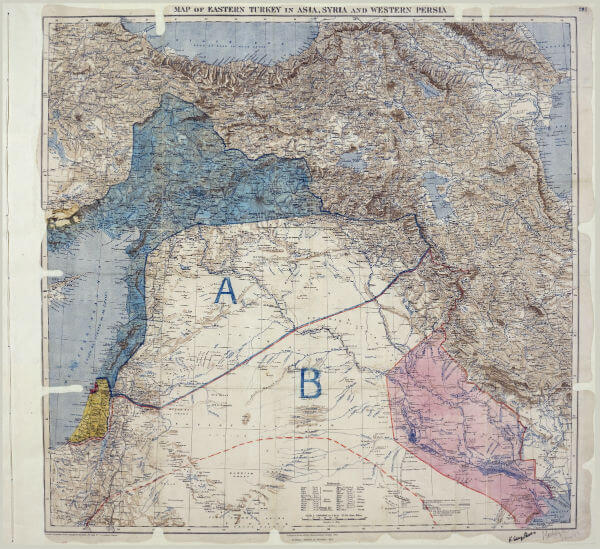
sykes-picot

In 2014, Malise Ruthven wrote: When the jihadists of ISIS (the Islamic State of Iraq and Syria) tweeted pictures of a bulldozer crashing through the earthen barrier that forms part of the frontier between Syria and Iraq, they announced — triumphantly — that they were destroying the “Sykes-Picot” border. The reference to a 1916 Franco-British agreement about the Middle East may seem puzzling, coming from a radical group fighting a brutal ethnic and religious insurgency against Bashar al-Assad’s Syria and Nouri al-Maliki’s Iraq. But jihadist groups have long drawn on a fertile historical imagination, and old grievances about the West in particular.

This symbolic action by ISIS fighters against a century-old imperial carve-up shows the extent to which one of the most radical groups fighting in the Middle East today is nurtured by the myth of precolonial innocence, when the Ottoman Empire and Sunni Islam ruled over an unbroken realm from North Africa to the Persian Gulf and the Shias knew their place. (Indeed, the Arabic name of ISIS — al-Dawla al-Islamiya fil-Iraq wa al-Sham — refers to a historic idea of the greater Levant (al-Sham) that transcends the region’s modern, Western-imposed state borders.)

But why is Sykes-Picot so important? One reason is that it stands near the beginning of what many Arabs view as a sequence of Western betrayals spanning from the dismantling of the Ottoman Empire in World War I to the establishment of Israel in 1948 and the 2003 invasion of Iraq. The Sykes-Picot agreement — named after the British and French diplomats who signed it — was entered in secret, with Russia’s assent, in May 1916 to divide the Arab provinces of the Ottoman Empire into British and French “spheres of influence.” It designated each power’s areas of future control in the event of victory by the Triple Entente over Germany, Austria, and their Ottoman ally. Under the agreement Britain was allocated the coastal strip between the Mediterranean and the river Jordan, Transjordan and southern Iraq, with enclaves including the ports of Haifa and Acre, while France was allocated south-eastern Turkey, northern Iraq, all of Syria and Lebanon. Russia was to get Istanbul, the Dardanelles, and the Ottoman Empire’s Armenian districts.

Under the 1920 San Remo agreement, which built on Sykes-Picot, the Western powers were free to decide on state boundaries within these areas. The international frontiers — with Iraq’s framed by the merging of the three Ottoman vilayets of Mosul, Baghdad, and Basra — were consolidated by the separate mandates granted by the League of Nations to France in Lebanon and Syria, and to Britain in Palestine, Transjordan, and Iraq. The frontier between French-controlled Syria and British-controlled Iraq included the desert of Anbar province that was bulldozed by ISIS this month.

Kept hidden for more than a year, the Anglo-French pact caused a furor when it was first revealed by the Bolsheviks after the 1917 Russian Revolution — with the Syrian Congress, convened in July 1919, demanding “the full freedom and independence that had been promised to us.” Not only did the agreement map out — unbeknownst to the Arab leaders of the time — a new system of Western control of local populations. It also directly contradicted the promise that Britain’s man in Cairo, Sir Henry McMahon, had made to the ruler of Mecca, the Sharif Hussein, that he would have an Arab kingdom in the event of Ottoman defeat. In fact, that promise itself, which had been conveyed in McMahon’s correspondence with the Sharif between July 1915 and January 1916, left ambiguous the borders of the future Arab state, and was later used to deny Arab control of Palestine. McMahon had excluded from the proposed Arab kingdom “portions of Syria lying to the west of the districts of Damascus, Homs, Hama and Aleppo [that] cannot be said to be purely Arab.” This clause led to lengthy and bitter debates as to whether Palestine — which Britain meanwhile promised as a homeland for Jews under the terms of the November 1917 Balfour Declaration — could be defined as lying “west” of the vilayet, or district, of Damascus. [Continue reading…]

Facebooktwittermail

ISIS, growing stronger in Libya, sets its sights on fragile neighbor Tunisia

The Washington Post reports: The families arrived at the cemetery in the night carrying the bullet-riddled corpses of their sons and brothers, residents recalled. One by one, the bodies were placed in unmarked graves, outcasts even in death.

The dead men had been fighters for the Islamic State. All Tunisians, they had crossed into Libya to join the terrorist group’s affiliate there. In March, they returned with other radicalized Tunisians in an attempt to seize Ben Guerdane, a smuggling hub 20 miles from the border. Dozens of the militants were killed in fierce clashes with security forces, including at least 10 who were raised here in the southeastern corner of the country.

Only eight were buried in the cemetery.

“Some families refused to take the bodies,” said Samir Naqi, a senior police official.

That Ben Guerdane, long known as an incubator for jihadists, was not captured was a victory for Tunisia. But the attack and its aftermath revealed the North African nation’s fragility as it struggles to contain the toxic fallout from the Arab Spring uprisings five years ago, and represented an escalation in the Islamic State’s ambitions.

Tunisians form the largest contingent of foreign fighters in Syria and Iraq. But with U.S. and Russian airstrikes hammering them there, and travel bans and stricter border controls in place, more Tunisians are joining the Islamic State in Libya. Increasingly, Libya’s conflict is spilling into Tunisia, the only country to emerge as a functioning democracy after the revolutions. [Continue reading…]

The Guardian reports: Leading foreign ministers from Europe and the Middle East are to meet in Vienna on Monday under the joint chairmanship of the US and Italy to discuss how to bolster support for the UN-backed Libyan government in the face of deepening splits in the country over political legitimacy, oil resources and Islamic State.

Elaborate plans to send thousands of Italian-led troops to the area are either on hold, or have been abandoned. But the west is still desperate to find ways to strengthen the political authority of the Tripoli-based government since it will help create a single military Libyan force able both to defeat Isis and tighten the control of refugees leaving the lawless coastland for Italy.

Special forces from the US, UK, France and Italy are operating in various parts of Libya, sometimes backing different military forces and hindering efforts to reunite Libyan politics behind the UN government of Fayez al-Sarraj. [Continue reading…]

Facebooktwittermail

ISIS cancels fighters’ holidays as it prepares to defend Raqqa

The Telegraph reports: Isil has cancelled holidays for militants in its Syrian stronghold of Raqqa as it maximises available manpower ahead of a feared international assault on the city.

Over the past two weeks, the group has accelerated its drive to defend Raqqa, sources inside the area told The Telegraph, digging trenches alongside checkpoints and strengthening a network of underground bunkers.

“Isil cancelled holidays, increased the number of shifts, and asked all members to be present – even the administrators,” said a source in regular contact with civilians inside the city.

Although the extremist group is far from defeat, it is under pressure across several battlefronts, losing strongholds including the Iraqi city of Ramadi in December and the ancient town of Palmyra in March. As Kurdish and Syrian rebel forces prepare to edge towards Raqqa, the city is frequently the target of airstrikes by the US-led coalition, as well as the Syrian air force and Russian warplanes that began an air campaign in the country in late September.

In an attempt to block the view of circling drones, the militants have started hanging sheets across shop-fronts and homes. They are also believed to have moved several key headquarters underground. [Continue reading…]

Facebooktwittermail

How ISIS uses the internet: Talking on Telegram and sending viruses to their enemies

BuzzFeed reports: Abu Majad figured that when ISIS came for him, it would be with a knife on a dark street, or a bomb planted on his car. The 34-year-old had been living in southern Turkey since fleeing Syria nearly three years ago and knew that his outspoken stance against ISIS — online and in his hometown in northern Syria — had put him in the terrorist group’s crosshairs. What he wasn’t expecting was to wake up on the morning of March 29 to a virus planted by ISIS within a seemingly innocuous email attachment.

“Everything about this looked like a real email, sent from the admin of my own website. It looked safe, but it was not. They were trying to get my login information, my passwords. They were trying to get things that could have put real lives in danger,” said Abu Majad, who asked that his nickname be used instead of his real name to protect himself and his remaining family in Syria from reprisal attacks by ISIS. “It was very clever. When I saw it I thought to myself, Shit, now they are professional hackers?”

Cybersecurity experts and intelligence agencies who monitor ISIS say the malware is just one more sign that ISIS is growing more sophisticated in its use of the internet.

“I don’t think it is far-fetched to say that the internet is a major reason why ISIS is so successful, and so worrying, as far as global terror movements go,” said one U.S. intelligence officer, who spoke to BuzzFeed News in Washington, D.C., and asked not to be named as he wasn’t authorized to speak to the press. “They have always been ‘good’ at the internet, at the strategy of how they use it. Now they are smarter at the internet too.” [Continue reading…]

Facebooktwittermail

Kurdish tensions undermine the war against ISIS

Hassan Hassan writes: Amnesty International has in seven months issued two major reports highlighting allegations of war crimes by rebel and Kurdish forces in northern Syria. The two reports are related to a secondary conflict brewing between Arabs and Kurds from Hasakah to Qamashli to Aleppo, which could easily spin out of control and add to the many conflicts that already plague the country.

The United States has an unintentional hand in this new conflict, and de-escalation hinges largely on whether Washington is willing to review its strategy in northern Syria, which sometimes privileges the appearance of success in the battle against ISIL over sustainable policies.

On Friday, Amnesty published a damning new report accusing rebel factions in Aleppo, organised under the Army of Conquest, of committing acts that may amount to war crimes. The rights group said it gathered strong evidence of indiscriminate attacks that killed at least 83 civilians, including 30 children, in the Kurdish-dominated Sheikh Maqsoud between February and April.

On October 13 last year, Amnesty issued a report, Forced Displacement and Demolitions in Northern Syria, accusing the Kurdish political party PYD, the Democratic Union Party, of carrying out a wave of forced displacement and home demolitions that it also said may amount to war crimes. The shelling of civilians by rebel forces cannot be justified, and perpetrators must be punished and restrained by their regional backers. The attacks on Sheikh Maqsoud were encouraged by some supporters of the opposition living abroad, after the PYD’s military wing, the YPG, attacked the rebels in February. Worse, such calls continue to be heard and more indiscriminate attacks can be expected. [Continue reading…]

Facebooktwittermail

Belgium to begin air strikes against ISIS in Syria

AFP reports: Belgium will extend its F-16 air strikes against Islamic State jihadists in Iraq into Syria, the government said Friday, as it grapples with the aftermath of deadly IS-claimed bomb attacks in Brussels in March.

“In accordance with UN Resolution 2249, the engagement will be limited to those areas of Syria under the control of IS and other terrorist groups,” a spokesman for Prime Minister Charles Michel told AFP after a cabinet meeting.

“The objective will be to destroy these groups’ refuges,” the spokesman said, adding that the strikes would begin on July 1.

Belgium launched its first attacks against IS in Iraq in late 2014 as part of the US-led coalition, but decided against strikes in Syria amid public fears over getting dragged into a wider conflict. [Continue reading…]

Facebooktwittermail

How Russia allowed homegrown radicals to go and fight in Syria with ISIS

Reuters reports: Four years ago, Saadu Sharapudinov was a wanted man in Russia. A member of an outlawed Islamist group, he was hiding in the forests of the North Caucasus, dodging patrols by paramilitary police and plotting a holy war against Moscow.

Then his fortunes took a dramatic turn. Sharapudinov, 38, told Reuters that in December 2012 Russian intelligence officers presented him with an unexpected offer. If he agreed to leave Russia, the authorities would not arrest him. In fact, they would facilitate his departure.

“I was in hiding, I was part of an illegal armed group, I was armed,” said Sharapudinov during an interview in a country outside Russia. Yet he says the authorities cut him a deal. “They said: ‘We want you to leave.’”

Sharapudinov agreed to go. A few months later, he was given a new passport in a new name, and a one-way plane ticket to Istanbul. Shortly after arriving in Turkey, he crossed into Syria and joined an Islamist group that would later pledge allegiance to radical Sunni group Islamic State.

Reuters has identified five other Russian radicals who, relatives and local officials say, also left Russia with direct or indirect help from the authorities and ended up in Syria. The departures followed a pattern, said Sharapudinov, relatives of the Islamists and former and acting officials: Moscow wanted to eradicate the risk of domestic terror attacks, so intelligence and police officials turned a blind eye to Islamic militants leaving the country. Some sources say officials even encouraged militants to leave. [Continue reading…]

Facebooktwittermail

What leads engineers to become jihadists?

structure12

In a review of Engineers of Jihad: The Curious Connection between Extremism and Education, by Diego Gambetta and Steffen Hertog, Ursula Lindsey writes: The second argument advanced by the authors to explain the “strange correlation” between studying engineering and joining a jihadist group is based on a comparative study of the political affinities of the members of radical left- and right-wing groups in the West. It shows that engineers are overrepresented among right-wing radicals generally (while humanities and social science students are more abundant among left-wing militants).

The authors suggest that Islamist and right-wing militants share a number of personality traits that have been shown to be associated with political conservatism. These include a propensity to feel disgust; a strong identification with an “in-group” and hostility toward those who don’t belong to it; and a discomfort with ambiguity and open-ended discussions (known in the literature as a “need for closure”). In Islamist circles, the authors write, “proneness to disgust is related to the strong reaction to perceived corruption of customs and a desire for social and sexual purity. In-group bias is related to a marked aversion for those who are different, be they immigrants, ethnic others, or infidels. The most multifaceted of these traits, need for closure (NFC), is related to a strong preference for hierarchy and social order and an aversion to change, which can reach the extreme of longing for a mythical past.”

Because of these underlying affinities, the authors speculate, some individuals may be “attracted to engineering as a discipline that provides concrete, unambiguous answers, and recoil from the open-ended project of natural science and the ambiguities of the humanities and social sciences.” Engineering students, “like followers of text-based religions, rely more strongly on answers that have already been given.” [Continue reading…]

Facebooktwittermail

Four ideas about the crisis of the Arab world that need to be repudiated

sykes-picot

An editorial in The Economist says: Arab states are suffering a crisis of legitimacy. In a way, they have never got over the fall of the Ottoman empire. The prominent ideologies — Arabism, Islamism and now jihadism — have all sought some greater statehood beyond the frontiers left by the colonisers. Now that states are collapsing, Arabs are reverting to ethnic and religious identities. To some the bloodletting resembles the wars of the former Yugoslavia in the 1990s. Others find parallels with the religious strife of Europe’s Thirty Years War in the 17th century. Whatever the comparison, the crisis of the Arab world is deep and complex. Facile solutions are dangerous. Four ideas, in particular, need to be repudiated.

First, many blame the mayhem on Western powers — from Sykes-Picot to the creation of Israel, the Franco-British takeover of the Suez Canal in 1956 and repeated American interventions. Foreigners have often made things worse; America’s invasion of Iraq in 2003 released its sectarian demons. But the idea that America should turn away from the region — which Barack Obama seems to embrace — can be as destabilising as intervention, as the catastrophe in Syria shows.

Lots of countries have blossomed despite traumatic histories: South Korea and Poland — not to mention Israel. As our special report (see article) sets out, the Arab world has suffered from many failures of its own making. Many leaders were despots who masked their autocracy with the rhetoric of Arab unity and the liberation of Palestine (and realised neither). Oil money and other rents allowed rulers to buy loyalty, pay for oppressive security agencies and preserve failing state-led economic models long abandoned by the rest of the world.

A second wrong-headed notion is that redrawing the borders of Arab countries will create more stable states that match the ethnic and religious contours of the population. Not so: there are no neat lines in a region where ethnic groups and sects can change from one village or one street to the next. A new Sykes-Picot risks creating as many injustices as it resolves, and may provoke more bloodshed as all try to grab land and expel rivals. Perhaps the Kurds in Iraq and Syria will go their own way: denied statehood by the colonisers and oppressed by later regimes, they have proved doughty fighters against IS. For the most part, though, decentralisation and federalism offer better answers, and might convince the Kurds to remain within the Arab system. Reducing the powers of the central government should not be seen as further dividing a land that has been unjustly divided. It should instead be seen as the means to reunite states that have already been splintered; the alternative to a looser structure is permanent break-up.

A third ill-advised idea is that Arab autocracy is the way to hold back extremism and chaos. In Egypt Mr Sisi’s rule is proving as oppressive as it is arbitrary and economically incompetent. Popular discontent is growing. In Syria Bashar al-Assad and his allies would like to portray his regime as the only force that can control disorder. The contrary is true: Mr Assad’s violence is the primary cause of the turmoil. Arab authoritarianism is no basis for stability. That much, at least, should have become clear from the uprisings of 2011.

The fourth bad argument is that the disarray is the fault of Islam. Naming the problem as Islam, as Donald Trump and some American conservatives seek to do, is akin to naming Christianity as the cause of Europe’s wars and murderous anti-Semitism: partly true, but of little practical help. Which Islam would that be? The head-chopping sort espoused by IS, the revolutionary-state variety that is decaying in Iran or the political version advocated by the besuited leaders of Ennahda in Tunisia, who now call themselves “Muslim democrats”? To demonise Islam is to strengthen the Manichean vision of IS. The world should instead recognise the variety of thought within Islam, support moderate trends and challenge extremists. Without Islam, no solution is likely to endure. [Continue reading…]

Facebooktwittermail

Struggling to fight ISIS in a fractured Libya

Frederic Wehrey writes from Sabratha, Libya: Ahmed “Amu” Dabbashi, the 28-year-old leader of a militia in this seaside town near the Tunisian border, proudly unfurls a black Islamic State flag, seized during late-February raids on safe houses of ISIS, as the group is also known. He shows me a captured arsenal, too: truck-borne explosives, detonators, crates of ammo, crew-served machine guns, and identification cards of foreign fighters.

Days earlier, American warplanes had bombed an Islamic State training site at a nearby house. Then, Amu tells me, “we decided to cleanse our town.” In the raids that followed, fighters for the so-called caliphate struck back, assaulting a police station and cutting the throats of several officers. Scores of youths perished in gunbattles.

Elsewhere across Libya, disparate factions are trying to hold the line against ISIS, often tenuously. The terrorist group is most entrenched in the central city of Sirte. Refugees fleeting Sirte tell me that ISIS extorts businesses and stops traffic to conduct executions.

In late March, a new presidential council — formed under the auspices of a U.N.-brokered unity agreement — arrived with great fanfare in the capital of Tripoli. Washington and its allies had hoped this would provide a foundation for a military campaign against ISIS. But after an initial burst of public enthusiasm, the council is struggling to exert its authority.

The fight against Islamic State faces daunting challenges. First, there still is no unified military structure through which the U.S. and Western allies can channel assistance. A powerful eastern faction allied with Gen. Khalifa Haftar remains hostile to the unity agreement and has tried to sell oil independently from Tripoli. Other militias, even if nominally supporting the new government, remain beholden to towns, tribes and power brokers.

Thus, Western special forces must work with militia surrogates in any operations against Islamic State. But this is risky: Assisting these armed groups could rekindle old rivalries and further reduce the incentives for national reconciliation.

Militias have figured out that signing up for the campaign against Islamic State is the best way to get legitimacy and attention. Whether or not they intend to use outside support solely against ISIS is another story. Many still regard their local rivals as the pressing concern. In some cases, the West may find them unsavory partners: traffickers, hard-line Salafists, tribal supremacists, military officers with authoritarian and anti-Islamist leanings.

This is evident in Sabratha, where Amu’s extended family has had longtime links with smugglers and jihadists. In the capital of Tripoli, a Salafist militia leader lets me tour his prison’s rehabilitation center, where Islamic State suspects are thrown in with drug addicts for undefined stretches with no due process. In a trip to Benghazi last fall, I saw how neighborhood militias carried out what amounts to personal and tribal vendettas, all under the cover of combating Islamic State. [Continue reading…]

Facebooktwittermail

U.S. establishes Libyan outposts with eye toward offensive against ISIS

The Washington Post reports: American Special Operations troops have been stationed at two outposts in eastern and western Libya since late 2015, tasked with lining up local partners in advance of a possible offensive against the Islamic State, U.S. officials said.

Two teams totaling fewer than 25 troops are operating from around the cities of Misurata and Benghazi to identify potential ­allies among local armed factions and gather intelligence on threats, according to the officials, who spoke on the condition of anonymity to discuss a sensitive mission overseas.

The insertion of a tiny group of U.S. personnel into a country rife with militant threats reflects the Obama administration’s worries about the Islamic State’s powerful Libyan branch and the widespread expectations of an expanded campaign against it. For months, the Pentagon has been developing plans for potential action against the group, which has at least several thousand fighters in the coastal city of Sirte and other areas. And the U.S. personnel, whose ongoing presence had not been previously reported, is a sign of the acceleration toward another military campaign in Libya.

The mission is also an illustration of President Obama’s reliance on elite units to advance counterterrorism goals in low-visibility operations. [Continue reading…]

Facebooktwittermail

Behind the carnage in Iraq: ISIS intends to divide and conquer

The Daily Beast reports: Baghdad suffered its deadliest day in months during a series of attacks Wednesday. The carnage not only shocked the capital, but also raised questions about whether Iraqi security forces are capable of reclaiming Mosul, Iraq’s second-largest city, which has been occupied for almost two years by the self-proclaimed Islamic State.

One obvious question is how Iraqi security forces can retake and secure Mosul if they cannot protect Baghdad from three suicide bombings in a matter of hours. But the picture is more complicated, and indeed, more problematic even than that.

The bombings targeted Shia neighborhoods in what appears to be part of the continuing ISIS effort to provoke a frenzy of ethnic cleansing similar to that of a decade ago. As one U.S. official immersed in the anti-ISIS war puts it, “Sunnis see ISIS as their protection — their wall against Shia revenge.”

The estimates of those killed Wednesday are as high as 150, with hundreds more injured. Among those reportedly killed were several women at a hair salon struck by a truck bomb as they prepared for their wedding day. [Continue reading…]

Facebooktwittermail

Lack of plan for ISIS detainees raises human rights concerns

The New York Times reports: The Islamic State calls them “inghimasi” — zealous foot soldiers who intend to fight to their deaths. And as the American-backed coalition has reclaimed territory from the group in Iraq and Syria, that fervor has kept prisoners from being much of a problem: The shooting only stops when almost every Islamic State fighter has been killed.

But that could change as the coalition moves toward the Islamic State’s largest urban strongholds — Mosul, Iraq, and Raqqa, Syria — raising a potential problem for the United States. If the coalition is successful and thousands of ordinary members of a collapsing Islamic State have nowhere left to retreat, will they start to surrender in greater numbers? And if so, who will be responsible for imprisoning them?

After the experiences of the past decade in the wars in Afghanistan and Iraq, the Obama administration is determined not to revive large-scale detention operations. But it is far from clear whether allies on the ground — especially rebels in Syria — are prepared to hold large numbers of prisoners, raising the prospect of an ugly aftermath to any victory.

“If they’re not killed but detained, we are concerned about the standards of care, who would do it and how it would be done,” Peter Maurer, the president of the International Committee of the Red Cross, said in an interview. [Continue reading…]

Facebooktwittermail

In remote corner of Iraq, an unlikely alliance forms against ISIS

Reuters reports: They share little more than an enemy and struggle to communicate on the battlefield, but together two relatively obscure groups have opened up a new front against Islamic State militants in a remote corner of Iraq.

The unlikely alliance between an offshoot of a leftist Kurdish organization and an Arab tribal militia in northern Iraq is a measure of the extent to which Islamic State has upended the regional order.

Across Iraq and Syria, new groups have emerged where old powers have waned, competing to claim fragments of territory from Islamic State and complicating the outlook when they win.

“Chaos sometimes produces unexpected things,” said the head of the Arab tribal force, Abdulkhaleq al-Jarba. “After Daesh (Islamic State), the political map of the region has changed. There is a new reality and we are part of it.”

In Nineveh province, this “new reality” was born in 2014 when official security forces failed to defend the Sinjar area against the Sunni Islamic State militants who purged its Yazidi population.

A Syrian affiliate of the Kurdistan Workers’ Party (PKK) came to the rescue, which won the gratitude of Yazidis, and another local franchise called the Sinjar Resistance Units (YBS) was set up.

The mainly Kurdish secular group, which includes Yazidis, controls a pocket of territory in Sinjar and recently formed an alliance with a Sunni Arab militia drawn from the powerful Shammar tribe.

“In the beginning we were unsure (about them),” said a wiry older member of the Arab force, which was assembled over the past three months and is now more than 400-strong. “We thought they were Kurdish occupiers.”

Their cooperation is all the more unusual because many Yazidis accuse their Sunni Muslim neighbors of complicity in atrocities committed against them by Islamic State, and say they cannot live together again. [Continue reading…]

Facebooktwittermail

Mosul: Suspicion and hostility cloud fight to recapture Iraqi city from ISIS

The Guardian reports: At the bottom of a hill near the frontline with Islamic State fighters, the Iraqi army had been digging in. Their white tents stood near the brown earth gouged by the armoured trucks that had carried them there – the closest point to Mosul they had reached before an assault on Iraq’s second largest city.

For a few days early last month, the offensive looked like it already might be under way. But that soon changed when the Iraqis, trained by US forces, were quickly ousted from al-Nasr, the first town they had seized. There were about 25 more small towns and villages, all occupied by Isis, between them and Mosul. And 60 miles to go.

Behind the Iraqis, the Kurdish peshmerga remained dug into positions near the city of Makhmour that had marked the frontline since not long after Mosul was seized in June 2014. The war had been theirs until the national army arrived. The new partnership is not going well.

On both sides, there is a belief that what happens on the road to Mosul will not only define the course of the war but also shape the future of Iraq. And, despite the high stakes, planning for how to take things from here is increasingly clouded by suspicion and enmity. [Continue reading…]

Facebooktwittermail