Category Archives: ISIS

Islamic State of Iraq and Syria

Life in the ‘Islamic State’

In this five-part project, the Washington Post’s Kevin Sullivan reports on key aspects of daily life in the so-called “caliphate,” including the failing economy, the devastated education system, a justice system based on violence and fear, and the constant terror faced by women and girls.

Life in the ‘Islamic State’: Spoils for the rulers, terror for the ruled

The white vans come out at dinnertime, bringing hot meals to unmarried Islamic State fighters in the city of Hit in western Iraq.

A team of foreign women, who moved from Europe and throughout the Arab world to join the Islamic State, work in communal kitchens to cook the fighters’ dinners, which are delivered to homes confiscated from people who fled or were killed, according to the city’s former mayor.

The Islamic State has drawn tens of thousands of people from around the world by promising paradise in the Muslim homeland it has established on conquered territory in Syria and Iraq.

But in reality, the militants have created a brutal, two-tiered society, where daily life is starkly different for the occupiers and the occupied, according to interviews with more than three dozen people who are now living in, or have recently fled, the Islamic State. [Continue reading…]

Women in the ‘Islamic State’: ‘Till martyrdom do us part’

Somewhere in Syrian territory controlled by Islamic State militants, a jihadist from the Netherlands posted a cheerful photo on Twitter, showing off an Oreo cheesecake that she had made.

It was a fizzy propaganda moment that she shared with others who might be thinking about traveling to Syria to join the cause. It also had a very Islamic State twist: The cheesecake was photographed next to a grenade.

About 200 miles to the south, in an oven-hot refugee camp in Jordan, Rudeina, 17, said her life under the Islamic State in northern Syria, which she fled in April, was miserable. She said she stayed inside her house near the city of Raqqa, the Islamic State capital, for more than a year, terrified that if she went outside she would be abducted and forced to marry a foreign fighter.

“They cut the Internet, but we didn’t even want it anymore,” she said. “If we looked at the Internet, we would see people living in the outside world. That made us sad. Seeing the outside world was just another sorrow.” [Continue reading…]

Justice in the ‘Islamic State’: A climate of fear and violence

Islamic State militants dragged the blindfolded man into the main square in a town near the city of Raqqa, their self-proclaimed capital in Syria. It was Friday, right after prayers, when the market was filled with people. The fighters loudly announced that the man was a government spy, and they pulled off his blindfold so that everyone could see his face.

Nabiha, a 42-year-old woman who fled the town in April and now lives in a refugee camp in Jordan, recalled her disgust as she watched the militants force the man down on a wooden block normally used to slaughter sheep, then raise a heavy butcher’s cleaver.

“It was just one swing,” said Nabiha, who asked that her last name not be used, fearing for her safety. “His body went one way, and his head went the other. I will never forget it.”

The Islamic State uses its brutal and often arbitrary justice system to control the millions of people who live in its territory. By publicly beheading and crucifying people suspected even of disloyalty, the militants have created a culture of horror and fear that has made it virtually impossible for people to rise up against them. [Continue reading…]

Economy in the ‘Islamic State’: Where the poor starve and the tax man carries a whip

Before the Islamic State captured Faten Humayda’s town in northern Syria nearly two years ago, a tank of propane gas for her stove cost the equivalent of 50 cents. But as the militants settled in, the cost shot up to $32, forcing Humayda, a 70-year-old grandmother, to cook over an open fire in the back yard.

“It used to be paradise,” she said, describing her former life along the Euphrates River, while sitting in a metal hut in the Azraq refu­gee camp in Jordan, where she arrived in May with the help of smugglers.

The Islamic State has tried to do what al-Qaeda and other jihadist groups never attempted: establish an actual state, with government institutions and a functioning economy. Although the militants have had some success at governing, millions of people under their control find food, fuel and other basics of daily life either impossible to come by or too expensive to afford. [Continue reading…]

Education in the ‘Islamic State’: For boys, God and guns; for girls, God and cooking

War closed most schools in Yahyah Hadidi’s home town in 2013, as battles raged between Syrian rebels and the government.

Hadidi, a recent college graduate with a passion for education, decided to do something about it. He started conducting impromptu classes in an abandoned school in his neighborhood, drawing more than 50 boys and girls each day.

Then the Islamic State arrived in early 2014 and ordered all schools closed.

Hadidi was crushed, and he asked for permission to reopen his school, in the village of Manbij between the northern cities of Raqqa and Aleppo.

He said a large, bearded fighter from Saudi Arabia told him that if he wanted to teach, he could conduct religious education classes at the mosque, for boys only, under Islamic State supervision. [Continue reading…]


Facebooktwittermail

Russian air strikes target Assad regime’s opponents

Reuters reports: Russian air strikes in Syria are targeting a list of well-known militant organizations, not only Islamic State, the Kremlin said on Thursday, a day after the launch of its aerial campaign opened up a volatile new phase in the conflict.

Moscow had previously framed its campaign as primarily aimed at Islamic State militants, saying it feared Russian and other ex-Soviet citizens who belong to the group would shift their focus to their home countries if they were not stopped in Syria.

But on Thursday, after the United States and rebels on the ground suggested Russian strikes had so far not focused on Islamic State, it said its operation was pitched more broadly.

“These organizations (on the target list) are well-known and the targets are chosen in coordination with the armed forces of Syria,” Kremlin spokesman Dmitry Peskov told reporters, when asked if Russia and the West had different views on what constituted a terrorist group. [Continue reading…]

The New York Times reports: The start of the Russian air campaign against Syrian rebels on Wednesday unfolded in territory largely off limits to journalists, but at least some of the bombing runs appear to have been well documented on YouTube. Within hours of the first sorties, Russia’s Air Force released aerial views of some strikes, and footage recorded by militants and activists on the ground appeared to show the impact of the bombing.

Perhaps the most contested footage was uploaded by the Russian Defense Ministry and showed what officials described as evidence of three strikes “against Islamic State terrorist organization positions in Syria.”

However, an analysis of the topography shown in the video by a team of Russian bloggers who honed their craft parsing social media evidence of the war in Ukraine suggested that the strikes had taken place in a part of Syria controlled not by the Islamic State but by rival insurgent groups that oppose both Syria’s president, Bashar al-Assad, and the Islamic State. [Continue reading…]

Facebooktwittermail

Bombing Syria

Facebooktwittermail

Russia’s first reported air strikes in Syria assist regime by targeting broader opposition

Institute for the Study of War reports: Syrian Civil Defense Forces reported 33 civilian casualties from the Russian airstrike in Talbisah in northern Homs. According to local sources, these Russian airstrikes have expanded into the provinces of Hama and Latakia, as well as other rebel-held areas in the northern countryside of Homs. These airstrikes continue to target areas held by Syrian rebels, including Syrian al-Qaeda affiliate Jabhat al-Nusra, hardline Islamist Ahrar al-Sham, Western-backed TOW anti-tank missile recipients, and a number of other local rebel groups. Notably, the nearest positions held by ISIS are over 55 km from the areas targeted by the Russian airstrikes. No Russian airstrikes have yet been reported against ISIS’s positions in Syria.

Russia’s foreign ministry accused international media of conducting information warfare by reporting civilian casualties from Russian airstrikes in Syria. As Russian involvement in Syria continues to expand, Russian disinformation will come in direct conflict with the situation reported by ground forces inside Syria. In this instance, despite claims by Syrian sources that Russian airstrikes are exclusively targeting Jabhat al-Nusra and rebel locations, Russian officials claim that the airstrikes are only targeting ISIS in Syria.

After a vote in Russia’s upper house of parliament unanimously authorized President Vladimir Putin to conduct military operations in Syria, the head of President Putin’s administration stated that the military objective of the operation was “exclusively” to provide air support to the Syrian government forces in combatting ISIS. [Continue reading…]

Fox News reports: According to a U.S. senior official, Presidents Obama and Putin agreed on a process to “deconflict” military operations. The Russians on Wednesday “bypassed that process,” the official said.

“That’s not how responsible nations do business,” the official said.

The development came after Pentagon officials, in a development first reported by Fox News, brushed aside an official request, or “demarche,” from Russia to clear air space over northern Syria, where Moscow said it intended to conduct airstrikes against ISIS on behalf of Assad, according to sources who spoke to Fox News. The request was made in a heated discussion between a Russian three-star general and U.S. officials at the American Embassy in Baghdad, sources said.

“If you have forces in the area we request they leave,” said the general, who used the word “please” in the contentious encounter.

A senior Pentagon official said the U.S., which also has been conducting airstrikes against ISIS, but does not support Assad, said the request was not honored.

“We still conducted our normal strike operations in Syria today,” the official said. “We did not and have not changed our operations.” [Continue reading…]

Facebooktwittermail

Obama’s call at UN to fight ISIS with ideas is largely seen as futile

The New York Times reports: At least eight Islamic State branches in the Middle East and Afghanistan have cropped up in recent years or have redefined themselves as allies, such as the Boko Haram insurgency group in Nigeria.

At the same time, international efforts to combat the Islamic State’s online propaganda messaging has been an abysmal failure, according to a recent State Department assessment.

So far, the Islamic State’s violent narrative — promulgated through thousands of messages each day — has effectively “trumped” the efforts of some of the world’s richest and most technologically advanced nations, the State Department assessment said. [Continue reading…]

Facebooktwittermail

U.S. gives up effort to train Syrian opposition forces

CBS News reports: President Obama and Russian President Vladimir Putin on Monday met privately, about their opposite views of the 40-year-old war in Syria that has led to the rise of ISIS and set off an enormous refugee crisis.

All this on the same day the Pentagon was forced to concede a key part of the president’s Syria policy is a dismal failure. The program to train and equip Syrian opposition forces has been suspended.

The $500-million program had once been a linchpin of the strategy to defeat ISIS but so far has proved a fiasco. It was put on hold after a band of fighters turned over their U.S.-supplied equipment to terrorists linked to al Qaeda. [Continue reading…]

Facebooktwittermail

West ‘walking into abyss’ on Syria

Charles Lister writes: IS remains a potent force in Syria and must be countered, but it will not be marching on Damascus anytime soon, contrary to some uninformed fear mongering. Al-Qaeda also poses a pressing and more long-term threat, perhaps more so than has been acknowledged. But at the end of the day, the root cause of the entire Syrian crisis is Assad and his regime.

While an unenviable challenge, it remains the international community’s moral and political responsibility to find a solution in Syria that ensures the best chance of a sustainable peace. This means genuinely engaging with Syrians of all stripes, including the armed opposition and incorporating their views into a potential solution.

Contrary to popular opinion, the Syrian armed opposition is not divided, but has in fact spent much of the past year focused on developing a clear and unified political vision. These are all groups composed of and led by Syrians and which explicitly limit their objectives to within Syria’s national boundaries – not IS and roughly a dozen Al-Qaeda-linked factions.

Simply put, this amounts to a core of roughly 100 factions. Amid the threat of being excluded from determining their country’s future, dozens of the most powerful of these armed groups are now negotiating the establishment of a single “political office”.

Western governments are ignoring the armed opposition at our own peril. [Continue reading…]

Hassan Hassan writes: The Russians will help the regime to secure and fortify its bases, but not to claw back lost territories. The problem for the regime is not firepower but ground forces capable of pushing back incessant rebel attacks, something that Hizbollah and Iranian fighters are better equipped to provide in the Syrian terrain. Hizbollah has made successive gains against the rebels in some areas but it also suffered defeats or impasse, including in areas where it has a strategic depth, notably near the Lebanese border. A Hizbollah-led three-month offensive in Zabadani, for example, failed to clear a few hundred rebel fighters, compelling Iran to negotiate a truce with the militants.

The idea that Russian fighters will enable the regime to reclaim territory is a fantasy. Russia also has little to offer against ISIL in eastern Syria, except perhaps to reinforce three airbases under attack by ISIL in Deir Ezzor, Aleppo and Homs. Moscow will bolster the regime’s capabilities to defend itself in key towns and cities, but nothing more.

Western officials are therefore greatly misguided to signal a softening towards Mr Al Assad in the wake of the Russian intervention. They should recognise they are fast losing any shred of credibility among the opposition. [Continue reading…]

Facebooktwittermail

In Baghdad, Russia catches the U.S. by surprise — again

The New York Times reports: For the second time this month, Russia moved to expand its political and military influence in the Syria conflict and left the United States scrambling, this time by reaching an understanding, announced on Sunday, with Iraq, Syria and Iran to share intelligence about the Islamic State.

Like Russia’s earlier move to bolster the government of President Bashar al-Assad by deploying warplanes and tanks to a base near Latakia, Syria, the intelligence-sharing arrangement was sealed without notice to the United States. American officials knew that a group of Russian military officers were in Baghdad, but they were clearly surprised when the Iraqi military’s Joint Operations Command announced the intelligence sharing accord on Sunday.

It was another sign that President Vladimir V. Putin of Russia was moving ahead with a sharply different tack from that of the Obama administration in battling the Islamic State, also known as ISIS or ISIL, by assembling a rival coalition that includes Iran and the Syrian government. [Continue reading…]

Facebooktwittermail

Defecting jihadists help reveal why they signed up to ISIS

By Sarah Marsden, Lancaster University

They say disillusionment is the gap between expectation and reality. If the conclusions of a report just published by the International Centre for the Study of Radicalisation and Political Violence are anything to go by, it’s a gap that’s causing an increasing number of Islamic State fighters to defect.

Based on the accounts of 58 people who left IS between January 2014 and August 2015, the report draws attention to a range of factors associated with both joining and leaving ISIS.

The report revealed three broad motivations for joining IS in the first place: they opposed the brutality of the Assad regime in Syria and saw a need to protect fellow Muslims; they believed in establishing an Islamic state governed by Sharia law; and they were drawn by the promise of material goods and adventure.

But these motivations are also part of why they leave. The infighting among Sunni groups and the comparative neglect of the battle against Assad is an important cause of defection. There is also concern over the amount of violence directed at Sunni Muslims – including the mistreatment of hostages, civilians and fellow fighters. The corruption of local commanders displaying un-Islamic behaviour is another driver. And some of the defectors were disappointed when the promised utopia of luxury goods and cars failed to materialise. They soon realised that living conditions were much harder than they had imagined.

We should be cautious about the conclusions we draw from accounts of such a small number of defectors. Potentially tens of thousands of people have travelled to Syria to fight. Those willing to speak publicly about their experience are, as the ICSR report acknowledges, unlikely to be entirely representative, are certainly not comprehensive, and may not be wholly truthful.

But these findings do offer valuable insight into an issue we know little about. Since IS emerged, much time has been spent trying to work out why people from all over the world are joining. However, while increasing efforts are being directed at understanding how and why people leave militant groups, our knowledge remains, at best, incomplete.

Continue reading

Facebooktwittermail

Russia’s move into Syria upends U.S. plans

The Washington Post reports: Russia’s expanding military intervention in Syria has the potential to tilt the course of the war in favor of Syrian President Bashar al-Assad, leaving U.S. policies aimed at securing his departure in tatters and setting the stage for a new phase in the four-year-old conflict.

Exactly what Russia intends with its rapidly growing deployment of troops, tanks and combat aircraft in the Assad family heartland on Syria’s northern coast is difficult to discern, according to military experts and U.S. officials, who say they were not consulted on the Russian moves and were caught off guard by the intervention.

Already, however, the Russian activity has thrown into disarray three years of U.S. policy planning on Syria, derailing calculations about how the conflict would play out that may never have come to fruition and now almost certainly won’t.

Foremost among those was the expectation, frequently expressed by officials in the Obama administration, that both Iran and Russia would eventually tire of supporting the embattled Syrian regime and come around to the American view that Assad should step down as part of a negotiated transition of power. The conclusion of the nuclear talks with Iran in July further raised hopes that Washington and Tehran would also find common ground on Syria.

Instead, the arrival of hundreds of Russian marines, sophisticated fighter jets and armor at a newly expanded air base in the province of Latakia appears to signal a convergence of interests between Moscow and Tehran in support of Assad.

The intervention has given the regime a much-needed boost at a time when government loyalists had been losing ground to the opposition, and it has been broadly welcomed by Syria, Iran and their allies. [Continue reading…]

Facebooktwittermail

Russian troops in Syria could end up helping ISIS, report claims


The Guardian reports: The deployment of Russian troops in Syria could end up helping Islamic State as they have been sent to areas where they are most likely to fight other groups opposed to Isis, according to a new report.

The Royal United Services Institute (Rusi) report comes ahead of a US-Russian summit meeting at the UN on Monday, when Barack Obama will question Vladimir Putin on the intention behind Russia’s deepening military involvement in Syria, according to US officials.

The Iranian president, Hassan Rouhani – also in New York for the UN general assembly meeting – rejected suggestions that his country was operating in concert with Russia against Isis. “I do not see a coalition between Iran and Russia on fighting terrorism in Syria,” Rouhani said. [Continue reading…]

The Associated Press reports: Iraq will begin sharing “security and intelligence” information with Russia, Syria and Iran to help combat the advances of the Islamic State group, the Iraqi military announced Sunday.

A statement issued by the Iraqi Joint Operations Command said the countries will “help and cooperate in collecting information about the terrorist Daesh group,” using the Arabic acronym for the Islamic State group.

Iraq has long had close ties with neighboring Iran and has coordinated with Tehran in fighting the advance of IS — which controls about a third of Iraq and Syria in a self-declared caliphate. Iranian commanders have helped lead Iraqi Shiite militiamen in combat. [Continue reading…]

Facebooktwittermail

Thousands enter Syria to join ISIS despite global efforts

The New York Times reports: Nearly 30,000 foreign recruits have now poured into Syria, many to join the Islamic State, a doubling of volunteers in just the past 12 months and stark evidence that an international effort to tighten borders, share intelligence and enforce antiterrorism laws is not diminishing the ranks of new militant fighters.

Among those who have entered or tried to enter the conflict in Iraq or Syria are more than 250 Americans, up from about 100 a year ago, according to intelligence and law enforcement officials.

President Obama will take stock of the international campaign to counter the Islamic State at the United Nations on Tuesday, a public accounting that comes as American intelligence analysts have been preparing a confidential assessment that concludes that nearly 30,000 foreign fighters have traveled to Iraq and Syria from more than 100 countries since 2011. A year ago, the same officials estimated that flow to be about 15,000 combatants from 80 countries, mostly to join the Islamic State. [Continue reading…]

Facebooktwittermail

Putin supports Assad in ‘fighting terrorism’

CBS News: Charlie Rose: So you would like to join the United States in the fight against ISIS? That’s part of why you’re there [in Syria]. Others think that while that may be part of your goal, you’re trying to save the Assad administration because they’ve been losing ground and the war has not been going well for them. And you’re there to rescue them.

Vladimir Putin (through translator): Well, you’re right. And it’s my deep belief that any actions to the contrary in order to destroy the legitimate government will create a situation which you can witness now in the other countries of the region or in other regions, for instance in Libya, where all the state institutions are disintegrated. We see a similar situation in Iraq.

And there is no other solution to the Syrian crisis than strengthening the effective government structures and rendering them help in fighting terrorism. But at the same time, urging them to engage in positive dialogue with the rational opposition and conduct reform. [Continue reading…]

Aron Lund writes: the Kremlin has every reason to continue blurring the already indistinct dividing line between “extremist” and “moderate” rebels upon which Western states insist. Even though this neatly black and white categorization of Syria’s murky insurgency is at least partly fiction, it remains a politically indispensable formula for Western states that wish to arm anti-Assad forces. Which is precisely why erasing this distinction by extending airstrikes against all manners of rebels as part of an ostensibly anti-jihadi intervention, may turn out to be Putin’s long-term plan.

Blanket attacks on Syrian rebels on the pretext that they are all “al-Qaeda” would lead to much outraged commentary in the Western and Arab press. But to the Russian president it doesn’t matter if you think he’s Mad Vlad or Prudent Putin. He isn’t trying to win hearts and minds, least of all those of the Syrian rebels or their backers. Rather, he is trying to change the balance of power on the ground while firing missile after missile into the West’s political narrative.

Whatever one thinks of that, it is a big and bold idea of the sort that sometimes end up working. [Continue reading…]

While Putin reinforces the perception that the Assad regime is inseparable from the Syrian state, Scott Lucas writes: In Syria, the “state” and the “regime” are not the same thing. The state is the apparatus that administers the country and provides services, including education, health, and official papers that allow Syrians to marry, register property, or travel outside the country. The regime is a collection of informal networks based on personal, family, community, religious, and other ties that control the upper ranks of the state apparatus.

Before the uprising, most Syrians had an informal understanding of this distinction, particularly in areas of the country where social services were well-provided. In short, they were able to draw a line between the local branch of the Ministry of Water Resources, to which they could appeal if they had problems with their water supply, and the plainclothes officer from the Political Security Directorate who came inquiring at their door.

During the war, the regime has managed to blur this distinction to its advantage. [Continue reading…]

Facebooktwittermail

Who is Putin really protecting Assad from?

Mark N. Katz writes: Although the West may not like Assad, Russian officials and commentators are saying, his authoritarian regime is preferable to an even worse one that IS would establish that would pose a real threat to Western, as well as Russian, interests. Furthermore, Assad regime forces are needed in order to stop IS from taking over more — or even the rest — of Syria. Western insistence that Assad must step down, then, is foolish since this would gravely weaken the forces fighting against IS. The West should work with Moscow and the Assad regime against the common IS threat, and not against them.

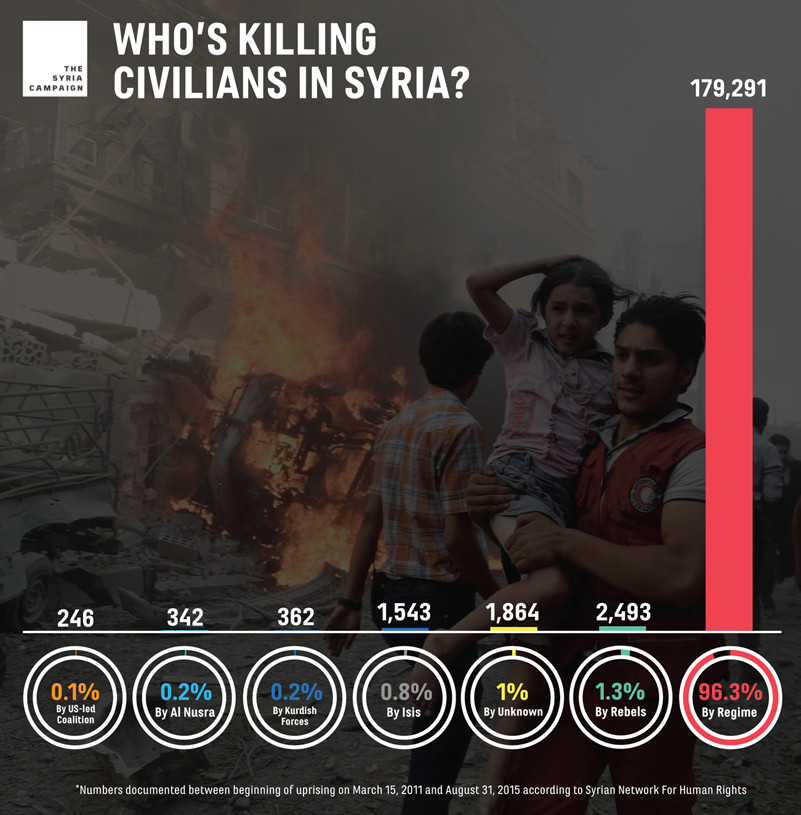
This argument is based on the premise that the Assad regime is actively fighting against IS. There have been numerous reports, though, that the Assad regime and IS have actually not been fighting with each other, or not doing so very much. A widely quoted study by IHS Jane’s Terrorism and Insurgency Center at the end of last year noted that the Assad regime’s “counterterrorism operations…skew heavily towards groups whose names aren’t ISIS. Of 982 counterterrorism operations for the year up through Nov. 21 [2014], just 6 percent directly targeted ISIS.”

In February of this year, Time reported on a Sunni businessman with close ties to the Assad regime describing various forms of actual cooperation between the Assad regime and IS, including how the Assad regime buys oil from IS-controlled oil facilities, how Syria’s two main mobile phone operators provide service and send repair teams to IS-controlled areas, and how Damascus allows food shipments to the IS capital, Raqqa.

At the beginning of June 2015, US Embassy Damascus “accused the Syrian government of providing air support to an advance by Islamic State militants against opposition groups north of Aleppo.” In July, Turkish intelligence sources claimed that “an agreement was made between the Assad regime and ISIS to destroy the Free Syrian Army in the country’s north.”

Why would the Assad regime not fight against IS and even cooperate with it? Both of them have an interest in weakening their common foes: Syrian opposition groups supported by Turkey, Saudi Arabia, Qatar, and other countries. [Continue reading…]

Facebooktwittermail

Egypt destroys thousands of homes to create ‘buffer zone’ with Gaza Strip

Human Rights Watch reports: Between July 2013 and August 2015, Egyptian authorities demolished at least 3,255 residential, commercial, administrative, and community buildings in the Sinai Peninsula along the border with the Gaza Strip, forcibly evicting thousands of people. Extended families who had lived side by side for decades found themselves dispersed, forced to abandon the multi-story houses they had built next to their relatives and passed down through generations. Some families became homeless and lived in tents or sheds on open land or in informal settlements. The Egyptian authorities razed around 685 hectares of cultivated farmland, depriving families of food and livelihood and stripping most of the border of its traditional olive, date and citrus groves. The evictions scattered families among the Sinai’s towns and villages and in some cases as far as Cairo and the Nile Delta. The Egyptian government has indicated that these evictions could continue.

The Egyptian army began demolishing buildings along the border in July 2013 as part of a reinvigorated but long-considered plan to establish a “buffer zone” with the Gaza Strip. These demolitions rapidly accelerated after October 24, 2014, when the Sinai-based armed group Ansar Beit al-Maqdis, or Supporters of Jerusalem, carried out an unprecedented attack on an army checkpoint in North Sinai governorate, reportedly killing 28 soldiers. The following month, Ansar Beit al-Maqdis pledged allegiance to the extremist group Islamic State, also known as ISIS, and changed its name to Sinai Province.

President Abdel Fattah al-Sisi, who had taken office in June 2014 after orchestrating the ouster of former president Mohamed Morsy the year before, said in a speech on national television the day after the attack that Egypt was fighting a war “for its existence.” He declared a three-month state of emergency in most of North Sinai and convened the National Defense Council and Supreme Council of the Armed Forces, which agreed on a plan to establish a “secure zone” along the Gaza border. Five days after the attack, Prime Minister Ibrahim Mehleb issued a decree ordering the “isolation” and “evacuation” of 79 square kilometers stretching along the entire Gaza border and extending between five and seven kilometers into the Sinai. The buffer zone encompassed all of Rafah, a town of some 78,000 people that lies directly on the border, as well as significant agricultural land around the town. [Continue reading…]

Facebooktwittermail

Syrian Kurd offensive against ISIS has stalled

McClatchy reports: A Syrian Kurdish offensive described last week by U.S. officials as the most effective assault to date on the Islamic State has ground to a virtual halt because of Turkey’s opposition to the advance and Kurdish commanders’ reluctance to extend their frontlines beyond Kurdish areas, Syrian Kurdish and Arab militants say.

The stalling of the offensive, which was aided by U.S. airstrikes that were coordinated with Syrian Kurdish fighters on the ground, deals a new setback to the Obama administration’s efforts to build an anti-Islamic State coalition among Syrian opposition forces, and it comes amidst a buildup of Russian jet fighters, armored vehicles and personnel near Syria’s coast.

“The Kurdish forces are important because they are America’s boots on the ground in Syria and Iraq,” said Soner Cagaptay, an expert with the Washington Institute for Near East Policy, a think tank.

The slackening in the drive by the Peoples Protection Units, a Syrian Kurdish militia known as the YPG, can be traced through the dramatic drop in the rate of U.S. airstrikes launched against the Islamic State in areas inside and adjacent to the swath of territory along the border with Turkey from which the brutal Islamist movement was expelled by the YPG offensive. [Continue reading…]

Facebooktwittermail

Military analyst again raises red flags on ‘progress’ in Iraq

The New York Times reports: As the war in Iraq deteriorated, a senior American intelligence analyst went public in 2005 and criticized President George W. Bush’s administration for pushing “amateurish and unrealistic” plans for the invasion two years before.

Now that same man, Gregory Hooker, is at the center of an insurrection of United States Central Command intelligence analysts over America’s latest war in Iraq, and whether Congress, policy makers and the public are being given too rosy a picture of the situation.

As the senior Iraq analyst at Central Command, the military headquarters in Tampa that oversees American military operations across the Middle East and Central Asia, Mr. Hooker is the leader of a group of analysts that is accusing senior commanders of changing intelligence reports to paint an overly optimistic portrait of the American bombing campaign against the Islamic State. The Pentagon’s inspector general is investigating.

Although the investigation became public weeks ago, the source of the allegations and Mr. Hooker’s role have not been previously known. Interviews with more than a dozen current and former intelligence officials place the dispute directly at the heart of Central Command, with Mr. Hooker and his team in a fight over what Americans should believe about the war. [Continue reading…]

Facebooktwittermail