Category Archives: ISIS

Islamic State of Iraq and Syria

ISIS surprises Kurds in Iraq, killing a commander in a day of attacks

The New York Times reports: Exploiting a foggy night as cover, Islamic State militants launched a surprise attack on Iraqi Kurdish positions on the outskirts of Kirkuk early Friday, killing a senior Kurdish commander and at least five of his men, security officials in the city said.

The assault was one of the most aggressive undertaken against Kirkuk in months by the Islamic State, the jihadist group that straddles a large stretch of Iraq and Syria. The city, in northern Iraq, is an oil hub that is seen as central to the aspiration of Iraqi Kurdish leaders and that poses an attractive strategic target for the Islamic State, also known as ISIS or ISIL.

Families fled their homes as the fighting intensified, and at one point, the militants stormed an abandoned hotel in the Kirkuk city center.

The deadly foray on Friday demonstrated the continued ability of Islamic State fighters to harass Iraq’s cities, despite a punishing monthslong campaign by Iraqi forces backed by United States airstrikes to dislodge the extremists. [Continue reading…]

Facebooktwittermail

How hostage pilot drama is feeding an antiwar movement in Jordan

Taylor Luck reports: The ongoing drama of a Jordanian pilot held hostage by the Islamic State has escalated into a political crisis for King Abdullah II, threatening the position of a stalwart US ally and leading player in the coalition against the jihadist group.

Jordanians have been gripped by the detention of Lt. Muath Kassasbeh, whose fighter jet crashed near Raqqa, Syria on Dec. 24.

A sunset deadline passed Thursday with the government refusing to pull the trigger on a prisoner swap with the jihadist movement, saying IS had failed to provide proof Lt. Kassasbeh was still alive and well.

Rather than blame IS for the protracted hostage crisis, the public at large and members of the pilot’s family have turned on the government. They are hitting the streets and faulting Amman for putting Jordanians into harm’s way in a war they say is not their own. [Continue reading…]

Facebooktwittermail

The ISIS model for expansion

Aaron Y. Zelin writes: The Islamic State announced several months ago that it was “annexing” territory in Algeria (Wilayat al-Jazair), Libya (Wilayat al-Barqah, Wilayat al-Tarabulus and Wilayat al-Fizan), Sinai (Wilayat Sinai), Saudi Arabia (Wilayat al-Haramayn) and Yemen (Wilayat al-Yaman). It is likely that the Islamic State plans to pursue a similar approach in Afghanistan and Pakistan following its announcement of accepting pledges of allegiance from former members of the Afghan and Pakistan Taliban to also try and “annex” territory there under the framework of a new wilayah called “Wilayat Khorasan.” On its face, this bold declaration of an expanding number of wilayat (provinces) resembles the announcements by al-Qaeda of creating numerous franchises in the mid-2000s. The Islamic State’s “wilayat” strategy differs in significant ways from al-Qaeda’s “franchise” strategy, however.

The academic literature has shed great light on the al-Qaeda franchising strategy. In a recent article Daniel Byman highlights a number of key factors within the al-Qaeda network regarding motivations for affiliation and franchising. Typically, affiliates joined up with al-Qaeda as a result of failure. Affiliation helped with financial support; offered a potential haven that could be exploited, along with access to new training, recruiting, publicity and military expertise; gave branding and publicity; and opened up personal networks from past foreign fighter mobilizations. It in turn helps al-Qaeda with mission fulfillment, remaining relevant, providing access to new logistics networks, and building a new group of hardened fighters.

But, Byman argues, those franchises often became as much a burden as an asset as local interests and views diverged with those of the parent organization. Leah Farrall argues that al-Qaeda increasingly came to view franchising “warily” in part due to its inability to always control its new partners such as Abu Musab al-Zarqawi and al-Qaeda in Iraq as well as because of backlash from unsuccessful cooptation of organizations such as the Libyan Islamic Fighting Group or Egyptian Islamic Jihad. This is one of the reasons why, prior to Osama bin Laden’s death, the Somali jihadi group Harakat al-Shabab al-Mujahideen was not given franchise status. Bin Laden had apprehensions about the group’s utility due to past clan infighting and lack of unity. Following the death of bin Laden though, his replacement, Ayman al-Zawahiri, brought Shabab into the fold, but the results have been quite disastrous; Shabab has declined and also was in an internal feud between its foreign and local members. Will the Islamic State’s wilayat pose a similar burden?

There is one key difference between al-Qaeda’s and the Islamic State’s model for expansion. Al-Qaeda wanted to use its new franchises in service of its main priority: attacking Western countries to force them to stop supporting “apostate” Arab regimes, which without the support of Western countries would then be ripe for the taking. This has only truly worked out with its Yemeni branch, al-Qaeda in the Arabian Peninsula (AQAP). On the other hand, while the Islamic State does not have an issue with its supporters or grassroots activists attacking Western countries, its main priority is building out its caliphate, which is evident in its famous slogan baqiya wa tatamaddad (remaining and expanding). As a result, it has had a relatively clear agenda and model: fighting locally, instituting limited governance and conducting outreach. [Continue reading…]

Facebooktwittermail

Does defeat in Kobane mark the beginning of the end for ISIS?

Al Jazeera reports: Losing Kobane after more than four months of intense fighting is a significant propaganda blow to ISIL. The group invested extensive military resources to capture the isolated town on the border with Turkey.

“Daesh [ISIL] took most of the places it wanted in Syria and Iraq but could not capture Kobane,” said Anwar Muslim, the prime minister of the self-ruled administration of Kobane, referring to the organisation by its Arabic name.

“This victory marks the beginning of the end for Daesh.”

Kurdish forces have so far taken control of at least three villages in the southern surroundings of Kobane. It will be a highly challenging task for them to expel ISIL from the dozens of villages that dot the plains around the agricultural town. [Continue reading…]

Robin Wright writes: Stuart Jones, the U.S. Ambassador to Iraq, told Al Arabiya last week that more than six thousand militants, including many top commanders, have died in Iraq and Syria since launching their blitz last summer. Some are apparently no longer so keen on martyrdom. The senior Administration official also said that the human toll may be demoralizing to ISIS. “We track quite closely the over-all attrition of its ranks, its vehicles, and the dissension it has caused within the organization,” he said. “We understand that a lot of its fighters now are simply refusing to go to Kobani, and the fighters refusing to go to Kobani are being assassinated by ISIL.”

The campaign has been expensive for the West. The U.S.-led coalition ran more than six hundred airstrikes on Kobani — eighty per cent of all its bombings in Syria — which cost hundreds of millions of dollars. Kobani has certainly paid a price. Fighting and bombings have destroyed half the city, which now has no economy, let alone electricity. There is little left for the forty thousand residents who fled; many may remain refugees for some time.

Kobani’s fate could have little impact on how the rest of Syria fares. It may be true, as the senior Administration official told me, that in areas of northern Iraq where ISIS’s command and control is broken down, “its ability to direct fighters to certain areas of the front — where, whenever fighters go there, they never return — is not nearly what it was four months ago.” But the Islamic State nevertheless appears capable of recruiting more men. Twenty thousand foreigners have now gone to fight in Syria and Iraq. It is “the largest mobilization of foreign fighters in Muslim countries since 1945,” the International Centre for the Study of Radicalisation and Political Violence, at King’s College London, reported on Monday.

The total number of foreign fighters now exceeds that of foreigners mobilized during the ten-year war against the Soviet occupation in Afghanistan, which was the genesis of extremist movements like Al Qaeda. Unlike the situation in the eighties, though, nearly a fifth of today’s fighters — some four thousand — are residents or nationals of Western European countries, the I.C.S.R. reported. The largest numbers come from France, Britain, and Germany. Others come from Ukraine, China, and New Zealand. [Continue reading…]

Facebooktwittermail

ISIS affiliate in Egypt claims responsibility for attack that killed 32 in Sinai

Reuters: Egyptian President Abdel Fattah al-Sisi cut short a visit to Ethiopia for an African Union summit on Friday after Islamic State’s Egyptian wing claimed the killing of at least 30 soldiers and police officers in the Sinai Peninsula.

The four separate attacks on security forces in North Sinai on Thursday night were among the bloodiest in years and the first significant assault in the region since the most active Sinai militant group swore allegiance to IS in November.

Militant attacks in Sinai, while far from Cairo and tourist attractions, has crimped government efforts to project an image of stability to woo back foreign investors and tourists driven away by frequent political violence since a popular uprising four years ago that overthrew veteran autocrat Hosni Mubarak.

Facebooktwittermail

French prisons, long hotbeds of radical Islam, get new scrutiny after Paris attacks

The Washington Post reports: The man was sent to France’s largest prison for armed robbery. He emerged a toughened radical who would go on to take part in the bloodiest terrorist attacks on French soil in decades.

France’s prisons have a reputation as factories for radical Islamists, taking in ordinary criminals and turning them out as far more dangerous people. Here at the Fleury-Merogis prison — where Amedy Coulibaly did time alongside another of the attackers in the deadly assaults this month in and around Paris — authorities are struggling to quell a problem that they say was long threatening to explode.

Former inmates, imams and guards all describe a chaotic scene inside these concrete walls, 15 miles from the elegant boulevards surrounding the Eiffel Tower. Militancy lurks in the shadows, and the best-behaved men are sometimes the most dangerous. French Prime Minister Manuel Valls promised last week to flood his nation’s prisons with 60 more Muslim chaplains, doubling their budget to try to combat radicalization. Authorities this week raided 80 prison cells of suspected radicals, saying they found cellphones, USB drives and other contraband. Hundreds of inmates in French prisons are a potential threat, authorities say.

But critics say that these efforts are minuscule compared with the scope of the problem, with prisons so poorly controlled that a leaked French government report once described Osama bin Laden posters hanging on inmates’ walls. The challenge may be compounded by the dozens of people sent to jail after the recent attacks, some for more than a year, under fast-track proceedings in which they were charged with verbal support for terrorism.

“Prison destroys men,” said Mohamed Boina M’Koubou, an imam who works in the Fleury-Merogis prison. “There are people who are easy targets to spot and make into killers.” [Continue reading…]

Facebooktwittermail

Inside Kobane

Bulent Kilic writes: We’ve been waiting for two days to get into Kobane, ever since Kurdish fighters wrested back the town from IS jihadists. Finally, this morning, the Turkish authorities say they will allow us access for a few hours. The police take down our names, and we’re escorted over the border into Kobane, about 20 reporters from Turkish and foreign media. [Continue reading…]

Facebooktwittermail

Western women joining ISIS militants are ‘cheerleaders, not victims’

AFP reports: Western women who join Islamic State militants are driven by the same ideological passion as many male recruits and should be seen as potentially dangerous cheerleaders, not victims, experts said Wednesday.

A new study from the London-based Institute for Strategic Dialogue (ISD) said the estimated 550 women who have travelled to Iraq and Syria are expected to marry, keep house and bear children.

But despite being banned from fighting, many are active propagandists for the cause on social media, celebrating the brutal violence of IS militants, acting as recruiting sergeants and even encouraging attacks abroad.

“The violent language and dedication to the cause is as strong as we find in some of the men,” said co-author Ross Frenett, an extremism expert.

“The worry is that as ISIS (the IS group) loses ground, as everyone hopes it does, that more and more of these women will transfer from the domestic world they’re in now to a more violent one,” he told AFP. [Continue reading…]

Facebooktwittermail

Kurds celebrate liberation of Kobane as ISIS calls for new Paris-style attacks

Vice News reports: On Monday, the same day Kurdish fighters in Syria decisively broke the Islamic State’s bloody and sustained siege of Kobane, a senior leader of the extremist group called for jihadists to carry out fresh Paris-style attacks across Europe.

Fireworks lit up the dark night in Turkish and Syrian towns and refugee camps across the border from the embattled Syrian town of Kobane Monday night, while elated Kurdish residents bearing flame torches flooded the streets, celebrating the liberation of their friends, family, and neighbors, who until earlier that morning had been under militant control since September. In the distance, the Kurdish flag flapped silently on a hill east of Kobane — a declaration of the resilience of peshmerga fighters and rebel brigades who had fought deadly battles to drive out the extremists for four months. [Continue reading…]

David L. Phillips writes: The battle for Kobani is significant for several reasons:

  • It’s a major setback for Daesh’s propaganda campaign. Daesh uses its aura of invincibility to gain recruits. In Kobani, Daesh was bloodied and beaten.
  • It has brought global attention to the Kurds of Syria and their social revolution, which is based on grass-roots democracy, women’s empowerment, and environmental sustainability.
  • It was a public-relations disaster for Turkey’s President Recep Tayyip Erdogan. Turkey sealed its border to cut off Kobani’s defenders. Erdogan demanded that the U.S. impose a no-fly-zone and a security buffer in exchange for Turkey’s cooperation with the U.S.-led multinational coalition fighting Daesh. Many observers (including this author) allege Turkey is providing military, logistical, financial and medical support for Daesh and other jihadists.
  • It did what no Kurdish leader could do: Kurds from Syria, Turkey, Iraq, and Iran found common cause in forming a united front against terrorism and the Islamic State’s fascist nihilism.

The Islamic State’s defeat in Syria followed a victory for the Peshmerga in Sinjar, where they defeated Daesh and saved thousands of Yazidis. The Iraqi armed forces is also rolling up Daesh in Iraq’s Diyala province.

Despite these battlefield gains, challenges remain. Thousands of displaced persons need assistance resettling to their ruined homes in Kobani. Villages around Kobani are still under control of Daesh. Cooperation between Washington and the Democratic Union Party, which represents Syrian Kurds, is shallow and should expand.

Today Kurds rejoice. The world applauds their heroism — and joins their celebration.

When Daesh’s obituary is written, Kobani will be enshrined as the turning point in the struggle to destroy the Islamic State.

Reuters adds: Turkish police fired tear gas on Tuesday to stop people trying to cross back into Kobani to celebrate its retaking, a Kurdish politician and a journalist said. [Continue reading…]

Facebooktwittermail

Turkey won’t accept Iraq-style Kurdish rule in Syria, says Erdoğan

Today’s Zaman reports: Turkish President Recep Tayyip Erdoğan has ruled out any possibility of accepting an autonomous Kurdish government in northern Syria similar to the one in northern Iraq, saying a government like this would cause major problems in the future.

In his remarks to reporters on his way back to Turkey after an African tour, Erdoğan criticized the United States’ policy on Syria, which doesn’t involve toppling Syrian President Bashar al-Assad.

“[The US] doesn’t want to make moves that target the [Syrian] regime. It says [toppling the government] is not among its targets. If it doesn’t take place, there won’t be any solution. What would happen? The same thing that happened in Iraq will happen. We don’t want a new Iraq. What is this? Northern Iraq… [We don’t want] a northern Syria to appear! It is not possible for us to accept this,” Erdoğan said.

“I know the burden on Turkey is heavy. We have to keep our stance [firm] on this issue. Otherwise, after a northern Iraq, there would be a northern Syria. These formations will cause big problems in the future,” he concluded.

Erdoğan also pointed to the three Kurdish autonomous administrations formed by Syrian Kurds in January 2014, and once more scolded the US for only placing importance on Kobani. [Continue reading…]

Facebooktwittermail

ISIS said to execute 10 doctors in Mosul for refusing to treat wounded fighters

Rudaw reports: The Islamic State (ISIS) executed 10 physicians in Mosul for refusing to treat the group’s wounded fighters, well-placed sources in Mosul said.

They reported Monday that ISIS had shot the physicians over their refusal to treat jihadi fighters wounded in clashes or shelling.

“Because of extensive attacks and shelling on ISIS, the hospitals of the city (Mosul) are filled with ISIS wounded fighters,” said a source in Mosul. “ISIS has evacuated all other patients in the hospitals in order to treat its own wounded fighters,” he added. “Medical equipment is only being used to treat ISIS fighters.” [Continue reading…]

Facebooktwittermail

Obama cuts off Syrian rebels’ cash

The Daily Beast reports: In the past several months, many of the Syrian rebel groups previously favored by the CIA have had their money and supplies cut off or substantially reduced, even as President Obama touted the strategic importance of American support for the rebels in his State of the Union address.

The once-favored fighters are operating under a pall of confusion. In some cases, they were not even informed that money would stop flowing. In others, aid was reduced due to poor battlefield performance, compounding already miserable morale on the ground.

From afar, the U.S.-approved and partially American-armed Syrian “opposition” seems to be a single large, if rather amorphous, organization. But in fact it’s a collection of “brigades” of varying sizes and potentially shifting loyalties that have grown up around local leaders, or, if you will, local warlords. And while Washington talks about the Syrian “opposition” in general terms, the critical question for the fighters in the field and those supporting them is, “opposition to whom?” To Syrian President Assad? To the so-called Islamic State, widely known as ISIS or ISIL? To the al Qaeda affiliate Jabhat al Nusra?

That lack of clarity is crippling the whole effort, not least because of profound suspicions among rebel groups that Washington is ready to cut some sort of deal with Assad in the short or medium term if, indeed, it has not done so already. [Continue reading…]

Facebooktwittermail

Kurds liberate Kobane, expelling ISIS after 134 days of fighting

AFP reports: Kurdish fighters have expelled Islamic State group militants from inside the Syrian border town of Kobane, a monitor said Monday, dealing a key symbolic blow to the jihadists’ ambitions.

The Syrian Observatory for Human Rights, a Britain-based monitor, said fighters from the Kurdish People’s Protection Units (YPG) had pushed IS militants out of the town after four months of fighting.

In Iraq meanwhile, a senior army officer announced that Iraqi forces had also “liberated” Diyala province from the Islamic State group.

Observatory director Rami Abdel Rahman told AFP that YPG forces had “expelled all Islamic State fighters from Kobane and have full control of the town.” [Continue reading…]

Facebooktwittermail

The ISIS ideology: Spreading by the sword what it asserts as ‘the true message of Islam’

Hassan Hassan reports: Little is known about what goes on inside training camps run by Isis in areas under its control in Iraq and Syria – particularly its religious component. The Isis ideology is generally viewed as identical to al-Qaida’s or the Saudi version of Salafism – adherence to fundamental Islamic tenets – and so there does not seem to be a serious effort to study it more closely. There is also a tendency to play down the role of religious ideology as a recruitment tool, since the motives of many Isis members have little to do with religion.

Another problem that muddles understanding of Isis’s appeal is that politicians tend to deliberately misrepresent the role of ideology to undermine the group’s propaganda, while objective observers often have no access to Isis associates beyond social media. As a result, a flawed understanding of the ideological appeal of Isis is common, despite its central role in the fight against it. Both the commander of the American special operations forces in the Middle East, Major General Michael Nagata, and the general in charge of leading the international coalition against Isis, John Allen, have emphasised that the ideology of Isis is insufficiently understood and that ideological delegitimisation is crucial in the effort to defeat it.

So what specific ideas, stories and narratives do new members learn at these camps? What does Isis tell its new recruits to make them so zealously committed to its ideology? More important, does the Isis ideology serve to attract or merely retain new recruits?

As part of research involving in-depth interviews with Isis members for a book about the organisation, American analyst Michael Weiss and I have identified half a dozen categories of Isis members according to the factors that drew them to the group. In at least two of those categories, religion more than anything else has been the driving force. But these two demographic components – long-standing takfiris (radicals who adhere to teachings that declare fellow Muslims as infidels) and young zealots – are more central for Isis than other members because they formulate the group’s identity and ensure its resilience. In addition, the appeal of Isis outside its conflict zones tends to be primarily ideologically driven. [Continue reading…]

Facebooktwittermail

Japanese reporter’s bid to save friend led to ISIS abduction

Before the apparent murder of the Japanese hostage, Haruna Yukawa, Reuters reported: It is an unlikely friendship that ties the fates of war correspondent Kenji Goto and troubled loner Haruna Yukawa, the two Japanese hostages for which Islamic State militants demanded a $200 million (132.34 million pounds) ransom this week.

Yukawa was captured in August outside Aleppo. Goto, who had returned to Syria in late October to try to help his friend, had been missing since then.

For Yukawa, who dreamed of becoming a military contractor, travelling to Syria had been part of an effort to turn his life around after going bankrupt, losing his wife to cancer and attempting suicide, according to associates and his own accounts.

A unit at Japan’s Ministry of Foreign Affairs had been seeking information on him since August, people involved in that effort said. Goto’s disappearance had not been reported until Tuesday’s video apparently showing him and Yukawa kneeling in orange t-shirts next to a masked Islamic State militant wielding a knife.

Yukawa first met Goto in Syria in April and asked him to take him to Iraq. He wanted to know how to operate in a conflict zone. They went together in June.

“He was hapless and didn’t know what he was doing. He needed someone with experience to help him,” Goto told Reuters in August.

Yukawa then returned to Syria in July on his own. Goto, 47, returned to Japan. Yukawa’s subsequent abduction haunted Goto, who felt he had to do something to help the man, a few years his junior. [Continue reading…]

Facebooktwittermail

ISIS wants to swap this woman for Japanese hostage

Al Jazeera: The Islamic State of Iraq and the Levant (ISIL) has reportedly demanded the release of an Iraqi woman detained in Jordan in exchange for a Japanese national they have held captive.

In a video recording posted online on Saturday, Kenji Goto, a freelance Japanese journalist abducted while reporting on Syria’s civil war last year, spoke of ISIL’s demand for a prisoner exchange to guarantee his release.

“They are just demanding the release of their imprisoned sister Sajida al-Rishawi. It is simple. You give them Sajida and I will be released,” Goto says in the video.

Facebooktwittermail

Inexperienced Colorado judge sends wrong message to potential ISIS recruits and their families

There is a strange and cowardly convention in American journalism and society at large that treats criminal action as a mark of adulthood.

If an eighteen-year-old gets shot, there is a reasonable chance that he or she will be referred to as a teen, but whoever pulls the trigger is supposedly an adult — and the worse the crime, the more likely a child is going to be tried as an adult.

The United States and many other countries could learn a lot from Germany.

As Andrew Neilson writes: “Germany sentences young adults under either juvenile or adult law based on an assessment of a young adult’s maturity. The courts have a choice based on the person they see before them.”

Any legal process that has the capacity to determine an individual’s guilt should also be able to make a judgment about their level of maturity.
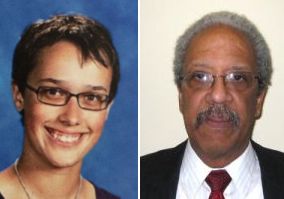
Shannon Conley and Judge Raymond Moore.

Shannon Conley and Judge Raymond Moore

Shannon Maureen Conley is a Colorado teenager who just got sentenced to four years in prison for attempting to go to Syria to join ISIS. Most press reports refer to her as a woman — I guess she entered womanhood the minute she declared jihad.

The gray-haired judge, Raymond P. Moore, who is in his early sixties, conceded that Conley was naive but said at sentencing: “I need to send a message.”

Like most people who use that expression, Moore didn’t spell out exactly what the message was, but given that despite his mature appearance he has only been a judge for less than two years, my suspicion is that he was less concerned about his message than he was afraid of showing any leniency — possessed by a fear that guides the actions of thousands of government officials across America who are terrified of being viewed as soft on terrorism.

Three other Denver teenage girls were stopped in Germany last Fall as they attempted to make their way to Syria where they apparently intended to marry ISIS fighters. They were returned to their parents without facing charges. Presumably the officials involved in that case felt that everyone’s interests would be better served by returning these kids to their homes rather than locking them in prison cells.

No doubt Moore thought he was sending a strong message to potential ISIS recruits, but in doing so he has sent the wrong message to their parents. No one wants to see their child risk their life by going to join ISIS, yet neither do they want to see them thrown behind bars because of naive, ill-informed, and youthful idealism.

Anyone who actually reaches Syria or Iraq and takes up arms with ISIS is willingly entering a war and will suffer the consequences of that choice, but prior to crossing that threshold — and especially if that individual has yet to exercise the autonomy of an adult — they should be shown some kindness.

By failing to follow that course, the Colorado judge has probably made it likely that kids contemplating running off to Syria will take even greater care to avoid detection, and parents who learn about such plans will be more hesitant about alerting the authorities.

Facebooktwittermail

Mosul residents describe ‘hell’ of ISIS occupation as Kurdish fighters close in

The Guardian reports: Few people dare talk to the media, and those who do speak only on condition of anonymity, fearing reprisals against themselves and their families. Only a trickle of information comes out of Mosul besides Isis’s own slick propaganda.

Civilians inside the city – from taxi drivers to housewives, students to shopkeepers – paint a gloomy picture of life there. “All I can say is that life under Daesh [Isis] is hell, not heaven as they claim,” said Tariq, who used to study at a technical institute before Isis took over. “We can’t study and we don’t know what the future holds for us.”

A shopkeeper near Nabi Yunus mosque, which was destroyed by Isis last July, said he was weary of life under Isis but saw no way out. “If you want to leave Mosul you need three people to guarantee that you will come back after five days. If you don’t return, you put their lives at risk.”

The shopkeeper said many militants killed or injured fighting in Sinjar had been brought back to Mosul. “I have been forced to give blood three times,” he added. [Continue reading…]

Facebooktwittermail
