Category Archives: Obama administration

OBAMA’S “NEW” APPROACH TO THE MIDDLE EAST: Bring in a “dead-hand on the wheel peacemaker”

Obama picks Ross as Mideast envoy

Dennis Ross, a former top diplomat for the George H W Bush and Clinton administrations, will become the Obama administration’s top envoy on the Middle East, an internal email from Mr Ross’s current employer has revealed.

Mr Ross, who previously served as the US envoy for the Israeli-Palestinian conflict, is set to take a wider role as Hillary Clinton’s top adviser for the Middle East as a whole. Ms Clinton herself is due to appear before the Senate Foreign Relations Committee for her confirmation hearing for Secretary of State next Tuesday. [continued…]

Editor’s Comment — As Augustus Norton said: “Dennis Ross who was a dead-hand on the wheel as peacemaker in the Clinton [and Bush senior administrations]. His chief accomplishment the Hebron agreement –enough said.”

Can Obama change the Middle East? No, he can’t

Many Americans who voted for Barack Hussein Obama are hoping that his administration will at last break with America’s traditional, and invariably harmful, behaviour in the Middle East.

That would mean letting American oil companies fend for themselves in the free-for-all to control Mideast oil, leaving Israel’s colonists on the West Bank to pay their own way and abandoning the dictatorships in Egypt and Saudi Arabia to face the wrath of their populations without protection from American weapons and spies. And that is as likely as President Obama naming Ralph Nader to head the Securities and Exchange Commission and Patrick Fitzgerald, the US Attorney now prosecuting Obama’s Democratic Party comrades in Illinois, to be Attorney General.

Obama has improved the rhetoric, but no one who asked Hillary (“annihilate Iran”) Clinton to preside over the State Department or the failed Clinton-era hatchet man Dennis Ross to advise on Palestine has any intention of making the Middle East safe for democracy. [continued…]


Facebooktwittermail

OPINION & EDITOR’S COMMENT: Time for engagement in a new political process

Israel can’t bomb its way to peace

Israel has no viable political endgame here: There’s just no clear route from bombardment to a sustainable peace. But the damage caused by this new conflagration won’t be limited to the Israelis and Palestinians. Israel’s military offensive already has sparked outrage and protests throughout the Arab world. The current crisis also may destabilize some of the more moderate Arab governments in the region — in Egypt, for instance — where leaders now face popular backlash if they don’t repudiate Israel.

And if you think that none of this really matters for us here in the U.S., you’re kidding yourself. Arab and Islamic anger over Palestine continues to fuel anti-Western and anti-U.S. terrorism around the globe.

It’s time for the United States to wake up from its long slumber and reengage — forcefully — with the Middle East peace process. Only the U.S. — Israel’s primary supporter and main financial sponsor — can push it to make the hard choices necessary for its own long-term security, as well as the region’s. In January 2001, the Taba talks between Israel and the Palestinian Authority came achingly close to a final settlement, but talks broke down after Likud’s Ariel Sharon was elected prime minister on Feb. 6, 2001. Sharon refused to meet with Yasser Arafat, and newly inaugurated President George W. Bush had no interest in pushing Israel toward peace.

Eight years later, Israel faces another election, and we’re about to swear in a new president. When he takes office, Obama needs to push both Israelis and Palestinians to sit back down, with the abandoned Taba agreements as the starting point. Here’s to a less bloody 2009. [continued…]

Editor’s Comment — It’s good that there’s at least one American columnist willing to speak about what’s happening in Gaza without being an apologist for Israel. Yet in terms of the broader political perspective, calls for renewed US engagement in the Middle East peace process beg the most important question: engagement with whom?

When the dust finally settles in Gaza, Hamas will re-emerge politically strengthened while Fatah and the Palestinian Authority will be seen by most Palestinians as having been at best, ineffectual, and at worst, quislings serving the Israeli government.

What Israel’s latest war is doing is further unmasking the chasm between Arab leaders and the people they claim to represent.

The code word “moderate” means nothing more than an Arab leader with whom a Western leader is willing to be seen shaking hands. But what these hand shakes are capable of accomplishing politically has been vastly overestimated for the simple reason that the will of the people continues being left out of the equation.

If the Obama administration wants to make a radical break with the past, it might consider not a re-engagement with what has become a hollow “peace process.” It might in fact disengage from an issue that Israel has to solve for itself. Instead, it should look across the political landscape, become better acquainted with the real locuses of emerging political power and then deliver a message of bitter political realism to its regional allies: Look hard and fast for ways to accommodate your political foes, because if you don’t they will destroy you and in the chaos that ensues the whole world will suffer.

Facebooktwittermail

EDITORIAL: Silence has become complicity

Silence has become complicity

Is the incoming president, world-renowned for his eloquence, about to become better known for his silence?
Barack Obama may not have assumed office yet but a war is already being conducted in his name.

Israel’s defense minister, Ehud Barak, now says that Israel is engaged in a “war to the bitter end” against Hamas in Gaza. And in justifying this war to Israel’s state assembly, the Knesset, Barak said: “Obama said that if rockets were being fired at his home while his two daughters were sleeping, he would do everything he could to prevent it.”

Barak’s war has become Barack’s war — unless he breaks his silence.

Obama chooses his words carefully. He did so when speaking to the press in Sderot in southern Israel, during the presidential election campaign this summer. While he was clearly and shamelessly pandering to American Jewish voters, his statement expressed sympathy for the Israelis being targeted by Qassam rocket fire, but it also underlined that an effective response would focus on preventing further attacks — not merely the retaliatory and bellicose response with which Israelis are so familiar, that is, a military operation whose purpose is “to teach the Palestinians a lesson.”

If Obama continues to remain silent he will implicitly be sending a message to Israelis, Palestinians, and everyone else across the Arab world. His silence will be seen and will have the operational effect of providing an endorsement for Israel’s war on Gaza. His silence will set the tone for his whole approach to the Middle East. If his plan to give a major speech in a Muslim capital has not already been put on hold, it might as well now be scrapped.

But there is an alternative. This is what Obama can and should say:

I support the Israeli government in its goal of providing security for its citizens. However, I believe that the current operation in Gaza is unlikely to serve that goal and in the long run may further undermine Israel’s security.

What can Israel do now? Pull back its troops, offer to renew the truce and lift the siege.

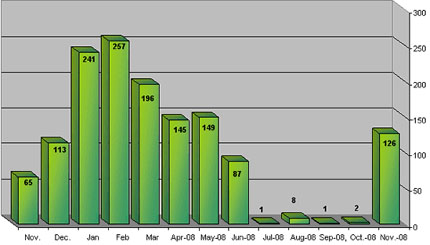
The truce actually worked, as this graph from the Israeli Foreign Ministry clearly shows.

Rocket fire did not resume until Israel broke the truce on November 5.

What we now know, is that Israel did not view the truce as a means to bring calm to southern Israel but instead used it as an aid for gathering intelligence in preparation for war.

Had the Olmert government regarded the cessation of rocket fire as a foundation upon which it could build, it would have taken clear steps to lift the siege. (But to have pursued such a course would not however have provided the Palestinian body count upon which Israel’s next prime minister hopes to ride into office.)

Instead, what we now witness is a brutal spectacle in which, using the Orwellian language of war, Israel claims that it’s target is Hamas, not the residents of Gaza.

Obama is still in a position to exert influence, but the longer he waits, the less power he will have; the more likely he will be seen as the perpetuator of George Bush’s failed approach to the Middle East.

Facebooktwittermail

NEWS, VIEWS & EDITOR’S COMMENT: A president who believes in science

Obama science picks hailed as signal of policy shift

President-elect Barack Obama’s decision to name two of the nation’s most prominent scientists to crucial roles in his administration was being heralded in the scientific community as a signal that the new president is serious about taking on the challenges of climate change and creating a new energy policy for the nation.

Obama is expected today to name John P. Holdren, 64, a former professor of energy and natural resources at UC Berkeley who is now at Harvard, as his science adviser and executive director of the White House Office of Science and Technology Policy.

He also reportedly has settled on Jane Lubchenco, 61, a world-renowned marine biologist and expert on the ocean environment at Oregon State University, to head the National Oceanic and Atmospheric Administration. The influential agency measures the pace of global warming, tracks hurricanes, predicts the weather and monitors the health of the world’s seas.

Their impending selection, along with the naming last week of Nobel Prize-winning physicist Steven Chu to head the Department of Energy, is seen as the surest sign yet that Obama will reverse Bush administration policies on energy and global warming. [continued…]

Obama’s strongest message on climate yet

John Holdren’s selection] is an even stronger signal than the terrific choice of Steven Chu for Energy Secretary that Obama is dead serious about the strongest possible action on global warming. After all, the science adviser works out of the White House and oversees science and technology funding, analysis, and messaging for all federal agencies. [continued…]

Editor’s Comment — With all due respect to everyone who was offended by Obama’s choice of Rick Warren to serve God’s middleman on Inauguration Day, it’s important to highlight the difference between those choices that Obama makes that matter and those that don’t. I doubt that even among those who found the Warren pick offensive that many imagined that this ominously marked top of a slippery slope.

What Obama did was toss a symbolic bone to evangelicals who can now savor it and feel respected. It has no policy implications and it also pays the dividend of making it clear that Obama is not afraid of offending progressives (again).

Contrast this with his choice of John Holdren. Most Americans have never heard of him, but to put his voice in a pivotal position in policymaking is of vital importance for the future of the planet.

Note that Obama made the announcement through his YouTube address on the weekend that most Americans are out lost in shopping psychosis.

Perhaps this will be the signature of his presidency: that he makes his most important moves with the least amount of noise.

Facebooktwittermail

Secretary of State

Clinton is said to opt for Secretary of State position

Hillary Rodham Clinton has decided to give up her Senate seat and accept the position of secretary of state, making her the public face around the world for the administration of the man who beat her for the Democratic presidential nomination, two confidants said Friday. [continued…]

Will Clinton fill State Dept. with loyalists?

With Sen. Hillary Rodham Clinton (D-N.Y.) almost certain to become President-elect Barack Obama’s secretary of state, some foreign-policy experts in the Obama orbit are expressing frustration.

Clinton herself isn’t so much the problem, they say. It’s the loyalists and traditional thinkers Clinton is likely to bring into the State Dept. if she becomes secretary. [continued…]

Editor’s Comment — This would be a moment to relish: After Thanksgiving, the official announcement comes out and Hillary Clinton turns out not to be Obama’s pick for Secretary of State. At least, I’d relish that moment not so much because I hate the idea of her getting that position as much I’d delight in the chattering classes being made to look so foolish for having engaged in so much speculation about the meaning of something that never happened.

Even so, in the spirit of the times, I’ll join the herd and add a few thoughts of my own:

1. If HRC becomes SoS, it means she’s laid to rest any aspiration to become president. If the Obama administration turns out to be a failure, she could conceivably run in 2012 but only if she’d remained in the Senate.
2. The idea that Obama has picked her because he wants to create a “team of rivals” has been ridiculously overstated. Sure, that may have influenced his thinking but I doubt very much that it would be the core of his reasoning for selecting her in this particular position.
3. I would expect that he has laid out the parameters for her policy making role with sufficient clarity that they both agree on exactly what it means to be “serving at the president’s pleasure”. She’ll have a strong voice but she won’t have the final say.
4. Bob Woodward apparently said:

    Being president is about control, and tell me who ever controlled Bill or Hillary Clinton. They can’t control each other. … I think it’s because Warren Buffett and Paul Volcker and others have convinced Obama, ‘You’re going to have to focus like a laser on the economy. That’s issue Number One. And give Hillary and Bill the world.’ … I think people are fantasizing or smoking something if they think Joe Biden’s going to call Hillary Clinton up and say, ‘This is what we want you to do.’

I don’t buy it. This caricature of the Clintons as being utterly uncontrollable should have been laid to rest after HRC conceded her defeat in the primaries and then went on to help get Obama elected.
5. There seems to be a widely held view that as an executive rookie, Obama is now being buffeted by Washington’s institutional powers and pushed into making decisions that reflect the conventional wisdom of seasoned operatives more than judgments of his own. I suspect this perception is largely a product of a false equation being made between the mildness of Obama’s manner and the idea that this must make him susceptible to being pushed around. I believe, on the contrary, that he will turn out to be much more of a ‘decider’ than Bush ever was. His receptiveness to input from others is a reflection of the confidence he has in the power of his own mind.

Facebooktwittermail