The Washington Post reports: The Puerto Rico that President Trump saw during his four-hour visit on Tuesday afternoon was that of Angel Pérez Otero, the mayor of Guaynabo, a wealthy San Juan suburb known for its amenity-driven gated communities that was largely spared when Hurricane Maria hit nearly two weeks ago.
Pérez Otero led Trump and his entourage on a walking tour of a neighborhood, where high-speed winds had blown out some second-story windows and knocked over a few trees — but where life seemed to be returning to normal, thanks to assistance from the government. Neighbors stood outside their homes ready to warmly greet the president, their phones powered up and ready to snap photos.
One homeowner told Trump that he lost a couple windows and still hasn’t regained electricity, but he was never worried about his family’s safety.
“We have a good house, thank God,” he told the president.
“That’s fantastic,” Trump said. “Well, we’re going to help you out. Have a good time.”
If the president had traveled a little deeper into the island, to the communities that sustained some of the heaviest damage, he would have witnessed a very different Puerto Rico. [Continue reading…]
Category Archives: Trump administration
White House dials back Trump’s vow to clear Puerto Rico’s debt
The New York Times reports: The Trump administration on Wednesday walked back the president’s apparent vow to wipe out Puerto Rico’s debt, suggesting that the island would have to solve its own fiscal woes despite the catastrophic damage it has endured from two powerful hurricanes.
“I wouldn’t take it word for word with that,” Mick Mulvaney, director of the Office of Management and Budget, said on CNN in reference to President Trump’s suggestion that the United States might clear Puerto Rico’s debt.
Mr. Mulvaney said that the administration would be focusing its efforts on helping Puerto Rico rebuild from storm damage but that the commonwealth would continue to proceed through the debt restructuring process it was undertaking before the storm.
“Puerto Rico is going to have to figure out how to fix the errors that it’s made for the last generation on its own finances,” Mr. Mulvaney said.
For more than a year, Puerto Rico has clashed with investors who hold slivers of its $73 billion debt, and who have pushed the United States territory to pay up.
Confusion over the future of that debt was ignited on Tuesday when Mr. Trump raised the prospect of erasing it. [Continue reading…]
Rex Tillerson is running the State Department into the ground
Nik Steinberg writes: On November 10, 2016, my colleagues and I at the U.S. Mission to the United Nations gathered on the top floor of the building, which overlooks the U.N. General Assembly. My boss at the time, Ambassador Samantha Power, had convened the staff to discuss the transition in the aftermath of the election, the results of which had caught many of us by surprise. The U.S. Mission, like the State Department as a whole, brings together career foreign and civil service officers with a handful of political appointees chosen by the president. Out of a staff of roughly 150 people, I was one of a few dozen political appointees.
It was an emotional gathering for all, but there were differences in the staff’s reactions that day. The political appointees spoke mostly about the deep divisions exposed by the election, and expressed concern that many of the issues we’d worked hardest on during our time in government—such as rallying a global response to the refugee crisis and marshaling support for a landmark agreement on climate change—would be undone by a president-elect who had campaigned against those efforts.
The career officers, in contrast, tended to focus on a point of continuity. They talked about how, whether serving in a Republican or Democratic administration, their responsibility was to offer the best advice they could on how to advance America’s interests in the world. As one foreign service officer put it: “We will keep serving this country. That’s what we do.”
I’ve thought a lot about those former colleagues during the first eight months of the Trump administration. The seriousness with which they approach the job of representing our country, and the fact that many of them continue to serve, has been a source of profound solace to me in an otherwise bleak period. [Continue reading…]
Russian-linked Facebook ads targeted Michigan and Wisconsin
CNN reports: A number of Russian-linked Facebook ads specifically targeted Michigan and Wisconsin, two states crucial to Donald Trump’s victory last November, according to four sources with direct knowledge of the situation.
Some of the Russian ads appeared highly sophisticated in their targeting of key demographic groups in areas of the states that turned out to be pivotal, two of the sources said. The ads employed a series of divisive messages aimed at breaking through the clutter of campaign ads online, including promoting anti-Muslim messages, sources said.
It has been unclear until now exactly which regions of the country were targeted by the ads. And while one source said that a large number of ads appeared in areas of the country that were not heavily contested in the elections, some clearly were geared at swaying public opinion in the most heavily contested battlegrounds. [Continue reading…]
Tillerson recognizes that Trump is a ‘moron’ but has yet to resign
NBC News reports: Secretary of State Rex Tillerson was on the verge of resigning this past summer amid mounting policy disputes and clashes with the White House, according to multiple senior administration officials who were aware of the situation at the time.
The tensions came to a head around the time President Donald Trump delivered a politicized speech in late July to the Boy Scouts of America, an organization Tillerson once led, the officials said.
Just days earlier, Tillerson had openly disparaged the president, referring to him as a “moron,” after a July 20 meeting at the Pentagon with members of Trump’s national security team and Cabinet officials, according to three officials familiar with the incident. [Continue reading…]
In San Juan, Trump tells Puerto Ricans that they have been lucky
Philip Gourevitch writes: One of the more memorable headlines of the past quarter century read, simply, “If Bosnians were Dolphins.” It appeared in Commentary magazine, on an article by Edward Luttwak, which began, “If Bosnian Muslims had been bottle-nosed dolphins, would the world have allowed Croats and Serbs to slaughter them by the tens of thousands?” That question came to mind as Donald Trump flew south to spend a few hours in Puerto Rico, nearly two weeks after the island was devastated by Hurricane Maria: two weeks during which it became clear that the Administration had done practically nothing to prepare the island for the alarmingly forecast storm; two weeks in which the federal response to the storm’s ravages has only gradually approached something like a mobilization that would have been appropriate on Day One for a much lesser calamity; two weeks in which nearly all of Puerto Rico has been without electricity, and more than half the population has been without access to potable water; two weeks in which Puerto Rico’s frail grew frailer, its sick grew sicker, its sense of abandonment grew more desperate; two weeks in which the President focussed on talking about what a great job he and his team were doing (“A-plus”), tweeting contempt at Puerto Ricans, collectively, and at the mayor of San Juan, Carmen Yulín Cruz, specifically; two weeks in which the relative effectiveness and success of the federal government’s preparation for and response to Hurricane Harvey’s assault on Texas and Irma’s rampage in Florida threw the dereliction of duty in Puerto Rico into ever starker relief; two weeks in which we were reminded that whenever we speak of a humanitarian crisis we are really speaking of a political crisis. All of which raises the question: If Puerto Ricans could vote, would they be so grossly ill served?
The press has been at pains to explain that Puerto Rico is not a foreign country but an American territory whose three and a half million people are U.S. citizens. Repeating this fact is essential service journalism: as the Times has reported, about half of America’s non-Puerto Rican population was unaware of that fact—and, as my colleague Amy Davidson Sorkin has written, Trump’s remarks did nothing to inform them otherwise. And, yet, Puerto Ricans are not citizens like the rest of us, because Puerto Rico is not a state. It is a so-called commonwealth of the United States, whose people are denied electoral representation in the federal government that decides their political destiny: no voice in Congress, no vote in Presidential elections. This arrangement, born of America’s conquest of the island, in the Spanish-American War, makes the islanders more like colonial subjects than citizens of a democratic republic. They are, in effect, second-class citizens. [Continue reading…]
The death toll in Puerto Rico isn’t being accurately documented or reported
Vox reports: Twelve days ago, Hurricane Maria trashed Puerto Rico, demolishing its already weak power, communications, and transportation infrastructure. The storm quickly gave way to a humanitarian crisis, with many of Puerto Rico’s residents struggling to access food, water, and fuel to run generators and cars. Help has been slow to arrive. And with each passing day, we’re learning more about the frightening conditions on the ground, from the sick being turned away from barely functioning hospitals to mothers desperate for water for their babies.
But one figure is disquietingly absent: an accurate death toll.
The official death count has not budged since Wednesday, when the Puerto Rican government said that just 16 people had been killed as a result of the storm. That prompted President Trump to claim Tuesday on his visit to the island that it wasn’t a “real catastrophe” like Hurricane Katrina in New Orleans, which had thousands of deaths.
Yet there is good reason to believe the actual figure is much higher than 16, and will continue to climb.
Omaya Sosa Pascual is a reporter with the Center for Investigative Journalism (CPI) in San Juan. She was skeptical of the government’s figure of 16 and began to call the 69 hospitals around the country, asking them about deaths related to the hurricane.
Pascual spoke to dozens of doctors, administrators, morgue directors, and funeral directors around the country, and wrote up her initial findings in a September 28 report in the Miami Herald. She then got Puerto Rico’s public safety secretary to confirm Monday that there have been dozens more deaths than the official statistic reflects. By her count, there are now an estimated 60 confirmed deaths linked to the hurricane and possibly hundreds more to come.
So why has the government been so slow to document the dead? Is this a cover-up, or just an administrative casualty of the all-encompassing crisis?
One part of the answer is simple: The situation is so chaotic that death certificates aren’t being signed, which means deaths aren’t being officially recorded.
“Everything in the government has collapsed,” Pascual told me by phone from the parking lot of a San Juan medical center, one of the few places in the city where she said she could get a reliable cellphone signal. “Some of the people who work in the government lost their homes themselves and aren’t at work. So they can’t do death certificates. The dead can’t be documented because of all the logistics and legal aspects of declaring someone dead.”
Still, she said, “not being able to document it doesn’t mean it’s not happening.” [Continue reading…]
Oxfam criticizes U.S. government response in Puerto Rico
CNN reports: Oxfam, a global organization working to end poverty, is criticizing the United States government’s response to the crisis in Puerto Rico in the aftermath of Hurricane Maria.
The group specifically criticized President Donald Trump’s administration.
“Oxfam has monitored the response in Puerto Rico closely, and we are outraged at the slow and inadequate response the US government has mounted in Puerto Rico,” Oxfam America President Abby Maxman said in a statement. “Clean water, food, fuel, electricity, and health care are in desperately short supply and quickly dwindling, and we’re hearing excuses and criticism from the administration instead of a cohesive and compassionate response.”
The group rarely criticizes government strategies in crises affecting wealthy nations such as the US.
“The US has more than enough resources to mobilize an emergency response but has failed to do so in a swift and robust manner,” Maxman said. [Continue reading…]
U.S. defense secretary breaks with Trump in backing Iran nuclear deal
The Guardian reports: The US defense secretary, James Mattis, has backed the nuclear deal with Iran, saying it is in the interests of national security to maintain it, breaking with Donald Trump and potentially making it harder for the president to withdraw from the deal.
The timing and nature of Mattis’s remarks are particularly significant because Trump has threatened to withhold certification of the 2015 international agreement in a report to Congress due on 15 October . Under the relevant legislation, the administration has to certify whether Iran is in material breach of the agreement, or if the deal is not serving the national interest.
Mattis was asked at a hearing of the Senate armed services committee whether he believed it was currently in the US national security interest to remain in the agreement.
After a significant pause, the defense secretary replied: “Yes, senator, I do.”
At the same hearing, the chairman of the US joint chiefs of staff, General Joseph Dunford agreed that Iran was abiding by the deal, known as the Joint Comprehensive Plan of Action (JCPOA), which he said had delayed Iran’s acquisition of nuclear weapons. Last week, Dunford said the US should uphold the agreement, in the absence of a clear Iranian breach, or risk losing credibility when it came to signing future agreements. [Continue reading…]
How Trump turned the Las Vegas massacre into an America First moment — updated
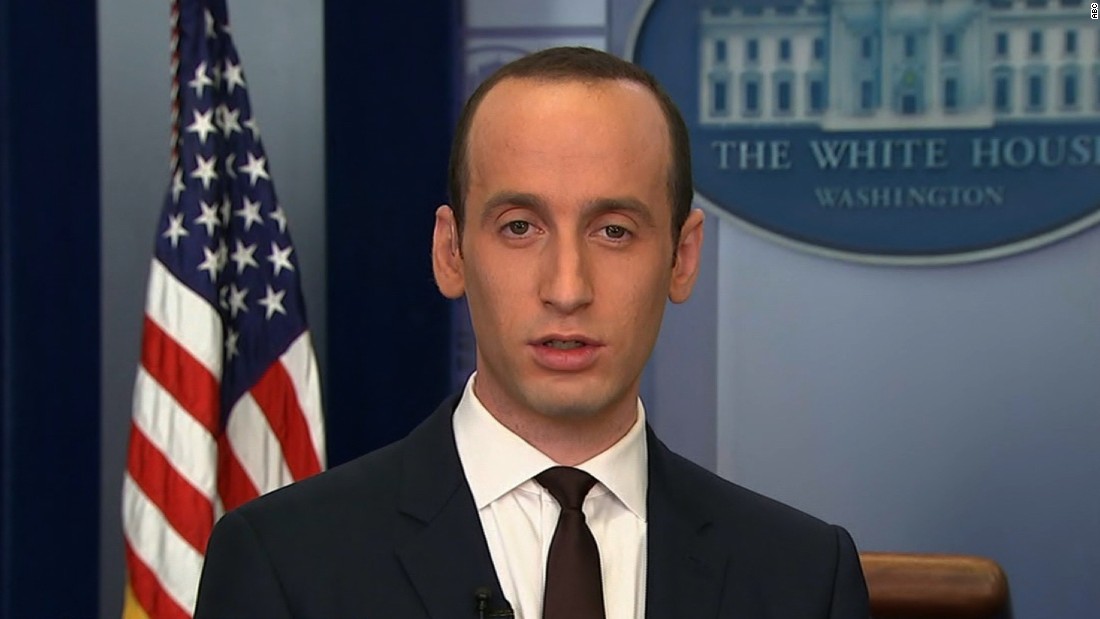
Even though Stephen Miller looks like a ventriloquist’s dummy, it’s often clear that it’s Trump who is the dummy whose lips are getting animated by Miller — no more so than when the president robotically read from his script in an unlikely performance yesterday as America’s impromptu prayer leader:
In times such as these, I know we are searching for some kind of meaning in the chaos, some kind of light in the darkness. The answers do not come easy. But we can take solace knowing that even the darkest space can be brightened by a single light, and even the most terrible despair can be illuminated by a single ray of hope.
Melania and I are praying for every American who has been hurt, wounded or lost the ones they love so dearly in this terrible, terrible attack.
We pray for the entire nation to find unity and peace. And we pray for the day when evil is banished, and the innocent are safe from hatred and from fear.
For some cable news anchors this might have sounded “pitch perfect” and yet that perception required overlooking not only the glaringly obvious fact that none of these were Trump’s own words, but most importantly that his speechwriter should choose to single out the American victims of Sunday’s violence.
Even though country music is a quintessentially white American cultural phenomenon, Las Vegas is an international tourist destination and believe it or not there are actually millions of non-American lovers of this musical genre.
It might turn out that every single one among the hundreds of victims and their thousands of relatives and friends are or were indeed all Americans, but that’s actually very unlikely.
So, at a moment that calls out for human sympathy, why declare we are “praying for every American”? The lives of the non-American victims are surely just as precious and just as deserving of prayer.
And yet, at a time when America could engage in some kind of moral reckoning through facing the culpability that extends through gun dealers, gun manufacturers, the NRA, the GOP, Congress, the president, and all those who value the Second Amendment more than the lives of those around them, what better way of ducking the issue than turning this into a nationalistic America First moment.
Update — CBC News reports: Four Canadians are among the 59 dead in Sunday’s mass shooting in Las Vegas.
On Tuesday it was confirmed that Calla Medig and Tara Roe Smith, 34, both from Alberta, died in the attack.
Medig, who was in her 20s, was from Jasper, Alta. Roe, 34, was from Okotoks, just south of Calgary. She had been reported missing since Sunday.
Jordan McIldoon, 23, of Maple Ridge, B.C., and Jessica Klymchuk, 34, of Valleyview, Alta., were also killed when a gunman opened fire on a large crowd near the end of the outdoor festival on the Vegas Strip. Their deaths were confirmed by their families on Monday. [Continue reading…]

In San Juan, we wait hours to buy groceries. We’re the lucky ones
Armando Valdés Prieto writes: My pregnant wife and I stood in line for two hours outside our neighborhood grocery store over the weekend. Once inside, we found that most essential products were scarce, and we were limited in the number we could buy of each item.
But we’re in Puerto Rico’s capital city, and we’re middle class, and that makes us pretty lucky. Millions of poor Puerto Ricans are worse off since Hurricane Maria hit, and if the government and aid organizations can’t figure out the best way to deploy lifesaving supplies to the rest of the island, it will only get bleaker.
In San Juan, folks have to choose between different lines: at the supermarket for food, at the gas station for a fill-up or at the bank to access cash — the only form of payment accepted at most stores, since ongoing telecommunications outages make it difficult to accept credit cards or other electronic payment methods. Even the commonwealth’s Nutritional Assistance Program, which feeds 1.3 million people out of Puerto Rico’s population of nearly 3.4 million, operates mostly electronically, which means it’s currently also not accepted at many retail outlets, so poorer residents can’t buy food without cash. Thankfully, many low-lying areas in San Juan do have potable water service. El Nuevo Día, the island’s largest and most influential newspaper, reported on Friday that 45 to 50 percent of the Aqueduct and Sewer Authority’s customers now have service. But that number has barely budged since the first wave of repairs began days after the disaster.
Still, outside the San Juan metro area, reports paint starker choices. In many rural towns there are no lines; stores haven’t been able to open, tanker trucks can’t reach distant gas stations to resupply and many bank branches are still closed. Water service has not been reestablished in many areas, and people I’ve spoken with tell me of hour-long slogs just to get drinking water for their families. Rural residents have no basic goods to buy, and no way to buy them even if supplies arrived. They need help immediately.
This past weekend, I spoke to an aid worker for an international NGO and a high-ranking official in the federal disaster response bureaucracy in Puerto Rico. To my surprise, they both agreed that the island’s current predicament is one of the worst, if not the worst, natural and human catastrophe they’d worked on. [Continue reading…]
Trump faces political danger in visit to Puerto Rico
Politico reports: President Donald Trump on Tuesday will come face to face with the “politically motivated ingrates” he slammed on Twitter just days before.
The president will land in Puerto Rico after spending much of the past week boasting about a wildly successful response effort that hasn’t matched the reality of the hurricane-ravaged island and after picking a fight over the weekend with the San Juan mayor.
The visit comes as he’s also attempting to be soother-in-chief for the nation after a shooting in Las Vegas left at least 59 dead on Sunday night — the first time he’s had to navigate two disasters of national scope that are politically perilous for any president, but especially one prone to off-the-cuff riffs. [Continue reading…]
Russians took a page from corporate America by using Facebook tool to ID and influence voters
The Washington Post reports: Russian operatives set up an array of misleading Web sites and social media pages to identify American voters susceptible to propaganda, then used a powerful Facebook tool to repeatedly send them messages designed to influence their political behavior, say people familiar with the investigation into foreign meddling in the U.S. election.
The tactic resembles what American businesses and political campaigns have been doing in recent years to deliver messages to potentially interested people online. The Russians exploited this system by creating English-language sites and Facebook pages that closely mimicked those created by U.S. political activists.
The Web sites and Facebook pages displayed ads or other messages focused on such hot-button issues as illegal immigration, African American political activism and the rising prominence of Muslims in the United States. The Russian operatives then used a Facebook “retargeting” tool, called Custom Audiences, to send specific ads and messages to voters who had visited those sites, say people familiar with the investigation who spoke on the condition of anonymity to share details from an ongoing investigation. [Continue reading…]
Hundreds of White House emails sent to third Kushner family account
Politico reports: White House officials have begun examining emails associated with a third and previously unreported email account on Jared Kushner and Ivanka Trump’s private domain, according to three people familiar with the matter.
Hundreds of emails have been sent since January from White House addresses to accounts on the Kushner family domain, these people said. Many of those emails went not to Kushner’s or Ivanka Trump’s personal addresses but to an account they both had access to and shared with their personal household staff for family scheduling.
The emails — which include nonpublic travel documents, internal schedules and some official White House materials —were in many cases sent from Ivanka Trump, her assistant Bridges Lamar and others who work with the couple in the White House. The emails to the third account were largely sent from White House accounts but occasionally came from other private accounts, one of these people said. [Continue reading…]
What Puerto Rico needs
Simon Johnson writes: President Donald Trump and the US Congress are coming under mounting pressure to increase assistance to Puerto Rico. The devastation caused there last week by Hurricane Maria has only exacerbated severe longer-term problems resulting from deferred maintenance on the island’s critical infrastructure. Puerto Rico needs more than short-term assistance (although this is also urgent); it needs bipartisan support to rebuild, with an initial and essential focus on a more robust and cheaper supply of electricity.
The existing electricity grid has substantially collapsed, with the Federal Emergency Management Administration (FEMA) estimating that up to 90% of the transmission system may have been destroyed by the hurricane. A major dam is at risk. Damage to the air traffic control infrastructure has severely limited flights to and from the island. As Governor Ricardo Rosselló has stated publicly, there is now a real risk of a major humanitarian disaster. Donations are flowing in, but the total will be small relative to what is needed.
The Trump administration says that FEMA is working hard and effectively. Let’s hope they are right. There will be a lot of questions about whether Puerto Rico’s roughly 3.4 million US citizens receive the same support as Texas and Florida (and other parts of the 50 states) when natural disaster strikes. But the bigger question is this: What will be done – and by whom – to help Puerto Rico really recover?
Puerto Rico – a dependent territory of the US – needs major investment in its essential infrastructure to bring it at least to the level of the 50 states. After the humanitarian situation is stabilized, policymakers should focus on providing Puerto Rico with stable, reliable, and cost-effective electric power, generated primarily by renewables and distributed over a smart, resilient grid. Ensuring energy availability will be indispensable for stability and sustained economic growth. [Continue reading…]
Las Vegas shooting good news for gun makers
MarketWatch reports: Shares of gun makers rallied Monday, in the wake of what has been described as the deadliest mass shooting on U.S. soil.
Smith & Wesson parent American Outdoor Brands Corp.’s stock AOBC, +0.64% jumped 3.0% in afternoon trade. Volume topped 3.7 million shares, compared with the full-day average over the past 30 days of 2.1 million shares.
Sturm, Ruger & Co. Inc. shares RGR, +3.48% climbed 2.7% and Vista Outdoor Inc. shares VSTO, +2.44% ran up 1.8% toward a 6-week high.
Analysts say the regulatory environment is among the biggest drivers of demand for guns, as fears of tighter regulation have boosted gun sales and share prices in the past. Since President Trump was elected, however, fears of tighter regulations have faded and share prices have dropped. [Continue reading…]
For gun makers, this would have to be the perfect combination: increased fear of gun control boosting gun sales at a time when a Republican president and Congress means there is zero chance of increased gun control. Add to that the fact that the Trump administration is looking for ways to “turn the spigot” on overseas gun sales and there’s never been a better time for trading in deadly weapons.
GOP effort to ease gun restrictions put on hold
Politico reports: A controversial bill to loosen restrictions on purchasing gun silencers won’t be reaching the House floor anytime soon following a horrific mass shooting in Las Vegas that left at least 59 dead and hundreds more wounded, according to GOP sources.
Another bill to allow concealed-carry permit holders to take their guns with them to another state could also be impacted by the tragedy, the worst mass shooting in modern U.S. history.
In what has become a familiar pattern, President Donald Trump and lawmakers in both parties issued somber statements of condolences following Sunday’s shooting, in which a heavily armed gunman opened fire at a crowd attending a concert. A number of Democrats called for immediate hearings and votes on gun-control measures, while Republicans and conservatives countered that it was inappropriate to talk politics when the tragedy was still fresh.
“Politicizing this terrible tragedy is, I think, beyond disgusting,” Senate Majority Whip John Cornyn (R-Texas) said Monday afternoon.
“Unfortunately I think some of the statements that have been made are fairly predicable. A time with 50-plus people are dead and 500 people are wounded is not a time to be politicizing this. There’s plenty of time to talk after a respectful period,” he added.
While there is virtually no chance that any new gun-control measures will be enacted in a GOP-controlled Congress or with Trump in the White House, the shooting could derail consideration of the silencer bill, known as the Sportsmen’s Heritage and Recreational Enhancement Act, at least in the short term. [Continue reading…]
Did Manafort use Trump to curry favor with a Putin ally?
Julia Ioffe and Franklin Foer write: On the evening of April 11, 2016, two weeks after Donald Trump hired the political consultant Paul Manafort to lead his campaign’s efforts to wrangle Republican delegates, Manafort emailed his old lieutenant Konstantin Kilimnik, who had worked for him for a decade in the Ukrainian capital, Kiev.
“I assume you have shown our friends my media coverage, right?” Manafort wrote.
“Absolutely,” Kilimnik responded a few hours later from Kiev. “Every article.”
“How do we use to get whole,” Manafort asks. “Has OVD operation seen?”
According to a source close to Manafort, the initials “OVD” refer to Oleg Vladimirovich Deripaska, a Russian oligarch and one of Russia’s richest men. The source also confirmed that one of the individuals repeatedly mentioned in the email exchange as an intermediary to Deripaska is an aide to the oligarch.
The emails were provided to The Atlantic on condition of anonymity. They are part of a trove of documents turned over by lawyers for Trump’s presidential campaign to investigators looking into the Kremlin’s interference in the 2016 election. A source close to Manafort confirmed their authenticity. Excerpts from these emails were first reported by The Washington Post, but the full text of these exchanges, provided to The Atlantic, shows that Manafort attempted to leverage his leadership role in the Trump campaign to curry favor with a Russian oligarch close to the Russian president, Vladimir Putin. Manafort was deeply in debt, and did not earn a salary from the Trump campaign. [Continue reading…]