Category Archives: climate change

Rate of arctic summer sea ice loss is 50% higher than predicted

The Observer reports: Sea ice in the Arctic is disappearing at a far greater rate than previously expected, according to data from the first purpose-built satellite launched to study the thickness of the Earth’s polar caps.

Preliminary results from the European Space Agency’s CryoSat-2 probe indicate that 900 cubic kilometres of summer sea ice has disappeared from the Arctic ocean over the past year.

This rate of loss is 50% higher than most scenarios outlined by polar scientists and suggests that global warming, triggered by rising greenhouse gas emissions, is beginning to have a major impact on the region. In a few years the Arctic ocean could be free of ice in summer, triggering a rush to exploit its fish stocks, oil, minerals and sea routes.

Using instruments on earlier satellites, scientists could see that the area covered by summer sea ice in the Arctic has been dwindling rapidly. But the new measurements indicate that this ice has been thinning dramatically at the same time. For example, in regions north of Canada and Greenland, where ice thickness regularly stayed at around five to six metres in summer a decade ago, levels have dropped to one to three metres.

“Preliminary analysis of our data indicates that the rate of loss of sea ice volume in summer in the Arctic may be far larger than we had previously suspected,” said Dr Seymour Laxon, of the Centre for Polar Observation and Modelling at University College London (UCL), where CryoSat-2 data is being analysed. “Very soon we may experience the iconic moment when, one day in the summer, we look at satellite images and see no sea ice coverage in the Arctic, just open water.”

The consequences of losing the Arctic’s ice coverage, even for only part of the year, could be profound. Without the cap’s white brilliance to reflect sunlight back into space, the region will heat up even more than at present. As a result, ocean temperatures will rise and methane deposits on the ocean floor could melt, evaporate and bubble into the atmosphere. Scientists have recently reported evidence that methane plumes are now appearing in many areas. Methane is a particularly powerful greenhouse gas and rising levels of it in the atmosphere are only likely to accelerate global warming. And with the disappearance of sea ice around the shores of Greenland, its glaciers could melt faster and raise sea levels even more rapidly than at present. [Continue reading…]

Facebooktwittermail

Heat wave: reports on rising temperatures across the U.S.

By Cora Currier and Suevon Lee, ProPublica, August 10, 2012

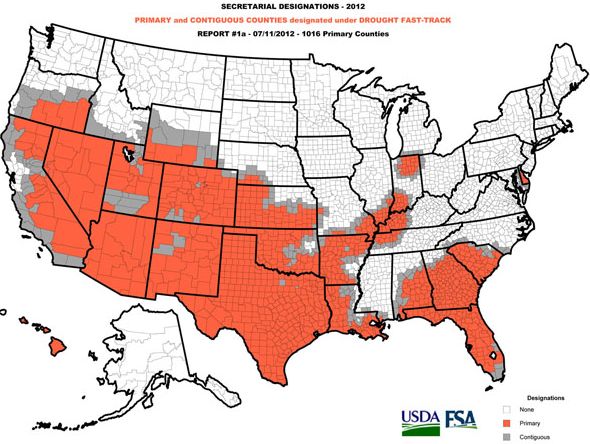
July was the hottest month ever in the continental U.S., and the past twelve months have been hotter than any such period on record. Half of all counties in the country have been declared disaster areas, mainly due to drought. We’ve rounded up some of the best journalism on the effects of rising temperatures. Got others you’re burning to share? Add them in the comments.

Profits on Carbon Credits Drive Output of a Harmful Gas, New York Times, August 2012Under a U.N. carbon credit program, manufacturers can get credits for reducing emission of greenhouse gases. But air-conditioner and refrigerator manufacturers realized they could profit from a waste gas produced while making coolant, and they started making and destroying more of it to earn credits. The result: more production of the original coolant, which also contributes to global warming and damages the ozone layer.

In Drought-Stricken Midwest, It’s Fodder Vs. Fuel, NPR, July 2012A U.S. law requires gas companies to buy a certain amount of ethanol, which is made from corn. That means ethanol factories are buying up the crop. Farmers who need corn for livestock, and who are already struggling with drought, say the system isn’t fair.

Wildfire: Red slurry’s toxic dark side,Denver Post, June 2012Hundreds of thousands of gallons of “red slurry” were dropped on wildfires raging in Colorado. The chemical mixture is effective at firefighting, but it’s also full of toxins, including ammonia and nitrates, which threaten the water supply and wildlife. For more background on the Colorado fires, read I-News Network’s account on how more people are moving into the state’s high-risk “red zones”, even as the frequency of fires has increased over the past decade.

Oysters in deep trouble: Is Pacific Ocean’s chemistry killing sea life?, The Seattle Times, April 2012Since 2005, millions of Pacific oysters in a Washington estuary have failed to reproduce and the oyster larvae have been dying. Though region-specific causes contributed to the decline, some scientists believe that greenhouse gases are leading to increased corrosive seawater sooner than expected.

The Great Oasis, The New Yorker, December 2011About a third of the earth is covered in desert, a percentage that increases each year thanks in part to climate change and unsustainable farming. The New Yorker’s Burkhard Bilger examines the science and politics involved in various countries’ efforts to stop desertification, from China and Israel to Oman and Nigeria.

Our Dying Forests, The Salt Lake Tribune, September 2011This multi-part series centers on the decline of the once-lush forestation in the Rocky Mountain West, where warmer winters and longer growing seasons have sparked an explosion of native beetle species that have destroyed 40 million acres of moisture-starved spruce, firs and aspen.

Extreme Heat Blanches Coral, and Threat is Seen, The New York Times, September 2010In 2010 many of the world’s coral reefs turned white in reaction to too-warm waters. Coral bleaching and die-offs often occur in years when El Niño or other unusual weather patterns contribute to hot ocean temperatures, but scientists say that global warming is also playing a factor in what they call “global bleachings.”

Losing Louisiana, The Times-Picayune, December 2008Rising sea levels pose a particular problem for Louisiana’s fragile coastline, where the land is sinking and protective wetlands have been ravaged by development and hurricanes. North Carolina’s shore is also seeing the impact of rising seas, as the Charlotte Observer covered in a recent series on coastal erosion.


Facebooktwittermail

America’s drought of political will on climate change

Naomi Wolf writes: As the US faces record drought and an Old Testament-level pestilential heatwave in the midwest, American environmental denialism may be starting to change. The question is: is it too late?

America has led the world in climate change denial, a phenomenon noted with amazement by Europeans, not to mention thinking people around the world. Year after year, the US has failed to sign global treaties or curb emissions, even as our status as a source of a third of the world’s carbon emissions goes unchanged.

It is fairly well-known what has been behind that climate change denial in America: vast sums pumped into an ignorance industry by the oil and gas lobbies. Entire thinktanks to obfuscate manmade climate change have been funded by these interests, as have individual congressmen and women. Entirely typical, for instance, is Louisiana Representative John Fleming, whose campaigns, according to blogger John Henry, accept about $200,000 a year from oil and gas lobbyists, and who uses his social media pages to deny global warming.

It is weird to live inside that US denial about climate change. Last year, for example, as tropical storm Irene approached New York, we duly boarded up windows, put in emergency supplies, and heard endless alarming bulletins from the mayor’s office about which neighborhoods were likely to be submerged if the tides surged – without ever hearing from local officials or the media a word connecting rising sea levels with manmade global warming. All the more weird because New Yorkers weren’t writing off portions of their downtown neighborhoods to overflowing seawater a century ago.

It is weird, too, to watch the leaves turn red earlier and earlier in the fall in the American northeast and have absolutely everyone say, “the weather is strange” – yet never see mainstream media reflect any interest in the connection between human industrial activity and that strangeness. And this weather map shows how widespread and extensive that extreme weather is in the US.

But could our denial be cracking, this summer, as, in the heartland – that most iconic of American landscapes – broiling temperatures injure humans and cook fish in the water? [Continue reading…]

Facebooktwittermail

Power outage in India and the risk of a climate change tipping point

A power failure in North India has left 620 million people without electricity. That’s a 100 million more than the total population of North America. That’s like the lights going out from Anchorage in Alaska all the way down to Caracas in Venezuela.

The Associated Press reports:

The massive failure — a day after a similar, but smaller power failure — has raised serious concerns about India’s outdated infrastructure and the government’s inability to meet its huge appetite for energy as the country aspires to become a regional economic superpower.

But what’s driving that growing energy demand is not simply economic growth but also a warming planet evident in “a booming market for air conditioning — world sales in 2011 were up 13 percent over 2010, and that growth is expected to accelerate in coming decades.”

The United States has long consumed more energy each year for air conditioning than the rest of the world combined. In fact, we use more electricity for cooling than the entire continent of Africa, home to a billion people, consumes for all purposes. Between 1993 and 2005, with summers growing hotter and homes larger, energy consumed by residential air conditioning in the U.S. doubled, and it leaped another 20 percent by 2010. The climate impact of air conditioning our buildings and vehicles is now that of almost half a billion metric tons of carbon dioxide per year.

China is already sprinting forward and is expected to surpass the United States as the world’s biggest user of electricity for air conditioning by 2020. Consider this: The number of U.S. homes equipped with air conditioning rose from 64 to 100 million between 1993 and 2009, whereas 50 million air-conditioning units were sold in China in 2010 alone. And it is projected that the number of air-conditioned vehicles in China will reach 100 million in 2015, having more than doubled in just five years.

As urban China, Japan, and South Korea approach the air-conditioning saturation point, the greatest demand growth in the post-2020 world is expected to occur elsewhere, most prominently in South and Southeast Asia. India will predominate — already, about 40 percent of all electricity consumption in the city of Mumbai goes for air conditioning. The Middle East is already heavily climate-controlled, but growth is expected to continue there as well. Within 15 years, Saudi Arabia could actually be consuming more oil than it exports, due largely to air conditioning. And with summers warming, the United States and Mexico will continue increasing their heavy consumption of cool.

Kurt Cobb notes:

It’s easy to forget that every piece of our current infrastructure — roads, rails, runways, bridges, industrial plants, housing — was built with a certain temperature range in mind. Our agricultural system and much of our electrical generating system (including dams, nuclear power stations and conventional thermal electric plants which burn coal and natural gas) were created not only with a certain temperature range in mind, but also a certain range of rainfall. Rainfall, whether it is excessive or absent, can become a problem if it creates 1) floods that damage and sweep away buildings and crops or 2) if there isn’t enough water to quench crops and supply industrial and utility operating needs.

This summer has shown just what can happen when those built-in tolerances for heat, moisture (or lack of it) and wind are exceeded. The New York Times did an excellent short piece providing examples of some of those effects:

  1. A jet stuck on the tarmac as its wheels sank into asphalt softened by 100-degree heat.
  2. A subway train derailed by a kink in the track due to excessive heat.
  3. A power plant that had to be shut down due to lack of cooling water when the water level dropped below the intake pipe.
  4. A “derecho“, a severe weather pattern of thunderstorms and very high straight-line winds, that deprived 4.3 million people of power in the eastern part of the United States, some for eight days.
  5. Drainage culverts destroyed by excessive rains.

Past attempts to forecast the possible costs of climate change have been largely inadequate. They failed because of unanticipated effects on and complex interconnections among various parts of critical infrastructure.

Back in 2007 Yale economist William Nordhaus wrote in a paper that “[e]conomic studies suggest that those parts of the economy that are insulated from climate, such as air-conditioned houses or most manufacturing operations, will be little affected directly by climatic change over the next century or so.” Having air-conditioning does not do you much good, however, if the electricity is out. And, manufacturing operations depend on reliable electric service. Many manufacturing operations are also water-intensive and so will be affected by water shortages.

India’s current energy demands have been worsened by this year’s weak monsoon and consequent higher temperatures — in some states rainfall has been 70% below average. Monsoons are erratic in four years out of ten, but as Fred Guterl explains, the Indian monsoon may be subject to a much greater vulnerability: the dynamics of a climate change tipping point in which the monsoons could be here one year and then gone the next. In that event, the effects will be devastating not only across India but far beyond.

So far 2012 is on pace to be the hottest year on record. But does this mean that we’ve reached a threshold — a tipping point that signals a climate disaster?

For those warning of global warming, it would be tempting to say so. The problem is, no one knows if there is a point at which a climate system shifts abruptly. But some scientists are now bringing mathematical rigor to the tipping-point argument. Their findings give us fresh cause to worry that sudden changes are in our future.

One of them is Marten Scheffer, a biologist at Wageningen University in the Netherlands, who grew up swimming in clear lowland ponds. In the 1980s, many of these ponds turned turbid. The plants would die, algae would cover the surface, and only bottom-feeding fish remained. The cause — fertilizer runoff from nearby farms — was well known, but even after you stopped the runoff, replanted the lilies and restocked the trout, the ponds would stay dark and scummy.

Mr. Scheffer solved this problem with a key insight: the ponds behaved according to a branch of mathematics called “dynamical systems,” which deals with sudden changes. Once you reach a tipping point, it’s very difficult to return things to how they used to be. It’s easy to roll a boulder off a cliff, for instance, but much harder to roll it back. Once the ponds turned turbid, it wasn’t enough to just replant and restock. You had get them back to their original, clear state.

Science is a graveyard of grand principles that fail in the end to explain the real world. So it is all the more surprising that Mr. Scheffer’s idea worked.

By applying the principles of dynamical systems, Mr. Scheffer was able to figure out that to fix the ponds, he had to remove the fish that thrive in the turbid water. They stir up sediment, which blocks sunlight from plants, and eat the zooplankton that keep the water clear. His program of fixing the Netherlands’ ponds and lakes is legendary in ecology.

Mr. Scheffer and other scientists are now trying to identify the early-warning signals for climate that precede abrupt transitions. Tim Lenton, a climate scientist at the University of Exeter in England, has identified a handful of climate systems that could reach tipping points in the not-too-distant future. These are not so much related to global average temperatures — the main metric for climate-change arguments — as they are to patterns of climate that repeat themselves each year.

El Niño is one such pattern — a gigantic blob of warm water that sloshes around in the Pacific Ocean, causing weather changes across wide swaths of the globe. Another is the West African monsoon, which brings rain to the west coast of the continent. Each is subject to behaving like dynamical systems — which means they are prone to “flip” from one state to another, like one of Mr. Scheffer’s ponds, over time periods that vary from a year to a few hundred.

The most frightening prospect that Mr. Lenton has found is the vulnerability of the Indian monsoon. More than a billion people depend on this weather pattern each year for the rain it brings to crops. The monsoon, though, is being affected by two conflicting forces: the buildup of carbon dioxide in the atmosphere is adding energy to the monsoons, making them more powerful. On the other hand, soot from fires and coal plants acts to blocks the sun’s energy, weakening the monsoons.

This opposition creates potential instability and the possibility that the atmospheric dynamics that bring the monsoons could change suddenly. Mr. Lenton’s analysis shows this could occur in a remarkably short time. The monsoons could be here one year, then gone the next year.

Other possible tipping points are the melting of the North Pole’s sea ice, Greenland’s glaciers and the Antarctic ice sheets, and the destruction of the Amazon rain forest and Canada’s boreal forests.

We know that the dynamical-systems idea worked for Mr. Scheffer’s ponds because he achieved real-world results. But why should we believe that the principle explains things like El Niño and the Indian monsoon? The acid test will be whether the real world behaves the way Mr. Lenton says it will. If the Indian monsoon disappears, we’ll know he is right.

What then? The real worst-case scenario would have one such event triggering others, until you have a cascade of weather flips from one end of the planet to another. It wouldn’t be quite as dramatic as Hollywood might want to depict, perhaps, but it would be dramatic enough to rewrite the predictions for sea level and temperature rises that are part of the current consensus. This worst case is highly speculative, but sudden shifts in climate patterns may already be happening.

The policy makers aren’t likely to be discussing dynamical-systems theory anytime soon. Fortunately, scientists like Mr. Scheffer and Mr. Lenton are trying to work out the details of how closely nature hews to these mathematics, what a true tipping point would look like and what we might do if and when we face one.

We need a tipping point in climate politics, where all of a sudden we start paying attention.

Facebooktwittermail

The conversion of a climate-change skeptic

Richard A. Muller, professor of physics at the University of California, Berkeley, writes: Call me a converted skeptic. Three years ago I identified problems in previous climate studies that, in my mind, threw doubt on the very existence of global warming. Last year, following an intensive research effort involving a dozen scientists, I concluded that global warming was real and that the prior estimates of the rate of warming were correct. I’m now going a step further: Humans are almost entirely the cause.

My total turnaround, in such a short time, is the result of careful and objective analysis by the Berkeley Earth Surface Temperature project, which I founded with my daughter Elizabeth. Our results show that the average temperature of the earth’s land has risen by two and a half degrees Fahrenheit over the past 250 years, including an increase of one and a half degrees over the most recent 50 years. Moreover, it appears likely that essentially all of this increase results from the human emission of greenhouse gases.

These findings are stronger than those of the Intergovernmental Panel on Climate Change, the United Nations group that defines the scientific and diplomatic consensus on global warming. In its 2007 report, the I.P.C.C. concluded only that most of the warming of the prior 50 years could be attributed to humans. It was possible, according to the I.P.C.C. consensus statement, that the warming before 1956 could be because of changes in solar activity, and that even a substantial part of the more recent warming could be natural. [Continue reading…]

Facebooktwittermail

The world is closer to a food crisis than most people realise

Lester R. Brown writes: In the early spring this year, US farmers were on their way to planting some 96m acres in corn, the most in 75 years. A warm early spring got the crop off to a great start. Analysts were predicting the largest corn harvest on record.

The United States is the leading producer and exporter of corn, the world’s feedgrain. At home, corn accounts for four-fifths of the US grain harvest. Internationally, the US corn crop exceeds China’s rice and wheat harvests combined. Among the big three grains – corn, wheat, and rice – corn is now the leader, with production well above that of wheat and nearly double that of rice.

The corn plant is as sensitive as it is productive. Thirsty and fast-growing, it is vulnerable to both extreme heat and drought. At elevated temperatures, the corn plant, which is normally so productive, goes into thermal shock.

As spring turned into summer, the thermometer began to rise across the corn belt. In St Louis, Missouri, in the southern corn belt, the temperature in late June and early July climbed to 100F or higher 10 days in a row. For the past several weeks, the corn belt has been blanketed with dehydrating heat.

Weekly drought maps published by the University of Nebraska show the drought-stricken area spreading across more and more of the country until, by mid-July, it engulfed virtually the entire corn belt. Soil moisture readings in the corn belt are now among the lowest ever recorded. [Continue reading…]

Facebooktwittermail

Time for fossil fuel industry and consumers to pay for climate change

2012 drought - the worst 'natural' disaster in U.S. history

Myles Allen writes: The climate may have changed this week. Not the physical climate, but the climate of the climate change debate. Tuesday marked the publication of a series of papers examining the factors behind extreme weather events in 2011. Nothing remarkable about that, you might think, except, if all goes well, this will be the first of a regular, annual assessment quantifying how external drivers of climate contribute to damaging weather.

Some of these drivers, like volcanoes, are things we can do nothing about. But others, like rising levels of greenhouse gases, we can. And quantifying how greenhouse gases contribute to extreme weather is a crucial step in pinning down the real cost of human influence on climate. While most people think of climate change in terms of shrinking ice-sheets and slowly rising sea levels, it is weather events that actually do harm.

This week also saw a workshop in Oxford for climate change negotiators from developing countries. Again, nothing remarkable about that except, for the first time, the issue of “loss and damage” was top of the agenda. For years negotiations have been over emission reductions and sharing the costs of adaptation. Now the debate is turning to: who is going to pay for damage done?

It is a good time to ask, since the costs that can unambiguously be attributed to human-induced climate change are still relatively small. Although Munich Re estimates that weather events in 2011 cost more than $100bn and claimed many thousands of lives, only a few of these events were clearly made more likely by human influence. Others may have been made less likely, but occurred anyway – chance remains the single dominant factor in when and where a weather event occurs. For the vast majority of events, we simply don’t yet know either way.

Connecting climate change and specific weather events is only one link in the causal chain between greenhouse gas emissions and actual harm. But it is a crucial link. If, as planned, the assessment of 2011 becomes routine, we should be able to compare actual weather-related damage, in both good years and bad, with the damage that might have been in a world without human influence on climate. This puts us well on our way to a global inventory of climate change impacts. And as soon as that is available, the question of compensation will not be far behind.

The presumption in climate change negotiations is that “countries with historically high emissions” would be first in line to foot the bill for loss and damage. There may be some logic to this, but if you are an African (or Texan) farmer hit by greenhouse-exacerbated drought, is the European or American taxpayer necessarily the right place to look for compensation? As any good lawyer knows, there is no point in suing a man with empty pockets.

The only institution in the world that could deal with the cost of climate change without missing a beat is the fossil fuel industry: BP took a $30bn charge for Deepwater Horizon, very possibly more than the total cost of climate change damages last year, and was back in profit within months. Of the $5 trillion per year we currently spend on fossil energy, a small fraction would take care of all the loss and damage attributable to climate change for the foreseeable future several times over.

Such a pay-as-you-go liability regime would not address the impacts of today’s emissions on the 22nd century. Governments cannot wash their hands of this issue entirely. But we have been so preoccupied with the climate of the 22nd century that we have curiously neglected to look after the interests of those being affected by climate change today.

So rather than haggling over emission caps and carbon taxes, why not start with a simple statement of principle: standard product liability applies to anyone who sells or uses fossil fuels, including liability for any third-party side-effects. There is no need at present to say what these side-effects might be – indeed, the scientific community does not yet know. But we are getting there.

Facebooktwittermail

Fossil fuel industry has plan to save itself and put others at risk

Peter Montague and Steve Horn write: Most Americans are now convinced that climate change is real because dramatic evidence keep piling up – searing heat waves, multiyear droughts, record-setting wildfires, unprecedented tornadoes and Biblical floods.

Furthermore, there’s now widespread agreement among scientists that humans are causing these problems by burning fossil fuels (coal, oil, natural gas), thus emitting carbon dioxide (CO2) gas, which acts like a blanket, warming the planet.

One obvious solution: use fossil fuels far more efficiently (doing the same work with less energy), thus drastically reducing CO2 emissions. Wherever we use lights, heat or motors, we could greatly enhance efficiency.

Furthermore, efficiency could improve quickly – the National Academy of Sciences said recently we could cut the nation’s energy use 20 percent by 2020 and 30 percent by 2030 using technologies that are available and affordable today. David Goldstein has shown how we could cut national energy use more than 80 percent in ten to 20 years, creating many thousands of good jobs while saving trillions of dollars in reduced fuel costs – enough to fund a modern, renewable energy system.

One crucial caveat: the people who would benefit least from efficiency are the purveyors of fossil fuels – they’d sell less product, reducing their profits. For them, efficiency is a threat, not an opportunity.

In response, fossil fuel corporations have devised their own plan to mitigate global warming while burning more and more coal, oil and natural gas. Their plan is called “carbon capture and sequestration,” or CCS, for short.

In a nutshell, the plan would capture CO2 as a gas, pressurize it into a liquid, pipe it to a suitable location and then pump it a mile below ground, hoping it will stay there forever. You may not have heard of it, but the CCS plan is chugging along worldwide. [Continue reading…]

Facebooktwittermail

We were wrong on peak oil. There’s enough to fry us all

George Monbiot writes: The facts have changed, now we must change too. For the past 10 years an unlikely coalition of geologists, oil drillers, bankers, military strategists and environmentalists has been warning that peak oil – the decline of global supplies – is just around the corner. We had some strong reasons for doing so: production had slowed, the price had risen sharply, depletion was widespread and appeared to be escalating. The first of the great resource crunches seemed about to strike.

Among environmentalists it was never clear, even to ourselves, whether or not we wanted it to happen. It had the potential both to shock the world into economic transformation, averting future catastrophes, and to generate catastrophes of its own, including a shift into even more damaging technologies, such as biofuels and petrol made from coal. Even so, peak oil was a powerful lever. Governments, businesses and voters who seemed impervious to the moral case for cutting the use of fossil fuels might, we hoped, respond to the economic case.

Some of us made vague predictions, others were more specific. In all cases we were wrong. In 1975 MK Hubbert, a geoscientist working for Shell who had correctly predicted the decline in US oil production, suggested that global supplies could peak in 1995. In 1997 the petroleum geologist Colin Campbell estimated that it would happen before 2010. In 2003 the geophysicist Kenneth Deffeyes said he was “99% confident” that peak oil would occur in 2004. In 2004, the Texas tycoon T Boone Pickens predicted that “never again will we pump more than 82m barrels” per day of liquid fuels. (Average daily supply in May 2012 was 91m.) In 2005 the investment banker Matthew Simmons maintained that “Saudi Arabia … cannot materially grow its oil production“. (Since then its output has risen from 9m barrels a day to 10m, and it has another 1.5m in spare capacity.)

Peak oil hasn’t happened, and it’s unlikely to happen for a very long time. [Continue reading…]

Facebooktwittermail

Rise in sea level can’t be stopped: scientists

Reuters reports: Rising sea levels cannot be stopped over the next several hundred years, even if deep emissions cuts lower global average temperatures, but they can be slowed down, climate scientists said in a study on Sunday.

A lot of climate research shows that rising greenhouse gas emissions are responsible for increasing global average surface temperatures by about 0.17 degrees Celsius a decade from 1980-2010 and for a sea level rise of about 2.3mm a year from 2005-2010 as ice caps and glaciers melt.

Rising sea levels threaten about a tenth of the world’s population who live in low-lying areas and islands which are at risk of flooding, including the Caribbean, Maldives and Asia-Pacific island groups.

More than 180 countries are negotiating a new global climate pact which will come into force by 2020 and force all nations to cut emissions to limit warming to below 2 degrees Celsius this century – a level scientists say is the minimum required to avert catastrophic effects.

But even if the most ambitious emissions cuts are made, it might not be enough to stop sea levels rising due to the thermal expansion of sea water, said scientists at the United States’ National Centre for Atmospheric Research, U.S. research organization Climate Central and Centre for Australian Weather and Climate Research in Melbourne.

“Even with aggressive mitigation measures that limit global warming to less than 2 degrees above pre-industrial values by 2100, and with decreases of global temperature in the 22nd and 23rd centuries … sea level continues to rise after 2100,” they said in the journal Nature Climate Change.

Facebooktwittermail

A catastrophe if global warming falls off the international agenda

Will Hutton writes: A month’s rain fell in a day last week in parts of Britain. There were 140 flood warnings in the north of England, rain forcing the evacuation of Croston and Darwen in Lancashire; elsewhere, it washed out the Isle of Wight festival. Indeed, rainfall over the last three months has broken new records – following two years in which less rain had fallen than at any time since the 1920s.

This is part of a wider pattern. It is not just that world temperatures are on average steadily rising, the weather everywhere is becoming more extreme. Eleven of the last 12 years have been the hottest on record, and the growing volatility in our weather is linked to global warming. As the earth warms, the relationships between ocean currents, the ice caps, atmospheric pressure and the jet stream become more turbulent, and the weather turns more unpredictable.

Twenty years ago these trends, already visible but less marked, prompted the first earth summit in Rio. The second one closed on Friday night with a political declaration as long as it was vapid. There were plenty of warm words and reaffirmations of intent – but nothing that might address the intense pressure on the natural environment.

There was, for example, no deterrent to the burning of fossil fuels or incentive to make renewable ones more economically attractive. Targets for sustainable development? Forget them. And so it went on — a non-event that hardly got reported.

There was the usual cast of suspects. China and India were determined that action on carbon emissions must be undertaken by the west and not by them, so creating political deadlock. American oil, car and airline companies lobby intensely to stop any tax being levied on oil and gas, while global banks lobby no less furiously against a financial transactions tax whose proceeds might be used to alleviate the impact of climate change on those countries and regions most badly affected – usually the very poorest.

Climate change is not just about life on earth tomorrow: it is about justice today. But lobbying and political intransigence are much easier to achieve when there is no intellectual consensus – and one of the dramatic changes since 1992 is the worldwide growth of climate change scepticism. [Continue reading…]

Facebooktwittermail

Rio 2012: it’s a make-or-break summit. Just like they told us at Rio 1992

George Monbiot writes: Worn down by hope. That’s the predicament of those who have sought to defend the earth’s living systems. Every time governments meet to discuss the environmental crisis, we are told that this is the “make or break summit”, on which the future of the world depends. The talks might have failed before, but this time the light of reason will descend upon the world.

We know it’s rubbish, but we allow our hopes to be raised, only to witness 190 nations arguing through the night over the use of the subjunctive in paragraph 286. We know that at the end of this process the UN secretary general, whose job obliges him to talk nonsense in an impressive number of languages, will explain that the unresolved issues (namely all of them) will be settled at next year’s summit. Yet still we hope for something better.

This week’s earth summit in Rio de Janeiro is a ghost of the glad, confident meeting 20 years ago. By now, the leaders who gathered in the same city in 1992 told us, the world’s environmental problems were to have been solved. But all they have generated is more meetings, which will continue until the delegates, surrounded by rising waters, have eaten the last rare dove, exquisitely presented with an olive leaf roulade. The biosphere that world leaders promised to protect is in a far worse state than it was 20 years ago. Is it not time to recognise that they have failed?

These summits have failed for the same reason that the banks have failed. Political systems that were supposed to represent everyone now return governments of millionaires, financed by and acting on behalf of billionaires. The past 20 years have been a billionaires’ banquet. At the behest of corporations and the ultra-rich, governments have removed the constraining decencies – the laws and regulations – which prevent one person from destroying another. To expect governments funded and appointed by this class to protect the biosphere and defend the poor is like expecting a lion to live on gazpacho. [Continue reading…]

Facebooktwittermail

How climate change got removed from the agenda of the Rio+20 Summit

In These Times reports: The Durban Climate Conference last winter ended in almost unqualified failure. The original framework of U.N. climate negotiations was all but abandoned in favor of a new global pact that may or may not be negotiated by 2015 and may or may not be legally binding. Climate change deniers literally crashed the party by parachuting onto a beach in Durban carrying a “Climategate 2.0” banner—and public perception in the U.S. on the reliability of climate science continued to shift in their direction, cementing the stalemate on a domestic climate deal.

Now, it would seem, many international negotiators have altogether given up on the idea of establishing a global regulatory framework for reducing carbon emissions. Next week, more than 130 national leaders will gather at the Earth Summit in Rio de Janeiro to discuss proposals ranging from replacing GDP as the indicator of economic prosperity to conducting annual “state-of-the-planet” assessments. Notably absent, particularly given a new U.N. study finding that carbon emissions have increased by 40% in the past two decades, will be any concrete negotiations on climate change.

The summit, to be held in Rio from June 20 – 22, is the follow-up to the 1992 Earth Summit that produced multilateral agreements on climate change, biodiversity and desertification. But this time, no binding agreements are expected to result from the three-day meeting. At best, the talks may result in a commitment to drafting new goals for sustainable development by 2015.

The summit’s dodge of continued climate talks is an intentional move to avoid politics in favor of platitudes. After Durban, U.N. officials sought to redirect the agenda for Rio away from the contentious territory of emissions cuts and climate finance and toward issues of trade and technology. In an interview with Reuters in January, when pre-Rio talks were underway, Brazilian negotiator Ambassador Andre Correa do Lago acknowledged that the focus on sustainable development was more palatable to politicians and business leaders with a stake in the negotiations. [Continue reading…]

Facebooktwittermail