Science Daily reports: Sea levels are rising faster than expected from global warming, and University of Colorado geologist Bill Hay has a good idea why. The last official IPCC report in 2007 projected a global sea level rise between 0.2 and 0.5 meters by the year 2100. But current sea-level rise measurements meet or exceed the high end of that range and suggest a rise of one meter or more by the end of the century.
“What’s missing from the models used to forecast sea-level rise are critical feedbacks that speed everything up,” says Hay. He will be presenting some of these feedbacks in a talk on Nov. 4, at the meeting of The Geological Society of America in Charlotte, North Carolina, USA.
One of those feedbacks involves Arctic sea ice, another the Greenland ice cap, and another soil moisture and groundwater mining.
“There is an Arctic sea ice connection,” says Hay, despite the fact that melting sea ice — which is already in the ocean — does not itself raise sea level. Instead, it plays a role in the overall warming of the Arctic, which leads to ice losses in nearby Greenland and northern Canada. When sea ice melts, Hay explains, there is an oceanographic effect of releasing more fresh water from the Arctic, which is then replaced by inflows of brinier, warmer water from the south.
“So it’s a big heat pump that brings heat to the Arctic,” says Hay. “That’s not in any of the models.” That warmer water pushes the Arctic toward more ice-free waters, which absorb sunlight rather than reflect it back into space like sea ice does. The more open water there is, the more heat is trapped in the Arctic waters, and the warmer things can get. [Continue reading…]
Category Archives: climate change
Why Europe deserves your respect: They had first word on Hurricane Sandy
Jim Galloway writes: If you’re familiar with Republican talking points, then you understand that “Europe” has become political shorthand for “socialist, debt-ridden mediocrity.”
We must now make an exception for the art of weather forecasting. How did U.S. meteorologists first learn that Hurricane Sandy would make a deadly beeline for the Jersey shore? Socialist, debt-ridden Europe told them.
Specifically, while U.S. computer models still had Hurricane Sandy dying in the deep Atlantic, the European Centre for Medium-Range Weather Forecasts, located in the United Kingdom town of Reading, declared that Sandy was about to give the northeastern United States a devastating right hook.
European superiority is an accepted fact within the forecasting craft. Which is why – nine days ago — Marshall Shepherd pointed to the calculations coming out of Britain and told his students in Athens to keep their eyes open.
“It’s fairly well known that the European model is a bit better than our model because they use something called four-dimensional data assimilation in their weather model,” said Shepherd, a professor of geography and director of the atmospheric sciences program at the University of Georgia.
We’ll offer a translation later.
For the moment, what you need to know is that, in January, Shepherd will become president of the 15,000-member American Meteorological Society. Which means that both he and Hurricane Sandy will have significant parts to play in the next chapter of the ongoing debate on the size and role of our federal government.
While Republicans would prefer to discuss Benghazi, Sandy is all but certain to dominate the final days of the presidential contest. President Barack Obama will push photos of himself touring the devastation with a well-known Republican governor of New Jersey.
Mitt Romney will continue to fend off questions about that 2011 primary debate in which he suggested a return of disaster relief duties to the states, or privatizing the process. (The Federal Emergency Management Agency is “really important,” but states are “first responders,” a Romney aide said Thursday.)
But the debate over the reach of federal government won’t disappear after next Tuesday. Rather, it will ratchet up, as Congress turns its attention toward a lame-duck session and a “fiscal cliff” of automated tax hikes and spending cuts.
“When you have a Katrina, or you have a Sandy, that’s the time to get things done in the policy world,” Shepherd said. “With Sandy, I think it’s raising the right questions about the role of government.” [Continue reading…]
It’s global warming, stupid
Paul M. Barrett writes: Yes, yes, it’s unsophisticated to blame any given storm on climate change. Men and women in white lab coats tell us — and they’re right — that many factors contribute to each severe weather episode. Climate deniers exploit scientific complexity to avoid any discussion at all.
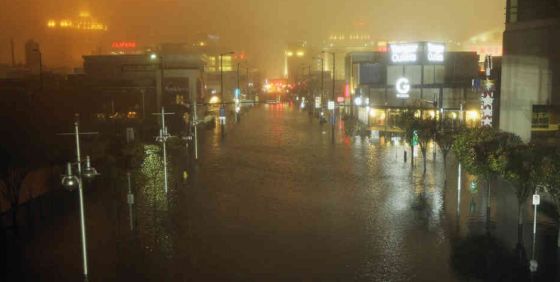
Clarity, however, is not beyond reach. Hurricane Sandy demands it: At least 40 U.S. deaths. Economic losses expected to climb as high as $50 billion. Eight million homes without power. Hundreds of thousands of people evacuated. More than 15,000 flights grounded. Factories, stores, and hospitals shut. Lower Manhattan dark, silent, and underwater.
An unscientific survey of the social networking literature on Sandy reveals an illuminating tweet (you read that correctly) from Jonathan Foley, director of the Institute on the Environment at the University of Minnesota. On Oct. 29, Foley thumbed thusly: “Would this kind of storm happen without climate change? Yes. Fueled by many factors. Is storm stronger because of climate change? Yes.” Eric Pooley, senior vice president of the Environmental Defense Fund (and former deputy editor of Bloomberg Businessweek), offers a baseball analogy: “We can’t say that steroids caused any one home run by Barry Bonds, but steroids sure helped him hit more and hit them farther. Now we have weather on steroids.”
In an Oct. 30 blog post, Mark Fischetti of Scientific American took a spin through Ph.D.-land and found more and more credentialed experts willing to shrug off the climate caveats. The broadening consensus: “Climate change amps up other basic factors that contribute to big storms. For example, the oceans have warmed, providing more energy for storms. And the Earth’s atmosphere has warmed, so it retains more moisture, which is drawn into storms and is then dumped on us.” Even those of us who are science-phobic can get the gist of that.
Sandy featured a scary extra twist implicating climate change. An Atlantic hurricane moving up the East Coast crashed into cold air dipping south from Canada. The collision supercharged the storm’s energy level and extended its geographical reach. Pushing that cold air south was an atmospheric pattern, known as a blocking high, above the Arctic Ocean. Climate scientists Charles Greene and Bruce Monger of Cornell University, writing earlier this year in Oceanography, provided evidence that Arctic icemelts linked to global warming contribute to the very atmospheric pattern that sent the frigid burst down across Canada and the eastern U.S..
Sandy forces climate change on U.S. election despite fossil fuel lobby
Bill McKibben writes: Here’s a sentence I wish I hadn’t written – it rolled out of my Macbook in May, part of an article for Rolling Stone that quickly went viral:
“Say something so big finally happens (a giant hurricane swamps Manhattan, a megadrought wipes out Midwest agriculture) that even the political power of the industry is inadequate to restrain legislators, who manage to regulate carbon.”
I wish I hadn’t written it because the first half gives me entirely undeserved credit for prescience: I had no idea both would, in fact, happen in the next six months. And I wish I hadn’t written it because now that my bluff’s been called, I’m doubting that even Sandy, the largest storm ever, will be enough to make our political class serious about climate change.
Maybe I’m wrong, though. Maybe – just maybe – the arrival of a giant wall of water in the exact middle of the financial and media capital of our home planet will be enough to get this conversation unstuck. Maybe that obscene slick of ocean spreading unnaturally into the tubes and tunnels of the greatest city on earth will shock enough people to change the debate. New York Governor Andrew Cuomo, at a press conference Tuesday afternoon, allowed as how:
“There has been a series of extreme weather incidents. That is not a political statement, that is a factual statement … Anyone who says there’s not a dramatic change in weather patterns, I think, is denying reality.”
New York Mayor Michael Bloomberg added:
“What is clear is that the storms we’ve experienced in the last year or so around this country and around the world are much more severe than before.”
Truthfully, I think I’d just as soon see statements like that as carefully thought-out endorsements of climate science. It’s experience that changes people: the summer’s drought left more than half of American counties as federal disaster areas, and meteorologist Jeff Masters estimates Sandy hit 100 million Americans with “extreme weather”. Add in the largest forest fires in Colorado and New Mexico, the hottest month in US history, and the completely absurd summer-in-March heatwave that kicked off our year of living sweatily, and you can begin to understand why the percentage of Americans worrying about global warming has spiked sharply this year. Spiked high enough that even a few politicians are willing to speak out. [Continue reading…]
A convenient excuse
Wen Stephenson writes: On October 2, I led a climate protest inside the offices of the Boston Globe.
OK, it was really a meeting in a small conference room with editorial page editor Peter Canellos and members of his staff. But it was, in essence, a protest.
I used to be a card-carrying member of the mainstream media; just a few years ago, I was the editor of the Globe‘s Ideas section. Peter is a former colleague.
With me was Craig Altemose, founder and executive director of Better Future Project, a Cambridge-based non-profit dedicated to climate action, on whose working board I serve as a volunteer. We were joined by two members of BFP’s advisory board: MIT’s Kerry Emanuel, one of the country’s leading climate scientists (and, until recently, a Republican); and Boston College’s Juliet Schor, a sociologist and economist who is a respected thinker on climate and the economy. Last year, Altemose was arrested protesting the Keystone XL pipeline at the White House along with another advisory board member, Bill McKibben of 350.org, and 1251 other concerned citizens.
After a quick round of introductions, I explained to my former Globe colleagues that I wasn’t there to “save the planet” or to protect some abstraction called “the environment.” I’m really not an environmentalist, and never have been. No, I said, I was there for my kids: my son, who’s 12, and my daughter, who’s 8. And not only my kids — all of our kids, everywhere. Because on our current trajectory, it’s entirely possible that we’ll no longer have a livable climate — one that allows for stable, secure societies to survive — within the lifetimes of today’s children.
And I told them that I was there, in that room, because the national conversation we’re having about this situation, this emergency, is utterly inadequate — or, really, nonexistent. And I looked Peter in the eye, and told him that I’m sorry, but that’s completely unacceptable to me. If we can’t speak honestly about this crisis — if we can’t lay it on the line — then how can we look at ourselves in the mirror?
Since I had requested the meeting, I told Peter that I hoped to frame the discussion around two points:
First: We need to see a much greater sense of urgency in the media’s coverage of climate change, including in the Globe’s editorial and opinion pages. This is more than an environmental crisis: it’s an existential threat, and it should be treated like one, without fear of sounding alarmist, rather than covered as just another special interest, something only environmentalists care about. And it should be treated as a central issue in this election, regardless of whether the candidates or the political media are talking about it.
Second: Business-as-usual, politics-as-usual, and journalism-as-usual are failing us when it comes to addressing the climate threat. If there’s to be any hope for the kind of bold action we need, a great deal of pressure must be brought from outside the system, in the form of a broad-based grassroots movement, in order to break the stranglehold of the big-money fossil fuel lobby on our politics. And in fact, there is a movement emerging on campuses and in communities across the country — especially here in New England — and the Globe should be paying attention to it.
But that wasn’t the conversation Peter was prepared to have — and we never got around to having it.
Canellos, the paper’s former Washington bureau chief, was more interested in the short-term politics of the Keystone pipeline debate, and the economic impact of natural gas expansion in Massachusetts, and what raising renewable energy standards would mean for regional jobs. Smart, sensible questions. Balanced. Analytical. Above the fray. In short, what counts as serious on the opinion pages of mainstream American newspapers.
And, it has to be said, they were questions that revealed precisely the kind of narrow, incremental, politically straitjacketed mindset that’s leading us off the climate cliff. Indeed, they were the kind of questions that make you wonder whether the speaker is even aware of the cliff we’re racing toward — or what planet we’re living on. [Continue reading…]

Video: ‘We have a planetary emergency’ — NASA’s James Hansen addressing union leaders
School of Industrial and Labor Relations at Cornell University: The world’s most well-known climate scientist, James Hansen of NASA’s Goddard Institute, addressed 75 union leaders and allies at a global trade union roundtable in New York City this month.
Entitled “Energy Emergency, Energy Transition,” the event was convened by ILR’s Global Labor Institute (GLI), part of the new Worker Institute at Cornell. The Rosa Luxemburg Foundation’s New York City office partnered with GLI in organizing the Oct. 10-12 event.
“The truth is, we have a planetary emergency,” Hansen said. Union representatives from 18 countries listened in silence as Hansen described what is happening to the earth’s climate, ice sheets, oceans and weather patterns.
“The volume of Arctic sea ice has been reduced by 75 percent in just 30 years. Greenland’s ice sheet is losing mass at about 300 cubic kilometers per year. Sea levels are going up, and there is a danger that the ice sheets will begin to collapse and we could get several meters (of rising sea levels) in one year – which would be disastrous,” Hansen said.
“The frequency of extreme weather events is changing because the planet is getting warmer. It was exceedingly hot this past summer, and the frequency and area covered by these events are both increasing.”
“We have only burned a small fraction of the fossil fuels, but we can not burn all of them. And yet the governments are going right ahead, encouraging even more use of fossil fuels through mountain top removal, tar sands, tar shale, drilling in the Arctic. We can’t do that if we want to be fair to our children.”
Solutions for the climate problem and for our children’s futures are really going to depend on workers understanding the situation, he said.
“It’s hard to communicate with people if they feel their job is threatened, but the jobs associated with clean energy technologies would be good jobs. Workers will get much better opportunities. We need to have cooperation and understanding between labor and environmental organizations and people who are concerned about the future of their children.”
In an interview following the presentation, Hansen said, “Unions are an important force globally. They represent hundreds of millions of workers and their families. The thought of having them joining in the effort to bring about an energy revolution to fight climate change is very exciting. Stabilizing the climate is a battle for survival that needs everyone involved.”
More information about the roundtable, including participants, presentations and trade union statements on climate change and energy, is available at http://energyemergencyenergytransition.org/
New York City: For years, warnings that it would happen here

The New York Times reports: The warnings came, again and again.
For nearly a decade, scientists have told city and state officials that New York faces certain peril: rising sea levels, more frequent flooding and extreme weather patterns. The alarm bells grew louder after Tropical Storm Irene last year, when the city shut down its subway system and water rushed into the Rockaways and Lower Manhattan.
On Tuesday, as New Yorkers woke up to submerged neighborhoods and water-soaked electrical equipment, officials took their first tentative steps toward considering major infrastructure changes that could protect the city’s fragile shores and eight million residents from repeated disastrous damage.
Gov. Andrew M. Cuomo said the state should consider a levee system or storm surge barriers and face up to the inadequacy of the existing protections.
“The construction of this city did not anticipate these kinds of situations. We are only a few feet above sea level,” Mr. Cuomo said during a radio interview. “As soon as you breach the sides of Manhattan, you now have a whole infrastructure under the city that fills — the subway system, the foundations for buildings,” and the World Trade Center site.
The Cuomo administration plans talks with city and federal officials about how to proceed. The task could be daunting, given fiscal realities: storm surge barriers, the huge sea gates that some scientists say would be the best protection against floods, could cost as much as $10 billion.
But many experts say, given what happened with the latest storm, that inertia could be more expensive.
After rising roughly an inch per decade in the last century, coastal waters in New York are expected to climb as fast as six inches per decade, or two feet by midcentury, according to a city-appointed scientific panel. That much more water means the city’s flood risk zones could expand in size.
“Look, the city is extremely vulnerable to damaging storm surges just for its geography, and climate change is increasing that risk,” said Ben Strauss, director of the sea level rise program at the research group Climate Central in Princeton, N.J. “Three of the top 10 highest floods at the Battery since 1900 happened in the last two and a half years. If that’s not a wake-up call to take this seriously, I don’t know what is.” [Continue reading…]
Video: U.S. 2012 climate dialogue runs aground
Superstorm Sandy estimated to cause $20 billion or more in damage in U.S.
Time reports: Even before Hurricane Sandy made landfall on the East Coast of the U.S., economists were predicting that the historic storm would cause billions of dollars in damage across more than a dozen states where planes were grounded, stock exchanges were closed, public transportation was halted and homes began to get pounded by devastating wind and torrential rain.
By Monday, disaster-modeling company Eqecat estimated that Sandy would cause $5 billion to $10 billion in insured losses and $10 billion to $20 billion in economic damages. (In 2008, Hurricane Ike had similar economic damages at $20 billion.) Others have estimated as much as $100 billion in damages. The real cost is probably somewhere in the middle. For example, Peter Morici, a business professor at the University of Maryland, is estimating up to $45 billion in losses by comparing Sandy with Hurricane Irene when it hit the Northeast in 2011.
The initial estimates last year for Irene were around $7 billion, but it eventually caused about $10 billion to $15 billion worth of damage. Morici says he’s predicting a similar increase from the estimate to the actual damages for Sandy considering the size of the storm, the number of Americans who will be affected (estimated around 60 million) and the possibility that metropolitan areas like New York City and Washington, D.C., could essentially be shut down for several days. [Continue reading…]
We are all from New Orleans now: Climate change, hurricanes and the fate of America’s coastal cities
Mike Tidwell writes: The presidential candidates decided not to speak about climate change, but climate change has decided to speak to them. And what is a thousand-mile-wide storm pushing 11 feet of water toward our country’s biggest population center saying just days before the election? It is this: we are all from New Orleans now. Climate change—through the measurable rise of sea levels and a documented increase in the intensity of Atlantic storms—has made 100 million Americans virtually as vulnerable to catastrophe as the victims of Hurricane Katrina were seven years ago.
Arriving atop fantastically warm water and aided by a full foot of sea-level rise during the last century, Hurricane Sandy is just the latest example of climate change’s impact on human society. Unless we rapidly phase out our use of fossil fuels, most Americans within shouting distance of an ocean will—in coming years—live behind the sort of massive levees and floodgates that mark Louisiana today.
The New York Academy Sciences has already begun examining the viability of three massive floodgates near the mouth of New York Harbor, not unlike the Thames River floodgate that protects London today. Another floodgate has been proposed for the Potomac River just south of Washington, fending against tsunami-like surge tides from future mega storms. Plus there will be levees—everywhere. Imagine the National Mall, Reagan National Airport and the Virginia suburbs—all well below sea level—at the mercy of “trust-us-they’ll-hold” levees maintained by the Army Corps of Engineers.
Oceans worldwide are projected to rise as much as three more feet this century—much higher if the Greenland ice sheet melts away. Intense storms are already becoming much more common. These two factors together will in essence export the plight of New Orleans, bringing the Big Easy “bowl” effect here to New York City and Washington, as well as to Charleston, Miami, New York and other coastal cities. Assuming we want to keep living in these cities, we’ll have to build dikes and learn to exist beneath the surface of surrounding tidal bays, rivers and open seas—just like New Orleans.
Meanwhile, it’s not our imagination that hurricanes have grown more ferocious than in the past. Multiple scientific studies in the past few years have found that rising sea-surface temperatures linked to global warming are causing an increase in the number of stronger hurricanes. Sandy, right now, is approaching the east coast atop Atlantic sea-surface temperatures a full five degrees Fahrenheit above normal. [Continue reading…]
Neither Obama nor Romney have the guts to talk about the greatest global threat
The New York Times reports: For all their disputes, President Obama and Mitt Romney agree that the world is warming and that humans are at least partly to blame. It remains wholly unclear what either of them plans to do about it.
Even after a year of record-smashing temperatures, drought and Arctic ice melt, none of the moderators of the four general-election debates asked about climate change, nor did either of the candidates broach the topic.
Throughout the campaign, Mr. Obama and Mr. Romney have seemed most intent on trying to outdo each other as lovers of coal, oil and natural gas — the very fuels most responsible for rising levels of carbon dioxide in the atmosphere.
Mr. Obama has supported broad climate change legislation, financed extensive clean energy projects and pushed new regulations to reduce global warming emissions from cars and power plants. But neither he nor Mr. Romney has laid out during the campaign a legislative or regulatory program to address the fundamental questions arising from one of the most vexing economic, environmental, political and humanitarian issues to face the planet. Should the United States cut its greenhouse gas emissions, and, if so, how far and how fast? Should fossil fuels be more heavily taxed? Should any form of clean energy be subsidized, and for how long? Should the United States lead international mitigation efforts? Should the nation pour billions of new dollars into basic energy research? Is the climate system so fraught with uncertainty that the rational response is to do nothing?
Many scientists and policy experts say the lack of a serious discussion of climate change in the presidential contest represents a lost opportunity to engage the public and to signal to the rest of the world American intentions for dealing with what is, by definition, a global problem that requires global cooperation. [Continue reading…]
A vanishing chronicle of climates past

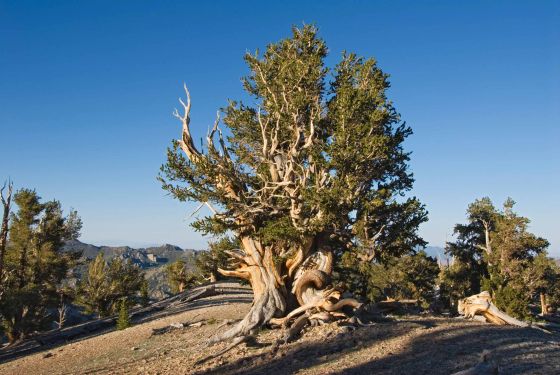
The world's oldest living trees, bristlecone pines each stand on their own pedestal of dolomite rock, high in the Californian mountains.
At Aeon Magazine, Ross Andersen writes: No event, however momentous, leaves an everlasting imprint on the world. Take the cosmic background radiation, the faint electromagnetic afterglow of the Big Bang. It hangs, reassuringly, in every corner of our skies, the firmest evidence we have for the giant explosion that created our universe. But it won’t be there forever. In a trillion years’ time it is going to slip beyond what astronomers call the cosmic light horizon, the outer edge of the observable universe. The universe’s expansion will have stretched its wavelength so wide that it will be undetectable to any observer, anywhere. Time will have erased its own beginning.
On Earth, the past is even quicker to vanish. To study geology is to be astonished at how hastily time reorders our planet’s surface, filling its craters, smoothing its mountains and covering its continents in seawater. Life is often the fastest to disintegrate in this constant churn of water and rock. The speed of biological decomposition ensures that only the most geologically fortunate of organisms freeze into stone and become fossils. The rest dissolve into sediment, leaving the thinnest of molecular traces behind.
Part of what separates humans from nature is our striving to preserve the past, but we too have proved adept at its erasure. It was humans, after all, who set fire to the ancient Library of Alexandria, whose hundreds of thousands of scrolls contained a sizable fraction of classical learning. The loss of knowledge at Alexandria was said to be so profound that it set Western civilisation back 1,000 years. Indeed, some have described the library’s burning as an event horizon, a boundary in time across which information cannot flow.
The burning of books and libraries has perhaps fallen out of fashion, but if you look closely, you will find its spirit survives in another distinctly human activity, one as old as civilisation itself: the destruction of forests. Trees and forests are repositories of time; to destroy them is to destroy an irreplaceable record of the Earth’s past. Over this past century of unprecendented deforestation, a tiny cadre of scientists has roamed the world’s remaining woodlands, searching for trees with long memories, trees that promise science a new window into antiquity. To find a tree’s memories, you have to look past its leaves and even its bark; you have to go deep into its trunk, where the chronicles of its long life lie, secreted away like a library’s lost scrolls. This spring, I journeyed to the high, dry mountains of California to visit an ancient forest, a place as dense with history as Alexandria. A place where the heat of a dangerous fire is starting to rise. [Continue reading…]

Americans are waking up to the reality of global warming
These are the highlights from a newly-released report from Yale’s Project on Climate Change Communication, “Americans’ Global Warming Beliefs and Attitudes in September 2012“:
- Americans’ belief in the reality of global warming has increased by 13 percentage points over the past two and a half years, from 57 percent in January 2010 to 70 percent in September 2012. At the same time, the number of Americans who say global warming is not happening has declined nearly by half, from 20 percent in January 2010 to only 12 percent today.
- For the first time since 2008, more than half of Americans (54%) believe global warming is caused mostly by human activities, an increase of 8 points since March 2012. Americans who say it is caused mostly by natural changes in the environment have declined to 30 percent (from 37% in March).
- A growing number of Americans believe global warming is already harming people both at home and abroad. Four in ten say people around the world are being harmed right now by climate change (40%, up 8 percentage points since March 2012), while 36 percent say global warming is currently harming people in the United States (up six points since March).
- In addition, they increasingly perceive global warming as a threat to themselves (42%, up 13 points since March 2012), their families (46%, up 13 points), and/or people in their communities (48%, up 14 points). Americans also perceive global warming as a growing threat to people in the United States (57%, up 11 points since March 2012), in other modern industrialized countries (57%, up 8 points since March), and in developing countries (64%, up 12 points since March).
- Today over half of Americans (58%) say they are “somewhat” or “very worried” – now at its highest level since November 2008.
- For the first time since 2008, Americans are more likely to believe most scientists agree that global warming is happening than believe there is widespread disagreement on the subject (44% versus 36%, respectively). This is an increase of 9 percentage points since March 2012.
If extreme weather becomes the norm, starvation awaits
George Monbiot writes: I believe we might have made a mistake: a mistake whose consequences, if I am right, would be hard to overstate. I think the forecasts for world food production could be entirely wrong. Food prices are rising again, partly because of the damage done to crops in the northern hemisphere by ferocious weather. In the US, Russia and Ukraine, grain crops were clobbered by remarkable droughts. In parts of northern Europe, such as the UK, they were pummelled by endless rain.
Even so, this is not, as a report in the Guardian claimed last week, “one of the worst global harvests in years”. It’s one of the best. World grain production last year was the highest on record; this year’s crop is just 2.6% smaller. The problem is that, thanks to the combination of a rising population and the immoral diversion of so much grain into animal feed and biofuels, a new record must be set every year. Though 2012’s is the third biggest global harvest in history (after 2011 and 2008), this is also a year of food deficit, in which we will consume 28m tonnes more grain than farmers produced. If 2013’s harvest does not establish a new world record, the poor are in serious trouble.
So the question of how climate change might alter food production could not be more significant. It is also extremely hard to resolve, and relies on such daunting instruments as “multinomial endogenous switching regression models“. The problem is that there are so many factors involved. Will extra rainfall be cancelled out by extra evaporation? Will the fertilising effect of carbon dioxide be more powerful than the heat damage it causes? To what extent will farmers be able to adapt? Will new varieties of crops keep up with the changing weather? [Continue reading…]
Video: Rising sea levels threaten U.S. coastline
The Arctic ice cap is melting — and with it goes our future

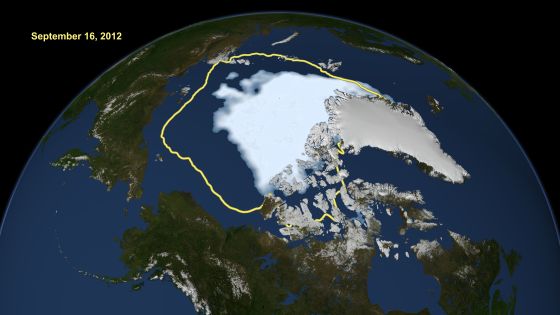
Satellite data reveal how the new record low Arctic sea ice extent, from Sept. 16, 2012, compares to the average minimum extent over the past 30 years (in yellow). NASA/Goddard Scientific Visualization Studio
In the Irish Times, John Gibbons writes: It is difficult to overstate the magnitude of what is currently unfolding in the Arctic region
THE TRUTH, as Winston Churchill put it, is incontrovertible. “Malice may attack it, ignorance may deride it, but in the end, there it is.” Scrape away the layers of denial, obfuscation and spin that cloud climate change and one unvarnished truth emerges: the Arctic ice cap is dying – and, with it, humanity’s best hopes for a prosperous, predictable future.
In the most dramatic reconfiguration of the map of the world since the end of the last Ice Age, the Arctic ice cap is now committed to accelerated collapse.
In 2007, the intergovernmental panel on climate change warned that, unless emissions were drastically curbed globally, the Arctic ocean could be clear of summer sea ice towards the end of this century.
They were hopelessly optimistic. On September 16th last, Arctic sea ice hit its lowest level ever recorded, at 3.41 million sq km, barely half the 1979-2000 average. The area of sea ice lost is 41 times larger than the island of Ireland. While the drop in sea ice extent is alarming, the 72 per cent decline in its volume is worse. Not only is ice cover shrinking, the surviving ice is thinning precipitously.
Prof Peter Wadhams of the Polar Ocean Physics Group described the September 2012 figures as a “global disaster”. He now projects the destruction of Arctic summer sea ice by 2015-16 – more than half a century ahead of the IPCC’s projections. “The final collapse towards that state is now happening and will probably be complete by those dates,” he added.
It is difficult to overstate the magnitude of what is now unfolding in the Arctic region. The Arctic ice cap used to cover 2 per cent of the Earth’s surface, and the ice albedo effect meant vast amounts of solar energy were bounced back into space from the bright white ice mass.
Losing this ice, and replacing it with dark open ocean, creates a dramatic tipping point in planetary energy balance. [Continue reading…]
100 million will die by 2030 if world fails to act on climate
Reuters reports: More than 100 million people will die and global economic growth will be cut by 3.2 percent of gross domestic product (GDP) by 2030 if the world fails to tackle climate change, a report commissioned by 20 governments said on Wednesday.
As global average temperatures rise due to greenhouse gas emissions, the effects on the planet, such as melting ice caps, extreme weather, drought and rising sea levels, will threaten populations and livelihoods, said the report conducted by humanitarian organisation DARA.
It calculated that five million deaths occur each year from air pollution, hunger and disease as a result of climate change and carbon-intensive economies, and that toll would likely rise to six million a year by 2030 if current patterns of fossil fuel use continue.
More than 90 percent of those deaths will occur in developing countries, said the report that calculated the human and economic impact of climate change on 184 countries in 2010 and 2030. It was commissioned by the Climate Vulnerable Forum, a partnership of 20 developing countries threatened by climate change.
Along with the Arctic ice, the rich world’s smugness will melt
George Monbiot writes: There are no comparisons to be made. This is not like war or plague or a stockmarket crash. We are ill-equipped, historically and psychologically, to understand it, which is one of the reasons why so many refuse to accept that it is happening.
What we are seeing, here and now, is the transformation of the atmospheric physics of this planet. Three weeks before the likely minimum, the melting of Arctic sea ice has already broken the record set in 2007. The daily rate of loss is now 50% higher than it was that year. The daily sense of loss – of the world we loved and knew – cannot be quantified so easily.
The Arctic has been warming roughly twice as quickly as the rest of the northern hemisphere. This is partly because climate breakdown there is self-perpetuating. As the ice melts, for example, exposing the darker sea beneath, heat that would previously have been reflected back into space is absorbed.
This great dissolution, of ice and certainties, is happening so much faster than most climate scientists predicted that one of them reports: “It feels as if everything I’ve learned has become obsolete.” In its last assessment, published in 2007, the Intergovernmental Panel on Climate Change noted that “in some projections, Arctic late-summer sea ice disappears almost entirely by the latter part of the 21st century”. These were the most extreme forecasts in the panel’s range. Some scientists now forecast that the disappearance of Arctic sea-ice in late summer could occur in this decade or the next.
As I’ve warned repeatedly, but to little effect, the IPCC’s assessments tend to be conservative. This is unsurprising when you see how many people have to approve them before they are published. There have been a few occasions – such as its estimate of the speed at which glaciers would be lost in the Himalayas – on which the panel has overstated the case. But it looks as if these will be greatly outnumbered by the occasions on which the panel has understated it. [Continue reading…]