Category Archives: Iran deal

Faltering Iran talks stoke fears of war

The Washington Post reports: The near-collapse of nuclear talks with Iran has ushered in what experts on Wednesday described as a dangerous new phase in the decade-long standoff over Tehran’s nuclear program.

A new round of sanctions is scheduled to take effect July 1, increasing the pressure on Iran’s faltering economy. At the same time, prominent Israeli and U.S. politicians are renewing calls for preparations for a military strike to halt Iran’s nuclear progress.

Iranian officials sounded fresh notes of defiance a day after talks concluded in Moscow, blaming Western countries for the lack of progress and insisting that no amount of pressure would persuade Iran to give up its right to a civilian nuclear energy program. The negotiations between Iran and the bloc of countries known as the P5-plus-1 ended late Tuesday with no agreement and no further substantive talks scheduled, other than technical consultations.

“There is not a one of us who is not aware how serious this is,” said a senior Obama administration official, reflecting on the failure to achieve any meaningful agreement with Tehran after three rounds of direct negotiations with Iranian officials since April.

While insisting that diplomatic efforts would continue, the official said the White House was “sober” in assessing the outcome of the Moscow talks, in which Iran was said to have balked at demands for freezing production of a type of enriched uranium that can be easily converted to fuel for nuclear weapons. The United States and its allies contend that Iran is using civilian facilities as a cover for developing a nuclear weapons capability, an assertion Iran denies.

The counterproposals from the Iranian side were “far from where the rest of us are,” leading to the decision to hold low-level technical consultations next month in Turkey so the sides can clarify their positions, said the official, who insisted on anonymity in describing the diplomatically sensitive negotiations.

The United States and other members of the six-nation bloc (the U.N. Security Council’s five permanent members and Germany) pushed hard in the final hours of the Moscow meeting to preserve at least an appearance of continuing negotiations, fearing that a complete failure would increase the likelihood of a military strike. But U.S. officials said they would not agree to open-ended talks that allow Iran to continue adding to its uranium stockpile. “This is not indefinite,” the administration official said.

Iran had sought relief from potentially crippling sanctions as a condition for any concessions on curbs to its nuclear program.

With diplomacy in tatters, Tehran faces the full brunt of a European Union oil embargo on July 1 and new U.S. sanctions targeting the country’s central bank.

Facebooktwittermail

Blame Israel and AIPAC for a U.S. war in Iran

Larry Derfner writes: I never went along with the argument that the Israel lobby, taking its directions from Jerusalem, pushed the United States to invade Iraq in 2003. Israel wanted the U.S. to knock over Saddam, of course, but it didn’t make a lot of noise about it, and neither did its Washington lobbyists because Israel and AIPAC knew they didn’t have to push against an open door. The Bush administration wanted to go to war against Saddam as soon as 9/11 happened, and while I’m sure the administration saw the benefit to Israel as one more reason to invade, that was never the main reason. The Bush team fought that war because of its misbegotten notion of America’s national security, and they would have fought it even if there had been no Israel lobby – even if there had been no Israel.

But Iran is different. Israel and AIPAC have been leading the charge on this one for years, and they’re hardly hiding it – the Israeli campaign for America to get tough, tougher, toughest on Iran has been as bombastic as could possibly be. If America ends up bombing Iran first (unlikely), or being drawn into a war as a result of Israel’s bombing Iran first (much more likely), that American war will be stamped “Made In Israel” – not by Walt and Mearsheimer, but by everyone with eyes and ears in his or her head.

This is new. For all the Israel lobby’s power over U.S. policy in the Middle East, it has never led the U.S. into a war the White House and Pentagon clearly did not want to fight. And that’s what’s happening, that’s what’s been happening for nearly four years – the Obama administration and U.S. military establishment don’t want to fight in Iran, and Israel and AIPAC have been dragging them toward it with all their might.

Again, this is unprecedented. And it is quite a responsibility for Israel and the American Jewish leadership to assume – one they don’t want to face, though, because if they did, they might have to restrain their war-mongering, and for the AIPAC crowd, war-mongering on Israel’s behalf is just too much fun. But here’s the deal: If Israel hits Iran and Iran hits back at American targets and draws the U.S. into a war, and that war doesn’t go well for the U.S. – if American troops start getting killed, if the U.S. economy suffers, if the U.S. finds itself stuck in a war it doesn’t want and doesn’t know how to get out of – then not only Israel, but American Jews, too, are likely to be blamed by the U.S. public at large.

And for the first time in history, blaming the Jews for getting America into a war would not be anti-Semitic lunacy, it would be a logical reaction. I want to stress here that blaming American Jews in general for “wagging the dog” would be totally wrong and unfair – most of them are liberal doves. However, blaming AIPAC, the rest of the Israel lobby and, above all, Israel for wagging the dog would be like adding two and two.

For some Israelis, the risk of American Jews ending up getting blamed for a war against Iran might look less like a risk than potentially part of the upside. From this vantage point a backlash against Jews would not demonstrate the recklessness of the Israel lobby; it would demonstrate the recklessness of belonging to the diaspora and the necessity of “returning” to Israel. The irony is that the ranks of the lobby are filled with Jews whose choice is to love Israel from afar. For those for whom home is really New York or Miami, such a return would in truth be a form of exile.

Facebooktwittermail

We can’t crush Iran

Jordan Michael Smith reports: This month’s Vanity Fair has a feature on Israeli leader Benjamin Netanyahu. “An Israeli strike against Tehran’s nuclear facilities gone awry may pose the single greatest peril to his political future, which may be the biggest guarantee — more than American opposition to any move or the effectiveness of sanctions — that it won’t happen,” the article reads. Indeed, gradually and without fanfare, the possibility of a military strike against Iran, which only a few months ago seemed imminent, has lately receded from view. It seems that perhaps the U.S. and Israel came to their senses and realized that an attack on Iran would be disastrous.

The turning tide against a military strike is underscored by three new reports on the problems of an attack. Taken together, they suggest that significant parts of the U.S. establishment are pushing back against the notion that, in senior Romney adviser John Bolton’s words, “There is no doubt that Washington could shatter Iran’s nuclear program,” and that “Iran’s real options, post-attack,” would be “limited.”

First on the table is a monograph from the staunchly pro-Israel think tank the Washington Institute on Near East Policy. The report is called “Beyond Worst-Case Analysis,” suggesting that it intends to avoid what it calls “apocalyptic” conclusions about an attack on Iran. And yet, as former CIA analyst Paul Pillar notes, the paper’s ideas suggest that the “consequences would be very bad indeed.” The report’s authors, Michael Eisenstadt and Michael Knights, write that Iran would “respond in a way that deters additional Israeli strikes and U.S. intervention.” They suggest Iran would strike against any attacking country, which even if it is meant to be “limited” could easily escalate into a full-blown regional conflict. Iran would want to make retaliation as “painful as possible” for Israel, employing direct and indirect measures.

It would use Hezbollah and other proxies to sabotage petrochemical infrastructure in the Gulf, and attack “commercial ships or elements of the U.S. Fifth fleet in the area.” In other words, it would attack the United States military. Iran also “would likely respond almost immediately with missile strikes on Israel, to punish it and deter follow-on strikes.” The Persian nation would attack Israeli military and civilian population centers with its hundreds of long-range conventional missiles. Hezbollah could launch thousands of rockets from Lebanon, and attacks could be forthcoming from Hamas, Islamic Jihad and even beleaguered Syria. Israeli or Jewish targets around the world would not be immune. The list goes on: terrorism against U.S. targets on several continents, attacks on U.S. personnel in Iraq and Afghanistan, kidnapping American citizens, strikes against neighboring countries, harassment of U.S. vessels in the Strait of Hormuz and a revitalization of the popularity of the Iranian government. And all of this, according to the report, is far from a worst-case scenario. [Continue reading…]

Facebooktwittermail

Obama’s drift toward war with Iran

Robert Wright writes: The most undercovered story in Washington is how President Obama, under the influence of election-year politics, is letting America drift toward war with Iran. This story is the unseen but ominous backdrop to next week’s Moscow round of negotiations with Iran over its nuclear program.

The basic story line, pretty well known inside the beltway, is simple: There are things Obama could do to greatly increase the chances of a negotiated solution to the Iranian nuclear problem, but he seems to have decided that doing them would bring political blowback that would reduce his chances of re-election.

The good news is that Obama’s calculation may be wrong. The blowback he fears–largely from Bibi Netanyahu, AIPAC, and other “pro-Israel” voices–is probably less forbidding than he assumes. And the political upside of successful statesmanship may be greater than he realizes.

But suppose Obama’s right about the politics. It’s still a little scandalous that he’s imperiling peace and America’s security in order to increase his chances of re-election by 1.5 percent, or whatever the imagined number is. And it’s even more scandalous how unscandalous this is, how people throughout the Washington establishment–in government, in NGOs, in journalism–are so inured to the corruption of policy by politics that almost nobody bothers to complain about it even when it could lead to war. [Continue reading…]

Facebooktwittermail

Respect is crucial in nuclear talks with Iran

Hossein Mousavian and Mohammad Ali Shabani write: After a decade, we are nearing an endgame on Iran’s nuclear file. The initial positive atmosphere during Tehran’s talks with the P5+1 (the five members of the UN security council plus Germany) in Istanbul in April had been lost by the next round of talks in Baghdad, in May.

In Istanbul all the players seemed to understand that the most important issue was trust – not the number of centrifuges in the Islamic republic’s possession. This was displayed through the announcement of EU foreign policy chief, Catherine Ashton, that negotiations would be held on the basis of the nuclear non-proliferation treaty (NPT, which recognises Iran’s right to enrich uranium for peaceful purposes). Such mutual respect must be the basis of any dialogue, and future agreement.

Yet in Baghdad it became obvious there was a long road ahead when the P5+1 went in demanding the maximum concessions from Iran, in return for making minimal concessions themselves. The Iranian negotiators were offered merely spare parts for passenger planes and help with acquiring a light water reactor. In exchange the P5+1 wanted Iran to stop enriching uranium to 19.75% (medium enriched uranium), export all such material, halt operations at the Fordo plant and allow IAEA inspectors to visit sensitive military sites.

This trade-off was considered an insult by the Iranians. And the P5+1’s incentive of fuel plates (uranium enriched to 19.75% moulded into plates) or the Tehran research reactor – which could have been attractive to Iran as recently as 2010, when it hadn’t mastered the technology to manufacture such fuel on its own – didn’t improve the mood. Luckily, this did not lead to the dialogue collapsing. [Continue reading…]

Facebooktwittermail

Tehran’s views on U.S. politics, nuclear talks

Mehdi Khaliji writes: Iran’s ruling regime pays close attention to American politics in its own calculations about how to negotiate with Washington—and how to game the new diplomatic effort. Supreme Leader Ayatollah Ali Khamenei and his inner circle, for example, believe that President Barack Obama needs to talk to Iran, but they also sense that the U.S. president will be unable to make any concessions because it might endanger his reelection bid.

So Tehran has concluded that Obama needs to prolong the talks and achieve minor goals to demonstrate that talks are making progress.

The regime also believes that reaching an agreement with Washington before the presidential election will be futile, since a new administration could change U.S. discourse and any agreement that is reached before the election.

As a result, the regime has concluded that both sides will benefit in delaying any substantive agreement until after the U.S. elections in November.

In the meantime, Khamenei continues to believe that neither the United States nor Israel is willing to attack Iranian nuclear facilities, at least before the U.S. election. So rather than seek a solution to the standoff, Iran’s short-term goal is to decrease diplomatic pressure, or at least prevent new sanctions before the election.

Historically, the Islamic Republic has viewed Republican presidents more favorably than Democratic ones. In 2008, nuclear negotiator Hassan Rowhani said publically that Iran would prefer that a Republican win the presidential election because Democrats incessantly pressured Tehran. In trying to game diplomatic talks in its favor, Iran could even employ the nuclear issue to influence the U.S. presidential election—in an attempt to replicate the impact of the 1979-1981 hostage crisis. President Jimmy Carter’s inability to resolve that crisis contributed to Ronald Reagan’s victory. [Continue reading…]

Facebooktwittermail

Iran nuclear talks succeed just by continuing

Daniel Levy writes: The economic and political news out of Europe may be grim, but on the diplomatic front Europe is leading what may be the most consequential negotiations of 2012 – the so-called E3+3 talks with Iran. Those talks are being managed by the EU foreign policy chief, Catherine Ashton, and shepherded by the European External Action Service’s trouble-shooter, Helga Schmid.

Accounts from all sides suggest that Ashton and Schmid are making rather a good fist of it – the Iranians are still at the table (with a third round of talks scheduled for Moscow in mid-June) – and that the countries participating have remained sufficiently united to avoid descending into mutual recriminations. No easy task given how high the stakes are, the history of failed talks, the tensions within participants and the curveballs that Israel, the US Congress and Iran itself have a habit of throwing.

That’s all good and dandy, but the Europeans may soon have to make a decisive call on substance rather than management. What does Europe want out of these talks? At the Pollyanna-ish end of the spectrum would be a definitive, implementable and sustainable deal laying to rest nuclear suspicions towards Iran and opening a door to western-Iranian co-operation across a range of issues (think Afghanistan, Horn of Africa security, and possibly Syria and Iraq; but even Pollyanna might balk at co-operation on Israel/Palestine or democracy promotion). While the contours for such a deal exist (variations on Iran’s right to enrich being recognised, being limited and being verified), the political realities in 2012 – notably in the US and Iran – decisively undermine this prospect.

The opposite end of that scale would see talks as intended to expose Iranian malfeasance, helping to maintain international commonality of purpose as sanctions are ratcheted up further. If the ultimate goal is regime change induced by economic strangulation or Iranian capitulation (as opposed to negotiated compromise), or even to provoke Iran as a justification for military intervention, then this makes sense. Yet it is hard to view this as being the desired European outcome.

Which brings us to what is desirable and achievable in 2012. The best, realistic prognosis for these talks is that they deliver a partial enrichment freeze in return for partial sanctions relief. Short of that, the goal is more talks – improving mutual understanding for when there is greater political room for compromise – in Iran, the US or both. Crucially, military action is averted. [Continue reading…]

Facebooktwittermail

MEK: Terrorists? Us?

Owen Bennett-Jones writes: The story of the People’s Mujahedin of Iran, also known as the Mujahedin e Khalq (MEK), is all about the way image management can enable a diehard enemy to become a cherished ally. The MEK is currently campaigning to be officially delisted in the US as a terrorist organisation. Once off the list it will be free to make use of its support on Capitol Hill in order to become America’s most favoured, and no doubt best funded, Iranian opposition group.

The last outfit to achieve something similar was the Iraqi National Congress, the lobby group led by Ahmed Chalabi that talked of democracy and paved the way for the US invasion of Iraq by presenting Washington with highly questionable ‘evidence’ of weapons of mass destruction and Saddam Hussein’s links with al-Qaida. Then, as George Bush took the US to war, all that remained for the INC and its leaders was to sit back and prepare for government. Many in Washington believe that, for better or worse, the US will go to war with Iran and that the MEK will have a role to play. But first they will have to persuade Hillary Clinton to take the group off the US’s official terrorist list. Some of Clinton’s officials are urging her to keep the MEK on it but some of the big beasts in Washington are angrily demanding that she delist. After an exhaustive inter-agency process the MEK file is now in her in-tray. Recent State Department statements indicate that she is likely to delist the group.

Formed in the 1960s as an anti-imperialist, Islamist organisation with socialist leanings, dedicated to the overthrow of the shah, the MEK originally stood not only for Islamic revolution but also for such causes as women’s rights – an appealing combination on Iran’s university campuses. It went on to build a genuine popular base and played a significant role in overthrowing the shah in 1979. It was popular enough for Ayatollah Khomeini to feel he had to destroy it; throughout the 1980s he instigated show trials and public executions of its members. The MEK retaliated with attacks on senior clerical leaders inside Iran.

Fearing for their lives, MEK members fled first to Paris and later to Iraq, where Saddam Hussein, desperate for allies in the war with Iran, provided them with millions of dollars of funding as well as tanks, artillery pieces and other weapons. He also made land available to them. Camp Ashraf became their home, a citadel in the desert, 80 kilometres north of Baghdad and an hour’s drive from the Iranian border. Since the 1970s, the MEK’s rhetoric has changed from Islamist to secular, from socialist to capitalist, from pro-revolution to anti-revolution. And since Saddam’s fall it has portrayed itself as pro-American, peaceful and dedicated to democracy and human rights. Continual reinvention can be dangerous, however, and the new, pro-Iranian Iraqi government is under pressure from Tehran to close down Camp Ashraf, which has grown over three decades to the size of a small town. And it’s not just Iran. Many Iraqis too bear grudges against the MEK, not only for having worked alongside Saddam Hussein but also for having taken part in his violent suppression of the Kurds and Shias. [Continue reading…]

Facebooktwittermail

Iran nuke talks: Don’t blow it

John Tirman writes: The news from Baghdad is good. The nuclear talks between Iran and the so-called P5+1 countries paused somewhat amicably, with signs of progress and a schedule to meet in a month in Moscow. The question is, as always, how many ways can this progress be derailed?

Details of what transpired in Baghdad will leak out over the coming days, but chief negotiator Catherine Ashton’s official statement at the end of talks Thursday made it clear that both sides regard the negotiations as promising and will return to the bargaining table very quickly.

The U.S. and its negotiating partners (China, Russia, U.K., France, and Germany) seek to rein in Iran’s enrichment program, by which uranium is brought closer to weapons grade. Iran’s position is to link any concessions on enrichment to the lifting of U.N. and U.S. sanctions, which have become very damaging to Iran’s economy. There are many more details, of course, but that is the essence of any deal.

Critics of the talks, which include Mitt Romney and Benjamin Netanyahu, insist that Iran is only delaying to build a nuclear weapon, but that old dog won’t hunt. Negotiations on complex technical issues, where suspicion and national pride are in play, take some time. There are reasonable proposals on the table, and an agreement could be within reach.

The question is, who will try to be the spoiler? Israel is the top candidate for that role. It uses the Iran issue for domestic politics and to manipulate the United States. It distracts from their 45-year occupation of Palestine and their unwillingness to negotiate for a Palestinian state. Fortunately, a number of high-level Israelis have decried Netanyahu’s Iran gambit. And Israel does not have the military prowess to eliminate Iran’s nuclear program by its oft-repeated threat to bomb.

Often forgotten in the hoopla about Iran’s program is that U.S. intelligence agencies have declared twice, in 2007 under President Bush and again 12 weeks ago, that Iran does not have a nuclear-weapons program. Israel, by contrast, is said to have as many as 200 nuclear weapons. India and Pakistan’s move to nuclear-weapons status in the 1990s was punished with a slap on the wrist compared with Iran’s non-program.

Even more vexing is that the Nuclear Non-Proliferation Treaty (NPT) obligates all nuclear powers to move toward disarmament, a legal obligation that the five nuclear powers represented in the Iran negotiations (all but Germany) have quite obviously ignored. (There is an even more taboo topic, however — which is what would happen if Iran did get a bomb or two or three, which is almost certainly not much at all; they would be completely deterred by the U.S. and Israel from ever using them. But as my friend Hugh Gusterson has argued, we are in the grip of “nuclear orientalism,” imputing to Iranians a savagery and irrationality that is baseless but convenient.) [Continue reading…]

Facebooktwittermail

How to strike a deal with Iran

Stephen Walt writes: Will the U.S. and the rest of the P5+1 manage to turn a potential diplomatic breakthrough with Iran into another counterproductive failure? It’s too soon to tell, but betting on failure has been the smart wager in the past.

The Baghdad talks between Iran and the P5+1 apparently got a lot of serious issues on the table, but didn’t achieve a breakthrough, let alone an agreement. The main reason is the hardline position adopted by the United States and its partners, and especially our refusal to grant any sort of sanctions relief. The parties will resume discussions in Moscow in June.

From a purely strategic point of view, this situation is pretty simple. Iran is not going to give up its right to enrich uranium. Period. If the West insists on a full suspension, there won’t be a deal. It’s that simple. At the same time, the U.S. and the rest of the P5+1 would like to maximize the amount of time it would take Iran to “break out” and assemble a weapon. The best way to do that is to limit Iran’s stockpile of enriched uranium to concentrations of less than 5 percent. If Iran insists on keeping a large supply of 20 percent enriched uranium on hand, we’ll walk too.

So there you have the outline of the deal–we accept low-level enrichment and lift sanctions, and Iran gives up the 20% stuff–although there are other details what will have to be worked out too. Frankly, given where we are today, it’s surprising the U.S. isn’t grabbing that deal with both hands. Why? Because unless the U.S. is willing to invade and occupy Iran (and we aren’t) or unless we are willing to bomb its facilities over and over (i.e., every time Iran rebuilds them), there is no way to prevent Iran from having the potential to obtain nuclear weapons if it decides it wants to. They know how to build centrifuges, folks, and the rest of the technology isn’t that hard to master. So the potential is there, and there’s no realistic way to eliminate it.

The smart strategy, therefore, is to keep them as far away from the bomb as possible, and to reduce Iran’s incentive to go all the way to an actual weapon. And the best way to do that — duh! — is to take the threat of military force off the table and to stop babbling about the need for regime change.

Facebooktwittermail

Did Iran kill one of its own nuclear scientists?

ABC News reports: Iranian dissidents have long suspected that the country’s Islamist regime has used the cover of its not-so-covert war with Israel to crack down on internal opponents, and that a leading Iranian nuclear scientist whose death was blamed on Mossad might really have been killed by his own government.

Now a prominent opposition blogger based in London says that discrepancies in the recent trial and execution of the “Israeli spy” officially charged with killing scientist Masoud Ali Mohammadi are yet more evidence that Iranian intelligence agents may have been the real assassins.

Mohammadi, a nuclear physicist, died in January 2010 when a motorcycle parked outside his house was detonated by remote control when he walked past.

A half dozen scientists and officials linked to the nation’s nuclear and long-range missile programs have died under suspicious circumstances since 2010, deaths the Iranian regime usually blames on Israel, the U.S., and the U.K. When Mohammadi died, the regime immediately blamed his murder on a “triangle of wickedness,” meaning the U.S., Israel and their “hired agents.”

“Zionists did it,” said President Mahmoud Ahmadinejad. “They hate us and they don’t want us to progress.” Ali Larjani, chairman of the Iranian parliament, said the government had “clear information that the intelligence regime of the Zionist regime and the CIA wanted to implement terrorist acts.”

But Western intelligence agencies had conflicting information about whether Mohammadi, a particle physicist, was really contributing to the nuclear program. Iranian dissidents, meanwhile, said Mohammadi had been killed by the regime because he was a supporter of reformist candidate Mir Hossein Mousavi, whom many believe actually won the 2009 Iranian presidential election before vote-tampering handed the victory to Ahmadinejad. A German-based opposition group released a photo of an alleged Arab hitman who had supposedly carried out Mohammadi’s assassination on regime orders.

At Mohammadi’s funeral, hundreds of regime loyalists waving anti-Israel banners packed the procession, where they clashed with supporters of Mousavi’s Green Movement.

More than two years later, on May 15, 2012, the Iranian government executed 24-year-old Majid Jamali Fashi, who had been convicted of assassinating Mohammadi.

Iranian authorities claimed that Fashi, 24, was recruited and trained by Mossad and was paid $120,000 to kill Mohammadi. In January 2011, Iranian media had broadcast Fashi’s confession, in which he said he “received different training including chasing, running, counter-chasing and techniques for planting bombs in a car” while in Tel Aviv. Fashi also confessed to receiving forged travel documents in Azerbaijan to travel to Israel, Iran’s Press TV reported.

A report which refers to Iran’s “not-so-covert war with Israel” stumbles at the gate. Can the reporter possibly not know that he got that back to front? It could just be standard mainstream sloppy journalism. Really, most of the content of this article is recycled news — the one new element comes not from ABC’s own reporting but from the London-based Iranian dissident Potkin Azarmehr in this post.

Azarmehr points to two rather glaring discrepancies in the fake Israeli passport that the Iranian hitman, Jamali Fashi, was supposedly provided by Mossad. The photo of Jamali would have been taken before the passport was issued in 2003 at which time Jamali would only have been 15, but he appears older. Also, he is not posing in the standard face-forward position used universally for passport photos. But then commenters on Azarmehr’s blog noticed an even more glaring problem: the passport contains exactly the same information as can be found on an image of an Israeli passport appearing on Wikipedia.

What others have not noted is perhaps the most basic problem with Jamali’s Israeli passport: it shows no name nor birth year!

Whatever Mossad is or is not capable of doing, I have no doubt that they could provide an agent with a flawless passport. (As for why they would be handing out such passports is a question I’ll come back to in a moment.)

So, whoever made Jamali’s Israeli passport it seems they were more likely serving the Iranian rather than the Israeli government and their objective was not to construct a physical document that could be shown to an immigration official but instead a document that could appear on TV. For that purpose, Wikipedia might have appeared to provide enough information.

Even so, the passport-maker seems to have been singularly lacking in imagination. Where Wikipedia redacted personally identifying information from an image of what is obviously a real Israeli passport, in the fake passport, instead of filling in the gaps the passport-maker just left these spaces blank — hence no surname or given name.

However, there was one blank he had to fill: the photo — and here’s where he seems to have been inspired by a creative impulse. How should Jamali pose? Just like another Israeli spy, Jonathan Pollard. Perhaps Israel has a special format it reserves for passports issued to spies, the counterfeiter thought.
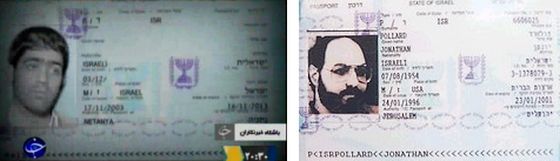
OK. Enough of this blogger’s attention to detail.

There is a more basic question: why in heaven’s name would Mossad give an Iranian agent an Israeli passport? An Israeli passport is like the kiss of death and thus Mossad goes to great lengths to disguise the Israeli identity of its own operatives. So while the Israelis move around under assumed non-Israeli identity, they give their Iranian assassin an Israeli passport as though they wanted to pin a target on his back?

There is of course the much more obvious explanation: the Jamali-Mossad story was a dumb Iranian plot designed to cover up their own assassination of one of their own nuclear scientists.

But why is this story emerging now? Jamali’s confession was used by Iranian authorities to demonstrate that the dissident People’s Mujahedin of Iran or MEK have been collaborating with Israel in conducting assassinations inside Iran. The MEK, designated a terrorist organization by the U.S. government, is attempting to get this label removed. For that purpose there’s little doubt that the Jamali story, as it is now being retold, could serve as a useful element in the MEK’s PR campaign.

There is also another question: does this story have some relevance to the current negotiations between Iran and the P5 Plus One? Perhaps.

Can a government that’s willing to assassinate its own nuclear scientists operate a viable nuclear program whether that be for peaceful or military purpose?

As Jacques E.C. Hymans has noted, authoritarian governance and the challenges of scientific development do not work well together. Fear shackles creativity. That Iran’s nuclear program has advanced at a snail’s pace might not simply be a reflection of caution among Iran’s leaders but rather that the scientific community upon whose efforts progress depends has become so risk-averse that they are incapable of moving any faster. For those who fear the creation of an Iranian bomb, probably the smartest thing to do would be to do nothing.

Facebooktwittermail

Breakdown or breakthrough? Iran nuclear talks hit a snag

Tony Karon writes: Nobody was expecting a breakthrough at Wednesday’s nuclear talks in Baghdad, but most weren’t expecting a breakdown, either. Indeed, predictions were that Iran and the P5+1 (the U.S., Britain, France, Germany, Russia and China) would engage on more detailed proposals for concrete, reciprocal confidence building measures, and then adjourn by day’s end having scheduled a new round of talks in a few weeks. But in what may be an exercise in brinkmanship, or a sign of an impending crisis, Iranian officials balked at the offer from the Western powers. ”The points of agreement are not yet sufficient for another round,” an anonymous Iranian official at the talks told AFP.

Iran’s state media, whose upbeat spin on the talks in recent weeks had many analysts concluding that Tehran was preparing its public for a deal, slammed what it called the “outdated” and “unbalanced” proposals by the Western powers in Baghdad. At Iranian insistence, Thursday will see a second day of talks in Baghdad, and the parties remained locked in negotiations until midnight. That looked like a tactic to create a mini crisis on the key sticking point in the talks: the question of whether Iran will be granted any relief from escalating Western sanctions if it agrees to the immediate confidence-building steps demanded by the P5+1. [Continue reading…]

Facebooktwittermail

Long-term uncertainty remains in nuclear talks with Iran

Tony Karon writes: Anyone banking on a big-win breakthrough in Wednesday’s nuclear talks with Iran will likely find themselves in the same boat as investors who bet on an instant surge in the Facebook stock price last week. If there’s value to be found in nuclear negotiations with Iran, then — like an investment in Facebook — it’s likely to emerge over time. And in both cases, even the long-term outcome remains uncertain.

After weeks of upbeat assessments, Western officials seemed to tamp down expectations ahead of the meeting that got underway in Baghdad on Wednesday. “If we talk substantively on elements of a deal and agree to meet again in three weeks, Baghdad will have been a success,” a senior U.S. official told al-Monitor on Monday. The spin ahead of the talks in recent weeks has been positive — almost too positive for diplomats, who naturally prefer diminished expectations. At home, Iran’s leaders are proclaiming a great victory in the willingness of Western powers to negotiate while Iran continues to enrich uranium, suggesting that they’re preparing their public for a compromised deal that will be sold as a great victory. The Western narrative paints Iran’s willingness to negotiate as a consequence of ever tightening economic sanctions, implying that such pressure must be maintained to curb its nuclear ambitions.

There are some positive signs: Sunday’s talks in Tehran between IAEA chief Yukiya Amano and Iran’s nuclear negotiator Saeed Jalili appear to have yielded an in-principle agreement, not yet inked or finalized, to expand the nuclear-watchdog agency’s access to sensitive sites in Iran. Amano, who has taken a tough line in dealing with Iran, was upbeat, expecting a signed agreement “quite soon.” But the IAEA talks are the undercard to the negotiations between Iran and the P5+1 (the U.S., France, Britain, Germany, Russia and China). Even if they improve the atmosphere for the Baghdad meeting, a breakdown between Iran and the P5+1 would likely imperil any progress made by the IAEA.

Facebooktwittermail
