Category Archives: Iran deal

NEWS: Ahmadinejad, the flinty populist

Ahmadinejad hailed in Middle East

Iranian President Mahmoud Ahmadinejad, a flinty populist in a zip-up jacket whose scathing rhetoric and defiance of Washington are often caricatured in the Western media, has transcended national and religious divides to become a folk hero across the Middle East.

The diminutive, at times inscrutable, president is a wellspring of stinging sound-bites and swagger for Muslims who complain that their leaders are too beholden to or frightened of the Bush administration. Ahmadinejad, who arrived in New York Sunday ahead of a U.N. General Assembly meeting, is an easily marketable commodity:a streetwise politician with nuclear ambitions and an open microphone.

“I like him a lot,” said Mahmoud Ali, a medical student in Cairo. “He’s trying to protect himself and his nation from the dangers around him. He makes me feel proud. He’s a symbol of Islam. He seems the only person capable of taking a stand against Israel and the West. Unfortunately, Egypt has gotten too comfortable with Washington.” [complete article]

See also, 60 Minutes interview with President Ahmadinejad (CBS video) and Iran’s Ahmadinejad: No attack on Israel (AP interview).

Facebooktwittermail

NEWS: Brzezinski warns about risk of war

Brzezinski: U.S. in danger of “stampeding” to war with Iran

Former national security adviser Zbigniew Brzezinski likened U.S. officials’ saber rattling about Iran’s alleged nuclear ambitions to similar statements made before the start of the Iraq war.

“I think the administration, the president and the vice president particularly, are trying to hype the atmosphere, and that is reminiscent of what preceded the war in Iraq,” Brzezinski told CNN’s “Late Edition” on Sunday. [complete article]

Facebooktwittermail

NEWS & EDITOR’S COMMENT: Israel’s success story

Israeli air strike did not hit nuclear facility, intelligence officials say

Israel did not strike a nuclear weapons facility in Syria on Sept. 6, instead striking a cache of North Korean missiles, current and former intelligence officials say.

American intelligence sources familiar with key events leading up to the Israeli air raid tell RAW STORY that what the Syrians actually had were North Korean No-Dong missiles, possibly located at a site in either the city of Musalmiya in the northern part of Syria or further south around the city of Hama.

While reports have alleged the US provided intelligence to Israel or that Israel shared their intelligence with the US, sources interviewed for this article believe that neither is accurate. [complete article]

Editor’s Comment — If an explanation for the purpose of the Israeli attack could be derived from understanding the nature of the target, by this point I think that the veil of secrecy would have been lifted. The fact that it hasn’t may have more to do with how little rather than how much the veil conceals. Indeed, it suggests that the physical target in Syria may well have had much less to do with Israel’s political objectives than has been assumed.

As former Clinton administration Middle-East envoy, Dennis Ross notes:

Statecraft involves using all the tools of the state to affect the behavior of friends and foes alike. Israel’s raid against the Syrian plant reflects the use of a military instrument applied quite selectively to affect the psychologies of many different actors on the world stage. Whether it will have the affect [sic] the Israelis desire remains to be seen. But for now, the Israelis have made a statement without triggering a wider conflict in the process.

The statement seems to be: Israel can conduct a regional military operation at a time and place of its choosing and suffer no adverse consequences. As if to underline this sense of impunity, Israel announced today that it welcomes the US’s oblique invitation for Syria to join the upcoming Mideast peace conference. (How comforted Bashar al-Assad must feel, knowing that Olmert harbors no lingering hostility!)

As Ross points out, “had Israel taken credit for the raid, Arab states would have felt duty-bound to condemn it, Israel’s resort to force, and its unilateral effort to impose its will once again.” Not only that, but skepticism about the conference might then likely have led to non-cooperation.

But the message of Israel’s success — success deriving from what didn’t happen — also resonated clearly in Washington where:

…administration hawks had closely studied the international fallout from Israel’s clandestine raid on Syria… as a guide to how military action against Iran would be received.

“Their attitude is: where was the fuss? Some of them think they would get away with it in Iran,” the source said.

As for what conclusions Syria and Iran draw from this episode, neither the Israelis nor Americans seem to care — for as long, that is, that they can continue to spin their success story.

Facebooktwittermail

EDITORIAL: Why the nuclear story isn’t nuclear

Why the nuclear story isn’t nuclear

“Israelis seized nuclear material in Syrian raid,” blares the headline in The Sunday Times. After two weeks of furious speculation about the purpose and significance of Israel’s September 6 attack on a target in eastern Syria, we finally know that this really was something really big that went down: it was nuclear! The Syrians had “nuclear materials” that have been traced to North Korea. Except… “nuclear materials” turns out to be a headline (and first paragraph) paraphrase. “Nuclear materials” turns out to be short for “nuclear-related” material — almost certainly no fissile material, nor even anything radioactive. And no one has forgotten that the most famous example of nuclear-related material turned out to be no such thing. Continue reading

Facebooktwittermail

EDITORIAL: Deconstructing the neocon nuclear narrative

Deconstructing the neocon nuclear narrative

Why can the neocons never get their story straight?

Because they’ve figured out the ending but they’re still working on the plot.

The end is the end of the Islamic State of Iran, but the first draft of the narrative that was supposed to lead there — through Baghdad — took a major detour, providing Iran with the opportunity to become more powerful than ever.

Even so, a few lessons have been learned from the atrociously written Iraq story.

Don’t talk about “WMD,” is one such lesson. The only weapons worth talking about (as frequently as possible) are nuclear. Fortunately (if you’re a neocon) the press continues to be as obliging as ever in repeating whatever you say. Continue reading

Facebooktwittermail

OPINION: The face of American extremism

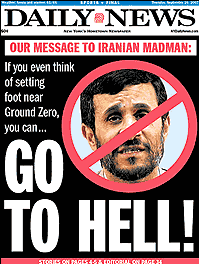
Iranophobia hits Ground Zero

ahmadinejad-nydailynews1.gif…the US media have once again fallen victim to an orchestration of “enemy image” that aims to vilify, intimidate, deface and demonize a Middle Eastern leader who, ironically, has been unusually forthcoming in his expressions of warm feelings toward the American people (though not the US government and its policies).

Never mind that Ahmadinejad has released a few Iranian-Americans who were suspected of instigating a “velvet revolution”, or that he has broken the ice of diplomatic non-dialogue with the US by consenting to direct meetings between Iranian and US ambassadors in Iraq, or that he has made the most far-reaching Iranian cooperation with the International Atomic Energy Agency (IAEA) to date.

None of this matters the least to frenzied pundits and politicians who want to cash in on the feverish anti-Iran mood in the US, whose government has done nothing to quell this Iranophobic frenzy and, instead, is fanning the flames by escalating accusations against Tehran. [complete article]

Editor’s Comment — Televised images of street protests in Pakistan where effigies of George Bush are being burned and the US flag is being trampled on are standard fare when it comes to representations of anti-American Islamic extremism. The New York Daily News presents nothing less than a mirror image — our own xenophobic extremism.

Facebooktwittermail

NEWS: U.S. builds up pressure on Iran; Bolton backs Israeli strike; ElBaradei’s inconvenient deal

U.S. ramps up pressure on Iran

One year after the United States launched an intensified global economic campaign against Iran with the stated aim of halting Tehran’s nuclear work, the Bush administration is counting its successes — and calling for still more pressure.

In recent months, once-reluctant European countries have joined the effort, which some are calling a financial war, with more vigor.

Germany’s largest bank, Deutsche Bank AG, said recently that it would stop doing business in Iran. France has trimmed export credits that encourage business in Iran and advised French firms, including the oil and gas giant Total S.A., not to start new investments there. Even Japan, heavily dependent on Persian Gulf oil, has pulled back from energy projects in Iran. [complete article]

Bolton: US would support preemptive Israeli strike on Iran

President Bush’s former United Nations ambassador John Bolton said the United States would stand behind a pre-emptive strike by Israel against countries developing “WMD facilities.”

In his remark, printed in Tuesday’s edition of the Israeli daily Yediot Achronot, Bolton directly referenced Iran.

“The greatest concern is to prevent Iran and other countries in the region from acquiring nuclear weapons,” Bolton said, according to JTA.org, a Jewish news service. “We’re talking about a clear message to Iran — Israel has the right to self-defense –and that includes offensive operations against WMD facilities that pose a threat to Israel. The United States would justify such attacks.” [complete article]

Iran’s pact threatens to wrongfoot the West

Diplomats from the permanent five members of the United Nations Security Council and from Germany are to discuss Iran tomorrow, amid disagreement over whether to impose a new round of UN sanctions.

Although the US, UK and France are determined to renew pressure on Iran to suspend its uranium enrichment programme, this new drive in Washington for UN sanctions is unlikely to get far, as it will be blocked by Russia and China.

At the heart of the dispute is an accord between Iran and Mohamed ElBaradei, head of the International Atomic Energy Agency – the UN nuclear watchdog. [complete article]

Facebooktwittermail

NEWS: Iran will retaliate against attack

In case of war, Iran has plans for airstrikes on Israel, general says

A senior Iranian military official said today that his country had drawn up plans to launch airstrikes against Israel in case of war between the two countries, according to an interview published by an Iranian news agency.

Gen. Mohammed Alavi, a deputy commander in the Iranian air force, told the semi-official Fars News Agency that his country could attack Israel with long-range missiles as well as fighter planes in case of war between the two countries.

Israeli and U.S. officials have threatened the possibility of preemptive attacks on Iran to block it from obtaining advanced nuclear technology that could be used to build atomic weapons. Iran insists its nuclear program is meant to augment civilian energy needs.

Military analysts say Iran could retaliate against any U.S. or Israeli air raids by hitting targets in the Persian Gulf, disrupting oil flows or launching attacks on U.S. forces in Iraq or Afghanistan. [complete article]

Editor’s Comment — When for weeks the Bush administration has been doing nothing to dampen speculation that Iran has been targeted for bombing, and after Israel’s recent mysterious attack on facilities in eastern Syria, it is completely disingenuous for the White House to claim that Iran’s comments on retaliation were “totally unprovoked.”

Israel itself has downplayed the Iranian threat:

Israeli officials are treating Iran’s latest claims that it has 600 Shihab-3 missiles aimed at targets throughout the country the same way it treated Teheran’s claims last month to have crossed a key nuclear threshold: by listening carefully, but not believing everything they hear.

Is this the response we would expect from a nation that supposedly lives in the shadow of an existential threat?

Facebooktwittermail

OPINION: Who will start the war on Iran?

Why Bush won’t attack Iran

During a recent high-powered Washington dinner party attended by 18 people, Zbigniew Brzezinski and Brent Scowcroft squared off across the table over whether President Bush will bomb Iran.

Brzezinski, former national security advisor to President Carter, said he believed Bush’s team had laid a track leading to a single course of action: a military strike against Iran’s nuclear facilities. Scowcroft, who was NSA to Presidents Ford and the first Bush, held out hope that the current President Bush would hold fire and not make an already disastrous situation for the U.S. in the Middle East even worse.

The 18 people at the party, including former Pakistani Prime Minister Benazir Bhutto, then voted with a show of hands for either Brzezinski’s or Scowcroft’s position. Scowcroft got only two votes, including his own. Everyone else at the table shared Brzezinski’s fear that a U.S. strike against Iran is around the corner. [complete article]

See also, Adm. Fallon Presses Case Against Iran (AP) and Rice swipes at IAEA, urges bold action on Iran (Reuters).

Editor’s Comment — Here’s the inside story from someone who knows more than the insiders. Steve Clemons always comes up with interesting stuff. He is of course far too modest to divulge whether he was one of the high-powered people at the dinner party he describes, but he was obviously there in spirit if not body, casting his vote with Scowcroft. By the end of the piece though, the insider’s insight — that Bush won’t initiate an attack on Iran — becomes what Clemons should concede: a moot point.

Clemons says that “a classic buildup to war with Iran, one in which the decision to bomb has already been made, is not something we should be worried about today.” He nevertheless concedes that we should be worried about an “accidental war” — one not preceded by a classic buildup. This sounds like a distinction that probably concerns high-powered dinner-party pundits more than anyone else.

What should concern us all is whether those who are trying to build up the momentum for war can effectively be disempowered. In that regard, the role of the press is crucial and just as happened in the buildup to the war in Iraq, with all too much frequency the press is letting us down by parroting unsubstantiated accusations and failing to challenge their precious political sources.

Facebooktwittermail

NEWS: Living with a nuclear Iran

Abizaid: World could abide nuclear Iran

Every effort should be made to stop Iran from obtaining nuclear weapons, but failing that, the world could live with a nuclear-armed regime in Tehran, a recently retired commander of U.S. forces in the Middle East said Monday.

John Abizaid, the retired Army general who headed Central Command for nearly four years, said he was confident that if Iran gained nuclear arms, the United States could deter it from using them.

“Iran is not a suicide nation,” he said. “I mean, they may have some people in charge that don’t appear to be rational, but I doubt that the Iranians intend to attack us with a nuclear weapon.”

The Iranians are aware, he said, that the United States has a far superior military capability.

“I believe that we have the power to deter Iran, should it become nuclear,” he said, referring to the theory that Iran would not risk a catastrophic retaliatory strike by using a nuclear weapon against the United States. [complete article]

Facebooktwittermail

EDITORIAL: Neoconservative terrorism

Neoconservative terrorism

If neoconservatives experienced the same level of fear that they seem intent on promoting, then it is possible that they might be suffering from what could be called pre-traumatic stress disorder. The fact is, they are far too calm and calculating to be victims of any kind of trauma, and given their focus on fueling widespread fear, the best way of understanding what they do is to say that they are artful practitioners of a particular form of terrorism. That is to say, their intent is to use blind emotion as the means for forcing the adoption of a political agenda that cannot withstand critical analysis.

For conventional terrorists, acts of violence are the means through which a small organization lacking a grassroots constituency can exert broad political influence by employing the instrument of broad-based fear. Neoconservatives, on the other hand, while no greater in number than say the membership of al Qaeda, have much more direct access to the levers of political influence and thus have no need to employ the crude techniques of the average terrorist. Nevertheless, like every terrorist, they see fear as the indispensable tool for furthering their political aims.

Their latest campaign, aimed at stoking hysteria in the Islamophobic West, is what The Observer describes as:

… a series of piecemeal leaks from US officials that gave the impression of being co-ordinated, a narrative … laid out that combined nuclear skulduggery and the surviving members of the ‘axis of evil’: Iran, North Korea and Syria.

Central to this narrative is an event wrapped in mystery: Israel’s strike on unknown targets in Syria and a “suspicious” North Korean freighter, Al Hamed, whereabouts unknown, cargo unknown, ownership unknown.

This is classic smoke and mirrors — there are no substantive allegations and thus nothing to refute. Everything is suggestive — suggestive of the possibility of a strike on Iran, or the outbreak of a long-feared war between Israel and Syria. Yet among the competing theories about what purpose lay behind Israel’s sudden strike — and one has to assume this occurred with Washington’s foreknowledge, consent and support — one detail provides a clear indication that whatever the physical target might have been, the target audience was not in Damascus. Dion Nissenbaum writes:

Hours before the Israeli strike, Prime Minister Ehud Olmert reportedly sent word to Syria that it had no hostile intentions. Syrian leaders complained bitterly this week that Olmert’s message was a diversion meant to get Syria to drop its guard before the strike.

Syria’s leaders would of course bitterly complain — after all they were being treated like fools — yet what Olmert seems to have done was in effect to provide Syria with a heads up whose purpose was to make it clear that Israel had no intention of starting a war. A game was in play, Syria’s sovereignty would be treated with contempt — as it has so often been before — but the audience for this performance was located outside the region, in Washington, Europe, and at the UN. If Syria was to protest too loudly, it would compel itself to retaliate. In the interlude, a contrived silence keeps the peace, but at the same time the authors of this peace are framing it quite intently as a prelude to war.

Facebooktwittermail

FEATURE: Mohamed ElBaradei

An indispensable irritant to Iran and its foes

While Dr. ElBaradei’s harshest detractors describe him as drunk with the power of his Nobel, what keeps him on center stage is a pragmatic truth: He is everyone’s best hope.

He has grown ever more indispensable as American credibility on atomic intelligence has nose-dived and European diplomacy with Tehran has stalled.

For the world powers, he is far and away the best source of knowledge about Iran’s nuclear progress — information Washington uses regularly to portray Tehran as an imminent global danger.

Even the Iranians need him (as he likes to remind them) because his maneuvers promise to lessen and perhaps end the sting of United Nations sanctions.

Dr. ElBaradei, who is 65, seems unfazed, even energized, by all the dissent. He alludes to a sense of destiny that has pressed him into the role of world peacemaker. He has called those who advocate war against Iran “crazies,” and in two long recent interviews described himself as a “secular pope” whose mission is to “make sure, frankly, that we do not end up killing each other.” [complete article]

Editor’s Comment — In their reference to ElBaradei’s “mangled metaphors,” his “naive grandiosity,” and his being “drunk with the power of his Nobel,” (references all conveniently ascribed to others), these reporters betray a subtle contempt reserved for UN officials which we rarely find directed at even some of the most moronic buffoons who sit in Congress or have been presidentially appointed in the executive branch of government. If, as reported, ElBaradei is “everyone’s best hope,” the Times seems intent on doing its best to undercut that hope. And is that for nothing more than the reason that as an Arab, as a Middle Easterner, and as an unelected non-American official, Mohamed ElBaradei’s political authority cannot be acknowledged by the newspaper that treasures its privileged access to the seat of American power?

Facebooktwittermail

NEWS: The coming war with Iran

Bush setting America up for war with Iran

Senior American intelligence and defence officials believe that President George W Bush and his inner circle are taking steps to place America on the path to war with Iran, The Sunday Telegraph has learnt.

Pentagon planners have developed a list of up to 2,000 bombing targets in Iran, amid growing fears among serving officers that diplomatic efforts to slow Iran’s nuclear weapons programme are doomed to fail.

Pentagon and CIA officers say they believe that the White House has begun a carefully calibrated programme of escalation that could lead to a military showdown with Iran. [complete article]

Editor’s Comment — Back on July 13, the New York Sun reported:

President Bush is set to instruct the Treasury Department to block assets associated with Iran’s revolutionary guard corps in a new executive order declaring financial war on foreign saboteurs of the Iraqi government.

The paperwork to designate Iran’s revolutionary guard corps, or IRGC, and Quds Force is now on the president’s desk awaiting his signature, according to three administration officials who requested anonymity. The designation of the IRGC and Quds Force would mark the first time the finance related executive order process, reserved usually for foreign terrorist organizations, would be used against a branch of a foreign military.

On August 15, a month later, the Washington Post reported:

The United States has decided to designate Iran’s Revolutionary Guard Corps, the country’s 125,000-strong elite military branch, as a “specially designated global terrorist,” according to U.S. officials, a move that allows Washington to target the group’s business operations and finances.

Today, in an article that refers to the “intensifying the debate over the Revolutionary Guard Corps,” the New York Times reports:

While some White House officials and some members of the vice president’s staff have been pushing to blacklist the entire Revolutionary Guard, administration officials said, officials at the State and Treasury Departments have been pushing a narrower approach that would list only the Revolutionary Guard’s elite Quds Force, or perhaps, only companies and organizations with financial ties to that group.

If either the Quds Force or the entire Revolutionary Guard fits the legal criteria for a “specially designated global terrorist,” why would President Bush have waited two months to sign the order? What the debate and the delay makes clear is that if and when this designation is made it will be done so for purely political reasons. Indeed, if the Iranians were guilty of everything about which they are being accused, the question would not be about when it becomes expedient to apply the force of the US Treasury Department; it would be how the United States is going to respond to acts of war.

We’ve been here before. Whenever this administration is bobbing and diving in the process of shaping its legal arguments, the political thrust is already evident. George Bush’s gut is telling him, it’s time to hit Iran. The legal, strategic, political, and purely rational arguments are being constructed after the fact.

And where in this is it possible to imagine that lessons learned from Iraq are being applied?

Inside Cheney’s brain, I imagine it runs something like this: Shock-and-awe works — it brought down Saddam; reconstruction doesn’t. So long as we don’t send in the army, the air force and the navy can take care of Iran.

And now that the British poodle is no longer available to provide Bush with some sycophantic “international support,” a French poodle has happily taken his place. The French Foreign Minister Bernard Kouchner today said, “We have to prepare for the worst, and the worst is war.”

Facebooktwittermail

EDITORIAL: As Israel bombs Syria, the United States prepares to attack Iran

As Israel bombs Syria, the United States prepares to attack Iran

With contradictory statements coming from unnamed Bush administration officials, there continues to be speculation around the purpose and significance of Israel’s incursion into Syrian airspace last week. The New York Times reports that:

One Bush administration official said Israel had recently carried out reconnaissance flights over Syria, taking pictures of possible nuclear installations that Israeli officials believed might have been supplied with material from North Korea. The administration official said Israeli officials believed that North Korea might be unloading some of its nuclear material on Syria.

While Associated Press says that:

Israeli warplanes targeted weapons destined for Hezbollah in a strike last week in northeastern Syria, a U.S. government official said Wednesday, even as Syria and Israel remained silent on the incident. […] U.S. officials have declined to comment on whether the suspected weapons targeted might have originated in North Korea, whether the aircraft passed over Turkey on their way into or out of Syria or whether Israel had used weapons from the United States in the airstrike.

Given that North Korea has just opened up its nuclear facilities to American inspectors and it recently entered into a bilateral agreement with the U.S. saying it will disable its nuclear facilities by the end of this year, the North Korean angle to the Syrian story looks to me like a smokescreen.

In World Politics Review, Frida Ghitis points out that:

Israel is undoubtedly developing contingency plans in case it decides it must stop Iran’s nuclear program. If it decides to bomb Iran’s nuclear installations, a possible flight route could take it over the Syria-Turkey border, along Northern Iraq’s friendly Kurdish region, and into Iran. Flying safely over Syria would be key to the success of the mission against Iran.

It is becoming increasingly clear, however, that Israel will not need to follow through with such plans. Fox News reports that:

Political and military officers, as well as weapons of mass destruction specialists at the State Department, are now advising Secretary of State Condoleezza Rice that the diplomatic approach [to Iran] favored by [Under Secretary of State for Political Affairs Nicholas] Burns has failed and the administration must actively prepare for military intervention of some kind. Among those advising Rice along these lines are John Rood, the assistant secretary for the Bureau of International Security and Nonproliferation; and a number of Mideast experts, including Ambassador James Jeffrey, deputy White House national security adviser under Stephen Hadley and formerly the principal deputy assistant secretary for Near Eastern affairs.

Consequently, according to a well-placed Bush administration source, “everyone in town” is now participating in a broad discussion about the costs and benefits of military action against Iran, with the likely timeframe for any such course of action being over the next eight to 10 months, after the presidential primaries have probably been decided, but well before the November 2008 elections.

The discussions are now focused on two basic options: less invasive scenarios under which the U.S. might blockade Iranian imports of gasoline or exports of oil, actions generally thought to exact too high a cost on the Iranian people but not enough on the regime in Tehran; and full-scale aerial bombardment.

On the latter course, active consideration is being given as to how long it would take to degrade Iranian air defenses before American air superiority could be established and U.S. fighter jets could then begin a systematic attack on Iran’s known nuclear targets.

Most relevant parties have concluded such a comprehensive attack plan would require at least a week of sustained bombing runs, and would at best set the Iranian nuclear program back a number of years — but not destroy it forever. Other considerations include the likelihood of Iranian reprisals against Tel Aviv and other Israeli population centers; and the effects on American troops in Iraq. There, officials have concluded that the Iranians are unlikely to do much more damage than they already have been able to inflict through their supply of explosives and training of insurgents in Iraq.

That is a mind-boggling assertion. Do these officials regard IEDs to be as powerful as Iranian missiles or that the latter are no more dangerous than an IED? The Iranians themselves have been quite blunt in their warnings:

[Former head of Iran’s Revolutionary Guard,] General Rahim Yahya Safavi, Jaafari’s predecessor and now special military advisor to supreme leader Ayatollah Ali Khamenei, had warned last week that the United States did not appreciate how at risk its troops were.

“It can not evaluate the vulnerability of its 200,000 troops in the region since we have accurately identified all of their camps,” said Safavi.

It’s hard not to believe that at the beginning of a war with Iran, the United States might lose more troops than it has over the course of four and a half years in Iraq.

But if anyone thinks that General Petraeus seems like far too prudent a commander to allow his forces to become so vulnerable, his comments in an interview given to The Independent on Monday offer no reassurance:

General Petraeus strongly implied that it would soon be necessary to obtain authorisation to take action against Iran within its own borders, rather than just inside Iraq. “There is a pretty hard look ongoing at that particular situation” he said.

See also, N. Korea: Israeli invasion of Syrian airspace ‘dangerous provocation’ (Ynet) and Nuclear? Chemical? Missiles? What was hit? (Joshua Landis).

Facebooktwittermail

EDITORIAL: Iran isn’t scared

Iran isn’t scared

The latest move in the U.S.’s escalating rhetoric aimed at Iran is Maj. Gen. Rick Lynch’s claim — no evidence provided — that 50 members of Iran’s Revolutionary Guard Corps (IRGC) are training Shiite militias, south of Baghdad, the area under Lynch’s command. He hasn’t caught any of them but he knows they’re there. He also confirms that after spending two months patrolling a 125-mile stretch of the Iraq-Iran border, his troops haven’t once intercepted shipments of illegal weapons. I guess it just goes to show what a devilishly cunning enemy Iran is: it can sneak in sophisticated bombs and train militias how to use them, all without getting caught.

What the U.S. seems to be doing is providing “proof” (threadbare as usual) as to why the Revolutionary Guard needs to be labeled as an SDGT (“specially designated global terrorist”). I’m sure Joe Lieberman thinks the argument is iron-clad.

What seems much less clear is whether there is any real strategic thinking going on here. Robert Baer says he has been told by an administration official, “IRGC IED’s are a casus belli for this administration. There will be an attack on Iran.” It’s a simple as that. Baer writes, “The feeling in the Administration is that we should have taken care of the IRGC a long, long time ago.”

Nothing better optimizes American hubris than the expression “taking care” — as though the solution to any problem merely hinges on whether the all-powerful U.S. of A. gets around to deciding to fix it. Meanwhile the world — convinced that the United States is much better at breaking than fixing — shudders at the prospect that the Pentagon is getting ready to engage in another bout of Middle East problem-solving.

As for how Iran is reacting to the administration’s increasingly bellicose rhetoric? It seems to be eagerly lapping it up.

The Ayatollah’s are far too sophisticated to use an expression like “bring ’em on,” but in effect, that’s what they are saying. Associated Press reports that last week,

Ayatollah Ahmad Khatami [not to be confused with former president Mohammad Khatami], who does not hold a government post but once a month delivers the official Friday prayer sermon, told thousands of worshippers at Tehran University in a speech broadcast on radio that the designation [SDGT] showed that the Guards were doing something right.

“I believe the U.S. decision for including the Guards in the list of terrorist organizations is an honor and a golden card in their file,” he said. “Whenever your enemy is saying something bad about an organization, it shows that the organization has been effective,” he added.

Now, in a move that seems calculated to demonstrate who really holds greater political influence in Baghdad — Tehran or Washington — Iranian President Mahmoud Ahmadinejad has accepted an invitation to the Iraqi capital. I doubt that President Bush will be able to avail himself of a similar photo opportunity.

Facebooktwittermail

COMMENTARY: “The Bush administration is testing a new rationale for attacking Iran” – Stephen Kinzer

The new drumbeat on Iran
By Stephen Kinzer, The Guardian, July 11, 2007

Why attack Iran? War hawks in Washington are having trouble answering that question. Even their dire warnings about Iran’s nuclear program have not been enough to alarm Americans already weary of Middle East conflicts.

Now the war drums have taken on a different tone. The Bush administration is testing a new rationale for attacking Iran: We must strike because Iranians are killing our soldiers in Iraq.

This is not simply a charge made by one state against another in the hope that a misguided policy will be changed. It is also part of a calculated effort to find an argument for bombing Iran that Americans will accept.

The politically ambidextrous Senator Joseph Lieberman, a vigorous supporter of Israel and the Iraq war, floated the new gambit a couple of weeks ago. He calculated that Iran-trained units fighting in Iraq, and weapons from Iran or manufactured with Iranian help, have been responsible for the death of 200 American soldiers.

If Iran does not change course, he said, the United States should “take aggressive military action against the Iranians to stop them from killing Americans in Iraq.” [complete article]

Facebooktwittermail