



Glenn Greenwald writes: In 2006, The New York Times‘ James Risen and Eric Lichtblau won the Pulitzer Prize for their December, 2005 article revealing that the Bush administration was eavesdropping on the electronic communications of Americans without the warrants required by the FISA law (headline: “Officials Say U.S. Wiretaps Exceeded Law”). Even though multiple federal judges eventually ruled the program illegal, that scandal generated no accountability of any kind for two reasons: (1) federal courts ultimately accepted the arguments of the Bush and Obama DOJs that the legality of Bush’s domestic spying program should not be judicially reviewed; and (2) the Democratic-led Congress, in 2008, enacted the Bush-designed FISA Amendments Act, which not only retroactively immunized the nation’s telecom giants for their illegal participation in that spying program and thus terminated pending lawsuits, but worse, also legalized the vast bulk of the Bush spying program by vesting vast new powers in the U.S. Government to eavesdrop without warrants (in his memoir, President Bush gleefully recounted that the 2008 eavesdropping bill supported by the Democrats gave him more than he ever expected).
It was then-Sen. Obama’s vote in favor of the FISA Amendments Act that caused the first serious Election Year rift between him and his own supporters. Obama’s vote in favor of the bill was so controversial for two independent reasons: (1) when he was seeking the Democratic nomination only a few months earlier and needed the support of the progressive base, Obama unequivocally vowed to filibuster “any bill that includes retroactive immunity for telecommunications companies,” only to turn around once he had secured the nomination and not only vote against a filibuster of that bill but then vote in favor of the bill itself; and (2) the bill itself legalized vast new powers of warrantless eavesdropping: powers which the Democratic Party (and Obama) had spent years denouncing (as Yale Law Professor Jack Balkin put it at the time: “Through the FISA Amendments Act of 2008, Congress has legitimated many of the same things people are now complaining about”). When Obama announced his reversal, his defenders insisted he was only doing it so that he could win the election and then use his power as President to stop warrantless eavesdropping abuses, while Obama himself claimed he voted for the FISA bill “with the firm intention — once I’m sworn in as President — to have my Attorney General conduct a comprehensive review of all our surveillance programs, and to make further recommendations on any steps needed to preserve civil liberties and to prevent executive branch abuse in the future.”
The only positive aspect of the FISA Amendments Act of 2008 was that Congress imposed a four-year sunset provision on the new warrantless eavesdropping powers it authorized. That sunset provision is set to expire and — surprise, surprise — the Obama administration, just like it did for the Patriot Act, is demanding its full-scale renewal without a single change or reform: [Continue reading…]
George Monbiot writes: The term genocide conjures up attempts to kill an entire people: the German slaughter of the Jews or the Herero, the Turkish slaughter of the Armenians, the near-extermination of the Native Americans. But the identity of the crime does not depend on its scale or success: genocide means “acts committed with intent to destroy, in whole or in part, a national, ethnical, racial or religious group.”
Though, in 1995, the women and children of Srebrenica were first removed from the killing grounds by Bosnian Serb troops, though the 8,000 men and boys they killed were a small proportion of the Bosnian Muslim population, it meets the definition. So the trial of Ratko Mladic, the troops’ commander, which began last week, matters. Whatever one thinks of the even-handedness of international law, and though it remains true that men who commissioned or caused the killing of greater numbers of people (George Bush and Tony Blair for example) have not been brought to justice and are unlikely to be, every prosecution of this kind makes the world a better place.
So attempts to downplay or dismiss this crime matter too, especially when they emerge from the unlikely setting of the internationalist left. I’m using this column to pursue a battle which might be hopeless and which many of you might regard as obscure. Perhaps I have become obsessed, but it seems to me to be necessary. Tacitly on trial beside Mladic in the Hague is a set of ideas: in my view the left’s most disturbing case of denial and doublethink since the widespread refusal to accept that Stalin had engineered a famine in the Ukraine.
I first raised this issue a year ago, when I sharply criticised a book by two luminaries of the left, Edward Herman and David Peterson. The Politics of Genocide seeks to downplay or dismiss both the massacre of Bosniaks at Srebrenica in 1995 and the genocide of Tutsis committed by Hutu militias in Rwanda in 1994. Their claims are extraordinary: that the cause of death of the “vast majority” of the Bosniaks at Srebrenica remains “undetermined”; that rather than 800,000 or more Tutsis being killed by Hutu militias in Rwanda, “the great majority of deaths were Hutu, with some estimates as high as two million”, while members of the Hutus’ Interahamwe militia were the “actual victims” of genocide.
What has changed since then is that the movement to which I thought I belonged has closed ranks: against attempts to challenge this revisionism, against the facts, in effect against the victims of these genocides. My attempts to pursue this question number among the most dispiriting experiences of my working life. [Continue reading…]
Chris Hedges writes: In January, attorneys Carl Mayer and Bruce Afran asked me to be the lead plaintiff in a lawsuit against President Barack Obama and Defense Secretary Leon Panetta that challenged the harsh provisions of the National Defense Authorization Act (NDAA). We filed the lawsuit, worked for hours on the affidavits, carried out the tedious depositions, prepared the case and went to trial because we did not want to be passive in the face of another egregious assault on basic civil liberties, because resistance is a moral imperative, and because, at the very least, we hoped we could draw attention to the injustice of the law. None of us thought we would win. But every once in a while the gods smile on the damned.
U.S. District Judge Katherine Forrest, in a 68-page opinion, ruled Wednesday that Section 1021 of the NDAA was unconstitutional. It was a stunning and monumental victory. With her ruling she returned us to a country where—as it was before Obama signed this act into law Dec. 31—the government cannot strip a U.S. citizen of due process or use the military to arrest him or her and then hold him or her in military prison indefinitely. She categorically rejected the government’s claims that the plaintiffs did not have the standing to bring the case to trial because none of us had been indefinitely detained, that lack of imminent enforcement against us meant there was no need for an injunction and that the NDAA simply codified what had previously been set down in the 2001 Authorization to Use Military Force Act. The ruling was a huge victory for the protection of free speech. Judge Forrest struck down language in the law that she said gave the government the ability to incarcerate people based on what they said or wrote. Maybe the ruling won’t last. Maybe it will be overturned. But we and other Americans are freer today than we were a week ago. And there is something in this.
The government lawyers, despite being asked five times by the judge to guarantee that we plaintiffs would not be charged under the law for our activities, refused to give any assurances. They did not provide assurances because under the law there were none. We could, even they tacitly admitted, be subject to these coercive measures. We too could be swept away into a black hole. And this, I think, decided the case.
“At the hearing on this motion, the government was unwilling or unable to state that these plaintiffs would not be subject to indefinite detention under [Section] 1021,” Judge Forrest noted. “Plaintiffs are therefore at risk of detention, of losing their liberty, potentially for many years.”
The government has 60 days to appeal. It can also, as Mayer and Afran have urged, accept the injunction that nullifies the law. If the government appeals, the case will go to a federal appellate court. The ruling, even if an appellate court upholds it, could be vanquished in the Supreme Court, especially given the composition of that court. [Continue reading…]
Naomi Wolf writes: On Wednesday 16 May, at about 4pm, the republic of the United States of America was drawn back – at least for now – from a precipice that would have plunged our country into moral darkness. One brave and principled newly-appointed judge ruled against a law that would have brought the legal powers of the authorities of Guantánamo home to our own courthouses, streets and backyards.
US district judge Katherine Forrest, in New York City’s eastern district, found that section 1021 – the key section of the National Defense Authorization Act (NDAA) – which had been rushed into law amid secrecy and in haste on New Year’s Eve 2011, bestowing on any president the power to detain US citizens indefinitely, without charge or trial, “facially unconstitutional”. Forrest concluded that the law does indeed have, as the journalists and peaceful activists who brought the lawsuit against the president and Leon Panetta have argued, a “chilling impact on first amendment rights”. Her ruling enjoins that section of the NDAA from becoming law.
In her written opinion, the judge noted that she had been persuaded by what the lead plaintiffs – who include Pulitzer prize-winner Chris Hedges of the Nation Institute, editor Jennifer Bolen of RevolutionTruth, Noam Chomsky, Daniel Ellsberg, co-founder of Occupy London Kai Wargalla, Days of Rage editor Alexa O’Brien, and the Icelandic parliamentarian and WikiLeaks activist Birgitta Jónsdóttir – had argued. In their testimonies (in court and by affidavit), these plaintiffs compiled a persuasive case that they had “standing” to sue because it was reasonable for them to worry that they could conceivably could be detained indefinitely under the section 1021 law because their work requires them to have contact with sources the US government might assert were “terrorists” or “associated forces” of al-Qaida.
The key claim made by the plaintiffs – of which Judge Forrest was persuaded – was that the language in section 1021 is so vague that it could sweep up anyone. The law fails to define or specify what “associated forces” or the concept of “substantial support” actually mean. [Continue reading…]
Glenn Greenwald writes: The ruling was a sweeping victory for the plaintiffs, as it rejected each of the Obama DOJ’s three arguments: (1) because none of the plaintiffs has yet been indefinitely detained, they lack “standing” to challenge the statute; (2) even if they have standing, the lack of imminent enforcement against them renders injunctive relief unnecessary; and (3) the NDAA creates no new detention powers beyond what the 2001 AUMF already provides.
As for the DOJ’s first argument — lack of standing — the court found that the plaintiffs are already suffering substantial injury from the reasonable fear that they could be indefinitely detained under section 1021 of the NDAA as a result of their constitutionally protected activities. As the court explained (h/t Charles Michael):
In support of their motion, Plaintiffs assert that § 1021 already has impacted their associational and expressive activities–and would continue to impact them, and that § 1021 is vague to such an extent that it provokes fear that certain of their associational and expressive activities could subject them to indefinite or prolonged military detention.
The court found that the plaintiffs have “shown an actual fear that their expressive and associational activities” could subject them to indefinite detention under the law,and “each of them has put forward uncontroverted evidence of concrete — non-hypothetical — ways in which the presence of the legislation has already impacted those expressive and associational activities” (as but one example, Hedges presented evidence that his “prior journalistic activities relating to certain organizations such as al-Qaeda and the Taliban” proves “he has a realistic fear that those activities will subject him to detention under § 1021″). Thus, concluded the court, these plaintiffs have the right to challenge the constitutionality of the statute notwithstanding the fact that they have not yet been detained under it; that’s because its broad, menacing detention powers are already harming them and the exercise of their constitutional rights.
Significantly, the court here repeatedly told the DOJ that it could preclude standing for the plaintiffs if they were willing to state clearly that none of the journalistic and free speech conduct that the plaintiffs engage in could subject them to indefinite detention. But the Government refused to make any such representation. Thus, concluded the court, “plaintiffs have stated a more than plausible claim that the statute inappropriately encroaches on their rights under the First Amendment.” [Continue reading…]
David Cole writes: Sometimes I think being American means never having to say you’re sorry. On Wednesday, May 2, the US Court of Appeals for the Ninth Circuit, a federal appeals court in San Francisco, unanimously dismissed a lawsuit against former Justice Department lawyer John Yoo by José Padilla, the US citizen picked up at O’Hare Airport and held in military custody as an “enemy combatant” for three and a half years, during which he says he was subject to physical and psychological abuse.
As an official in the Justice Department’s Office of Legal Counsel from 2001 to 2003, Yoo wrote multiple memos designed to deny “enemy combatants” legal protections that might get in the way of our holding them incommunicado, depriving them of sleep, slamming them into walls, forcing them into painful stress positions, and waterboarding them. Padilla alleged that Yoo’s memos provided the basis for his years in detention, of which twenty-one months were in incommunicado isolation, and authorized his captors to subject him to abuse. As a result, he claims, he was threatened with death and serious physical abuse; shackled in painful stress positions for hours at a time; administered psychotropic drugs; denied medical care; and exposed to extreme temperatures.
The court dismissed the case before the truth of these allegations could be tested. It reasoned that even if Padilla’s allegations were true, it was not “clearly established” that his treatment violated the Constitution, and therefore the suit must be dismissed. John Yoo could not even be sued for the nominal damages of one dollar that Padilla and his mother sought as a way of emphasizing that their desire was for vindication of their rights, not remuneration. [Continue reading…]
Human Rights Watch: In a statement at the Woodrow Wilson Center on April 30, 2012, chief US counterterrorism advisor John Brennan sought to clarify and justify the US use of aerial drones in targeted killings in Pakistan, Yemen, and elsewhere.
He acknowledged that all targeted killings are governed by the requirements of international and domestic US law. At the same time, he asserted, consistent with previous statements of administration officials, that targeted killings are justified under the laws of war against anyone who is “part of” al Qaeda, the Taliban, or associated forces, even in situations far from a recognizable battlefield. However, including anyone ambiguously considered “part of” an armed group as a valid military target exceeds what is permissible under the laws of war. During an armed conflict between a state and a non-state armed group, it is lawful to target only persons taking a direct part in hostilities. This would include individuals planning and directing operations, but not those linked to the armed group in a non-operational way.
Moreover, “part of” is an elastic standard, and given the unilateral way in which it is being applied, it is dangerous to suggest that only the laws of war are relevant. Rather, in situations away from a recognized battlefield, the more appropriate standard is found in international human rights law. It permits the use of force only as a last resort to stop an imminent threat to life, not simply because someone is “part of” a violent organization or may have committed acts of violence in the past. Brennan mentioned these standards – pledging that the US will use lethal force not to punish individuals for past acts, but against those it believes are planning or carrying out future attacks, and only in parts of the world where arresting a suspect is not feasible. But he treats these as discretionary, not as legal requirements. In the case of the “imminence” requirement, he incorrectly suggests it is legally binding only when US citizens are targeted, though in fact it applies to all people, irrespective of citizenship.
Addressing these concerns is all the more important because, as Brennan acknowledged, many nations are seeking and will obtain drone technology. He said the administration was “very mindful that as our nation uses this technology, we are establishing precedents that other nations may follow, and not all of them will be nations that share our interests or the premium we put on protecting human life, including innocent civilians.” Because the US treats many of the most important constraints on the use of force as matters of discretionary prudence rather than legal requirements, the US approach would not forbid the Russians to target an alleged Chechen militant in New York, or the Chinese a Uighur separatist in Washington, DC, if they said they were at war with these groups and the US didn’t apprehend them. That is a deeply troublesome precedent to set. If the US is in fact willing to live within these constraints as a matter of policy, it should be willing to promote wider observance of them as a matter of law.
Brennan says the administration is committed to “greater transparency,” but then suggests that this commitment is satisfied – if not exceeded – by his speech. Despite administration assertions that “innocent civilians” have not been injured or killed, except in the “rarest of circumstances,” there has been no clear accounting of civilian loss or opportunity to meaningfully examine the administration’s assertions. Moreover, given that the CIA is one of the least transparent agencies, with no tradition of public accountability, Human Rights Watch repeats its call to transfer command of drone operations to the US armed forces.
John Pilger writes: You are all potential terrorists. It matters not that you live in Britain, the United States, Australia or the Middle East. Citizenship is effectively abolished. Turn on your computer and the US Department of Homeland Security’s National Operations Center may monitor whether you are typing not merely “al-Qaeda,” but “exercise,” “drill,” “wave,” “initiative” and “organization”: all proscribed words. The British government’s announcement that it intends to spy on every email and phone call is old hat. The satellite vacuum cleaner known as Echelon has been doing this for years. What has changed is that a state of permanent war has been launched by the United States and a police state is consuming Western democracy.
What are you going to do about it?
In Britain, on instructions from the CIA, secret courts are to deal with “terror suspects.” Habeas Corpus is dying. The European Court of Human Rights has ruled that five men, including three British citizens, can be extradited to the US even though none except one has been charged with a crime. All have been imprisoned for years under the 2003 US/UK Extradition Treaty which was signed one month after the criminal invasion of Iraq. The European Court had condemned the treaty as likely to lead to “cruel and unusual punishment.” One of the men, Babar Ahmad, was awarded 63,000 pounds compensation for 73 recorded injuries he sustained in the custody of the Metropolitan Police. Sexual abuse, the signature of fascism, was high on the list. Another man is a schizophrenic, who has suffered a complete mental collapse and is in Broadmoor secure hospital; another is a suicide risk. To the Land of the Free they go – along with young Richard O’Dwyer, who faces ten years in shackles and an orange jump suit because he allegedly infringed US copyright on the Internet.
As the law is politicized and Americanized, these travesties are not untypical. In upholding the conviction of a London university student, Mohammed Gul, for disseminating “terrorism” on the Internet, appeal court judges in London ruled that “acts … against the armed forces of a state anywhere in the world which sought to influence a government and were made for political purposes” were now crimes. Call to the dock Thomas Paine, Aung San Suu Kyi, Nelson Mandela.
The Guardian reports: “I can make about four steps forward before I touch the door,” Herman Wallace says as he describes the cell in which he has lived for the past 40 years. “If I turn an about-face, I’m going to bump into something. I’m used to it, and that’s one of the bad things about it.”
On Tuesday, Wallace and his friend Albert Woodfox will mark one of the more unusual, and shameful, anniversaries in American penal history. Forty years ago to the day, they were put into solitary confinement in Louisiana’s notorious Angola jail. They have been there ever since.
They have spent 23 hours of every one of the past 14,610 days locked in their single-occupancy 9ft-by-6ft cells. Each cell, Amnesty International records, has a toilet, a mattress, sheets, a blanket, pillow and a small bench attached to the wall. Their contact with the world outside the windowless room is limited to the occasional visit and telephone call, “exercise” three times a week in a caged concrete yard, and letters that are opened and read by prison guards.
A new documentary film takes us into that cell, providing rare insight into the personal psychological impact of such prolonged isolation. Herman’s House tracks the experiences and thoughts of Wallace as he reflects on four decades banged away in a box.
The film is based on recorded telephone conversations between Wallace and the documentary’s director Angad Bhalla. Wallace, a New Orleans native now aged 70, speaks with powerful understatement about his time in solitary.
“Being in a cage for such an extended period of time, it has its downfalls. You may not feel it, you may not know it, you may think you’re OK, and you’re just perfunctory about it.”
In recordings that are not included in the film but have been made available to the Guardian, Wallace gives more detail about his cell: “Every time I stand up from the bed I could hit my hips on the table, it’s that close. As far as moving about – there is no movement. I suffer from arthritis that has come about because of being in the cell.”
Wallace was first imprisoned in 1967 after he committed a bank robbery. The late sixties were a heady time inside Angola, reputed to be the worst jail in America, whose 5,000 inmates were still racially segregated and where violence and sexual slavery were rampant.
Wallace, Woodfox and a third black man, Robert King, came together to form a chapter of the Black Panther movement inside the prison, hoping to organise African American inmates against the brutal treatment they endured. Then on April 17, 1972, a prison guard called Brent Miller was murdered during an arrest on one of the wings.
The Angola 3 were immediately accused of the murder, and placed that same day in solitary. They have insisted ever since on their innocence, pointing to the lack of any physical evidence linking them to Miller’s death and suggestions that the main eyewitness against them was bribed by prison officials.
They say that the murder charge was trumped up to punish them for their political activities.
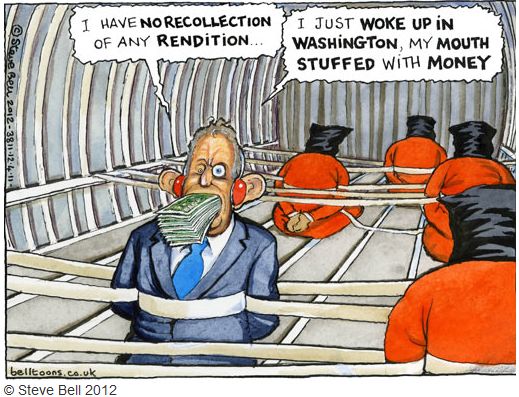
The Guardian reports: Tony Blair, prime minister at the time MI6 rendered Abdel Hakim Belhaj, a prominent Libyan dissident, to the Gaddafi regime in 2004, has said he had “no recollection” of the incident.
But he said he was sure the operation would be investigated “as it should be”.
Interviewed for BBC Radio 4’s World at One programme, Blair added that it should be remembered that “people in the Middle East were also trying to fight terrorism and extremism”. Britain’s co-operation with Libya at the time was important, the former prime minister said.
He referred to comments made by the then foreign secretary, Jack Straw, who said the government had been opposed to unlawful rendition. “As far as I know [the government] kept to that position,” Blair said.
Straw has said: “We were opposed to unlawful rendition. We were opposed to any use of torture. Not only did we not agree with it; we were not complicit in it and nor did we turn a blind eye to it.”
However, Straw has added: “No foreign secretary can know all the details of what its intelligence agencies are doing at any one time.”

The Guardian reports: Just when Fatima Bouchar thought it couldn’t get any worse, the Americans forced her to lie on a stretcher and began wrapping tape around her feet. They moved upwards, she says, along her legs, winding the tape around and around, binding her to the stretcher. They taped her stomach, her arms and then her chest. She was bound tight, unable to move.
Bouchar says there were three Americans: two tall, thin men and an equally tall woman. Mostly they were silent. She never saw their faces: they dressed in black and always wore black balaclavas. Bouchar was terrified. They didn’t stop at her chest – she says they also wound the tape around her head, covering her eyes. Then they put a hood and earmuffs on her. She was unable to move, to hear or to see. “My left eye was closed when the tape was applied,” she says, speaking about her ordeal for the first time. “But my right eye was open, and it stayed open throughout the journey. It was agony.” The journey would last around 17 hours.
Bouchar, then aged 30, had become a victim of the process known as extraordinary rendition. She and her husband, Abdel Hakim Belhaj, a Libyan Islamist militant fighting Muammar Gaddafi, had been abducted in Bangkok and were being flown to one of Gaddafi’s prisons in Libya, a country where she had never before set foot. However, Bouchar’s case is different from the countless other renditions that the world has learned about over the past few years, and not just because she was one of the few female victims.
Documents discovered in Tripoli show that the operation was initiated by British intelligence officers, rather than the masked Americans or their superiors in the US. There is also some evidence that the operation may have been linked to a second British-initiated operation, which saw two men detained in Iraq and rendered to Afghanistan. Furthermore, the timing of the operation, and the questions that Bouchar’s husband and a second rendition victim say were subsequently put to them under torture, raise disturbing new questions about the secret court system that considers immigration appeals in terrorist cases in the UK – a system that the government has pledged to extend to civil trials in which the government itself is the defendant.
This year, the Crown Prosecution Service announced police had launched an investigation into the “alleged rendition and alleged ill-treatment” of Bouchar and Belhaj, and a second operation in which a Libyan family of six were flown to one of Gaddafi’s prisons.
It appears inevitable that Scotland Yard’s detectives will want to question the man who was foreign secretary at the time – Jack Straw.
Ten years before Bouchar’s abduction and rendition, many of her husband’s associates had been permitted to settle in Britain. These men were members of al-Jama’a al-Islamiyyah al-Muqatilah fi-Libya, the Libyan Islamic Fighting Group (LIFG), an organisation formed in the early 1990s and dedicated to Gaddafi’s removal. The LIFG was not banned in the UK, and its members appear to have found the country a convenient place to gather and raise funds. There were even reports – officially denied – that MI6 encouraged the LIFG in an unsuccessful attempt on the dictator’s life.
But from 2002 the UK ceased to be such a safe haven for the LIFG. The US and UK governments were beginning to repair their relations with Gaddafi, a rapprochement that would soon see him abandon his WMD programme and open his country’s oil and gas reserves to western corporations.
One Thursday evening in November that year, a 36-year-old LIFG member who was living in London was arrested by armed police as he attempted to board a flight at Heathrow. He was told he was being detained under the Anti-terrorism, Crime and Security Act, a piece of legislation that had been rushed on to the statute books within weeks of 9/11, and which allowed the British government to detain international terrorism suspects without trial. From that moment the man was anonymised, by court order – in part to protect his relatives in Libya – and could be referred to only as “M”.
When M had arrived in the UK as an asylum seeker eight years earlier, he had readily told Special Branch detectives that he was a member of the LIFG. On his arrest at Heathrow he insisted that the organisation had no connection with international terrorism and was concerned only with the removal of Gaddafi. After being detained at Belmarsh high security prison in south-east London, M appealed to the Special Immigration Appeals Commission (SIAC), a tribunal that allows the government to give evidence in secret, unseen by the appellant or the appellant’s lawyers.
In March 2004, M became the first and only person detained under the act to win an appeal at SIAC. The tribunal accepted that there were no links between LIFG and al-Qaida, and criticised the Home Office for its “consistent exaggeration” of M’s alleged links with members of al-Qaida. As the law permitted only “international terrorists” to be detained without trial, and not domestic insurgents, M was set free. A few days after SIAC’s decision, notice was passed to the Home Office and MI5, and Fatima Bouchar and her husband were detained in Bangkok.
Bouchar’s husband made no secret of being a leading member of the LIFG. That year, the couple had left China, where they had been living in exile, and attempted to travel to the UK via Malaysia. When they were detained in Kuala Lumpur and questioned about Belhaj’s false Iraqi passport, an acquaintance went to the British high commission to explain that the couple were attempting to reach London. Shortly after this, they were told that they would be permitted to travel to the UK on a BA flight, despite not having EU passports or UK visas. But when the aircraft stopped off at Bangkok, the pair were detained and taken to a US-run detention facility.
It was known that the CIA had been operating a secret prison in Thailand since 9/11, but its precise location was unknown. Bouchar and Belhaj arrived there within minutes of being detained, suggesting that it was located within the perimeter of Don Muang international airport. They were immediately separated.
Belhaj says he was blindfolded, hooded, forced to wear ear defenders, and hung from hooks in his cell wall for what seemed to be hours. He says he was severely beaten. The ear defenders were removed only for him to be blasted with loud music, he says, or when he was interrogated by his US captors. [Continue reading…]
Naomi Wolf writes: In a five-four ruling this week, the supreme court decided that anyone can be strip-searched upon arrest for any offense, however minor, at any time. This horror show ruling joins two recent horror show laws: the NDAA, which lets anyone be arrested forever at any time, and HR 347, the “trespass bill”, which gives you a 10-year sentence for protesting anywhere near someone with secret service protection. These criminalizations of being human follow, of course, the mini-uprising of the Occupy movement.
Is American strip-searching benign? The man who had brought the initial suit, Albert Florence, described having been told to “turn around. Squat and cough. Spread your cheeks.” He said he felt humiliated: “It made me feel like less of a man.”
In surreal reasoning, justice Anthony Kennedy explained that this ruling is necessary because the 9/11 bomber could have been stopped for speeding. How would strip searching him have prevented the attack? Did justice Kennedy imagine that plans to blow up the twin towers had been concealed in a body cavity? In still more bizarre non-logic, his and the other justices’ decision rests on concerns about weapons and contraband in prison systems. But people under arrest – that is, who are not yet convicted – haven’t been introduced into a prison population.
Our surveillance state shown considerable determination to intrude on citizens sexually. There’s the sexual abuse of prisoners at Bagram – der Spiegel reports that “former inmates report incidents of … various forms of sexual humiliation. In some cases, an interrogator would place his penis along the face of the detainee while he was being questioned. Other inmates were raped with sticks or threatened with anal sex”. There was the stripping of Bradley Manning is solitary confinement. And there’s the policy set up after the story of the “underwear bomber” to grope US travelers genitally or else force them to go through a machine – made by a company, Rapiscan, owned by terror profiteer and former DHA czar Michael Chertoff – with images so vivid that it has been called the “pornoscanner”.
Believe me: you don’t want the state having the power to strip your clothes off. History shows that the use of forced nudity by a state that is descending into fascism is powerfully effective in controlling and subduing populations.
Roy Eidelson writes: Shortly after learning about the American Psychological Association’s (APA) late February announcement of its new Member-Initiated Task Force to Reconcile Policies Related to Psychologists’ Involvement in National Security Settings, I found my thoughts turning to the School of the Americas, Blackwater and perhaps even more surprisingly, the Patagonian toothfish. Those may seem like a strange threesome, but they share one important thing in common. All have undergone a thorough repackaging and renaming in a marketing effort aimed at obscuring – but not altering – some ugly truth.
The School of the Americas in Fort Benning, Georgia, became infamous for training Latin American soldiers who returned home and engaged in repressive campaigns involving rape, torture and murder of political dissidents. To combat its negative image, the school was renamed the Western Hemisphere Institute for Security Cooperation, but the nature of its activities remain largely unchanged. During the Iraq War, Blackwater, a private military company supported by hundreds of millions of dollars in US government contracts, gained international notoriety on many counts, including its use of excessive and often deadly force against Iraqi civilians. The company therefore renamed itself – twice – first as Xe Services and then again as Academi, with essentially the same core businesses. As for the Patagonian toothfish, it’s wrong to blame the fish itself. But in an effort to spur sales, merchants renamed it Chilean sea bass (for similar reasons, the slimehead fish is now known as orange roughy instead).
Sadly, the same repackaging and renaming strategy of illusion and deception characterizes the APA’s latest gambit to both protect and disguise the role of psychologists as purveyors of harm. But to fully understand this new ploy – a so-called “task force” to produce a comprehensive document of all APA ethics policies relevant to psychologists in national security settings – it’s helpful to first review some disturbing history.
There is incontrovertible evidence that in the years following the 9/11 attacks, psychologists served as planners, consultants, researchers and overseers to the abusive and torturous interrogations of prisoners in the US “global war on terror.” Multiple reports of wrongdoing emerged, such as one from the International Committee of the Red Cross describing psychological coercion techniques at Guantanamo Bay as “tantamount to torture.” APA members and others responded with outrage and clamor. It was immediately clear that the world’s largest psychological association needed to engage in a careful and transparent examination of whether professional ethics allow psychologists to serve in aggressive operational roles, such as detention and interrogation activities involving national security detainees. Tragically, however, APA’s leadership decided to take a very different path. They chose to rubberstamp the status quo without any meaningful deliberation whatsoever. [Continue reading…]