The Washington Post reports: The CIA assessment that Russia waged a cyber-campaign to help elect Donald Trump is based in part on intelligence suggesting that Moscow’s hacking efforts were disproportionately aimed at targets tied to the Democratic Party and its nominee, Hillary Clinton, U.S. officials said.
U.S. officials said that both parties were repeatedly targeted as part of a months-long cyber-operation linked to Moscow, but that Democratic institutions and operatives came under a more sustained and determined online assault.
U.S. officials said the Republican National Committee’s computer systems were also probed and possibly penetrated by hackers tied to Russian intelligence services, but that it remains unclear how much material — if any — was taken from the RNC.
The lack of a corresponding Republican trove has contributed to the CIA assessment, reported by The Washington Post, that Russia was seeking to elect Trump and not merely to disrupt last month’s presidential election. [Continue reading…]
Category Archives: Issues
Fmr. CIA Acting Dir. Michael Morell on Russian interference: ‘This is the political equivalent of 9/11’
Suzanne Kelly interviewed former CIA Acting Director Michael Morell: Tell me about the significance of these allegations if they are true, what’s the overall significance to national security if Russia was successful in doing something like this?
I think the first point is it’s really interesting, and you said this earlier, this is not a new story. We knew back in October that Russia was meddling in the election. In October, the Obama Administration said publicly that Russia was interfering with the election and that the knowledge and direction of that went to the highest levels of the Russian government. This was, in my mind, the first time in American history that our government has accused another government of meddling in our election. This is huge. What was new in The Washington Post story, if its right—we still don’t know whether its right, and whether the rest of the IC agrees or not—but that the CIA believes the intent of the meddling was to help Mr. Trump and hurt Mrs. Clinton’s chances. That meddling went way beyond just stealing the DNC and Podesta information and giving it to WikiLeaks, that’s what’s new.
But what’s important to me is, it’s less important that they had picked the winner and loser, which I thought all along they had done. What’s most important is that they did indeed meddle. I think the implications of that are just absolutely huge, and I think there are three of them:
The first is, we need to see this for what it is. It is an attack on our very democracy. It’s an attack on who we are as a people. A foreign government messing around in our elections is, I think, an existential threat to our way of life. To me, and this is to me not an overstatement, this is the political equivalent of 9/11. It is huge and the fact that it hasn’t gotten more attention from the Obama Administration, Congress, and the mainstream media, is just shocking to me.
The second is that I agree with a whole bunch of people on the Hill, Democrats and Republicans, Sen. John McCain, that we need a bi-partisan commission to look into exactly what the Russians did and what we can do here at home to make sure that no foreign government can ever do this again to us. That’s why that commission is so important. The commission shouldn’t look into what is an unknowable thing – which is: did they affect the outcome or not – we’ll never know that. We’ll never know what the Russians did, whether it affected a single vote or not. But what we can do is figure out exactly what they did and make changes here at home as to how information is handled, how we protect information, and make sure they never do this again.
The third implication is we need to respond to the Russian attack. We need to deter the Russians and anyone else who is watching this—and you can bet your bottom dollar that the Chinese, the North Koreans, the Iranians are all watching. We need to deter all of those folks from even thinking about doing something like this in the future.
I think that our response needs to have two key pieces to it. One is it’s got to be overt. It needs to be seen. A covert response would significantly limit the deterrence effect. If you can’t see it, its not going to deter the Chinese and North Koreans and Iranians and others, so it’s got to be seen.
The second, is that it’s got to be significant from Putin’s perspective. He has to feel some pain, he has to pay a price here or again, there will be no deterrence, and it has to be seen by the rest of the world as being significant to Mr. Putin so that it can be a deterrant. [Continue reading…]
Stay informed. Click below to sign up for daily email updates from War in Context:
McConnell announces Senate probe of suspected Russian election interference
The Washington Post reports: Senate Majority Leader Mitch McConnell (R-Ky.) on Monday strongly condemned any foreign interference with U.S. elections and announced that the Senate intelligence panel will investigate Russia’s suspected election interference.
“The Russians are not our friends,” he told reporters at a scheduled year-end news conference.
McConnell’s announcement came a day after a group of senators called for a thorough, bipartisan investigation of Russian interference. Some have endorsed the idea of a special select committee to lead an inquiry, but McConnell stopped short of endorsing that, saying that any congressional probe would follow “regular order” through the current committee structure.
“This simply cannot be a partisan issue,” he said, before adding that the Intelligence Committee “is more than capable of conducting a complete review of this matter.”
McConnell declined to address his role in a September briefing for lawmakers, where he reportedly dismissed intelligence assessments suggesting that Russia was trying to sway the presidential election in favor of Donald Trump. Instead, he credited Senate Republicans for standing firm against Russia and blamed President Obama for Russian encroachment around the globe. [Continue reading…]
Trump’s ideological affinity with Putin
Peter Beinart writes: Through his public statements and presidential appointments, Donald Trump is remaking Republican foreign policy in two fundamental ways. The first concerns Russia. Previous GOP leaders like Mitt Romney and John McCain described Moscow as an adversary. Trump describes it as a partner. The second concerns Islam. Previous GOP leaders — most notably George W. Bush — insisted that the U.S. had no beef with Islam, or with the vast majority of Muslims worldwide. Trump and his top advisors disagree. They often describe Islam itself as a hostile force, and view ordinary Muslims as guilty of jihadist sympathies until proven innocent.
On the surface, these two shifts seem unrelated. But they’re deeply intertwined. Before Trump, Republican leaders generally described the United States as fighting an ideological struggle against the enemies of freedom. Now, Trump and his advisors describe America as fighting a civilizational struggle against the enemies of the West. Seen through that very different lens, Muslims look more nefarious and Vladimir Putin looks more benign. [Continue reading…]
The Kremlin gloats over Trump’s CIA tantrum
Anna Nemtsova reports: The news that U.S. President-elect Donald Trump called CIA claims about Russia’s involvement in the election process “ridiculous” was cause for celebration in Russia.
“Finally, the U.S. president does not trust CIA!” exclaimed one of Trump’s many Russian fans.
Authorities, who just a few weeks ago were busy training people to hide in bunkers in case the Americans dropped nuclear bombs, now applauded the U.S. president-elect and welcomed his incoming administration’s “a dream team.”
To Moscow officials every step Trump takes, including his harsh criticism of the Central Intelligence Agency, sounds like a victory for President Vladimir Putin.
But wait, was Moscow in fact behind the hackers who attacked the Democratic National Committee and leaked their goodies to Wikileaks, among others (and also attacked the Republican National Committee, but kept that stuff to themselves)?
In Russia, many people are blasé about such charges. This is a country where opposition politicians and journalists are gunned down in the streets. This is a government that has annexed Crimea, and backed rebels in the war in Ukraine. It is also the government, that called the international investigation into the catastrophe of a civilian airliner, MH17, blown out of the sky: “biased.” It’s also the same government that insists it never had ++a state-sponsored doping system for its athletes. Plausible deniability — and even implausible deniability — is its standard operating procedure.
It’s also a country with vast and deep criminal organizations well versed in cyber crimes. [Continue reading…]
After ISIS, Iraq at risk of a new battle for disputed territory
The Washington Post reports: When the Kurdish peshmerga commander arrived in this town in northern Iraq last month, he knew he was there to stay.
Col. Nabi Ahmed Mohammed’s force of 300 fighters had been tasked with securing Bashiqa as part of the Iraqi military’s offensive against the Islamic State in the nearby city of Mosul. The town had been home to minority Yazidis who were forced to flee when the militants arrived in 2014.
When Kurdish troops pressed into the town, they faced sniper fire and attacks from militants in underground tunnels. At least eight peshmerga were killed.
Now, Mohammed’s men are making plans for a permanent presence in the bombed-out town, long claimed by both the Kurds as part of their semiautonomous region and by the central government in Baghdad. [Continue reading…]
Russian interference in American democracy
In responding to assertions attributed to CIA analysts who say that Russia interfered in the U.S. presidential election in order to help Donald Trump win, the president-elect is following the standard business practice employed by oil companies and the tobacco industry in order to deflect criticism: first come the categorical denials whose purpose is to trample on the questions and belittle the questioners; then comes the cloud of uncertainty whose purpose is to promote a sense of equality in the face of the unknown.
Whereas other practitioners of this strategy often take years to move from stage one to stage two, Trump makes the leap within a few sentences. Having first dismissed the CIA’s claim as ridiculous, Trump then pleaded ignorance.
In order to foster an all-embracing sense of uncertainty, in his interview aired on Fox News yesterday, Trump said: “there’s great confusion. Nobody really knows…. They’re not sure. They’re fighting among themselves. They’re not sure…. if you read the stories, the various stories, they’re disputing. And certain groups don’t necessarily agree. Personally, it could be Russia. It — I don’t really think it is. But who knows? I don’t know either. They don’t know and I don’t know.”
If Trump has actually read the news reports he’d know that there is a consensus in the intelligence community and the FBI that Russia interfered in the election.
What is in dispute is not the fact of the interference but its purpose.
News reporting is currently reducing this dispute to a binary question about whether Russia was trying to install Trump as president, but for those willing to speculate about Russian objectives the analysis needs to be a bit more subtle.
What should not be in dispute is the claim that Russia had a preference for Trump. As the New York Times reports:
American officials cite broad evidence that Mr. Putin and the Russian government favored Mr. Trump over Mrs. Clinton.
After demonstrators marched through Moscow in 2011 chanting “Putin is a thief” and “Russia without Putin,” Mr. Putin publicly accused Mrs. Clinton, then the secretary of state, of instigating the protests. “She set the tone for some actors in our country and gave them a signal,” he said.
More generally, the Russian government has blamed Mrs. Clinton, along with the C.I.A. and other American officials, for encouraging anti-Russian revolts during the 2003 Rose Revolution in Georgia and the 2004 Orange Revolution in Ukraine. What Americans saw as legitimate democracy promotion, Mr. Putin saw as an unwarranted intrusion into Russia’s geographic sphere of interest, as the United States once saw Soviet meddling in Cuba.
By contrast, Mr. Trump and Mr. Putin have had a very public mutual admiration society. In December 2015, the Russian president called Mr. Trump “very colorful” — using a Russian word that Mr. Trump and some news outlets mistranslated as “brilliant” — as well as “talented” and “absolutely the leader in the presidential race.” Mr. Trump called Mr. Putin “a strong leader” and further pleased him by questioning whether the United States should defend NATO members that did not spend enough on their militaries.
Russian television, which is tightly controlled by the government, has generally portrayed Mr. Trump as a strong, friendly potential partner while often airing scathing assessments of Mrs. Clinton.
And yet, there is skepticism within the American government, particularly at the F.B.I., that this evidence adds up to proof that the Russians had the specific objective of getting Mr. Trump elected.
A senior American law enforcement official said the F.B.I. believed that the Russians probably had a combination of goals, including damaging Mrs. Clinton and undermining American democratic institutions. Whether one of those goals was to install Mr. Trump remains unclear to the F.B.I., he said.
The official played down any disagreement between the F.B.I. and the C.I.A., and suggested that the C.I.A.’s conclusions were probably more nuanced than they were being framed in the news media.
There is little reason to doubt that Russia has always had a strong preference for Trump and yet when the DNC hacking was instigated, everyone — including the Russians — must have seen a Trump victory as a long-shot.
So, discussion about Russian intentions needs to take account of the strong likelihood that its goals evolved. As the Washington Post reported in July, “It may be that the Kremlin wishes to disrupt and discredit the U.S. political process without seeking any particular result.”
And yet through a combination of the effect of multiple factors — leaked emails, relentless attacks on Hillary Clinton’s integrity, the lack of a compelling Democratic Party message, and then a decisive last minute assist from the FBI — Donald Trump won the election.
This is the outcome Russia wanted and helped bring about.
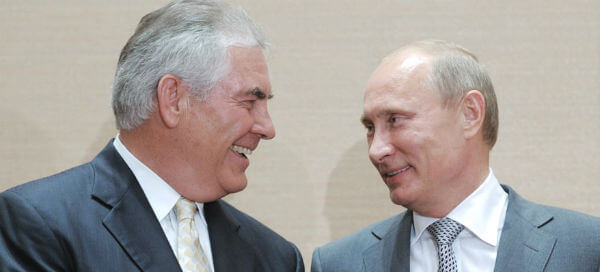
And if there is any remaining doubt that it will be duly rewarded for its efforts, the first serving is about to get dished out this week in the form of Rex Tillerson, chief executive of Exxon Mobil, whose appointment as Secretary of State is already being praised by the Kremlin even before it has been announced.
Stay informed. Click below to sign up for daily email updates from War in Context:

Bolton: Russian hacks could actually have been by Obama administration
Politico reports: Ambassador John Bolton claimed Sunday that hacks during the election season could have been “a false flag” operation — possibly committed by the Obama administration itself.
In an interview with Fox News’ Eric Shawn, Bolton questioned why FBI Director James Comey said during the investigation of Hillary Clinton’s private server, there was no direct evidence found of foreign intelligence service penetration, but cyber fingerprints were found in regards to the presidential election.
“It is not at all clear to me just viewing this from the outside, that this hacking into the DNC and the RNC computers was not a false flag,” Bolton said. “So the question has to be asked, why did the Russians run their smart intelligence service against Hillary’s server, but their dumb intelligence service against the election?”
Shawn then asked Bolton — who has been mentioned as a possible Trump appointment — if he was accusing someone in “the administration or in the intelligence community of” the alleged false flag.
“We just don’t know,” Bolton said. “But I believe that the intelligence community has been politicized in the Obama administration to a very significant degree.” [Continue reading…]
Politico reports: Sen. Rand Paul is threatening to block President-elect Donald Trump’s likely pick of John Bolton as the No. 2 in the State Department.
The Kentucky Republican, who serves on the Senate Foreign Relations Committee, could stop the hawkish former ambassador to the United Nations from getting out of committee if there is unanimous Democratic resistance. The committee is narrowly divided among 10 Republicans and nine Democrats, and Paul said Sunday on ABC’s “This Week” that he’s an “automatic no on Bolton.”
“John Bolton doesn’t get it. He still believes in regime change. He’s still a big cheerleader for the Iraq War,” Paul said. “John Bolton is so far out of it and has such a naive understanding of the world.” [Continue reading…]
Benjamin Netanyahu welcomes Trump presidency
Rex Tillerson, from a corporate oil sovereign to the State Department
Steve Coll writes: The news that President-elect Donald Trump is expected to nominate Rex Tillerson, the chairman and chief executive of ExxonMobil, as his Secretary of State is astonishing on many levels. As an exercise of public diplomacy, it will certainly confirm the assumption of many people around the world that American power is best understood as a raw, neocolonial exercise in securing resources.
Tillerson figures prominently in “Private Empire: ExxonMobil and American Power,” a book I wrote about the corporation that came out in 2012. He declined my requests to interview him for that project, but I turned up at several public appearances he made and asked him a few questions from the reporters’ gallery. I also studied his public remarks, reviewed accounts of his activities reported in State Department cables obtained by Freedom of Information Act requests or released by WikiLeaks, and conducted interviews with other ExxonMobil executives, retirees, friends, competitors, civil-society activists and business partners from Asia to Africa to the Middle East.
Tillerson’s life has been shaped to a profound extent by two institutions: ExxonMobil and the Boy Scouts of America. He grew up in Texas, where his father was a modestly compensated administrator for the Scouts. Tillerson became an Eagle Scout. An engineering major at the University of Texas, in Austin, Tillerson joined ExxonMobil in 1975. He has never worked anywhere else. Of all the companies that were born out of the breakup of Standard Oil, Exxon is culturally the most direct descendant of John D. Rockefeller’s monopolistic giant, which was organized on principles of ruthless capitalism and Protestant faith. Exxon today is an unusually cloistered corporation that promotes virtually all of its top executives from within. Former executives I interviewed mentioned that as recently as the nineteen-seventies, it was not unusual to start company meetings with a prayer. When Tillerson finally won a competition for the top job, in 2004, he directed substantial time and charitable activity toward the Boy Scouts. In public appearances, he comes across as sophisticated, yet his life is rooted in environments that are fundamentally nostalgic for imagined midcentury virtues and for the days when burning fossil fuels did not threaten to trigger catastrophic climate change. Tillerson once listed his favorite book as “Atlas Shrugged,” Ayn Rand’s 1957 novel that has become a touchstone for libertarians and promoters of unbridled capitalism. Compared to the records of some of the other people around Trump, Tillerson’s is at least one of professional integrity; Exxon is a ruthless and unusually aggressive corporation, but it is also rule-bound, has built up a relatively strong safety record, and has avoided problems such as prosecutions under the Foreign Corrupt Practices Act, even though it operates in many countries that are rife with corruption. [Continue reading…]
What it really means to be a ‘friend of Putin’
Julia Ioffe writes: In June 2008, ExxonMobil CEO Rex Tillerson attended the St. Petersburg Economic Forum, Russia’s answer to Davos, its way of showing itself to the world as the kind of economic powerhouse that can attract executives like Rex Tillerson to its banquets. It was a key and very shaky moment for Russia. Vladimir Putin was bowing out after his second term as president of Russia — the most the Russian constitution allows in a row, though he would figure out a way around it by 2012 — and his successor, the relatively liberal Dmitri Medvedev, was debuting at the Forum. Tensions were heating up with Russia’s southern neighbor, Georgia, and would soon spill into war. The Russian economy was already getting shaky, and within a few months it would crater, faring the worst out of all the G20 economies, sinking from eight percent GDP growth, to negative eight percent.
Even after eight years of Putin assiduously taking control of the Russian economy and trying to restore some modicum of Soviet geopolitical power, Russia was still a pretty weak player. It had been relegated to last place among the BRICs, that term coined by a Goldman Sachs banker to connote the emerging markets of Brazil, Russia, India, and China. And despite surging commodity prices — oil at the time was around $130 a barrel — Russia wasn’t making a good case for itself in the world. Gazprom, the Russian state gas monopoly, was rattling European nerves by shutting gas supplies on and off in an effort to control an increasingly independent Ukraine, thus leaving much of Central Europe without heat in the winters. It had only been five years since oil tycoon Mikhail Khodorkovsky was thrown in jail for not bowing to Putin’s will, and two years since the Kremlin unceremoniously pushed Royal Dutch Shell out of a lucrative gas project in the far eastern island of Sakhalin. BP was on the obvious verge of meeting the same fate. The following month, BP chief Robert Dudley would flee Russia, complaining of “sustained harassment.”
When Tillerson mounted the stage in St. Petersburg that summer, he chastised the Russian government for the way it was operating. The Kremlin, he said, “must improve the functioning of its judicial system and its judiciary. There is no respect for the rule of law in Russia today.”
It’s hard to imagine Tillerson, now reportedly the frontrunner for Secretary of State under president-elect Donald Trump, saying something similar today, much less from a stage in Russia’s second capital, Vladimir Putin’s birthplace, and at a high-stakes, window-dressing government function. It’s not that Russia has suddenly acquired a taste for the rule of law—if anything, things have only gotten far, far worse, and Russia’s judiciary has become no more independent. And it’s not even because Tillerson is now ubiquitously identified in the press as being personally close to Putin. As the Wall Street Journal puts it, “Among those considered for the post, Mr. Tillerson has perhaps the closest ties to Russian President Vladimir Putin,” adding that, in 2012, Putin personally bestowed Russia’s Order of Friendship on Tillerson.
It’s hard to imagine Tillerson publicly chiding Putin today because he is now so very dependent on that friendship. [Continue reading…]
Let’s get the facts right on foreign involvement in our elections
Michael McFaul, former U.S. ambassador to Russia from 2012-2014, writes: President-elect Donald Trump won the 2016 presidential election and will be the next president of the United States. As I have written before in these pages, the rules of the game for choosing our presidents need to be changed, but that discussion concerns future elections, not this past one. A win is a win.
That most people acknowledge Trump’s victory should now free us to have a serious discussion about the role of foreign interference in the 2016 presidential election. During the campaign, mentions of foreign meddling quickly became partisan and polarized, blocking any real examination of the facts, let alone a discussion of prescriptions. Even Obama administration officials seemed to tiptoe around these issues, not wanting to appear to use their privileged access to classified information to help the Democratic Party’s candidate, Hillary Clinton. But now the election is over. Before the next one, we need to know the facts — investigate what did and did not occur — so that we can develop procedures, policies and laws to strengthen the integrity of our electoral process before 2020. This is not a partisan plea; it is a national security issue.
We know some facts, and they are disturbing. For instance, we know that Russian actors stole data from people working at the Democratic National Committee. We know that another foreign actor, WikiLeaks, published data stolen from the DNC to adversely affect Clinton. We also know that WikiLeaks and others published data stolen from John Podesta, Clinton’s campaign chairman, in order to try to damage further the Democratic candidate. We also know that WikiLeaks did not publish similar kinds of data from the Trump campaign or the Republican Party. [Continue reading…]
An alt-right makeover shrouds the swastikas
The New York Times reports: A small but determined political organization in Detroit began to worry that its official symbol was a bit off-putting. With the group’s central philosophy suddenly finding traction in the daily discourse, appearances mattered.
So in November, as the country’s divisive presidential campaign became ever more jagged, the National Socialist Movement, a leading neo-Nazi group, did away with its swastika. In its stead, the group chose a symbol from a pre-Roman alphabet that was also adopted by the Nazis.
According to Jeff Schoep, the movement’s leader, the decision to dispense with the swastika was “an attempt to become more integrated and more mainstream.”
Let us pause. Not even two years ago, white supremacists like Mr. Schoep would rant from the fringe of the fringe, their attention-desperate events rarely worth mention. Today, though, the Schoeps of America are undergoing a rebranding, as part of the so-called alt-right: a grab bag of far-right groups generally united by the belief that white identity has become endangered in what they deride as this era of dangerous diversity and political correctness.
The deceptively benign phrase “alt-right” now peppers the national conversation, often in ways that play down its fundamental beliefs, which have long been considered intolerant and hateful. The term’s recent prevalence corresponds with the rise of President-elect Donald J. Trump; alt-right leaders say his inflammatory statements and Twitter habits in the campaign energized, even validated, their movement.
The movement is also acutely image-conscious, seeing the burning crosses, swastikas and language of yesteryear as impediments to recruitment. Its adherents talk of “getting red-pilled,” a reference to the movie “The Matrix,” in which the protagonist ingests a tablet that melts away artifice to reveal the truth. New, coded slurs have emerged. Fewer pointed hoods, more khaki pants.
But the alt-right movement is hardly monolithic, despite a well-publicized gathering last month in Washington — one that might have been mistaken for just another corporate conference were it not for the white-nationalist sentiments and the Nazi salutes. The factions within its ranks can differ on any number of subjects: white supremacy versus white nationalism, for example, or the vexing “J.Q.” — the “Jewish Question.”
James Edwards, a far-right talk radio host who describes himself as a “European-American advocate” — and who interviewed the president-elect’s son Donald Trump Jr. this year — wrote in an email that the alt-right movement was “a group of marauding conservatives who reject both the failures of establishment conservatism and the false gods of political correctness.”
Race is the uniting factor, Mr. Edwards wrote. “One fundamental element of the Alt-Right that brings the disparate factions together is the awareness of the reality of race and the need for European Americans to have organizations and spokespeople that explicitly advocate for our unique group interests.” [Continue reading…]
BuzzFeed reports: On Saturday evening, Twitter reinstated — with verification — the account of Richard Spencer, a leading figure of the so-called alt-right movement, and the head of the white nationalist think tank, The National Policy Institute.
Spencer’s account was suspended mid-November as part of a larger cull of prominent alt-right accounts, including Ricky Vaughn (who was previously banned after a BuzzFeed News story detailing his campaign to disenfranchise voters with false information), former Business Insider CTO Pax Dickenson, and John Rivers. Twitter did provide a reason for the move at the time it was undertaken, leading many to conclude the accounts were suspended for violations of the company’s prohibitions on targeted harassment, incitement, and hate speech.
However, according to Twitter, Spencer was banned on a technicality: creating multiple accounts with overlapping uses. [Continue reading…]
Bill Gates and investors worth $170 billion are launching a fund to fight climate change through energy innovation
Quartz reports: Bill Gates is leading a more than $1 billion fund focused on fighting climate change by investing in clean energy innovation.
The Microsoft co-founder and his all-star line-up of fellow investors plan to announce tomorrow the Breakthrough Energy Ventures fund, which will begin making investments next year. The BEV fund, which has a 20-year duration, aims to invest in the commercialization of new technologies that reduce greenhouse-gas emissions in areas including electricity generation and storage, transportation, industrial processes, agriculture, and energy-system efficiency.
“Anything that leads to cheap, clean, reliable energy we’re open-minded to,” says Gates, who is serving as chairman of BEV and anticipates being actively involved.
The directors of BEV include Alibaba founder Jack Ma, Reliance Industries chairman Mukesh Ambani, venture capitalists John Doerr and Vinod Khosla, former energy hedge fund manager John Arnold, and SAP cofounder Hasso Plattner. The combined net worth of the directors is nearly $170 billion, based on estimates of their individual wealth by Bloomberg and Forbes. [Continue reading…]
The Washington Post reports: President-elect Donald Trump said Sunday that “nobody really knows” whether climate change is real and that he is “studying” whether the United States should withdraw from the global warming agreement struck in Paris a year ago.
In an interview with “Fox News Sunday” host Chris Wallace, Trump said he’s “very open-minded” on whether climate change is underway but has serious concerns about how President Obama’s efforts to cut carbon emissions have undercut America’s global competitiveness.
“I’m still open-minded. Nobody really knows,” Trump said. “Look, I’m somebody that gets it, and nobody really knows. It’s not something that’s so hard and fast. I do know this: Other countries are eating our lunch.”[Continue reading…]
FBI and CIA give differing accounts to lawmakers on Russia’s motives in 2016 hacks
The Washington Post reports: In a secure meeting room under the Capitol last week, lawmakers held in their hands a classified letter written by colleagues in the Senate summing up a secret, new CIA assessment of Russia’s role in the 2016 presidential election.
Sitting before the House Intelligence Committee was a senior FBI counterintelligence official. The question the Republicans and Democrats in attendance wanted answered was whether the bureau concurred with the conclusions the CIA had just shared with senators that Russia “quite” clearly intended to help Republican Donald Trump defeat Democrat Hillary Clinton and clinch the White House.
For the Democrats in the room, the FBI’s response was frustrating — even shocking.
During a similar Senate Intelligence Committee briefing held the previous week, the CIA’s statements, as reflected in the letter the lawmakers now held in their hands, were “direct and bald and unqualified” about Russia’s intentions to help Trump, according to one of the officials who attended the House briefing.
The FBI official’s remarks to the lawmakers on the House Intelligence Committee were, in comparison, “fuzzy” and “ambiguous,” suggesting to those in the room that the bureau and the agency weren’t on the same page, the official said.
The divergent messages from the CIA and the FBI put a spotlight on the difficulty faced by intelligence and law enforcement officials as they try to draw conclusions about the Kremlin’s motives for hacking Democratic Party emails during the 2016 race. Officials are frequently looking at information that is fragmentary. They also face issues assessing the intentions of a country expert at conducting sophisticated “influence” operations that made it hard — if not impossible — to conclusively detect the Kremlin’s elusive fingerprints.
The competing messages, according to officials in attendance, also reflect cultural differences between the FBI and the CIA. The bureau, true to its law enforcement roots, wants facts and tangible evidence to prove something beyond all reasonable doubt. The CIA is more comfortable drawing inferences from behavior. [Continue reading…]
White House ethics experts argue Trump’s business conflicts are so big it should affect how the Electoral College votes
Politico reports: Norm Eisen has become an unlikely media darling. Since Donald Trump’s victory on Nov. 8 opened a debate about how the president-elect would keep his vast business interests separate from his new public obligations, Eisen has emerged as one of the two most prominent government ethicists calling for Trump to take drastic action to avoid scandal or worse. Eisen, the former top Obama White House ethics lawyer, has been cited more than 1,000 times in news stories, explaining the intricacies of the “emoluments clause” to journalists many of whom hadn’t heard the words a month ago. With Richard Painter, who held the same job under President George W. Bush, Eisen has taken control of a leading government watchdog group that’s staffing up to hound Trump’s administration for conflicts of interest they say are unprecedented for the occupant of the Oval Office. A video produced by the liberal advocacy group MoveOn.org of Eisen and Painter talking about a potentially obscure constitutional violation notched more than 2.5 million views in its first week.
“It’s unreal. It’s like a full-employment plan for government ethicists, for White House ethicists,” Eisen told me Monday as he dashed between interviews with U.S. and international journalists lining up to ask him about Trump’s complicated financial arrangements. “Fortunately, there’s basically only a handful of us. There’s really only two.”
That might be an exaggeration, but Eisen and Painter happen to be the two ethicists who are actively working to shape the outcome of an election that most voters think has already been decided. For the #stillnevertrump faction, Eisen and Painter represent the last hope of persuading wobbly members of the Electoral College to vote against the president-elect when they convene on Dec. 19. Failing that, the two men are laying the groundwork for a case that Trump’s sprawling financial arrangements—real estate investments, hotels, golf courses and product licenses spread across the U.S. and at least 20 other countries—will inevitably lead him into scandal or worse once he takes office. Trump is set to hold a news conference Dec. 15 in New York to provide more detail on his future financial plans, but the two men have no expectation that Trump will take their advice and sell off his entire business enterprise and put the proceeds into a “blind trust” with no control or knowledge over where the money goes. [Continue reading…]
Rex Tillerson, Exxon chief with close ties to Russia, is expected to be Trump’s pick for secretary of state

The New York Times reports: Rex W. Tillerson, the chief executive of Exxon Mobil, whose extensive deal-making for the energy giant has plunged him into global politics from Yemen to Russia, is expected to be offered the secretary of state post this weekend by President-elect Donald J. Trump, according to two people close to Mr. Trump’s transition team.
Mr. Tillerson, 64, has spent the past 41 years at Exxon, where he began as a production engineer and went on to strike deals around the world for a company that explores, buys and sells oil and gas in some of the globe’s most troubled corners.
Those travels have engendered close ties with a number of world leaders, notably President Vladimir V. Putin of Russia, who has known Mr. Tillerson for more than two decades, and who awarded him the country’s Order of Friendship in 2013. The next year, Washington’s relationship with Moscow was plunged into a deep freeze with Russia’s annexation of Crimea and its shadow war in eastern Ukraine, a problem that Mr. Tillerson would inherit. [Continue reading…]
Steve Horn notes: Exxon, the top U.S. producer of oil and gas and a well-documented funder of climate science denial, actually leases more land in Russia than it does in the U.S.
“Exxon boosted its Russian holdings to 63.7 million acres in 2014 from 11.4 million at the end of 2013, according to data from U.S. regulatory filings,” reported Bloomberg in March 2014. “That dwarfs the 14.6 million acres of rights Exxon holds in the U.S., which until last year was its largest exploration prospect.”
Exxon, though headquartered in Irving, Texas near Dallas, is a sprawling “private empire” with assets spread across the globe. When asked about building more U.S. refineries to protect the U.S. economy and consumers from fuel shortages, former CEO and chairman Lee Raymond put Exxon’s view of itself and its loyalty to the U.S. bluntly.
“I’m not a U.S. company, and I don’t make decisions based on what’s good for the U.S,” Raymond is quoted as saying in the 2012 book Private Empire: ExxonMobil and American Power by Steve Coll. [Continue reading…]
Stay informed. Click below to sign up for daily email updates from War in Context:

Trump transition team for Energy Department seeks names of employees involved in climate meetings
The Washington Post reports: Donald Trump’s transition team has issued a list of 74 questions for the Energy Department, asking agency officials to identify which employees and contractors have worked on forging an international climate pact as well as domestic efforts to cut the nation’s carbon output.
The questionnaire requests a list of those individuals who have taken part in international climate talks over the past five years and “which programs within DOE are essential to meeting the goals of President Obama’s Climate Action Plan.”
Trump and his team have vowed to dismantle specific aspects of Obama’s climate policies, and Trump has questioned the reality of climate change. The questionnaire, which one Energy Department official described as unusually “intrusive” and a matter for departmental lawyers, has raised concern that the Trump transition team is trying to figure out how to target the people, including civil servants, who have helped implement policies under Obama.
Thousands of scientists have signed petitions calling on the president-elect and his team to respect scientific integrity and refrain from singling out individual researchers whose work might conflict with the new administration’s policy goals. This potential clash could prompt a major schism within the federal government, with many career officials waging a battle against incoming political appointees.
While there have been many instances of political appointees and career scientists clashing in various administrations, what is novel is the request for the names of so many individual scientists, and the fact that it comes during the transition period, before the Trump administration has even taken power. This may be a signal of even more intense politicization after the inauguration. [Continue reading…]